isofix VOLVO XC90 TWIN ENGINE 2018 Owners Manual
[x] Cancel search | Manufacturer: VOLVO, Model Year: 2018, Model line: XC90 TWIN ENGINE, Model: VOLVO XC90 TWIN ENGINE 2018Pages: 686, PDF Size: 17 MB
Page 5 of 686
3
Top tether anchors72
Lower child seat attachment points74
ISOFIX/LATCH lower anchors74
Integrated booster cushion*76
Folding up the integrated boostercushion*77
Folding down the integrated boostercushion*78
DISPLAYS AND VOICE CONTROL
Instruments and controls in left-handdrive vehicles82
Instrument panel84
Instrument panel settings86
Fuel gauge86
Hybrid gauge87
Hybrid gauge88
Trip computer89
Displaying trip data in the instrumentpanel90
Resetting the trip odometer91
Displaying trip statistics in the centerdisplay92
Trip statistics settings92
Date and time93
Ambient temperature sensor94
Indicator symbols in the instrument panel94
Warning symbols in the instrument panel97
Instrument panel licenses98
App menu in instrument panel103
Handling the App menu in the instru-ment panel104
Messages in the instrument panel105
Handling messages in the instru-ment panel106
Handling messages saved from theinstrument panel107
Center display overview109
Handling the center display112
Activating and deactivating the cen-ter display115
Navigating in the center display's views115
Handling tiles in the center display119
Function view in the center display122
Moving apps and buttons in the cen-ter display124
Symbols in the center display status bar124
Using the center display keyboard126
Changing keyboard language in thecenter display129
Entering characters, letters andwords by hand in the center display129
Changing the appearance of thecenter display131
Turning off and adjusting the volumeof the center display system sounds131
Changing system units of measurement132
Changing system language132
Opening settings in the center display132
Opening contextual setting in thecenter display133
Changing settings in the center display134
Page 65 of 686
SAFETY
}}63
Related information
• Safety mode (p. 61)
• Starting the vehicle (p. 424)
• Recovery (p. 477) Child safety
Children should always be seated safely when
traveling in the vehicle.
General informationVolvo recommends the proper use of restraint
systems for all occupants including children.
Remember that, regardless of age and size, a
child should always be properly restrained in a
vehicle.
Your vehicle is also equipped with ISOFIX/
LATCH attachments, which make it more conven-
ient to install child seats.
Some restraint systems for children are designed
to be secured in the vehicle by lap belts or the
lap portion of a lap-shoulder belt. Such child
restraint systems can help protect children in
vehicles in the event of an accident only if they
are used properly. However, children could be
endangered in a crash if the child restraints are
not properly secured in the vehicle. Failure to fol-
low the installation instructions for your child
restraint can result in your child striking the vehi-
cle's interior in a sudden stop.
Holding a child in your arms is NOT a suitable
substitute for a child restraint system. In an acci-
dent, a child held in a person's arms can be
crushed between the vehicle's interior and an
unrestrained person. The child could also be
injured by striking the interior, or by being ejected
from the vehicle during a sudden maneuver or impact. The same can also happen if the infant or
child rides unrestrained on the seat. Other occu-
pants should also be properly restrained to help
reduce the chance of injuring or increasing the
injury of a child.
All states and provinces have legislation govern-
ing how and where children should be carried in
a vehicle. Find out the regulations existing in your
state or province. Recent accident statistics have
shown that children are safer in rear seating
positions than front seating positions when prop-
erly restrained. A child restraint system can help
protect a child in a vehicle. Here's what to look
for when selecting a child restraint system:
It should have a label certifying that it meets
applicable Federal Motor Vehicle Safety Stand-
ards (FMVSS 213) - or in Canada, CMVSS 213.
Make sure the child restraint system is approved
for the child's height, weight and development -
the label required by the standard or regulation,
or instructions for infant restraints, typically pro-
vide this information.
In using any child restraint system, we urge you
to carefully look over the instructions that are
provided with the restraint. Be sure you under-
stand them and can use the device properly and
safely in this vehicle. A misused child restraint
system can result in increased injuries for both
the infant or child and other occupants in the
vehicle.
Page 67 of 686
SAFETY
}}65
Related information
• Safety (p. 42)
• Child restraints (p. 65)
• Activating and deactivating child safety locks
(p. 259) Child restraints
Suitable child restraints should always be used
when children travel in the vehicle.
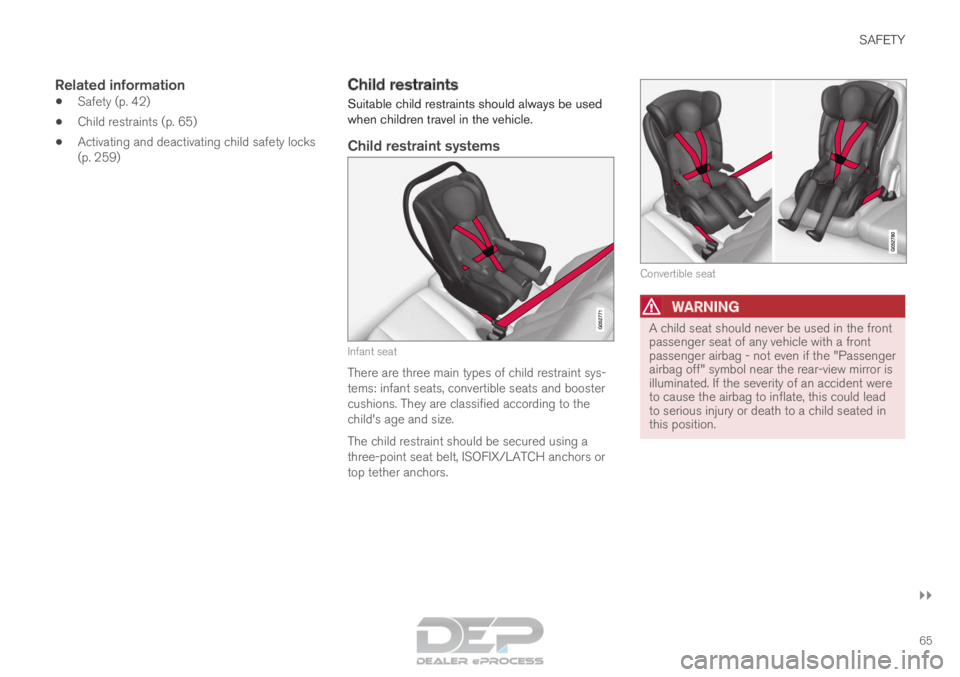
Child restraint systems Infant seat
There are three main types of child restraint sys-
tems: infant seats, convertible seats and booster
cushions. They are classified according to the
child's age and size.
The child restraint should be secured using a
three-point seat belt, ISOFIX/LATCH anchors or
top tether anchors. Convertible seat
WARNING
A child seat should never be used in the front
passenger seat of any vehicle with a front
passenger airbag - not even if the "Passenger
airbag off" symbol near the rear-view mirror is
illuminated. If the severity of an accident were
to cause the airbag to inflate, this could lead
to serious injury or death to a child seated in
this position.
Page 69 of 686

SAFETY
}}
* Option/accessory. 67
Related information
•Child safety (p. 63)
• Infant seats (p. 67)
• Convertible seats (p. 69)
• Booster cushions (p. 71)
• Integrated booster cushion* (p. 76)
• Top tether anchors (p. 72)
• Lower child seat attachment points (p. 74)
• ISOFIX/LATCH lower anchors (p. 74) Infant seats
Suitable child restraints should always be used
when children (depending on their age/size) are
seated in the vehicle.
Securing an infant seat with a seat belt Do not place the infant seat in the front passenger's
seat
1. Place the infant seat in the rear seat of the
vehicle.
2.
Attach the seat belt to the infant seat
according to the child restraint manufactur-
er's instructions. Route the seat belt through the infant seat.
WARNING
•
An infant seat must be in the rear-facing
position only.
• The infant seat should not be positioned
behind the driver's seat unless there is
adequate space for safe installation.
Page 71 of 686
SAFETY
}}69
WARNING It should not be possible to move the child
restraint more than 2.5 cm (1 in.) in any direc-
tion along the seat belt path.
The infant seat can be removed by unbuckling
the seat belt and letting it retract completely.
Related information
• Child restraints (p. 65)
• Convertible seats (p. 69)
• Booster cushions (p. 71)
• Top tether anchors (p. 72)
• Lower child seat attachment points (p. 74)
• ISOFIX/LATCH lower anchors (p. 74) Convertible seats
Suitable child restraints should always be used
when children (depending on their age/size) are
seated in the vehicle.
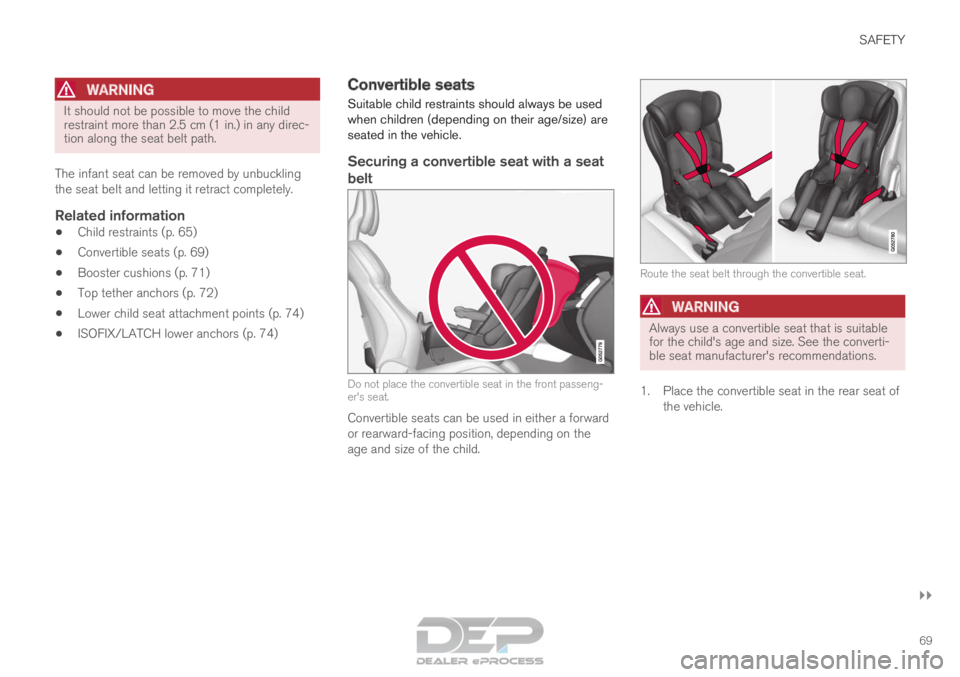
Securing a convertible seat with a seat
belt Do not place the convertible seat in the front passeng-
er's seat.
Convertible seats can be used in either a forward
or rearward-facing position, depending on the
age and size of the child. Route the seat belt through the convertible seat.
WARNING
Always use a convertible seat that is suitable
for the child's age and size. See the converti-
ble seat manufacturer's recommendations.
1.
Place the convertible seat in the rear seat of
the vehicle.
Page 73 of 686
SAFETY
}}71
WARNING It should not be possible to move the child
restraint more than 2.5 cm (1 in.) in any direc-
tion along the seat belt path.
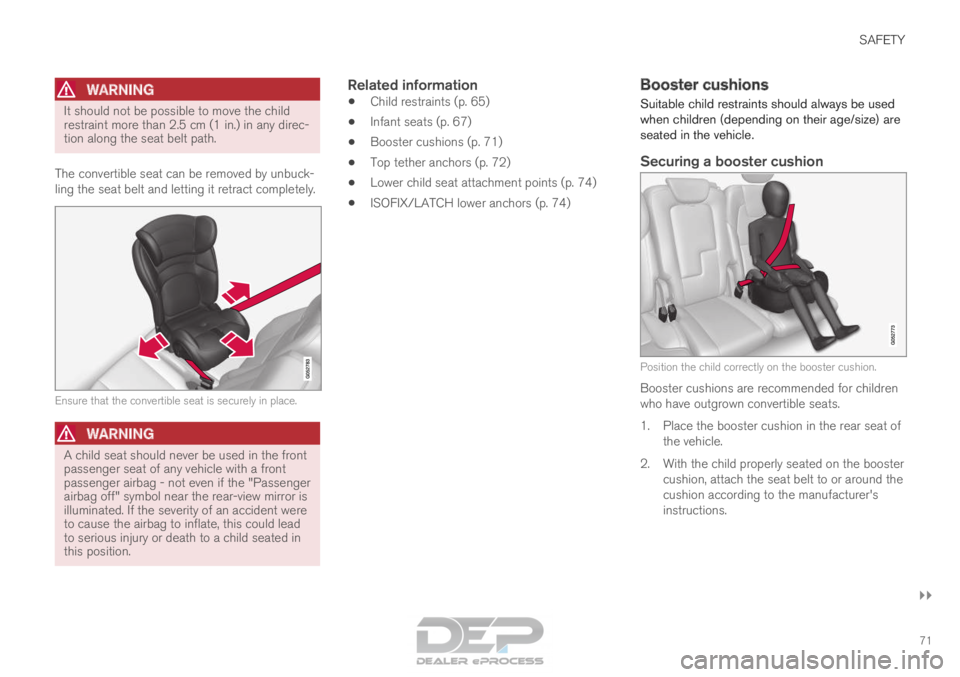
The convertible seat can be removed by unbuck-
ling the seat belt and letting it retract completely. Ensure that the convertible seat is securely in place.
WARNING
A child seat should never be used in the front
passenger seat of any vehicle with a front
passenger airbag - not even if the "Passenger
airbag off" symbol near the rear-view mirror is
illuminated. If the severity of an accident were
to cause the airbag to inflate, this could lead
to serious injury or death to a child seated in
this position.
Related information
•
Child restraints (p. 65)
• Infant seats (p. 67)
• Booster cushions (p. 71)
• Top tether anchors (p. 72)
• Lower child seat attachment points (p. 74)
• ISOFIX/LATCH lower anchors (p. 74) Booster cushions
Suitable child restraints should always be used
when children (depending on their age/size) are
seated in the vehicle.
Securing a booster cushion Position the child correctly on the booster cushion.
Booster cushions are recommended for children
who have outgrown convertible seats.
1.
Place the booster cushion in the rear seat of
the vehicle.
2. With the child properly seated on the booster cushion, attach the seat belt to or around the
cushion according to the manufacturer's
instructions.
Page 74 of 686
||SAFETY
72
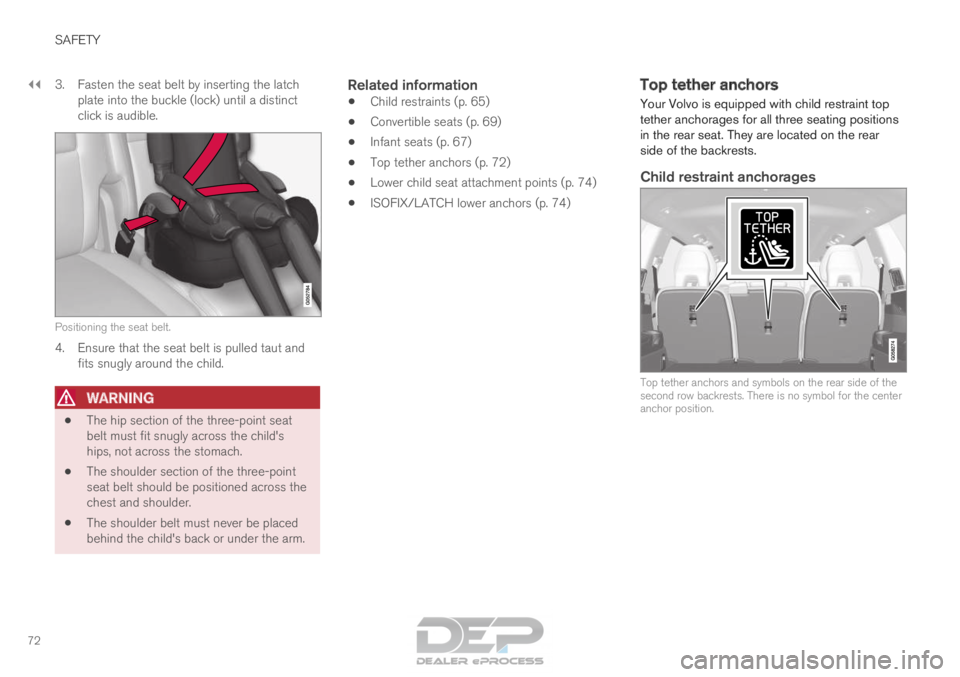
3. Fasten the seat belt by inserting the latch
plate into the buckle (lock) until a distinct
click is audible. Positioning the seat belt.
4. Ensure that the seat belt is pulled taut and
fits snugly around the child.
WARNING •
The hip section of the three-point seat
belt must fit snugly across the child's
hips, not across the stomach.
• The shoulder section of the three-point
seat belt should be positioned across the
chest and shoulder.
• The shoulder belt must never be placed
behind the child's back or under the arm.
Related information
• Child restraints (p. 65)
• Convertible seats (p. 69)
• Infant seats (p. 67)
• Top tether anchors (p. 72)
• Lower child seat attachment points (p. 74)
• ISOFIX/LATCH lower anchors (p. 74) Top tether anchors
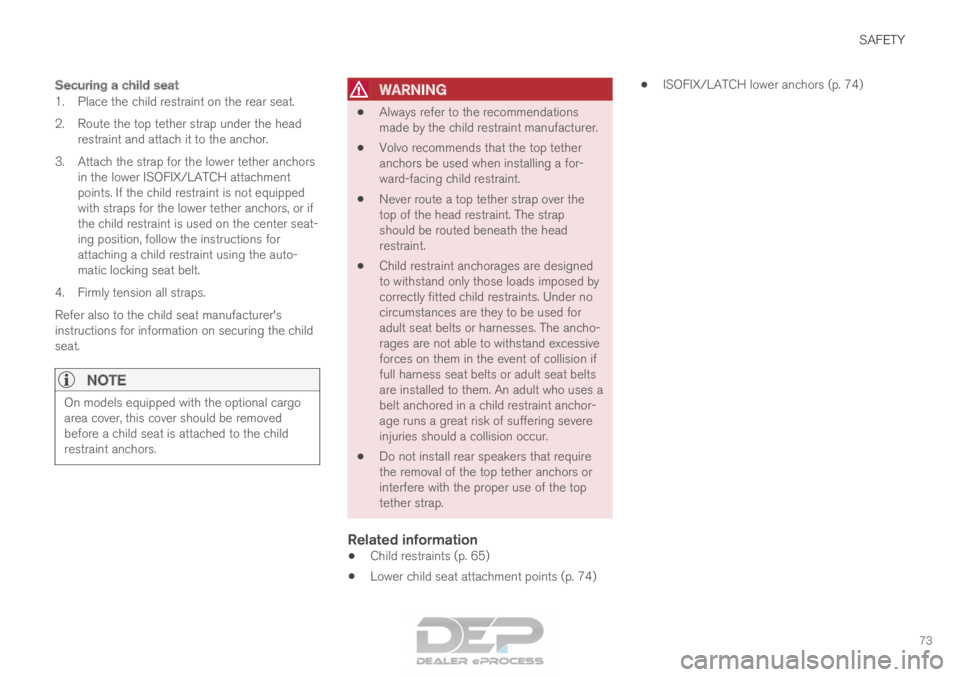
Your Volvo is equipped with child restraint top
tether anchorages for all three seating positions
in the rear seat. They are located on the rear
side of the backrests.
Child restraint anchorages Top tether anchors and symbols on the rear side of the
second row backrests. There is no symbol for the center
anchor position.
Page 75 of 686
SAFETY
73
Securing a child seat
1. Place the child restraint on the rear seat.
2. Route the top tether strap under the headrestraint and attach it to the anchor.
3. Attach the strap for the lower tether anchors in the lower ISOFIX/LATCH attachment
points. If the child restraint is not equipped
with straps for the lower tether anchors, or if
the child restraint is used on the center seat-
ing position, follow the instructions for
attaching a child restraint using the auto-
matic locking seat belt.
4. Firmly tension all straps.
Refer also to the child seat manufacturer's
instructions for information on securing the child
seat.
NOTE On models equipped with the optional cargo
area cover, this cover should be removed
before a child seat is attached to the child
restraint anchors.
WARNING •
Always refer to the recommendations
made by the child restraint manufacturer.
• Volvo recommends that the top tether
anchors be used when installing a for-
ward-facing child restraint.
• Never route a top tether strap over the
top of the head restraint. The strap
should be routed beneath the head
restraint.
• Child restraint anchorages are designed
to withstand only those loads imposed by
correctly fitted child restraints. Under no
circumstances are they to be used for
adult seat belts or harnesses. The ancho-
rages are not able to withstand excessive
forces on them in the event of collision if
full harness seat belts or adult seat belts
are installed to them. An adult who uses a
belt anchored in a child restraint anchor-
age runs a great risk of suffering severe
injuries should a collision occur.
• Do not install rear speakers that require
the removal of the top tether anchors or
interfere with the proper use of the top
tether strap.
Related information
•Child restraints (p. 65)
• Lower child seat attachment points (p. 74) •
ISOFIX/LATCH lower anchors (p. 74)
Page 76 of 686

SAFETY
74Lower child seat attachment points
The vehicle is equipped with lower child restraint
attachment points in the second row of seats. The lower child seat attachment points are
intended for use with certain rear-facing child
restraints.
Always follow the manufacturer's installation
instructions when attaching a child seat to the
lower child seat attachment points.
Location of child seat attachment
points Location of the child seat attachment points in the sec-
ond row of seats.
The child seat attachment points in the second
row of seats are located on the rear section of
the front seat floor rails.
Related information
• Child restraints (p. 65)
• Top tether anchors (p. 72)
• ISOFIX/LATCH lower anchors (p. 74) ISOFIX/LATCH lower anchors
Lower anchors for ISOFIX/LATCH-equipped
child seats are located in the second row, out-
board seats, hidden below the backrest cush-
ions.
Using the ISOFIX/LATCH lower child
seat anchors Location of the ISOFIX/LATCH anchors
Symbols on the seat back upholstery mark the
ISOFIX/LATCH anchor positions as shown. To
access the anchors, kneel on the seat cushion
and locate the anchors by feel. Always follow your
child seat manufacturer's installation instructions,
and use both ISOFIX/LATCH lower anchors and
top tethers whenever possible.
Page 77 of 686

SAFETY
75
To access the anchors
1. Put the child restraint in position.
2. Kneel on the child restraint to press downthe seat cushion and locate the anchors by
feel.
3. Fasten the attachment on the child restraint's lower straps to the ISOFIX/LATCH
lower anchors.
4. Firmly tension the lower child seat straps according to the manufacturer's instructions.
WARNING Volvo's ISOFIX/LATCH anchors conform to
FMVSS/CMVSS standards. Always refer to
the child restraint system's manual for weight
and size ratings.
NOTE •
The rear center seat is not equipped with
ISOFIX/LATCH lower tether anchors. If a
child restraint is used in this seat, attach
the restraint's upper anchor strap (if
equipped with these) to the top tether
anchor point for this strap and secure the
child restraint with the vehicle's center
seat belt.
• Always follow your child seat manufactur-
er's installation instructions, and use both
ISOFIX/LATCH lower anchors and top
tethers whenever possible. Fasten the attachment correctly to the ISOFIX/LATCH
lower anchorsWARNING •
Be sure to fasten the attachment cor-
rectly to the anchor (see the illustration).
If the attachment is not correctly fas-
tened, the child restraint may not be
properly secured in the event of a colli-
sion.
• The ISOFIX/LATCH lower child restraint
anchors are only intended for use with
child seats positioned in the outboard
seating positions. These anchors are not
certified for use with any child restraint
that is positioned in the center seating
position. When securing a child restraint
in the center seating position, use only
the vehicle's center seat belt.
Related information
• Child restraints (p. 65)
• Top tether anchors (p. 72)
• ISOFIX/LATCH lower anchors (p. 74)