change wheel VOLVO XC90 TWIN ENGINE 2018 Owner's Guide
[x] Cancel search | Manufacturer: VOLVO, Model Year: 2018, Model line: XC90 TWIN ENGINE, Model: VOLVO XC90 TWIN ENGINE 2018Pages: 686, PDF Size: 17 MB
Page 321 of 686
DRIVER SUPPORT
}}
319
Deactivating/reactivating Pilot
Assist
Pilot Assist
can be temporarily put into standby
mode and then reactivated.
Deactivating and putting Pilot Assist in
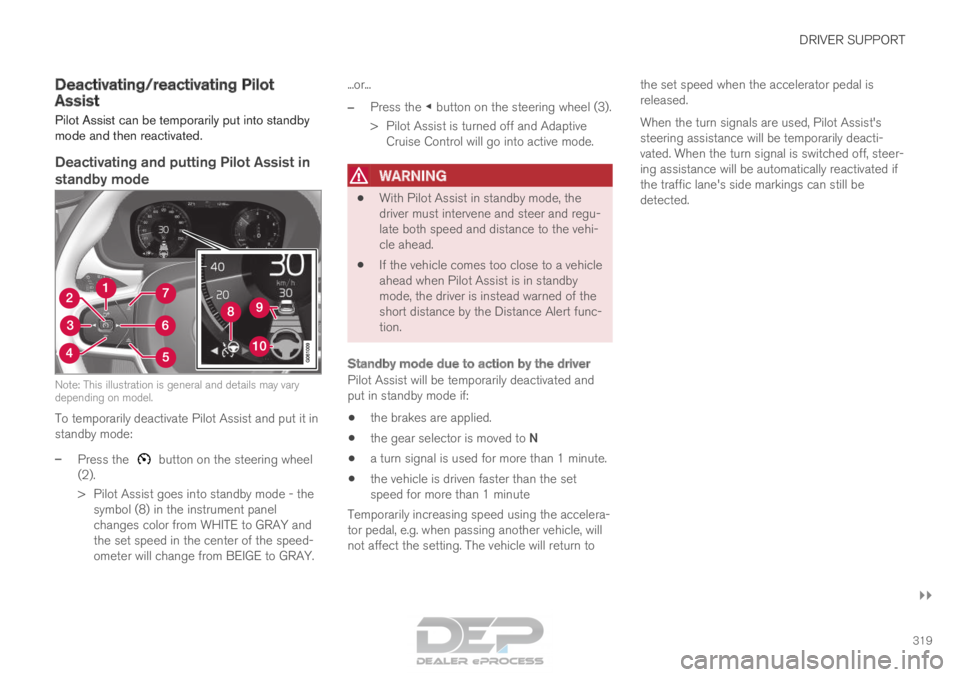
standby mode Note: This illustration is general and details may vary
depending on model.
To temporarily deactivate Pilot Assist and put it in
standby mode:
–
Press the button on the steering wheel
(2).
>
Pilot Assist goes into standby mode - the
symbol (8) in the instrument panel
changes color from WHITE to GRAY and
the set speed in the center of the speed-
ometer will change from BEIGE to GRAY. ...or...
– Press the ◀ button on the steering wheel (3).
>
Pilot Assist is turned off and Adaptive
Cruise Control will go into active mode.
WARNING •
With Pilot Assist in standby mode, the
driver must intervene and steer and regu-
late both speed and distance to the vehi-
cle ahead.
• If the vehicle comes too close to a vehicle
ahead when Pilot Assist is in standby
mode, the driver is instead warned of the
short distance by the Distance Alert func-
tion.
Standby mode due to action by the driver
Pilot Assist will be temporarily deactivated and
put in standby mode if:
• the brakes are applied.
• the gear selector is moved to N
• a turn signal is used for more than 1 minute.
• the vehicle is driven faster than the set
speed for more than 1 minute
Temporarily increasing speed using the accelera-
tor pedal, e.g. when passing another vehicle, will
not affect the setting. The vehicle will return to the set speed when the accelerator pedal is
released.
When the turn signals are used, Pilot Assist's
steering assistance will be temporarily deacti-
vated. When the turn signal is switched off, steer-
ing assistance will be automatically reactivated if
the traffic lane's side markings can still be
detected.
Page 324 of 686

DRIVER SUPPORT
322Switching target vehicles with Pilot
Assist
At certain speeds, models with automatic trans-
missions and
Pilot Assist can switch target vehi-
cles.
Switching target vehicles If the target vehicle ahead turns suddenly, there may be
stationary traffic ahead.
When Pilot Assist is actively following another
vehicle at speeds under 30 km/h (20 mph) and
switches targets from a moving vehicle to a sta-
tionary vehicle,
Pilot Assist will brake for the sta-
tionary vehicle.
WARNING When Pilot Assist follows another vehicle at
speeds over approx. 30 km/h (20 mph) and
changes target vehicle – from a moving vehi-
cle to a stationary one – Pilot Assist will
ignore the stationary vehicle and instead
accelerate to the stored speed.
• The driver must then intervene and apply
the brakes.
Automatic standby mode when switching
targets
Pilot Assist disengages and goes into standby
mode if:
• your vehicle's speed goes below 5 km/h
(3 mph) and Pilot Assist cannot determine if
the target object is a stationary vehicle or
another object, e.g. a speed bump.
• your vehicle's speed goes under 5 km/h
(3 mph) and the vehicle ahead turns so that
Pilot Assist no longer has a vehicle to follow.
Related information
•Pilot Assist (p. 311) Automatic braking with Pilot Assist
Pilot Assist has a special braking function in
slow traffic and at a standstill.
Braking function in slow traffic and at a
standstill
In slow-moving, stop-and-go traffic or when stop-
ped at a traffic light, driving will resume automati-
cally if the vehicle is stopped for less than
approx. 3 seconds. If it takes more than 3 sec-
onds for the vehicle ahead to begin moving again,
Pilot Assist will go into standby mode and the
Auto-hold brake function will activate.
– Pilot Assist can be reactivated by:
• Pressing the button on the steering
wheel keypad.
• Pressing the accelerator pedal.
>
Pilot Assist will resume following the vehi-
cle ahead if it begins to move within
approx. 6 seconds.
NOTE Pilot Assist can keep the vehicle stationary
for no more than 5 minutes – after that time
the parking brake is applied and the function
is deactivated.
The parking brake must be released before
Pilot Assist can be reactivated.
Page 366 of 686
DRIVER SUPPORT
364Selecting guidance to a rest area if
the Driver Alert Control warning has
been given
The Rest Stop Guidance function can be
switched on or off. When the guide is activated, it will automatically
display suggestions for a suitable place to take a
break if the DAC warning is given.
To select Rest Stop Guidance:
1. Tap Settings in the center display's Top
view.
2.
Select My Car IntelliSafe Driver Alert
Control .
3. Select/deselect Rest Stop Guidance to
activate/deactivate the function.
Related information
• Driver Alert Control (p. 362) Driver Alert Control limitations
Driver Alert Control (DAC) functionality may be
reduced in certain situations.
In certain situations, the system may provide a
warning even if it has not detected a change in
driving behavior, e.g.:
• in strong crosswinds
• on grooved road surfaces.
WARNING In certain cases, driving behavior might not be
affected despite the driver's fatigue – when
using the Pilot Assist function – resulting in
the driver not getting a warning from DAC.
It is therefore very important to always stop
and take a break at the slightest sign of fati-
gue, regardless of whether the DAC function
has issued a warning or not.
NOTE
The function uses the vehicle's camera unit,
which has some general limitations – see the
section "Camera unit limitations".
Related information
•
Driver Alert Control (p. 362) Lane Keeping Aid
Lane Keeping Aid (LKA 107
) is designed to
actively steer the vehicle on freeways, highways
and other major roads to help the driver reduce
the risk of the vehicle unintentionally veering out
of the lane.
Lake Keeping Assistance steers the vehicle back
into the lane and/or alerts the driver using vibra-
tions in the steering wheel.
Lane Keeping Aid is active at speeds between
65-200 km/h (40-125 mph) on roads with
clearly visible traffic lane marker lines.
On narrow roads, the function may be unavailable
and go into standby mode. The function will
become available again when the road becomes
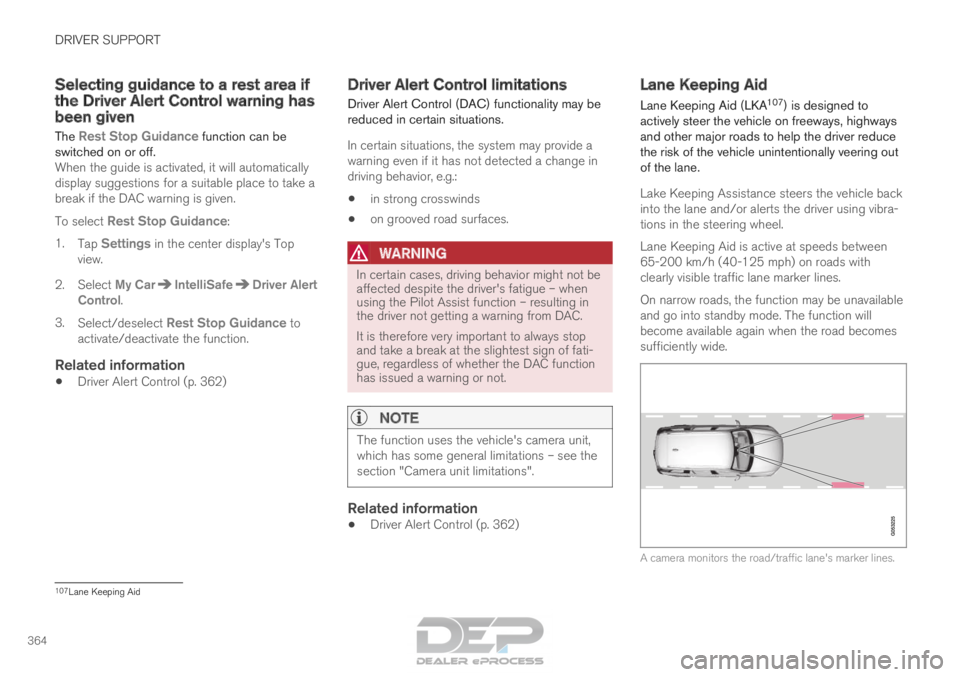
sufficiently wide. A camera monitors the road/traffic lane's marker lines.
107
Lane Keeping Aid
Page 379 of 686
DRIVER SUPPORT
}}
* Option/accessory. 377
NOTEThe function uses the vehicle's camera unit,
which has some general limitations – see the
section "Camera unit limitations".
NOTE
The function uses the vehicle's radar unit,
which has some general limitations – see the
section "Radar unit limitations".
Related information
•
Steering assistance at risk of collision
(p. 372)
• Speed-dependent steering wheel resistance
(p. 272) Steering assistance during collision
risks from behind*
If you become distracted and do not notice your
vehicle starting to veer out of the lane while
another vehicle is approaching from behind or is
in your vehicle's blind spot, this sub-function can
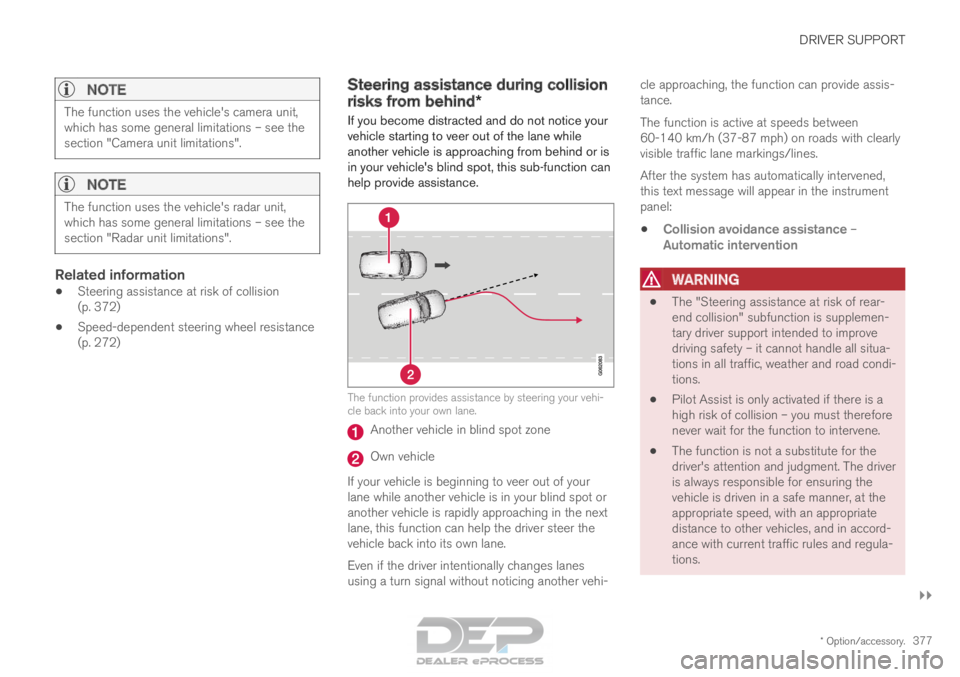
help provide assistance. The function provides assistance by steering your vehi-
cle back into your own lane.
Another vehicle in blind spot zone
Own vehicle
If your vehicle is beginning to veer out of your
lane while another vehicle is in your blind spot or
another vehicle is rapidly approaching in the next
lane, this function can help the driver steer the
vehicle back into its own lane.
Even if the driver intentionally changes lanes
using a turn signal without noticing another vehi- cle approaching, the function can provide assis-
tance.
The function is active at speeds between
60-140 km/h (37-87 mph) on roads with clearly
visible traffic lane markings/lines.
After the system has automatically intervened,
this text message will appear in the instrument
panel:
• Collision avoidance assistance –
Automatic interventionWARNING •
The "Steering assistance at risk of rear-
end collision" subfunction is supplemen-
tary driver support intended to improve
driving safety – it cannot handle all situa-
tions in all traffic, weather and road condi-
tions.
• Pilot Assist is only activated if there is a
high risk of collision – you must therefore
never wait for the function to intervene.
• The function is not a substitute for the
driver's attention and judgment. The driver
is always responsible for ensuring the
vehicle is driven in a safe manner, at the
appropriate speed, with an appropriate
distance to other vehicles, and in accord-
ance with current traffic rules and regula-
tions.
Page 403 of 686
DRIVER SUPPORT
* Option/accessory.401
NOTEDirt, ice and snow covering the sensors
reduce their function and can make measure-
ment impossible.
Driver responsibilityThe driver should keep in mind that PAP is a
parking aid ‒ not an infallible fully automatic sys-
tem. The driver must always be prepared to take
control and cancel a parking sequence if neces-
sary.
There are a number of things to keep in mind
when parking, including:
• The driver is always responsible for determin-
ing if the space suggested by PAP is suita-
ble for parking.
• Do not use PAP when using snow chains or
a temporary spare tire.
• Do not use PAP if there are any objects pro-
truding from the vehicle.
• Heavy rain or snowfall may inhibit PAP's abil-
ity to accurately measure a parking space.
• While searching and measuring the parking
space, PAP may be unable to detect objects
located far into the space.
• PAP may not suggest parking spaces on
narrow streets if it does not detect sufficient
space for maneuvering the vehicle. •
Use approved tires 128
inflated to the correct
tire pressure because this affects PAP's abil-
ity to provide parking assistance.
• PAP's function is based on the way the vehi-
cles are parked behind and in front of your
parking space. If they are, for example,
parked too close to the curb, there is a risk
that your vehicle's tires or wheel rims could
be damaged by the curb during the parking
procedure.
• Perpendicular parking spaces may not be
detected or may be suggested unnecessarily
if a parked vehicle is sticking out more than
other parked vehicles.
• PAP is intended to provide parking assis-
tance on straight streets, not sections of
street with sharp curves or bends. Always
make sure that your vehicle is parallel to rel-
evant parking spaces when PAP is measur-
ing the parking space.
CAUTION Switching to another approved wheel and/or
tire dimension could change the tire circum-
ference, which would then require the PAP
system to be updated. Consult a workshop –
an authorized Volvo workshop is recom-
mended.
Related information
•
Park Assist Pilot* (p. 395)
• Speed-dependent steering wheel resistance
(p. 272) 128
"Approved tires" refers to tires of the same type and make as the vehicl\
e's original, factory-installed tires.
Page 440 of 686
||STARTING AND DRIVING
* Option/accessory.
438
Related information
• Rear Collision Warning (p. 347)
• BLIS* (p. 348)
• Brake functions (p. 429) Transmission
The transmission is part of the vehicle's driveline
(power transmission) between the engine and
the drive wheels. The function of the transmis-
sion is to change gears depending on speed
and power needs.
The vehicle has an 8-speed automatic transmis-
sion and an electric motor for rear-wheel drive.
The number of gears allows the engine's torque
and power band to be effectively utilized. Two of
the gears are overdrive gears that save fuel when
driving at a constant engine speed. The steering
wheel paddles* can be used to shift up or down
manually. The instrument panel shows the gear
currently in use.
CAUTION Check the operating temperature of the
transmission to help avoid damage to any of
the drive system components. If there is a risk
of overheating, a warning symbol will appear
in the instrument panel and a text message
will be displayed. Follow the recommenda-
tions given.
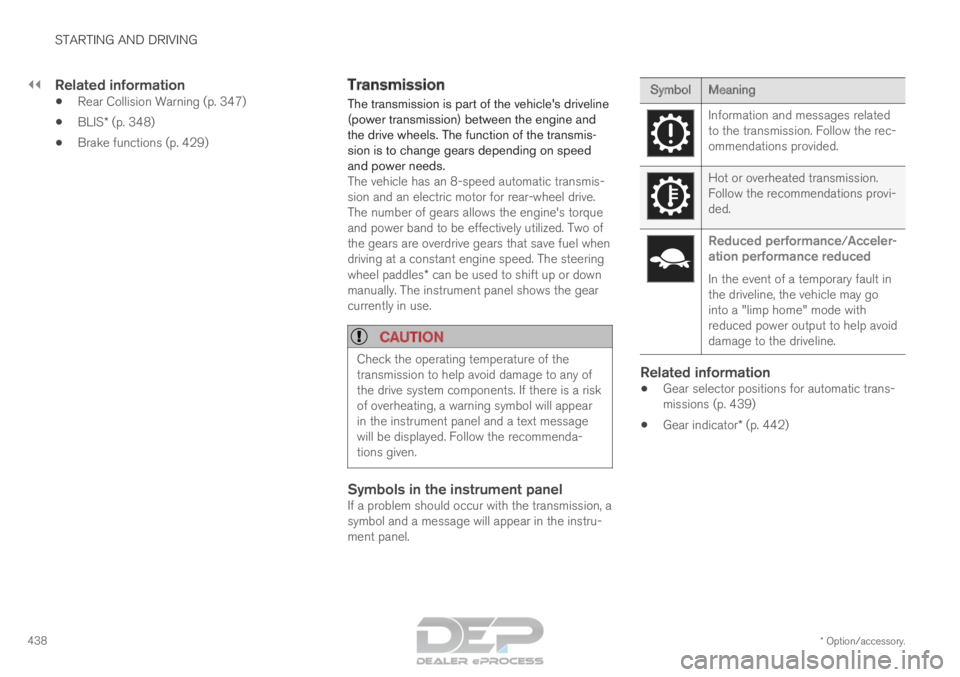
Symbols in the instrument panelIf a problem should occur with the transmission, a
symbol and a message will appear in the instru-
ment panel. Symbol
Meaning Information and messages related
to the transmission. Follow the rec-
ommendations provided.
Hot or overheated transmission.
Follow the recommendations provi-
ded.
Reduced performance/Acceler-
ation performance reduced
In the event of a temporary fault in
the driveline, the vehicle may go
into a "limp home" mode with
reduced power output to help avoid
damage to the driveline.
Related information
• Gear selector positions for automatic trans-
missions (p. 439)
• Gear indicator* (p. 442)
Page 443 of 686

STARTING AND DRIVING
* Option/accessory.441
Using the steering wheel paddles*
to shift
The steering wheel paddles are a supplement to
the gear selector and make it possible to shift
manually without removing your hands from the
steering wheel.
Activating the steering wheel paddlesIn order to shift gears using the paddles, they
must first be activated:
– Pull one of the paddles toward the steering
wheel.
>
A number in the instrument panel indi-
cates the current gear being used. Instrument panel when the paddles are activated for
shifting.
ChangeTo shift one gear: –
Pull one of the paddles toward the steering
wheel and then release. "-": Shift down one gear.
"+": Shift up one gear.
As long as the engine speed (rpm) is within the
permissible range for the selected gear, a gear
shift will take place each time a paddle is pulled.
After each gear shift, a number indicating the
current gear will be displayed in the instrument
panel.
Turning off Start/Stop
Manual deactivation in gear D and B
– Deactivate the paddles by pulling the right
paddle (+) toward the steering wheel and
holding it until the number of the current
gear is no longer displayed in the instrument
panel.
> The transmission will revert to gear D or B
depending on which gear was selected
before the paddles were activated.
Automatic deactivation
In gear position D, the steering wheel paddles
are deactivated after a short period of time if they
are not used. The number of the current gear will
no longer be displayed in the instrument panel.
In gear position B, the paddles will not activate
automatically.
Related information
• Gear selector positions for automatic trans-
missions (p. 439)
• Gear indicator* (p. 442)
Page 449 of 686
STARTING AND DRIVING
}}
447
OFF ROAD
• Maximizes the vehicle's ability to traverse dif-
ficult terrain or poor roads.
In this mode, ground clearance 4
is high, steering
is light, and all-wheel drive and Hill Descent
Control are activated.
This drive mode is only available at low speeds,
up to 40 km/h (25 mph). If this speed is excee-
ded, Off road mode will be cancelled and AWD
mode will be activated instead.
All-wheel drive requires both the combustion and
electric motor to be in continuous operation,
which results in higher fuel consumption.
In Off road mode, a compass will be displayed
between the speedometer and the tachometer in
the instrument panel. The permissible speed
range will be shown in the speedometer.
This drive mode is optimized for maximum control
when driving at low speeds on very poor roads or
difficult terrain. It raises the chassis 4
, reduces
driveline throttle response, and locks the vehicle
in all-wheel drive. The Hill Descent Control func-
tion facilitates controlled driving on steep down-
grades.NOTE This drive mode is not designed to be used
for normal street driving.
NOTE
Due to the increased ground clearance, if the
OFF ROAD mode was selected when the
engine was switched off, the suspension will
lower when the engine is restarted.
CAUTION
Do not use the OFF ROAD drive mode when
towing a trailer without an electrical connec-
tion. This could result in damage to the pneu-
matic suspension system's bellows.
AWD
•
Improves the vehicle's traction and handling
by increasing all-wheel drive.
This drive mode locks the vehicle in all-wheel
drive. An optimal distribution between front and
rear axle torque helps provide the best possible
control, stability and traction, e.g. on slippery
roads or when towing a heavy trailer or another
vehicle. The AWD drive mode is always available
regardless of the hybrid battery's charge status. Both the combustion engine and the electric
motor are engaged to enable all-wheel drive,
which results in higher fuel consumption.
In the other drive modes, the vehicle automati-
cally adapts the need for all-wheel drive accord-
ing to the road surface, and can activate the elec-
tric motor or start the combustion engine as nee-
ded.
POWER
•
Power mode is designed to provide sportier
driving characteristics and a faster accelera-
tion response.
This drive mode maximizes the combined power
from the combustion engine and the electric
motor by providing power to both the front and
rear wheels. Gear shifting will be faster and more
distinct and the transmission will prioritize gears
with a higher traction force. Steering response is
faster, suspension is stiffer and ground clearance
is lower 4
to help reduce body roll when cornering.
Both the combustion engine and the electric
motor are engaged to enable all-wheel drive,
which results in higher fuel consumption.
This drive mode is optimized for maximum per-
formance and throttle response. It changes the
throttle response, gear shifting program and
turbo boost system. Chassis settings and steer-
ing and brake response are also optimized. The
Power drive mode is always available regardless
of the hybrid battery's charge status. 4
For vehicles with pneumatic suspension.
Page 451 of 686

STARTING AND DRIVING
449
Related information
•Changing drive mode (p. 449)
• Economical driving (p. 456)
• Hybrid gauge (p. 87)
• General information about Twin Engine
(p. 406) Changing drive mode
The drive mode is changed using the control in
the tunnel console.
Select the drive mode that is best suited to the
current driving conditions. Keep in mind that not
all drive modes are available in all situations.
To change drive mode: 1.
Press the DRIVE MODE control.
>
A pop-up menu will appear in the center
display.
2. Roll the wheel upward or downward to the desired drive mode.
3. Press the drive mode control or tap its button in the center display to confirm the selection.
> The selected drive mode is shown in theinstrument panel. If a drive mode is grayed out in the pop-up menu,
it cannot be selected.
Related information
•
Drive modes (p. 445)
• Activating and deactivating Low Speed Con-
trol using the function button (p. 454)
• Activating and deactivating Hill Descent Con-
trol using the function button (p. 455)
Page 456 of 686

||STARTING AND DRIVING
454
NOTE
When LSC with HDC is activated in the OFF
ROAD drive mode, the feel of the accelerator
pedal and engine response will change.
NOTE
This drive mode is not designed to be used
for normal street driving.
NOTE
The function is deactivated when driving at
high speeds and must be reactivated at lower
speeds if so desired.
Related information
•
Activating and deactivating Low Speed Con-
trol using the function button (p. 454)
• Changing drive mode (p. 449)
• Hill Descent Control (p. 454)
• All Wheel Drive (AWD) (p. 443) Activating and deactivating Low
Speed Control using the function
button
Vehicles that are not equipped with drive mode
controls in the tunnel console have a function
button for Low Speed Control with Hill Descent
Control in the center display's Function view.
Selecting Low Speed Control in the
center display's Function view
– Tap the Hill Descent Control button to
activate or deactivate the function. > An indicator light in the button will illumi-
nate when the function is activated.
When the engine is switched off, the function will
be automatically deactivated.
NOTE The function is deactivated when driving at
high speeds and must be reactivated at lower
speeds if so desired.
Related information
•
Low Speed Control (p. 453)
• Changing drive mode (p. 449) Hill Descent Control
The function for assisting when driving downhill,
Hill Descent Control (HDC), is a low-speed
function with increased engine braking. The
function makes it possible to increase or
decrease the vehicle's speed on steep downhill
gradients by only using the accelerator pedal,
without applying the brakes.
The function is included in the Off Road drive
mode.
HDC is designed for driving on rough roads at
low speeds and downhill gradients with slippery
or otherwise difficult road surfaces. The driver
does not need to use the brake pedal but can
instead focus on steering.
WARNING
HDC is only intended to be a supplementary
braking aid and it does not function in all sit-
uations.
The driver is always ultimately responsible for
operating the vehicle in a safe manner.
FunctionHill Descent Control allows the vehicle to move
forward or backward at very low speeds assisted
by the brake system. The driver can increase the
speed by pressing the accelerator pedal. When
the accelerator pedal is released, the vehicle will
return to very low speed regardless of how steep