ignition VOLVO XC90 TWIN ENGINE 2018 Workshop Manual
[x] Cancel search | Manufacturer: VOLVO, Model Year: 2018, Model line: XC90 TWIN ENGINE, Model: VOLVO XC90 TWIN ENGINE 2018Pages: 686, PDF Size: 17 MB
Page 516 of 686
AUDIO, MEDIA AND INTERNET
* Option/accessory.
514 Playing media via the USB port
External audio sources, such as an iPod® or
MP3 player, can be connected to the audio sys-
tem via the vehicle's USB port.
Devices with rechargeable batteries can be
charged when they are connected via the USB
port and the ignition is in mode I, II or the engine
is running.
The content on the external source can be read
faster if it only contains data of a compatible for-
mat. Video files can also be played via the USB
port.
Some MP3 players have their own file system
that the vehicle has support for.
Related information
• Connecting a device via the USB port
(p. 514)
• Playing media (p. 508)
• Video (p. 512)
• Ignition modes (p. 427)
• Technical specifications for USB devices
(p. 537)
• Apple ®
CarPlay ®
* (p. 515)
• Android Auto* (p. 518) Connecting a device via the USB
port
External audio sources, such as an iPod ®
or
MP3 player, can be connected to the audio sys-
tem via any of the vehicle's USB ports.
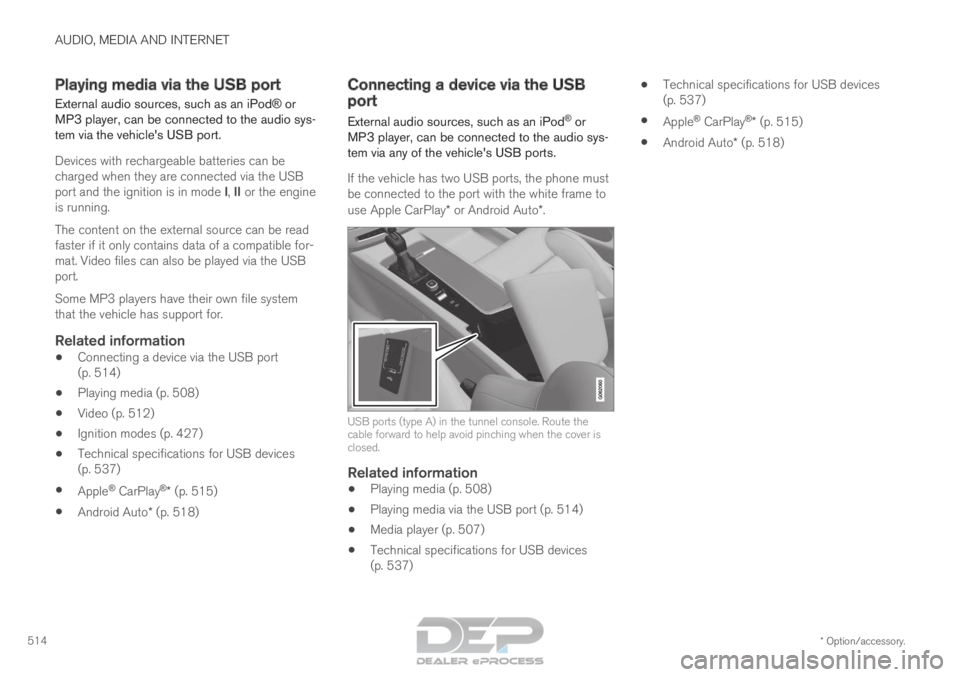
If the vehicle has two USB ports, the phone must
be connected to the port with the white frame to
use Apple CarPlay* or Android Auto*. USB ports (type A) in the tunnel console. Route the
cable forward to help avoid pinching when the cover is
closed.
Related information
•
Playing media (p. 508)
• Playing media via the USB port (p. 514)
• Media player (p. 507)
• Technical specifications for USB devices
(p. 537) •
Technical specifications for USB devices
(p. 537)
• Apple ®
CarPlay ®
* (p. 515)
• Android Auto* (p. 518)
Page 525 of 686
AUDIO, MEDIA AND INTERNET
}}
523
Connecting a phone to the car via
Bluetooth automatically
A phone can be automatically connected to the
vehicle via Bluetooth. The phone must have first
been paired with the vehicle. Only the two most recently connected phones
can be connected automatically.
1.
Activate Bluetooth in the phone before turn-
ing the vehicle's ignition to mode I.
To simultaneously connect the vehicle to the
Internet, the phone's personal hotspot must
also be activated.
2. Turn the ignition to I or higher.
> The phone will be connected.
Related information
• Phone (p. 520)
• Connecting a phone to the car via Bluetooth
for the first time (p. 521)
• Connecting a phone to the car via Bluetooth
manually (p. 523)
• Disconnecting a Bluetooth-connected phone
(p. 524)
• Switch between phones connected via Blue-
tooth (p. 524)
• Removing a Bluetooth-connected phone
(p. 525)
• Settings for Bluetooth devices (p. 529) •
Connecting the car to the Internet via a
mobile device (Bluetooth) (p. 531)
• Ignition modes (p. 427) Connecting a phone to the car via
Bluetooth manually
A phone can be manually connected to the vehi-
cle via Bluetooth. The phone must have first
been paired with the vehicle.
1. Activate Bluetooth in the phone.
To simultaneously connect the vehicle to the
Internet, the phone's personal hotspot must
also be activated.
2.
Open the phone tile.
> A list of available phones will be displayed.
3. Tap the name of the phone you would like to connect.
> The phone will be connected.
Related information
• Phone (p. 520)
• Connecting a phone to the car via Bluetooth
for the first time (p. 521)
• Connecting a phone to the car via Bluetooth
automatically (p. 523)
• Disconnecting a Bluetooth-connected phone
(p. 524)
• Switch between phones connected via Blue-
tooth (p. 524)
• Removing a Bluetooth-connected phone
(p. 525)
Page 563 of 686

WHEELS AND TIRES
}}
* Option/accessory. 561
Calibrating the tire pressure
monitoring system*
In order for the tire pressure monitoring system,
Tyre Pressure Monitoring System (TPMS), to
function correctly, tire pressure reference values
must be set correctly. This must be done each
time the tires are changed or the tire pressure is
adjusted.
For example, when driving with a heavy load or at
high speeds (over 160 km/h (100 mph)), tire
pressure should be adjusted to the Volvo-recom-
mended tire pressure values. The system should
then be recalibrated.
1.
Switch off the ignition.
2. Inflate the tires to the pressure indicated on the tire pressure placard on the driver's side
B pillar.
3. Start the vehicle.
4. Open the Car status app in App view. 5.
Tap TPMS.NOTE The car must be stationary when calibration is
started.
6.
Tap Calibrate.
7. Tap OK to confirm that the tire pressure in
all four tires has been checked and adjusted. 8.
Run the car until calibration is complete.
Calibration is done when the vehicle is driv-
ing at a speed above 35 km/h (22 mph).
> When enough data has been collected for the system to detect low tire pressure, the
color of the tire symbols in the center dis-
play will change from gray to green. The
system will not provide any other confir-
mation that calibration has been comple-
ted.
If the car's ignition is switched off before
calibration is complete, the tires in the
center display change color from gray to
green upon next start-up, even if calibra-
tion is not complete. Perform the calibra-
tion again and allow it to complete within
the same operating cycle to ensure that
the calibration is carried out correctly.
If start-up of calibration fails, the following
message appears: Calibration
unsuccessful. Try again..
Page 565 of 686

WHEELS AND TIRES
}}
* Option/accessory. 563
The vehicle may need to be driven for a few
minutes at a speed above 35 km/h (22 mph) to
activate the system.
All tires gray and a message:
•
Tire pressure system Temporarily
unavailable. The indicator symbol will flash
for about 1 minute and then glow steadily.
The system is temporarily unavailable and will
be activated momentarily.
• Tire pressure system Service required.
The indicator symbol will flash for about 1
minute and then glow steadily. If the system
is not working properly, contact a workshop 9
.
Related information
• Calibrating the tire pressure monitoring sys-
tem* (p. 561)
• Action when warned of low tire pressure
(p. 563)
• Tire pressure monitoring system* (p. 559)
• Vehicle status (p. 602) Action when warned of low tire
pressure
When the tire pressure monitoring system, Tyre
Pressure Monitoring System (TPMS), detects
low pressure in one or more of the vehicle's
tires, the driver will be alerted that action is nee-
ded. If the system's indicator symbol illumi-
nates and the message Tire pressure
low is displayed, check the tire pres-
sure and inflate if necessary. 1. Switch off the ignition.
2.
Check the inflation pressure on all four tires
using a tire pressure gauge.
3. Inflate the tire to the correct pressure (see the tire pressure decal on the driver's side
door pillar).
4. Through calibration of the system via the center display after the tire pressure has
been adjusted.
Please be aware that the indicator symbol
will not go out until the low tire pressure has
been corrected and the system has been
recalibrated.
NOTE To help prevent incorrect inflation pressure,
pressure should be checked when the tires
are cold. The tires are considered to be cold
when they have reached the same tempera-
ture as the ambient temperature (about 3
hours after the vehicle was last driven). After
driving for a few kilometers, the tires will warm
up and the pressure will increase.
NOTE
•
After inflating a tire, always replace the
valve cap to help prevent valve damage
caused by gravel, dirt, etc.
• Use plastic valve caps only. Metal caps
could corrode and become difficult to
remove.
WARNING •
Incorrect inflation pressure could lead to
tire failure, which could cause the driver
to lose control of the vehicle.
• The system cannot predict sudden tire
damage. 9
An authorized Volvo workshop is recommended.
Page 585 of 686

LOADING, STORAGE AND PASSENGER COMPARTMENT
583Status indicator light
Cause Action
Steady green light
The socket is providing electrical current to a connected device. None.
Flashing orange light The socket's voltage converter is too hot (e.g. if the device draws \
too much cur- rent or if the temperature in the passenger compartment is very high). Unplug the device, let the voltage converter cool
down and plug in the device again.
The connected device is drawing too much current (at the moment or con-\
stantly) or is not functioning properly. None. The device cannot be used in the socket.
Indicator light off The socket has not detected a device plugged into the socket. Make sure the device is correctly plugged into the
socket.
The socket is not active. Make sure the vehicle's ignition is in at least
mode I.
The socket has been active but has been deactivated. Start the engine and/or charge the start battery.
Related information
•Passenger compartment interior (p. 580)
• Using the electrical outlets (p. 584)
Page 586 of 686

LOADING, STORAGE AND PASSENGER COMPARTMENT
* Option/accessory.
584 Using the electrical outlets
The 12 V outlet can be used for devices
intended for this such as MP3 players, coolers
and cellular phones.
The high-voltage outlet* can be used for devices
intended for this, such as chargers, laptops, etc. The ignition must be in at least mode I for the
outlets to supply current. The outlets will then be
active as long as there is sufficient charge in the
start battery.
If the engine is turned off and the vehicle is
locked, the outlets will be deactivated. If the
engine is turned off and the vehicle remains
unlocked, the sockets will remain active for up to
7 minutes.
NOTE Bear in mind that using the electrical outlets
when the engine is off could cause the starter
battery to have too low of a charge level,
which could limit other functionality.
Accessories connected to the electrical out-
lets can be activated even when the vehicle
electrical system is off or if preconditioning is
used. For this reason, disconnect plugs when
they are not in use to prevent the starter bat-
tery from becoming discharged.
WARNING •
Do not use accessories with large or
heavy plugs – they could damage the out-
let or come loose while you are driving.
• Do not use accessories that could cause
disruptions to e.g. the vehicle's radio
receiver or electrical system.
• Position the accessory so that there is no
risk of it injuring the driver or passengers
in the event of heavy braking or a colli-
sion.
• Pay attention to connected accessories
as they can generate heat that could burn
passengers or the interior.
Using 12 V outlets1. Remove the stopper (tunnel console) or fold
down the cover (trunk/cargo compartment)
over the socket and plug in the device.
2. Unplug the device and put the stopper back in (tunnel console) or fold up the cover
(trunk/cargo compartment) when the socket
is not in use or left unattended.
CAUTION The maximum power is 120 W (10 A) per
outlet.
Using high-voltage outletsThe ignition must be in at least mode I for outlets
to supply current. The outlets will then be active
as long as there is sufficient charge in the start
battery.
1. Slide down the cover over the outlet and plug
in the device.
>
The LED 2
light on the outlet will indicate
its status.
2. The outlet is supplying electrical current when the light is glowing steadily green.
3. Disconnect the device by pulling out the plug (do not pull on the cord).
Pull up the cover when the outlet is not in
use or is left unattended.
CAUTION The maximum power is 150 W.
WARNING
Do not attempt to alter or repair the high-volt-
age outlet on your own. Volvo recommends
contacting an authorized Volvo workshop.
2
LED (Light Emitting Diode)
Page 587 of 686

LOADING, STORAGE AND PASSENGER COMPARTMENT
585
WARNING•
Only use accessories that are not dam-
aged or malfunctioning. The accessories
must be designed for 120 V and 60 Hz,
with plugs intended for the outlet. The
accessories must be CE marked, UL
marked or have an equivalent safety
marking.
• New let outlets, plugs or accessories
come into contact with water or another
fluid. Do not touch or use the outlet if it
appears damaged or has been in contact
with water or another fluid.
• Do not connect power strips, adapters or
extension cords to the outlet has this
could cause the outlet's safety functions
to malfunction.
• The outlet is equipped with a pet guard.
Make sure that no one picks at or dam-
ages the outlet in such a way that the
guard is disabled. Children should not be
left unsupervised in the vehicle when the
outlet is active.
Failure to follow the above could lead to
severe or fatal electrical shocks.
Related information
• Electrical outlets (p. 582)
• Passenger compartment interior (p. 580) Using the glove compartment
The glove compartment is located on the pas-
senger side. The glove compartment can be
used to store the Owner's Manual, maps, etc.
There is also room for a pen and a card holder. Glove compartment and opening button on the center
console.
The glove compartment is opened by pressing
the opening button in the center console.
Locking and unlocking the glove box
The glove compartment can be locked ("private
locking") when the vehicle is left at a workshop,
hotel, etc. When private locking is activated, the
tailgate is also locked.
Using the glove box as a cooled area
The glove compartment can be used to cool e.g.
drinks or food. Cooling is possible when the cli-
mate system is active (i.e. when the ignition is in
mode II or when the engine is running). The illustration is generic – the design may vary.
Activate cooling
Deactivate cooling
– Activate or deactivate cooling by moving the
control as far as possible toward the passen-
ger compartment/glove compartment.
Related information
•
Passenger compartment interior (p. 580)
• Private Locking (p. 266)
Page 611 of 686
MAINTENANCE AND SERVICE
609
Engine compartment overview
This overview shows some service-related com-
ponents. Some of the components included in the vehi-
cle's electric drive system are located in the
engine compartment. Exercise caution when
accessing the engine compartment and only
touch what is required for normal maintenance.
WARNING Orange wiring may only be handled by quali-
fied personnel.
WARNING
Several components in the vehicle work with
high voltage that can be hazardous in case of
an incorrect procedure.
• Do not touch anything that is not clearly
described in this Owner's Manual.
• Be careful when checking/filling fluids in
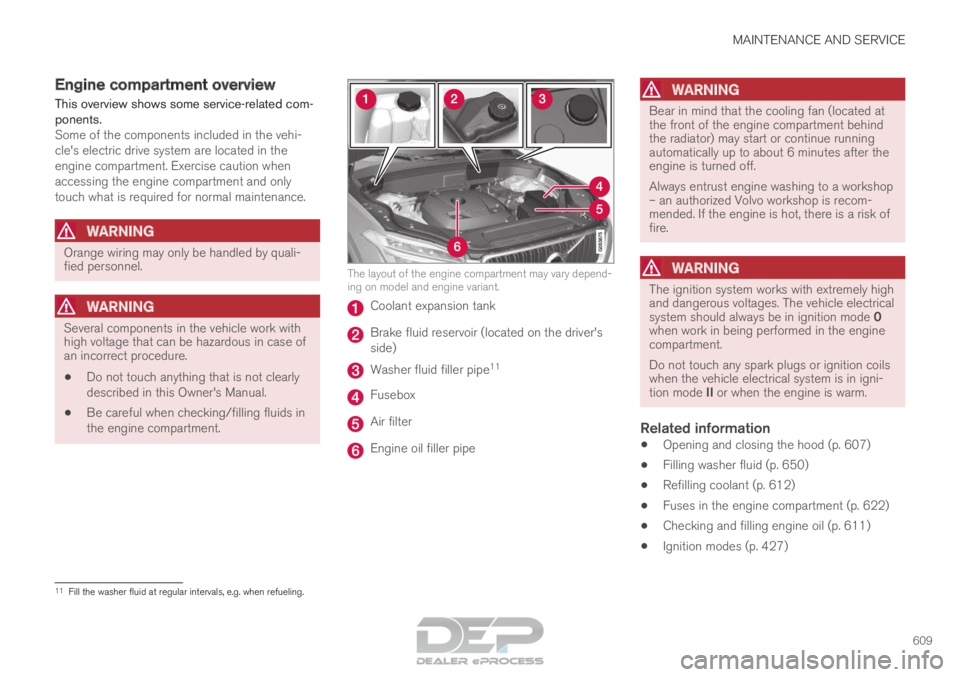
the engine compartment. The layout of the engine compartment may vary depend-
ing on model and engine variant.
Coolant expansion tank
Brake fluid reservoir (located on the driver's
side)
Washer fluid filler pipe
11 Fusebox
Air filter
Engine oil filler pipe
WARNING Bear in mind that the cooling fan (located at
the front of the engine compartment behind
the radiator) may start or continue running
automatically up to about 6 minutes after the
engine is turned off.
Always entrust engine washing to a workshop
– an authorized Volvo workshop is recom-
mended. If the engine is hot, there is a risk of
fire.
WARNING
The ignition system works with extremely high
and dangerous voltages. The vehicle electrical
system should always be in ignition mode 0
when work in being performed in the engine
compartment.
Do not touch any spark plugs or ignition coils
when the vehicle electrical system is in igni-
tion mode II or when the engine is warm.
Related information
•
Opening and closing the hood (p. 607)
• Filling washer fluid (p. 650)
• Refilling coolant (p. 612)
• Fuses in the engine compartment (p. 622)
• Checking and filling engine oil (p. 611)
• Ignition modes (p. 427) 11
Fill the washer fluid at regular intervals, e.g. when refueling.
Page 614 of 686
||MAINTENANCE AND SERVICE
612
NOTE
If the conditions for measuring oil level are
not properly fulfilled (time after engine shut-
down, vehicle inclination, ambient tempera-
ture, etc.) the message
No value available
will be shown in the center display. This does
not mean that anything is wrong in the vehi-
cle systems.
Related information
• Engine oil (p. 610)
• Engine oil specifications (p. 662)
• Ignition modes (p. 427)
• Vehicle status (p. 602) Refilling coolant
Coolant helps keep the combustion engine at
the right operating temperature. The heat trans-
ferred from the engine to the coolant can be
used to warm the passenger compartment.
When refilling coolant, follow the instructions on
the package. Never fill the cooling system with
only water. The risk of freezing is increased with
too low or too high amounts of coolant.
If there is coolant under the vehicle, smoke from
the cooling system, or if more than 2 liters (about
2 quarts) of coolant has been added to the sys-
tem, there could be something wrong with the
cooling system and starting the vehicle could
damage the engine. Call a tow truck and do not
attempt to start the engine.
WARNING The coolant may be very hot. Never unscrew
the cap when the coolant is hot. If coolant
must be filled, unscrew the expansion tank
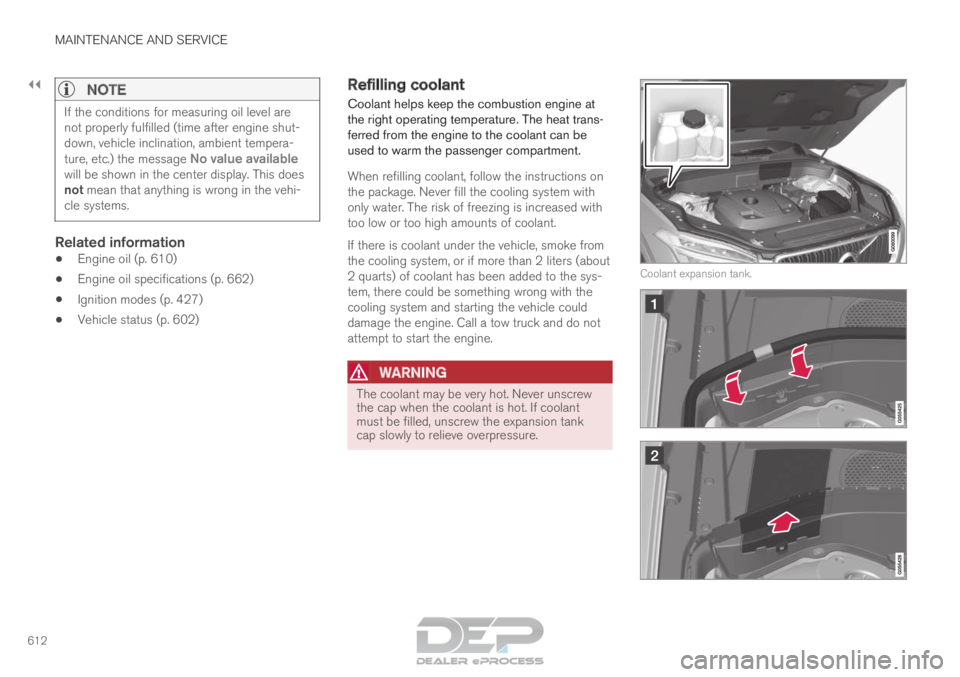
cap slowly to relieve overpressure. Coolant expansion tank.
Page 626 of 686
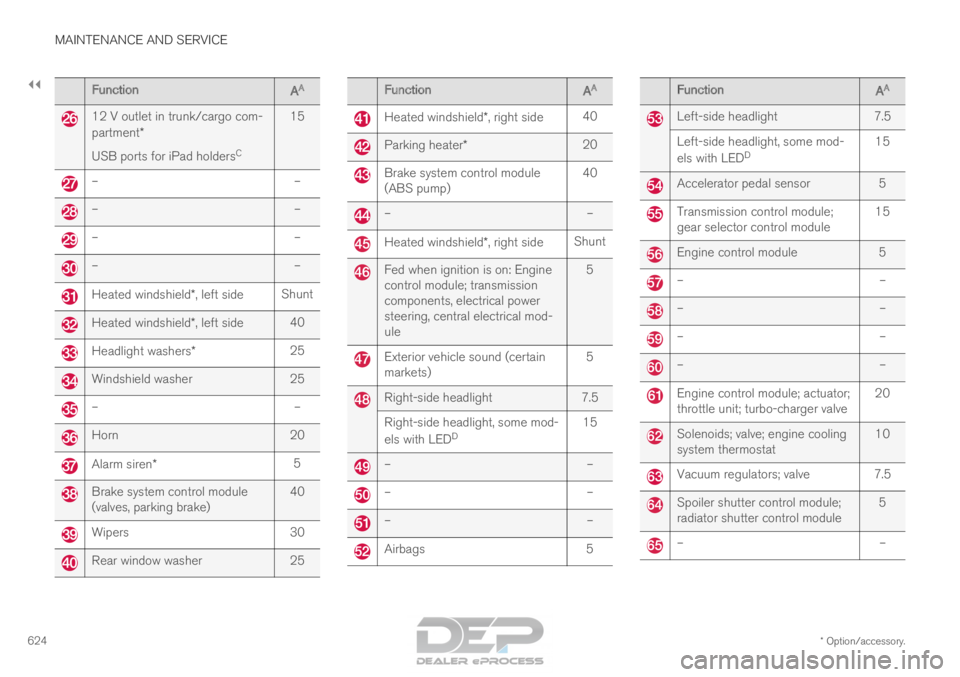
||MAINTENANCE AND SERVICE
* Option/accessory.
624 Function
AA 12 V outlet in trunk/cargo com-
partment*
USB ports for iPad holders
C15 –
––
––
––
–Heated windshield*, left side
ShuntHeated windshield*, left side
40Headlight washers*
25Windshield washer
25–
–Horn
20Alarm siren*
5Brake system control module
(valves, parking brake)
40Wipers
30Rear window washer
25 Function
AA Heated windshield*, right side
40 Parking heater*
20 Brake system control module
(ABS pump)
40 –
– Heated windshield*, right side
Shunt Fed when ignition is on: Engine
control module; transmission
components, electrical power
steering, central electrical mod-
ule
5 Exterior vehicle sound (certain
markets)
5 Right-side headlight
7.5
Right-side headlight, some mod-
els with LED D 15 –
– –
– –
– Airbags
5 Function
AA Left-side headlight
7.5
Left-side headlight, some mod-
els with LED D 15 Accelerator pedal sensor
5 Transmission control module;
gear selector control module
15 Engine control module
5 –
– –
– –
– –
– Engine control module; actuator;
throttle unit; turbo-charger valve
20 Solenoids; valve; engine cooling
system thermostat
10 Vacuum regulators; valve 7.5
Spoiler shutter control module;
radiator shutter control module
5 –
–