climate control VOLVO XC90 TWIN ENGINE 2018 Repair Manual
[x] Cancel search | Manufacturer: VOLVO, Model Year: 2018, Model line: XC90 TWIN ENGINE, Model: VOLVO XC90 TWIN ENGINE 2018Pages: 686, PDF Size: 17 MB
Page 553 of 686

WHEELS AND TIRES
}}
551
imprinted on the sidewall of the tire. The last four
digits in the series is the Department of
Transportation (DOT) stamp and indicates the
week and year the tire was manufactured. The
tire in the illustration has 0717 as the last four
digits, which means it was manufactured week 7
of 2017.
Tire ageTires degrade over time, even when they are not
being used. It is recommended that tires gener-
ally be replaced after 6 years of normal service.
Heat caused by hot climates, frequent high load-
ing conditions or Ultra Violet (U.V.) exposure can
accelerate the aging process. The temporary
spare
2
should also be replaced at 6-year inter-
vals, even if it has never been used. A tire with
e.g., visible cracks or discoloration should be
replaced immediately.
Tire economy
• Maintain correct tire pressure.
• Avoid fast starts, hard braking and tire
screeching.
• Tire wear increases with speed.
• Correct front wheel alignment is very impor-
tant.
• Unbalanced wheels impair tire economy and
driving comfort. •
Tires must maintain the same direction of
rotation throughout their lifetime.
• When replacing tires, the tires with the most
tread should be mounted on the rear wheels
to reduce the chance of oversteer during
hard braking.
• Hitting curbs or potholes can damage the
tires and/or wheels permanently.
Tire rotationYour vehicle has no required tire rotation. Driving
style, tire pressure, climate and road conditions
affect how quickly the tires age and exhibit signs
of wear. Maintaining the correct tire pressure
helps keep tread wear evenly distributed.
To help prevent differences in tread depth and
wear patterns forming on the tires, the front and
rear wheels should be rotated, i.e. the front tires
moved to the rear and the rear tires moved to the
front. Ideally, tire rotation should be done the first
time after approximately 5000 km (ca
3100 miles) and thereafter at 10,000 km
(approx. 6200 miles) intervals.
If you have any questions regarding tread depth,
Volvo recommends consulting an authorized
Volvo workshop. If significant differences in wear
(> 1 mm difference in tread depth) between the
tires have already occurred, the least worn tires
should always be mounted on the rear wheels. A
front-wheel skid (understeer) is usually easier to control than a rear-wheel skid (oversteer). If the
front wheels skid, the vehicle will continue in a
straight line instead of the rear wheels skidding
to the side, which could cause you to completely
lose control of the vehicle. It is therefore impor-
tant that the rear wheels never lose grip before
the front wheels.
Storing wheels and tiresWhen storing complete wheels (tires mounted on
rims), they should be suspended off the floor or
placed on their sides on the floor.
Tires not mounted on rims should be stored on
their sides or standing upright, but should not be
suspended.
CAUTION
Tires should preferably be stored in a cool,
dry, dark place, and should never be stored in
close proximity to solvents, gasoline, oils, etc.
2
Not available on all models.
Page 558 of 686

WHEELS AND TIRES
556Uniform Tire Quality Grading
ALL PASSENGER VEHICLE TIRES MUST
CONFORM TO FEDERAL SAFETY REQUIRE-
MENTS IN ADDITION TO THESE GRADES.
Quality grades can be found, where applica-
ble, on the tire sidewall between the tread
shoulder and maximum section width. For
example:
Treadwear 200 Traction AA Temperature A
TREADWEARThe treadwear grade is a comparative rating
based on the wear rate of the tire when tested
under controlled conditions on a specified gov-
ernment test course. For example, a tire graded
150 would wear one and one half (1 ½) times as
well on the government course as a tire graded
100. The relative performance of tires depends
upon the actual conditions of their use, however,
and many depart significantly from the norm due
to variation in driving habits, maintenance practi-
ces and differences in road characteristics and
climate.
TRACTIONThe traction grades, from highest to lowest, are
AA, A, B, and C, as measured under controlled
conditions on specified government test surfaces
of asphalt and concrete. A tire marked C may
have poor traction performance.
WARNING The traction grade assigned to this tire is
based on braking (straight-ahead) traction
tests and is not a measure of cornering (turn-
ing) traction.
TEMPERATUREThe temperature grades are A (the highest), B,
and C, representing the tire's resistance to the
generation of heat and its ability to dissipate heat
when tested under controlled conditions on a
specified indoor laboratory test wheel. Sustained
high temperature can cause the material of the
tire to degenerate and reduce tire life, and exces-
sive temperature can lead to sudden tire failure.
The grade C corresponds to a minimum level of
performance that all passenger vehicle tires must
meet under the Federal Motor Safety Standard
No. 109. Grades B and A represent higher levels
of performance on the laboratory test wheel than
the minimum required by law.
WARNING
The temperature grade for this tire is estab-
lished for a tire that is properly inflated and
not overloaded. Excessive speed, under-infla-
tion, or excessive loading, either separately or
in combination, can cause heat buildup and
tire failure.
Related information
•
Tires (p. 550)
• Tire sidewall designations (p. 554)
Page 583 of 686

LOADING, STORAGE AND PASSENGER COMPARTMENT
* Option/accessory.581
Related information
•Electrical outlets (p. 582)
• Using the glove compartment (p. 585)
• Sun visors (p. 586)
• Tunnel console (p. 581)
• Connecting a device via the USB port
(p. 514) Tunnel console
The tunnel console is located between the front
seats. Storage compartment with cover*. The cover
can be opened/closed by pressing the han-
dle. Storage compartment with a 12 V outlet and
cup holders for the driver and passenger.
Storage compartment and USB port under
the armrest.
Climate control panel for the rear seats* or
storage compartment.WARNING Store loose objects, such as cell phone, cam-
era, remote control for extra equipment, etc.,
in the glove compartment or another compart-
ment. Otherwise, these could injure people in
the vehicle in the event of hard braking or a
collision.
NOTE
One of the sensors for the alarm* is located
under the cup holder in the center console.
Avoid placing coins, keys and other metal
objects in the cup holder as this could trigger
the alarm.
CAUTION Keep in mind that glossy surfaces can be
easily scratched by e.g. metal objects. Do not
place keys, phones or similar items on sensi-
tive surfaces.
Related information
•
Passenger compartment interior (p. 580)
• Electrical outlets (p. 582)
• Climate system controls (p. 213)
Page 602 of 686

||MAINTENANCE AND SERVICE
600
Monthly:
•
Check cold tire pressure in all tires. Inspect
the tires for wear.
• Check that engine coolant and other fluid
levels are between the indicated "min" and
"max" markings.
• Clean interior glass surfaces with a glass
cleaner and soft paper towels.
• Wipe driver information displays with a soft
cloth.
• Visually inspect battery terminals for corro-
sion. Corrosion may indicate a loose terminal
connector, or a battery near the end of its
useful service life. Consult your Volvo retailer
for additional information.
As needed:
Wash the car, including the undercarriage, to
reduce wear that can be caused by a buildup of
dirt, and corrosion that can be caused by salt res-
idues.
Clean leaves and twigs from air intake vents at
the base of the windshield, and from other places
where they may collect.
NOTE Complete service information for qualified
technicians is available online for purchase or
subscription at www.volvotechinfo.com.
Related information
•
Vehicle status (p. 602)
• Scheduling service and repairs (p. 603)
• Connecting equipment to the vehicle's data
link connector (p. 36)
• Technician certification (p. 37)
• Climate control system service (p. 608)
• Maintenance of the brake system (p. 432)
• Engine compartment overview (p. 609) Data transfer between vehicle and
workshop over Wi-Fi
Volvo workshops have a designated Wi-Fi net-
work for secure data transfer between your vehi-
cle and the workshop. Your visit to the workshop
will be easier and more effective when diagnos-
tics information and software can be transferred
over the workshop's network.
When you arrive at the workshop, your technician
can connect your vehicle to the workshop's Wi-Fi
network to perform troubleshooting and down-
load software. For this type of communication,
the vehicle only connects to the workshop's net-
work. The vehicle can only be connected to the
designated workshop networks, not to any other
network, e.g. your home network.
Manual connection to workshop Wi-FiManual connection is usually performed by a
service technician. Because the technician uses
the buttons on your remote key to connect the
vehicle, it is important that you bring a key with
buttons when taking the vehicle in to a workshop.
Pressing the lock button on the remote key three
times will connect the vehicle to the workshop's
Wi-Fi network.
When the car is connected to a Wi-Fi network,
the symbol appears in the center display.
Page 610 of 686
||MAINTENANCE AND SERVICE
* Option/accessory.
608 Hood completely closed. The illustration is generic -
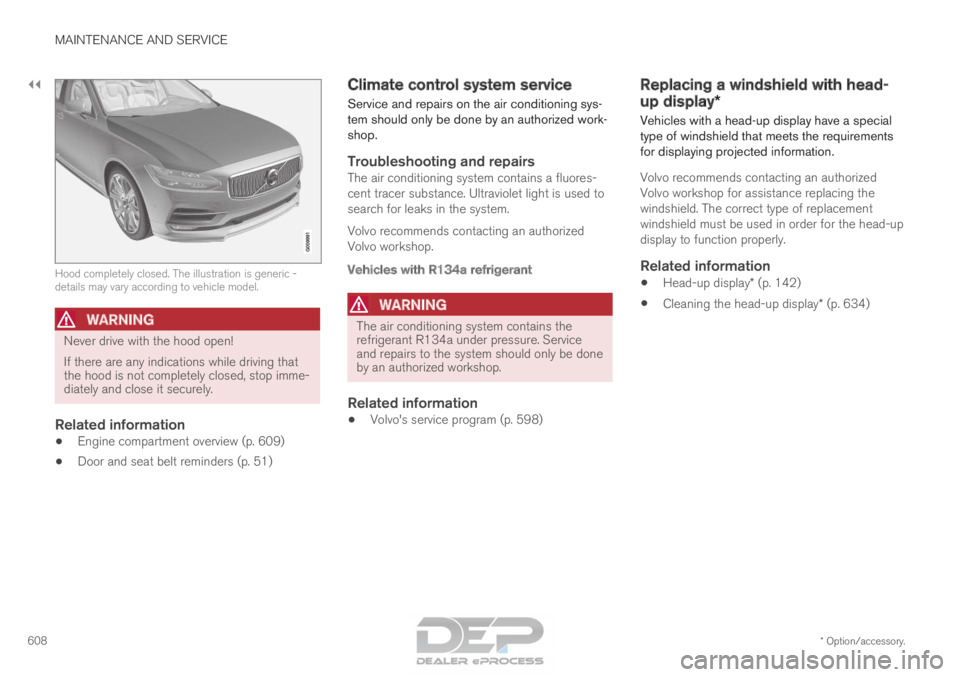
details may vary according to vehicle model.
WARNING
Never drive with the hood open!
If there are any indications while driving that
the hood is not completely closed, stop imme-
diately and close it securely.
Related information
•
Engine compartment overview (p. 609)
• Door and seat belt reminders (p. 51) Climate control system service
Service and repairs on the air conditioning sys-
tem should only be done by an authorized work-
shop.
Troubleshooting and repairsThe air conditioning system contains a fluores-
cent tracer substance. Ultraviolet light is used to
search for leaks in the system.
Volvo recommends contacting an authorized
Volvo workshop.
Vehicles with R134a refrigerant
WARNING
The air conditioning system contains the
refrigerant R134a under pressure. Service
and repairs to the system should only be done
by an authorized workshop.
Related information
•
Volvo's service program (p. 598) Replacing a windshield with head-
up display*
Vehicles with a head-up display have a special
type of windshield that meets the requirements
for displaying projected information.
Volvo recommends contacting an authorized
Volvo workshop for assistance replacing the
windshield. The correct type of replacement
windshield must be used in order for the head-up
display to function properly.
Related information
•
Head-up display* (p. 142)
• Cleaning the head-up display* (p. 634)
Page 618 of 686
||MAINTENANCE AND SERVICE
616
CAUTION
Only a modern battery charger with controlled
charge voltage should be used to charge the
starter battery. The rapid charging function
should not be used as this could damage the
battery.
NOTE
If both the starter battery and the hybrid bat-
tery are discharged, both batteries must be
charged. In such cases, it is not possible to
charge only the hybrid battery first.
The starter battery must have a certain level
of charge for it to be possible to charge the
hybrid battery.
CAUTION Failure to observe the following could cause
the infotainment energy save mode to tempo-
rarily stop working and/or a message in the
driver's display regarding the state of charge
of the starter battery may be temporarily
incorrect after an external starter battery or
battery charger has been connected:
• The negative battery terminal of the vehi-
cle's starter battery must never be used
to connect an external starter battery or
battery charger – only the vehicle's neg-
ative charging point should be used as
a grounding point.NOTE If the starter battery becomes discharged too
many times, it will shorten its service life.
The service life of the starter battery is affec-
ted by several factors, such as driving condi-
tions and climate. The starting capacity of the
battery reduces gradually over time. The bat-
tery must therefore be recharged if the vehi-
cle is not used or a long period of time or if it
is only driven short distances. Severe cold fur-
ther limits the starting capacity.
To keep the starter battery in a good condi-
tion, the vehicle should be driven at least
15 minutes per week or the battery should be
connected to a battery charger with automatic
trickle charging.
A starter battery that is always kept fully
charged has the maximum service life.
Page 629 of 686
MAINTENANCE AND SERVICE
}}
* Option/accessory. 627
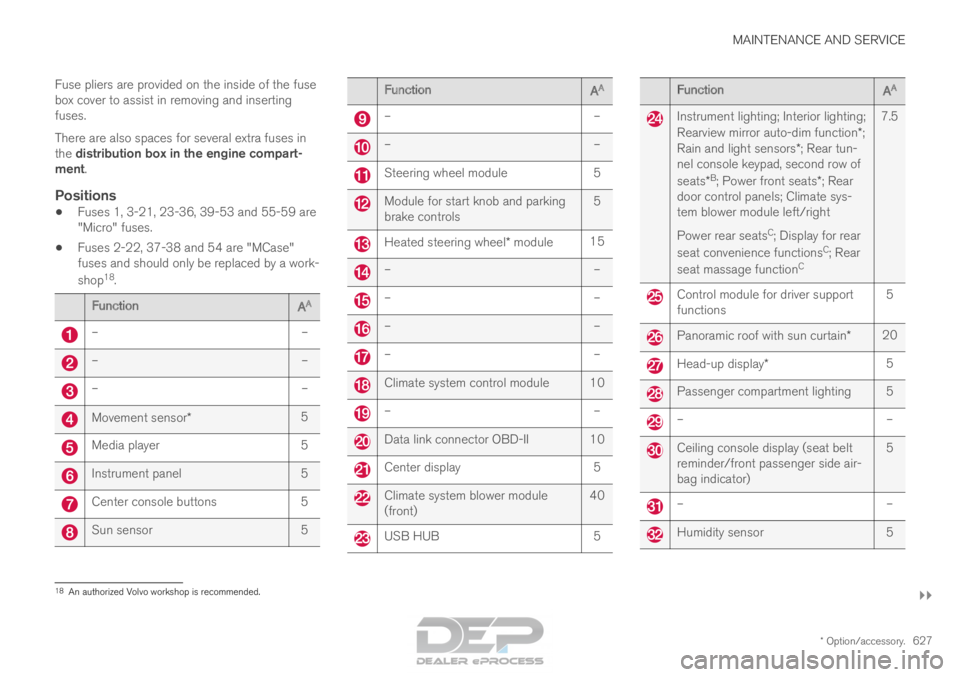
Fuse pliers are provided on the inside of the fuse
box cover to assist in removing and inserting
fuses.
There are also spaces for several extra fuses in
the distribution box in the engine compart-
ment.
Positions
•
Fuses 1, 3-21, 23-36, 39-53 and 55-59 are
"Micro" fuses.
• Fuses 2-22, 37-38 and 54 are "MCase"
fuses and should only be replaced by a work-
shop 18
. Function
AA –
––
––
–Movement sensor*
5Media player
5Instrument panel
5Center console buttons
5Sun sensor
5 Function
AA –
– –
– Steering wheel module
5 Module for start knob and parking
brake controls
5 Heated steering wheel* module
15 –
– –
– –
– –
– Climate system control module 10
–
– Data link connector OBD-II 10
Center display
5 Climate system blower module
(front)
40 USB HUB
5 Function
AA Instrument lighting; Interior lighting;
Rearview mirror auto-dim function*;
Rain and light sensors*; Rear tun-
nel console keypad, second row of
seats* B
; Power front seats*; Rear
door control panels; Climate sys-
tem blower module left/right
Power rear seats C
; Display for rear
seat convenience functions C
; Rear
seat massage function C7.5 Control module for driver support
functions
5 Panoramic roof with sun curtain*
20 Head-up display*
5 Passenger compartment lighting 5
–
– Ceiling console display (seat belt
reminder/front passenger side air-
bag indicator)
5 –
– Humidity sensor
518
An authorized Volvo workshop is recommended.
Page 630 of 686
||MAINTENANCE AND SERVICE
* Option/accessory.
628 Function
AA Door module in right-side rear door 20
Fuses in the trunk/cargo compart-
ment
10Control module for Internet-con-
nected vehicle; Control module for
Volvo On Call
5Door module in left-side rear door 20
Audio control module (amplifier)
(certain models only)
40Climate system blower module
(rear)*
40Multi-band antenna module 5
Front seat massage function*
5–
–Rear window wiper
15Fuel pump control module
15Relay windings for distribution box
in engine compartment; Relay
windings for transmission oil pump
5–
– Function
AA Driver's seat heating
15 Front passenger's seat heating 15
Coolant pump
10 –
– Door module in left-side front door 20
Active chassis control module*
20 –
– Sensus control module
10 –
– –
– Door module in right-side front
door
20 Display for rear seat convenience
functions
C
; On-board diagnostics
(OBD II) in tunnel console between
rear seats C
; Extra movement sen-
sor C 5
C Function
AA TV* (certain markets only)
5 Primary fuse for fuses 53 and 58 15
A
Ampere
B Not Excellence
C Excellence
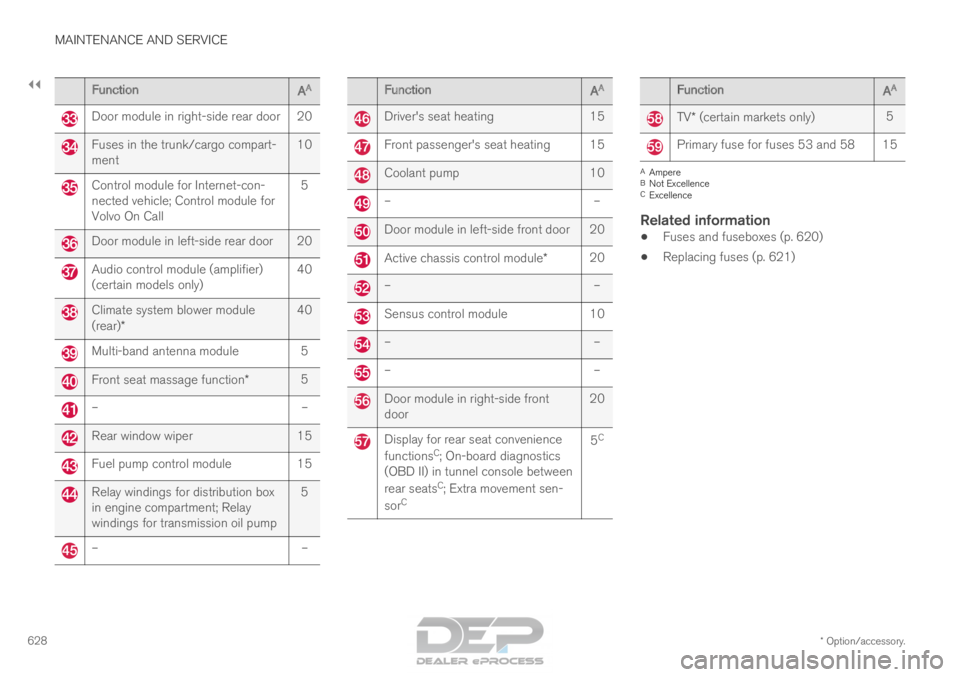
Related information
• Fuses and fuseboxes (p. 620)
• Replacing fuses (p. 621)
Page 666 of 686
SPECIFICATIONS
664Fuel tank volume
The fuel tank's refillable volume is shown in the
table below. All models
Liter (approx.)
50
US gallons (approx.) 13.2
Related information
•Refueling (p. 463)
• Octane rating (p. 465) Air conditioning specifications
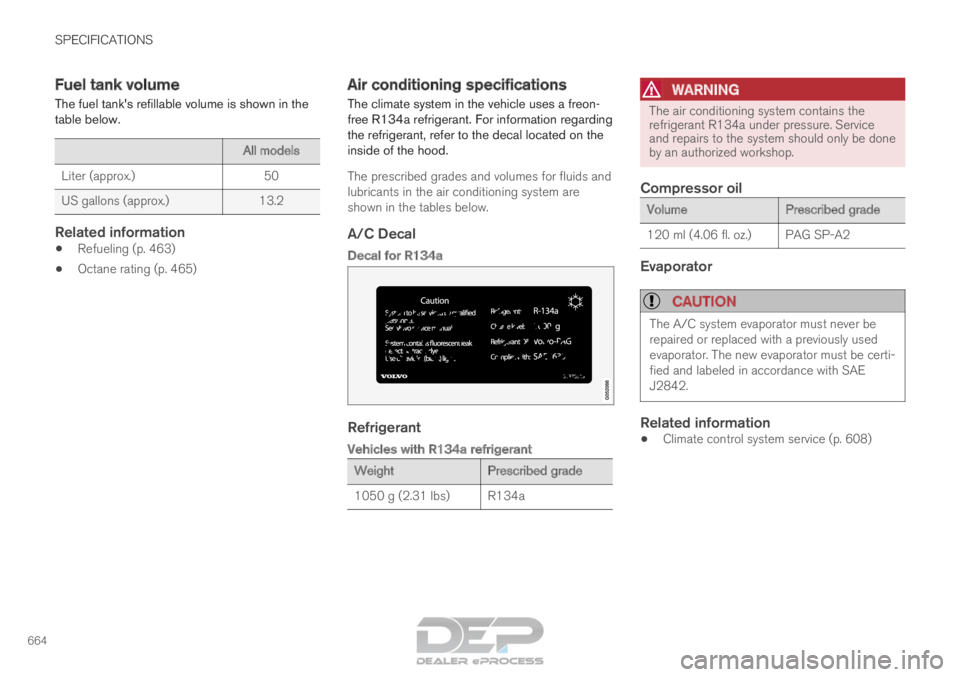
The climate system in the vehicle uses a freon-
free R134a refrigerant. For information regarding
the refrigerant, refer to the decal located on the
inside of the hood.
The prescribed grades and volumes for fluids and
lubricants in the air conditioning system are
shown in the tables below.A/C Decal Decal for R134a
Refrigerant
Vehicles with R134a refrigerant Weight
Prescribed grade
1050 g (2.31 lbs)
R134a
WARNING The air conditioning system contains the
refrigerant R134a under pressure. Service
and repairs to the system should only be done
by an authorized workshop.
Compressor oil
Volume
Prescribed grade
120 ml (4.06 fl. oz.)
PAG SP-A2
Evaporator
CAUTION The A/C system evaporator must never be
repaired or replaced with a previously used
evaporator. The new evaporator must be certi-
fied and labeled in accordance with SAE
J2842.
Related information
•
Climate control system service (p. 608)
Page 669 of 686
INDEX
667
1, 2, 3 ... 4WD
443
A ABS
anti-lock brakes
429
AC (Air conditioning) 228
ACC - Adaptive Cruise Control 295, 298, 299, 300, 301, 302, 304, 305, 306, 307, 309
Accessories and extra equipment 35 installation 36
Accessory installation warning 36
Active Bending Lights 159
Adapting driving characteristics 272, 445
Adaptive Cruise Control 295, 298, 299, 300, 301, 302, 304, 305, 306, 307, 309
change cruise control functionality 307
function 295
manage speed 299, 300
pass 304, 305
radar sensor 326
set time interval 301, 302
troubleshooting 307
Adjusting the steering wheel 199 Airbag
52
activation/deactivation
56
driver's side 53
passenger side 53, 56
Air bag, see Airbag 52
Air conditioning 228
Air conditioning, fluid volume and grade 664
Air distribution 207
air vents 207, 209
changing 208
defrosting 220
recirculation 219
table showing options 210
Air quality 204, 206
allergy and asthma 206
passenger compartment filter 207
Air recirculation 219
Alarm 268
deactivating 269
Allergy and asthma-inducing substances 206
All Wheel Drive, AWD 443
All Wheel Drive (AWD) 443
All Wheel Drive (four-wheel drive) 443
Android Auto 518, 520
Antenna location 257 Apple CarPlay
515, 517
Approach lighting 161
Apps 487
Assistance at risk of collision 372, 373, 374, 375, 376, 377, 378, 380
Audio and media 486
Audio system HD digital radio 497
SiriusXM® Satellite radio 498, 499, 500
Auto-climate 219
Auto hold 436
Auto-hold brakes 436
activate and deactivate 436
after collision 437
Automatic car wash 641
Automatic high beam 157
Automatic locking 261
Automatic relocking 241, 254
Automatic Speed Limiter 282, 284, 285
Automatic transmission 439
kickdown 442
oil 663
Trailer 472
INDEX