wheel VOLVO XC90 TWIN ENGINE 2019 Owners Manual
[x] Cancel search | Manufacturer: VOLVO, Model Year: 2019, Model line: XC90 TWIN ENGINE, Model: VOLVO XC90 TWIN ENGINE 2019Pages: 697, PDF Size: 10.33 MB
Page 403 of 697
DRIVER SUPPORT
}}
401
Sensor field from Park Assist for
Park Assist Camera
If the vehicle is equipped with Park Assist, dis-
tances will be shown in the 360° view with col-
ored fields for each sensor that has detected an
obstacle.
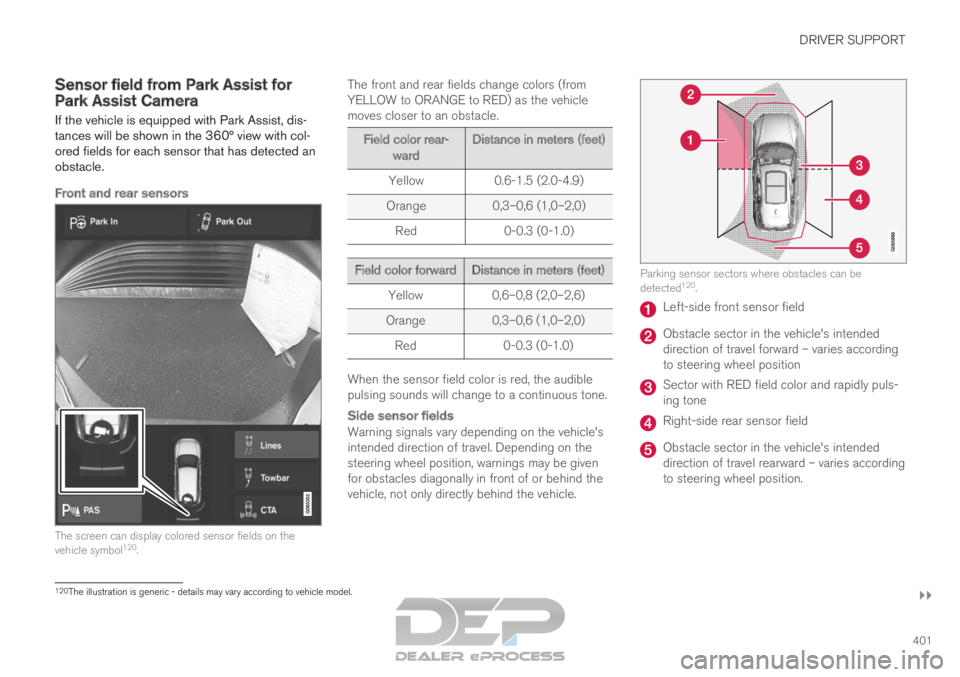
Front and rear sensors The screen can display colored sensor fields on the
vehicle symbol
120
. The front and rear fields change colors (from
YELLOW to ORANGE to RED) as the vehicle
moves closer to an obstacle. Field color rear-
ward Distance in meters (feet)
Yellow
0.6-1.5 (2.0-4.9)
Orange 0,3–0,6 (1,0–2,0)
Red 0-0.3 (0-1.0) Field color forward
Distance in meters (feet)
Yellow
0,6–0,8 (2,0–2,6)
Orange 0,3–0,6 (1,0–2,0)
Red 0-0.3 (0-1.0) When the sensor field color is red, the audible
pulsing sounds will change to a continuous tone.
Side sensor fields
Warning signals vary depending on the vehicle's
intended direction of travel. Depending on the
steering wheel position, warnings may be given
for obstacles diagonally in front of or behind the
vehicle, not only directly behind the vehicle. Parking sensor sectors where obstacles can be
detected
120
. Left-side front sensor field
Obstacle sector in the vehicle's intended
direction of travel forward – varies according
to steering wheel position
Sector with RED field color and rapidly puls-
ing tone
Right-side rear sensor field
Obstacle sector in the vehicle's intended
direction of travel rearward – varies according
to steering wheel position.
120
The illustration is generic - details may vary according to vehicle mode\
l.
Page 407 of 697

DRIVER SUPPORT
* Option/accessory.405
Park Assist Camera symbols and
messages
Symbols and messages for the Park Assist
Camera may be displayed in the instrument
panel and/or the center display.
Some examples of symbols and messages are shown in the table below. Symbol
Message Meaning The rear Park Assist sensors are turned off and no acoustic warnings or field markings for obsta-
cles/objects will be provided.
The camera is not functioning properly.
Park Assist System
Sensors blocked, cleaning
needed One or more of the sensors are blocked. Check and clean/remove the obsta\
cle as soon as possible.
Park Assist System
Unavailable Service required The system is not functioning as intended. Contact a workshop ‒ an authorized Volvo workshop is
recommended. A text message can be erased by briefly pressing
the
button in the center of the right-side
steering wheel keypad. If the message persists: Contact a workshop ‒ an
authorized Volvo workshop is recommended.
Related information
Park Assist Camera* (p. 396)
Page 411 of 697

DRIVER SUPPORT
}}
409
1.
The vehicle's speed may not exceed
30 km/h (20 mph) when parallel parking or
20 km/h (12 mph) when perpendicular park-
ing.
2. Tap Park In in Function view or in Camera
view.
>
PAP will search for a potential parking
space and measure it to determine if it is
big enough.
3. Be prepared to stop the vehicle when a graphic and message in the center display
indicate that a suitable parking space has
been found.
> A pop-up window will appear.
4. Select Parallel parking or Perpendicular
parking and engage reverse gear.
NOTE PAP searches for space for parking, shows
instructions and guides the vehicle on its pas-
senger side. But, if so desired the vehicle can
be parked on the driver's side of the street:
Activate the turn signals on the driver's
side – the system will then search for
space to park on that side of the vehicle
instead.
Backing into a parking space Parallel.
Perpendicular.
To back into a parking space:
1.
Make sure the path behind your vehicle is
clear and engage reverse gear. 2. Back up slowly and carefully without touch-
ing the steering wheel and do not exceed a
speed of 7 km/h (4 mph).
3. Be prepared to stop the vehicle when instructed to do so by a graphic and mes-
sage in the center display.
NOTE
Keep your hands away from the steering
wheel when the PAP function is acti-
vated.
Make sure that the steering wheel is not
hindered in any way and can rotate freely.
To achieve the best results – wait until
the steering wheel is finished turning
before beginning to drive forward/in
reverse.
Page 412 of 697
||DRIVER SUPPORT
* Option/accessory.
410
Positioning the vehicle in the parking space Parallel.
Perpendicular.
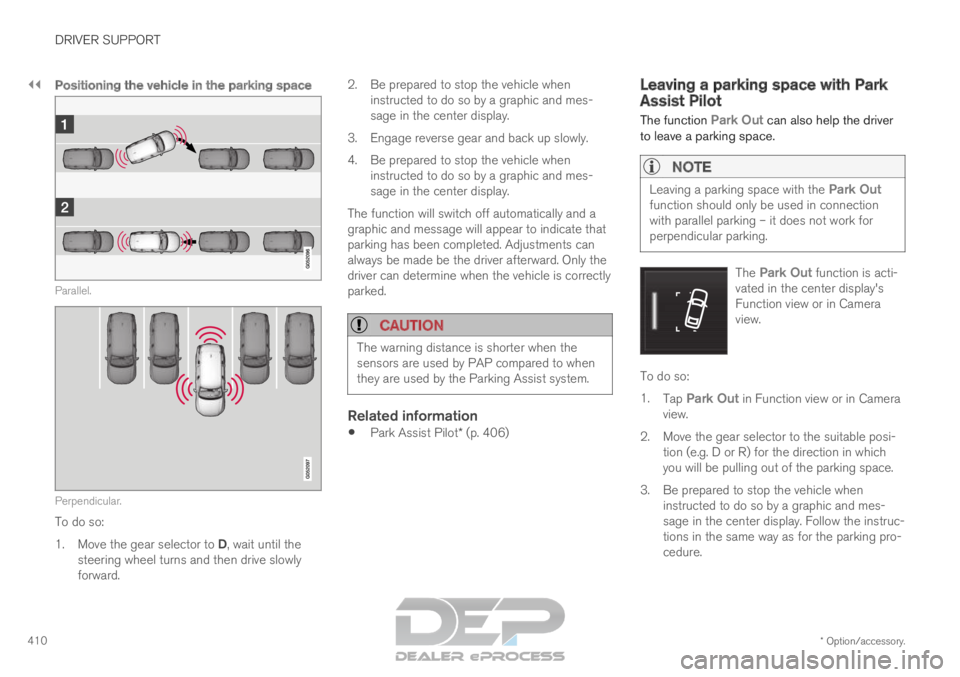
To do so:
1. Move the gear selector to D, wait until the
steering wheel turns and then drive slowly
forward. 2.
Be prepared to stop the vehicle when
instructed to do so by a graphic and mes-
sage in the center display.
3. Engage reverse gear and back up slowly.
4. Be prepared to stop the vehicle when instructed to do so by a graphic and mes-
sage in the center display.
The function will switch off automatically and a
graphic and message will appear to indicate that
parking has been completed. Adjustments can
always be made be the driver afterward. Only the
driver can determine when the vehicle is correctly
parked.
CAUTION The warning distance is shorter when the
sensors are used by PAP compared to when
they are used by the Parking Assist system.
Related information
Park Assist Pilot* (p. 406) Leaving a parking space with Park
Assist Pilot
The function Park Out can also help the driver
to leave a parking space.
NOTE Leaving a parking space with the Park Out
function should only be used in connection
with parallel parking – it does not work for
perpendicular parking.
The Park Out function is acti-
vated in the center display's
Function view or in Camera
view. To do so:
1.
Tap Park Out in Function view or in Camera
view.
2.
Move the gear selector to the suitable posi-
tion (e.g. D or R) for the direction in which
you will be pulling out of the parking space.
3. Be prepared to stop the vehicle when instructed to do so by a graphic and mes-
sage in the center display. Follow the instruc-
tions in the same way as for the parking pro-
cedure.
Page 413 of 697

DRIVER SUPPORT
}}
* Option/accessory. 411
Note that the steering wheel can "spring" back
when the procedure is completed and the driver
may need to turn the steering wheel back to the
maximum position in order to pull out of the park-
ing space.
If PAP determines that the driver can pull out of
the parking space without any extra maneuvers,
the function will be deactivated, even if it seems
as though the vehicle is not completely out of the
parking space.
Related information
Park Assist Pilot* (p. 406) Park Assist Pilot* limitations
Park Assist Pilot PAP 125
may not be able to
detect all conditions in all situations and func-
tionality may therefore be limited.
WARNING
The PAP function is supplementary driver
support intended to facilitate driving and
help make it safer – it cannot handle all
situations in all traffic, weather and road
conditions.
Pay particular attention to people and
animals near the vehicle.
Bear in mind that the front end of the
vehicle may swing out towards oncoming
traffic during the parking maneuver.
Objects situated higher than the detec-
tion area of the sensors are not included
when the parking maneuver is calculated,
which could cause PAP to swing into the
parking space too early. Such parking
spaces should be avoided for this reason.
PAP is not a substitute for the driver's
attention and judgment. The driver is
always responsible for ensuring the vehi-
cle is driven in a safe manner, at the
appropriate speed, with an appropriate
distance to other vehicles, and in accord-
ance with current traffic rules and regula-
tions.
The driver should be aware of the following limi-
tations for Park Assist Pilot: 125
Park Assist Pilot
Page 414 of 697

||DRIVER SUPPORT
412
The parking sequence is cancelledA parking sequence will be cancelled if:
the driver moves the steering wheel
the vehicle's speed exceeds 7 km/h (4 mph)
the driver taps
Cancel in the center display
when the anti-lock brakes or the Electronic
stability control are engaged - e.g. when a
wheel loses grip on a slippery road
when the power steering works at reduced
power - e.g. during cooling due to overheat-
ing (see section "Speed-dependent steering
force").
A message in the center display will explain why
the parking sequence was cancelled.
CAUTION Under certain circumstances, PAP may not be
able to find parking spaces – one reason may
be that the sensors are disrupted by external
sound sources that emit the same ultrasonic
frequencies that the system works with.
Examples of such sources include horns, wet
tires on asphalt, pneumatic brakes, exhaust
noise from motorcycles, etc.
NOTE Dirt, ice and snow covering the sensors
reduce their function and can make measure-
ment impossible.
Driver responsibilityThe driver should keep in mind that PAP is a
parking aid ‒ not an infallible fully automatic sys-
tem. The driver must always be prepared to take
control and cancel a parking sequence if neces-
sary.
There are a number of things to keep in mind
when parking, including:
The driver is always responsible for determin-
ing if the space suggested by PAP is suita-
ble for parking.
Do not use PAP when using snow chains or
a temporary spare tire.
Do not use PAP if there are any objects pro-
truding from the vehicle.
Heavy rain or snowfall may inhibit PAP's abil-
ity to accurately measure a parking space.
While searching and measuring the parking
space, PAP may be unable to detect objects
located far into the space.
PAP may not suggest parking spaces on
narrow streets if it does not detect sufficient
space for maneuvering the vehicle.
Use approved tires 126
inflated to the correct
tire pressure because this affects PAP's abil-
ity to provide parking assistance.
PAP's function is based on the way the vehi-
cles are parked behind and in front of your
parking space. If they are, for example,
parked too close to the curb, there is a risk
that your vehicle's tires or wheel rims could
be damaged by the curb during the parking
procedure.
Perpendicular parking spaces may not be
detected or may be suggested unnecessarily
if a parked vehicle is sticking out more than
other parked vehicles.
PAP is intended to provide parking assis-
tance on straight streets, not sections of
street with sharp curves or bends. Always
make sure that your vehicle is parallel to rel-
evant parking spaces when PAP is measur-
ing the parking space.
CAUTION Switching to another approved wheel and/or
tire dimension could change the tire circum-
ference, which would then require the PAP
system to be updated. Consult a workshop –
an authorized Volvo workshop is recom-
mended.
126
"Approved tires" refers to tires of the same type and make as the vehicl\
e's original, factory-installed tires.
Page 415 of 697
DRIVER SUPPORT
* Option/accessory.413
Related information
Park Assist Pilot* (p. 406)
Parking with Park Assist Pilot (p. 408)
Speed-dependent steering wheel resistance
(p. 278) Recommended maintenance for
Park Assist Pilot
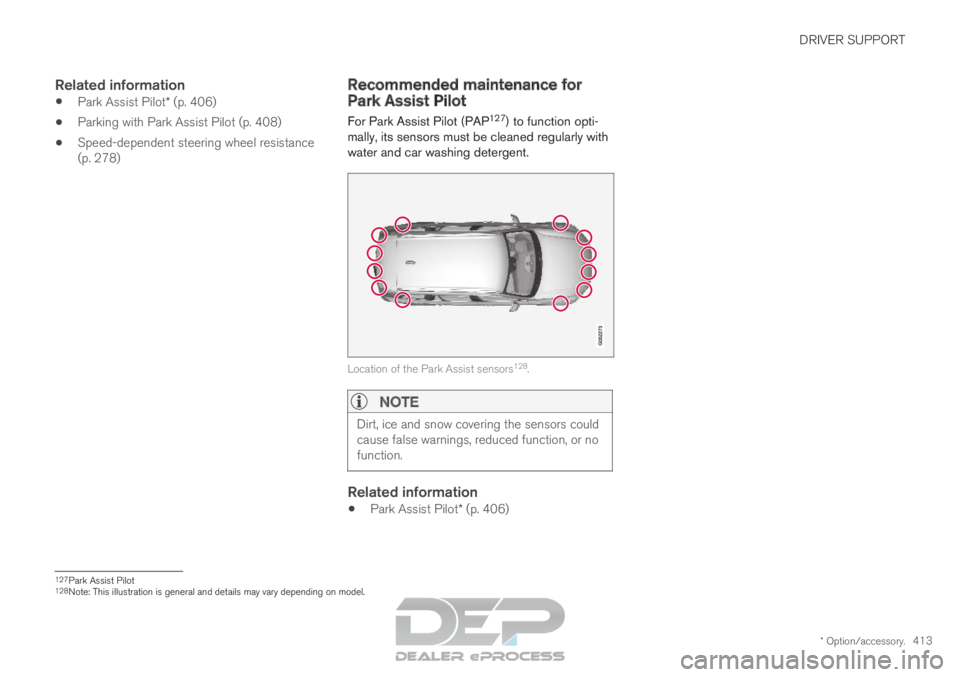
For Park Assist Pilot (PAP
127
) to function opti-
mally, its sensors must be cleaned regularly with
water and car washing detergent. Location of the Park Assist sensors
128
.
NOTE Dirt, ice and snow covering the sensors could
cause false warnings, reduced function, or no
function.
Related information
Park Assist Pilot* (p. 406) 127
Park Assist Pilot
128 Note: This illustration is general and details may vary depending on mod\
el.
Page 416 of 697

DRIVER SUPPORT
* Option/accessory.
414 Park Assist Pilot* messages
Messages for Park Assist Pilot PAP 129
may be
displayed in the instrument panel and/or the
center display. Some examples of symbols and messages are shown in the table below. Message
Meaning
Park Assist System
Sensors blocked, cleaning needed One or more of the sensors are blocked. Check and clean/remove the obsta\
cle as soon as possible.
Park Assist System
Unavailable Service required The system is not functioning as intended. Contact a workshop ‒ an authorized Volvo workshop is recommended.A text message can be erased by briefly pressing
the
button in the center of the right-side
steering wheel keypad.
If the message persists: Contact a workshop ‒ an
authorized Volvo workshop is recommended.
Related information
Park Assist Pilot* (p. 406) 129
Park Assist Pilot
Page 436 of 697
STARTING AND DRIVING
* Option/accessory.
434 Starting the vehicle
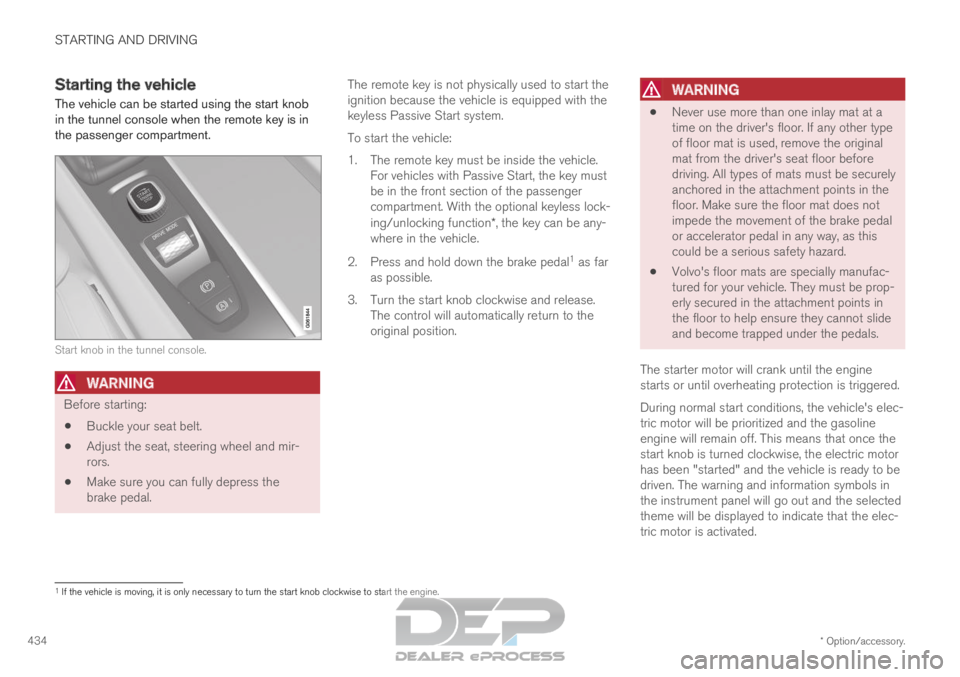
The vehicle can be started using the start knob
in the tunnel console when the remote key is in
the passenger compartment. Start knob in the tunnel console.
WARNING
Before starting:
Buckle your seat belt.
Adjust the seat, steering wheel and mir-
rors.
Make sure you can fully depress the
brake pedal. The remote key is not physically used to start the
ignition because the vehicle is equipped with the
keyless Passive Start system.
To start the vehicle:
1.
The remote key must be inside the vehicle.
For vehicles with Passive Start, the key must
be in the front section of the passenger
compartment. With the optional keyless lock-
ing/unlocking function*, the key can be any-
where in the vehicle.
2. Press and hold down the brake pedal 1
as far
as possible.
3. Turn the start knob clockwise and release. The control will automatically return to the
original position.
WARNING
Never use more than one inlay mat at a
time on the driver's floor. If any other type
of floor mat is used, remove the original
mat from the driver's seat floor before
driving. All types of mats must be securely
anchored in the attachment points in the
floor. Make sure the floor mat does not
impede the movement of the brake pedal
or accelerator pedal in any way, as this
could be a serious safety hazard.
Volvo's floor mats are specially manufac-
tured for your vehicle. They must be prop-
erly secured in the attachment points in
the floor to help ensure they cannot slide
and become trapped under the pedals.
The starter motor will crank until the engine
starts or until overheating protection is triggered.
During normal start conditions, the vehicle's elec-
tric motor will be prioritized and the gasoline
engine will remain off. This means that once the
start knob is turned clockwise, the electric motor
has been "started" and the vehicle is ready to be
driven. The warning and information symbols in
the instrument panel will go out and the selected
theme will be displayed to indicate that the elec-
tric motor is activated. 1
If the vehicle is moving, it is only necessary to turn the start knob cl\
ockwise to start the engine.
Page 438 of 697
||STARTING AND DRIVING
436
CAUTION
When starting in cold weather, the auto-
matic transmission may shift up at slightly
higher engine speeds than normal until
the automatic transmission fluid reaches
normal operating temperature.
Do not race a cold engine immediately
after starting. This could prevent fluids
from properly lubricating vital compo-
nents in the engine before it has reached
the proper operating temperature.
The engine should be idling when the
gear selector is moved. Never accelerate
until the gear is fully engaged. Accelerat-
ing rapidly before a gear is properly
engaged could lead to harder wear of
components.
To help prevent the transmission oil from
overheating, select P or N when idling at
a standstill for prolonged periods of time.
Related information
Switching off the vehicle (p. 436)
Ignition modes (p. 437)
Adjusting the steering wheel (p. 201)
Jump starting using another battery (p. 481)
Selecting ignition mode (p. 438) Switching off the vehicle
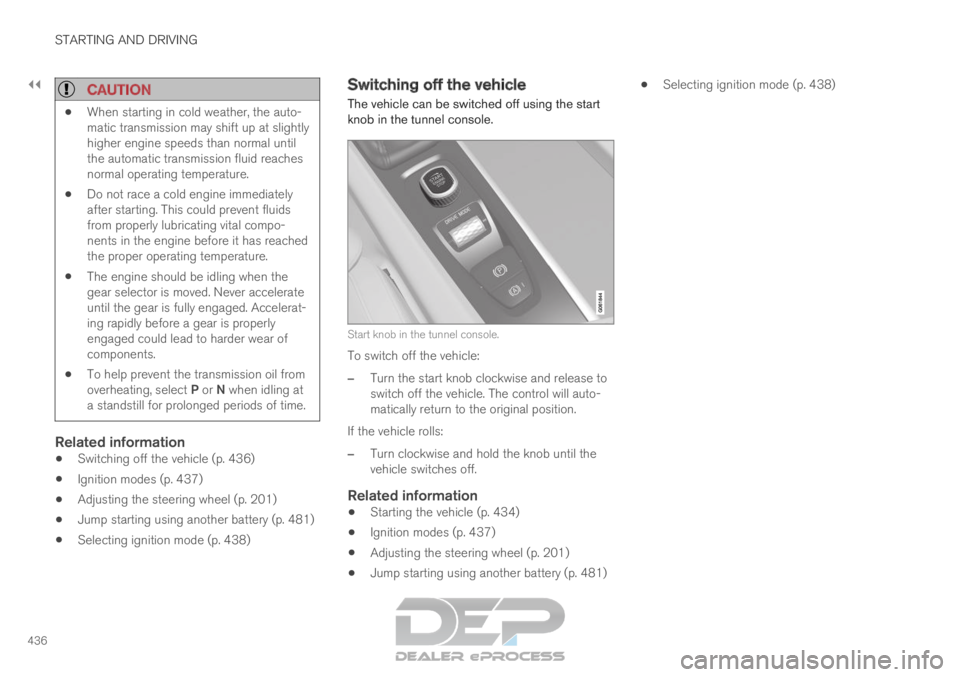
The vehicle can be switched off using the start
knob in the tunnel console.
Start knob in the tunnel console.
To switch off the vehicle:
– Turn the start knob clockwise and release to
switch off the vehicle. The control will auto-
matically return to the original position.
If the vehicle rolls:
– Turn clockwise and hold the knob until the
vehicle switches off.
Related information
Starting the vehicle (p. 434)
Ignition modes (p. 437)
Adjusting the steering wheel (p. 201)
Jump starting using another battery (p. 481)
Selecting ignition mode (p. 438)