light VOLVO XC90 TWIN ENGINE 2019 Owners Manual
[x] Cancel search | Manufacturer: VOLVO, Model Year: 2019, Model line: XC90 TWIN ENGINE, Model: VOLVO XC90 TWIN ENGINE 2019Pages: 697, PDF Size: 10.33 MB
Page 440 of 697
STARTING AND DRIVING
438Selecting ignition mode
The vehicle's ignition can be put in various
modes (levels) to make different functions availa-
ble.
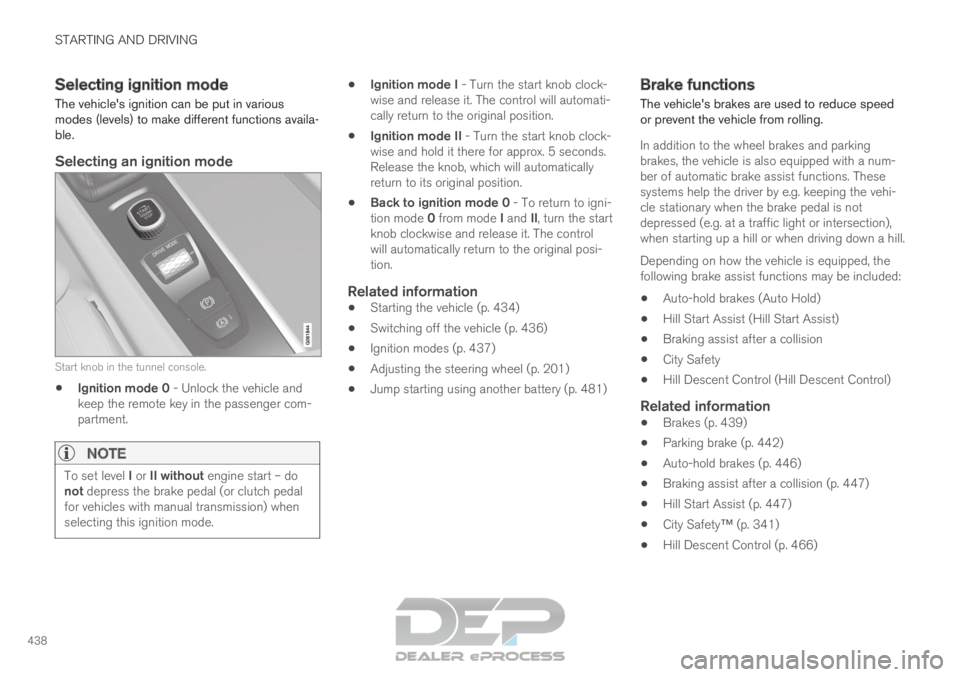
Selecting an ignition mode Start knob in the tunnel console.
Ignition mode 0 - Unlock the vehicle and
keep the remote key in the passenger com-
partment.
NOTE To set level I or II without engine start – do
not depress the brake pedal (or clutch pedal
for vehicles with manual transmission) when
selecting this ignition mode.
Ignition mode I - Turn the start knob clock-
wise and release it. The control will automati-
cally return to the original position.
Ignition mode II - Turn the start knob clock-
wise and hold it there for approx. 5 seconds.
Release the knob, which will automatically
return to its original position.
Back to ignition mode 0 - To return to igni-
tion mode 0 from mode I and II, turn the start
knob clockwise and release it. The control
will automatically return to the original posi-
tion.
Related information
Starting the vehicle (p. 434)
Switching off the vehicle (p. 436)
Ignition modes (p. 437)
Adjusting the steering wheel (p. 201)
Jump starting using another battery (p. 481) Brake functions
The vehicle's brakes are used to reduce speed
or prevent the vehicle from rolling.
In addition to the wheel brakes and parking
brakes, the vehicle is also equipped with a num-
ber of automatic brake assist functions. These
systems help the driver by e.g. keeping the vehi-
cle stationary when the brake pedal is not
depressed (e.g. at a traffic light or intersection),
when starting up a hill or when driving down a hill.
Depending on how the vehicle is equipped, the
following brake assist functions may be included:
Auto-hold brakes (Auto Hold)
Hill Start Assist (Hill Start Assist)
Braking assist after a collision
City Safety
Hill Descent Control (Hill Descent Control)
Related information
Brakes (p. 439)
Parking brake (p. 442)
Auto-hold brakes (p. 446)
Braking assist after a collision (p. 447)
Hill Start Assist (p. 447)
City Safety™ (p. 341)
Hill Descent Control (p. 466)
Page 441 of 697
STARTING AND DRIVING
}}
439
Brakes
The brake pedal is used to apply the vehicle's
regular brakes, which are part of the brake sys-
tem.
The vehicle is equipped with two brake circuits. If
one brake circuit is damaged, the brake pedal will
go down further when depressed. More pressure
will then be required from the driver for normal
braking effect.
WARNING
The power brakes only work when the electric
motor or combustion engine is running.
If the brake pedal is used when the engine is
switched off, greater pressure must be applied to
brake the vehicle.
In very hilly areas or when driving with a heavy
load, gear position B can be used to augment the
brakes with engine braking.
Use the Off Road drive mode to increase the
engine braking effect when driving on steep
downgrades at low speeds.
Anti-lock brakesThe vehicle is equipped with an Anti-lock Braking
System (ABS), which helps prevent the wheels
from locking and helps maintain steering control
when braking. Vibrations may be felt from the brake pedal when ABS is operating, which is nor-
mal.
After the vehicle is started, a brief test of the
ABS system is automatically performed when the
driver releases the brake pedal. An additional
automatic test of the system may be performed
when the vehicle is traveling at a low speed. Dur-
ing the test, the brake pedal may feel as though it
is pulsating.
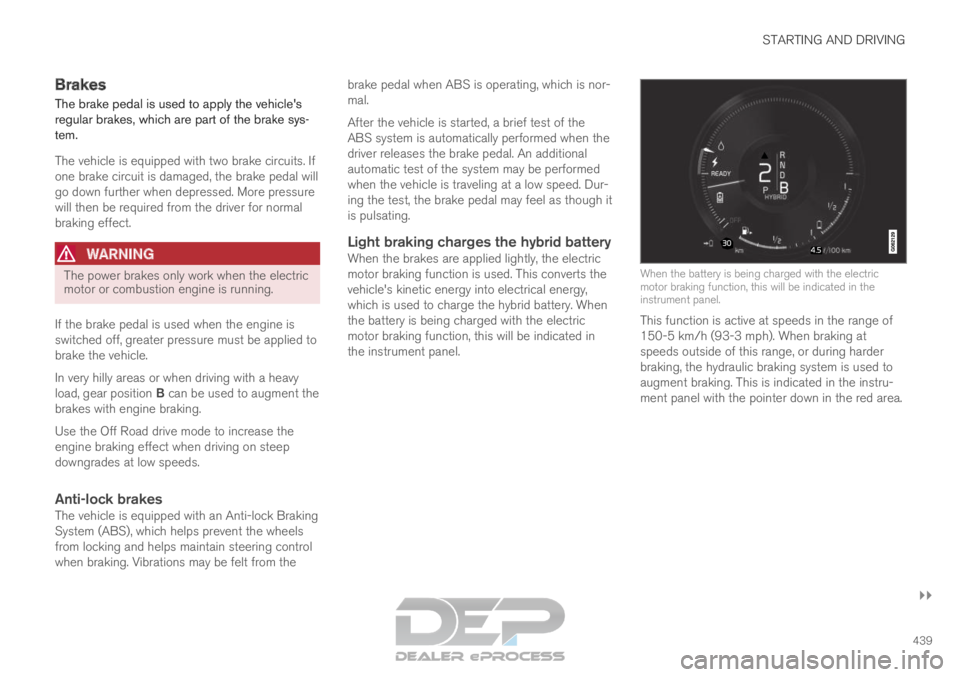
Light braking charges the hybrid batteryWhen the brakes are applied lightly, the electric
motor braking function is used. This converts the
vehicle's kinetic energy into electrical energy,
which is used to charge the hybrid battery. When
the battery is being charged with the electric
motor braking function, this will be indicated in
the instrument panel.
When the battery is being charged with the electric
motor braking function, this will be indicated in the
instrument panel.
This function is active at speeds in the range of
150-5 km/h (93-3 mph). When braking at
speeds outside of this range, or during harder
braking, the hydraulic braking system is used to
augment braking. This is indicated in the instru-
ment panel with the pointer down in the red area.
Page 442 of 697
||STARTING AND DRIVING
440
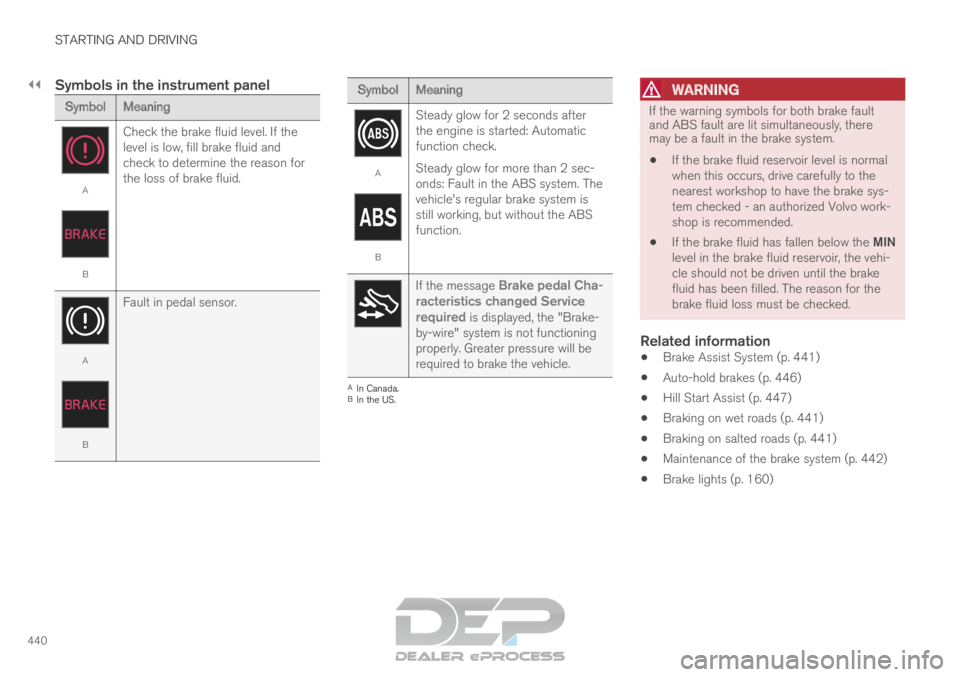
Symbols in the instrument panel
Symbol
Meaning A
B
Check the brake fluid level. If the
level is low, fill brake fluid and
check to determine the reason for
the loss of brake fluid. A
B
Fault in pedal sensor. Symbol
Meaning A
B
Steady glow for 2 seconds after
the engine is started: Automatic
function check.
Steady glow for more than 2 sec-
onds: Fault in the ABS system. The
vehicle's regular brake system is
still working, but without the ABS
function. If the message Brake pedal Cha-
racteristics changed Service
required is displayed, the "Brake-
by-wire" system is not functioning
properly. Greater pressure will be
required to brake the vehicle. A
In Canada.
B In the US.WARNING If the warning symbols for both brake fault
and ABS fault are lit simultaneously, there
may be a fault in the brake system.
If the brake fluid reservoir level is normal
when this occurs, drive carefully to the
nearest workshop to have the brake sys-
tem checked - an authorized Volvo work-
shop is recommended.
If the brake fluid has fallen below the MIN
level in the brake fluid reservoir, the vehi-
cle should not be driven until the brake
fluid has been filled. The reason for the
brake fluid loss must be checked.
Related information
Brake Assist System (p. 441)
Auto-hold brakes (p. 446)
Hill Start Assist (p. 447)
Braking on wet roads (p. 441)
Braking on salted roads (p. 441)
Maintenance of the brake system (p. 442)
Brake lights (p. 160)
Page 443 of 697
STARTING AND DRIVING
441
Brake Assist System
The brake enhancing system, Brake Assist
System (BAS
), helps increase braking force and
thereby reduce braking distance.
The system monitors the driver's braking habits
and increases braking force when necessary.
Braking force can be increased up to the point at
which the ABS intervenes. The function is deacti-
vated when pressure on the brake pedal is
decreased.
Related information
Brakes (p. 439) Braking on wet roads
Prolonged driving in heavy rain without braking
may cause braking effect to be slightly delayed
the first time the brakes are applied.
This may also occur after washing the vehicle. It
will then be necessary to apply greater pressure
to the brake pedal. You should therefore maintain
a greater distance to the vehicle ahead.
Firmly apply the brakes after washing the vehicle
or driving on wet roads. This helps warm up the
brake discs, enabling them to dry more quickly
and protecting them against corrosion. Consider
the current traffic situation when braking.
Related information
Brakes (p. 439)
Braking on salted roads (p. 441) Braking on salted roads
When driving on salted roads, a layer of salt may
form on the brake discs and brake pads.
This could increase stopping distance. Maintain
an extra large safety distance to the vehicle
ahead. Make sure to also:
Apply the brakes from time to time to help
remove salt. Make sure braking does not
pose a risk to any other road users.
Gently apply the brakes when you have fin-
ished driving and before driving again.
Related information
Brakes (p. 439)
Braking on wet roads (p. 441)
Page 448 of 697
STARTING AND DRIVING
446Auto-hold brakes
With the Auto-hold brake function, the driver can
release the brake pedal and the brakes will
remain applied, for example, when the vehicle
has stopped at a traffic light or intersection.
When the vehicle stops, the brakes are activated
automatically. The function can use either the
normal brakes or the parking brakes to keep the
vehicle stationary and works on flat surfaces or
hills. When driving off, the brakes will be automat-
ically released if the driver's seat belt is buckled.
NOTE When braking to a stop on an uphill or down-
hill gradient, depress the brake pedal with
slightly more force than usual before releas-
ing to ensure that the vehicle cannot move at
all.
The parking brake is activated if:
the vehicle is switched off
the driver's door is opened
the driver's seat belt is removed
the vehicle has been stationary for a pro-
longed period of time (5-10 minutes)
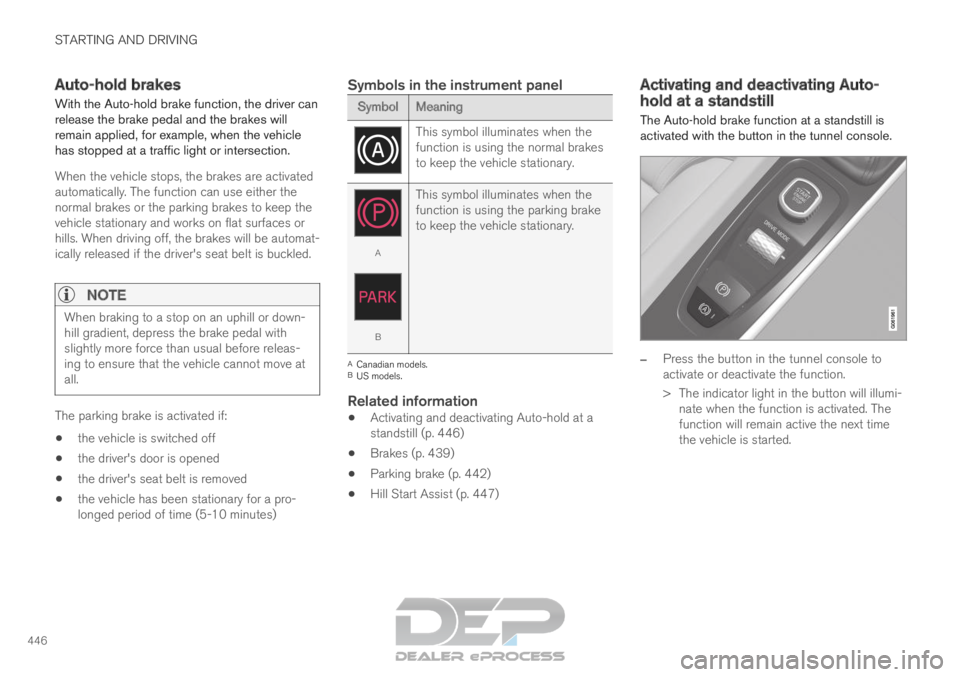
Symbols in the instrument panel Symbol
Meaning This symbol illuminates when the
function is using the normal brakes
to keep the vehicle stationary.
A
B
This symbol illuminates when the
function is using the parking brake
to keep the vehicle stationary. A
Canadian models.
B US models.
Related information
Activating and deactivating Auto-hold at a
standstill (p. 446)
Brakes (p. 439)
Parking brake (p. 442)
Hill Start Assist (p. 447) Activating and deactivating Auto-
hold at a standstill
The Auto-hold brake function at a standstill is
activated with the button in the tunnel console.
–
Press the button in the tunnel console to
activate or deactivate the function.
>
The indicator light in the button will illumi-
nate when the function is activated. The
function will remain active the next time
the vehicle is started.
Page 449 of 697
STARTING AND DRIVING
}}
447
When shutting off
If the function is active and holding the
vehicle stationary using the normal
brakes (A symbol lit), the brake pedal
must be depressed while pressing the
button in order to deactivate Auto-hold.
The function will remain off until it is reactiva-
ted.
When Auto-hold is switched off, Hill Start
Assist (HSA) will remain active to help pre-
vent the vehicle from rolling backward when
starting up a hill.
Related information
Auto-hold brakes (p. 446) Hill Start Assist
The function for assisting when starting the vehi-
cle on inclines, Hill Start Assist (HSA), helps
prevent the vehicle from rolling backward when
starting on an uphill gradient. When backing up
a hill, HSA helps prevent the vehicle from rolling
forward.
The function retains pressure from the brake
pedal in the brake system for several seconds
after the brake pedal has been released.
This temporary braking effect is released after a
few seconds or when the driver begins driving.
Hill Start Assist is available even if the Auto-hold
brake function is switched off.
Related information
Auto-hold brakes (p. 446)
Brakes (p. 439) Braking assist after a collision
In a collision in which the activation level is
reached for the pyrotechnic seat belt tensioners
or airbags, or if a collision with a large animal is
detected, the vehicle's brakes will be automati-
cally activated. This function is intended to help
prevent or reduce the effects of any subsequent
collision.
After a serious collision, it may no longer be pos-
sible to control and steer the vehicle. In order to
avoid or mitigate a possible further collision with
a vehicle or an object in the vehicle's path, the
brake assist system is activated automatically to
help stop the vehicle safely.
The brake lights and hazard warning flashers are
activated during braking. When the vehicle has
stopped, the hazard warning flashers will con-
tinue to flash and the parking brake will be
applied.
If braking is not appropriate, e.g. if there is a risk
of being hit by passing traffic, the driver can over-
ride the system by depressing the accelerator
pedal.
This function assumes that the brake system is
intact after a collision.
Brake assist is part of the Rear Collision Warning
and Blind Spot Information safety systems.
Page 457 of 697
STARTING AND DRIVING
}}
455
Available drive modes
WARNING Keep in mind that the vehicle does not emit
any engine noise when using the electric
motor and may therefore be difficult to detect
for children, pedestrians, cyclists or animals.
This is particularly true at low speeds, e.g. in
parking lots.
WARNING
Do not leave the vehicle in an unventilated
area with a drive mode activated and the com-
bustion engine switched off. The engine will
start automatically if the charge level in the
hybrid battery is low and the resulting exhaust
gases can be very harmful to people and ani-
mals.
HYBRID
This is the default mode in which the electric
motor and combustion engine work together.
The vehicle starts in Hybrid mode. The control
system uses both the electric motor and the gas-
oline engine - separately or in tandem - and cal-
culates optimal utilization with regard to perform-
ance, fuel consumption and comfort. At high
speeds, ground clearance is automatically low-
ered 3
to reduce air resistance. Driving capacity on
the electric motor alone is determined by factors such as the hybrid battery's charge level, the
need for heat/cooling in the passenger compart-
ment, etc.
If there is sufficient charge in the battery, it is
possible to drive solely on electric power. When
the accelerator pedal is pressed, only the electric
motor will be activated until the battery reaches a
certain charge level. Above this level, the current
in the battery cannot supply the power requested
by the accelerator pedal and the combustion
engine will start.
When the hybrid battery's charge level is low, the
combustion engine will start more frequently to
save the remaining current in the battery. Charge
the hybrid battery from a 120-240 volt outlet
using a charging cable, or activate
Charge in
Function view to reset the option of only using
the electric motor.
This drive mode is designed for low energy con-
sumption with an optimized mix between the
electric motor and gasoline engine, without com-
promising on climate comfort or driving experi-
ence. When faster acceleration is requested by
the driver, the electric driveline will be utilized to
help provide maximum additional power. The
vehicle also monitors the driving conditions and
automatically engages all-wheel drive if neces-
sary. All-wheel drive and extra electric power are
always available regardless of the battery's
charging status.
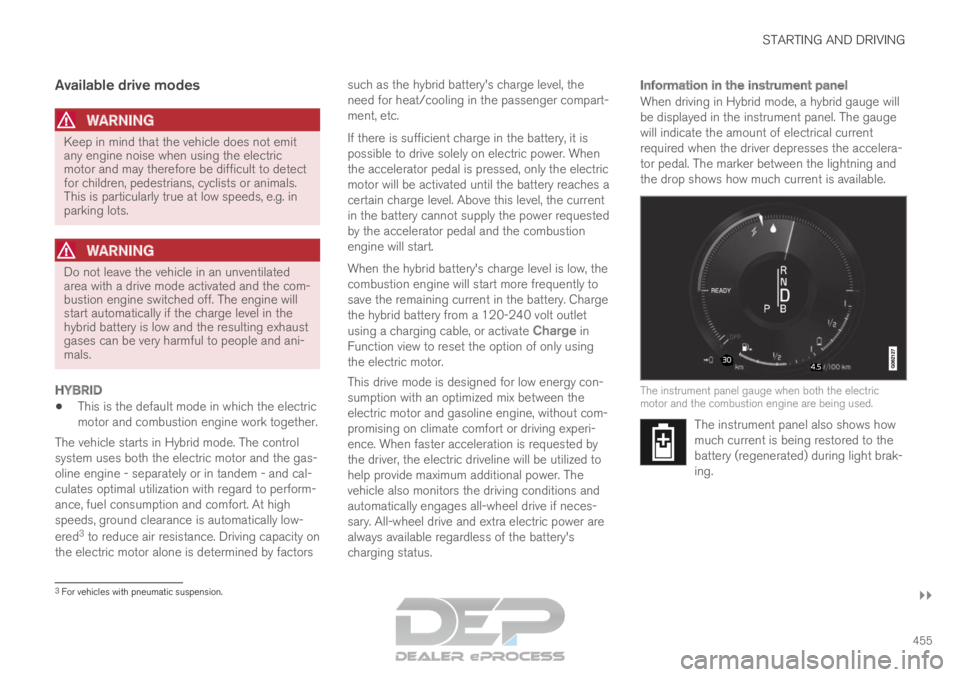
Information in the instrument panel
When driving in Hybrid mode, a hybrid gauge will
be displayed in the instrument panel. The gauge
will indicate the amount of electrical current
required when the driver depresses the accelera-
tor pedal. The marker between the lightning and
the drop shows how much current is available. The instrument panel gauge when both the electric
motor and the combustion engine are being used.
The instrument panel also shows how
much current is being restored to the
battery (regenerated) during light brak-
ing. 3
For vehicles with pneumatic suspension.
Page 458 of 697
||STARTING AND DRIVING
456
PURE
Uses the electric motor only, with the lowest
possible energy consumption and carbon
dioxide emissions.
This drive mode maximizes the use of the hybrid
battery. Ground clearance is lowered 3
to reduce
air resistance and certain climate system func-
tions are reduced to provide the longest possible
driving distance using only electricity.
Pure mode is available when the hybrid battery is
sufficiently charged. Even in Pure mode, the com-
bustion engine will start if the charge level in the
battery gets too low. The combustion engine will
also start
if the vehicle's speed goes above 125 km/h
(78 mph)
if the driver requests more power than the
electric motor can provide
if factors such as cold weather affect the
system or components.
This drive mode is optimized for maximum driving
distance with electric propulsion and is primarily
intended for use in city driving. Pure helps pro-
vide the lowest possible consumption even when
the hybrid battery is fully discharged. ECO climate
is activated to control the climate in the passen-
ger compartment, and in slippery road conditions
slightly more wheel spin may be permitted before
all-wheel drive is automatically activated.
ECO Climate
In Pure mode, ECO climate is automatically acti-
vated in the passenger compartment to help
reduce energy consumption.
NOTE When the
Pure drive mode is activated, set-
tings for certain climate system and electricity
consuming functions are reduced. Some of
these settings can be reset manually, but full
functionality will only be restored by leaving
Pure mode or adapting the Individual drive
mode to full climate system functionality. If condensation forms on the windows, tap the
max defroster button, which will function normally.
OFF ROAD
Maximizes the vehicle's ability to traverse dif-
ficult terrain or poor roads.
In this mode, ground clearance 3
is high, steering
is light, and all-wheel drive and Hill Descent
Control are activated.
This drive mode is only available at low speeds,
up to 40 km/h (25 mph). If this speed is excee-
ded, Off road mode will be cancelled and AWD
mode will be activated instead. All-wheel drive requires both the combustion and
electric motor to be in continuous operation,
which results in higher fuel consumption.
In Off road mode, a compass will be displayed
between the speedometer and the tachometer in
the instrument panel. The permissible speed
range will be shown in the speedometer.
3
For vehicles with pneumatic suspension.
Page 466 of 697
STARTING AND DRIVING
* Option/accessory.
464 Leveling control settings*
Turn off leveling control before lifting the vehicle
with a jack to help avoid problems with the
pneumatic suspension.
The vehicle can be lowered or raised to make it
easier to load or for passengers to get in and
out.
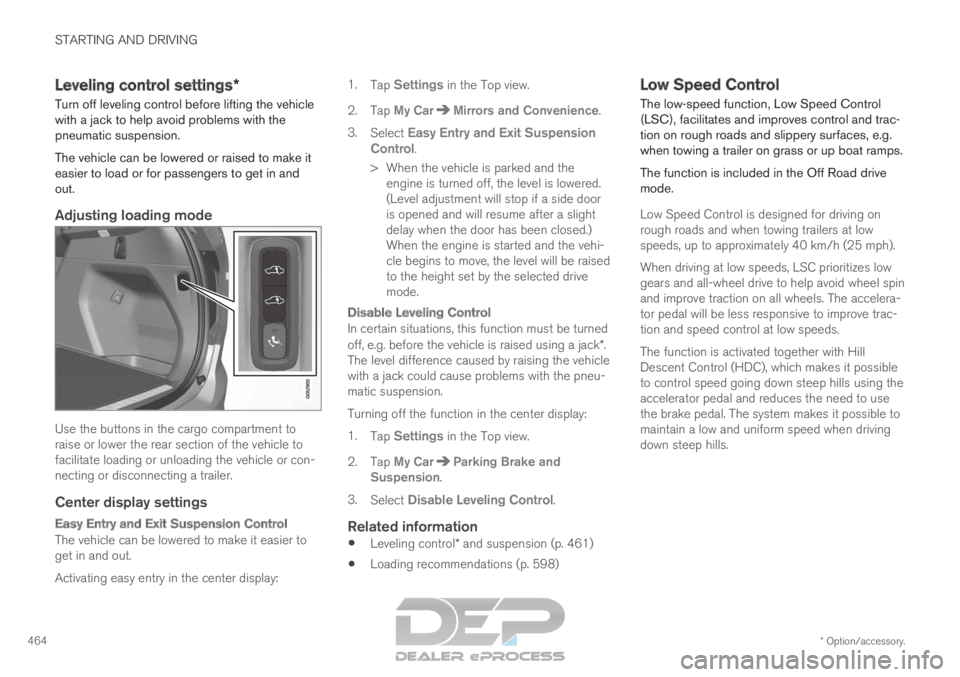
Adjusting loading mode Use the buttons in the cargo compartment to
raise or lower the rear section of the vehicle to
facilitate loading or unloading the vehicle or con-
necting or disconnecting a trailer.
Center display settings
Easy Entry and Exit Suspension Control
The vehicle can be lowered to make it easier to
get in and out.
Activating easy entry in the center display: 1.
Tap Settings in the Top view.
2.
Tap My Car Mirrors and Convenience
.
3. Select Easy Entry and Exit Suspension
Control.
>
When the vehicle is parked and the
engine is turned off, the level is lowered.
(Level adjustment will stop if a side door
is opened and will resume after a slight
delay when the door has been closed.)
When the engine is started and the vehi-
cle begins to move, the level will be raised
to the height set by the selected drive
mode.
Disable Leveling Control
In certain situations, this function must be turned
off, e.g. before the vehicle is raised using a jack*.
The level difference caused by raising the vehicle
with a jack could cause problems with the pneu-
matic suspension.
Turning off the function in the center display:
1. Tap Settings in the Top view.
2.
Tap My Car Parking Brake and
Suspension .
3. Select Disable Leveling Control.
Related information
Leveling control* and suspension (p. 461)
Loading recommendations (p. 598) Low Speed Control
The low-speed function, Low Speed Control
(LSC), facilitates and improves control and trac-
tion on rough roads and slippery surfaces, e.g.
when towing a trailer on grass or up boat ramps.
The function is included in the Off Road drive
mode.
Low Speed Control is designed for driving on
rough roads and when towing trailers at low
speeds, up to approximately 40 km/h (25 mph).
When driving at low speeds, LSC prioritizes low
gears and all-wheel drive to help avoid wheel spin
and improve traction on all wheels. The accelera-
tor pedal will be less responsive to improve trac-
tion and speed control at low speeds.
The function is activated together with Hill
Descent Control (HDC), which makes it possible
to control speed going down steep hills using the
accelerator pedal and reduces the need to use
the brake pedal. The system makes it possible to
maintain a low and uniform speed when driving
down steep hills.
Page 467 of 697
STARTING AND DRIVING
465
NOTEWhen LSC with HDC is activated in the OFF
ROAD drive mode, the feel of the accelerator
pedal and engine response will change.
NOTE
This drive mode is not designed to be used
for normal street driving.
NOTE
The function is deactivated when driving at
high speeds and must be reactivated at lower
speeds if so desired.
Related information
Activating and deactivating Low Speed Con-
trol using the function button (p. 465)
Changing drive mode (p. 459)
Hill Descent Control (p. 466)
All Wheel Drive (AWD) (p. 452) Activating and deactivating Low
Speed Control using the function
button
There is a function button for driving at low
speeds with Hill Descent Control in the center
display's Function view if the vehicle is not
equipped with a drive mode control in the tunnel
console.
Selecting Low Speed Control in the
center display's Function view
– Tap the Hill Descent Control button to
activate or deactivate the function. > An indicator light in the button will illumi-
nate when the function is activated.
When the engine is switched off, the function will
be automatically deactivated.
NOTE The function is deactivated when driving at
high speeds and must be reactivated at lower
speeds if so desired.
Related information
Low Speed Control (p. 464)
Changing drive mode (p. 459)