light VOLVO XC90 TWIN ENGINE 2019 Owners Manual
[x] Cancel search | Manufacturer: VOLVO, Model Year: 2019, Model line: XC90 TWIN ENGINE, Model: VOLVO XC90 TWIN ENGINE 2019Pages: 697, PDF Size: 10.33 MB
Page 325 of 697

DRIVER SUPPORT
}}
* Option/accessory. 323
Setting a time interval for Pilot
Assist
Pilot Assist
can be set to different time intervals.
Different time intervals to the
vehicle ahead can be selected
and are shown in the instru-
ment panel as 1–5 horizontal
bars. The more bars, the longer
the time interval. One bar rep-
resents an interval of
approx. 1 second to the vehicle ahead. 5 bars
represents approx. 3 seconds.
NOTE When the symbol in the instrument panel
shows a vehicle and a steering wheel, Pilot
Assist follows a vehicle ahead at a preset
time interval.
When only a steering wheel is shown, there is
no vehicle ahead within a reasonable dis-
tance. Controls for setting a time interval
60
. Reduce the time interval
Increase the time interval
Distance indicator
– Press the (1) or (2) button to decrease or
increase the time interval.
>
The distance indicator (3) shows the cur-
rent time interval.
In order to follow the vehicle ahead as smoothly
as possible, Pilot Assist allows the time interval to
vary considerably in certain situations. For exam-
ple, at low speeds and short distances to the
vehicle ahead, Pilot Assist increases the time
interval slightly.
NOTE
The greater the vehicles' speed, the
greater the distance between them for a
set time interval.
Only use the time intervals permitted by
local traffic regulations.
If Pilot Assist does not seem to respond
with a speed increase when activated, it
may be because the time interval to the
vehicle ahead is shorter than the set time
interval.
WARNING
Only use a time interval suitable for the
current traffic conditions.
The driver should be aware that short
time intervals give them limited time to
react and act to any unforeseen traffic
situation.
Setting how Pilot Assist should
maintain distance* to the vehicle ahead
The driver can choose different drive modes to
determine how Pilot Assist should maintain a
time interval to the vehicle ahead. Settings are
made using the DRIVE MODE controls. 60
Note: This illustration is general and details may vary depending on mod\
el.
Page 330 of 697
||DRIVER SUPPORT
328
WARNING
When Pilot Assist follows another vehicle at
speeds over approx. 30 km/h (20 mph) and
changes target vehicle – from a moving vehi-
cle to a stationary one – Pilot Assist will
ignore the stationary vehicle and instead
accelerate to the stored speed.
The driver must then intervene and apply
the brakes.
Automatic standby mode when switching
targets
Pilot Assist disengages and goes into standby
mode if:
your vehicle's speed goes below 5 km/h
(3 mph) and Pilot Assist cannot determine if
the target object is a stationary vehicle or
another object, e.g. a speed bump.
your vehicle's speed goes under 5 km/h
(3 mph) and the vehicle ahead turns so that
Pilot Assist no longer has a vehicle to follow.
Related information
Pilot Assist (p. 316) Auto-hold braking with Pilot Assist
Pilot Assist has a special braking function in
slow traffic and at a standstill.
Braking function in slow traffic and at a
standstill
In slow-moving, stop-and-go traffic or when stop-
ped at a traffic light, driving will resume automati-
cally if the vehicle is stopped for less than
approx. 3 seconds. If it takes more than 3 sec-
onds for the vehicle ahead to begin moving again,
Pilot Assist will go into standby mode and the
Auto-hold brake function will activate.
– Pilot Assist can be reactivated by:
Pressing the button on the steering
wheel keypad.
Pressing the accelerator pedal.
>
Pilot Assist will resume following the vehi-
cle ahead if it begins to move within
approx. 6 seconds.
NOTE Pilot Assist can keep the vehicle stationary
for no more than 5 minutes – after that time
the parking brake is applied and the function
is deactivated.
The parking brake must be released before
Pilot Assist can be reactivated.
Deactivation of the Auto-hold brake function
In certain situations, Auto-hold will be deactivated
when the vehicle is at a standstill and Pilot Assist
will go into standby mode. This means that the
brakes will be released and the vehicle could
begin to roll. The driver must actively apply the
brakes to keep the vehicle stationary.
This can occur if:
the driver depresses the brake pedal
the parking brake is applied
the gear selector is moved to the P, N or R
positions
the driver puts Pilot Assist in standby mode.
Auto Activate Parking BrakeIn certain situations, the parking brake will be
applied to keep the vehicle at a standstill.
This occurs if Pilot Assist is keeping the vehicle
stationary using the brakes and:
the driver opens the door or unbuckles
his/her seat belt
Pilot Assist has kept the vehicle at a stand-
still for more than approx. 5 minutes
the brakes overheat
the driver switches off the engine manually.
Related information
Pilot Assist (p. 316)
Page 331 of 697
DRIVER SUPPORT
}}
* Option/accessory. 329
Pilot Assist limitations
Pilot Assist functionality may be reduced in cer-
tain situations.
Pilot Assist is a driver support function designed
to simplify driving and assist the driver in many
situations. However, the driver is always responsi-
ble for maintaining a suitable distance to vehicles
or objects around it and ensuring that the vehicle
is correctly positioned in the traffic lane.
WARNING In some situations, Pilot Assist may have trou-
ble helping the driver properly or may be
deactivated automatically – we advise against
using Pilot Assist in such cases. Examples of
such situations include:
the lane markings are worn, missing or
cross each other.
lane division is unclear, for example, when
the lanes divide or merge or at exits or
when there are multiple sets of markings.
edges or other lines than lane markings
are present on or near the road, e.g.
curbs, joints or repairs to the road sur-
face, edges of barriers, roadside edges or
strong shadows.
the lane is narrow or winding.
the lane contains ridges or holes.
weather conditions are poor, e.g. rain,
snow or fog or slush or reduced visibility
with poor light conditions, backlighting,
wet road surface, etc.
The driver should also note that Pilot Assist
has the following limitations:
High curbs, roadside barriers, temporary
obstacles (traffic cones, safety barriers,
etc.) are not detected. Alternatively, they
may be detected incorrectly as lane mark-
ings, with a subsequent risk of contact
between the vehicle and such obstacles. The driver is responsible for ensuring that
the vehicle maintains a suitable distance
from such obstacles.
The camera and radar sensors do not
have the capacity to detect all oncoming
objects and obstacles in traffic environ-
ments, e.g. potholes, stationary obstacles
or objects that completely or partially
block the route.
Pilot Assist does not "see" pedestrians,
animals, etc.
The recommended steering input is lim-
ited in force, which means that it cannot
always help the driver to steer and keep
the vehicle within the lane.
In vehicles equipped with Sensus
Navigation*, the function is able to use
information from map data, which could
cause variations in performance.
Pilot Assist is switched off if the power
steering is working with reduced power -
e.g. during cooling due to overheating
(see section "Speed-dependent steering
force").
The driver can always correct or adjust steering
assistance provided by Pilot Assist by turning the
steering wheel to the desired position.
Page 340 of 697

DRIVER SUPPORT
338Camera limitations
The camera used by several of the driver support
functions has certain limitations, which also
affect the functions using the camera.
Reduced visibilityThe camera has the same limitations as the
human eye. In other words, its “vision" is impaired
by adverse weather conditions such as heavy
snowfall/rain, dense fog, swirling dust/snow, etc.
These conditions may reduce the function of sys-
tems that depend on the camera or cause these
systems to temporarily stop functioning.
Strong sunlight, reflections from the road surface,
ice or snow covering the road, a dirty road sur-
face, or unclear lane marker lines may drastically
reduce the camera
Page 341 of 697

DRIVER SUPPORT
}}}}
339 Cause
Action
The area of the windshield in front of the camera/radar sensor is
dirty or covered by ice or snow. Clean the windshield in front of the camera/radar sensor and remove dirt\
, ice and
snow.
Thick fog, heavy rain or snow is blocking the radar signals or the
camera's range of visibility. No action. Heavy precipitation may sometimes prevent the camera/radar se\
nsor from
functioning.
Water or snow is spraying/swirling up and blocking the radar signals
or the camera's range of visibility. No action. Very wet or snow-covered roads may sometimes prevent the came\
ra/
radar sensor from functioning.
There is dirt between the inside of the windshield and the camera/
radar sensor. Consult a workshop to have the area of the windshield on the inside of t\
he camera's
casing cleaned. An authorized Volvo workshop is recommended.
Bright sunlight. No action. The camera/radar sensor will reset automatically when lightin\
g conditions
improve.
NOTEKeep the windshield in front of the camera
and radar unit clean.
High temperaturesIf the temperature in the passenger compartment
is very high, the camera/radar sensor will switch
off temporarily for approx. 15 minutes after the
engine is started to protect its electronic compo-
nents. When the temperature has cooled suffi-
ciently, the camera/radar sensor will automati-
cally restart.
Damaged windshield
CAUTION
If there are cracks, scratches or stone chips
on the windshield in front of any of the cam-
era and radar unit "windows" and this covers
an area of about 0.5 × 3.0 mm
(0.02 × 0.12 in.) or more, contact a workshop
to have the windshield replaced – an author-
ized Volvo workshop is recommended.
Failure to take action could result in reduced
performance for the driver support systems
that use the camera and radar unit. It could cause functions to be reduced, deac-
tivated completely or produce an incorrect
function response.
To avoid the risk of loss of function, malfunc-
tion or reduced function of the driver support
systems that use the radar unit, the following
also apply:
Volvo advises against repairing cracks,
scratches or stone chips in the area in
front of the camera and radar unit – the
entire windshield should instead be
replaced.
Before replacing the windshield, contact
an authorized Volvo workshop to verify
Page 343 of 697
DRIVER SUPPORT
}}
341
Recommended maintenance for the
camera/radar sensor
In order for the camera/radar sensor to function
properly, the area of the windshield in front of
the unit must be kept free of dirt, ice, snow, etc.
and should be washed regularly with water and
car washing detergent.
NOTE Dirt, ice and snow covering the camera and
radar unit reduce their function and can make
measurement impossible.
It could cause functions to be reduced, deac-
tivated completely or produce an incorrect
function response.
Related information
Camera (p. 337) City Safety™
City Safety can alert the driver with light, sound
and pulsations in the brake pedal to help the
driver detect pedestrians, cyclists, large animals
and vehicles that appear suddenly – the vehicle
will then attempt to automatically brake if the
driver does not act within a reasonable amount
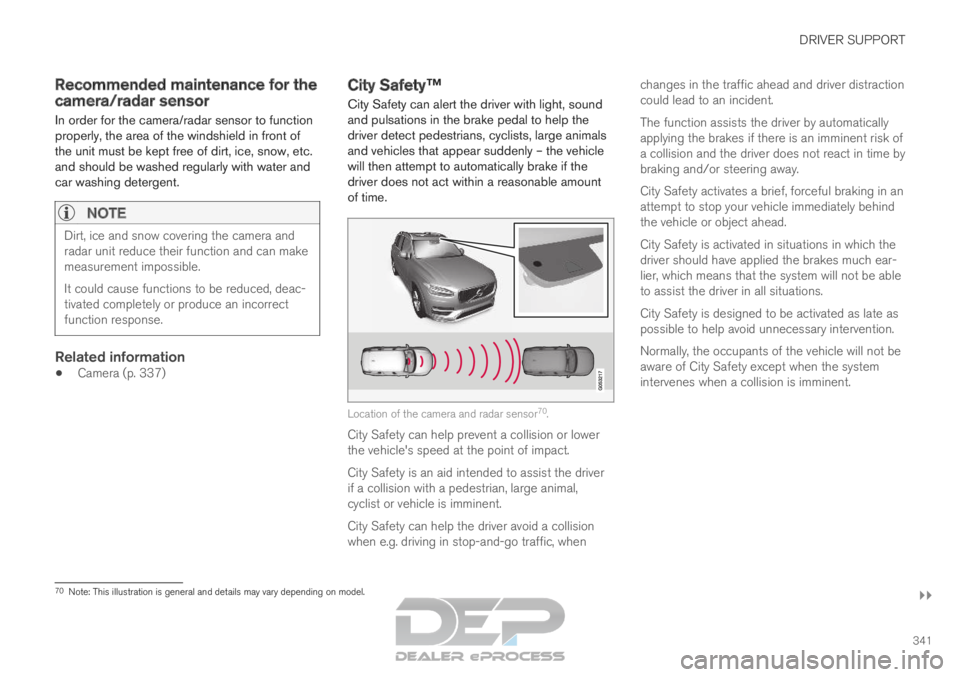
of time. Location of the camera and radar sensor
70
.
City Safety can help prevent a collision or lower
the vehicle's speed at the point of impact.
City Safety is an aid intended to assist the driver
if a collision with a pedestrian, large animal,
cyclist or vehicle is imminent.
City Safety can help the driver avoid a collision
when e.g. driving in stop-and-go traffic, when changes in the traffic ahead and driver distraction
could lead to an incident.
The function assists the driver by automatically
applying the brakes if there is an imminent risk of
a collision and the driver does not react in time by
braking and/or steering away.
City Safety activates a brief, forceful braking in an
attempt to stop your vehicle immediately behind
the vehicle or object ahead.
City Safety is activated in situations in which the
driver should have applied the brakes much ear-
lier, which means that the system will not be able
to assist the driver in all situations.
City Safety is designed to be activated as late as
possible to help avoid unnecessary intervention.
Normally, the occupants of the vehicle will not be
aware of City Safety except when the system
intervenes when a collision is imminent.
70
Note: This illustration is general and details may vary depending on mod\
el.
Page 345 of 697
DRIVER SUPPORT
}}
* Option/accessory. 343
Large animals
If there is a risk of colliding with a large animal,
City Safety can help reduce your vehicle's speed
by up to 15 km/h (9 mph).
The braking function for large animals is primarily
intended to mitigate the force of a collision at
higher speeds. Braking is most effective at
speeds above 70 km/h (43 mph) and less effec-
tive at lower speeds.
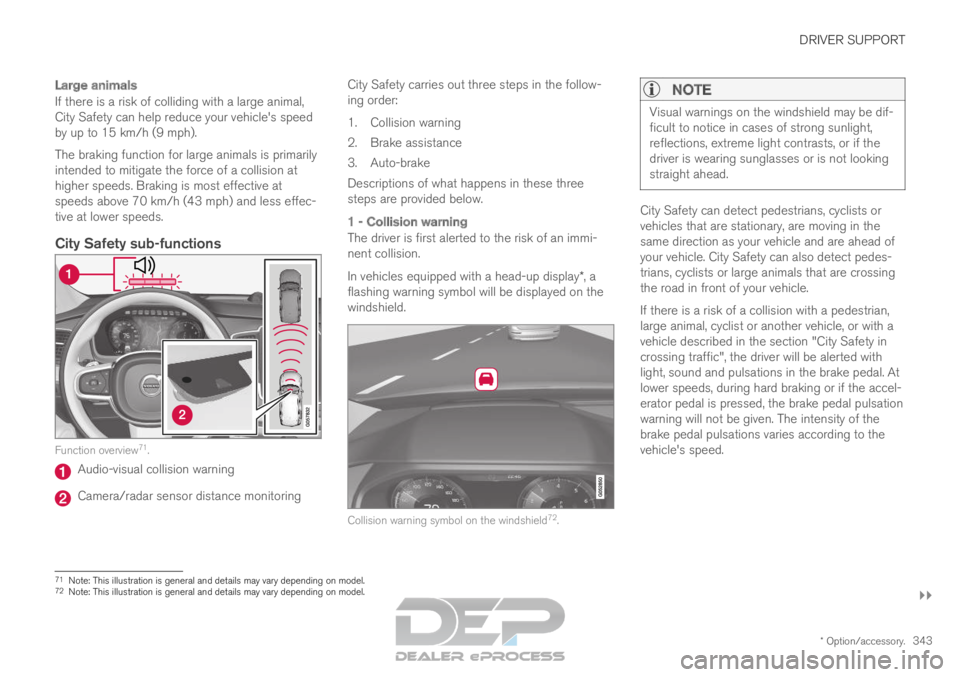
City Safety sub-functionsFunction overview
71
. Audio-visual collision warning
Camera/radar sensor distance monitoring City Safety carries out three steps in the follow-
ing order:
1.
Collision warning
2. Brake assistance
3. Auto-brake
Descriptions of what happens in these three
steps are provided below.
1 - Collision warning
The driver is first alerted to the risk of an immi-
nent collision.
In vehicles equipped with a head-up display*, a
flashing warning symbol will be displayed on the
windshield. Collision warning symbol on the windshield
72
.
NOTE Visual warnings on the windshield may be dif-
ficult to notice in cases of strong sunlight,
reflections, extreme light contrasts, or if the
driver is wearing sunglasses or is not looking
straight ahead.
City Safety can detect pedestrians, cyclists or
vehicles that are stationary, are moving in the
same direction as your vehicle and are ahead of
your vehicle. City Safety can also detect pedes-
trians, cyclists or large animals that are crossing
the road in front of your vehicle.
If there is a risk of a collision with a pedestrian,
large animal, cyclist or another vehicle, or with a
vehicle described in the section "City Safety in
crossing traffic", the driver will be alerted with
light, sound and pulsations in the brake pedal. At
lower speeds, during hard braking or if the accel-
erator pedal is pressed, the brake pedal pulsation
warning will not be given. The intensity of the
brake pedal pulsations varies according to the
vehicle's speed.
71
Note: This illustration is general and details may vary depending on mod\
el.
72 Note: This illustration is general and details may vary depending on mod\
el.
Page 346 of 697
||DRIVER SUPPORT
344
2 - Brake assistance
If the risk of a collision increases after the colli-
sion warning, brake support will be activated.
If the system determines that the pressure the
driver is exerting on the brake pedal is insufficient
to prevent the collision, brake support will
increase pressure.
3 - Auto-brake
The automatic braking function is activated at the
last moment.
If the driver has not taken evasive action by this
stage and a collision is imminent, the automatic
braking function will be triggered. This occurs
whether or not the driver is pressing the brake
pedal. Full braking force will be applied to reduce
the speed at impact or reduced braking effect will
be applied if this is sufficient to avoid the colli-
sion.
The seat belt tensioners may be activated along
with the automatic braking function. See "Seat
belt tensioners" for more information.
In certain situations, auto-braking may begin with
a limited braking force before applying full brak-
ing force.
If City Safety has prevented a collision, the vehi-
cle will be kept at a standstill until the driver
takes action. If the vehicle has slowed to avoid
colliding with a slower-moving vehicle ahead, your
speed will be reduced to that vehicle's speed.
Auto-braking can always be cancelled if the
driver presses hard on the accelerator pedal.
NOTE When City Safety activates the brakes, the
brake lights come on.
When City Safety applies the brakes, a text mes-
sage will appear in the instrument panel to notify
the driver that the function is/was activated.
WARNING
City Safety may not be used to change how
the driver operates the vehicle. The driver
must not only rely on City Safety to brake the
vehicle.
Related information
City Safety™ (p. 341) Setting a warning distance for City
Safety
City Safety is always active, but the function's
warning distance can be adjusted.
NOTE The City Safety function cannot be deacti-
vated. It is activated automatically each time
the engine/electric motor is started.
The alert distance determines the sensitivity of
the system and regulates the distance at which
the light, sound and brake pulsations will be acti-
vated.
To select warning distance:
1.
Select Settings My Car IntelliSafe
in
the center display's Top view.
2. Under City Safety Warning, tap Late,
Normal or Early to set the desired warning distance.
If the driver feels that the Early setting is giving
too many warnings or finds them irritating, the
Normal or Late warning distance settings can
be selected instead.
If the driver feels that the warnings are too fre-
quent and distracting, the warning distance can
be reduced. This will reduce the total number of
warnings, but it will also result in City Safety pro-
viding warnings at a later stage.
Page 347 of 697
DRIVER SUPPORT
}}
345
The
Late warning distance setting should there-
fore only be used in exceptional cases, such as
when a more dynamic driving style is preferred.
WARNING
No automatic system can guarantee
100% correct function in all situations.
You should therefore never test use of
City Safety in the direction of people, ani-
mals or vehicles – this could lead to
severe damage, serious personal injury or
even death.
City Safety warns the driver if there is a
risk of collision, but the function cannot
reduce the driver's reaction time.
Even if the warning distance has been set
to Early, warnings may be perceived as
late in certain situations – e.g. when there
are large speed differences or if the vehi-
cle ahead suddenly brakes heavily.
With the warning distance set to
Early,
warnings come further in advance. This
may cause the warnings to come more
frequently than with warning distance
Normal, but is recommended since it can
make City Safety more effective.
NOTE The warning with direction indicators for Rear
Collision Warning is deactivated if the colli-
sion warning distance in the City Safety func-
tion is set to the lowest level "
Late".
The seat belt tensioning and braking func-
tions remain active.
Related information
City Safety™ (p. 341) Detecting obstacles with City Safety
City Safety can help detect vehicles, cyclists,
large animals and pedestrians.
VehiclesCity Safety detects most types of vehicles that
are either stationary, moving in the same direc-
tion as your vehicle or those described in “City
Safety in crossing traffic” and City Safety braking
for oncoming vehicles”.
For City Safety to be able to detect a vehicle in
the dark, its headlights and taillights must be on
and clearly visible.
Cyclists
Optimal examples of what City Safety would interpret to
be a cyclist: clear body and bicycle shapes.
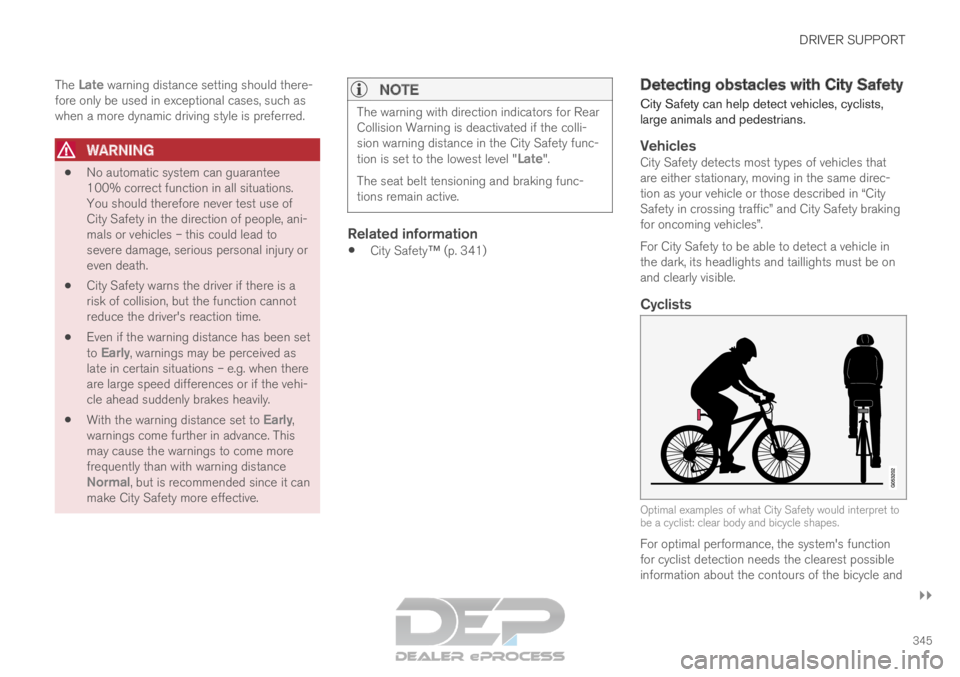
For optimal performance, the system's function
for cyclist detection needs the clearest possible
information about the contours of the bicycle and
Page 348 of 697
||DRIVER SUPPORT
346
of the cyclist's head, arm, shoulders, legs, torso
and lower body in combination with normal
human movements.
If large portions of the cyclist's body or the bicy-
cle itself are not visible to the function's camera,
it will not be able to detect a cyclist.
The system can only detect adult cyclists riding
on bicycles intended for adults.
WARNING
City Safety is supplementary driver support,
but it cannot detect all cyclists in all situations
and, for example, cannot see:
partially obscured cyclists.
cyclists if the background contrast of the
cyclist is poor - warning and brake inter-
ventions may then be late or not occur at
all.
cyclists in clothing that hides their body
contour.
bikes loaded with large objects.
The driver is always responsible for ensuring
that the vehicle is driven correctly and with a
safety distance suitable for the speed.
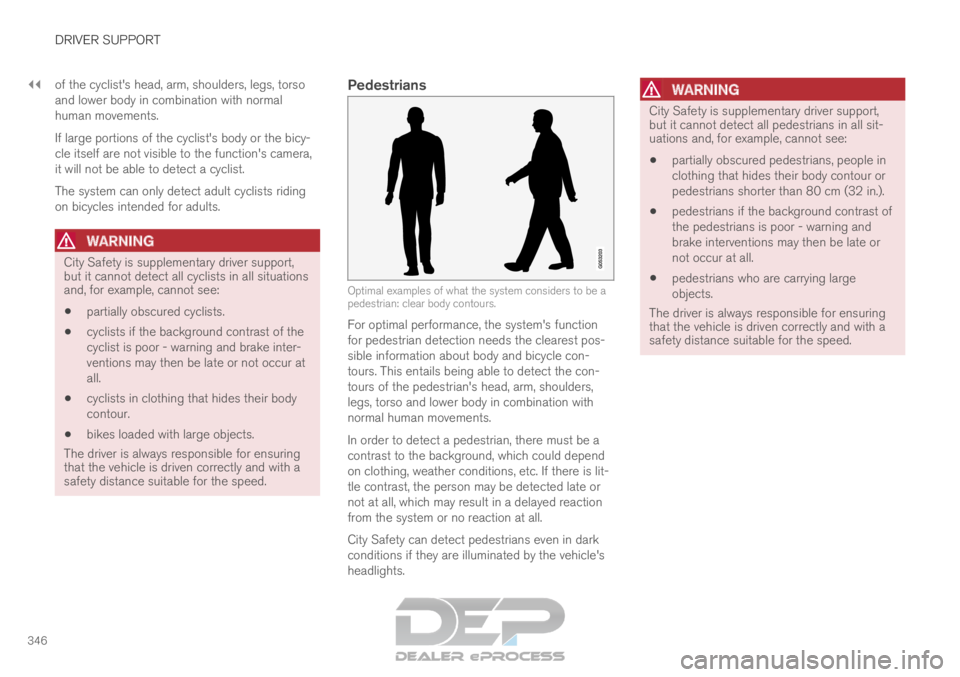
Pedestrians Optimal examples of what the system considers to be a
pedestrian: clear body contours.
For optimal performance, the system's function
for pedestrian detection needs the clearest pos-
sible information about body and bicycle con-
tours. This entails being able to detect the con-
tours of the pedestrian's head, arm, shoulders,
legs, torso and lower body in combination with
normal human movements.
In order to detect a pedestrian, there must be a
contrast to the background, which could depend
on clothing, weather conditions, etc. If there is lit-
tle contrast, the person may be detected late or
not at all, which may result in a delayed reaction
from the system or no reaction at all.
City Safety can detect pedestrians even in dark
conditions if they are illuminated by the vehicle's
headlights.WARNING City Safety is supplementary driver support,
but it cannot detect all pedestrians in all sit-
uations and, for example, cannot see:
partially obscured pedestrians, people in
clothing that hides their body contour or
pedestrians shorter than 80 cm (32 in.).
pedestrians if the background contrast of
the pedestrians is poor - warning and
brake interventions may then be late or
not occur at all.
pedestrians who are carrying large
objects.
The driver is always responsible for ensuring
that the vehicle is driven correctly and with a
safety distance suitable for the speed.