light VOLVO XC90 TWIN ENGINE 2019 Owners Manual
[x] Cancel search | Manufacturer: VOLVO, Model Year: 2019, Model line: XC90 TWIN ENGINE, Model: VOLVO XC90 TWIN ENGINE 2019Pages: 697, PDF Size: 10.33 MB
Page 349 of 697
DRIVER SUPPORT
}}
347
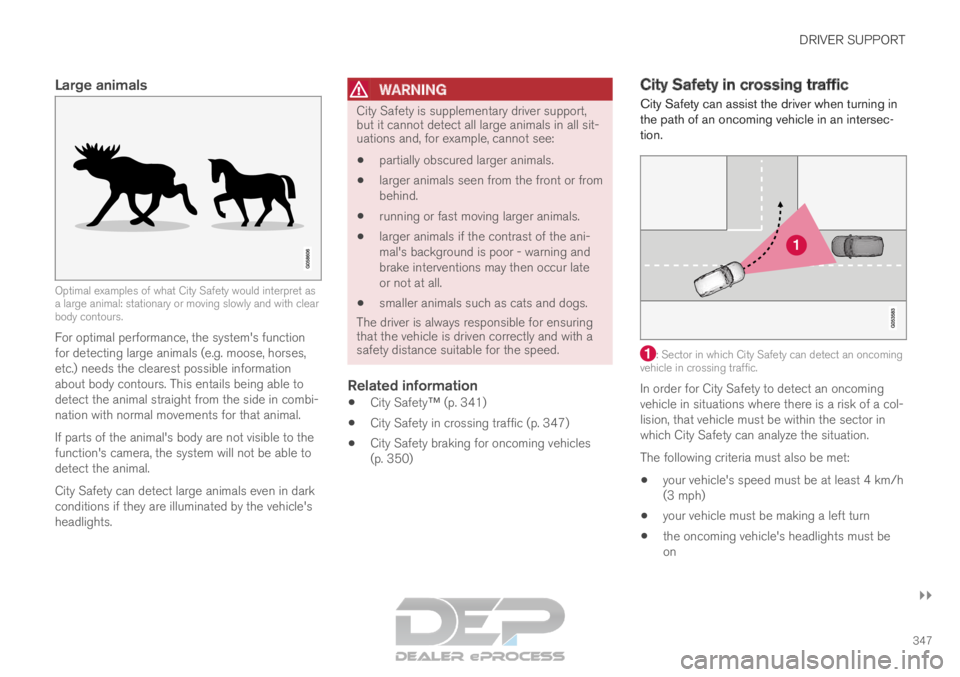
Large animals Optimal examples of what City Safety would interpret as
a large animal: stationary or moving slowly and with clear
body contours.
For optimal performance, the system's function
for detecting large animals (e.g. moose, horses,
etc.) needs the clearest possible information
about body contours. This entails being able to
detect the animal straight from the side in combi-
nation with normal movements for that animal.
If parts of the animal's body are not visible to the
function's camera, the system will not be able to
detect the animal.
City Safety can detect large animals even in dark
conditions if they are illuminated by the vehicle's
headlights.WARNING City Safety is supplementary driver support,
but it cannot detect all large animals in all sit-
uations and, for example, cannot see:
partially obscured larger animals.
larger animals seen from the front or from
behind.
running or fast moving larger animals.
larger animals if the contrast of the ani-
mal's background is poor - warning and
brake interventions may then occur late
or not at all.
smaller animals such as cats and dogs.
The driver is always responsible for ensuring
that the vehicle is driven correctly and with a
safety distance suitable for the speed.
Related information
City Safety™ (p. 341)
City Safety in crossing traffic (p. 347)
City Safety braking for oncoming vehicles
(p. 350) City Safety in crossing traffic
City Safety
can assist the driver when turning in
the path of an oncoming vehicle in an intersec-
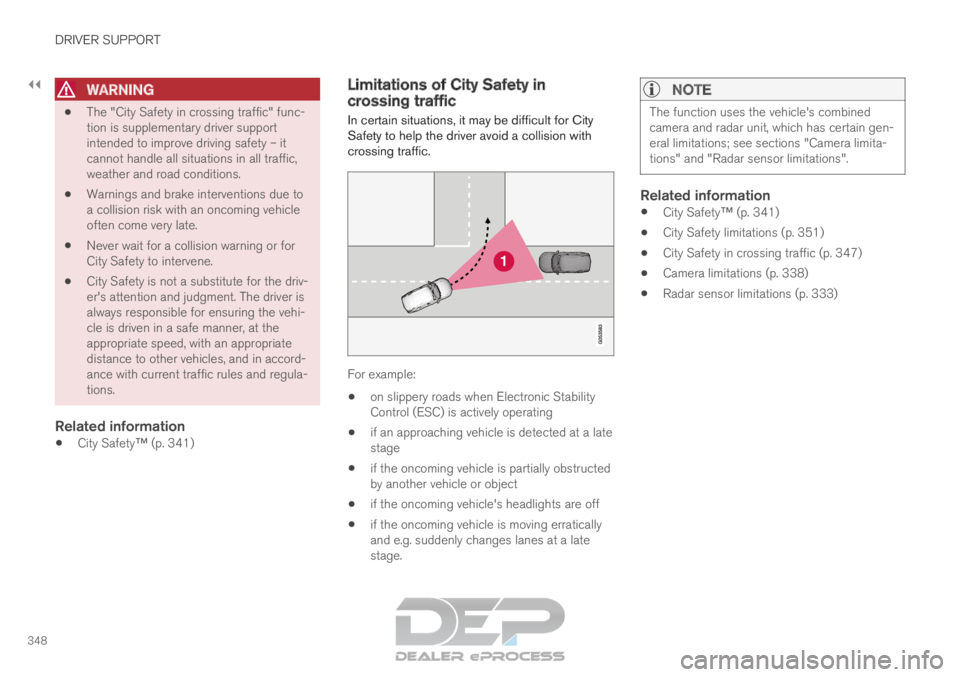
tion. : Sector in which City Safety can detect an oncoming
vehicle in crossing traffic.
In order for City Safety to detect an oncoming
vehicle in situations where there is a risk of a col-
lision, that vehicle must be within the sector in
which City Safety can analyze the situation.
The following criteria must also be met:
your vehicle's speed must be at least 4 km/h
(3 mph)
your vehicle must be making a left turn
the oncoming vehicle's headlights must be
on
Page 350 of 697
||DRIVER SUPPORT
348
WARNING
The "City Safety in crossing traffic" func-
tion is supplementary driver support
intended to improve driving safety – it
cannot handle all situations in all traffic,
weather and road conditions.
Warnings and brake interventions due to
a collision risk with an oncoming vehicle
often come very late.
Never wait for a collision warning or for
City Safety to intervene.
City Safety is not a substitute for the driv-
er's attention and judgment. The driver is
always responsible for ensuring the vehi-
cle is driven in a safe manner, at the
appropriate speed, with an appropriate
distance to other vehicles, and in accord-
ance with current traffic rules and regula-
tions.
Related information
City Safety™ (p. 341) Limitations of City Safety in
crossing traffic
In certain situations, it may be difficult for City
Safety to help the driver avoid a collision with
crossing traffic. For example:
on slippery roads when Electronic Stability
Control (ESC) is actively operating
if an approaching vehicle is detected at a late
stage
if the oncoming vehicle is partially obstructed
by another vehicle or object
if the oncoming vehicle's headlights are off
if the oncoming vehicle is moving erratically
and e.g. suddenly changes lanes at a late
stage.
NOTE The function uses the vehicle's combined
camera and radar unit, which has certain gen-
eral limitations; see sections "Camera limita-
tions" and "Radar sensor limitations".
Related information
City Safety™ (p. 341)
City Safety limitations (p. 351)
City Safety in crossing traffic (p. 347)
Camera limitations (p. 338)
Radar sensor limitations (p. 333)
Page 352 of 697
DRIVER SUPPORT
350City Safety braking for oncoming
vehicles
City Safety can help you apply the brakes for an
oncoming vehicle in your lane.
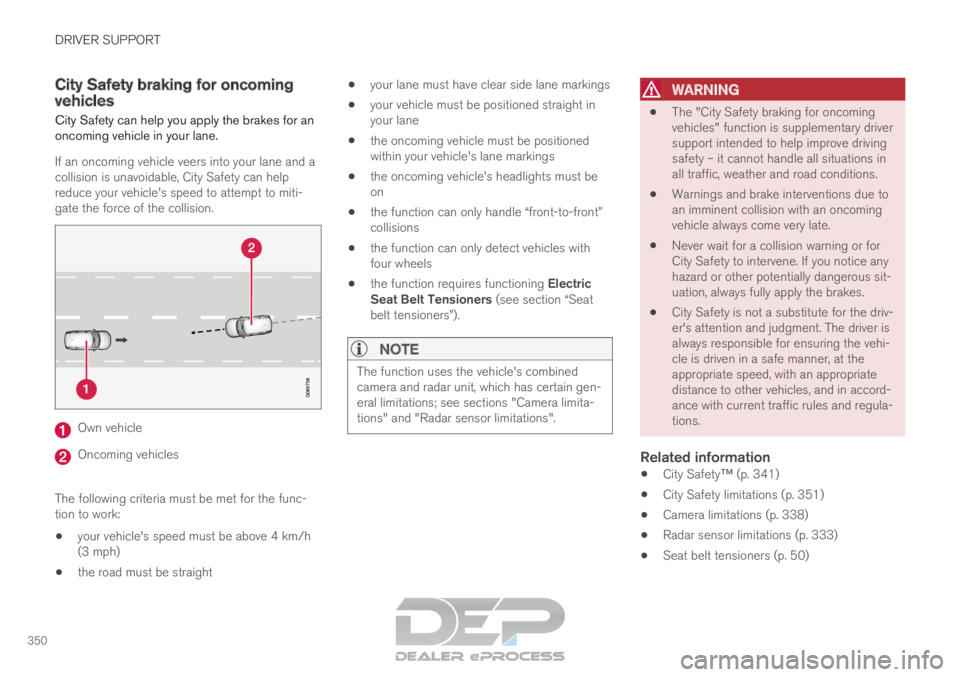
If an oncoming vehicle veers into your lane and a
collision is unavoidable, City Safety can help
reduce your vehicle's speed to attempt to miti-
gate the force of the collision. Own vehicle
Oncoming vehicles
The following criteria must be met for the func-
tion to work:
your vehicle's speed must be above 4 km/h
(3 mph)
the road must be straight
your lane must have clear side lane markings
your vehicle must be positioned straight in
your lane
the oncoming vehicle must be positioned
within your vehicle's lane markings
the oncoming vehicle's headlights must be
on
the function can only handle “front-to-front”
collisions
the function can only detect vehicles with
four wheels
the function requires functioning Electric
Seat Belt Tensioners (see section “Seat
belt tensioners”).
NOTE The function uses the vehicle's combined
camera and radar unit, which has certain gen-
eral limitations; see sections "Camera limita-
tions" and "Radar sensor limitations".
WARNING
The "City Safety braking for oncoming
vehicles" function is supplementary driver
support intended to help improve driving
safety – it cannot handle all situations in
all traffic, weather and road conditions.
Warnings and brake interventions due to
an imminent collision with an oncoming
vehicle always come very late.
Never wait for a collision warning or for
City Safety to intervene. If you notice any
hazard or other potentially dangerous sit-
uation, always fully apply the brakes.
City Safety is not a substitute for the driv-
er's attention and judgment. The driver is
always responsible for ensuring the vehi-
cle is driven in a safe manner, at the
appropriate speed, with an appropriate
distance to other vehicles, and in accord-
ance with current traffic rules and regula-
tions.
Related information
City Safety™ (p. 341)
City Safety limitations (p. 351)
Camera limitations (p. 338)
Radar sensor limitations (p. 333)
Seat belt tensioners (p. 50)
Page 353 of 697
DRIVER SUPPORT
}}
351
City Safety limitations
City Safety functionality may be reduced in cer-
tain situations.
Surroundings
Low objects
Hanging objects, such as flags for overhanging
loads or accessories such as auxiliary lights or
front protective grids that extend beyond the
height of the hood, may limit City Safety function-
ality.
Slippery road conditions
The extended braking distance on slippery roads
may reduce City Safety's capacity to help avoid a
collision. In these types of situations, the Anti-
lock Braking System and Electronic Stability Con-
trol (ESC 73
) will help provide optimal braking
power with maintained stability.
Backlighting
The visual warning signal in the windshield may
be difficult to detect in bright sunlight, if there are
reflections, or if the driver is wearing sunglasses
or not looking straight ahead.
Heat
If the temperature in the passenger compartment
is high due to e.g. bright sunlight, the visual warn-
ing signal in the windshield may be temporarily
disabled.
Camera and radar sensor's field of vision
The camera's field of vision is limited and in cer-
tain situations, it may be unable to detect pedes-
trians, large animals, cyclists or vehicles, or it may
detect them later than expected.
Vehicles that are dirty may be detected later than
clean vehicles, and in dark conditions, motorcy-
cles may be detected late or not at all.
If a text message displayed in the instrument
panel indicates that the camera/radar sensor is
obstructed, it may be difficult for City Safety to
detect pedestrians, large animals, cyclists, vehi-
cles or lane markings in front of the vehicle. City
Safety functionality may therefore be reduced.
Text messages may not be displayed for all situa-
tions in which the windshield sensors are
blocked. The driver must therefore always keep
the windshield in front of the camera/radar sen-
sor clean.
CAUTION Maintenance and replacement of City Safety
components may only be performed by a
workshop – an authorized Volvo workshop is
recommended.
Driver intervention
Backing up
City Safety is temporarily deactivated when the
vehicle is backing up.
Low speed
City Safety is not activated at very low speeds
under 4 km/h (3 mph). The system will therefore
not intervene in situations in which your vehicle is
approaching another vehicle very slowly, such as
when parking.
Active driver
Action by the driver always has priority. City
Safety will therefore not react or will react at a
later stage with a warning or intervention in situa-
tions in which the driver is clearly steering and
operating the accelerator pedal, even if a collision
is unavoidable.
An active and aware driving style may therefore
delay collision warnings and intervention in order
to minimize unnecessary warnings.
73
Electronic Stability Control
Page 354 of 697
||DRIVER SUPPORT
352
Other limitations
WARNING
Warnings and brake interventions can be
triggered late or not at all if the traffic sit-
uation or external influences prevent the
camera and radar unit from properly
detecting pedestrians, cyclists, large ani-
mals or vehicles ahead of the vehicle.
To be able to detect vehicles at night, its
front and rear lights must work and illumi-
nate clearly.
The camera and radar unit have a limited
range for pedestrians and cyclists – the
system can provide effective warnings
and brake interventions if the relative
speed is lower than 50 km/h (30 mph).
For stationary or slow-moving vehicles,
warnings and brake interventions are
effective at vehicle speeds of up to
70 km/h (43 mph). Speed reduction for
large animals is less than 15 km/h
(9 mph) and can be achieved at vehicle
speeds over 70 km/h (43 mph). At lower
speeds, the warning and brake interven-
tion for large animals is less effective.
Warnings for stationary or slow-moving
vehicles and large animals can be disen-
gaged due to darkness or poor visibility.
Warnings and brake interventions for
pedestrians and cyclists are disengaged
at vehicle speeds over 80 km/h
(50 mph).
Do not place, affix or mount anything on
the inside or outside of the windshield, or
in front of or around the camera and
radar unit – this could disrupt camera-
based functions.
Objects, snow, ice or dirt in the area of
the camera sensor can reduce the func-
tion, disengage it completely or give an
improper function response.
NOTE The function uses the vehicle's combined
camera and radar unit, which has certain gen-
eral limitations; see sections "Camera limita-
tions" and "Radar sensor limitations".
Market limitationsCity Safety is not available in all countries. If City
Safety is not shown in the center display's
Settings menu, your vehicle is not equipped with
this function.
In the center display's Top view, tap:
Settings My Car IntelliSafe
Related information
City Safety™ (p. 341)
Camera limitations (p. 338)
Radar sensor limitations (p. 333)
Page 357 of 697

DRIVER SUPPORT
}}
* Option/accessory. 355
BLIS*
The BLIS 74
function is designed to help provide
assistance in heavy traffic with several lanes
moving in the same direction by helping the
driver to detect the presence of vehicles in the
"blind spot" area behind and to the side of the
vehicle.
BLIS is a driver support system designed to alert
the driver of:
vehicles in your "blind spot"
vehicles approaching rapidly in adjacent
lanes. Location of BLIS indicator light.
75 Indicator light
The BLIS button in the center display's Func-
tion view is used to activate/deactivate the
function. BLIS overview
Blind spot zone
Rapidly approaching vehicle zone.
The BLIS function is active at speeds
above 10 km/h (6 mph).
The system is designed to react to: vehicles passing your vehicle
vehicles that are rapidly approaching your
vehicle from behind.
When BLIS
detects a vehicle in zone 1 or a rap-
idly approaching vehicle in zone 2, an indicator
light will illuminate in the relevant rearview mirror
and glow steadily. If the driver then uses the turn
signal on the side in which the warning has been 74
Blind Spot Information Systems
75 Note: This illustration is general and details may vary depending on mod\
el.
Page 358 of 697
||DRIVER SUPPORT
356
given, the indicator light will become brighter and
begin flashing.
NOTE
The light illuminates on the side of the vehicle
where the system has detected the vehicle. If
the vehicle is passed on both sides simulta-
neously, both lights come on.
WARNING
The BLIS function is supplementary driver
support intended to facilitate driving and
help make it safer – it cannot handle all
situations in all traffic, weather and road
conditions.
The responsibility for changing lanes
safely and using good judgment always
rests with the driver.
BLIS is not a substitute for the driver's
attention and judgment. The driver is
always responsible for ensuring the vehi-
cle is driven in a safe manner, at the
appropriate speed, with an appropriate
distance to other vehicles, and in accord-
ance with current traffic rules and regula-
tions.
Related information
Activating/deactivating BLIS (p. 356)
BLIS limitations (p. 357)
Recommended maintenance for BLIS
(p. 358)
BLIS messages (p. 359) Activating/deactivating BLIS
The BLIS
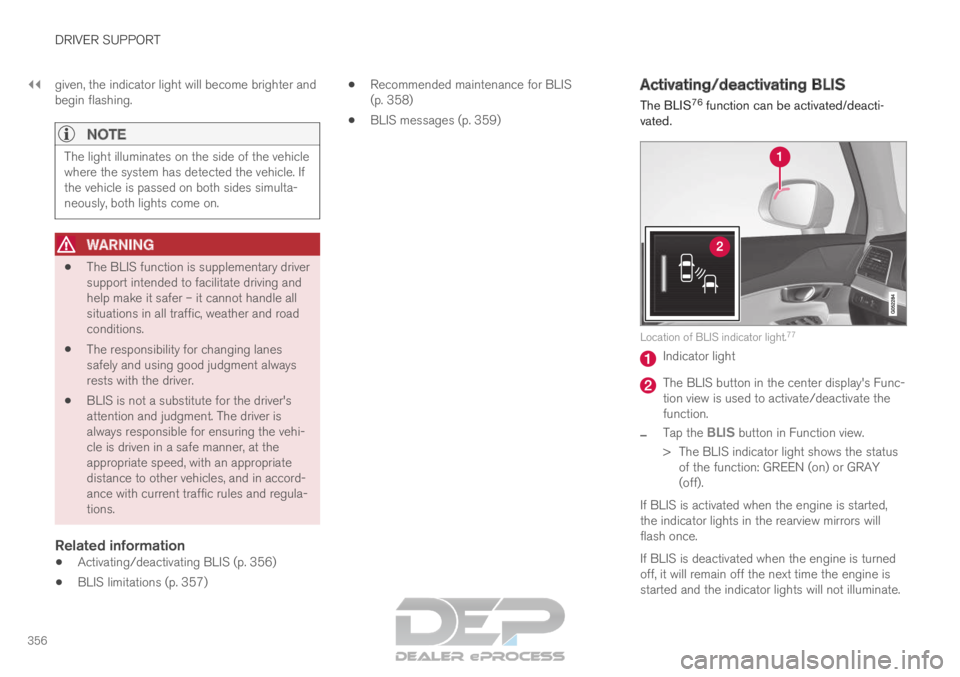
76
function can be activated/deacti-
vated. Location of BLIS indicator light.
77 Indicator light
The BLIS button in the center display's Func-
tion view is used to activate/deactivate the
function.
– Tap the
BLIS button in Function view.
>
The BLIS indicator light shows the status
of the function: GREEN (on) or GRAY
(off).
If BLIS is activated when the engine is started,
the indicator lights in the rearview mirrors will
flash once.
If BLIS is deactivated when the engine is turned
off, it will remain off the next time the engine is
started and the indicator lights will not illuminate.
Page 363 of 697
DRIVER SUPPORT
}}
* Option/accessory. 361
Activating/deactivating Cross Traffic
Alert
The driver can choose to deactivate the CTA 86
function as follows:
Press the Cross Traffic Alertbutton in the center display's
Function view.
GRAY button indicator light - CTA is deacti-
vated.
GREEN button indicator light - CTA is acti-
vated.
CTA is automatically activated each time the
engine is started.
Related information
Cross Traffic Alert* (p. 360) Cross Traffic Alert limitations
CTA 87
functionality may be reduced in certain
situations.
CTA does not function optimally in all situations
and has certain limitations. The CTA sensors, for
example, cannot "see" through other parked
vehicles or objects blocking the vehicle.
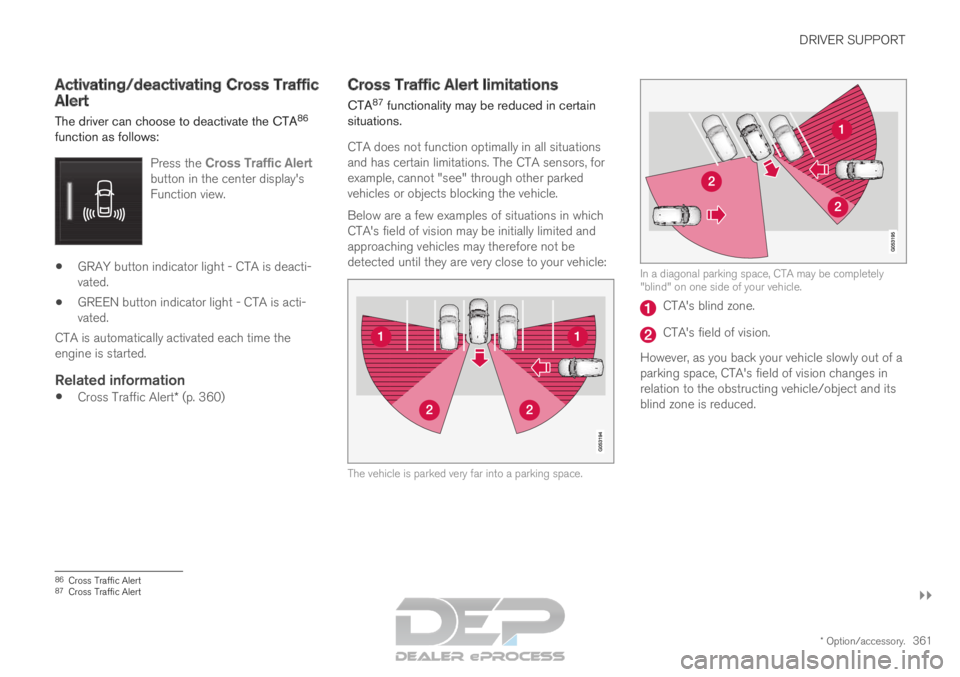
Below are a few examples of situations in which
CTA's field of vision may be initially limited and
approaching vehicles may therefore not be
detected until they are very close to your vehicle: The vehicle is parked very far into a parking space. In a diagonal parking space, CTA may be completely
"blind" on one side of your vehicle.
CTA's blind zone.
CTA's field of vision.
However, as you back your vehicle slowly out of a
parking space, CTA's field of vision changes in
relation to the obstructing vehicle/object and its
blind zone is reduced. 86
Cross Traffic Alert
87 Cross Traffic Alert
Page 367 of 697

DRIVER SUPPORT
* Option/accessory.365
Road Sign Information with speed camera
information (p. 368)
Road Sign Information limitations (p. 369) Activating/deactivating Road Sign
Information
The Road Sign Information function can be
switched On or Off.
Press the Road Sign
Information button in the cen-
ter display's Function view.
GREEN button indicator light - RSI is acti-
vated.
GRAY button indicator light - RSI is deacti-
vated.
NOTE
If the Automatic Speed Limiter function is
activated, road sign information is shown
in the driver display even if RSI 93
is not
activated.
To remove road sign information from the
driver display, you must deactivate both
Automatic Speed Limiter and RSI.
When the Automatic Speed Limiter func-
tion is activated but RSI is deactivated, no
warnings are given from RSI. RSI must
also be activated for warnings to be pos-
sible.
Related information
Road Sign Information* (p. 364) 93
Road Sign Information (RSI)
Page 374 of 697

DRIVER SUPPORT
* Option/accessory.
372 Selecting guidance to a rest area if
the Driver Alert Control warning has
been given
The Rest Stop Guidance function can be
switched on or off.
In vehicles equipped with Sensus Navigation*, the
driver can activate a guide that can automatically
suggest a suitable rest stop if the DAC warning
is given.
To select Rest Stop Guidance:
1. Tap Settings in the center display's Top
view.
2.
Select My Car IntelliSafe Driver Alert
Control .
3. Select/deselect Rest Stop Guidance to
activate/deactivate the function.
Related information
Driver Alert Control (p. 370) Driver Alert Control limitations
Driver Alert Control (DAC) functionality may be
reduced in certain situations.
In certain situations, the system may provide a
warning even if it has not detected a change in
driving behavior, e.g.:
in strong crosswinds
on grooved road surfaces.
WARNING In certain cases, driving behavior might not be
affected despite the driver's fatigue – when
using the Pilot Assist function – resulting in
the driver not getting a warning from DAC.
It is therefore very important to always stop
and take a break at the slightest sign of fati-
gue, regardless of whether the DAC function
has issued a warning or not.
NOTE
The function uses the vehicle's camera unit,
which has some general limitations – see the
section "Camera unit limitations".
Related information
Driver Alert Control (p. 370)
Camera limitations (p. 338) Lane Keeping Aid
Lane Keeping Aid (LKA 104
) is designed to
actively steer the vehicle on freeways, highways
and other major roads to help the driver reduce
the risk of the vehicle unintentionally veering out
of the lane.
Lake Keeping Assistance steers the vehicle back
into the lane and/or alerts the driver using vibra-
tions in the steering wheel.
Lane Keeping Aid is active at speeds between
65-200 km/h (40-125 mph) on roads with
clearly visible traffic lane marker lines.
On narrow roads, the function may be unavailable
and go into standby mode. The function will
become available again when the road becomes
sufficiently wide. A camera monitors the road/traffic lane's marker lines.
104
Lane Keeping Aid