tire type VOLVO XC90 TWIN ENGINE 2019 User Guide
[x] Cancel search | Manufacturer: VOLVO, Model Year: 2019, Model line: XC90 TWIN ENGINE, Model: VOLVO XC90 TWIN ENGINE 2019Pages: 697, PDF Size: 10.33 MB
Page 565 of 697
WHEELS AND TIRES
}}
563
Tread wear indicator
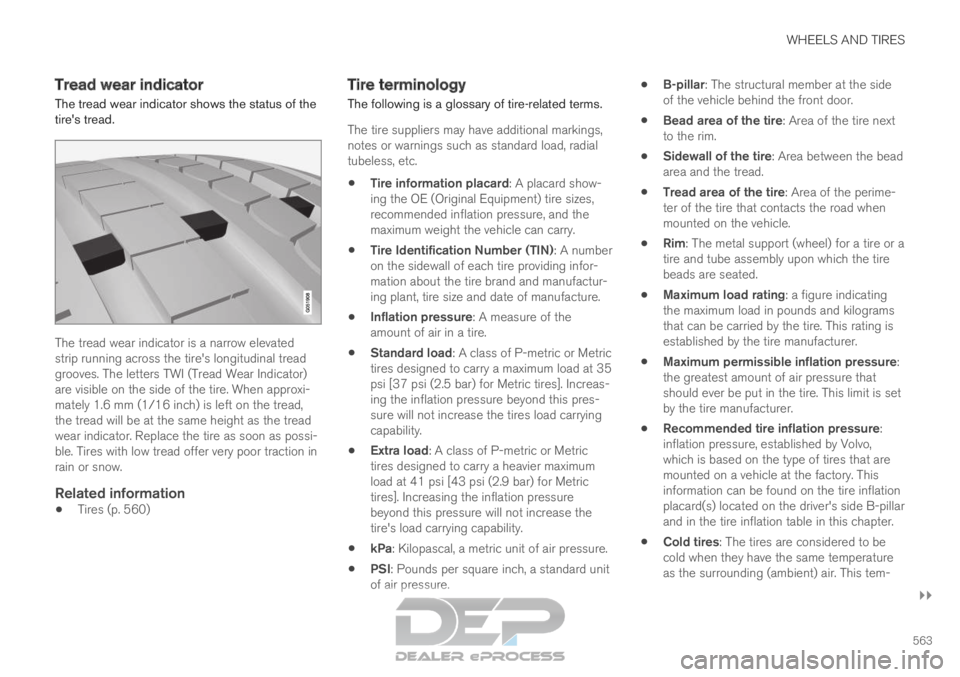
The tread wear indicator shows the status of the
tire's tread. The tread wear indicator is a narrow elevated
strip running across the tire's longitudinal tread
grooves. The letters TWI (Tread Wear Indicator)
are visible on the side of the tire. When approxi-
mately 1.6 mm (1/16 inch) is left on the tread,
the tread will be at the same height as the tread
wear indicator. Replace the tire as soon as possi-
ble. Tires with low tread offer very poor traction in
rain or snow.
Related information
Tires (p. 560) Tire terminology
The following is a glossary of tire-related terms.
The tire suppliers may have additional markings,
notes or warnings such as standard load, radial
tubeless, etc.
Tire information placard: A placard show-
ing the OE (Original Equipment) tire sizes,
recommended inflation pressure, and the
maximum weight the vehicle can carry.
Tire Identification Number (TIN): A number
on the sidewall of each tire providing infor-
mation about the tire brand and manufactur-
ing plant, tire size and date of manufacture.
Inflation pressure: A measure of the
amount of air in a tire.
Standard load: A class of P-metric or Metric
tires designed to carry a maximum load at 35
psi [37 psi (2.5 bar) for Metric tires]. Increas-
ing the inflation pressure beyond this pres-
sure will not increase the tires load carrying
capability.
Extra load: A class of P-metric or Metric
tires designed to carry a heavier maximum
load at 41 psi [43 psi (2.9 bar) for Metric
tires]. Increasing the inflation pressure
beyond this pressure will not increase the
tire's load carrying capability.
kPa: Kilopascal, a metric unit of air pressure.
PSI: Pounds per square inch, a standard unit
of air pressure.
B-pillar: The structural member at the side
of the vehicle behind the front door.
Bead area of the tire: Area of the tire next
to the rim.
Sidewall of the tire: Area between the bead
area and the tread.
Tread area of the tire: Area of the perime-
ter of the tire that contacts the road when
mounted on the vehicle.
Rim: The metal support (wheel) for a tire or a
tire and tube assembly upon which the tire
beads are seated.
Maximum load rating: a figure indicating
the maximum load in pounds and kilograms
that can be carried by the tire. This rating is
established by the tire manufacturer.
Maximum permissible inflation pressure:
the greatest amount of air pressure that
should ever be put in the tire. This limit is set
by the tire manufacturer.
Recommended tire inflation pressure:
inflation pressure, established by Volvo,
which is based on the type of tires that are
mounted on a vehicle at the factory. This
information can be found on the tire inflation
placard(s) located on the driver's side B-pillar
and in the tire inflation table in this chapter.
Cold tires: The tires are considered to be
cold when they have the same temperature
as the surrounding (ambient) air. This tem-
Page 583 of 697
WHEELS AND TIRES
}}
581
Snow tires
Snow tires are designed for winter driving.
Volvo recommends snow tires with specific
dimensions. The tire dimensions vary depending
on engine type. When driving with snow tires, the
correct type of tires must be mounted on all four
wheels.
NOTE Contact a Volvo dealer for advice on the best
choice of rims and tires.
Tips for changing snow tiresWhen switching between regular tires and snow
tires, mark the tires according to which side they
were mounted on, e.g. L for left and R for right.
Studded tiresStudded tires should be broken in by driving
500–1000 km (300–600 miles) slowly and gen-
tly to help the studs settle properly in the tires.
This gives the tire, and especially the studs, a
longer service life.
NOTE
Regulations regarding the use of studded
tires vary from country to country.
Tread depthRoad conditions with ice, slush and low tempera-
tures place considerably higher demands on tires
than summer conditions. Volvo therefore recom-
mends not driving on snow tires that have a tread
depth of less than 4 mm (0.15 inch).
Related information
When changing wheels (p. 574)
Winter driving (p. 472)
Tread wear indicator (p. 563) Snow chains
Using snow chains and/or snow tires can help
improve traction in winter driving conditions.
WARNING Use Volvo genuine snow chains or equivalent
snow chains that are suitable for the vehicle
model and the tire and wheel sizes. Only one-
sided snow chains are permitted.
If uncertain about snow chains, Volvo recom-
mends contacting an authorized Volvo work-
shop. Use of the wrong snow chains could
cause serious damage to the vehicle and
result in an accident.
16
The backrest in the third row of seats* must be folded down.
Page 584 of 697
||WHEELS AND TIRES
582
CAUTION
Snow chains can be used on the vehicle, with
the following restrictions:
Volvo recommends not using snow
chains on wheel dimensions larger than
19 inches.
Always follow the manufacturer's installa-
tion instructions carefully. Install chains
as tightly as possible and retighten peri-
odically.
Only put snow chains on the front wheels
(also applies to all-wheel drive vehicles).
If accessory, aftermarket or "custom"
tires and wheels with different dimen-
sions than the original tires and wheels
are used, snow chains in some cases
may NOT be used. Sufficient distance
between the chains and brakes, suspen-
sion and body components must be
maintained.
Check local regulations regarding the use
of snow chains before installing.
Never exceed the snow chain manufac-
turer's specified maximum speed limit.
Under no circumstances should you
exceed 50 km/h (30 mph).
Avoid bumps, holes or sharp turns when
driving with snow chains.
Avoid driving on surfaces without snow as
this wears out both the snow chains and
the tires.
The handling of the vehicle can be
adversely affected when driving with
chains. Avoid fast or sharp turns as well
as locked wheel braking.
Some types of strap-on chains affect
brake components and therefore must
NOT be used. Consult a Volvo retailer for more information
about snow chains.
Related information
Winter driving (p. 472) Tire sealing system
17
The temporary tire sealing system can be used
to seal a puncture in a tire or to check and
adjust the pressure in the tire.
Models equipped with a spare wheel 18
do not
have the tire sealing system.
WARNING California Proposition 65
Operating, servicing and maintaining a pas-
senger vehicle can expose you to chemicals
including engine exhaust, carbon monoxide,
phthalates, and lead, which are known to the
State of California to cause cancer and birth
defects or other reproductive harm. To mini-
mize exposure, avoid breathing exhaust, do
not idle the engine except as necessary, serv-
ice your vehicle in a well ventilated area and
wear gloves or wash your hands frequently
when servicing your vehicle. For more infor-
mation go to www.P65Warnings.ca.gov/
passenger-vehicle.
The tire sealing system consists of a compressor
and a bottle containing sealing compound. The
sealing functions as a temporary repair.
Page 614 of 697
||MAINTENANCE AND SERVICE
612
Monthly:
Check cold tire pressure in all tires. Inspect
the tires for wear.
Check that engine coolant and other fluid
levels are between the indicated "min" and
"max" markings.
Clean interior glass surfaces with a glass
cleaner and soft paper towels.
Wipe driver information displays with a soft
cloth.
Visually inspect battery terminals for corro-
sion. Corrosion may indicate a loose terminal
connector, or a battery near the end of its
useful service life. Consult your Volvo retailer
for additional information.
As needed:
Wash the car, including the undercarriage, to
reduce wear that can be caused by a buildup of
dirt, and corrosion that can be caused by salt res-
idues.
Clean leaves and twigs from air intake vents at
the base of the windshield, and from other places
where they may collect.
NOTE Complete service information for qualified
technicians is available online for purchase or
subscription at www.volvotechinfo.com.
Related information
Vehicle status (p. 614)
Scheduling service and repairs (p. 615)
Connecting equipment to the vehicle's data
link connector (p. 37)
Technician certification (p. 38)
Climate control system service (p. 621)
Maintenance of the brake system (p. 442)
Engine compartment overview (p. 622) Data transfer between vehicle and
workshop over Wi-Fi
Volvo workshops have a designated Wi-Fi net-
work for secure data transfer between your vehi-
cle and the workshop. Your visit to the workshop
will be easier and more effective when diagnos-
tics information and software can be transferred
over the workshop's network.
When you arrive at the workshop, your service
technician can connect your vehicle to the work-
shop's Wi-Fi network to perform troubleshooting
and download software. For this type of commu-
nication, the vehicle only connects to a work-
shop's network. It is not possible to connect the
vehicle to another Wi-Fi network (e.g. your home
network) in the same way as to a workshop's net-
work.
Connecting with remote keyConnection is usually managed by the service
technician, who will use the remote key buttons. It
is therefore important to bring a key with buttons
with you when you visit the workshop. Pressing
the lock button on the remote key three times will
connect the vehicle to the workshop's Wi-Fi net-
work.
When the car is connected to a Wi-Fi network,
the symbol appears in the center display.
Page 677 of 697

SPECIFICATIONS
675
Approved tire pressure
The following tire pressures are recommended
by Volvo for your vehicle. Refer to the tire infla- tion placard for information specific to the tires
installed on your vehicle at the factory.Tire dimensions
Cold tire pressure for up to seven people (depending on number of seats\
)
Front
psi (kPa) Rear
psi (kPa)
235/55 R19
275/45 R20
275/40 R21
275/35 R22 42 (290)
42 (290)
Temporary spare tire N/AN/A
Related information
Type designations (p. 664)
Checking tire pressure (p. 567)
Recommended tire pressure (p. 569)
Page 690 of 697
INDEX
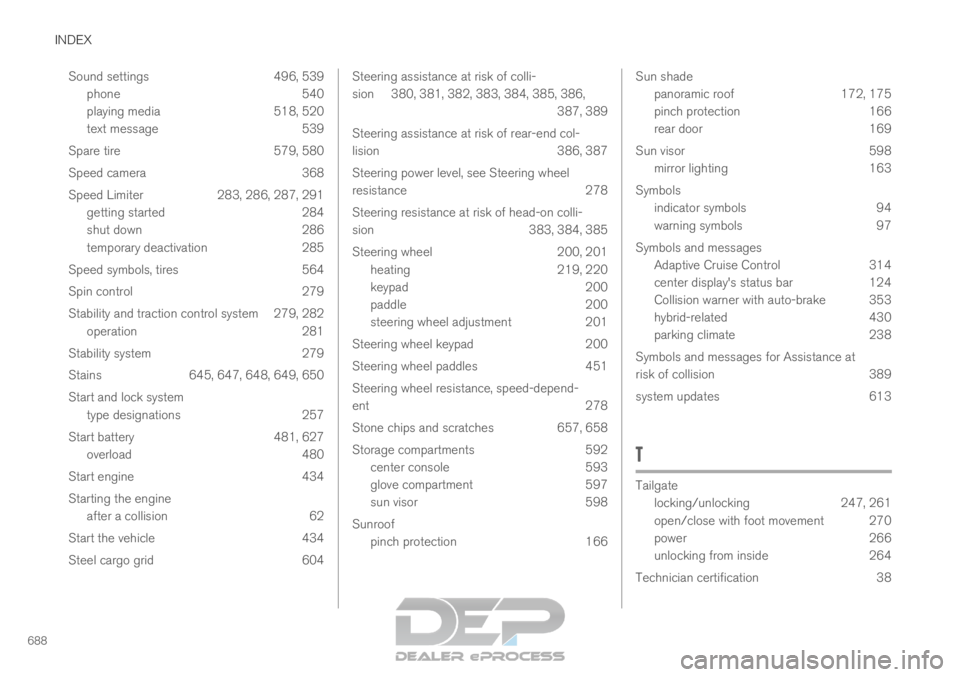
688Sound settings 496, 539
phone 540
playing media 518, 520
text message 539
Spare tire 579, 580
Speed camera 368
Speed Limiter 283, 286, 287, 291 getting started 284
shut down 286
temporary deactivation 285
Speed symbols, tires 564
Spin control 279
Stability and traction control system 279, 282 operation 281
Stability system 279
Stains 645, 647, 648, 649, 650
Start and lock system type designations 257
Start battery 481, 627 overload 480
Start engine 434
Starting the engine after a collision 62
Start the vehicle 434
Steel cargo grid 604 Steering assistance at risk of colli-
sion
380, 381, 382, 383, 384, 385, 386, 387, 389
Steering assistance at risk of rear-end col-
lision 386, 387
Steering power level, see Steering wheel
resistance 278
Steering resistance at risk of head-on colli-
sion 383, 384, 385
Steering wheel 200, 201
heating 219, 220
keypad 200
paddle 200
steering wheel adjustment 201
Steering wheel keypad 200
Steering wheel paddles 451
Steering wheel resistance, speed-depend-
ent 278
Stone chips and scratches 657, 658
Storage compartments 592
center console 593
glove compartment 597
sun visor 598
Sunroof pinch protection 166 Sun shade
panoramic roof 172, 175
pinch protection 166
rear door 169
Sun visor 598
mirror lighting 163
Symbols indicator symbols 94
warning symbols 97
Symbols and messages Adaptive Cruise Control 314
center display's status bar 124
Collision warner with auto-brake 353
hybrid-related 430
parking climate 238
Symbols and messages for Assistance at
risk of collision 389
system updates 613
T Tailgate
locking/unlocking
247, 261
open/close with foot movement 270
power 266
unlocking from inside 264
Technician certification 38
Page 692 of 697
INDEX
690Turn signals 158
Twin Engine
general 416
Type approval radar system 336
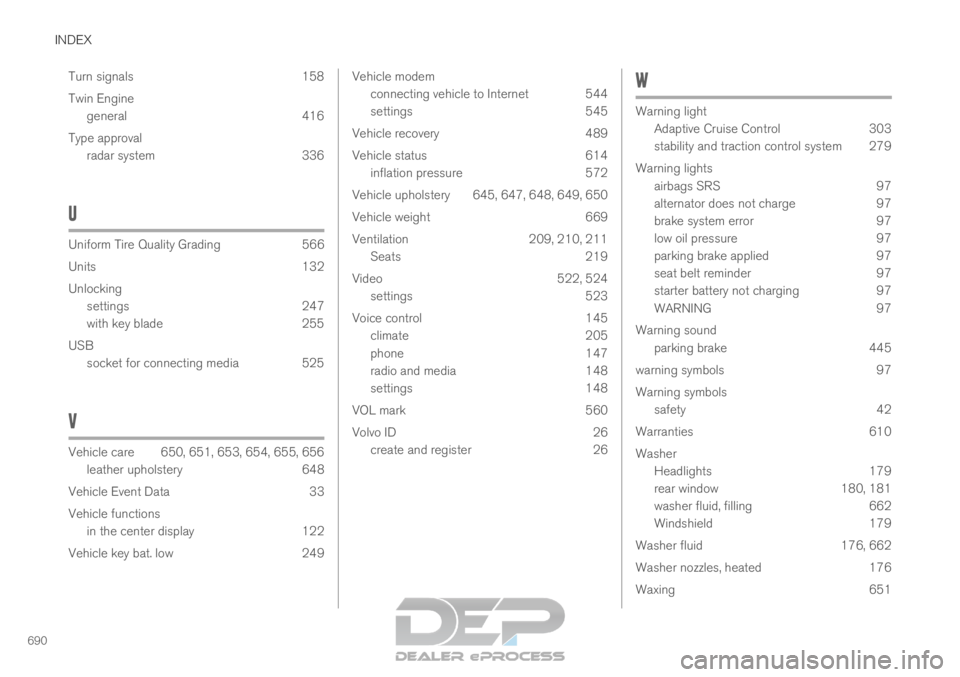
U Uniform Tire Quality Grading
566
Units
132
Unlocking settings 247
with key blade 255
USB socket for connecting media 525
V Vehicle care 650, 651, 653, 654, 655, 656
leather upholstery
648
Vehicle Event Data 33
Vehicle functions in the center display 122
Vehicle key bat. low 249 Vehicle modem
connecting vehicle to Internet
544
settings 545
Vehicle recovery 489
Vehicle status 614
inflation pressure 572
Vehicle upholstery 645, 647, 648, 649, 650
Vehicle weight 669
Ventilation 209, 210, 211
Seats 219
Video 522, 524
settings 523
Voice control 145
climate 205
phone 147
radio and media 148
settings 148
VOL mark 560
Volvo ID 26
create and register 26 W
Warning light
Adaptive Cruise Control
303
stability and traction control system 279
Warning lights airbags SRS 97
alternator does not charge 97
brake system error 97
low oil pressure 97
parking brake applied 97
seat belt reminder 97
starter battery not charging 97
WARNING 97
Warning sound parking brake 445
warning symbols 97
Warning symbols safety 42
Warranties 610
Washer Headlights 179
rear window 180, 181
washer fluid, filling 662
Windshield 179
Washer fluid 176, 662
Washer nozzles, heated 176
Waxing 651