reset VOLVO XC90 TWIN ENGINE 2019 Owner's Manual
[x] Cancel search | Manufacturer: VOLVO, Model Year: 2019, Model line: XC90 TWIN ENGINE, Model: VOLVO XC90 TWIN ENGINE 2019Pages: 697, PDF Size: 10.33 MB
Page 171 of 697

WINDOWS, GLASS AND MIRRORS
}}
* Option/accessory. 169
WARNINGMake sure that no child or other passenger
comes into contact with the windows as they
are closing with keyless closing*.
NOTE
One way to reduce the pulsating wind noise
heard when the rear windows are open is to
also open the front windows slightly.
NOTE
The windows cannot be opened at speeds
over approx. 180 km/h (ca112 mph), but they
can be closed.
The driver is always responsible for following
applicable traffic regulations.
Related information
Power windows (p. 167)
Pinch protection for windows and sun cur-
tains (p. 166)
Reset procedure for pinch protection
(p. 167)
Keyless locking and unlocking* (p. 259)
Locking and unlocking using the remote key
(p. 246) Using sun curtains*
There are integrated sun curtains in each rear
door.
Rear door – manually operated The illustration is generic – the design may vary.
Hook with locking mechanism
– Pull up the sun curtain and hook it to the
upper section of the door frame.
The window can be opened and closed when the
sun curtain is being used.
Related information
Pinch protection for windows and sun cur-
tains (p. 166)
Reset procedure for pinch protection
(p. 167)
Power windows (p. 167) Rearview/door mirrors
The rearview mirror and door mirrors can be
used to improve the driver's visibility behind the
vehicle.
Rearview mirrorThe rearview mirror can be easily adjusted man-
ually. The rearview mirror can be equipped with
HomeLink*, auto-dim* and compass*.
Door mirrors
WARNING The door mirror on the passenger side is
curved to improve visibility. Objects in the mir-
ror may appear farther away than they actually
are.
The joystick in the drivers' door control panel is
used to adjust the position of the door mirrors.
There are also several automatic settings that
can also be connected to the memory function
buttons for the power seat*.
Related information
HomeLink ®
* (p. 489)
Compass* (p. 493)
Adjusting the rearview mirror dimming func-
tion (p. 170)
Adjusting the door mirrors (p. 171)
Page 173 of 697
WINDOWS, GLASS AND MIRRORS
}}
* Option/accessory. 171
Adjusting the door mirrors
To improve visibility to the rear, the door mirrors
need to be adjusted to the driver's height and
seating position. There are several automatic
settings that can also be connected to the mem-
ory function buttons for the power seat*.
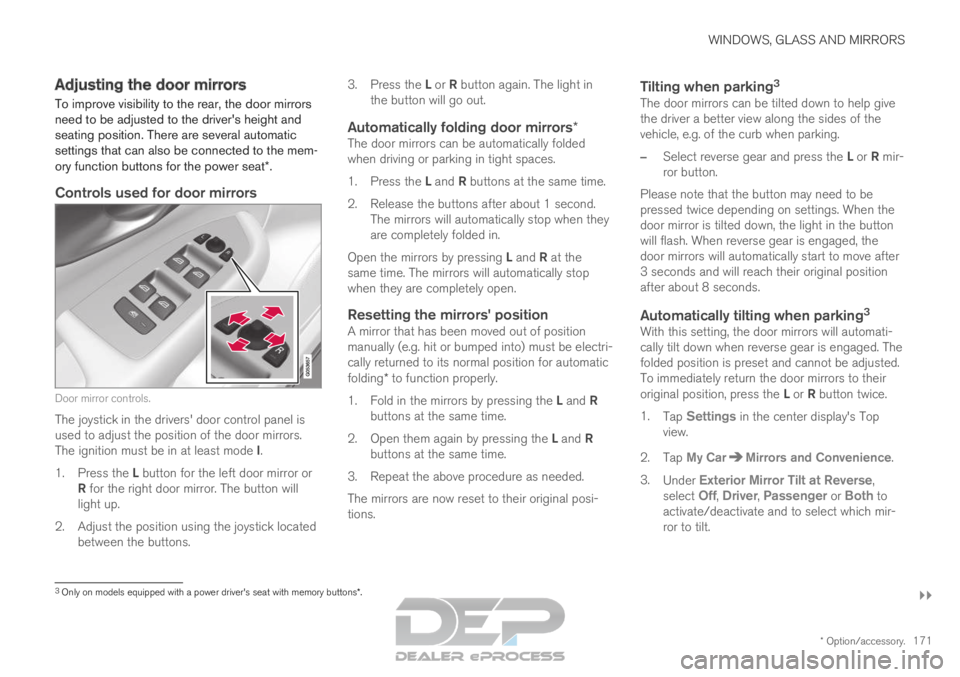
Controls used for door mirrors Door mirror controls.
The joystick in the drivers' door control panel is
used to adjust the position of the door mirrors.
The ignition must be in at least mode I.
1. Press the L button for the left door mirror or
R for the right door mirror. The button will
light up.
2.
Adjust the position using the joystick located
between the buttons. 3.
Press the L or R button again. The light in
the button will go out.
Automatically folding door mirrors*The door mirrors can be automatically folded
when driving or parking in tight spaces.
1. Press the L and R buttons at the same time.
2. Release the buttons after about 1 second. The mirrors will automatically stop when they
are completely folded in.
Open the mirrors by pressing L and R at the
same time. The mirrors will automatically stop
when they are completely open.
Resetting the mirrors' positionA mirror that has been moved out of position
manually (e.g. hit or bumped into) must be electri-
cally returned to its normal position for automatic
folding* to function properly.
1. Fold in the mirrors by pressing the L and R
buttons at the same time.
2. Open them again by pressing the L and R
buttons at the same time.
3. Repeat the above procedure as needed.
The mirrors are now reset to their original posi-
tions.
Tilting when parking 3The door mirrors can be tilted down to help give
the driver a better view along the sides of the
vehicle, e.g. of the curb when parking.
–
Select reverse gear and press the L or R mir-
ror button.
Please note that the button may need to be
pressed twice depending on settings. When the
door mirror is tilted down, the light in the button
will flash. When reverse gear is engaged, the
door mirrors will automatically start to move after
3 seconds and will reach their original position
after about 8 seconds.
Automatically tilting when parking 3With this setting, the door mirrors will automati-
cally tilt down when reverse gear is engaged. The
folded position is preset and cannot be adjusted.
To immediately return the door mirrors to their
original position, press the L or R button twice.
1. Tap Settings in the center display's Top
view.
2.
Tap My Car Mirrors and Convenience
.
3. Under Exterior Mirror Tilt at Reverse ,
select
Off, Driver, Passenger or Both to
activate/deactivate and to select which mir-
ror to tilt.
3 Only on models equipped with a power driver's seat with memory button\
s*.
Page 190 of 697
SEATS AND STEERING WHEEL
* Option/accessory.
188
Adjusting* front seat cushion length (p. 189)
Front seat massage* settings (p. 188)
Adjusting front seat side bolster settings*
(p. 190)
Adjusting front seat lumbar support* (p. 191)
Adjusting the passenger seat from the driv-
er's seat* (p. 192)
Adjusting the door mirrors (p. 171)
Head-up display settings* (p. 144) Front seat massage* settings
The settings for the multifunctional seats can be
adjusted using either the mutifunction control on
the seat or the center display. The adjustment
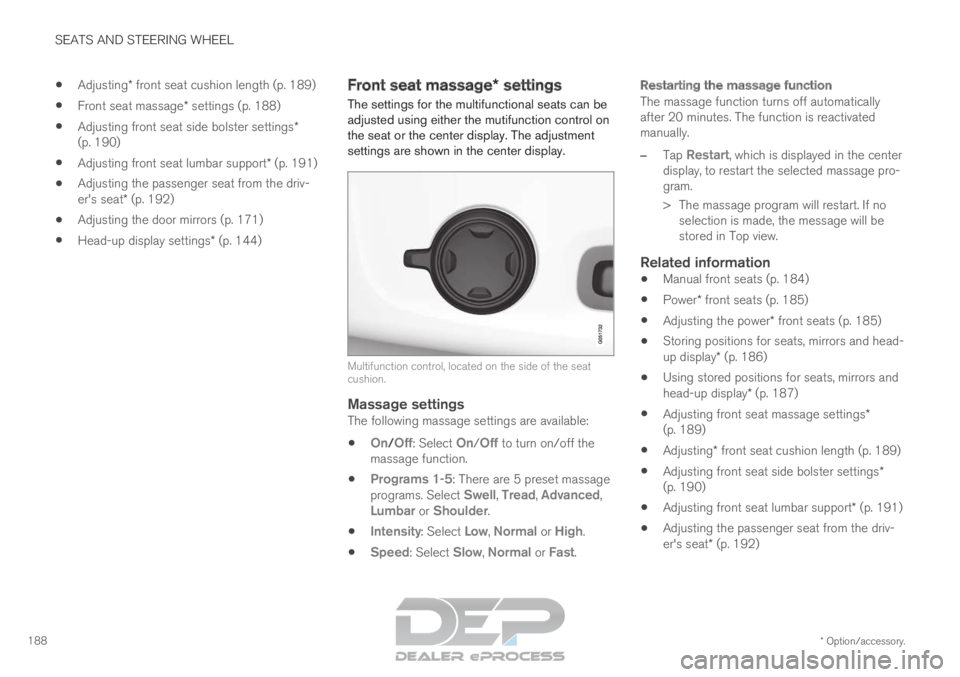
settings are shown in the center display. Multifunction control, located on the side of the seat
cushion.
Massage settingsThe following massage settings are available:
On/
Off: Select On/Off to turn on/off the
massage function.
Programs 1-5: There are 5 preset massage
programs. Select Swell, Tread, Advanced,
Lumbar or Shoulder.
Intensity: Select Low, Normal or High.
Speed: Select Slow, Normal or Fast.
Restarting the massage function
The massage function turns off automatically
after 20 minutes. The function is reactivated
manually.
–
Tap
Restart, which is displayed in the center
display, to restart the selected massage pro-
gram.
>
The massage program will restart. If no
selection is made, the message will be
stored in Top view.
Related information
Manual front seats (p. 184)
Power* front seats (p. 185)
Adjusting the power* front seats (p. 185)
Storing positions for seats, mirrors and head-
up display* (p. 186)
Using stored positions for seats, mirrors and
head-up display* (p. 187)
Adjusting front seat massage settings*
(p. 189)
Adjusting* front seat cushion length (p. 189)
Adjusting front seat side bolster settings*
(p. 190)
Adjusting front seat lumbar support* (p. 191)
Adjusting the passenger seat from the driv-
er's seat* (p. 192)
Page 234 of 697
CLIMATE CONTROL
* Option/accessory.
232
Climate comfort retaining function (p. 237)
Parking climate symbols and messages
(p. 238) Preconditioning
Preconditioning the vehicle before driving can
help reduce wear and reduce energy consump-
tion during a trip.
Preconditioning can be started immediately or
started at a preset time using a timer.
The function utilizes several of the vehicle's sys-
tems: In cold weather, the parking heater heats the
passenger compartment to a comfortable
temperature.
In warm weather, air conditioning cools the
passenger compartment to a comfortable
temperature.
The electrically heated steering wheel* and
seats* can be activated.
Heating for the windshield, rear window and
door mirrors are automatically activated as
needed.
During preconditioning in a hot climate, conden-
sation from the air conditions may drip under the
vehicle. This is normal.
NOTE Preconditioning is only available when the car
is connected to an electrical outlet. A charg-
ing post that is not always active, for example
because of a timer, can cause loss of function
for preconditioning.
If the car is not connected to an electrical
socket it is still possible in a warm climate to
achieve brief cooling of the passenger com-
partment by direct starting preconditioning.
NOTE
During preconditioning of the passenger
compartment, the vehicle works to reach a
comfortable temperature and not the tem-
perature set in the climate system.
Related information
Parking climate (p. 231)
Starting and stopping preconditioning
(p. 233)
Preconditioning timer (p. 234)
Page 236 of 697

||CLIMATE CONTROL
234
Related information
Parking climate (p. 231)
Preconditioning (p. 232)
Preconditioning timer (p. 234) Preconditioning timer
The timer can be set to finish preconditioning at
a predetermined time.
The timer can store up to 8 preset times for:
A time on a particular date
A time on one or more days of the week, with
or without the repeat function.
NOTE Preconditioning is only available when the car
is connected to an electrical outlet. A charg-
ing post that is not always active, for example
because of a timer, can cause loss of function
for preconditioning.
If the car is not connected to an electrical
socket it is still possible in a warm climate to
achieve brief cooling of the passenger com-
partment by direct starting preconditioning.
Related information
Preconditioning (p. 232)
Adding and editing timer settings for precon-
ditioning (p. 234)
Activating and deactivating preconditioning
timer (p. 235)
Deleting preconditioning timer settings
(p. 236) Adding and editing timer settings
for preconditioning
The preconditioning timer can store up to 8 pre-
set timer settings.
Adding a timer setting Button for adding a timer setting in the Parking climate
tab in Climate view.
1. Open Climate view in the center display.
2.
Select the Parking climate tab.
3. Tap Add timer.
>
A pop-up window will appear.
NOTE It is not possible to add a time setting if there
are already 8 settings for the timer. Delete a
time setting to be able to add a new one.
Page 271 of 697
KEY, LOCKS AND ALARM
* Option/accessory.269
Related information
Setting a maximum height for the power tail-
gate* (p. 269)
Foot movement tailgate operation* (p. 270)
Remote key range (p. 248) Setting a maximum height for the
power tailgate*
The tailgate can be set to stop opening at a cer-
tain height, for example if the tailgate needs to
be opened in a garage with a low ceiling.
Setting maximum opening height:
1.
Open the tailgate to the desired opening
height.
NOTE It is not possible to program an opening posi-
tion lower than half-open tailgate.
2.
Press the button on the lower edge of
the tailgate and hold for at least 3 seconds.
>
Two brief audio signals will sound to indi-
cate that the position has been stored.
Resetting to maximum opening position:
– Move the tailgate manually to its highest
possible position and press the button
on the tailgate for at least 3 seconds.
>
Two audio signals will sound to indicate
that the stored position has been erased.
The tailgate can then be opened to its
maximum position.
NOTE
If the system has been working continu-
ously for a prolonged period of time, it will
be switched off to avoid overload. It can
be used again after approximately
2 minutes.
Related information
Opening and closing the power tailgate*
(p. 266)
Page 274 of 697
KEY, LOCKS AND ALARM
* Option/accessory.
272 Activating and deactivating private
locking
Private locking is activated using the function
button in the center display and a PIN code.
NOTE For the valet lock function to be activated the
car must be in at least ignition mode I.
Entering security code before initial useThe first time the function is used, a security
code must be selected. This code can then be
used to deactivate private locking if the selected
PIN code has been lost or forgotten. The security
code functions as a PUK (security) code for all
PIN codes used for private locking.
Save the security code in a safe place.
To create a security code:
1. Tap the button for private locking in Function
view. > A pop-up window will appear. 2.
Enter your security code.
> The security code is saved. The private locking function is now ready for activa-
tion.
If the system has been reset, the above proce-
dure will need to be repeated.
Activating private locking1. Tap the button for private locking in Function view. > A pop-up window will appear.
2.
Enter the code you would like to use to
unlock the glove compartment and the tail-
gate and tap Confirm.
>
The glove compartment and tailgate will
lock. A green indicator light will illuminate
next to the button in Function view to con-
firm locked status.
Deactivating private locking1. Tap the button for private locking in Function view. > A pop-up window will appear.
2.
Enter the code used for locking and tap
Confirm.
>
The glove compartment and tailgate will
unlock. The green indicator light next to
the button in Function view will go out to
confirm unlocked status.
NOTE If you have forgotten or lost your PIN code or
if the PIN code has been entered incorrectly
more than three times, the security code can
be used to deactivate private locking.
NOTE
If private locking is activated and the vehicle
is unlocked using Volvo On Call* or the Volvo
On Call* app, private locking will be deacti-
vated automatically.
Page 285 of 697
DRIVER SUPPORT
283
Speed limiter
A Speed Limiter (SL 11
) could be described as a
reverse cruise control. The driver regulates the
vehicle's speed using the accelerator pedal, but
is prevented by the Speed Limiter from inadver-
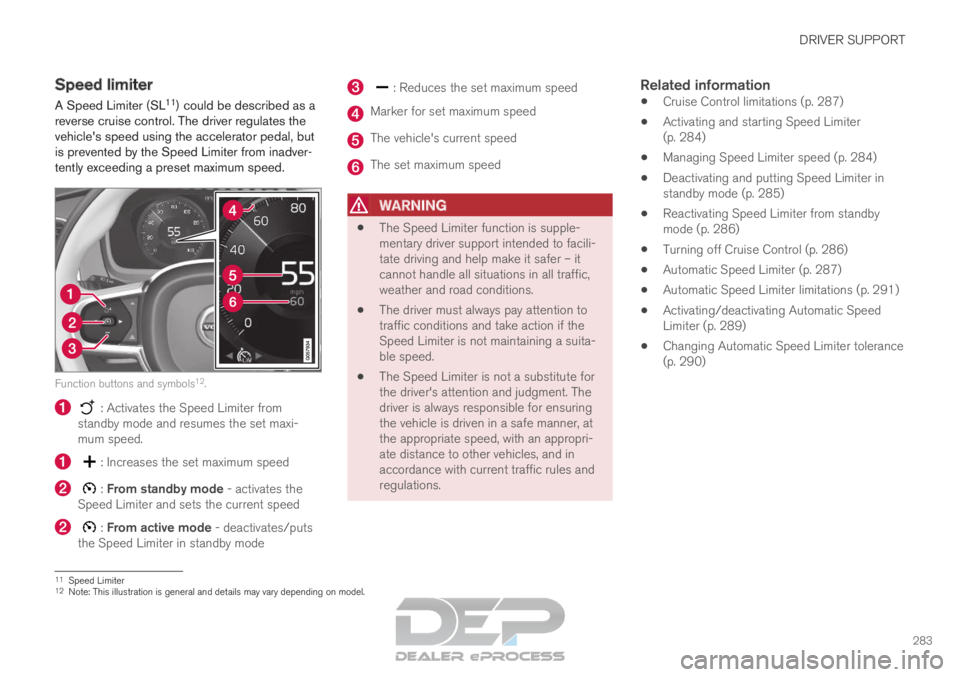
tently exceeding a preset maximum speed. Function buttons and symbols
12
. : Activates the Speed Limiter from
standby mode and resumes the set maxi-
mum speed. : Increases the set maximum speed
: From standby mode - activates the
Speed Limiter and sets the current speed : From active mode - deactivates/puts
the Speed Limiter in standby mode : Reduces the set maximum speed
Marker for set maximum speed
The vehicle's current speed
The set maximum speed
WARNING
The Speed Limiter function is supple-
mentary driver support intended to facili-
tate driving and help make it safer – it
cannot handle all situations in all traffic,
weather and road conditions.
The driver must always pay attention to
traffic conditions and take action if the
Speed Limiter is not maintaining a suita-
ble speed.
The Speed Limiter is not a substitute for
the driver's attention and judgment. The
driver is always responsible for ensuring
the vehicle is driven in a safe manner, at
the appropriate speed, with an appropri-
ate distance to other vehicles, and in
accordance with current traffic rules and
regulations.
Related information
Cruise Control limitations (p. 287)
Activating and starting Speed Limiter
(p. 284)
Managing Speed Limiter speed (p. 284)
Deactivating and putting Speed Limiter in
standby mode (p. 285)
Reactivating Speed Limiter from standby
mode (p. 286)
Turning off Cruise Control (p. 286)
Automatic Speed Limiter (p. 287)
Automatic Speed Limiter limitations (p. 291)
Activating/deactivating Automatic Speed
Limiter (p. 289)
Changing Automatic Speed Limiter tolerance
(p. 290) 11
Speed Limiter
12 Note: This illustration is general and details may vary depending on mod\
el.
Page 299 of 697

DRIVER SUPPORT
}}
* Option/accessory. 297Distance Alert warning light on the windshield
32
.
A warning light will appear on the windshield and
glow steadily if the time interval to the vehicle
ahead is shorter than the set time interval.
NOTE Visual warnings on the windshield may be dif-
ficult to notice in cases of strong sunlight,
reflections, extreme light contrasts, or if the
driver is wearing sunglasses or is not looking
straight ahead.
NOTE
Distance Alert is only available in vehicles
that can display information on the wind-
shield with a head-up display.
Distance Alert is deactivated while Adap-
tive Cruise Control or Pilot Assist is
active.
WARNING Distance Alert only reacts of the time interval
to the vehicle ahead is shorter than the preset
value – vehicle speed is not affected.
Related information
Head-up display for Distance Alert (p. 297)
Activating/deactivating Distance Alert
(p. 298)
Setting a time interval for Distance Alert
(p. 298)
Distance Alert limitations (p. 299) Head-up display for Distance Alert
33
In vehicles equipped with a head-up display*, a
symbol will be displayed on the windshield as
long as the time interval to the vehicle ahead is
shorter than the set time interval. Distance Alert warning symbol on the windshield
34
.
For this to be possible, however, the
Show
Driver Support function must be activated
under Settings in the center display's menus (see
"Head-up display" for instructions). 32
Note: This illustration is general and details may vary depending on mod\
el.
33 The Distance Alert function is only available in vehicles that can displ\
ay information on the windshield with a head-up display.
34 Note: This illustration is general and details may vary depending on mod\
el.
Page 308 of 697
||DRIVER SUPPORT
* Option/accessory.
306
Automatic transmission
Adaptive Cruise Control can follow another vehi-
cle at speeds from a standstill up to 200 km/h
(125 mph).
The lowest speed that can be set for Adaptive
Cruise Control is 30 km/h (20 mph). When fol-
lowing another vehicle, ACC can monitor that
vehicle's speed and slow your own vehicle down
to a standstill, but it is not possible to set speeds
lower than 30 km/h (20 mph).
The highest possible speed that can be set is
200 km/h (125 mph).
Related information
Adaptive Cruise Control* (p. 300) Setting Adaptive Cruise Control
time intervals
Adaptive Cruise Control (ACC
44
) can be set to
various time intervals to the vehicle ahead.
Different time intervals to the
vehicle ahead can be selected
and are shown in the instru-
ment panel as 1–5 horizontal
bars. The more bars, the longer
the time interval. One bar rep-
resents an interval of
approx. 1 second to the vehicle ahead. 5 bars
represents approx. 3 seconds.
The same symbol appears when the Distance
Alert function is activated.
NOTE When the symbol in the instrument panel
shows two vehicles, ACC is following the vehi-
cle ahead at a preset time interval.
When only one vehicle is shown, there is no
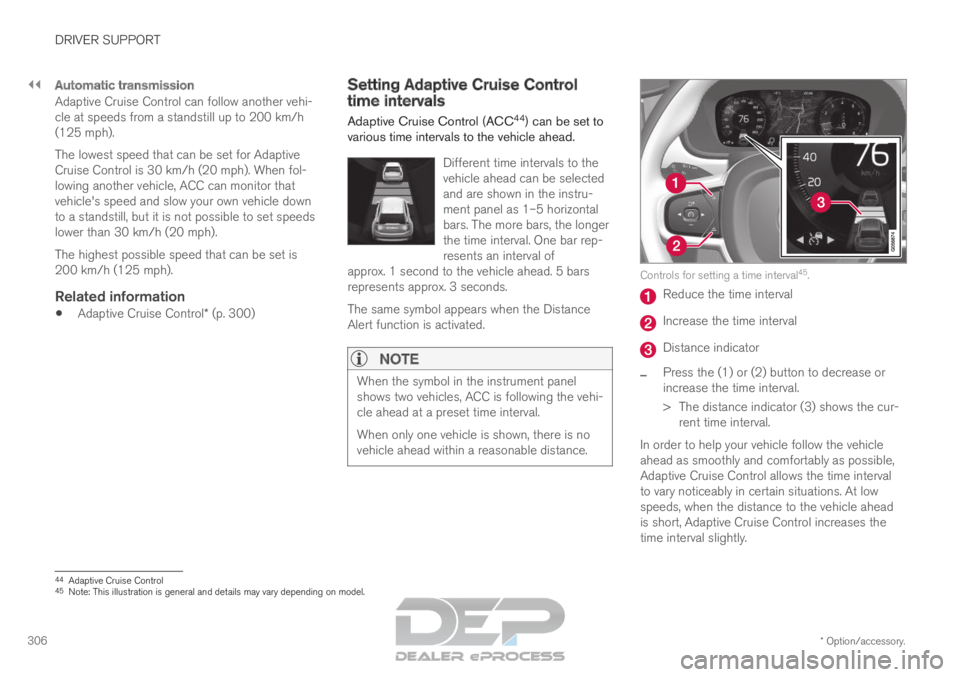
vehicle ahead within a reasonable distance. Controls for setting a time interval
45
. Reduce the time interval
Increase the time interval
Distance indicator
– Press the (1) or (2) button to decrease or
increase the time interval.
>
The distance indicator (3) shows the cur-
rent time interval.
In order to help your vehicle follow the vehicle
ahead as smoothly and comfortably as possible,
Adaptive Cruise Control allows the time interval
to vary noticeably in certain situations. At low
speeds, when the distance to the vehicle ahead
is short, Adaptive Cruise Control increases the
time interval slightly. 44
Adaptive Cruise Control
45 Note: This illustration is general and details may vary depending on mod\
el.