warning VOLVO XC90 TWIN ENGINE 2019 Manual PDF
[x] Cancel search | Manufacturer: VOLVO, Model Year: 2019, Model line: XC90 TWIN ENGINE, Model: VOLVO XC90 TWIN ENGINE 2019Pages: 697, PDF Size: 10.33 MB
Page 198 of 697

||SEATS AND STEERING WHEEL
* Option/accessory.
196 To lower the restraint, press and hold the button
(located between the backrest and the head
restraint, see illustration) while carefully lowering
the head restraint.
WARNING
The center seat head restraint must be in its
lowest position when the seat is not occupied.
When the center seat is occupied, the head
restraint must be correctly adjusted to the
passenger's height, covering the entire back
of the head if possible.
Electrically folding down the rear seat's
outboard head restraints* The outer head restraints can be folded via the
center display's function view. The head restraint
can be folded down when the vehicle is in igni-
tion mode 0.
Tap the Headrest Fold button
to activate/deactivate folding. Manually push the head restraint until it clicks
into position.WARNING Do not lower the head restraint if there are
passengers in any of the rear seats.
WARNING
The head restraint must be locked in the
upright position after it has been folded up.
WARNING
The head restraints on the outboard second-
row seats must always be folded up when
there are passengers in the third row of
seats*.
Related information
Folding the second row backrests (p. 193)
Moving the second row seats forward/rear-
ward* (p. 197)
Adjusting the second row backrest tilt
(p. 197)
Getting into and out of the third row of
seats* (p. 198)
Folding the third row backrests* (p. 199)
Page 199 of 697
SEATS AND STEERING WHEEL
}}
* Option/accessory. 197
Moving the second row seats
forward/rearward*
In vehicles with 7 seats*, the seats in the second
row can be moved forward or rearward individu-
ally to help optimize legroom for passengers in
the second and third rows. The second row
seats cannot be moved forward or backward in
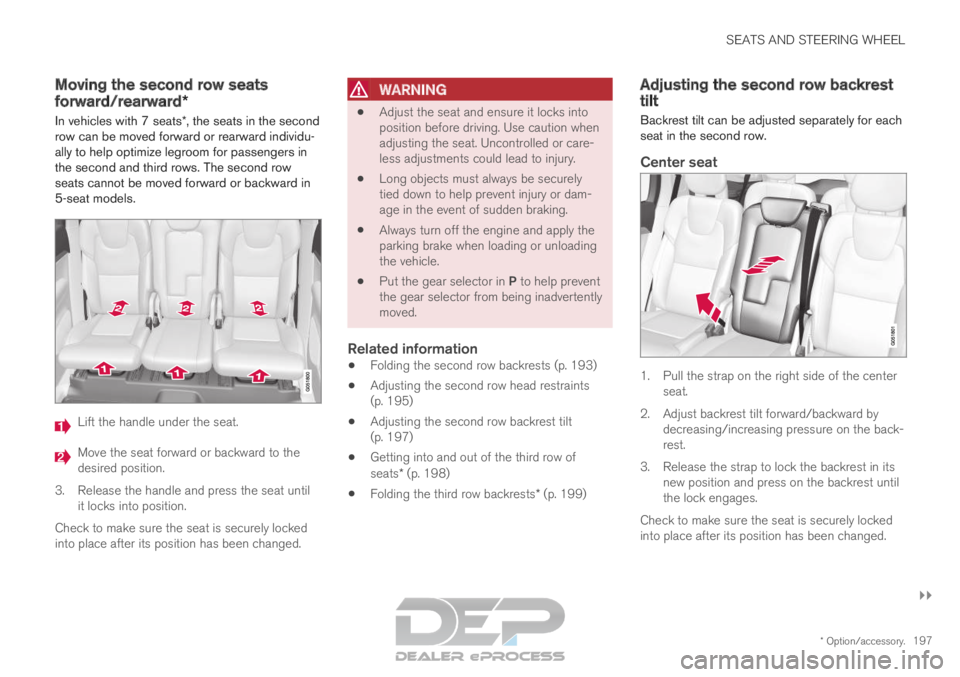
5-seat models. Lift the handle under the seat.
Move the seat forward or backward to the
desired position.
3.
Release the handle and press the seat until
it locks into position.
Check to make sure the seat is securely locked
into place after its position has been changed.
WARNING
Adjust the seat and ensure it locks into
position before driving. Use caution when
adjusting the seat. Uncontrolled or care-
less adjustments could lead to injury.
Long objects must always be securely
tied down to help prevent injury or dam-
age in the event of sudden braking.
Always turn off the engine and apply the
parking brake when loading or unloading
the vehicle.
Put the gear selector in P to help prevent
the gear selector from being inadvertently
moved.
Related information
Folding the second row backrests (p. 193)
Adjusting the second row head restraints
(p. 195)
Adjusting the second row backrest tilt
(p. 197)
Getting into and out of the third row of
seats* (p. 198)
Folding the third row backrests* (p. 199) Adjusting the second row backrest
tilt
Backrest tilt can be adjusted separately for each
seat in the second row.
Center seat 1. Pull the strap on the right side of the center
seat.
2.
Adjust backrest tilt forward/backward by
decreasing/increasing pressure on the back-
rest.
3. Release the strap to lock the backrest in its new position and press on the backrest until
the lock engages.
Check to make sure the seat is securely locked
into place after its position has been changed.
Page 200 of 697

||SEATS AND STEERING WHEEL
* Option/accessory.
198
Outboard seats 1. Pull the handle on the side of the seat
upward.
2.
Adjust backrest tilt forward/backward by
decreasing/increasing pressure on the back-
rest.
3. Release the handle to lock the backrest in its new position and press on the backrest until
the lock engages.
Check to make sure the seat is securely locked
into place after its position has been changed.
WARNING
Adjust the seat and ensure it locks into
position before driving. Use caution when
adjusting the seat. Uncontrolled or care-
less adjustments could lead to injury.
Long objects must always be securely
tied down to help prevent injury or dam-
age in the event of sudden braking.
Always turn off the engine and apply the
parking brake when loading or unloading
the vehicle.
Put the gear selector in P to help prevent
the gear selector from being inadvertently
moved.
Related information
Folding the second row backrests (p. 193)
Adjusting the second row head restraints
(p. 195)
Moving the second row seats forward/rear-
ward* (p. 197)
Getting into and out of the third row of
seats* (p. 198)
Folding the third row backrests* (p. 199) Getting into and out of the third row
of seats*
The second row of seats can be adjusted for
easier access to the third row of seats*. To fold down the backrest:
1.
Pull the handle on the upper side of the right
or left outboard second row seat upward/
forward.
2. Fold the backrest down and move the entire seat forward.
To return the seat to the upright position:
– Push the seat rearward to its end position.
The backrest should then easily return to the
correct position.
Page 201 of 697

SEATS AND STEERING WHEEL
}}
* Option/accessory. 199
NOTEIf a backrest in the second row of seats does
not lock back into the upright position after
being folded down (e.g. for getting in or out of
the third row of seats), it may need to be
pushed forward again and then pushed back
with more force.
WARNING
Make sure that the rear seat backrest and
head restraint are locked securely in place
after the seat is folded up.
The head restraints at the outer seats must
always be raised when there is a passenger in
one of these spots of the rear seat.
Related information
Folding the second row backrests (p. 193)
Adjusting the second row head restraints
(p. 195)
Moving the second row seats forward/rear-
ward* (p. 197)
Adjusting the second row backrest tilt
(p. 197)
Folding the third row backrests* (p. 199) Folding the third row backrests*
The third row has two individual seats. These
can be folded down separately.
CAUTION To fold down the third-row seat backrests, it
may be necessary to change the position/tilt
the seats in the second row.
1. Pull the handle on the upper side of the
backrest upward/forward. 2.
Make sure that backrest and head restraint
do not come in contact with the seat in front
while the backrest is being folded down. Fold
the backrest down.
> The seat cushion will move downward/ forward when the backrest is folded down
and create a flat surface. The head
restraint folds down automatically when
the backrest is lowered.
To return the seat to the upright position, fold the
backrest up manually until it locks into position.
Fold up the head restraint manually.
WARNING Make sure that the rear seat backrest and
head restraint are locked securely in place
after the seat is folded up.
The head restraints at the outer seats must
always be raised when there is a passenger in
one of these spots of the rear seat.
Related information
Folding the second row backrests (p. 193)
Adjusting the second row head restraints
(p. 195)
Moving the second row seats forward/rear-
ward* (p. 197)
Page 203 of 697

SEATS AND STEERING WHEEL
* Option/accessory.201
Adjusting the steering wheel
The steering wheel can be adjusted to various
positions. The steering wheel's reach and height can be adjusted.
WARNING
Adjust the steering wheel and ensure it locks
into position before driving. Never adjust the
steering wheel while driving.
Steering wheel force can be adjusted with
speed-dependent power steering. Steering wheel
force is adjusted according to the vehicle's speed
to give the driver an enhanced sense of control
and stability. Steering wheel adjuster lever.
1. Move the lever forward to release the steer-
ing wheel.
2.
Adjust the steering wheel to the desired
position.
3. Pull the lever back to lock the steering wheel into place. If the lever is difficult to move,
press the steering wheel lightly while pulling
the lever.
Related information
Steering wheel controls and horn (p. 200)
Adjusting the power* front seats (p. 185)
Page 246 of 697
||KEY, LOCKS AND ALARM
* Option/accessory.
244 The keyless system for locking/unlocking the
doors and tailgate (Passive Entry*) is available as
an option. This system has a range in a semicircle
with a radius of approximately 1.5 meter (5 feet)
out from the driver's door and approx. 1 meter
(3 feet) out from the tailgate.
With keyless start in combination with keyless
locking and unlocking, the remote key can be
located anywhere in the passenger compartment
or cargo compartment in order to start the
engine.
Each remote key supplied with the vehicle can be
linked to a driver profile with unique settings for
the vehicle. When a key with a specific profile is
used, the vehicle settings are adjusted according
to that profile.
Buttonless key, Key TagFor vehicles equipped with keyless locking and
unlocking*, a smaller, lighter and button-less key
(Key Tag 4
) is also provided. It works the same
way as the regular remote key as regard keyless
start and keyless locking and unlocking. The key
is waterproof up to a depth of approx. 10 meters
(30 feet) for up to 60 minutes. It does not have a
detachable key blade and its battery cannot be
replaced.
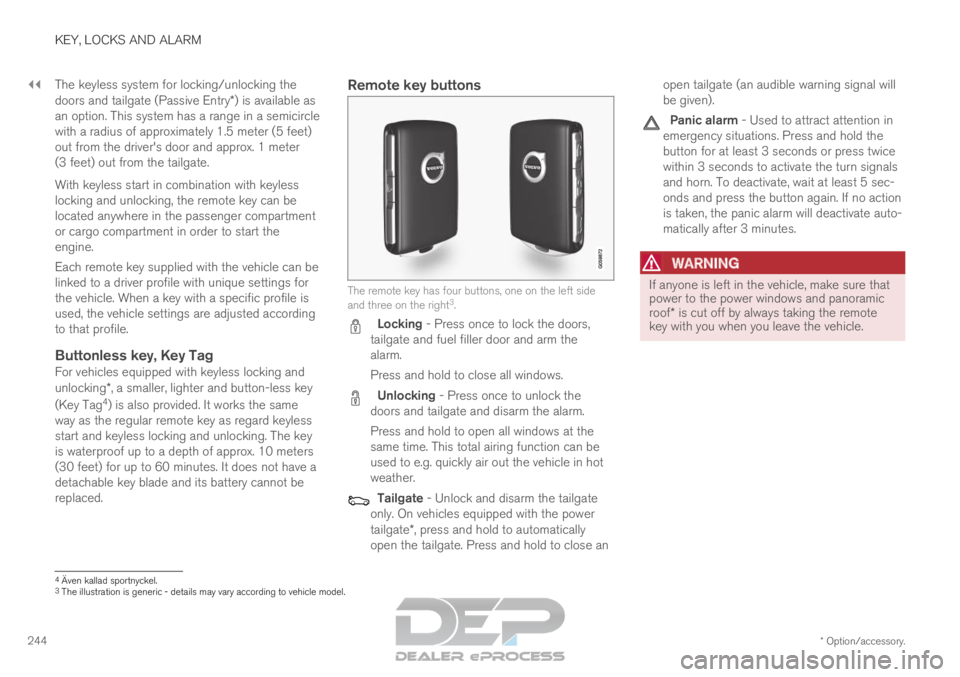
Remote key buttons The remote key has four buttons, one on the left side
and three on the right
3
. Locking - Press once to lock the doors,
tailgate and fuel filler door and arm the
alarm.
Press and hold to close all windows. Unlocking - Press once to unlock the
doors and tailgate and disarm the alarm.
Press and hold to open all windows at the
same time. This total airing function can be
used to e.g. quickly air out the vehicle in hot
weather. Tailgate - Unlock and disarm the tailgate
only. On vehicles equipped with the power
tailgate*, press and hold to automatically
open the tailgate. Press and hold to close an open tailgate (an audible warning signal will
be given). Panic alarm - Used to attract attention in
emergency situations. Press and hold the
button for at least 3 seconds or press twice
within 3 seconds to activate the turn signals
and horn. To deactivate, wait at least 5 sec-
onds and press the button again. If no action
is taken, the panic alarm will deactivate auto-
matically after 3 minutes.
WARNING If anyone is left in the vehicle, make sure that
power to the power windows and panoramic
roof* is cut off by always taking the remote
key with you when you leave the vehicle. 4
Även kallad sportnyckel.
3 The illustration is generic - details may vary according to vehicle mode\
l.
Page 247 of 697
KEY, LOCKS AND ALARM
* Option/accessory.245
NOTEBe aware of the risk of locking the remote
key in the vehicle.
If the remote key or Key Tag is left in the
vehicle, it will be deactivated when the
vehicle is locked and the alarm set using
another valid key. The deactivated key will
be reactivated when the vehicle is
unlocked.
If the remote key or Red Key is left in the
vehicle, it will be deactivated even if the
vehicle is locked using Volvo On Call, and
will be reactivated when the vehicle is
unlocked using Volvo On Call or by
pressing the unlock button on the key.
InterferenceElectromagnetic fields or obstructing objects may
interfere with the remote key's functions for key-
less start and keyless locking and unlocking*.
NOTE Avoid storing the remote control key near
metal objects or electronic devices, e.g. cell
phones, tablets, laptops or chargers – pref-
erably no closer than 10-15 cm (4-6 in.).
If you experience interference, use the remote
key's detachable blade to unlock the vehicle and place the remote key in the backup key reader in
the tunnel console cup holder to disarm the
alarm.
NOTE When the remote control key is placed in the
cup holder, make sure that no other vehicle
keys, metal objects or electronic devices (e.g.
cell phones, tablets, laptops or chargers) are
found in the cup holder. Multiple vehicle keys
close to each other in the cup holder can dis-
rupt their functionality.
WARNING
California Proposition 65
Operating, servicing and maintaining a pas-
senger vehicle can expose you to chemicals
including engine exhaust, carbon monoxide,
phthalates, and lead, which are known to the
State of California to cause cancer and birth
defects or other reproductive harm. To mini-
mize exposure, avoid breathing exhaust, do
not idle the engine except as necessary, serv-
ice your vehicle in a well ventilated area and
wear gloves or wash your hands frequently
when servicing your vehicle. For more infor-
mation go to www.P65Warnings.ca.gov/
passenger-vehicle.
Related information
Locking and unlocking using the remote key
(p. 246)
Remote key range (p. 248)
Replacing the remote key's battery (p. 249)
Detachable key blade (p. 254)
Electronic immobilizer (p. 257)
Linking a remote key to a driver profile
(p. 138)
Page 250 of 697
||KEY, LOCKS AND ALARM
* Option/accessory.
248 1.
Press the button on the remote key.
>
The lock and alarm indicator on the dash-
board will go out to indicate that the vehi-
cle is no longer fully armed.
The tailgate will be unlocked but remain
closed. However, the side doors will
remain locked and armed.
Press lightly on the rubberized pressure
plate under the tailgate handle to open
the tailgate.
If the tailgate is not opened within
2 minutes, it will be relocked and the
alarm armed.
2. With the optional power tailgate* -
Hold and press (about 1.5 seconds) the button on the remote key
>
The tailgate will unlock and open. How-
ever, the side doors will remain locked and
armed.
Related information
Locking and unlocking using the remote key
(p. 246)
Opening and closing the power tailgate*
(p. 266) Remote key range
In order to function correctly, the remote key
must be within a certain distance from the vehi-
cle.
Manual useThe remote key's functions for e.g. locking and
unlocking, which are activated by pressing or
, have a range of approx. 20 meters (65 feet)
from the vehicle.
If the vehicle's locks do not react, move closer
and try again.
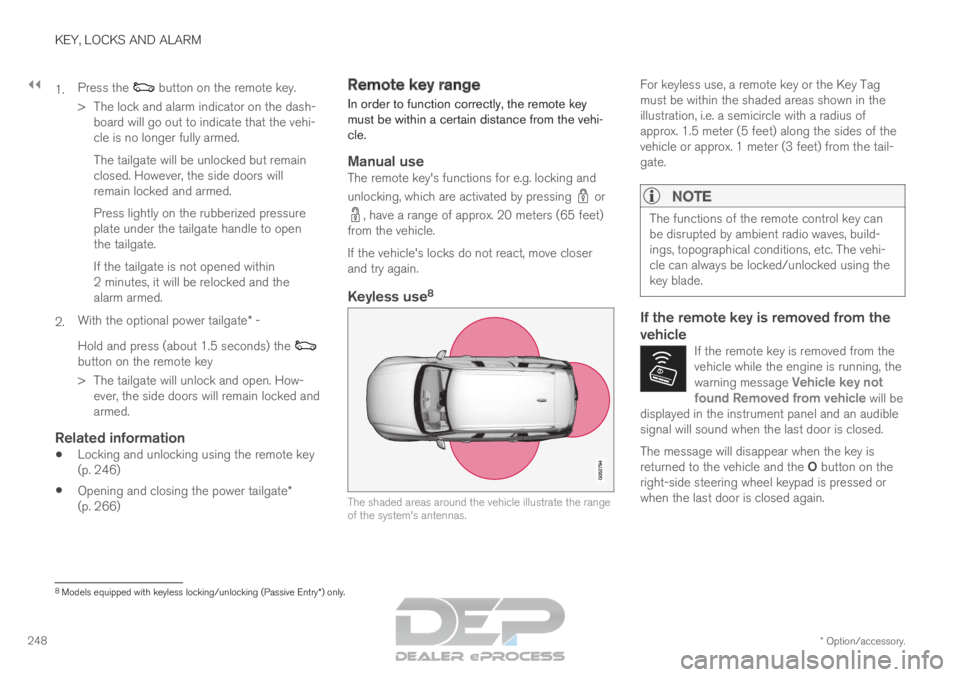
Keyless use 8 The shaded areas around the vehicle illustrate the range
of the system's antennas.For keyless use, a remote key or the Key Tag
must be within the shaded areas shown in the
illustration, i.e. a semicircle with a radius of
approx. 1.5 meter (5 feet) along the sides of the
vehicle or approx. 1 meter (3 feet) from the tail-
gate.
NOTE The functions of the remote control key can
be disrupted by ambient radio waves, build-
ings, topographical conditions, etc. The vehi-
cle can always be locked/unlocked using the
key blade.
If the remote key is removed from the
vehicle
If the remote key is removed from the
vehicle while the engine is running, the
warning message
Vehicle key not
found Removed from vehicle will be
displayed in the instrument panel and an audible
signal will sound when the last door is closed. The message will disappear when the key is
returned to the vehicle and the O button on the
right-side steering wheel keypad is pressed or
when the last door is closed again.
8 Models equipped with keyless locking/unlocking (Passive Entry*) only.
Page 254 of 697

||KEY, LOCKS AND ALARM
* Option/accessory.
252
CAUTION Be sure to dispose of end-of-life batteries in
a way that protects the environment.
WARNING
California Proposition 65
Operating, servicing and maintaining a pas-
senger vehicle can expose you to chemicals
including engine exhaust, carbon monoxide,
phthalates, and lead, which are known to the
State of California to cause cancer and birth
defects or other reproductive harm. To mini-
mize exposure, avoid breathing exhaust, do
not idle the engine except as necessary, serv-
ice your vehicle in a well ventilated area and
wear gloves or wash your hands frequently
when servicing your vehicle. For more infor-
mation go to www.P65Warnings.ca.gov/
passenger-vehicle.
Related information
Remote key (p. 243) Ordering additional remote keys
Two remote keys are provided with the vehicle.
One Key Tag is also included if the vehicle is
equipped with keyless locking/unlocking*. Addi-
tional keys can be ordered.
A total of 12 keys can be programmed and used
for the same vehicle. An additional driver profile
will be added for each new remote key. This also
applies to the key tag.
Loss of a remote keyIf you lose your remote key, you can order a
replacement from a workshop - an authorized
Volvo workshop is recommended. Bring the other
remaining remote keys to the workshop. As an
anti-theft measure, the code of the lost remote
key must be erased from the system.
The current number of keys registered for the
vehicle can be checked via driver profiles in the
center display's Top view. Select Settings System Driver Profiles
.
NOTE Volvo recommends that you order a new or
duplicate remote control key from an author-
ized Volvo workshop.
You can also obtain additional or duplicate
remote control keys from certain independent
repair facilities and locksmiths that are quali-
fied to make remote control keys. Each key
must be programmed to work with your vehi-
cle.
A list of independent repair facilities and/or
locksmiths known to Volvo that can cut and
code replacement keys can be found:
on Volvo's website www.volvocars.com/us
by calling Volvo Customer Care
1-800-458-1552.
Related information
Remote key (p. 243)
Page 255 of 697
KEY, LOCKS AND ALARM
}}
* Option/accessory. 253
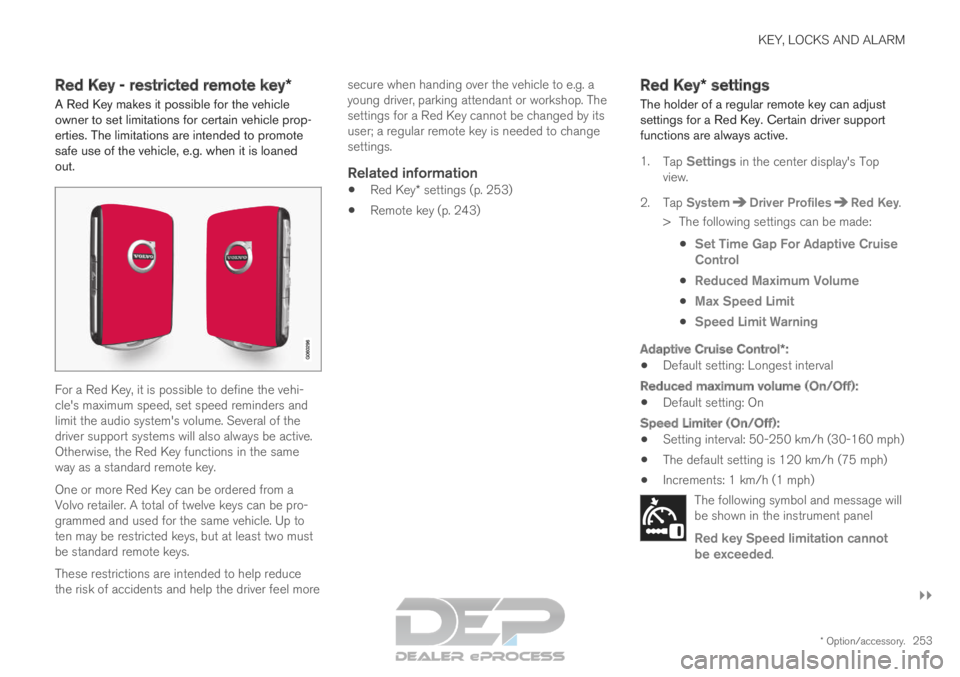
Red Key - restricted remote key*
A Red Key makes it possible for the vehicle
owner to set limitations for certain vehicle prop-
erties. The limitations are intended to promote
safe use of the vehicle, e.g. when it is loaned
out. For a Red Key, it is possible to define the vehi-
cle's maximum speed, set speed reminders and
limit the audio system's volume. Several of the
driver support systems will also always be active.
Otherwise, the Red Key functions in the same
way as a standard remote key.
One or more Red Key can be ordered from a
Volvo retailer. A total of twelve keys can be pro-
grammed and used for the same vehicle. Up to
ten may be restricted keys, but at least two must
be standard remote keys.
These restrictions are intended to help reduce
the risk of accidents and help the driver feel more secure when handing over the vehicle to e.g. a
young driver, parking attendant or workshop. The
settings for a Red Key cannot be changed by its
user; a regular remote key is needed to change
settings.
Related information
Red Key* settings (p. 253)
Remote key (p. 243) Red Key*
settings
The holder of a regular remote key can adjust
settings for a Red Key. Certain driver support
functions are always active.
1. Tap Settings in the center display's Top
view.
2.
Tap System Driver Profiles Red Key
.
> The following settings can be made:
Set Time Gap For Adaptive Cruise
Control
Reduced Maximum Volume
Max Speed Limit
Speed Limit Warning
Adaptive Cruise Control*:
Default setting: Longest interval
Reduced maximum volume (On/Off):
Default setting: On
Speed Limiter (On/Off):
Setting interval: 50-250 km/h (30-160 mph)
The default setting is 120 km/h (75 mph)
Increments: 1 km/h (1 mph)
The following symbol and message will
be shown in the instrument panel
Red key Speed limitation cannot
be exceeded.