child lock VOLVO XC90 TWIN ENGINE 2019 Owners Manual
[x] Cancel search | Manufacturer: VOLVO, Model Year: 2019, Model line: XC90 TWIN ENGINE, Model: VOLVO XC90 TWIN ENGINE 2019Pages: 697, PDF Size: 10.33 MB
Page 8 of 697

6
Activating and deactivating climatecontrol for the third-row seats*231
Parking climate231
Preconditioning232
Starting and stopping preconditioning233
Preconditioning timer234
Adding and editing timer settings forpreconditioning234
Activating and deactivating precondi-tioning timer235
Deleting preconditioning timer settings236
Climate comfort retaining function237
Starting and switching off the cli-mate retaining function when parking237
Parking climate symbols and messages238
Heater239
Parking heater239
Additional heater239
Activating and deactivating the auxili-ary heater240
KEY, LOCKS AND ALARM
Lock indication242
Lock confirmation settings243
Remote key243
Locking and unlocking using theremote key246
Settings for remote and inside doorunlock247
Unlocking the tailgate using theremote key247
Remote key range248
Replacing the remote key's battery249
Ordering additional remote keys252
Red Key - restricted remote key*253
Red Key* settings253
Detachable key blade254
Locking and unlocking with detacha-ble key blade255
Electronic immobilizer257
Start and lock system type designations257
Keyless and touch-sensitive surfaces*258
Keyless locking and unlocking*259
Keyless unlock settings*261
Keyless tailgate unlock*261
Antenna locations for the start andlock system262
Locking and unlocking from insidethe vehicle262
Unlocking the tailgate from insidethe vehicle264
Activating and deactivating childsafety locks264
Automatic locking when driving266
Opening and closing the power tailgate*266
Setting a maximum height for thepower tailgate*269
Foot movement tailgate operation*270
Private Locking271
Activating and deactivating privatelocking272
Alarm273
Arming and disarming the alarm274
Page 50 of 697
||
SAFETY
48
WARNING
Never repair the belt yourself. Repairsshould only be performed by a trainedand qualified Volvo service technician.
Any device used to induce slack into theshoulder belt portion of the three-pointbelt system will have a detrimental effecton the amount of protection available inthe event of a collision.
The seat back should not be tilted too farback. The shoulder belt must be taut inorder to function properly.
Do not use any type of child restraint inthe front passenger seat. We recommendthat children who have outgrown thesedevices sit in the rear seat with the seatbelt properly fastened.
Related information
Safety (p. 42)
Seat belt tensioners (p. 50)
Buckling and unbuckling seat belts (p. 48)
Door and seat belt reminders (p. 51)
Buckling and unbuckling seat belts
Make sure that all passengers have buckledtheir seat belts before starting to drive.
Buckling seat belts
1. Pull out the belt slowly and make sure it isnot twisted or damaged.
If the seat belt in the second row centerseating position is used, make sure it is prop-erly positioned in the correct seat belt guide.
NOTE
Each seat belt is equipped with a retractorthat will lock up in the following situations:
if the belt is pulled out rapidly
during braking and acceleration
if the vehicle is leaning excessively
when driving in turns
if the automatic locking retractor/emer-gency locking retractor (ALR/ELR) is acti-vated. Each seat belt (except for the driv-er's) is equipped with an ALR function,which is designed to keep the seat belttaut when installing a child restraint. ALRis activated when the seat belt is pulledout as far as possible. If this is done, asound from the seat belt retractor will beaudible, which is normal. The seat belt cannow only be fed into the retractor, notpulled out. This function is automaticallydisabled when the seat belt is unbuckledand fully retracted.
Page 61 of 697

SAFETY
59
WARNING
No objects that add to the total weight onthe seat should be placed on the frontpassenger's seat. If a child is seated inthe front passenger's seat with any addi-tional weight, this extra weight couldcause the OWS system to enable the air-bag, which might cause it to deploy in theevent of a collision, thereby injuring thechild.
The seat belt should never be wrappedaround an object on the front passeng-er's seat. This could interfere with theOWS system's function.
The front passenger's seat belt shouldnever be used in a way that exerts morepressure on the passenger than normal.This could increase the pressure exertedon the weight sensor by a child, andcould result in the airbag being enabled,which might cause it to deploy in theevent of a collision, thereby injuring thechild.
WARNING
Keep the following points in mind withrespect to the OWS system. Failure tofollow these instructions could adverselyaffect the system's function and result inserious injury to the occupant of the frontpassenger's seat:
The full weight of the front seat passen-ger should always be on the seat cushion.The passenger should never lift him/herself off the seat cushion using thearmrest in the door or the center console,by pressing the feet on the floor, by sit-ting on the edge of the seat cushion, orby pressing against the backrest in a waythat reduces pressure on the seat cush-ion. This could cause OWS to disable thefront, passenger's side airbag.
WARNING
Do not place any type of object on thefront passenger's seat in such a way thatjamming, pressing, or squeezing occursbetween the object and the front seat,other than as a direct result of the correctuse of the Automatic Locking Retractor/Emergency Locking Retractor (ALR/ELR)seat belt.
No objects should be placed under thefront passenger's seat. This could inter-fere with the OWS system's function.
Related information
Driver/passenger-side airbags (p. 53)
Page 67 of 697

SAFETY
}}65
Related information
Safety (p. 42)
Child restraints (p. 65)
Activating and deactivating child safety locks
(p. 264) Child restraints
Suitable child restraints should always be used
when children travel in the vehicle.
Child restraint systems Infant seat
There are three main types of child restraint sys-
tems: infant seats, convertible seats and booster
cushions. They are classified according to the
child's age and size.
The child restraint should be secured using a
three-point seat belt, ISOFIX/LATCH anchors or
top tether anchors. Convertible seat
WARNING
A child seat should never be used in the front
passenger seat of any vehicle with a front
passenger airbag - not even if the "Passenger
airbag off" symbol near the rear-view mirror is
illuminated. If the severity of an accident were
to cause the airbag to inflate, this could lead
to serious injury or death to a child seated in
this position.
Page 68 of 697
||SAFETY
66
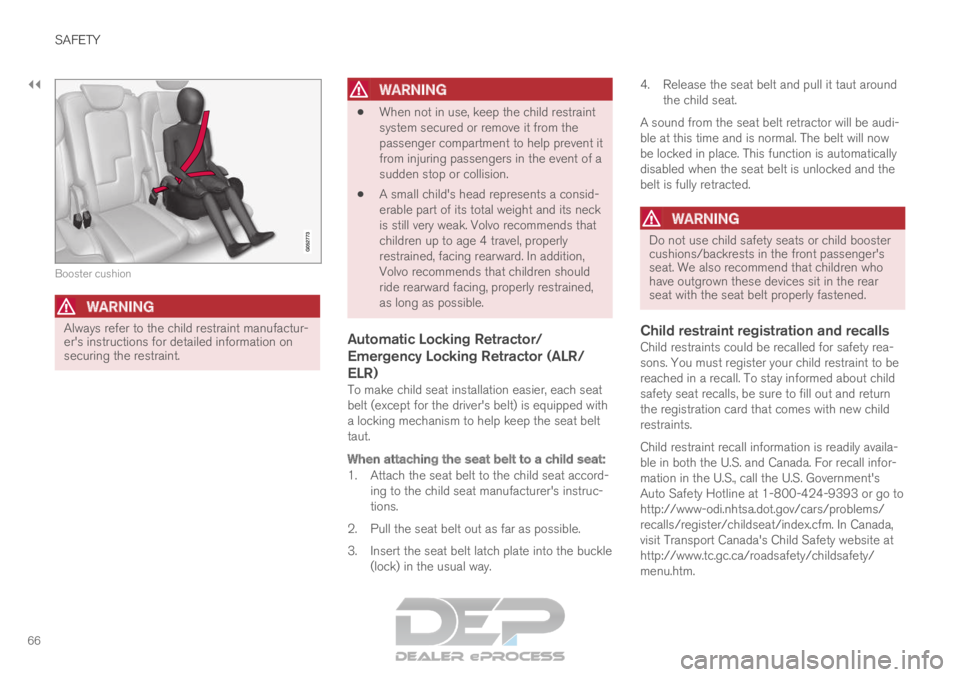
Booster cushion
WARNING
Always refer to the child restraint manufactur-
er's instructions for detailed information on
securing the restraint.
WARNING
When not in use, keep the child restraint
system secured or remove it from the
passenger compartment to help prevent it
from injuring passengers in the event of a
sudden stop or collision.
A small child's head represents a consid-
erable part of its total weight and its neck
is still very weak. Volvo recommends that
children up to age 4 travel, properly
restrained, facing rearward. In addition,
Volvo recommends that children should
ride rearward facing, properly restrained,
as long as possible.
Automatic Locking Retractor/
Emergency Locking Retractor (ALR/
ELR)
To make child seat installation easier, each seat
belt (except for the driver's belt) is equipped with
a locking mechanism to help keep the seat belt
taut.
When attaching the seat belt to a child seat:
1. Attach the seat belt to the child seat accord-
ing to the child seat manufacturer's instruc-
tions.
2. Pull the seat belt out as far as possible.
3. Insert the seat belt latch plate into the buckle (lock) in the usual way. 4. Release the seat belt and pull it taut around
the child seat.
A sound from the seat belt retractor will be audi-
ble at this time and is normal. The belt will now
be locked in place. This function is automatically
disabled when the seat belt is unlocked and the
belt is fully retracted.
WARNING Do not use child safety seats or child booster
cushions/backrests in the front passenger's
seat. We also recommend that children who
have outgrown these devices sit in the rear
seat with the seat belt properly fastened.
Child restraint registration and recallsChild restraints could be recalled for safety rea-
sons. You must register your child restraint to be
reached in a recall. To stay informed about child
safety seat recalls, be sure to fill out and return
the registration card that comes with new child
restraints.
Child restraint recall information is readily availa-
ble in both the U.S. and Canada. For recall infor-
mation in the U.S., call the U.S. Government's
Auto Safety Hotline at 1-800-424-9393 or go to
http://www-odi.nhtsa.dot.gov/cars/problems/
recalls/register/childseat/index.cfm. In Canada,
visit Transport Canada's Child Safety website at
http://www.tc.gc.ca/roadsafety/childsafety/
menu.htm.
Page 70 of 697

||SAFETY
68
WARNING
A child seat should never be used in the front
passenger seat of any vehicle with a front
passenger airbag - not even if the "Passenger
airbag off" symbol near the rear-view mirror is
illuminated. If the severity of an accident were
to cause the airbag to inflate, this could lead
to serious injury or death to a child seated in
this position.
3. Fasten the seat belt.
Fasten the seat belt by inserting the latch
plate into the buckle (lock) until a distinct
click is audible. Pull out the shoulder section of the seat belt.
4. Pull the shoulder section of the seat belt out
as far as possible to activate the belt's auto-
matic locking function.NOTE The locking retractor will automatically
release when the seat belt is unbuckled and
allowed to retract fully.
5. Press the infant seat firmly in place, let the
seat belt retract and pull it taut. A sound from
the seat belt retractor's automatic locking
function will be audible at this time and is
normal. The seat belt should now be locked
in place. Check that the infant seat is properly secured.
6. Press and pull the infant seat along the
direction of the seat belt to check that it is
properly held in place by the seat belt.
Page 72 of 697

||SAFETY
70
WARNING
A small child's head represents a consider-
able part of its total weight and its neck is
still very weak. Volvo recommends that
children up to age 4 travel, properly
restrained, facing rearward. In addition,
Volvo recommends that children should
ride rearward facing, properly restrained, as
long as possible.
Convertible child seats should be installed
in the rear seat only.
A rear-facing convertible seat should not
be positioned behind the driver's seat
unless there is adequate space for safe
installation.
2.
Attach the seat belt to the convertible seat
according to the child restraint manufactur-
er's instructions. Fasten the seat belt.
3. Fasten the seat belt by inserting the latch
plate into the buckle (lock) until a distinct
click is audible.
4.
Pull the shoulder section of the seat belt out
as far as possible to activate the belt's auto-
matic locking function.
NOTE The locking retractor will automatically
release when the seat belt is unbuckled and
allowed to retract fully.
5. Press the convertible seat firmly in place, let
the seat belt retract and pull it taut. A sound
from the seat belt retractor's automatic lock-
ing function will be audible at this time and is
normal. The seat belt should now be locked
in place. Pull out the shoulder section of the seat belt.
6. Push and pull the convertible seat along the
seat belt path to ensure that it is held
securely in place by the seat belt.
Page 74 of 697

||SAFETY
72
3. Fasten the seat belt by inserting the latch
plate into the buckle (lock) until a distinct
click is audible. Positioning the seat belt.
4. Ensure that the seat belt is pulled taut and
fits snugly around the child.
WARNING
The hip section of the three-point seat
belt must fit snugly across the child's
hips, not across the stomach.
The shoulder section of the three-point
seat belt should be positioned across the
chest and shoulder.
The shoulder belt must never be placed
behind the child's back or under the arm.
Related information
Child restraints (p. 65)
Convertible seats (p. 69)
Infant seats (p. 67)
Top tether anchors (p. 72)
Lower child seat attachment points (p. 74)
ISOFIX/LATCH lower anchors (p. 74) Top tether anchors
Your Volvo is equipped with child restraint top
tether anchorages for all three seating positions
in the rear seat. They are located on the rear
side of the backrests.
Child restraint anchorages Top tether anchors and symbols on the rear side of the
second row backrests. There is no symbol for the center
anchor position.
Page 75 of 697

SAFETY
73
Securing a child seat
1. Place the child restraint on the rear seat.
2. Route the top tether strap under the headrestraint and attach it to the anchor.
3. Attach the strap for the lower tether anchors in the lower ISOFIX/LATCH attachment
points. If the child restraint is not equipped
with straps for the lower tether anchors, or if
the child restraint is used on the center seat-
ing position, follow the instructions for
attaching a child restraint using the auto-
matic locking seat belt.
4. Firmly tension all straps.
Refer also to the child seat manufacturer's
instructions for information on securing the child
seat.
NOTE If the vehicle is equipped with a cargo com-
partment cover, this must be removed before
a child seat can be attached in the tether
anchors.
WARNING
Always refer to the recommendations
made by the child restraint manufacturer.
Volvo recommends that the top tether
anchors be used when installing a for-
ward-facing child restraint.
Never route a top tether strap over the
top of the head restraint. The strap
should be routed beneath the head
restraint.
Child restraint anchorages are designed
to withstand only those loads imposed by
correctly fitted child restraints. Under no
circumstances are they to be used for
adult seat belts or harnesses. The ancho-
rages are not able to withstand excessive
forces on them in the event of collision if
full harness seat belts or adult seat belts
are installed to them. An adult who uses a
belt anchored in a child restraint anchor-
age runs a great risk of suffering severe
injuries should a collision occur.
Do not install rear speakers that require
the removal of the top tether anchors or
interfere with the proper use of the top
tether strap.
Related information
Child restraints (p. 65)
Lower child seat attachment points (p. 74)
ISOFIX/LATCH lower anchors (p. 74)
Page 78 of 697

SAFETY
* Option/accessory.
76 Integrated booster cushion*
1
The integrated booster cushion in the second
row center seating position helps ensure that a
child can sit comfortably and safely.
The integrated booster cushion has been spe-
cially designed to help safeguard children in the
rear seat when used with the vehicle's seat belts.
If using a booster cushion does not result in
proper positioning of the shoulder strap, then the
child should be placed in a properly secured child
restraint. The shoulder belt must never be placed
behind the child's back or under the arm.
Only used for children in the weight range
15-36 kg (33-80 lbs) and height range
97-137 cm (38-54 inches).
In Canada: 18 kg (40 lbs) is the minimum
weight requirement for a child using booster
cushions according to the Canadian regulation
CMVSS 213.4 Correct seating position: the seat belt is positioned
across the collarbone.
Before driving, make sure that:
the booster cushion is locked into position
the head restraint is set to the same height
as the child's head, so that, if possible, the
entire back of the child's head is covered
the seat belt is taut, in contact with the
child's body and not twisted
the seat belt is not positioned across the
child's throat or below the shoulder
the lap section of the seat belt is placed low
over the child's hips to provide the best pro-
tection.
WARNING DEATH or SERIOUS INJURY can
occur
Follow all instructions on this
child restraint and in the vehicle's
owner's manual.
Make sure the booster cushion is
securely locked before the child
is seated.
Only use for children who weigh between
15-36 kg (33-80 lbs) and who are
between 97-137 cm (38-54 tum) in
height. In Canada: 18 kg (40 lbs) is the
minimum weight requirement for a child
using booster cushions according to the
Canadian regulation CMVSS 213.4
Use only the vehicle's lap and shoulder
belt system when restraining the child in
this booster cushion.
In the event of a collision while the inte-
grated booster cushion was occupied, the
entire booster cushion and seat belt must
be replaced. The booster cushion should
also be replaced if it is badly worn or
damaged in any way. This work should be
performed by a trained and qualified
Volvo service technician only. 1
Canada only: This cushion may be referred to as a built-in booster cushi\
on.