lock VOLVO XC90 TWIN ENGINE HYBRID 2017 Owners Manual
[x] Cancel search | Manufacturer: VOLVO, Model Year: 2017, Model line: XC90 TWIN ENGINE HYBRID, Model: VOLVO XC90 TWIN ENGINE HYBRID 2017Pages: 584, PDF Size: 14.2 MB
Page 363 of 584

DRIVER SUPPORT
* Option/accessory, for more information, see Introduction.361
Park assist symbols and messages
A number of messages relating to Park Assistwill appear in the instrument panel.
The following table provides some examples.
MessageExplanation
Park Assist System
Unavailable Service required
The system is not functioning properly. Contact a trained and qualified Volvo service technician.
Park Assist System
Sensors blocked, cleaning needed
One or more of the system's sensors are blocked. Check and clean the sensors as soon as possible.
A text message can be erased by briefly pressingthe O button on the right-side steering wheelkeypad. If the message recurs, contact a trainedand authorized Volvo service technician orretailer.
Related information
•Park Assist limitations (p. 360)
•Park Assist* (p. 358)
•Activating/deactivating Park Assist (p. 359)
Page 374 of 584
||
DRIVER SUPPORT
* Option/accessory, for more information, see Introduction.372
1. Tap the Park out button in the center display'sFunction view.
2. Use the turn signal to indicate the direction inwhich the vehicle should leave the parking space.
3. Follow the instructions provided in the centerdisplay. The procedure is the same as when park-ing the vehicle.
The steering wheel may turn back slightly whenthe function is completed and the driver mayhave to turn the back before leaving the parkingspace.
If PAP determines that the driver can leave theparking space without assistance, the functionwill deactivate before the vehicle is completelyout of the space.
Related information
•Park Assist Pilot (PAP)* (p. 368)
•Park Assist Pilot (PAP)* limitations (p. 372)
•Park Assist Pilot (PAP)* symbols and mes-sages (p. 374)
Park Assist Pilot (PAP)* limitations
The PAP function may be limited in certain situa-tions.
The PAP parking sequence is cancelled
A parking sequence will be cancelled:
•if the vehicle is driven too fast: above approx.4 mph (7 km/h)
•if the driver taps Cancel in the center display
•if the driver moves the steering wheel withsufficient force.
•if the anti-lock brakes or Electronic StabilityControl are activated (e.g., if a wheel beginsto spin or lose traction)
In such cases, a text message will explain whythe parking sequence was cancelled.
NOTE
•PAP will not function correctly if its sen-sors are obstructed by dirt, snow, etc.
•In certain situations, PAP may not be ableto measure a parking space. This couldbe due to external sources of sound (e.g.,a vehicle's horn, tires on wet asphalt,pneumatic brakes, noise from a motorcy-cle's exhaust, etc.) emitting ultrasoundusing approximately the same frequen-cies as PAP.
Points to keep in mind
PAP is a parking aid only and the driver shouldalways be prepared to take control and cancel aparking sequence. This can be due to one ormore of the following factors:
•PAP's function is based on the way that thevehicles are parked behind and in front ofyour parking space. If they are, for example,parked too close to the curb, there is a riskthat your vehicle's tires or wheel rims couldbe damaged by the curb during the parkingprocedure.
•PAP is intended to provide parking assis-tance on straight streets, not sections ofstreet with curved or irregular curbs. Be surethat your vehicle is parallel to the curb whenPAP measures the parking space.
•PAP may not be able to provide parkingassistance on narrow streets due to lack ofspace to maneuver the vehicle. In situationslike this, it may help to drive between1.5-5.0 ft (0.5-1.5 m) from the side of theroad where the parking space is located.
•Use only approved tires with the correct infla-tion pressure because this affects PAP'scapacity to provide parking assistance.Changing to a different approved tire sizemay affect PAP's parameters. Consult atrained and qualified Volvo service technician.
Page 376 of 584
DRIVER SUPPORT
* Option/accessory, for more information, see Introduction.374
Park Assist Pilot (PAP)* symbolsand messages
Park Assist Pilot uses graphics and text mes-sages to indicate if there is a problem with thesystem.
Various PAP-related combinations of graphicsand text messages are displayed in the instru-ment panel and sometimes also include suitableactions.
The following table provides some examples.
MessageExplanation
Park Assist System
Unavailable Service required
The system is not functioning properly. Contact a trained and qualified Volvo service technician.
Park Assist System
Sensors blocked, cleaning needed
One or more of the system's sensors are blocked. Check and clean the sensors as soon as possible.
A text message can be erased by briefly pressingthe O button in the center of the right-side steer-ing wheel keypad.
Contact a Volvo retailer or a trained and qualifiedVolvo service technician If a message indicatingthat PAP is not functioning properly remains dis-played or recurs.
Related information
•Park Assist Pilot (PAP)* (p. 368)
•Using Park Assist Pilot (PAP)* (p. 369)
•Park Assist Pilot (PAP)* limitations (p. 372)
Page 378 of 584
STARTING AND DRIVING
* Option/accessory, for more information, see Introduction.376
Starting and driving
The vehicle is equipped with an automatic trans-mission that also makes it possible to shift gearsmanually.
Certain functions can also be used when theengine is not running, depending on the ignitionmode being used.
Related information
•Starting the engine (p. 402)
•Ignition modes (p. 400)
•Automatic transmission (p. 424)
•Opening/closing the fuel filler door (p. 393)
•Parking brake (p. 382)
Brakes
The brake system is a hydraulic system consist-ing of two separate brake circuits. If a problemshould occur in one of these circuits, it is stillpossible to stop the vehicle with the other brakecircuit.
Brake system
If one of the brake circuits is not functioning,more pressure will be needed on the brake pedal(and the pedal will go down farther) for normalbraking effect.
If the brake pedal must be depressed fartherthan normal and requires greater foot pressure,the stopping distance will be longer.
Pressure on the brake pedal is enhanced by thepower braking function.
WARNING
If the vehicle does not have electrical currentand both the electric motor and gasolineengine are switched off, the brakes cannot beused to stop the vehicle.
When the Hill Start Assist function is being used,it will take slightly longer for the brake pedal toreturn to its normal position if the vehicle isparked on an incline or uneven surface.
When driving in very hilly areas or if the vehicle iscarrying a heavy load, using brake mode B toaugment the brakes or the Off Road* drive
mode can also be used on steep downgrades toincrease the engine braking effect at low speeds.
Anti-lock Braking System ABS
The ABS system helps to improve vehicle control(stopping and steering) during severe brakingconditions by limiting brake lockup.
When ABS is operating, there may be somevibration in the brake pedal, which is normal.
The system performs a brief self-diagnostic testwhen the engine has been started and driverreleases the brake pedal. Another automatic testmay be performed when the vehicle first reachesa speed of approximately 6 mph (10 km/h). Thebrake pedal will pulsate several times and asound may be audible from the ABS controlmodule, which is normal.
Function check when the engine is
started
A Plug-in Hybrid is equipped with a "brake bywire" brake system. A function check is per-formed each time the engine is started and thedriver depresses the brake pedal to move thegear selector from P.
In certain cases, a message may appear in theinstrument panel saying that pressure on thebrake pedal is too low. Press harder on the pedal.
Light braking charges the hybrid battery
When the brakes are applied lightly, the electricmotor's braking function is used, which converts
Page 379 of 584
STARTING AND DRIVING
}}
* Option/accessory, for more information, see Introduction.377
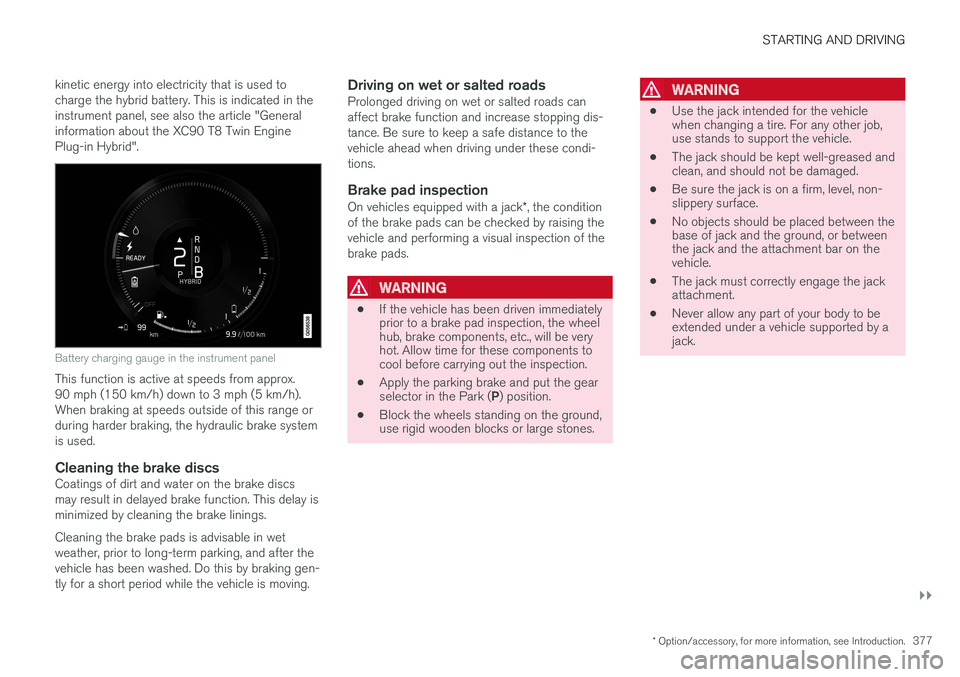
kinetic energy into electricity that is used tocharge the hybrid battery. This is indicated in theinstrument panel, see also the article "Generalinformation about the XC90 T8 Twin EnginePlug-in Hybrid".
Battery charging gauge in the instrument panel
This function is active at speeds from approx.90 mph (150 km/h) down to 3 mph (5 km/h).When braking at speeds outside of this range orduring harder braking, the hydraulic brake systemis used.
Cleaning the brake discs
Coatings of dirt and water on the brake discsmay result in delayed brake function. This delay isminimized by cleaning the brake linings.
Cleaning the brake pads is advisable in wetweather, prior to long-term parking, and after thevehicle has been washed. Do this by braking gen-tly for a short period while the vehicle is moving.
Driving on wet or salted roads
Prolonged driving on wet or salted roads canaffect brake function and increase stopping dis-tance. Be sure to keep a safe distance to thevehicle ahead when driving under these condi-tions.
Brake pad inspection
On vehicles equipped with a jack*, the conditionof the brake pads can be checked by raising thevehicle and performing a visual inspection of thebrake pads.
WARNING
•If the vehicle has been driven immediatelyprior to a brake pad inspection, the wheelhub, brake components, etc., will be veryhot. Allow time for these components tocool before carrying out the inspection.
•Apply the parking brake and put the gearselector in the Park (P) position.
•Block the wheels standing on the ground,use rigid wooden blocks or large stones.
WARNING
•Use the jack intended for the vehiclewhen changing a tire. For any other job,use stands to support the vehicle.
•The jack should be kept well-greased andclean, and should not be damaged.
•Be sure the jack is on a firm, level, non-slippery surface.
•No objects should be placed between thebase of jack and the ground, or betweenthe jack and the attachment bar on thevehicle.
•The jack must correctly engage the jackattachment.
•Never allow any part of your body to beextended under a vehicle supported by ajack.
Page 389 of 584
STARTING AND DRIVING
}}
387
Driving through standing water
The vehicle should be driven with extreme cau-tion if it is necessary to drive through standingwater.
The vehicle can be driven through water up to adepth approximately level with the floor at walk-ing speed to help prevent water from enteringthe differential and/or the transmission or dam-aging electrical components.
•If possible, check the depth of the waterbefore driving through it. Take particular carewhen driving through flowing water.
•Before driving through water, always selectthe Off Road drive mode to ensure that thegasoline engine is running and to maximizeground clearance.
•After driving through water, apply the brakesand check that they are functioning correctly.
•Clean the electrical connections for trailerwiring after driving in mud or water.
•When driving through water, maintain lowspeed and do not stop in the water.
CAUTION
•Damage may occur to the engine, trans-mission, electrical components, etc. if thevehicle is driven through water higherthan its floor level. Be aware that wavescreated by other vehicles could cause thelevel to temporarily be above the vehicle'sfloor level.
•Damage to any components due to waterabove the floor level, vapor lock or insuffi-cient oil is not covered under warranty.
•If the engine has been stopped while thevehicle is in water, do not attempt torestart it. Have the vehicle towed out ofthe water and inspected by a trained andqualified Volvo service technician.
WARNING
•Avoid driving through standing or rushingwater. Doing so can be dangerous and itmay also be difficult to determine theactual depth of the water.
•If water cannot be avoided, after drivingthrough the water, press lightly on thebrake pedal to ensure that the brakes arefunctioning normally. Water or mud canmake the brake linings slippery, resultingin delayed braking effect.
Related information
•Towing recommendations (p. 389)
Overheating the engine andtransmission
In demanding driving conditions, such as whentransporting heavy loads, driving in mountainousareas or in very hot weather there is a risk ofoverheating the engine or transmission.
•The engine's output may be slightly limited ifthere is a risk of overheating.
•Remove e.g., auxiliary lights mounted in frontof the grille in hot weather.
•If the temperature of the engine coolantbecomes too high, the warning symbol willilluminate and the message Enginetemperature/Stop safely will be displayed.Stop the vehicle as soon as possible in asafe place and let the engine idle for severalminutes.
•If the message Engine temperature/Hightemperature Turn off engine or Enginecoolant/Stop safely is displayed, stopsafely and turn off the engine.
•If the transmission begins to overheat, analternative gear shifting program will beselected. An integrated protective functionwill also by activated, the warning symbol willilluminate and the message TransmissionwarmHigh temperature Reduce speedor Transmission warmStop safely, waitfor cooling will be displayed in the instru-ment panel.
Page 390 of 584
||
STARTING AND DRIVING
388
•The air conditioning may be switched offtemporarily.
•After a prolonged period of driving, do notturn off the engine immediately after stop-ping.
•The engine cooling fan commonly continuesto run for several minutes after the enginehas been turned off.
WARNING
The cooling fan (located at the front of theengine compartment, behind the radiator) maystart or continue to operate (for up to6 minutes) after the engine has beenswitched off.
Related information
•Driving with a trailer (p. 397)
•Before a long distance trip (p. 385)
Winter driving
Check your vehicle before the approach of coldweather.
The following advice is worth noting:
•Make sure that the engine coolant contains50 percent antifreeze. Any other mixture willreduce freeze protection. This gives protec-tion against freezing down to –31 °F(–35 °C). The use of "recycled" antifreeze isnot approved by Volvo. Different types ofantifreeze must not be mixed.
•Volvo recommends using only genuine Volvoantifreeze in your vehicle's radiator.
•Try to keep the fuel tank well filled – thishelps prevent the formation of condensationin the tank. In addition, in extremely coldweather conditions it is worthwhile to addfuel line de-icer before refueling.
•The viscosity of the engine oil is important.Oil with low viscosity (thinner oil) improvescold-weather starting as well as decreasingfuel consumption while the engine is warm-ing up. Full synthetic 0W-30 oil is recom-mended for driving in areas with sustainedlow temperatures.
•The load placed on the battery is greater dur-ing the winter since the windshield wipers,lighting, etc., are used more often. Moreover,the capacity of the battery decreases as thetemperature drops. In very cold weather, apoorly charged battery can freeze and be
damaged. It is therefore advisable to checkthe state of charge more frequently andspray an anti-rust oil on the battery posts.
•Volvo recommends the use of snow tires onall four wheels for winter driving.
•To prevent the washer fluid reservoir fromfreezing, add washer solvents containingantifreeze. This is important since dirt is oftensplashed on the windshield during winterdriving, requiring the frequent use of thewashers and wipers. Volvo Washer Solventshould be diluted as follows: Down to 14 °F(–10 °C): 1 part washer solvent and 4 partswater Down to 5 °F (–15 °C): 1 part washersolvent and 3 parts water Down to 0 °F(–18 °C): 1 part washer solvent and 2 partswater Down to –18 °F (–28 °C): 1 partwasher solvent and 1 part water.
•Use Volvo Teflon Lock Spray in the locks.
•Avoid using de-icing sprays as they cancause damage to the locks.
Related information
•Snow tires and chains (p. 485)
Page 400 of 584

||
STARTING AND DRIVING
398
CAUTION
The maximum trailer weights listed are onlyapplicable for altitudes up to 3,280 ft(1000 m) above sea level. With increasingaltitude the engine power and therefore thecar's climbing ability are impaired because ofthe reduced air density, so the maximumtrailer weight has to be reduced accordingly.The weight of the vehicle and trailer must bereduced by 10% for every further 3,280 ft(1,000 m) (or part thereof). When towing5,000 lbs (2,250 kg) hill inclination is restric-ted to 14%.
WARNING
•Bumper-attached trailer hitches must notbe used on Volvos, nor should safetychains be attached to the bumper.
•Trailer hitches attaching to the vehiclerear axle must not be used.
•Never connect a trailer's hydraulic brakesystem directly to the vehicle brake sys-tem, nor a trailer's lighting system directlyto the vehicle lighting system. Consultyour nearest authorized Volvo retailer forcorrect installation.
•When towing a trailer, the trailer's safetychains or wire must be correctly fastenedto the attachment points provided in thetrailer hitch on the vehicle. The safetychain or wire must never be fastened toor wound around the towing ball.
Trailer cable
An adapter is required if the vehicle's trailer hitchhas a 13-pin connector and the trailer has 7 pins.Use an adapter cable approved by Volvo. Makesure the cable does not drag on the ground.
Related information
•Detachable trailer hitch (p. 398)
•Trailer Stability Assist (TSA) (p. 399)
•Weights (p. 563)
Detachable trailer hitch
Volvo recommends the use of Volvo trailerhitches that are specially designed for the vehi-cle.
Ball holder
Cotter pin
Hitch assembly
Locking bolt
Safety wire attachment
Installing the ball holder
1. If necessary, remove the cotter pin from thelocking bolt and slide the locking bolt out ofthe hitch assembly.
2. Slide the ball holder into the hitch assembly.
Page 401 of 584

STARTING AND DRIVING
}}
399
3.Align the hole in the ball holder with the onein the hitch assembly.
4. Slide the locking bolt through the hitchassembly/ball holder.
5. Insert the cotter pin in the hole at the end ofthe locking bolt.
Removing the ball holder
1. Remove the cotter pin from the locking boltand slide the locking bolt out of the ballholder/hitch assembly.
2. Pull the ball holder out of the hitch assembly.
NOTE
A cover for the hitch assembly is alsoincluded in the kit.
Stowing the ball holder
Compartment for the detachable trailer hitch
WARNING
When not in use, the detachable trailer hitchshould always be kept in its compartment inthe foam block under the cargo compartmentfloor (see the illustration).
Related information
•Driving with a trailer (p. 397)
•Trailer Stability Assist (TSA) (p. 399)
Trailer Stability Assist (TSA)
Trailer Stability Assist is a system designed tohelp stabilize a vehicle that is towing a trailerwhen the vehicle and trailer have begun to swayand is part of the Electronic Stability Control sys-tem.
Function
A vehicle towing a trailer may begin to sway forvarious reasons. Normally this only occurs at highspeeds but, for example, if the trailer is overloa-ded or if the load is unevenly distributed in thetrailer, there is risk of swaying.
Swaying may be caused by factors such as:
•The vehicle and trailer are hit by a sudden,strong crosswind
•The vehicle and trailer are traveling on anuneven road surface or drive over a bump
•Sudden movements of the steering wheel
Facts about TSA
•The stability system symbol in the instrumentpanel will flash when TSA is working
•If the driver switches off the stability system'sSpin Control function, TSA will also beswitched off (but will be on again the nexttime the engine is started)
•TSA may not intervene when the vehicle andtrailer begin to sway if the driver tries to com-pensate for the swaying motion by movingthe steering wheel rapidly
Page 403 of 584
STARTING AND DRIVING
* Option/accessory, for more information, see Introduction.401
ModeFunctions available
0•The odometer, clock and tem-perature gauge are illuminated
•Power seats* can be adjusted
•The power windows can be oper-ated
•The 12-volt socket in the cargocompartment can be used
•The center display is activatedand can be used
•The infotainment system can beused for a limited time
In this mode, certain functions canonly be used for a limited time to helpminimize battery drain
I•The laminated panoramic roof*,power seats*/windows,12-voltsockets in the passenger com-partment, Bluetooth, navigationsystem*, climate system blower,windshield wipers can be oper-ated
•The infotainment system will start(if it was started when the ignitionwas switched off)
Using electrical current will drainthe start battery in this mode.
ModeFunctions available
II•The headlights illuminate
•Warning/indicator lights illumi-nate for 5 seconds
•A number of other functions willalso be activated. However, theheated seats* and heated rearwindow functions can only beactivated when the engine is run-ning.
This mode should only be used forvery short periods to help avoiddraining the battery.
Selecting an ignition mode
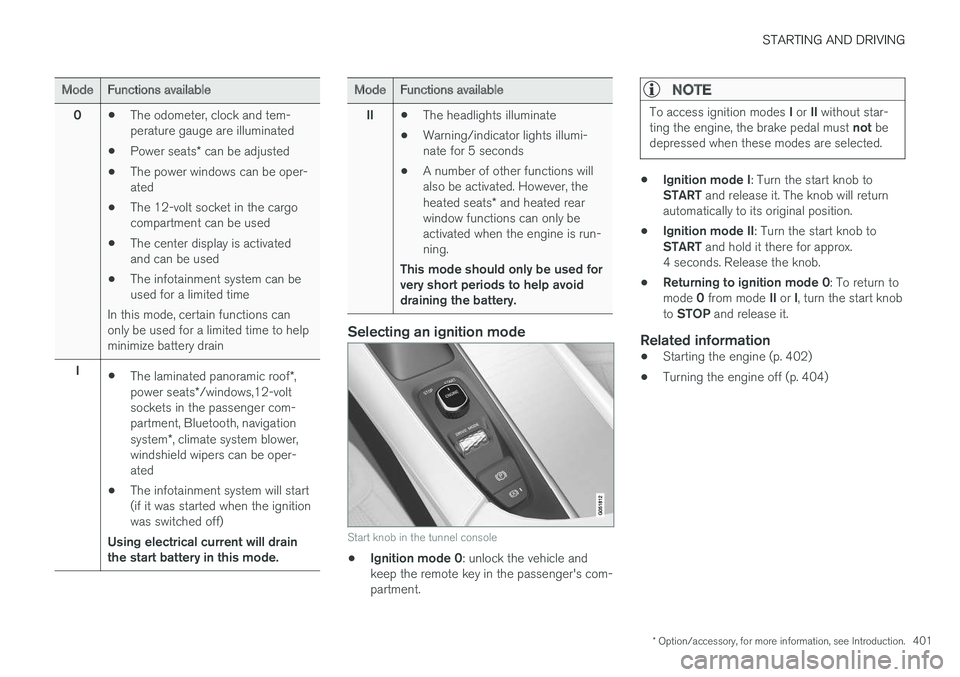
Start knob in the tunnel console
•Ignition mode 0: unlock the vehicle andkeep the remote key in the passenger's com-partment.
NOTE
To access ignition modes I or II without star-ting the engine, the brake pedal must not bedepressed when these modes are selected.
•Ignition mode I: Turn the start knob toSTART and release it. The knob will returnautomatically to its original position.
•Ignition mode II: Turn the start knob toSTART and hold it there for approx.4 seconds. Release the knob.
•Returning to ignition mode 0: To return tomode 0 from mode II or I, turn the start knobto STOP and release it.
Related information
•Starting the engine (p. 402)
•Turning the engine off (p. 404)