traction control VOLVO XC90 TWIN ENGINE HYBRID 2017 Owners Manual
[x] Cancel search | Manufacturer: VOLVO, Model Year: 2017, Model line: XC90 TWIN ENGINE HYBRID, Model: VOLVO XC90 TWIN ENGINE HYBRID 2017Pages: 584, PDF Size: 14.2 MB
Page 31 of 584
INTRODUCTION
}}
29
Driver distraction
Please keep the following warnings in mindwhen operating/servicing your vehicle.
A driver has a responsibility to do everything pos-sible to ensure his or her own safety and thesafety of passengers in the vehicle and otherssharing the roadway. Avoiding distractions is partof that responsibility.
Driver distraction results from driver activities thatare not directly related to controlling the vehiclein the driving environment. Your new Volvo is, orcan be, equipped with many feature-rich enter-tainment and communication systems. Theseinclude hands-free cellular telephones, navigationsystems, and multipurpose audio systems. Youmay also own other portable electronic devicesfor your own convenience. When used properlyand safely, they enrich the driving experience.Improperly used, any of these could cause a dis-traction.
For all of these systems, we want to provide thefollowing warning that reflects the strong Volvoconcern for your safety. Never use these devicesor any feature of your vehicle in a way that dis-tracts you from the task of driving safely. Distrac-tion can lead to a serious accident. In addition tothis general warning, we offer the following guid-ance regarding specific newer features that maybe found in your vehicle:
WARNING
•Never use a hand-held cellular telephonewhile driving. Some jurisdictions prohibitcellular telephone use by a driver whilethe vehicle is moving.
•If your vehicle is equipped with a naviga-tion system, set and make changes toyour travel itinerary only with the vehicleparked.
•Never program your audio system whilethe vehicle is moving. Program radio pre-sets with the vehicle parked, and use yourprogrammed presets to make radio usequicker and simpler.
•Never use portable computers or per-sonal digital assistants while the vehicleis moving.
Accessory installation
•We strongly recommend that Volvo ownersinstall only genuine, Volvo-approved acces-sories, and that accessory installations beperformed only by a trained and qualifiedVolvo service technician.
•Genuine Volvo accessories are tested toensure compatibility with the performance,safety, and emission systems in your vehicle.Additionally, a trained and qualified Volvoservice technician knows where accessoriesmay and may not be safely installed in yourVolvo. In all cases, please consult a trained
and qualified Volvo service technician beforeinstalling any accessory in or on your vehicle.
•Accessories that have not been approved byVolvo may or may not be specifically testedfor compatibility with your vehicle. Addition-ally, an inexperienced installer may not befamiliar with some of your car's systems.
•Any of your car's performance and safetysystems could be adversely affected if youinstall accessories that Volvo has not tested,or if you allow accessories to be installed bysomeone unfamiliar with your vehicle.
•Damage caused by unapproved or improperlyinstalled accessories may not be covered byyour new vehicle warranty. See your Warrantyand Service Records Information booklet formore warranty information. Volvo assumes noresponsibility for death, injury, or expensesthat may result from the installation of non-genuine accessories.
Page 265 of 584
DRIVER SUPPORT
* Option/accessory, for more information, see Introduction.263
Electronic Stability Control (ESC)
Electronic Stability Control (ESC) helps reducewheel spin, counteract skidding and to generallyhelp improve directional stability.
A pulsating sound will be audi-ble when the system is activelyoperating and is normal. Accel-eration may also be slightlyslower than normal.
WARNING
ESC is a supplementary aid and cannot dealwith all situations or road conditions.
The driver is always responsible for operatingthe vehicle in a safe manner in accordancewith current traffic regulations.
ESC consists of the following functions:
•Traction control
•Spin control
•Active Yaw Control
•Engine Drag Control
•Trailer Stability Assist
Traction control
This function is designed to help reduce wheelspin by transferring power from a drive wheel that
begins to lose traction to the wheel on the oppo-site side of the vehicle (on the same axle).
Spin control
This function is designed to help prevent thedrive wheels from spinning while the vehicle isaccelerating.
Active Yaw Control
At low speeds, this function helps maintain direc-tional stability by braking one or more of thewheels if the vehicle shows a tendency to skid orslide laterally.
Engine Drag Control EDC
EDC helps keep the engine running if the wheelsshow a tendency to lock, e.g., when shifting downin the manual shifting mode or while using theengine's braking function on a slippery surface. Ifthe wheels were to lock, the vehicle wouldbecome more difficult to steer.
Trailer Stability Assist * 1
TSA helps stabilize a vehicle that is towing atrailer when the vehicle and trailer have begun tosway.
This system is automatically deactivated if thedriver selects Sport mode.
Related information
•Detachable trailer hitch (p. 398)
•Driving with a trailer (p. 397)
•Trailer Stability Assist (TSA) (p. 399)
•Electronic Stability Control (ESC) sport mode(p. 264)
•Electronic Stability Control (ESC) symbolsand messages (p. 265)
1
This function is included if the vehicle is equipped with a Volvo original trailer hitch.
Page 278 of 584

DRIVER SUPPORT
276
Deactivating/resuming CruiseControl (CC)
Cruise Control (CC) can be temporarily deacti-vated and put in standby mode.
Deactivating and putting CC in standby
mode
To temporarily deactivate and put Cruise Controlin standby mode:
Function buttons and symbols (generic illustration)
–Press the button (2).
>The set speed marker (4) and symbols willchange colors from WHITE to GRAY.
This indicates that CC is temporarily instandby mode and will not maintain a setspeed.
Standby mode due to action by the driver
CC is temporarily deactivated and put in standbymode if:
•the brakes are applied
•The gear selector is moved to N
•the vehicle is driven faster than the setspeed for more than 1 minute.
In these cases, the driver will have to regulate thevehicle's speed.
A temporary increase in speed, such as whenpassing another vehicle, does not affect the CCset speed. The vehicle will return to the set speedwhen the accelerator pedal is released.
Automatic standby mode
CC switches automatically to standby mode if:
•the wheels lose traction
•engine speed (rpm) is too high/low
•brake temperature is too high
•the vehicle's speed goes below approx.20 mph (30 km/h)
In these cases, the driver will have to regulate thevehicle's speed.
Reactivating CC from standby mode
To reactivate CC after it has temporarily been putin standby mode:
–Press the button (1).
>The set speed marker (4) will changecolor from GRAY to WHITE. The vehiclewill then return to the most recently setspeed.
WARNING
There may be a significant increase in speed
after the button has been pressed.
or
Page 288 of 584
||
DRIVER SUPPORT
* Option/accessory, for more information, see Introduction.286
WARNING
When ACC is in standby mode, the driver hasto control the vehicle's speed and distance toa vehicle ahead.
When ACC is in standby mode, the driver willbe alerted if the distance to the vehicle aheadis too short by the Distance Alert function.See the article "Distance Alert" for additionalinformation.
Standby mode due to action by the driver
ACC is temporarily deactivated and put instandby mode if:
•the brakes are applied
•The gear selector is moved to N
•the vehicle is driven faster than the setspeed for more than 1 minute.
In these cases, the driver will have to regulate thevehicle's speed.
A temporary increase in speed, such as whenpassing another vehicle, does not affect the ACCset speed. The vehicle will return to the set speedwhen the accelerator pedal is released.
Automatic standby mode
ACC interacts with other systems, such asElectronic Stability Control. If any of these othersystems are not functioning properly, ACC willturn off automatically.
WARNING
If this happens, the driver will be alerted by anaudible signal and a message in the instru-ment panel. The driver will have to adapt thevehicle's speed, apply the brakes when nec-essary and keep a safe distance to the vehicleahead.
ACC switches automatically to standby mode if:
•the vehicle's speed goes below approx.3 mph (5 km/h) and ACC cannot determineif the vehicle ahead is stationary or is anobject such as a speed bump, etc
•the vehicle's speed goes below approx.3 mph (5 km/h) and the vehicle aheadchanges lanes or turns so that ACC nolonger has a target vehicle to follow
•the driver opens the door
•the driver unbuckles the seat belt
•the engine speed (rpm) is too high/low
•the wheels lose traction
•the brake temperature is too high
•the parking brake is applied
•the stability system's ESC Sport Mode isactivated
•the Off Road drive mode is selected
•The radar sensor is covered by e.g., wet snowor if heavy rain interferes with radar waves
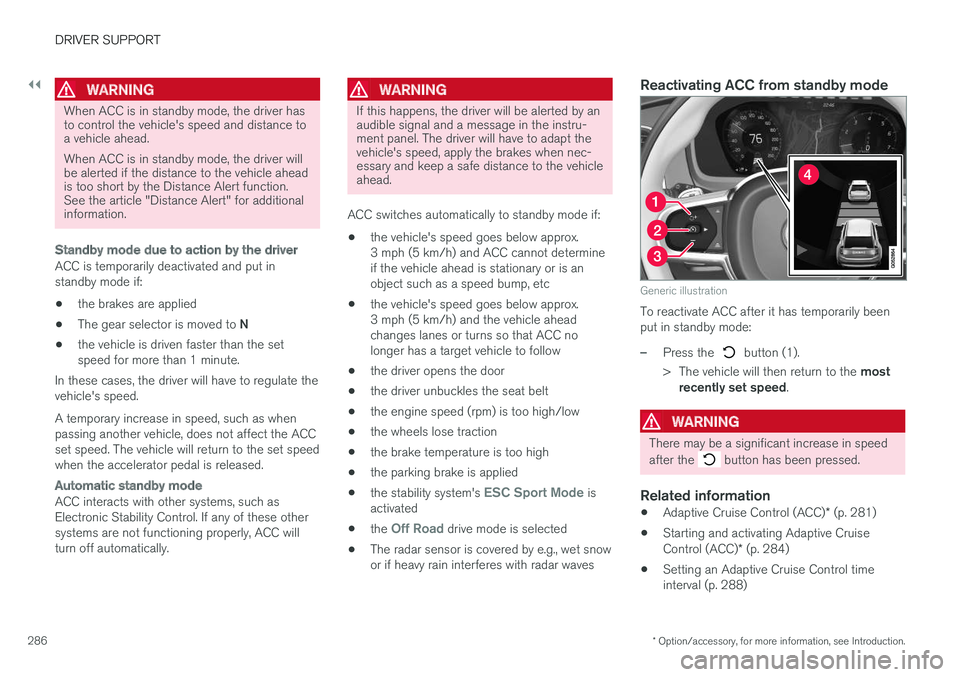
Reactivating ACC from standby mode
Generic illustration
To reactivate ACC after it has temporarily beenput in standby mode:
–Press the button (1).
>The vehicle will then return to the mostrecently set speed.
WARNING
There may be a significant increase in speed
after the button has been pressed.
Related information
•Adaptive Cruise Control (ACC)* (p. 281)
•Starting and activating Adaptive CruiseControl (ACC)* (p. 284)
•Setting an Adaptive Cruise Control timeinterval (p. 288)
Page 304 of 584
||
DRIVER SUPPORT
* Option/accessory, for more information, see Introduction.302
Automatic standby mode
Pilot Assist interacts with other systems, such asElectronic Stability Control. If any of these othersystems are not functioning properly, Pilot Assistwill automatically be deactivated.
WARNING
If this happens, the driver will be alerted by anaudible signal and a message in the instru-ment panel. The driver will have to adapt thevehicle's speed, apply the brakes when nec-essary and keep a safe distance to the vehicleahead.
Pilot Assist switches automatically to standbymode if:
•the camera cannot detect the traffic lane'sside marker lines
•the vehicle ahead is not within a reasonable(detectable) distance
•the driver's hands are not on the steeringwheel
•the driver unbuckles the seat belt
•engine speed (rpm) is too high/low
•the wheels lose traction
•brake temperature is too high
•the parking brake is set
•The camera lens/radar sensor is covered bye.g., wet snow or if heavy rain interferes withradar waves
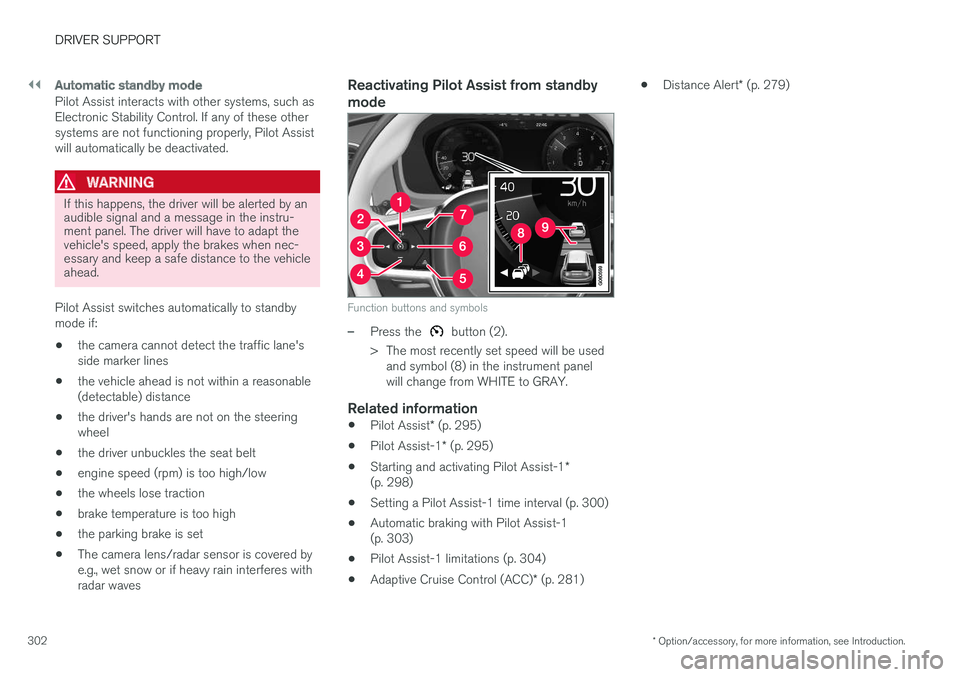
Reactivating Pilot Assist from standby
mode
Function buttons and symbols
–Press the button (2).
>The most recently set speed will be usedand symbol (8) in the instrument panelwill change from WHITE to GRAY.
Related information
•Pilot Assist* (p. 295)
•Pilot Assist-1* (p. 295)
•Starting and activating Pilot Assist-1*(p. 298)
•Setting a Pilot Assist-1 time interval (p. 300)
•Automatic braking with Pilot Assist-1(p. 303)
•Pilot Assist-1 limitations (p. 304)
•Adaptive Cruise Control (ACC)* (p. 281)
•Distance Alert* (p. 279)
Page 315 of 584

DRIVER SUPPORT
}}
* Option/accessory, for more information, see Introduction.313
In standby mode, the driver will have to regulatethe vehicle's speed and the distance to the vehi-cle ahead.
When Pilot Assist is in standby mode and yourvehicle comes too close to another vehicle, thedriver will be alerted by the Distance Alert func-tion.
Standby mode due to action by the driver
Pilot Assist is temporarily deactivated and put instandby mode if:
•the brakes are applied
•The gear selector is moved to N
•the turn signals are used for more than1 minute
•the vehicle is driven faster than the setspeed for more than 1 minute.
A temporary increase in speed, such as whenpassing another vehicle, does not affect the PilotAssist set speed. The vehicle will return to the setspeed when the accelerator pedal is released.
When the turn signals are used, Pilot Assist'ssteering function will be temporarily deactivated.When this is no longer the case, the steeringfunction will reactivate if the traffic lane's sidemarker lines can still be detected.
Automatic standby mode
Pilot Assist interacts with other systems, such asElectronic Stability Control. If any of these other
systems are not functioning properly, Pilot Assistwill automatically be deactivated.
WARNING
If this happens, the driver will be alerted by anaudible signal and a message in the instru-ment panel. The driver will have to adapt thevehicle's speed, apply the brakes when nec-essary and keep a safe distance to the vehicleahead.
Pilot Assist switches automatically to standbymode if:
•the vehicle's speed is below approx. 3 mph(5 km/h) and Pilot Assist cannot determine ifa vehicle ahead is a stationary vehicle or anobject.
•the vehicle's speed is below approx. 3 mph(5 km/h) and the vehicle ahead turns so thatPilot Assist no longer has a vehicle to follow(target vehicle).
•the driver's hands are not on the steeringwheel
•the driver's door is opened
•the driver unbuckles the seat belt
•engine speed (rpm) is too high/low
•the wheels lose traction
•brake temperature is too high
•the parking brake is set
•The camera lens/radar sensor is covered bye.g., wet snow or if heavy rain interferes withradar waves
Reactivating Pilot Assist from standby
mode
Generic illustration
–Press the button (1).
>The most recently set speed will be used.
WARNING
There may be a significant increase in speed
after the button has been pressed.
Related information
•Pilot Assist* (p. 295)
•Pilot Assist-2* (p. 305)
•Starting and activating Pilot Assist-2 (p. 308)
Page 350 of 584
DRIVER SUPPORT
* Option/accessory, for more information, see Introduction.348
Road Sign Information (RSI)*limitations
The RSI function may be limited in certain situa-tions.
RSI may have difficulty reading signs that are:
•Faded
•Located in a curve
•Twisted or damaged
•Positioned high above the road
•Obstructed (by bushes, etc.)
•Partially covered by snow, ice, etc.
•If the digital maps used by the SensusNavigation system* are not up-to-date or do
not contain speed information7.
The camera used by RSI has certain limitations.See the article "Camera limitations" for additionalinformation.
NOTE
RSI may perceive certain types of bicycleholders (with wiring attached to the trailerelectrical socket) as a trailer, which may resultin faulty speed limit information to the driver.
Related information
•Road Sign Information (RSI)* (p. 346)
•Road Sign Information (RSI)* operation(p. 346)
•Camera limitations (p. 323)
Driver Alert Control (DAC)
DAC is intended to alert the driver if his/her driv-ing becomes erratic due to e.g., distraction orfatigue.
DAC is designed to help detect a slowly chang-ing driving pattern. It is primarily intended to beused on main roads and is not meant for use incity traffic.
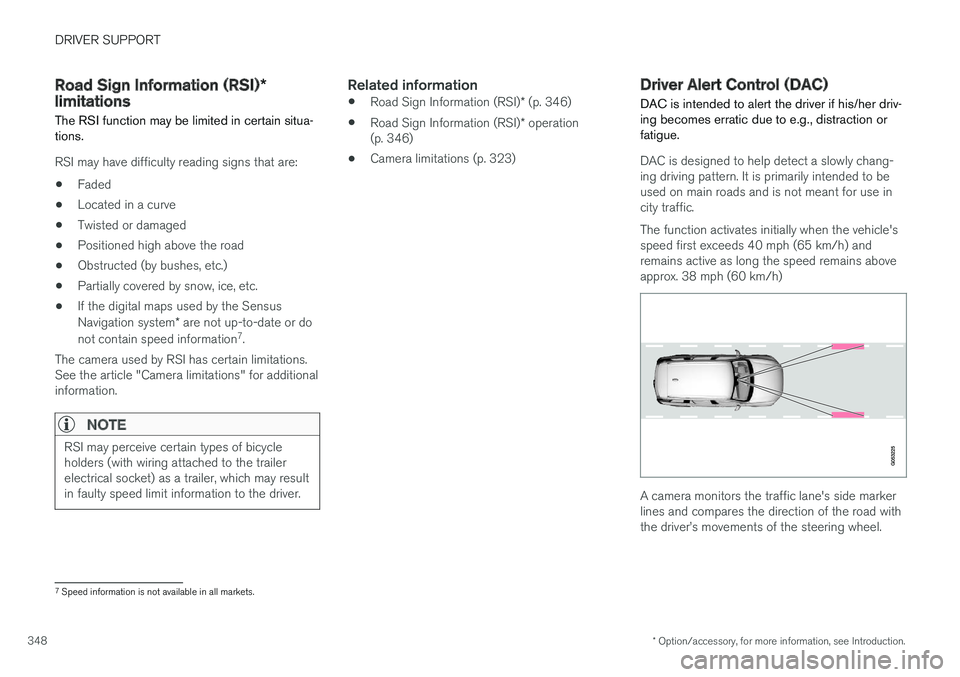
The function activates initially when the vehicle'sspeed first exceeds 40 mph (65 km/h) andremains active as long the speed remains aboveapprox. 38 mph (60 km/h)
A camera monitors the traffic lane's side markerlines and compares the direction of the road withthe driver
Page 374 of 584
||
DRIVER SUPPORT
* Option/accessory, for more information, see Introduction.372
1. Tap the Park out button in the center display'sFunction view.
2. Use the turn signal to indicate the direction inwhich the vehicle should leave the parking space.
3. Follow the instructions provided in the centerdisplay. The procedure is the same as when park-ing the vehicle.
The steering wheel may turn back slightly whenthe function is completed and the driver mayhave to turn the back before leaving the parkingspace.
If PAP determines that the driver can leave theparking space without assistance, the functionwill deactivate before the vehicle is completelyout of the space.
Related information
•Park Assist Pilot (PAP)* (p. 368)
•Park Assist Pilot (PAP)* limitations (p. 372)
•Park Assist Pilot (PAP)* symbols and mes-sages (p. 374)
Park Assist Pilot (PAP)* limitations
The PAP function may be limited in certain situa-tions.
The PAP parking sequence is cancelled
A parking sequence will be cancelled:
•if the vehicle is driven too fast: above approx.4 mph (7 km/h)
•if the driver taps Cancel in the center display
•if the driver moves the steering wheel withsufficient force.
•if the anti-lock brakes or Electronic StabilityControl are activated (e.g., if a wheel beginsto spin or lose traction)
In such cases, a text message will explain whythe parking sequence was cancelled.
NOTE
•PAP will not function correctly if its sen-sors are obstructed by dirt, snow, etc.
•In certain situations, PAP may not be ableto measure a parking space. This couldbe due to external sources of sound (e.g.,a vehicle's horn, tires on wet asphalt,pneumatic brakes, noise from a motorcy-cle's exhaust, etc.) emitting ultrasoundusing approximately the same frequen-cies as PAP.
Points to keep in mind
PAP is a parking aid only and the driver shouldalways be prepared to take control and cancel aparking sequence. This can be due to one ormore of the following factors:
•PAP's function is based on the way that thevehicles are parked behind and in front ofyour parking space. If they are, for example,parked too close to the curb, there is a riskthat your vehicle's tires or wheel rims couldbe damaged by the curb during the parkingprocedure.
•PAP is intended to provide parking assis-tance on straight streets, not sections ofstreet with curved or irregular curbs. Be surethat your vehicle is parallel to the curb whenPAP measures the parking space.
•PAP may not be able to provide parkingassistance on narrow streets due to lack ofspace to maneuver the vehicle. In situationslike this, it may help to drive between1.5-5.0 ft (0.5-1.5 m) from the side of theroad where the parking space is located.
•Use only approved tires with the correct infla-tion pressure because this affects PAP'scapacity to provide parking assistance.Changing to a different approved tire sizemay affect PAP's parameters. Consult atrained and qualified Volvo service technician.
Page 424 of 584
||
STARTING AND DRIVING
422
When the hybrid battery's charge level is low, thegasoline engine will start more often to help con-serve electrical energy. Charge the battery withthe charging cable as soon as possible.
PURE
This mode activates the electric motor only withas low energy consumption as possible and thelowest possible carbon dioxide emissions.
Ground clearance will be lowered to help reducewind resistance and certain climate system func-tions will be reduced.
Pure mode is available when the hybrid battery issufficiently charged. If the level gets too low, thegasoline engine will start.
The gasoline engine will also start:
•If the vehicle's speed goes above approx.78 mph (125 km/h)
•If the driver wants more response than theelectric motor alone can provide
•If factors such as cold weather, etc., affectthe system or components
To restart the climate system functions that havebeen reduced in the mode, press the AUTO ordefroster buttons.
In order to return to full functionality for all of thesystems that may be affected by Pure mode,select another drive mode or adapt the climatesystem functions using the INDIVIDUAL mode.
OFF ROAD
This mode helps maximize the vehicle's capacityto traverse difficult terrain or poor roads.
In OFF ROAD, ground clearance is maximized,the steering is light, All Wheel Drive and HillDescent Control are activated and a compassand altimeter will be displayed in the instrumentpanel.
This drive mode can only be activated at lowspeeds (the permissible speed range will beshown on the speedometer). At higher speeds,OFF ROAD mode will be cancelled and AWD willbe activated.
This mode is not intended for normal streetdriving.
CAUTION
OFF ROAD drive mode may not be used ifthe vehicle is towing a trailer without an elec-trical connection. This could result in damageto the pneumatic suspension system's bel-lows.
Due to the increased ground clearance, if theOFF ROAD mode was selected when the enginewas switched off, it will also restart in this mode.
AWD
This mode offers improved traction using four-wheel drive and is intended primarily for low-speed driving on slippery surfaces. However, it
also helps increase directional stability at higherspeeds.
In this mode, both the electric motor and the gas-oline engine are used continuously, which resultsin higher fuel consumption.
POWER
Power mode is intended for sportier, more activedriving.
This mode maximizes the combined effects ofthe electric motor and the gasoline engine andprovides power to all four wheels. Response topressure on the accelerator pedal is more imme-diate and the transmission shifts up at higherspeeds. Steering response is also more immedi-ate, the suspension is stiffer and lower groundclearance reduces body roll when cornering.
In this mode, both the electric motor and the gas-oline engine are used continuously, which resultsin higher fuel consumption.
Page 431 of 584
STARTING AND DRIVING
}}
* Option/accessory, for more information, see Introduction.429
Activating LSC
Select the Off Road drive mode to activate thefunction.
Select any other drive mode to turn it off.
NOTE
When LSC with HDC is activated by the OffRoad drive mode, the feel of the acceleratorpedal and engine response will change.
The function is deactivated when driving athigher speeds and must be reactivated atlower speeds if so desired.
Related information
•Brake functions (p. 378)
•Hill Descent Control (HDC) (p. 380)
•Drive modes (p. 420)
All Wheel Drive (AWD)8
Your Volvo can be equipped with All WheelDrive, which means that power is distributedautomatically between the front and rear wheels.
Under normal driving conditions, most of theengine's power is directed to the front wheels.However, if there is any tendency for the frontwheels to spin, an electronically controlled cou-pling distributes power to the wheels that havethe best traction.
AWD reacts differently, depending on the drivemode* selected.
Related information
•Drive modes (p. 420)
•Low Speed Control (LSC) (p. 428)
Suspension and leveling control*
The leveling control system adjusts the suspen-sion and shock absorbers automatically to helpprovide good comfort and control while driving.Leveling can also be controlled manually tomake loading or getting in and out of the vehicleeasier.
Pneumatic suspension and shock
absorbers
This system is linked to the selected drive modeand is adapted to the vehicle's speed. The pneu-matic suspension reduces the vehicle's groundclearance at higher speeds to reduce wind resis-tance and increase stability. The shock absorbersare normally set to provide the best possiblecomfort and are adjusted continuously accordingto the road surface, acceleration, braking andcornering.
The instrument panel will indicate when the sus-pension level is being adjusted.
The level cannot be adjusted if one of the sidedoors or the hood is open.