warning VOLVO XC90 TWIN ENGINE HYBRID 2017 Owners Manual
[x] Cancel search | Manufacturer: VOLVO, Model Year: 2017, Model line: XC90 TWIN ENGINE HYBRID, Model: VOLVO XC90 TWIN ENGINE HYBRID 2017Pages: 584, PDF Size: 14.2 MB
Page 410 of 584

STARTING AND DRIVING
408
Hybrid-related symbols andmessages
A number of symbols and messages relating tothe XC90 T8 Twin Engine Plug-in Hybrid may
appear in the instrument panel. They may alsobe displayed in combination with general indica-tor and warning symbols and will go out whenthe necessary action has been taken.
SymbolMessageExplanation
12 V Battery
Charging fault, service urgent. Driveto workshop
Battery fault. Contact a Volvo retailer or a trained and qualified Volvo service technician as soon aspossible.
12 V Battery
Charging fault Stop safely
Battery fault. Stop the vehicle as soon as possible and contact a Volvo retailer or a trained andqualified Volvo service technician.
12 V Battery
Low charge, temporarily reducedfunctionality
The hybrid battery's charge level is too low for optimal driving. Charge the battery as soon as possi-ble.
12 V Battery
Charging fault, low battery. Stopsafely
The hybrid battery is not sufficiently charged. Stop the vehicle as soon as possible and charge thebattery.
12 V Battery
Fuse failure Service required
Battery failure. Contact a Volvo retailer or a trained and qualified Volvo service technician as soon aspossible to have the system checked.
Hybrid battery
Overheated, stop safely
Battery temperature too high/too low. Stop the vehicle and turn off the engine. If the messageremains after the engine has been restarted, contact a Volvo retailer or a trained and qualified Volvoservice technician.
Page 412 of 584
STARTING AND DRIVING
410
Preparations for charging the hybridbattery
Several preparatory steps should be takenbefore starting to charge the hybrid battery.
WARNING
•The charging cable must be groundedwhen in use. It is equipped with a cordwith a grounding conductor and agrounding plug. The plug must beinserted into an appropriate outlet that isproperly installed and grounded inaccordance with all local codes and ordi-nances and is not damaged in any way
•Children should be supervised when inthe vicinity of the charging cable when itis plugged in
•High voltage is present in your electricmeter housing and power distributionservice panel. Contact with high voltagecan cause death or serious personalinjury
•Do not use the charging cable if it isdamaged in any way
•Always position the charging cable sothat it will not be driven over, stepped on,tripped over or otherwise damaged, orcause personal injury
•Disconnect the charger from the wall out-let before cleaning it
•Never connect the charging cable to anextension cord or a multiple plug socket
•If the hybrid battery needs to be replaced,this may only be done by Volvo retailer orauthorized Volvo workshop
Also, refer to the manufacturer's instructionsfor using the charging cable and its compo-nents.
Prior to charging
The charging cable and any of its componentsshould not be wet or submerged in any liquid.
The charge module or its plug should not beexposed to direct sunlight. This could cause theunit's overheating protector to reduce or stop thehybrid battery charging process.
Be sure the 120-/240-volt socket used has ade-quate current for charging electrically poweredvehicles. Have the socket checked by an licensedelectrician if you are uncertain.
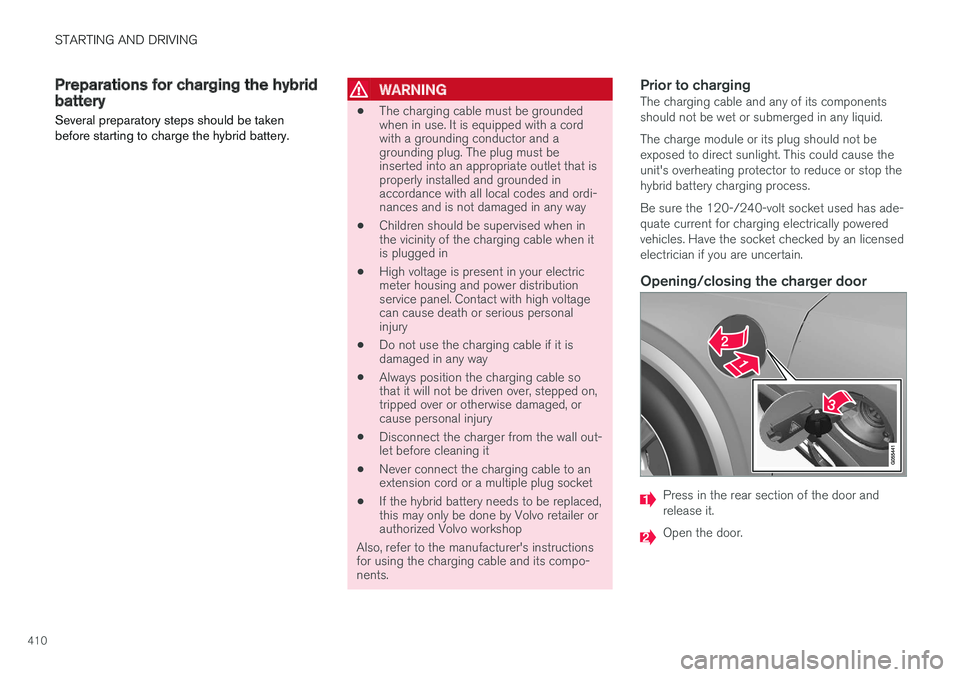
Opening/closing the charger door
Press in the rear section of the door andrelease it.
Open the door.
Page 415 of 584
STARTING AND DRIVING
}}
413
4.The charging cable's coupler will lock ontothe charging socket and charging will beginwithin approx. 10 seconds. The approximateremaining charging time and charging statuswill be displayed in the instrument panel. Seealso the article "Hybrid battery charge sta-tus."
Charging will be temporarily interrupted if thevehicle is unlocked:
•If a door is opened, charging will restartwithin 2 minutes.
•if no door is opened, the vehicle will auto-matically relock and charging will restartafter 1 minute.
NOTE
Charging status is shown in the instrumentpanel, which goes dark after a period of time.Reactivate the instrument panel by:
•pressing the brake pedal
•opening one of the doors
•putting the ignition in mode I (withoutpressing the brake pedal, turn the startknob to START and release it).
CAUTION
Never disconnect the charging cable from the120-/240-volt socket while charging is inprogress. This could damage the socket.
Always stop the charging process (by unlock-ing the vehicle) and disconnect the chargingcable from the vehicle's charging socketbefore disconnecting the other end from the120-/240-volt socket being used.
During the charging process, condensation mayform under the vehicle, which is normal and iscaused by cooling the hybrid battery.
Related information
•Hybrid battery charge status (p. 415)
•Charging the hybrid battery (p. 413)
•Hybrid battery charging cable (p. 405)
•Stopping hybrid battery charging (p. 411)
Charging the hybrid battery
In addition to the conventional fuel tank, theXC90 T8 Twin Engine Plug-in Hybrid is alsoequipped with a rechargeable lithium-ion hybridbattery.
The hybrid battery is recharged using a chargingcable located in a storage compartment underthe floor of the cargo area. See also the article"Charging cable."
WARNING
The hybrid electrical system in your vehicleuses high voltage electrical current. Any dam-age to this system or to the hybrid batterymay result in the danger of overheating, fire,or serious injury. If the vehicle is involved in acollision or is subjected to flooding, fires, etc.,have it inspected by a trained and qualifiedVolvo service technician. Prior to this inspec-tion, the vehicle should be parked outdoors ata safe distance from any building or poten-tially flammable materials.
The hybrid battery's charging time depends onthe charging current used.
Page 419 of 584
STARTING AND DRIVING
}}
417
Charger status indicators
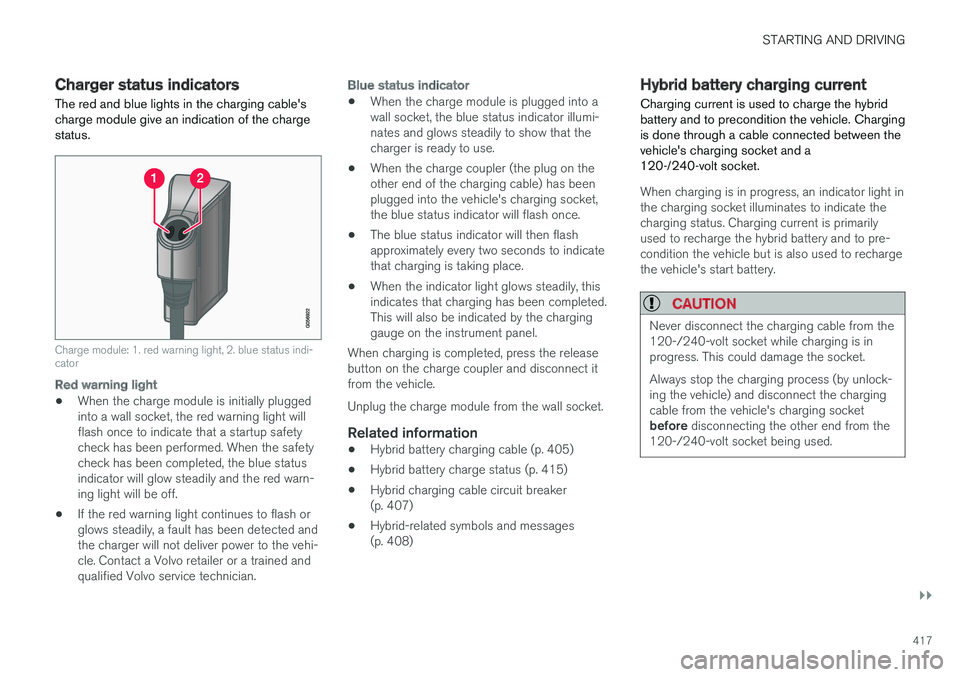
The red and blue lights in the charging cable'scharge module give an indication of the chargestatus.
Charge module: 1. red warning light, 2. blue status indi-cator
Red warning light
•When the charge module is initially pluggedinto a wall socket, the red warning light willflash once to indicate that a startup safetycheck has been performed. When the safetycheck has been completed, the blue statusindicator will glow steadily and the red warn-ing light will be off.
•If the red warning light continues to flash orglows steadily, a fault has been detected andthe charger will not deliver power to the vehi-cle. Contact a Volvo retailer or a trained andqualified Volvo service technician.
Blue status indicator
•When the charge module is plugged into awall socket, the blue status indicator illumi-nates and glows steadily to show that thecharger is ready to use.
•When the charge coupler (the plug on theother end of the charging cable) has beenplugged into the vehicle's charging socket,the blue status indicator will flash once.
•The blue status indicator will then flashapproximately every two seconds to indicatethat charging is taking place.
•When the indicator light glows steadily, thisindicates that charging has been completed.This will also be indicated by the charginggauge on the instrument panel.
When charging is completed, press the releasebutton on the charge coupler and disconnect itfrom the vehicle.
Unplug the charge module from the wall socket.
Related information
•Hybrid battery charging cable (p. 405)
•Hybrid battery charge status (p. 415)
•Hybrid charging cable circuit breaker(p. 407)
•Hybrid-related symbols and messages(p. 408)
Hybrid battery charging current
Charging current is used to charge the hybridbattery and to precondition the vehicle. Chargingis done through a cable connected between thevehicle's charging socket and a120-/240-volt socket.
When charging is in progress, an indicator light inthe charging socket illuminates to indicate thecharging status. Charging current is primarilyused to recharge the hybrid battery and to pre-condition the vehicle but is also used to rechargethe vehicle's start battery.
CAUTION
Never disconnect the charging cable from the120-/240-volt socket while charging is inprogress. This could damage the socket.
Always stop the charging process (by unlock-ing the vehicle) and disconnect the chargingcable from the vehicle's charging socketbefore disconnecting the other end from the120-/240-volt socket being used.
Page 428 of 584

||
STARTING AND DRIVING
426
Park – P
Park is activated using a switch located next tothe gear selector.
Select P when the vehicle is parked or when thestarting the engine. The vehicle must be station-ary when P is selected.
To select another gear, the ignition must be inmode II and the brake pedal must be depressed.
Help functions:
The system will automatically shift to P:
•If the ignition is switched off while D or R isselected.
•If the driver unbuckles the seat belt andopens the door while the engine is running ifP has not already been selected.
In position P, the transmission is mechanicallylocked. Always apply the parking brake when thevehicle is parked.
NOTE
The gear selector must be in the P positionbefore the vehicle can be locked and thealarm set.
WARNING
Always apply the parking brake when thevehicle is parked, particularly when parking ona hill. The transmission's P mode may not beable to keep the vehicle stationary if it isparked on an incline.
Reverse – R
The vehicle must be stationary before R can beselected.
Neutral – N
No gear is selected and the engine can bestarted. Always apply the parking brake if thevehicle is not moving and the gear selector is inthe N position.
The ignition must be in mode II and the brakepedal must be depressed before the gear selec-tor can be moved from N.
Drive – D
D is the normal driving position and gear shiftingis fully automatic. The vehicle must be stationarywhen the gear selector is moved from R to D.
Page 481 of 584
WHEELS AND TIRES
479
sidewall (see the illustration). A tire with e.g., visi-ble cracks or discoloration should be replacedimmediately.
Tire economy
•Maintain correct tire pressure.
•Avoid fast starts, hard braking and tirescreeching.
•Tire wear increases with speed.
•Correct front wheel alignment is very impor-tant.
•Unbalanced wheels impair tire economy anddriving comfort.
•Tires must maintain the same direction ofrotation throughout their lifetime.
•When replacing tires, the tires with the mosttread should be mounted on the rear wheelsto reduce the chance of oversteer duringhard braking.
•Hitting curbs or potholes can damage thetires and/or wheels permanently.
Tire rotation
Your vehicle has no required tire rotation. Tirewear is affected by a number of factors such astire inflation, ambient temperature, driving style,etc.
NOTE
•If the tires are rotated, they should onlybe moved from front to rear or vice versa.They should never be rotated left toright/right to left.
•Ideally, tire rotation should be done thefirst time after approximately 3,000 miles(5,000 km) and thereafter at 6,000-mile(10,000-km) intervals. Some customersfind that tire rotation may help to getextra mileage from tire life.
•Tire rotation should only be performed iffront/rear tire wear is fairly even andtread height is above 1/16" (1.6 mm).
Storing wheels and tires
When storing complete wheels (tires mounted onrims), they should be suspended off the floor orplaced on their sides on the floor.
Tires not mounted on rims should be stored ontheir sides or standing upright, but should not besuspended.
CAUTION
Tires should preferably be stored in a cool,dry, dark place, and should never be stored inclose proximity to solvents, gasoline, oils, etc.
WARNING
•The wheel and tire sizes for your Volvoare specified to meet stringent stabilityand handling requirements. Unapprovedwheel/tire size combinations can nega-tively affect your vehicle's stability andhandling.
•Any damage caused by installation ofunapproved wheel/tire size combinationswill not be covered by your new vehiclewarranty. Volvo assumes no responsibilityfor death, injury, or expenses that mayresult from such installations.
Related information
•Checking tire inflation pressure (p. 486)
•Tread wear indicator (p. 483)
Page 483 of 584
WHEELS AND TIRES
481
10.Maximum Load: Indicates the maximumload in pounds and kilograms that can becarried by the tire. Refer to the vehicle's tireinformation placard located on the B-Pillarfor the correct tire pressure for your vehicle.
11.Treadwear, Traction, and Temperaturegrades.
12.Maximum permissible inflationpressure: the greatest amount of air pres-sure that should ever be put in the tire. Thislimit is set by the tire manufacturer.
Speed Symbol
A tire's Speed Symbol (SS) indicates the maxi-mum speed for which the tire has been certifiedand should be at least equivalent to the vehicle'stop speed.
Winter tires, with our without studs, are excep-tions and may use a lower SS. When winter tiresare installed, the vehicle may not be driven fasterthan the tires' SS.
The vehicle's speed should always be determinedby the posted speed limit and traffic and roadconditions, not the tire's SS.
The following table indicates the maximum per-missible speed for each SS.
Speed Symbol
M81 mph (130 km/h)
Q100 mph (160 km/h)
T118 mph (190 km/h)
H130 mph (210 km/h)
V149 mph (240 km/h)
W168 mph (270 km/h)
Y186 mph (300 km/h)
WARNING
•The wheel and tire sizes for your Volvoare specified to meet stringent stabilityand handling requirements. Unapprovedwheel/tire size combinations can nega-tively affect your vehicle's stability andhandling.
•Any damage caused by installation ofunapproved wheel/tire size combinationswill not be covered by your new vehiclewarranty. Volvo assumes no responsibilityfor death, injury, or expenses that mayresult from such installations.
Wheel (rim) designations
Wheel and rim dimensions are shown in the fol-lowing table.
The vehicle has been certified with certain combi-nations of wheels and tires.
The following table shows an example of wheeldimensions: 8Jx18x42.5. This particular wheelmay not be available on your vehicle.
8Wheel width in inches
JRim flange profile
18Wheel diameter in inches
42.5Offset in mm (distance from the centerof the wheel to the wheel's contact sur-face on the hub)
Related information
•Tire sidewall designations (p. 480)
Page 484 of 584

WHEELS AND TIRES
482
Tire terminology
The following is a glossary of tire-related terms.
The tire suppliers may have additional markings,notes or warnings such as standard load, radialtubeless, etc.
•Tire information placard: A placard show-ing the OE (Original Equipment) tire sizes,recommended inflation pressure, and themaximum weight the vehicle can carry.
•Tire Identification Number (TIN): A numberon the sidewall of each tire providing infor-mation about the tire brand and manufactur-ing plant, tire size and date of manufacturer.
•Inflation pressure: A measure of theamount of air in a tire.
•Standard load: A class of P-metric or Metrictires designed to carry a maximum load at35 psi [37 psi (2.5 bar) for Metric tires].Increasing the inflation pressure beyond thispressure will not increase the tires load car-rying capability.
•Extra load: A class of P-metric or Metrictires designed to carry a heavier maximumload at 41 psi [43 psi (2.9 bar) for Metrictires]. Increasing the inflation pressurebeyond this pressure will not increase thetire's load carrying capability.
•kPa: Kilopascal, a metric unit of air pressure.
•PSI: Pounds per square inch, a standard unitof air pressure.
•B-pillar: The structural member at the sideof the vehicle behind the front door.
•Bead area of the tire: Area of the tire nextto the rim.
•Sidewall of the tire: Area between the beadarea and the tread.
•Tread area of the tire: Area of the perime-ter of the tire that contacts the road whenmounted on the vehicle.
•Rim: The metal support (wheel) for a tire or atire and tube assembly upon which the tirebeads are seated.
•Maximum load rating: a figure indicatingthe maximum load in pounds and kilogramsthat can be carried by the tire. This rating isestablished by the tire manufacturer.
•Maximum permissible inflation pressure:the greatest amount of air pressure thatshould ever be put in the tire. This limit is setby the tire manufacturer.
•Recommended tire inflation pressure:inflation pressure, established by Volvo,which is based on the type of tires that aremounted on a vehicle at the factory. Thisinformation can be found on the tire inflationplacard(s) located on the driver's side B-pillarand in the tire inflation table in this chapter.
•Cold tires: The tires are considered to becold when they have the same temperatureas the surrounding (ambient) air. This tem-
perature is normally reached after the vehiclehas been parked for at least 3 hours.
Page 486 of 584
WHEELS AND TIRES
484
Loading specifications
Properly loading your vehicle will provide maxi-mum return of vehicle design performance.
Weight designations
Before loading your vehicle, familiarize yourselfwith the following terms for determining yourvehicle's weight ratings, with or without a trailer,from the vehicle's Federal/Canadian Motor Vehi-cle Safety Standards (FMVSS/CMVSS) label, andthe vehicle's tire information placard:
Curb weight
The weight of the vehicle including a full tank offuel and all standard equipment. It does notinclude passengers, cargo, or optional equipment.
Capacity weight
All weight added to the curb weight, includingcargo and optional equipment. When towing,trailer hitch tongue load is also part of cargoweight.
Permissible axle weight
The maximum allowable weight that can be car-ried by a single axle (front or rear). These num-bers are shown on the Federal/Canadian MotorVehicle Safety Standards (FMVSS/CMVSS) label.The total load on each axle must never exceed itsmaximum permissible weight.
Gross vehicle weight (GVW)
The vehicle's curb weight + cargo + passengers.
Steps for Determining Correct Load
Limit
1. Locate the statement "the combined weightof occupants and cargo should never exceedXXX kg or XXX lbs." on your vehicle's plac-ard.
2. Determine the combined weight of the driverand passengers that will be riding in yourvehicle.
3. Subtract the combined weight of the driverand passengers from XXX kg or XXX lbs.
4. The resulting figure equals the availableamount of cargo and luggage load capacity.For example, if the "XXX" amount equals1400 lbs. and there will be five 150 lb. pas-sengers in your vehicle, the amount of availa-ble cargo and luggage load capacity is650 lbs. (1400 – 750 (5 × 150) = 650 lbs.)
5. Determine the combined weight of luggageand cargo being loaded on the vehicle. Thatweight may not safely exceed the availablecargo and luggage load capacity calculatedin Step 4.
6. If your vehicle will be towing a trailer, loadfrom your trailer will be transferred to yourvehicle. Consult this manual to determinehow this reduces the available cargo and lug-gage load capacity of your vehicle.
WARNING
•Exceeding the permissible axle weight,gross vehicle weight, or any other weightrating limits can cause tire overheatingresulting in permanent deformation orcatastrophic failure.
•Do not use replacement tires with lowerload carrying capacities than the tires thatwere original equipment on the vehiclebecause this will lower the vehicle's GVWrating. Use only tires with the correct loadcarrying capacity. Consult your Volvoretailer for information.
Related information
•Label information (p. 558)
•Weights (p. 563)
Page 487 of 584
WHEELS AND TIRES
}}
485
Uniform Tire Quality Grading
ALL PASSENGER VEHICLE TIRES MUSTCONFORM TO FEDERAL SAFETY REQUIRE-MENTS IN ADDITION TO THESE GRADES.
Quality grades can be found, where applica-ble, on the tire sidewall between the treadshoulder and maximum section width. Forexample:
Treadwear 200 Traction AA Temperature A
TREADWEAR
The treadwear grade is a comparative ratingbased on the wear rate of the tire when testedunder controlled conditions on a specified gov-ernment test course. For example, a tire graded150 would wear one and one half (1 ½) times aswell on the government course as a tire graded100. The relative performance of tires dependsupon the actual conditions of their use, however,and many depart significantly from the norm dueto variation in driving habits, maintenance practi-ces and differences in road characteristics andclimate.
TRACTION
The traction grades, from highest to lowest, areAA, A, B, and C, as measured under controlledconditions on specified government test surfacesof asphalt and concrete. A tire marked C mayhave poor traction performance. The tractiongrade assigned to this tire is based on braking
(straight-ahead) traction tests and is not a meas-ure of cornering (turning) traction.
WARNING
The traction grade assigned to this tire isbased on braking (straight-ahead) tractiontests and is not a measure of cornering (turn-ing) traction.
TEMPERATURE
The temperature grades are A (the highest), B,and C, representing the tire's resistance to thegeneration of heat and its ability to dissipate heatwhen tested under controlled conditions on aspecified indoor laboratory test wheel. Sustainedhigh temperature can cause the material of thetire to degenerate and reduce tire life, and exces-sive temperature can lead to sudden tire failure.The grade C corresponds to a minimum level ofperformance that all passenger vehicle tires mustmeet under the Federal Motor Safety StandardNo. 109. Grades B and A represent higher levelsof performance on the laboratory test wheel thanthe minimum required by law.
WARNING
The temperature grade for this tire is estab-lished for a tire that is properly inflated andnot overloaded. Excessive speed, under-infla-tion, or excessive loading, either separately orin combination, can cause heat buildup andtire failure.
Snow tires and chains
The use of snow chains and/or winter tires canhelp improve traction in winter driving conditions.
Snow chains can be used on your Volvo with thefollowing restrictions:
•Snow chains should be installed on frontwheels only. Use only Volvo approved snowchains.
•If accessory, aftermarket or "custom" tiresand wheels are installed and are of a size dif-ferent than the original tires and wheels,chains in some cases CANNOT be used.Sufficient clearances between chains andbrakes, suspension and body componentsmust be maintained.
•Some strap-on type chains will interfere withbrake components and therefore CANNOTbe used.
•All Wheel Drive models: Snow chainsshould only be installed on the front wheels.
•Certain size tires may not allow the assemblyof snow chains/traction devices.
Consult your Volvo retailer for additional snowchain information.