warning VOLVO XC90 TWIN ENGINE HYBRID 2017 Owners Manual
[x] Cancel search | Manufacturer: VOLVO, Model Year: 2017, Model line: XC90 TWIN ENGINE HYBRID, Model: VOLVO XC90 TWIN ENGINE HYBRID 2017Pages: 584, PDF Size: 14.2 MB
Page 353 of 584

DRIVER SUPPORT
}}
351
Driving lane assistance provide vibrations in the steeringwheel8.
Depending on the settings used, Lane KeepingAid functions in different ways:
•Assistance type Steering9 is activated: whenthe vehicle approaches a traffic lane markerline, LKA will provide active steering assis-tance to help steer it back into the lane.
•Assistance type Warning9 is activated: if thevehicle is moving out of its traffic lane, anaudible signal and/or vibrations in the steer-ing wheel will be provided.
NOTE
If the turn signal is used, Lane Keeping Aidwill not provide an alert or steering assis-tance.
WARNING
Lane Keeping Aid is only intended to assistthe driver and does not function in all driving,weather, traffic or road conditions.
As the driver, you have full responsibility foroperating the vehicle in a safe manner.
Steering assistance
In order for LKA's steering assistance to function,the driver's hands must be on the steering wheel,which the system monitors continuously.
If the driver's hands are not onthe steering wheel, this symbolwill illuminate in the instrumentpanel and the following mes-sage will be displayed:
•Lane Keeping Aid – Apply steering
If the driver does not begin to steer the vehicle,the symbol will illuminate again, an audible signal
will sound and the following message will be dis-played:
•Lane Keeping Aid – Standby untilsteering applied
If the driver still does not begin to steer the vehi-cle, LKA will go into standby mode. The functionwill not become available again until the driveractively steers the vehicle
Lane assistance do not react
The traffic lane assistance system do not intervene insharp curves
In certain cases, such as during active driving or ifthe turn signal is used, the traffic lane system willnot react if the vehicle crosses a lane markerline.
8The level of vibrations varies; the farther the vehicle is over a lane marker line, the greater the number of vibrations:9See "Type of assistance" in the article "Activating/deactivating Lane Keeping Aid".
Page 354 of 584

||
DRIVER SUPPORT
352
Limitations
In certain demanding driving situations, the driv-ing lane assistance functions may not be able toassist the driver. In these situations, it may beadvisable to turn the function off.
Examples of such situations:
•road construction
•winter driving conditions
•poor road surfaces
•a very active driving style
•bad weather with reduced visibility
•edges or lines other than the lane's markerlines
•roads with indistinct or no lane marker lines
The driving lane assistance function use the vehi-cle's camera, which has general limitations. Seethe article "Camera limitations."
Related information
•Activating/deactivating Lane Keeping Aid(LKA) (p. 352)
•Camera limitations (p. 323)
•Run-off Mitigation (p. 355)
Activating/deactivating LaneKeeping Aid (LKA)
LKA can be activated/deactivated.
Activating/deactivating
The function can be activated/deactivated in thecenter display's Function view.
–Tap Lane Keeping Aid.
>LKA is activated (GREEN indicator light inthe button), or is deactivated (GRAY indi-cator light in the button).
Type of warning
Choose the type of warning that the driver willreceive if the vehicle starts to leave its drivinglane.
1.Tap Settings in the center display's Topview.
2.Tap My CarIntelliSafeLaneAssistance.
3.Under Lane Keeping Aid WarningFeedback, select:
•Sound: an audible warning signal will beprovided
•Vibrations: the driver will be warned byvibrations in the steering wheel
Type of assistance
Select the type of assistance LKA should provide:
1.Tap Settings in the center display's Topview.
2.Tap My CarIntelliSafeLaneAssistance.
3.Under Lane Keeping Aid AssistanceMode, select:
•Steering: the system will provide steeringassistance but no warning.
•Both: the system will provide steeringassistance and warning
•Warning: the system will provide warningbut no steering assistance
Related information
•Driving lane assistance (p. 350)
•Driving lane assistance symbols and mes-sages (p. 353)
Page 355 of 584

DRIVER SUPPORT
}}
353
Driving lane assistance symbolsand messages
A number of symbols and messages relating toLane Keeping Aid (LKA) may appear in theinstrument panel.
Symbols in the instrument panel
The driving lane assistancesystems use a symbol in theinstrument panel in differentsituations.
Several examples of the symbol's appearance willbe given here:
Available
When the driving lane assistance systems are available,the marker lines in the symbol will be white.
LKA are monitoring the driving lane's markerline(s).
Not available
When the driving lane assistance systems are not avail-able, the marker lines in the symbol will be gray
This is because LKA cannot monitor (detect) thedriving lane's marker line(s) or the vehicle'sspeed is too low or the road is too narrow.
Steering/warning indicator
Steering/warning: the side marker lines in the symbolwill be colored
LKA indicates that the system is warning and/orattempting to steer the vehicle back into its lane.
Page 358 of 584

||
DRIVER SUPPORT
* Option/accessory, for more information, see Introduction.356
The setting selected when the engine wasswitched off will be used the next time theengine is started.
Limitations
In certain situations, it may be difficult for Run-offMitigation to assist the driver. In such cases, it isadvisable to deactivate the function.
Examples of these situations include:
•road construction
•winter driving conditions
•poor road surfaces
•narrow roads
•a very active driving style
•bad weather with reduced visibility
•edges or lines other than the lane's markerlines
•roads with indistinct or no lane marker lines
The Run-off Mitigation function use the vehicle'scamera, which has general limitations. See thearticle "Camera limitations".
WARNING
•Run-off Mitigation is only intended toassist the driver and does not function inall driving, weather, traffic or road condi-tions.
•This function cannot detect barriers, railsor similar obstructions at the side of aroad or traffic lane.
•As the driver, you have full responsibilityfor operating the vehicle in a safe man-ner.
Related information
•Run-off Mitigation* symbols and messages(p. 357)
•Driving lane assistance (p. 350)
•Camera limitations (p. 323)
Page 360 of 584

DRIVER SUPPORT
* Option/accessory, for more information, see Introduction.358
Park Assist*
The Park Assist system is designed to assist youwhen driving into parking spaces, garages, etc.An audible signal and symbols in the instrumentpanel and center display indicate the distance tothe object.
Display view showing object zones and sensor sectors
The center display shows an overview of the vehi-cle in relation to objects that have been detected.
The highlighted sector shows which of the sen-sors has detected the object. The closer thehighlighted sector is to the vehicle symbol, thecloser the actual object is to your vehicle.
The Park Assist system uses an intermittent tonethat pulses faster as you come closer to anobject. Sound from the infotainment system willbe temporarily turned down.
The audible signals for objects in front of and tothe sides are active while the vehicle is movingand will stop after the vehicle has been stoppedfor approx. 2 seconds. The audible signals forobjects behind the vehicle are active even whenthe vehicle has stopped moving.
The audible signal becomes constant when youare within approximately 1 ft (30 cm) of an objectand the highlighted sensor field is filled in.
While an audible signal is being given, its volumelevel can be raised/lowered using the >II controlin the center console or can be adjusted in thecenter displays Top view under Settings.
NOTE
Audible alerts will only be provided for objectsthat are directly in the vehicle's path.
WARNING
Park Assist is an information system, NOT asafety system. This system is designed to bea supplementary aid when parking the vehicle.It is not, however, intended to replace the driv-er's attention and judgement.
Rear park assist
The system's rear sensors are activated automat-ically when the engine is started and are active ifthe vehicle rolls rearward with the gear selectorin N or if R has been selected.
The distance monitored behind the vehicle isapproximately 5 ft (1.5 m). The audible signalcomes from the rear speakers.
The rear sensors will be deactivated automaticallywhen towing a trailer if Volvo genuine trailer wir-ing is used. If a non-Volvo trailer hitch is beingused, it may be necessary to switch off the sys-tem manually.
Page 361 of 584
DRIVER SUPPORT
* Option/accessory, for more information, see Introduction.359
Side park assist
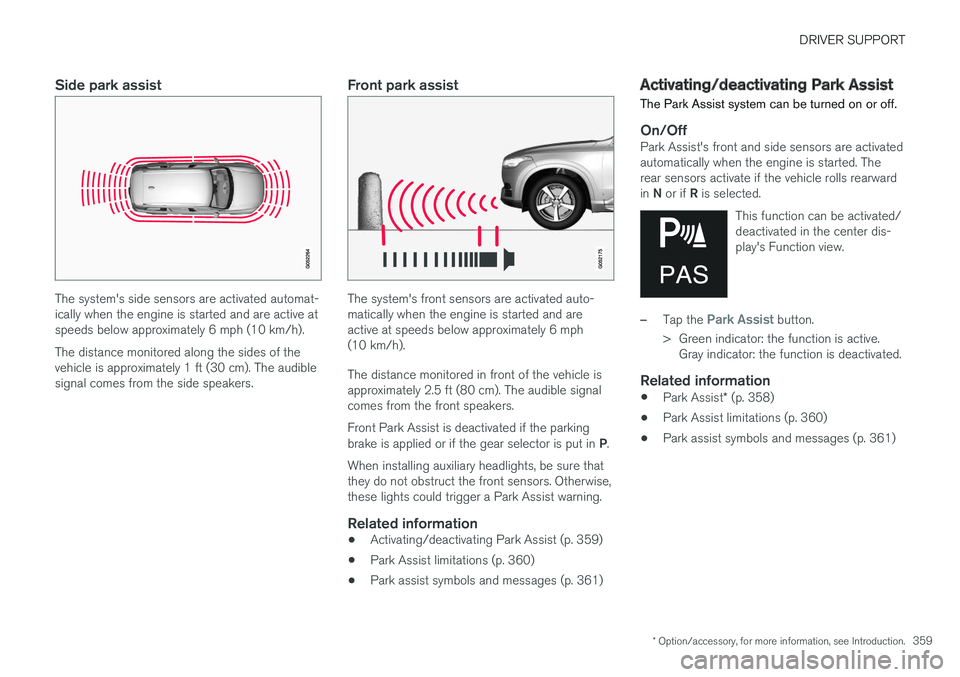
The system's side sensors are activated automat-ically when the engine is started and are active atspeeds below approximately 6 mph (10 km/h).
The distance monitored along the sides of thevehicle is approximately 1 ft (30 cm). The audiblesignal comes from the side speakers.
Front park assist
The system's front sensors are activated auto-matically when the engine is started and areactive at speeds below approximately 6 mph(10 km/h).
The distance monitored in front of the vehicle isapproximately 2.5 ft (80 cm). The audible signalcomes from the front speakers.
Front Park Assist is deactivated if the parkingbrake is applied or if the gear selector is put in P.
When installing auxiliary headlights, be sure thatthey do not obstruct the front sensors. Otherwise,these lights could trigger a Park Assist warning.
Related information
•Activating/deactivating Park Assist (p. 359)
•Park Assist limitations (p. 360)
•Park assist symbols and messages (p. 361)
Activating/deactivating Park Assist
The Park Assist system can be turned on or off.
On/Off
Park Assist's front and side sensors are activatedautomatically when the engine is started. Therear sensors activate if the vehicle rolls rearwardin N or if R is selected.
This function can be activated/deactivated in the center dis-play's Function view.
–Tap the Park Assist button.
>Green indicator: the function is active.Gray indicator: the function is deactivated.
Related information
•Park Assist* (p. 358)
•Park Assist limitations (p. 360)
•Park assist symbols and messages (p. 361)
Page 362 of 584
DRIVER SUPPORT
* Option/accessory, for more information, see Introduction.360
Park Assist limitations
The Park Assist system has certain limitations.
NOTE
A trailer hitch whose wiring is integrated withthe vehicle's electrical system will be takeninto account when measuring the availablespace behind the vehicle.
NOTE
•The system will not detect high objects,such as a loading dock, etc.
•Certain materials or fabrics may not bedetected by the sensors. Objects made ofthese materials or people wearing cloth-ing made of these fabrics may not bedetected.
•Children or animals near the vehicle maynot always be detected.
•Objects such as chains, thin shiny polesor low objects may temporarily not bedetected by the system. This may resultin the pulsing tone unexpectedly stoppinginstead of changing to a constant tone asthe vehicle approaches the object. Insuch cases, use caution when backing upor stop the vehicle to help avoid damage.
•In certain circumstances, the park assistsystem may give unexpected warning sig-nals that can be caused by externalsound sources that use the same ultra-sound frequencies as the system. Thismay include such things as the horns ofother vehicles, wet tires on asphalt, pneu-matic brakes, motorcycle exhaust pipes,other vehicles with similar ultrasound sys-tems, etc. This does not indicate a fault inthe system.
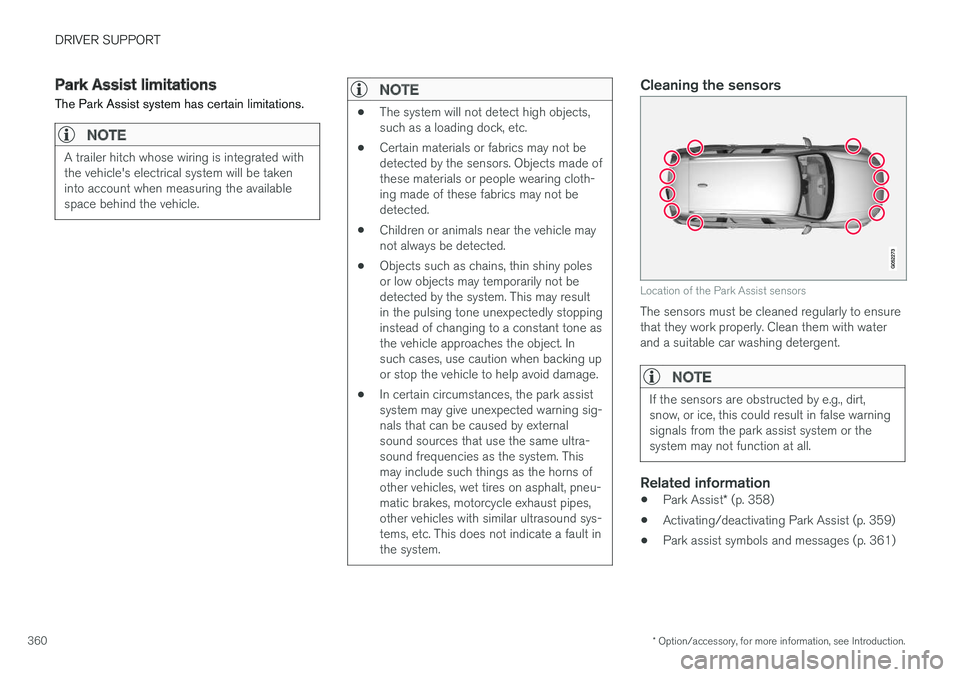
Cleaning the sensors
Location of the Park Assist sensors
The sensors must be cleaned regularly to ensurethat they work properly. Clean them with waterand a suitable car washing detergent.
NOTE
If the sensors are obstructed by e.g., dirt,snow, or ice, this could result in false warningsignals from the park assist system or thesystem may not function at all.
Related information
•Park Assist* (p. 358)
•Activating/deactivating Park Assist (p. 359)
•Park assist symbols and messages (p. 361)
Page 364 of 584

DRIVER SUPPORT
* Option/accessory, for more information, see Introduction.362
Park Assist Camera (PAC)*
The Park Assist Camera system is designed toprovide the driver with a view of the area aroundthe vehicle in the form of a camera image andgraphics in the center display.
PAC is a supplementary parking aid that can beactivated automatically when the gear selector isin R or by tapping a button in the center display,depending on the selected settings. See also thearticle "Starting the Park Assist Camera."
Lines: Guiding lines On/Off
Towbar: Guiding lines for a trailer hitch*11
On/Off
PAS: Park Assist On/Off
CTA: Cross Traffic Alert* On/Off
Zoom: Zoom in/out12
NOTE
A trailer hitch whose wiring is integrated withthe vehicle's electrical system will be takeninto account when measuring the availablespace behind the vehicle.
WARNING
•PAC is designed to be a supplementaryaid when parking the vehicle. It is not,however, intended to replace the driver
Page 365 of 584

DRIVER SUPPORT
* Option/accessory, for more information, see Introduction.363
Backing up
Location of the rear Park Assist Camera (generic illus-tration)
The rear camera shows a wide area behind thevehicle and on certain models, part of the bumperand the trailer hitch (if installed) will be visible.
Some objects on the screen may appear to “lean”slightly, which is normal.
WARNING
People/objects/obstructions displayed on thecenter console screen may be closer to thevehicle than they appear.
Front camera
Location of the front Park Assist Camera (generic illus-tration)
The front camera is located behind the grill andcan be useful when driving off in areas with lim-ited visibility (hedges, bushes, etc). It is active atspeeds up to approx. 16 mph (25 km/h) and isautomatically turned off when the vehicleexceeds this speed.
However, if the vehicle's speed does not exceed30 mph (50 km/h) and its speed goes under14 mph (22 km/h) within 60 seconds after thecamera has been switched off, the front camerawill reactivate.
NOTE
The front camera will only reactivate automati-cally if Auto Camera Reverse Activation
has been selected in SettingsMy CarPark Assist.
Side camera
The side cameras are located in the respectivedoor mirrors and shows views along the sides ofthe vehicle.
Related information
•Park Assist Camera (PAC)* trajectory linesand fields (p. 364)
•Park Assist Camera* (PAC) limitations(p. 367)
•Starting the Park Assist Camera (PAC)*(p. 366)
Page 366 of 584

DRIVER SUPPORT
* Option/accessory, for more information, see Introduction.364
Park Assist Camera (PAC)*trajectory lines and fields
The Park Assist Camera system uses trajectorylines and fields to indicate the vehicle's positionin relation to its immediate surroundings.
Trajectory lines
Sample guidelines
The trajectory lines are intended to show theposition of the vehicle's outermost dimensionsbased on the current position of the steeringwheel to help simplify parallel parking, backinginto tight spaces or when attaching a trailer.
The lines on the screen are projected as if theywere a path on the ground around the vehicleand are directly affected by the way in which thesteering wheel is turned. This enables the driverto see path the vehicle will take, even if he/sheturns the steering wheel.
These lines also indicate the outermost limits thatany object (door mirrors, corners of the body, atrailer hitch, etc.) extends out from the vehicle,even when it turns.
NOTE
When backing up with a trailer, the trajectorylines show the path that the vehicle will take,not the trailer.
Trajectory lines will not be displayed whilezooming in.
WARNING
Keep in mind that when the rear camera hasbeen selected, the image on the screen onlyshows the area behind the vehicle. The drivermust always watch for people, animals, othervehicles, etc., near the sides or the front of thevehicle when turning while backing up.
The opposite is true when the front camera isselected.
Please note that the trajectory lines show theshortest path. Be sure that the vehicle