engine YAMAHA AEROX50 2013 Owner's Manual
[x] Cancel search | Manufacturer: YAMAHA, Model Year: 2013, Model line: AEROX50, Model: YAMAHA AEROX50 2013Pages: 74, PDF Size: 2.34 MB
Page 43 of 74
PERIODIC MAINTENANCE AND ADJUSTMENT
6-7
6
EAU19622
Checking the spark plug The spark plug is an important engine
component, which should be checked
periodically, preferably by a Yamaha
dealer. Since heat and deposits will
cause any spark plug to slowly erode, it
should be removed and checked in ac-
cordance with the periodic mainte-
nance and lubrication chart. In addition,
the condition of the spark plug can re-
veal the condition of the engine.
The porcelain insulator around the cen-
ter electrode of the spark plug should
be a medium-to-light tan (the ideal color
when the vehicle is ridden normally). If
the spark plug shows a distinctly differ-
ent color, the engine could be operating
improperly. Do not attempt to diagnose
such problems yourself. Instead, have
a Yamaha dealer check the vehicle.
If the spark plug shows signs of elec-
trode erosion and excessive carbon or
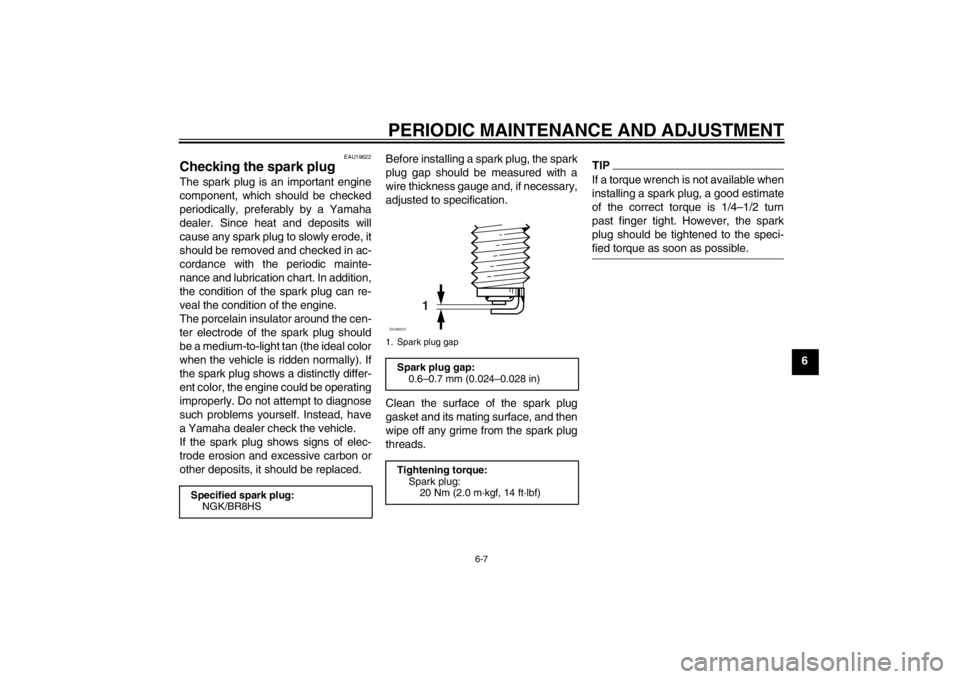
other deposits, it should be replaced.Before installing a spark plug, the spark
plug gap should be measured with a
wire thickness gauge and, if necessary,
adjusted to specification.
Clean the surface of the spark plug
gasket and its mating surface, and then
wipe off any grime from the spark plug
threads.
TIPIf a torque wrench is not available when
installing a spark plug, a good estimate
of the correct torque is 1/4–1/2 turn
past finger tight. However, the spark
plug should be tightened to the speci-
fied torque as soon as possible.
Specified spark plug:
NGK/BR8HS
1. Spark plug gap
Spark plug gap:
0.6–0.7 mm (0.024–0.028 in)
Tightening torque:
Spark plug:
20 Nm (2.0 m·kgf, 14 ft·lbf)
1
ZAUM0037
U1PHE0E0.book Page 7 Wednesday, August 29, 2012 4:42 PM
Page 44 of 74
PERIODIC MAINTENANCE AND ADJUSTMENT
6-8
6
EAU20066
Final transmission oil The final transmission case must be
checked for oil leakage before each
ride. If any leakage is found, have a
Yamaha dealer check and repair the
scooter. In addition, the final transmis-
sion oil must be changed as follows at
the intervals specified in the periodic
maintenance and lubrication chart.
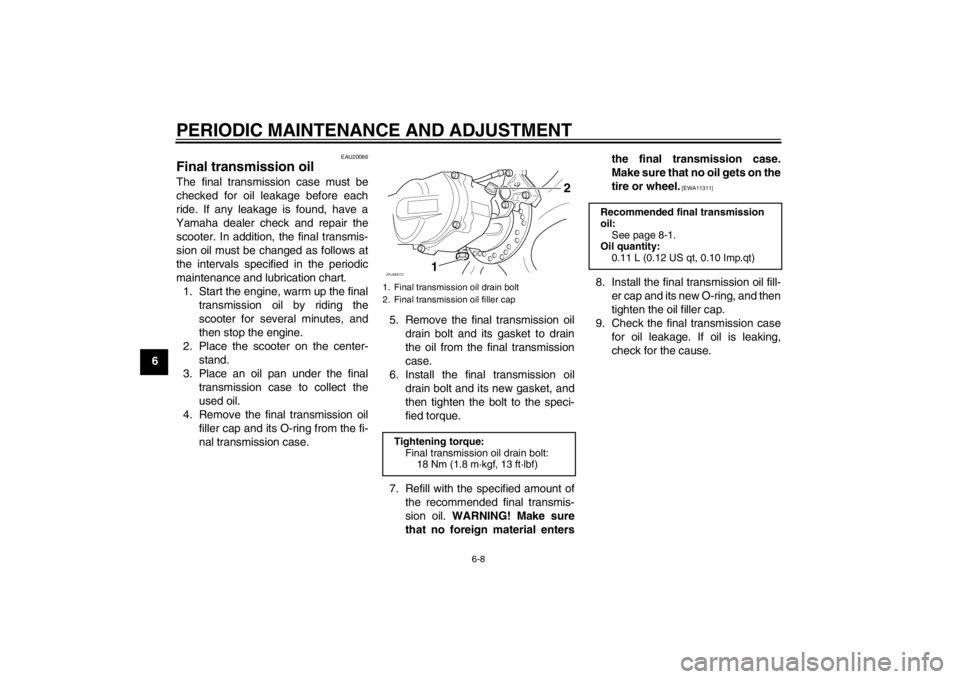
1. Start the engine, warm up the final
transmission oil by riding the
scooter for several minutes, and
then stop the engine.
2. Place the scooter on the center-
stand.
3. Place an oil pan under the final
transmission case to collect the
used oil.
4. Remove the final transmission oil
filler cap and its O-ring from the fi-
nal transmission case.5. Remove the final transmission oil
drain bolt and its gasket to drain
the oil from the final transmission
case.
6. Install the final transmission oil
drain bolt and its new gasket, and
then tighten the bolt to the speci-
fied torque.
7. Refill with the specified amount of
the recommended final transmis-
sion oil. WARNING! Make sure
that no foreign material entersthe final transmission case.
Make sure that no oil gets on the
tire or wheel.
[EWA11311]
8. Install the final transmission oil fill-
er cap and its new O-ring, and then
tighten the oil filler cap.
9. Check the final transmission case
for oil leakage. If oil is leaking,
check for the cause.
1. Final transmission oil drain bolt
2. Final transmission oil filler capTightening torque:
Final transmission oil drain bolt:
18 Nm (1.8 m·kgf, 13 ft·lbf)
12
ZAUM0273
Recommended final transmission
oil:
See page 8-1.
Oil quantity:
0.11 L (0.12 US qt, 0.10 Imp.qt)
U1PHE0E0.book Page 8 Wednesday, August 29, 2012 4:42 PM
Page 45 of 74
PERIODIC MAINTENANCE AND ADJUSTMENT
6-9
6
EAU20070
Coolant The coolant level should be checked
before each ride. In addition, the cool-
ant must be changed at the intervals
specified in the periodic maintenance
and lubrication chart.
EAUM2102
To check the coolant level
1. Place the vehicle on a level sur-
face and hold it in an upright posi-
tion.TIP●
The coolant level must be checked
on a cold engine since the level
varies with engine temperature.
●
Make sure that the vehicle is posi-
tioned straight up when checking
the coolant level. A slight tilt to the
side can result in a false reading.
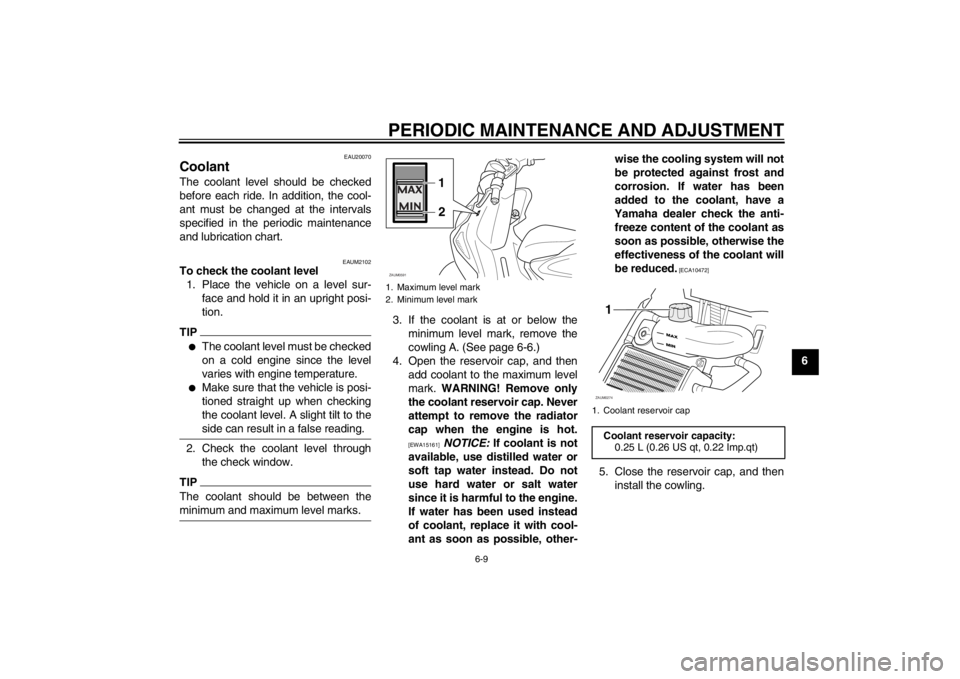
2. Check the coolant level through
the check window.TIPThe coolant should be between the
minimum and maximum level marks.
3. If the coolant is at or below the
minimum level mark, remove the
cowling A. (See page 6-6.)
4. Open the reservoir cap, and then
add coolant to the maximum level
mark. WARNING! Remove only
the coolant reservoir cap. Never
attempt to remove the radiator
cap when the engine is hot.
[EWA15161]
NOTICE: If coolant is not
available, use distilled water or
soft tap water instead. Do not
use hard water or salt water
since it is harmful to the engine.
If water has been used instead
of coolant, replace it with cool-
ant as soon as possible, other-wise the cooling system will not
be protected against frost and
corrosion. If water has been
added to the coolant, have a
Yamaha dealer check the anti-
freeze content of the coolant as
soon as possible, otherwise the
effectiveness of the coolant will
be reduced.
[ECA10472]
5. Close the reservoir cap, and then
install the cowling.
1. Maximum level mark
2. Minimum level mark
1
2
ZAUM0591
1. Coolant reservoir cap
Coolant reservoir capacity:
0.25 L (0.26 US qt, 0.22 Imp.qt)1ZAUM0274
U1PHE0E0.book Page 9 Wednesday, August 29, 2012 4:42 PM
Page 46 of 74
PERIODIC MAINTENANCE AND ADJUSTMENT
6-10
6
EAU33031
Changing the coolant
The coolant must be changed at the in-
tervals specified in the periodic mainte-
nance and lubrication chart. Have a
Yamaha dealer change the coolant.
WARNING! Never attempt to remove
the radiator cap when the engine is
hot.
[EWA10381]EAUM1642
Cleaning the air filter element The air filter element should be cleaned
at the intervals specified in the periodic
maintenance and lubrication chart.
Clean the air filter element more fre-
quently if you are riding in unusually
wet or dusty areas.
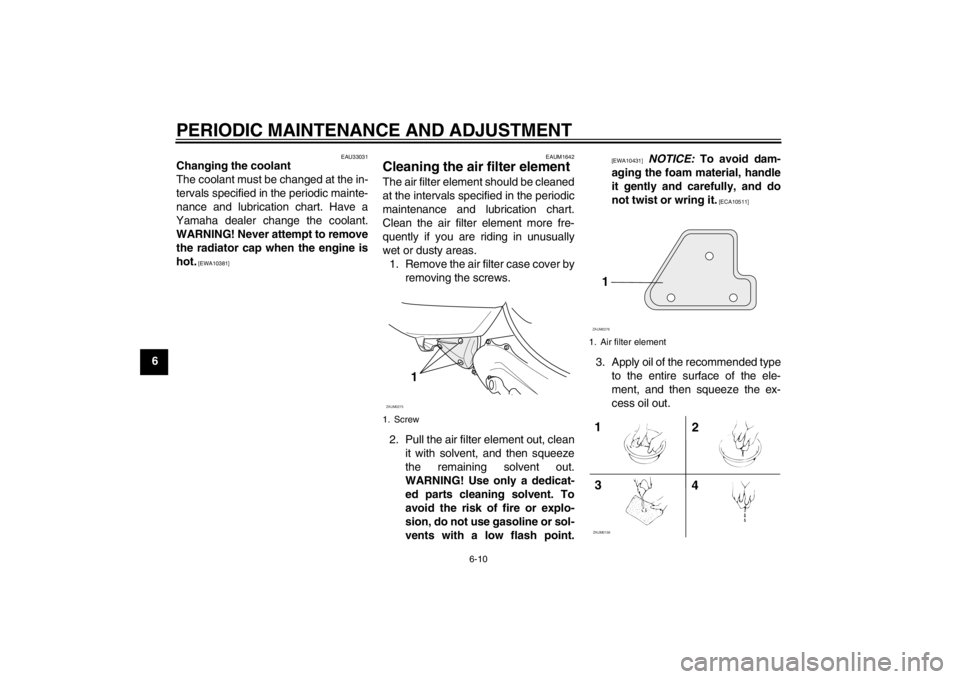
1. Remove the air filter case cover by
removing the screws.
2. Pull the air filter element out, clean
it with solvent, and then squeeze
the remaining solvent out.
WARNING! Use only a dedicat-
ed parts cleaning solvent. To
avoid the risk of fire or explo-
sion, do not use gasoline or sol-
vents with a low flash point.
[EWA10431]
NOTICE: To avoid dam-
aging the foam material, handle
it gently and carefully, and do
not twist or wring it.
[ECA10511]
3. Apply oil of the recommended type
to the entire surface of the ele-
ment, and then squeeze the ex-
cess oil out.
1. Screw
1
ZAUM0275
1. Air filter element
1ZAUM02761
4 32ZAUM0156
U1PHE0E0.book Page 10 Wednesday, August 29, 2012 4:42 PM
Page 47 of 74
PERIODIC MAINTENANCE AND ADJUSTMENT
6-11
6
TIPThe air filter element should be wet but
not dripping.4. Insert the element into the air filtercase. NOTICE: Make sure that
the air filter element is properly
seated in the air filter case. The
engine should never be operat-
ed without the air filter element
installed, otherwise the pis-
ton(s) and/or cylinder(s) may
become excessively worn.
[ECA10481]
5. Install the air filter case cover by in- stalling the screws.
EAU21300
Adjusting the carburetor The carburetor is an important part of
the engine and requires very sophisti-
cated adjustment. Therefore, all carbu-
retor adjustments should be left to a
Yamaha dealer, who has the neces-
sary professional knowledge and expe-
rience.
EAU21384
Checking the throttle grip free
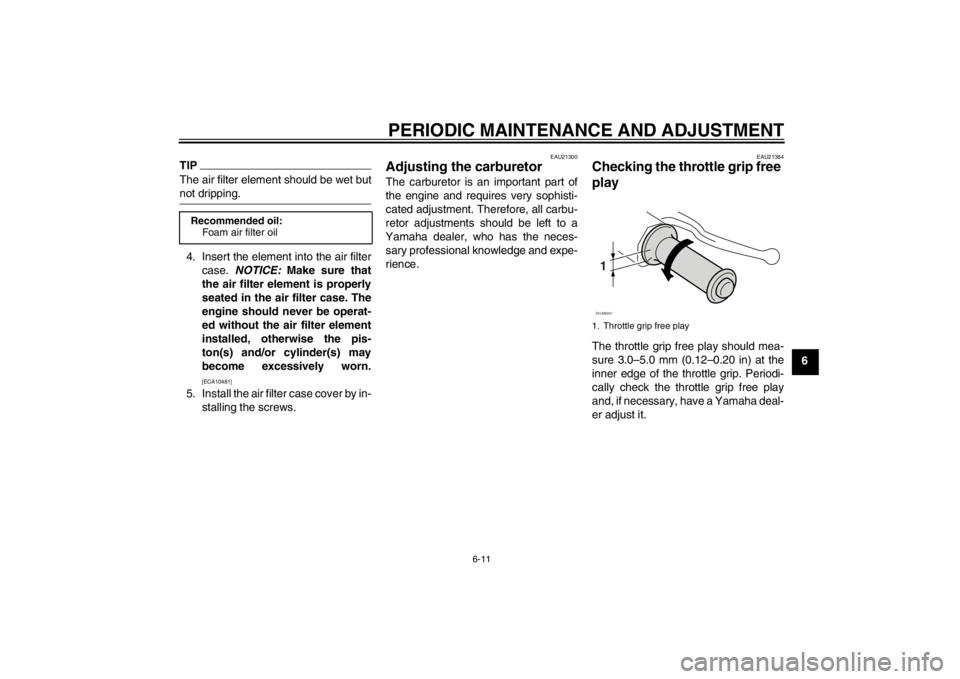
play The throttle grip free play should mea-
sure 3.0–5.0 mm (0.12–0.20 in) at the
inner edge of the throttle grip. Periodi-
cally check the throttle grip free play
and, if necessary, have a Yamaha deal-
er adjust it.
Recommended oil:Foam air filter oil
1. Throttle grip free play1ZAUM0051
U1PHE0E0.book Page 11 Thursday, September 6, 2012 3:31 PM
Page 62 of 74
PERIODIC MAINTENANCE AND ADJUSTMENT
6-26
6
EAU37622
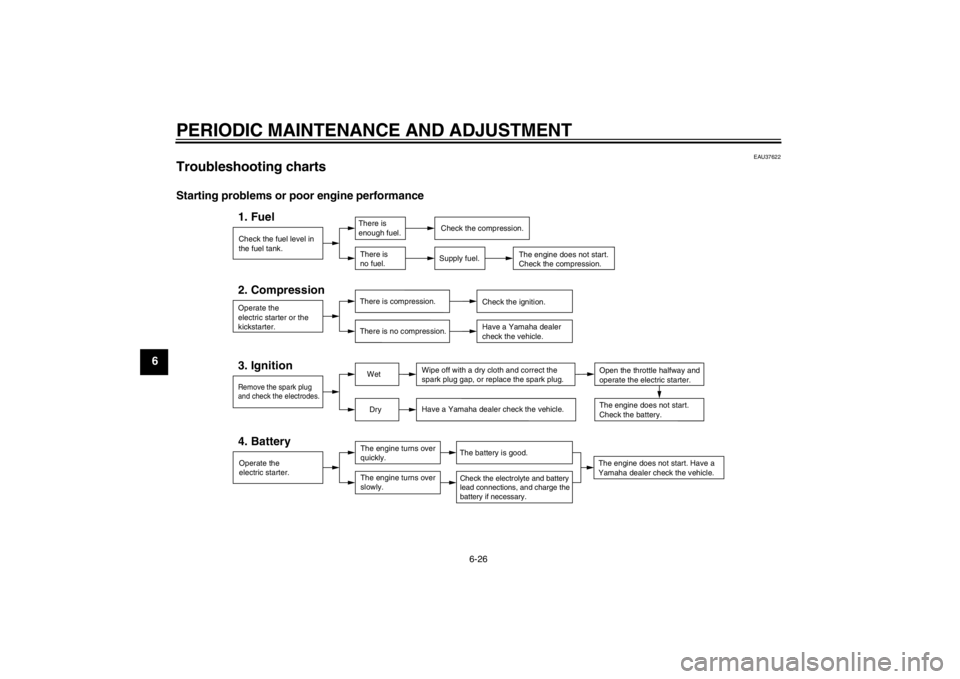
Troubleshooting charts Starting problems or poor engine performance
Check the fuel level in
the fuel tank.1. Fuel
There is
enough fuel.
There is
no fuel.
Check the compression.
Supply fuel.
The engine does not start.
Check the compression.
Operate the
electric starter or the
kickstarter.2. Compression
There is compression.
There is no compression.
Check the ignition.
Have a Yamaha dealer
check the vehicle.
Remove the spark plug
and check the electrodes.3. Ignition
Wet
Dry
Wipe off with a dry cloth and correct the
spark plug gap, or replace the spark plug.
Have a Yamaha dealer check the vehicle.
The engine does not start. Have a
Yamaha dealer check the vehicle.The engine does not start.
Check the battery.Open the throttle halfway and
operate the electric starter.
Operate the
electric starter.4. Battery
The engine turns over
quickly.
The engine turns over
slowly.
The battery is good.Check the electrolyte and battery
lead connections, and charge the
battery if necessary.
U1PHE0E0.book Page 26 Wednesday, August 29, 2012 4:42 PM
Page 63 of 74
PERIODIC MAINTENANCE AND ADJUSTMENT
6-27
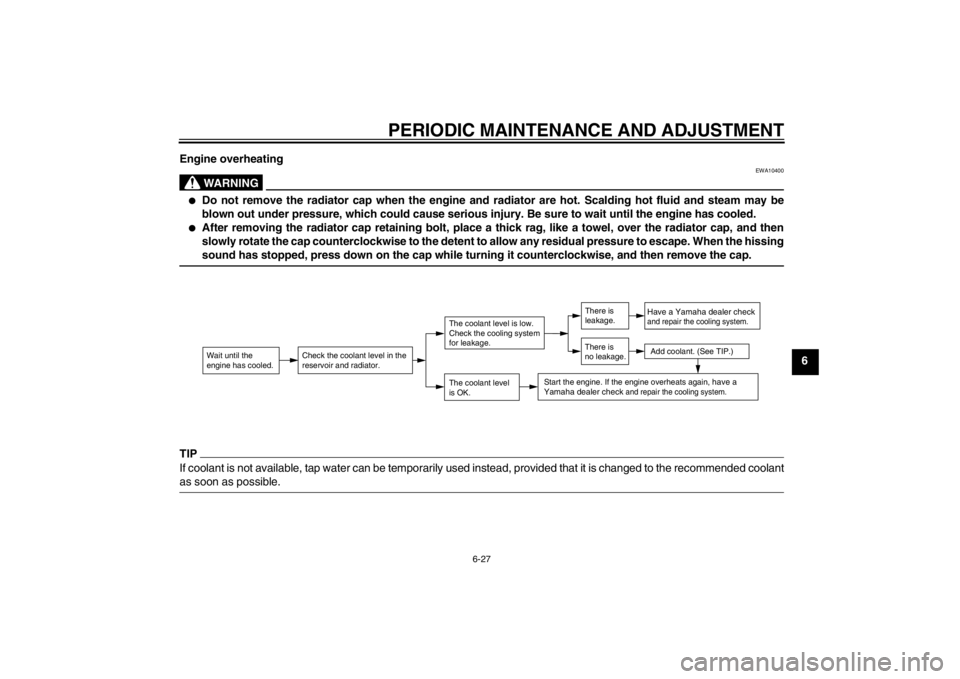
6 Engine overheating
WARNING
EWA10400
●
Do not remove the radiator cap when the engine and radiator are hot. Scalding hot fluid and steam may be
blown out under pressure, which could cause serious injury. Be sure to wait until the engine has cooled.
●
After removing the radiator cap retaining bolt, place a thick rag, like a towel, over the radiator cap, and then
slowly rotate the cap counterclockwise to the detent to allow any residual pressure to escape. When the hissing
sound has stopped, press down on the cap while turning it counterclockwise, and then remove the cap.
TIPIf coolant is not available, tap water can be temporarily used instead, provided that it is changed to the recommended coolant
as soon as possible.
Wait until the
engine has cooled.
Check the coolant level in the
reservoir and radiator.
The coolant level
is OK.The coolant level is low.
Check the cooling system
for leakage.
Have a Yamaha dealer checkand repair the cooling system.Add coolant. (See TIP.)
Start the engine. If the engine overheats again,
have a
Yamaha dealer check
and repair the cooling system.
There is
leakage.
There is
no leakage.
U1PHE0E0.book Page 27 Wednesday, August 29, 2012 4:42 PM
Page 64 of 74
SCOOTER CARE AND STORAGE
7-1
7
EAU37833
Matte color caution NOTICE
ECA15192
Some models are equipped with
matte colored finished parts. Be
sure to consult a Yamaha dealer for
advice on what products to use be-
fore cleaning the vehicle. Using a
brush, harsh chemical products or
cleaning compounds when cleaning
these parts will scratch or damage
their surface. Wax also should not
be applied to any matte colored fin-
ished parts.
EAU26094
Care While the open design of a scooter re-
veals the attractiveness of the technol-
ogy, it also makes it more vulnerable.
Rust and corrosion can develop even if
high-quality components are used. A
rusty exhaust pipe may go unnoticed
on a car, however, it detracts from the
overall appearance of a scooter. Fre-
quent and proper care does not only
comply with the terms of the warranty,
but it will also keep your scooter looking
good, extend its life and optimize its
performance.
Before cleaning
1. Cover the muffler outlet with a
plastic bag after the engine has
cooled down.
2. Make sure that all caps and covers
as well as all electrical couplers
and connectors, including the
spark plug cap, are tightly in-
stalled.
3. Remove extremely stubborn dirt,
like oil burnt onto the crankcase,
with a degreasing agent and a
brush, but never apply such prod-ucts onto seals, gaskets and wheel
axles. Always rinse the dirt and de-
greaser off with water.
Cleaning
NOTICE
ECA10783
●
Avoid using strong acidic wheel
cleaners, especially on spoked
wheels. If such products are
used on hard-to-remove dirt, do
not leave the cleaner on the af-
fected area any longer than in-
structed. Also, thoroughly rinse
the area off with water, immedi-
ately dry it, and then apply a cor-
rosion protection spray.
●
Improper cleaning can damage
plastic parts (such as cowlings,
panels, windshields, headlight
lenses, meter lenses, etc.) and
the mufflers. Use only a soft,
clean cloth or sponge with wa-
ter to clean plastic. However, if
the plastic parts cannot be thor-
oughly cleaned with water, di-
luted mild detergent with water
may be used. Be sure to rinse
U1PHE0E0.book Page 1 Wednesday, August 29, 2012 4:42 PM
Page 66 of 74
SCOOTER CARE AND STORAGE
7-3
73. To prevent corrosion, it is recom-
mended to apply a corrosion pro-
tection spray on all metal,
including chrome- and nickel-plat-
ed, surfaces.
4. Use spray oil as a universal clean-
er to remove any remaining dirt.
5. Touch up minor paint damage
caused by stones, etc.
6. Wax all painted surfaces.
7. Let the scooter dry completely be-
fore storing or covering it.
WARNING
EWA10942
Contaminants on the brakes or tires
can cause loss of control.●
Make sure that there is no oil or
wax on the brakes or tires. If
necessary, clean the brake
discs and brake linings with a
regular brake disc cleaner or ac-
etone, and wash the tires with
warm water and a mild deter-
gent.
●
Before operating the scooter
test its braking performance
and cornering behavior.
NOTICE
ECA10800
●
Apply spray oil and wax spar-
ingly and make sure to wipe off
any excess.
●
Never apply oil or wax to any
rubber and plastic parts, but
treat them with a suitable care
product.
●
Avoid using abrasive polishing
compounds as they will wear
away the paint.
TIP●
Consult a Yamaha dealer for ad-
vice on what products to use.
●
Washing, rainy weather or humid
climates can cause the headlight
lens to fog. Turning the headlight
on for a short period of time will
help remove the moisture from the
lens.
EAU26303
Storage Short-term
Always store your scooter in a cool, dry
place and, if necessary, protect it
against dust with a porous cover. Be
sure the engine and the exhaust sys-
tem are cool before covering the scoot-
er.NOTICE
ECA10820
●
Storing the scooter in a poorly
ventilated room or covering it
with a tarp, while it is still wet,
will allow water and humidity to
seep in and cause rust.
●
To prevent corrosion, avoid
damp cellars, stables (because
of the presence of ammonia)
and areas where strong chemi-
cals are stored.
Long-term
Before storing your scooter for several
months:
1. Follow all the instructions in the
“Care” section of this chapter.
U1PHE0E0.book Page 3 Wednesday, August 29, 2012 4:42 PM
Page 67 of 74

SCOOTER CARE AND STORAGE
7-4
7 2. Drain the carburetor float chamber
by loosening the drain bolt; this will
prevent fuel deposits from building
up. Pour the drained fuel into the
fuel tank.
3. Fill up the fuel tank and add fuel
stabilizer (if available) to prevent
the fuel tank from rusting and the
fuel from deteriorating.
4. Perform the following steps to pro-
tect the cylinder, piston rings, etc.
from corrosion.
a. Remove the spark plug cap
and spark plug.
b. Pour a teaspoonful of engine oil
into the spark plug bore.
c. Install the spark plug cap onto
the spark plug, and then place
the spark plug on the cylinder
head so that the electrodes are
grounded. (This will limit spark-
ing during the next step.)
d. Turn the engine over several
times with the starter. (This will
coat the cylinder wall with oil.)
WARNING! To prevent dam-
age or injury from sparking,
make sure to ground thespark plug electrodes while
turning the engine over.
[EWA10951]
e. Remove the spark plug cap
from the spark plug, and then
install the spark plug and the
spark plug cap.
5. Lubricate all control cables and the
pivoting points of all levers and
pedals as well as of the side-
stand/centerstand.
6. Check and, if necessary, correct
the tire air pressure, and then lift
the scooter so that both of its
wheels are off the ground. Alterna-
tively, turn the wheels a little every
month in order to prevent the tires
from becoming degraded in one
spot.
7. Cover the muffler outlet with a
plastic bag to prevent moisture
from entering it.
8. Remove the battery and fully
charge it. Store it in a cool, dry
place and charge it once a month.
Do not store the battery in an ex-
cessively cold or warm place [less
than 0 °C (30 °F) or more than 30°C (90 °F)]. For more information
on storing the battery, see page
6-19.
TIPMake any necessary repairs before
storing the scooter.
U1PHE0E0.book Page 4 Wednesday, August 29, 2012 4:42 PM