brake YAMAHA BLASTER 200 2002 User Guide
[x] Cancel search | Manufacturer: YAMAHA, Model Year: 2002, Model line: BLASTER 200, Model: YAMAHA BLASTER 200 2002Pages: 368, PDF Size: 4.89 MB
Page 131 of 368

6-3
EBU00512
Starting a cold engine
w
Always make sure all control cables work
smoothly before you begin riding in cold
weather. If the control cables are frozen or
do not work smoothly, you could be unable
to control the ATV, which could lead to an
accident or collision.
1. Set the parking brake.
2. Turn the fuel cock to “ON”.
3. Turn the main switch to “ON” and the engine
stop switch to “RUN”.
4. Shift the transmission into neutral.
5. Use the starter (choke) in reference to the
figure:
5KJ-62 (6 shou) 4/23/01 3:05 PM Page 4
Page 147 of 368

6-19
EBU00208
To decelerate:
When slowing down or stopping, release the
throttle and apply the brakes smoothly and
evenly. As you slow down, shift to a lower gear.
Be sure that the engine has sufficiently slowed
before engaging a lower gear. Improper use of
the brakes or shifting can cause the tires to lose
traction, reducing control and increasing the
possibility of an accident.
w
Make sure the engine has sufficiently slowed
before shifting to a lower gear. Engaging a
lower gear when the engine speed is too
high could make the wheels stop rotating.
This could cause loss of control, an accident
and injury. It could also cause engine or
drive train damage.
5KJ-62 (6 shou) 4/23/01 3:05 PM Page 20
Page 153 of 368
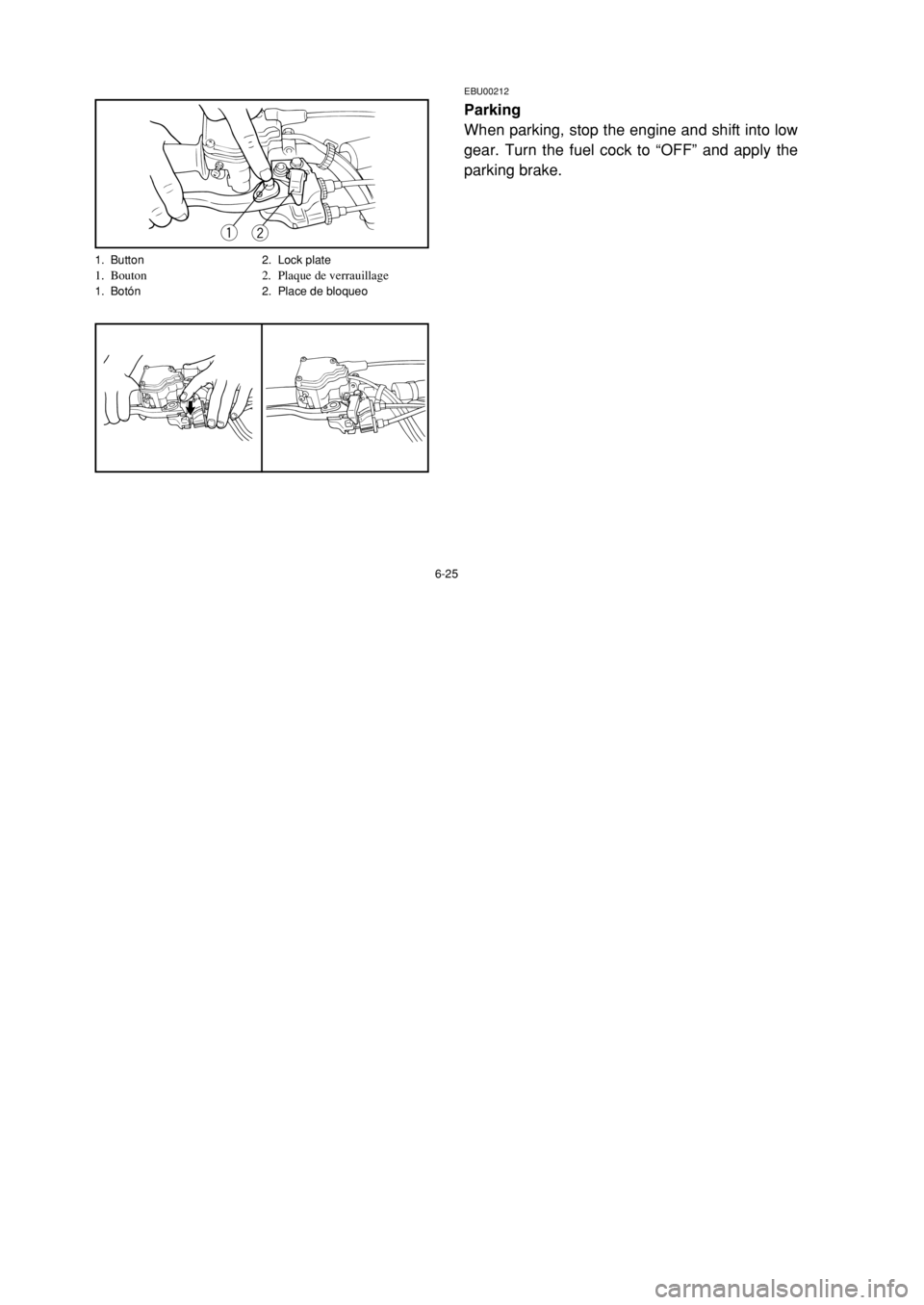
6-25
EBU00212
Parking
When parking, stop the engine and shift into low
gear. Turn the fuel cock to “OFF” and apply the
parking brake.
qw
1. Button 2. Lock plate1. Bouton 2. Plaque de verrauillage1. Botón 2. Place de bloqueo
5KJ-62 (6 shou) 4/23/01 3:05 PM Page 26
Page 155 of 368

6-27
EBU00214
Parking on a slope
w
Avoid parking on hills or other inclines.
Parking on a hill or other incline could cause
the ATV to roll out of control, increasing the
chance of an accident. If you must park on
an incline, put the machine in low gear, apply
the parking brake, and block the front and
rear wheels with rocks or other objects.
Do not park the ATV at all on hills that are so
steep you could not walk up them easily.
1. Bring the machine to a stop by applying the
brakes in low gear.
2. Stop the engine and release the clutch
lever.
3. With the front and rear brakes applied, apply
the parking brake and slowly release the
rear brake pedal.
5KJ-62 (6 shou) 4/23/01 3:05 PM Page 28
Page 201 of 368

7-35
Select a large, flat area off-road to become
familiar with your ATV. Make sure that this area
is free of obstacles and other riders. You should
practice control of the throttle, brakes, shifting
procedures, and turning techniques in this area
before trying more difficult terrain. Always avoid
riding on paved surfaces: the ATV is designed
for off-road use only, and handling maneuvers
are more difficult to perform on pavement.
Set the parking brake and follow the instruction
on page 6-3 to start the engine. Once it has
warmed up you are ready to begin riding your
ATV. As you get on the ATV, be sure not to
accidentally move the shift pedal. Remember
that the engine and exhaust pipe will be hot
when riding and afterwards; do not allow skin or
clothing to come in contact with these compo-
nents.
5KJ-62 (7 shou) 4/23/01 3:06 PM Page 36
Page 203 of 368

7-37
With the engine idling, pull the clutch lever to
disengage the clutch and shift into 1st gear, and
then release the parking brake. Open the throttle
gradually, and at the same time, release the
clutch lever slowly. Once the ATV has attained
adequate speed, release the throttle lever and at
same time, quickly pull in the clutch lever and
shift into 2nd gear. Open the throttle part way
and gradually release the clutch. Use this same
procedure as you move into the higher gears.
Be sure to coordinate the use of the throttle and
shift pedal properly. If the throttle is applied too
abruptly or if the throttle is not released during
shifting, or if the shift pedal is not released
before applying the throttle, the front wheels
may lift off the ground resulting in a loss of direc-
tional control. Avoid higher speeds until you are
thoroughly familiar with the operation of your
ATV.
5KJ-62 (7 shou) 4/23/01 3:06 PM Page 38
Page 205 of 368

7-39
w
Always open the throttle gradually and
release the clutch lever slowly. Otherwise,
the machine could wheelie which would
increase the chance of an accident.
cC
Do not shift gears without releasing the
throttle. Damage to the engine or drive train
may occur.
When slowing down or stopping, release the
throttle and apply the brakes smoothly and
evenly. As you slow down, shift to a lower gear.
Be sure that the engine has sufficiently slowed
before engaging a lower gear. Improper use of
the brakes or shifting can cause the tires to lose
traction, reducing control and increasing the
possibility of an accident.
5KJ-62 (7 shou) 4/23/01 3:06 PM Page 40
Page 221 of 368

7-55
If your ATV has stalled or stopped and you
believe you can continue up the hill, restart care-
fully to make sure you do not lift the front wheels
which could cause you to lose control. If you are
unable to continue up the hill, dismount the ATV
on the uphill side. Physically turn the ATV
around and then descend the hill.
If you start to roll backwards, DO NOT use the
rear brake to stop or try to put the ATV in gear.
The ATV could easily tip over backwards.
Instead, dismount the ATV immediately on the
uphill side.
5KJ-62 (7 shou) 4/23/01 3:06 PM Page 56
Page 223 of 368

7-57
w
Use proper gear and maintain steady speed
when climbing a hill.
If you lose all forward speed:
8Keep weight uphill.
8Apply the brakes.
8Lock parking brake, after you are stopped.
If you begin rolling backwards:
8Keep weight uphill.
8Never apply the rear brake while rolling
backwards. Apply the front brake.
When fully stopped, apply rear brake as
well, and then lock parking brake.
Dismount on uphill side or to a side if point-
ed straight uphill. Turn the ATV around and
remount, following the procedure described
in the Owner’s Manual.
5KJ-62 (7 shou) 4/23/01 3:06 PM Page 58
Page 233 of 368

7-67
CROSSING THROUGH SHALLOW WATER
The ATV can be used to cross slow moving,
shallow water of up to a maximum of 35 cm in
depth. Before entering the water, choose your
path carefully. Enter where there is no sharp
drop off, and avoid rocks or other obstacles
which may be slippery or upset the ATV. Drive
slowly and carefully.
w
Never operate this ATV in fast flowing water
or in water deeper than that specified in your
Owner’s Manual. Remember that wet brakes
may have reduced stopping ability. Test your
brakes after leaving water. If necessary,
apply them several times to let friction dry
out the linings. If the ATV is operated
through deep or fast flowing water, the tires
may float, causing loss of traction and loss
of control, which could lead to an accident.
5KJ-62 (7 shou) 4/23/01 3:06 PM Page 68