fuel YAMAHA DT125R 2000 User Guide
[x] Cancel search | Manufacturer: YAMAHA, Model Year: 2000, Model line: DT125R, Model: YAMAHA DT125R 2000Pages: 91, PDF Size: 4.67 MB
Page 34 of 91
5-3
OPERATION AND IMPORTANT RIDING POINTS
1
2
3
45
6
7
8
9 1.Turn the fuel cock to ÒONÓ.
2.Turn the main switch to ÒONÓ and
the engine stop switch to Ò#Ó.
3.Shift the transmission into neu-
tral.
NOTE:
When the transmission is in neutral,
the neutral indicator light should be
on. If the light does not come on, ask
a Yamaha dealer to inspect it.4.Turn on the starter (choke) and
completely close the throttle grip.
5.Kick the kick starter to start the
engine.
6.After starting the engine, move
the starter (choke) to the halfway
position.
NOTE:
For maximum engine life, never
accelerate hard with a cold engine!7.After the engine is warm, turn off
the starter (choke) completely.NOTE:
The engine is warm when it responds
normally to the throttle with the starter
(choke) turned off.
EAU01258
Starting a warm engineThe starter (choke) is not required
when the engine is warm.
EC000046
cCSee the ÒEngine break-inÓ section
prior to operating the motorcycle
for the first time.
3MB-9-E7 12/27/00 2:52 PM Page 33
Page 36 of 91
5-5
OPERATION AND IMPORTANT RIDING POINTS
1
2
3
45
6
7
8
9
EAU00424
Tips for reducing fuel
consumptionYour motorcycleÕs fuel consumption
depends to a large extent on your rid-
ing style. The following tips can help
reduce fuel consumption:
8Warm up the engine before rid-
ing.
8Turn off the starter (choke) as
soon as possible.
8Shift up swiftly and avoid high
engine speeds during accelera-
tion.
8Do not double-clutch or rev the
engine while shifting down and
avoid high engine speeds with
no load on the engine.
8Turn off the engine instead of let-
ting it idle for an extended length
of time, i.e. in traffic jams, at traf-
fic lights or railroad crossings.
EAU00436
Engine break-inThere is never a more important peri-
od in the life of your motorcycle than
the period between zero and 1,000
km. For this reason we ask that you
carefully read the following material.
Because the engine is brand new,
you must not put an excessive load
on it for the first 1,000 km. The vari-
ous parts in the engine wear and pol-
ish themselves to the correct operat-
ing clearances. During this period,
prolonged full throttle operation, or
any condition which might result in
excessive heating of the engine,
must be avoided.
EAU00453
0 ~ 500 km
Avoid operation above 6,000 r/min.
Stop the engine and let it cool for 5 to
10 minutes after every hour of opera-
tion. Vary the speed of the motorcy-
cle from time to time. Do not operate
it at one set throttle position.
500 ~ 1,000 km
Avoid prolonged operation above
7,000 r/min. Rev the motorcycle
freely through the gears, but do not
use full throttle at any time.
EC000060
cCAfter 1,000 km of operation, be
sure to replace the transmission
oil.
3MB-9-E7 12/27/00 2:52 PM Page 35
Page 37 of 91
1,000 km and beyondFull throttle can be used.
EC000053
cC8
8
Never let engine speeds enter
the red zone.
8 8
If any engine trouble should
occur during the break-in peri-
od, consult a Yamaha dealer
immediately.
EAU00458
ParkingWhen parking the motorcycle, stop
the engine and remove the ignition
key. Turn the fuel cock to ÒOFFÓ
whenever stopping the engine.
EW000058
wThe exhaust system is hot. Park
the motorcycle in a place where
pedestrians or children are not
likely to touch the motorcycle. Do
not park the motorcycle on a slope
or soft ground; the motorcycle
may overturn.
EC000062
cCNever park this motorcycle in an
area that would cause a fire haz-
zard such as grass or other materi-
als that may easily burn.
5-6
OPERATION AND IMPORTANT RIDING POINTS
1
2
3
45
6
7
8
9 3MB-9-E7 12/27/00 2:52 PM Page 36
Page 40 of 91

6-3
PERIODIC MAINTENANCE AND MINOR REPAIR
1
2
3
4
56
7
8
9
EAU03686
Periodic maintenance and lubrication chart
NOTE:
8The annual checks must be performed every year, except if a kilometer-based maintenance is performed instead.
8From 30,000 km, repeat the maintenance intervals starting from 6,000 km.
8Items marked with an asterisk should be performed by a Yamaha dealer as they require special tools, data and
technical skills.NO.ITEMCHECK OR MAINTENANCE JOBODOMETER READING (´ 1,000 km)
ANNUAL
CHECK
16121824
1
*Fuel line¥Check fuel hoses for cracks or damage.ÖÖÖÖÖ
2Spark plug¥Replace.ÖÖÖÖÖ
3Air filter element¥Clean.ÖÖ
¥Replace.ÖÖ
4*Battery¥Check electrolyte level and specific gravity.
¥Make sure that the breather hose is properly routed.ÖÖÖÖÖ
5Clutch¥Check operation.
¥Adjust.ÖÖÖÖÖ
6*Front brake¥Check operation, fluid level and vehicle for fluid leakage.
(See NOTE on page 6-5.)ÖÖÖÖÖÖ
¥Replace brake pads.Whenever worn to the limit
7*Rear brake¥Check operation, fluid level and vehicle for fluid leakage.
(See NOTE on page 6-5.)ÖÖÖÖÖÖ
¥Replace brake pads.Whenever worn to the limit
8*Brake hoses¥Check for cracks or damage.ÖÖÖÖÖ
¥Replace. (See NOTE on page 6-5.)Every 4 years
3MB-9-E7 12/27/00 2:52 PM Page 39
Page 76 of 91

6-39
PERIODIC MAINTENANCE AND MINOR REPAIR
1
2
3
4
56
7
8
9
EAU03106
Rear wheel installation1.Install the rear wheel and chain.
Guide the brake disc between
the brake pads. Make sure there
is enough gap between the
brake pads before inserting the
brake disc.
2.Make sure the wheel axle is
inserted from the left side and
that the chain adjusting plates
are installed with the punched
side outward.
3.Install the swingarm end bolts.
4.Adjust the drive chain.
5.Tighten the following parts to the
specified torques.
Tightening torque:
Axle nut:
90 Nm (9.0 m
0kg)
Swingarm end bolt:
3 Nm (0.3 m0kg)
EAU01008
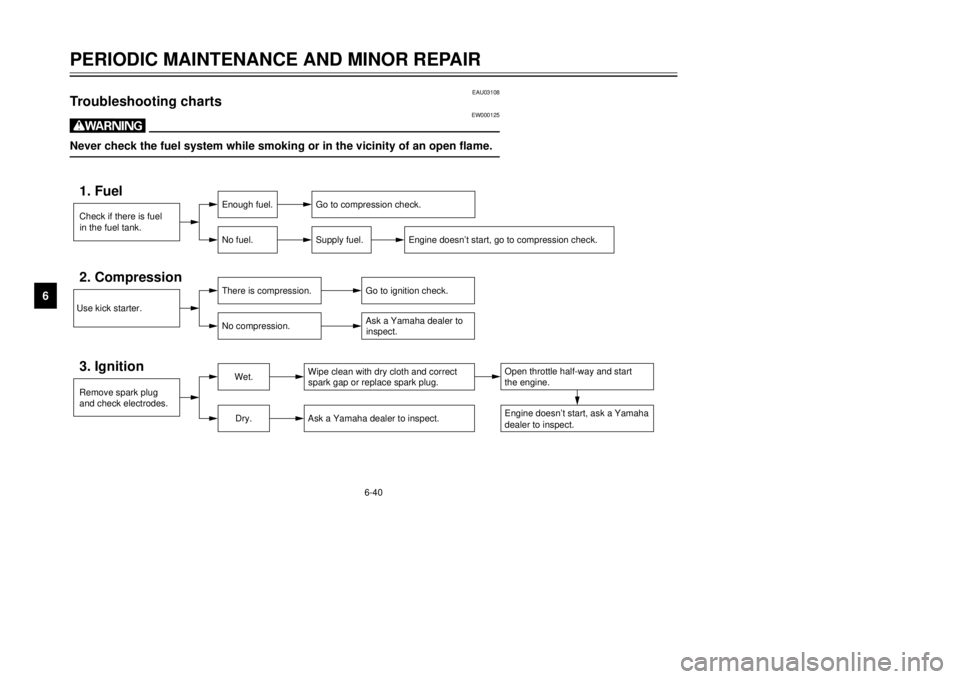
TroubleshootingAlthough Yamaha motorcycles
receive a rigid inspection before ship-
ment from the factory, trouble may
occur during operation.
Any problem in the fuel, compres-
sion, or ignition systems can cause
poor starting and loss of power. The
troubleshooting chart describes a
quick, easy procedure for making
checks.
If your motorcycle requires any
repair, bring it to a Yamaha dealer.
The skilled technicians at a Yamaha
dealership have the tools, experi-
ence, and know-how to properly ser-
vice your motorcycle. Use only gen-
uine Yamaha parts on your
motorcycle. Imitation parts may look
like Yamaha parts, but they are often
inferior. Consequently, they have a
shorter service life and can lead to
expensive repair bills.
3MB-9-E7 12/27/00 2:52 PM Page 75
Page 77 of 91
6-40
PERIODIC MAINTENANCE AND MINOR REPAIR
1
2
3
4
56
7
8
9
EAU03108
Troubleshooting charts
EW000125
wNever check the fuel system while smoking or in the vicinity of an open flame.Check if there is fuel1. Fuel
Enough fuel.
No fuel.
Go to compression check.
Supply fuel.
Engine doesn’t start, go to compression check.
Use kick starter.2. Compression
There is compression.
No compression.
Go to ignition check.
Ask a Yamaha dealer to
Remove spark plug3. Ignition
Wet.
Dry.
Wipe clean with dry cloth and correct
Ask a Yamaha dealer to inspect.
Engine doesn’t start, ask a YamahaOpen throttle half-way and start
in the fuel tank.
and check electrodes.spark gap or replace spark plug.the engine.
dealer to inspect. inspect.
3MB-9-E7 12/27/00 2:52 PM Page 76
Page 80 of 91
7-2
MOTORCYCLE CARE AND STORAGE
1
2
3
4
5
67
8
9 8 8
Improper cleaning can damage
windshields, cowlings, panels
and other plastic parts. Use
only a soft, clean cloth or
sponge with mild detergent
and water to clean plastic.
8 8
Do not use any harsh chemical
products on plastic parts. Be
sure to avoid using cloths or
sponges which have been in
contact with strong or abra-
sive cleaning products, sol-
vent or thinner, fuel (gasoline),
rust removers or inhibitors,
brake fluid, antifreeze or elec-
trolyte.8 8
Do not use high-pressure
washers or steam-jet cleaners
since they cause water seep-
age and deterioration in the
following areas: seals (of
wheel bearings, swingarm
bearings, forks and brakes),
electric components (cou-
plers, connectors, instru-
ments, switches and lights),
breather hoses and vents.
8 8
For motorcycles equipped
with a windshield: Do not use
strong cleaners or hard
sponges as they will cause
dulling or scratching. Some
cleaning compounds for plas-
tic may leave scratches on the
windshield. Test the product
on a small hidden part of the
windshield to make sure they
do not leave any marks. If the
windshield is scratched, use a
quality plastic polishing com-
pound after washing.
After riding in the rain, near the seaor on salt-sprayed roadsSince sea salt or salt sprayed on the
roads in the winter are extremely cor-
rosive in combination with water,
carry out the following steps after
each ride in the rain, near the sea or
on salt-sprayed roads. (Salt sprayed
in the winter may remain on the roads
well into spring.)
1.Clean your motorcycle with cold
water and soap after the engine
has cooled down.
ECA00012
cCDo not use warm water since it
increases the corrosive action of
the salt.2.Be sure to apply a corrosion pro-
tection spray on all (even
chrome- and nickel-plated) metal
surfaces to prevent corrosion.
3MB-9-E7 12/27/00 2:52 PM Page 79
Page 82 of 91
7-4
MOTORCYCLE CARE AND STORAGE
1
2
3
4
5
67
8
9
StorageShort-term
Always store your motorcycle in a
cool, dry place and, if necessary, pro-
tect it against dust with a porous
cover.
ECA00014
cC8
8
Storing the motorcycle in a
poorly ventilated room or cov-
ering it with a tarp while it is
still wet will allow water and
humidity to seep in and cause
rust.
8 8
To prevent corrosion, avoid
damp cellars, stables (because
of the presence of ammonia)
and areas where strong chemi-
cals are stored.
Long-term
Before storing your motorcycle for
several months:
1.Follow all the instructions in the
ÒCareÓ section of this chapter.
2.Drain the carburetor float cham-
ber by loosening the drain bolt;
this will prevent fuel deposits
from building up. Pour the
drained fuel into the fuel tank.
3.Only for motorcycles equipped
with a fuel cock which has an
ÒOFFÓ position: Turn the fuel
cock to ÒOFFÓ.
4.Fill up the fuel tank and add fuel
stabilizer (if available) to prevent
the fuel tank from rusting and the
fuel from deteriorating.
5.Perform the following steps to
protect the cylinder, piston rings,
etc. from corrosion.a.Remove the spark plug cap and
spark plug.
b.Pour a teaspoonful of engine oil
into the spark plug bore.
c.Install the spark plug cap onto
the spark plug and place the
spark plug on the cylinder head
so that the electrodes are
grounded. (This will limit spark-
ing during the next step.)
d.Turn the engine over several
times with the starter. (This will
coat the cylinder wall with oil.)
e.Remove the spark plug cap from
the spark plug, install the spark
plug and then the spark plug
cap.
EWA00003
wWhen turning the engine over, be
sure to ground the spark plug elec-
trodes to prevent damage or injury
from sparking.
3MB-9-E7 12/27/00 2:52 PM Page 81
Page 84 of 91

8-1
1
2
3
4
5
6
78
9
EAU01038
SPECIFICATIONS
Specifications
ModelDT125R
Dimensions
Overall length2,170 mm
2,235 mm (N, S, SF, CH, A only)
Overall width830 mm
Overall height1,255 mm
Seat height885 mm
Wheel base1,415 mm
Ground clearance315 mm
Minimum turning radius2,100 mm
Basic weight (with oil and
full fuel tank)127 kg
129 kg (CH, A only)
Engine
Engine typeLiquid-cooled 2-stroke
Cylinder arrangementForward-inclined single
cylinder
Displacement124 cm
3
Bore ´Stroke56.0 ´50.7 mm Compression ratio6.7:1
Starting systemKick starter
Lubrication systemSeparate lubrication
(Yamaha autolube)
Engine oil (2-cycle)
Type2 stroke engine oil
Capacity
Total amount1.2 L
Transmission oil
TypeSAE 10W30 type SE motor oil
Capacity
Periodic oil change0.75 L
Total amount0.8 L
Radiator capacity
(Including all routes)0.92 L
Air filterWet type element
Fuel
TypeRegular unleaded gasoline
Fuel tank capacity10 L
Reserve amount1.8 L
3MB-9-E7 12/27/00 2:52 PM Page 83