light YAMAHA DT125R 2000 User Guide
[x] Cancel search | Manufacturer: YAMAHA, Model Year: 2000, Model line: DT125R, Model: YAMAHA DT125R 2000Pages: 91, PDF Size: 4.67 MB
Page 36 of 91
5-5
OPERATION AND IMPORTANT RIDING POINTS
1
2
3
45
6
7
8
9
EAU00424
Tips for reducing fuel
consumptionYour motorcycleÕs fuel consumption
depends to a large extent on your rid-
ing style. The following tips can help
reduce fuel consumption:
8Warm up the engine before rid-
ing.
8Turn off the starter (choke) as
soon as possible.
8Shift up swiftly and avoid high
engine speeds during accelera-
tion.
8Do not double-clutch or rev the
engine while shifting down and
avoid high engine speeds with
no load on the engine.
8Turn off the engine instead of let-
ting it idle for an extended length
of time, i.e. in traffic jams, at traf-
fic lights or railroad crossings.
EAU00436
Engine break-inThere is never a more important peri-
od in the life of your motorcycle than
the period between zero and 1,000
km. For this reason we ask that you
carefully read the following material.
Because the engine is brand new,
you must not put an excessive load
on it for the first 1,000 km. The vari-
ous parts in the engine wear and pol-
ish themselves to the correct operat-
ing clearances. During this period,
prolonged full throttle operation, or
any condition which might result in
excessive heating of the engine,
must be avoided.
EAU00453
0 ~ 500 km
Avoid operation above 6,000 r/min.
Stop the engine and let it cool for 5 to
10 minutes after every hour of opera-
tion. Vary the speed of the motorcy-
cle from time to time. Do not operate
it at one set throttle position.
500 ~ 1,000 km
Avoid prolonged operation above
7,000 r/min. Rev the motorcycle
freely through the gears, but do not
use full throttle at any time.
EC000060
cCAfter 1,000 km of operation, be
sure to replace the transmission
oil.
3MB-9-E7 12/27/00 2:52 PM Page 35
Page 42 of 91

6-5
PERIODIC MAINTENANCE AND MINOR REPAIR
1
2
3
4
56
7
8
9
EAU03884
NOTE:
8The air filter needs more frequent service if you are riding in unusually wet or dusty areas.
8Hydraulic brake service
9Regularly check and, if necessary, correct the brake fluid level.
9Every two years replace the internal components of the brake master cylinders and calipers, and change the
brake fluid.
9Replace the brake hoses every four years and if cracked or damaged.21
*Carburetor¥Check starter (choke) operation.
¥Adjust engine idling speed.ÖÖÖÖÖÖ
22*Autolube pump¥Check operation.
¥Bleed if necessary.ÖÖÖÖ
23Transmission oil¥Check oil level.ÖÖÖÖÖÖ
¥Change.ÖÖ
24*Cooling system¥Check coolant level and vehicle for coolant leakage.ÖÖÖÖÖ
¥Change.Every 3 years
25*Front and rear brake
switches¥Check operation.ÖÖÖÖÖÖ
26Moving parts and cables¥Lubricate.ÖÖÖÖÖ
27*Lights, signals and
switches¥Check operation.
¥Adjust headlight beam.ÖÖÖÖÖÖ NO.ITEMCHECK OR MAINTENANCE JOBODOMETER READING (´ 1,000 km)
ANNUAL
CHECK
16121824
3MB-9-E7 12/27/00 2:52 PM Page 41
Page 47 of 91
6-10
PERIODIC MAINTENANCE AND MINOR REPAIR
1
2
3
4
56
7
8
9
1
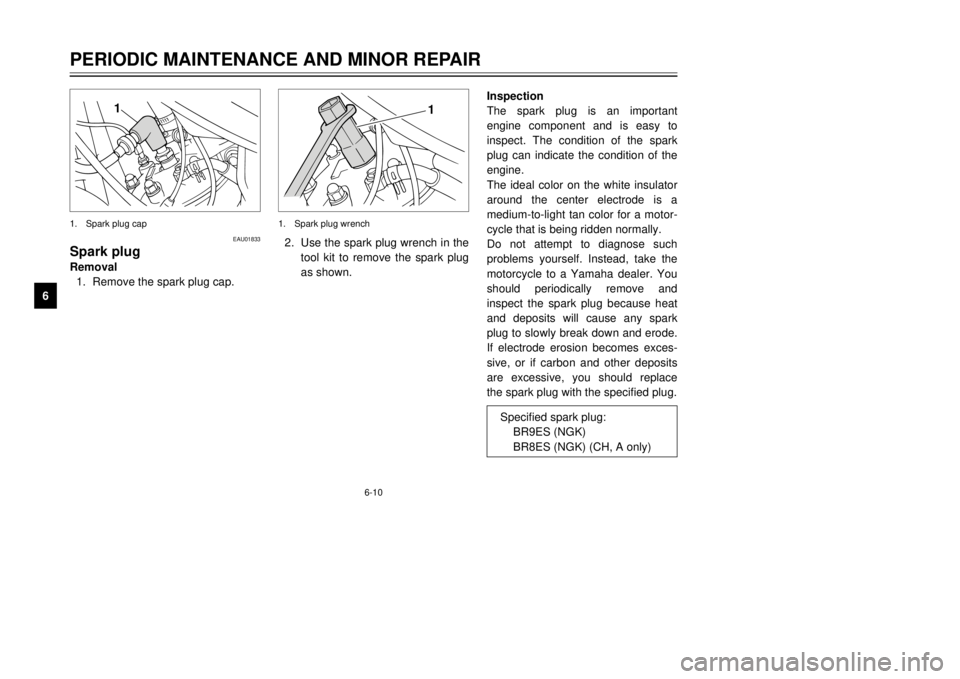
EAU01833
Spark plugRemoval
1.Remove the spark plug cap.2.Use the spark plug wrench in the
tool kit to remove the spark plug
as shown.Inspection
The spark plug is an important
engine component and is easy to
inspect. The condition of the spark
plug can indicate the condition of the
engine.
The ideal color on the white insulator
around the center electrode is a
medium-to-light tan color for a motor-
cycle that is being ridden normally.
Do not attempt to diagnose such
problems yourself. Instead, take the
motorcycle to a Yamaha dealer. You
should periodically remove and
inspect the spark plug because heat
and deposits will cause any spark
plug to slowly break down and erode.
If electrode erosion becomes exces-
sive, or if carbon and other deposits
are excessive, you should replace
the spark plug with the specified plug.1.Spark plug cap
Specified spark plug:
BR9ES (NGK)
BR8ES (NGK) (CH, A only)
1
1.Spark plug wrench
3MB-9-E7 12/27/00 2:52 PM Page 46
Page 48 of 91
6-11
PERIODIC MAINTENANCE AND MINOR REPAIR
1
2
3
4
56
7
8
9 Spark plug gap:
0.7 ~ 0.8 mm
Tightening torque:
Spark plug:
20 Nm (2.0 m
0kg)
1
3 2
EAU03109
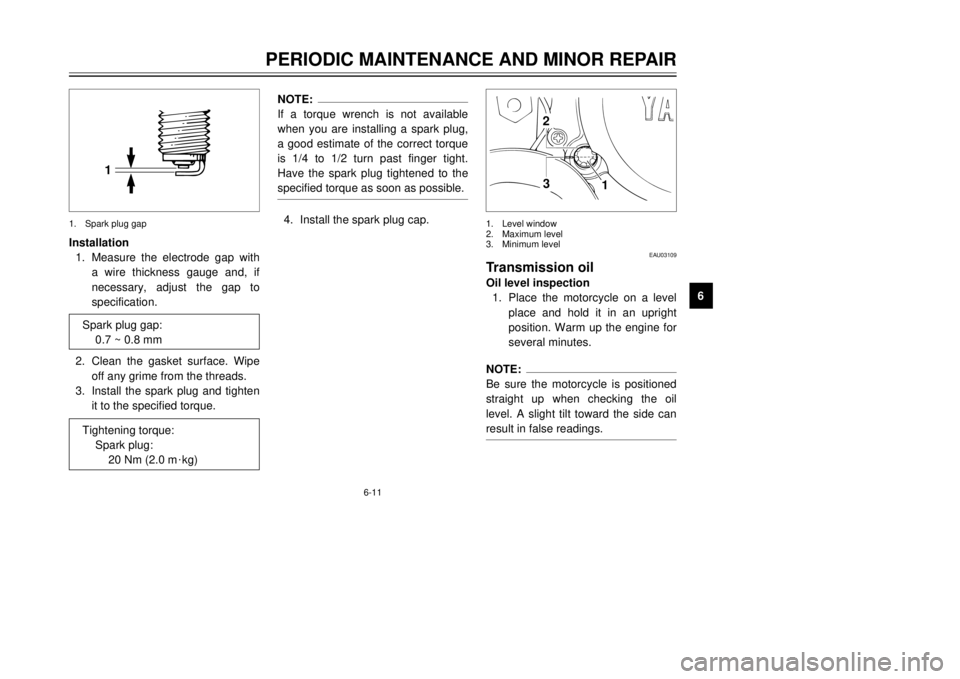
Transmission oilOil level inspection
1.Place the motorcycle on a level
place and hold it in an upright
position. Warm up the engine for
several minutes.NOTE:
Be sure the motorcycle is positioned
straight up when checking the oil
level. A slight tilt toward the side can
result in false readings.1.Level window
2.Maximum level
3.Minimum level
Installation
1.Measure the electrode gap with
a wire thickness gauge and, if
necessary, adjust the gap to
specification.
2.Clean the gasket surface. Wipe
off any grime from the threads.
3.Install the spark plug and tighten
it to the specified torque.
1
1.Spark plug gap
NOTE:
If a torque wrench is not available
when you are installing a spark plug,
a good estimate of the correct torque
is 1/4 to 1/2 turn past finger tight.
Have the spark plug tightened to the
specified torque as soon as possible.4.Install the spark plug cap.
3MB-9-E7 12/27/00 2:52 PM Page 47
Page 60 of 91
6-23
PERIODIC MAINTENANCE AND MINOR REPAIR
1
2
3
4
56
7
8
9
EAU00713
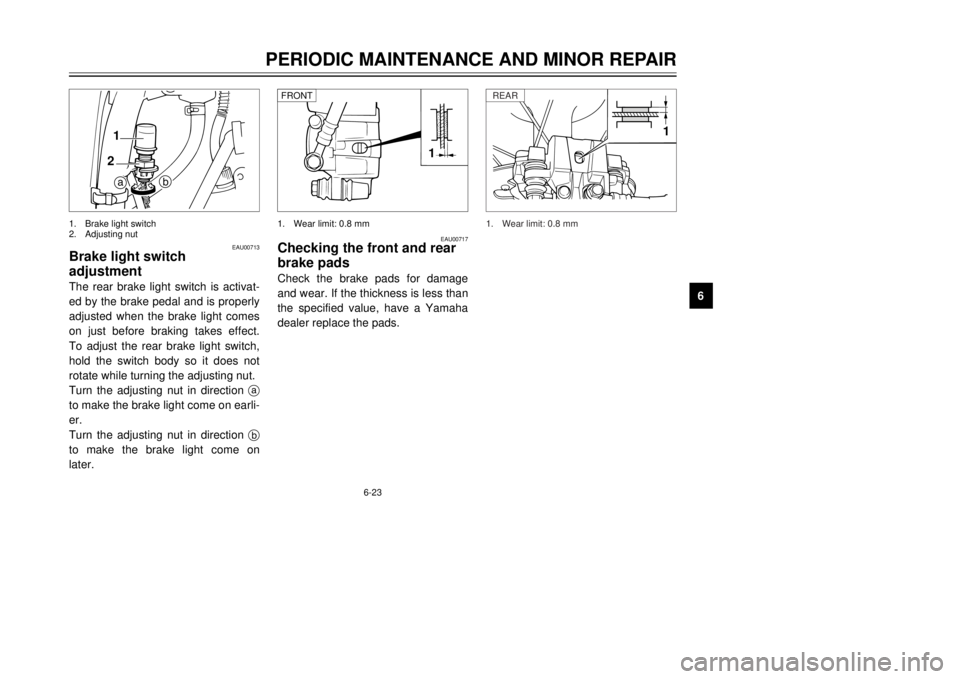
Brake light switch
adjustmentThe rear brake light switch is activat-
ed by the brake pedal and is properly
adjusted when the brake light comes
on just before braking takes effect.
To adjust the rear brake light switch,
hold the switch body so it does not
rotate while turning the adjusting nut.
Turn the adjusting nut in direction a
to make the brake light come on earli-
er.
Turn the adjusting nut in direction b
to make the brake light come on
later.
b
a 1
2
1.Brake light switch
2.Adjusting nut
EAU00717
Checking the front and rear
brake padsCheck the brake pads for damage
and wear. If the thickness is less than
the specified value, have a Yamaha
dealer replace the pads.
1
1.Wear limit: 0.8 mm FRONT
1
1.Wear limit: 0.8 mmREAR
3MB-9-E7 12/27/00 2:52 PM Page 59
Page 70 of 91
6-33
PERIODIC MAINTENANCE AND MINOR REPAIR
1
2
3
4
56
7
8
9
EAU00804
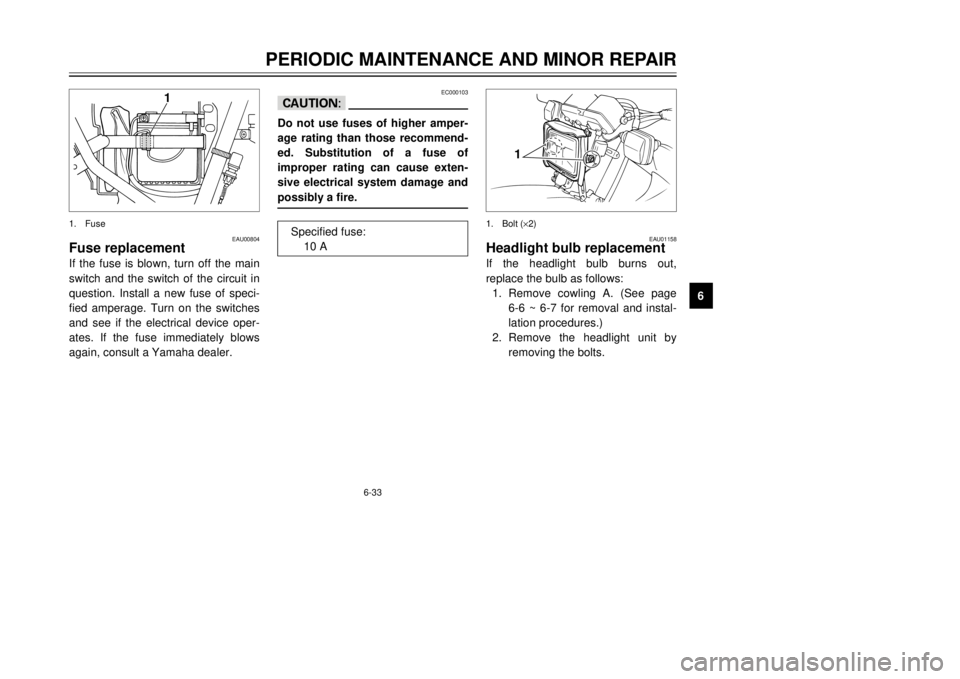
Fuse replacementIf the fuse is blown, turn off the main
switch and the switch of the circuit in
question. Install a new fuse of speci-
fied amperage. Turn on the switches
and see if the electrical device oper-
ates. If the fuse immediately blows
again, consult a Yamaha dealer.1.Fuse
EC000103
cCDo not use fuses of higher amper-
age rating than those recommend-
ed. Substitution of a fuse of
improper rating can cause exten-
sive electrical system damage and
possibly a fire.
Specified fuse:
10 A
1
1
1.Bolt (´2)
EAU01158
Headlight bulb replacementIf the headlight bulb burns out,
replace the bulb as follows:
1.Remove cowling A. (See page
6-6 ~ 6-7 for removal and instal-
lation procedures.)
2.Remove the headlight unit by
removing the bolts.
3MB-9-E7 12/27/00 2:52 PM Page 69
Page 71 of 91
6-34
PERIODIC MAINTENANCE AND MINOR REPAIR
1
2
3
4
56
7
8
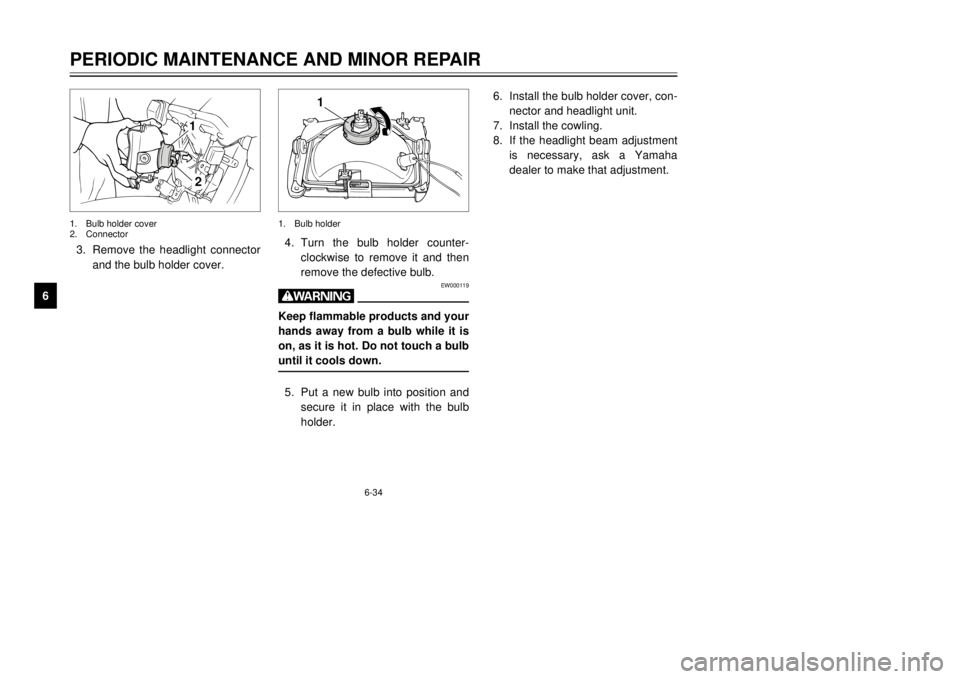
93.Remove the headlight connector
and the bulb holder cover.4.Turn the bulb holder counter-
clockwise to remove it and then
remove the defective bulb.
EW000119
wKeep flammable products and your
hands away from a bulb while it is
on, as it is hot. Do not touch a bulb
until it cools down.5.Put a new bulb into position and
secure it in place with the bulb
holder.
12
1.Bulb holder cover
2.Connector
1
1.Bulb holder
6.Install the bulb holder cover, con-
nector and headlight unit.
7.Install the cowling.
8.If the headlight beam adjustment
is necessary, ask a Yamaha
dealer to make that adjustment.
3MB-9-E7 12/27/00 2:52 PM Page 70
Page 72 of 91
6-35
PERIODIC MAINTENANCE AND MINOR REPAIR
1
2
3
4
56
7
8
9
1
2
3
1
2
3
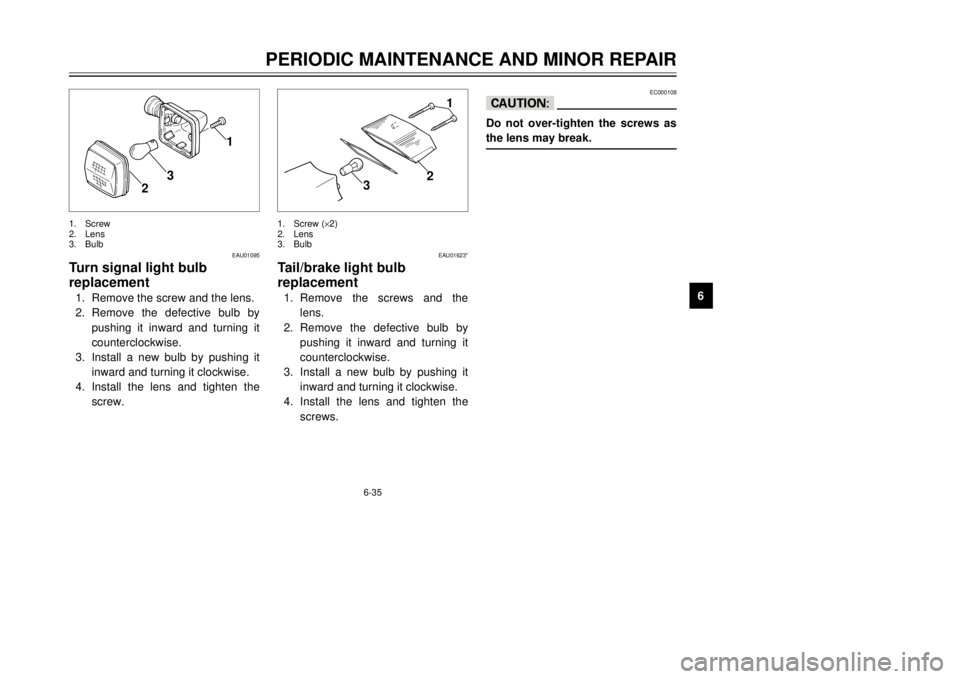
1.Screw (´2)
2.Lens
3.Bulb 1.Screw
2.Lens
3.Bulb
EAU01095
Turn signal light bulb
replacement1.Remove the screw and the lens.
2.Remove the defective bulb by
pushing it inward and turning it
counterclockwise.
3.Install a new bulb by pushing it
inward and turning it clockwise.
4.Install the lens and tighten the
screw.
EAU01623*
Tail/brake light bulb
replacement1.Remove the screws and the
lens.
2.Remove the defective bulb by
pushing it inward and turning it
counterclockwise.
3.Install a new bulb by pushing it
inward and turning it clockwise.
4.Install the lens and tighten the
screws.
EC000108
cCDo not over-tighten the screws as
the lens may break.
3MB-9-E7 12/27/00 2:52 PM Page 71
Page 80 of 91
7-2
MOTORCYCLE CARE AND STORAGE
1
2
3
4
5
67
8
9 8 8
Improper cleaning can damage
windshields, cowlings, panels
and other plastic parts. Use
only a soft, clean cloth or
sponge with mild detergent
and water to clean plastic.
8 8
Do not use any harsh chemical
products on plastic parts. Be
sure to avoid using cloths or
sponges which have been in
contact with strong or abra-
sive cleaning products, sol-
vent or thinner, fuel (gasoline),
rust removers or inhibitors,
brake fluid, antifreeze or elec-
trolyte.8 8
Do not use high-pressure
washers or steam-jet cleaners
since they cause water seep-
age and deterioration in the
following areas: seals (of
wheel bearings, swingarm
bearings, forks and brakes),
electric components (cou-
plers, connectors, instru-
ments, switches and lights),
breather hoses and vents.
8 8
For motorcycles equipped
with a windshield: Do not use
strong cleaners or hard
sponges as they will cause
dulling or scratching. Some
cleaning compounds for plas-
tic may leave scratches on the
windshield. Test the product
on a small hidden part of the
windshield to make sure they
do not leave any marks. If the
windshield is scratched, use a
quality plastic polishing com-
pound after washing.
After riding in the rain, near the seaor on salt-sprayed roadsSince sea salt or salt sprayed on the
roads in the winter are extremely cor-
rosive in combination with water,
carry out the following steps after
each ride in the rain, near the sea or
on salt-sprayed roads. (Salt sprayed
in the winter may remain on the roads
well into spring.)
1.Clean your motorcycle with cold
water and soap after the engine
has cooled down.
ECA00012
cCDo not use warm water since it
increases the corrosive action of
the salt.2.Be sure to apply a corrosion pro-
tection spray on all (even
chrome- and nickel-plated) metal
surfaces to prevent corrosion.
3MB-9-E7 12/27/00 2:52 PM Page 79
Page 87 of 91

SPECIFICATIONS
1
2
3
4
5
6
78
9
8-4 Battery
TypeGM3-3B
Voltage, capacity12 V, 3 AH
Headlight typeConventional incandescent bulb
Bulb voltage, wattage ´quantity
Headlight12 V, 45/40 W ´1
Tail / Brake light12 V, 5/21 W ´1
Front flasher light12 V, 21 W ´2
Rear flasher light12 V, 21 W ´2
Auxiliary light12 V, 4 W ´1
12 V, 3.4 W ´1 (GB only)
Meter light12 V, 3.4 W ´2
Neutral indicator light12 V, 3.4 W ´1
High beam indicator light12 V, 3.4 W ´1
Oil level indicator light12 V, 3.4 W ´1
Turn indicator light12 V, 3.4 W ´1
Fuse
Main10 A
3MB-9-E7 12/27/00 2:52 PM Page 86