oil YAMAHA FJR1300A 2013 Owners Manual
[x] Cancel search | Manufacturer: YAMAHA, Model Year: 2013, Model line: FJR1300A, Model: YAMAHA FJR1300A 2013Pages: 118, PDF Size: 3.28 MB
Page 6 of 118

TABLE OF CONTENTSSAFETY INFORMATION ..................1-1
DESCRIPTION ..................................2-1
Left view ..........................................2-1
Right view ........................................2-2
Controls and instruments.................2-3
INSTRUMENT AND CONTROL
FUNCTIONS .......................................3-1
Immobilizer system .........................3-1
Main switch/steering lock ................3-2
Indicator lights and warning lights ............................................3-4
Cruise control system .....................3-6
Multi-function meter unit .................3-9
D-mode (drive mode) ....................3-22
Handlebar switches ......................3-23
Clutch lever ...................................3-25
Shift pedal .....................................3-25
Brake lever ...................................3-26
Brake pedal ..................................3-26
ABS ..............................................3-26
Traction control system ................3-27
Fuel tank cap ................................3-29
Fuel ...............................................3-30
Fuel tank breather/overflow
hose ..........................................3-31
Catalytic converters ......................3-31
Seats ............................................3-32
Adjusting the rider seat height ......3-33
Storage compartments .................3-35 Accessory box .............................. 3-36
Adjusting the headlight beams ..... 3-37
Handlebar position ....................... 3-37
Opening and closing the cowling
vents ......................................... 3-37
Rear view mirrors ......................... 3-39
Adjusting the front fork ................. 3-39
Adjusting the shock absorber assembly ................................... 3-41
Sidestand ..................................... 3-42
Ignition circuit cut-off system ........ 3-43
Auxiliary DC jack .......................... 3-45
FOR YOUR SAFETY –
PRE-OPERATION CHECKS ............. 4-1
OPERATION AND IMPORTANT
RIDING POINTS ................................. 5-1
Starting the engine ......................... 5-1
Shifting ........................................... 5-2
Tips for reducing fuel consumption ............................... 5-3
Engine break-in .............................. 5-3
Parking ........................................... 5-4
PERIODIC MAINTENANCE AND
ADJUSTMENT ................................... 6-1
Owner’s tool kit ............................... 6-2
Periodic maintenance chart for the emission control system ............. 6-3 General maintenance and
lubrication chart .......................... 6-4
Removing and installing panels ..... 6-8
Checking the spark plugs ............ 6-11
Engine oil and oil filter cartridge ... 6-12
Final gear oil ................................ 6-14
Coolant ........................................ 6-16
Cleaning the air filter element ...... 6-17
Checking the engine idling speed ........................................ 6-18
Checking the throttle grip free
play ........................................... 6-19
Valve clearance ........................... 6-19
Tires ............................................. 6-19
Cast wheels ................................. 6-22
Clutch lever .................................. 6-22
Checking the brake lever free play ........................................... 6-23
Brake light switches ..................... 6-23
Checking the front and rear brake pads .......................................... 6-24
Checking the brake and clutch fluid levels ................................. 6-24
Changing the brake and clutch fluids ......................................... 6-26
Checking and lubricating the
cables ....................................... 6-26
Checking and lubricating the throttle grip and cable ............... 6-26
Checking and lubricating the brake and shift pedals .............. 6-27U1MCE0E0.book Page 1 Thursday, July 19, 2012 6:59 PM
Page 13 of 118
DESCRIPTION
2-1
2
EAU10410
Left view
12
34
5
76
8910111213
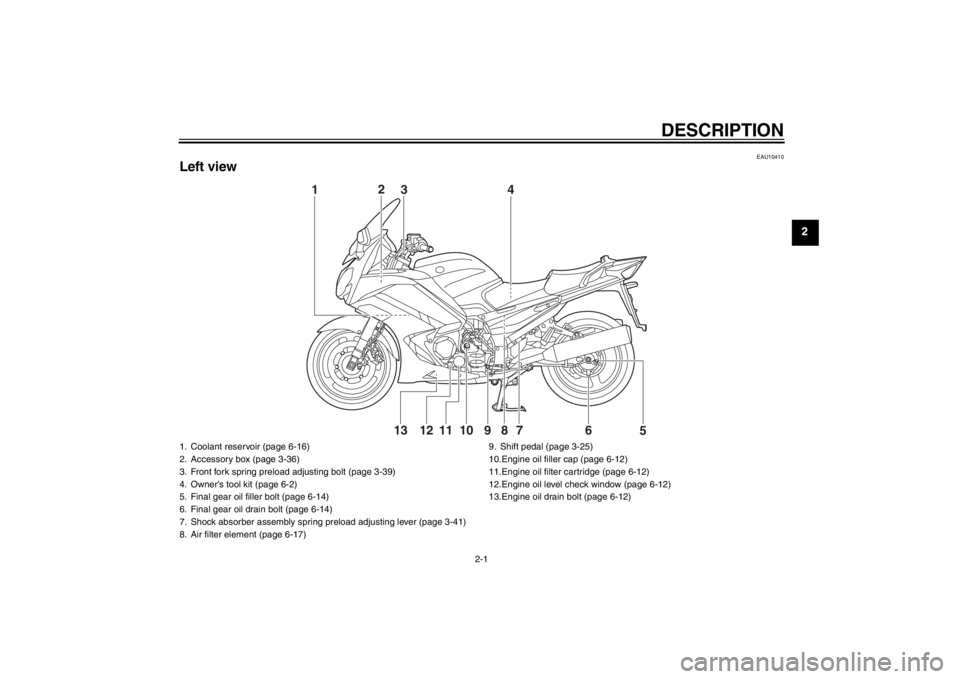
1. Coolant reservoir (page 6-16)
2. Accessory box (page 3-36)
3. Front fork spring preload adjusting bolt (page 3-39)
4. Owner’s tool kit (page 6-2)
5. Final gear oil filler bolt (page 6-14)
6. Final gear oil drain bolt (page 6-14)
7. Shock absorber assembly spring preload adjusting lever (page 3-41)
8. Air filter element (page 6-17) 9. Shift pedal (page 3-25)
10.Engine oil filler cap (page 6-12)
11.Engine oil filter cartridge (page 6-12)
12.Engine oil level check window (page 6-12)
13.Engine oil drain bolt (page 6-12)
U1MCE0E0.book Page 1 Thursday, July 19, 2012 6:59 PM
Page 19 of 118
INSTRUMENT AND CONTROL FUNCTIONS
3-4
3
EAU49392
Indicator lights and warning
lights
EAU11030
Turn signal indicator lights “ ”
and “ ”
The corresponding indicator light flash-
es when the turn signal switch is
pushed to the left or right.
EAU11060
Neutral indicator light “ ”
This indicator light comes on when the
transmission is in the neutral position.
EAU11080
High beam indicator light “ ”
This indicator light comes on when the
high beam of the headlight is switched
on.
EAU11123
Oil level warning light “ ”
This warning light comes on if the en-
gine oil level is low.
The electrical circuit of the warning light
can be checked by turning the key to
“ON”. The warning light should come
on for a few seconds, and then go off.
If the warning light does not come on
initially when the key is turned to “ON”,
or if the warning light remains on, have
a Yamaha dealer check the electrical
circuit.
TIPEven if the oil level is sufficient, the
warning light may flicker when riding on
a slope or during sudden acceleration
or deceleration, but this is not a mal-
function.
EAU11380
Cruise control indicator lights
See page 3-6 for an explanation of
these indicator lights.
EAU11534
Engine trouble warning light “ ”
This warning light comes on or flashes
if a problem is detected in the electrical
circuit monitoring the engine. If this oc-
curs, have a Yamaha dealer check the
self-diagnosis system. (See page 3-21
for an explanation of the self-diagnosis
device.)
The electrical circuit of the warning light
can be checked by turning the key to
“ON”. The warning light should come
on for a few seconds, and then go off.
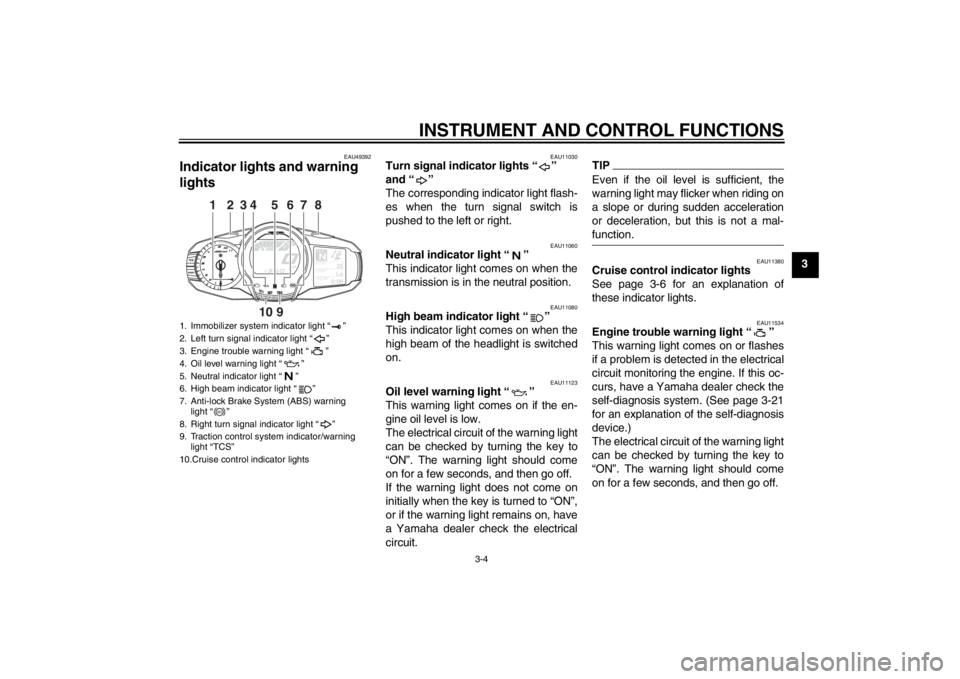
1. Immobilizer system indicator light “ ”
2. Left turn signal indicator light “ ”
3. Engine trouble warning light “ ”
4. Oil level warning light “ ”
5. Neutral indicator light “ ”
6. High beam indicator light “ ”
7. Anti-lock Brake System (ABS) warning light “ ”
8. Right turn signal indicator light “ ”
9. Traction control system indicator/warning light “TCS”
10.Cruise control indicator lights
GEARN
25
A.TEMP ˚C
Lo
C.TEMP˚C
0:06
TIME TRIP
1
2
8
3
7
4
9
10
6
5
ABS
U1MCE0E0.book Page 4 Thursday, July 19, 2012 6:59 PM
Page 31 of 118
INSTRUMENT AND CONTROL FUNCTIONS
3-16
3
●
The “L/100km” display shows the
amount of fuel necessary to travel
100 km.
●
For the UK only: The “MPG” dis-
play shows the distance that can
be traveled on 1.0 Imp.gal of fuel.
TIPIf traveling at speeds under 10 km/h, “_
_._” will be displayed.NOTICE
ECA15473
If there is a malfunction, “– –.–” will
be continuously displayed. Have a
Yamaha dealer check the vehicle.Setting mode
TIP●
The transmission must be in neu-
tral and the vehicle must be
stopped to change settings in this
mode.
●
Shifting the transmission into gear
and starting off, or turning the key
to “OFF”, saves all settings made,
then exits the setting mode.
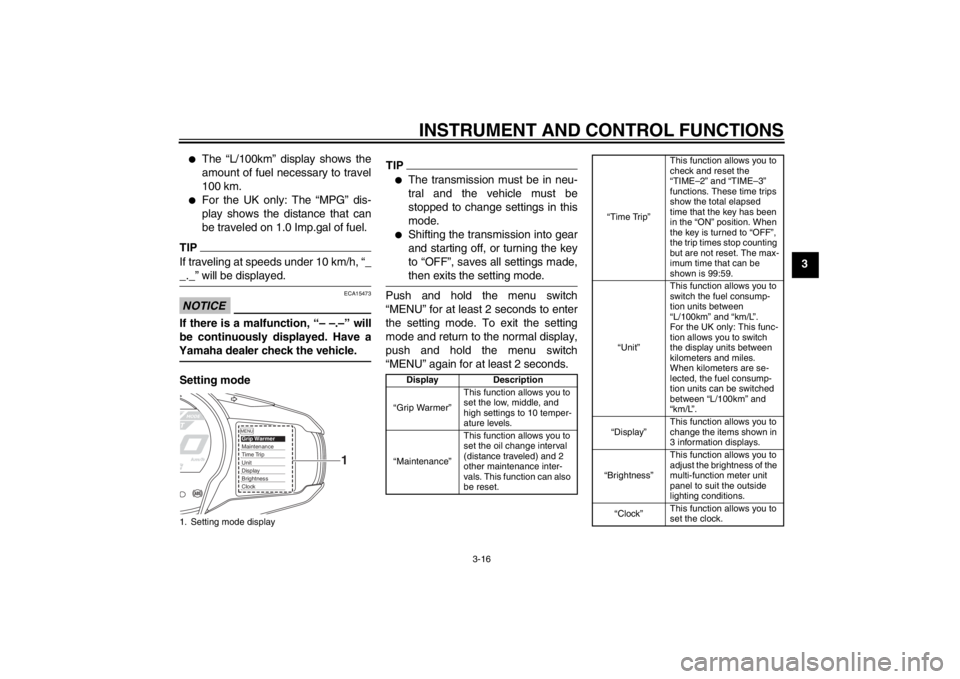
Push and hold the menu switch
“MENU” for at least 2 seconds to enter
the setting mode. To exit the setting
mode and return to the normal display,
push and hold the menu switch
“MENU” again for at least 2 seconds.
1. Setting mode display
MENUGrip WarmerMaintenanceTime TripUnitDisplayBrightnessClock
1
Display Description
“Grip Warmer” This function allows you to
set the low, middle, and
high settings to 10 temper-
ature levels.
“Maintenance” This function allows you to
set the oil change interval
(distance traveled) and 2
other maintenance inter-
vals. This function can also
be reset.
“Time Trip”This function allows you to
check and reset the
“TIME–2” and “TIME–3”
functions. These time trips
show the total elapsed
time that the key has been
in the “ON” position. When
the key is turned to “OFF”,
the trip times stop counting
but are not reset. The max-
imum time that can be
shown is 99:59.
“Unit” This function allows you to
switch the fuel consump-
tion units between
“L/100km” and “km/L”.
For the UK only: This func-
tion allows you to switch
the display units between
kilometers and miles.
When kilometers are se-
lected, the fuel consump-
tion units can be switched
between “L/100km” and
“km/L”.
“Display” This function allows you to
change the items shown in
3 information displays.
“Brightness” This function allows you to
adjust the brightness of the
multi-function meter unit
panel to suit the outside
lighting conditions.
“Clock” This function allows you to
set the clock.
U1MCE0E0.book Page 16 Thursday, July 19, 2012 6:59 PM
Page 33 of 118
INSTRUMENT AND CONTROL FUNCTIONS
3-18
3
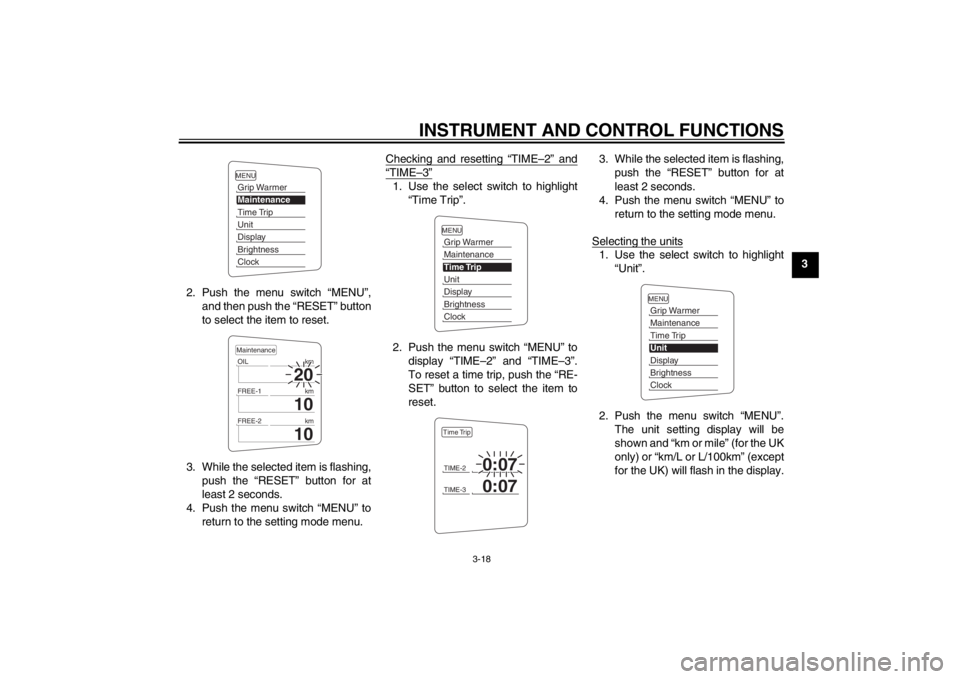
2. Push the menu switch “MENU”, and then push the “RESET” button
to select the item to reset.
3. While the selected item is flashing, push the “RESET” button for at
least 2 seconds.
4. Push the menu switch “MENU” to return to the setting mode menu. Checking and resetting “TIME–2” and
“TIME–3”1. Use the select switch to highlight
“Time Trip”.
2. Push the menu switch “MENU” to display “TIME–2” and “TIME–3”.
To reset a time trip, push the “RE-
SET” button to select the item to
reset. 3. While the selected item is flashing,
push the “RESET” button for at
least 2 seconds.
4. Push the menu switch “MENU” to return to the setting mode menu.
Selecting the units
1. Use the select switch to highlight “Unit”.
2. Push the menu switch “MENU”. The unit setting display will be
shown and “km or mile” (for the UK
only) or “km/L or L/100km” (except
for the UK) will flash in the display.
MENUGrip WarmerMaintenanceTime TripUnitDisplayBrightnessClock
20
OIL km
10
FREE-1km
10
FREE-2kmMaintenance
MENUGrip WarmerMaintenanceTime TripUnitDisplayBrightnessClockTIME-2
0:07
TIME-3
0:07
Time Trip
MENUGrip WarmerMaintenanceTime TripUnitDisplayBrightnessClock
U1MCE0E0.book Page 18 Thursday, July 19, 2012 6:59 PM
Page 61 of 118
FOR YOUR SAFETY – PRE-OPERATION CHECKS
4-1
4
EAU15596
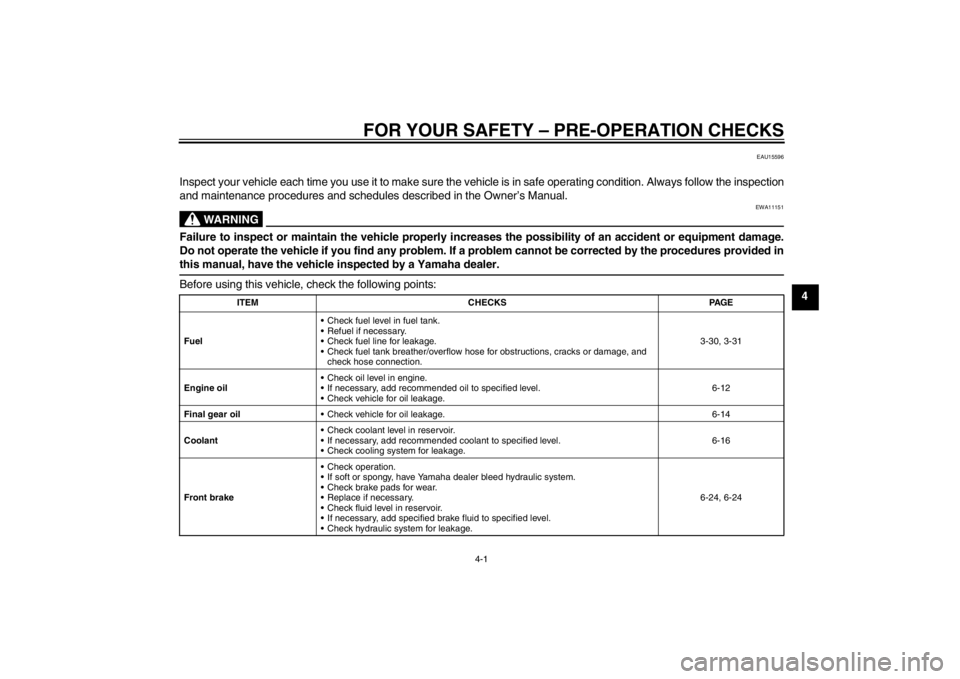
Inspect your vehicle each time you use it to make sure the vehicle is in safe operating condition. Always follow the inspection
and maintenance procedures and schedules described in the Owner’s Manual.
WARNING
EWA11151
Failure to inspect or maintain the vehicle properly increases the possibility of an accident or equipment damage.
Do not operate the vehicle if you find any problem. If a problem cannot be corrected by the procedures provided in
this manual, have the vehicle inspected by a Yamaha dealer.Before using this vehicle, check the following points:
ITEMCHECKS PAGE
Fuel Check fuel level in fuel tank.
Refuel if necessary.
Check fuel line for leakage.
Check fuel tank breather/overflow hose for obstructions, cracks or damage, and
check hose connection. 3-30, 3-31
Engine oil Check oil level in engine.
If necessary, add recommended oil to specified level.
Check vehicle for oil leakage. 6-12
Final gear oil Check vehicle for oil leakage. 6-14
Coolant Check coolant level in reservoir.
If necessary, add recommended coolant to specified level.
Check cooling system for leakage. 6-16
Front brake Check operation.
If soft or spongy, have Yamaha dealer bleed hydraulic system.
Check brake pads for wear.
Replace if necessary.
Check fluid level in reservoir.
If necessary, add specified brake fluid to specified level.
Check hydraulic system for leakage. 6-24, 6-24
U1MCE0E0.book Page 1 Thursday, July 19, 2012 6:59 PM
Page 64 of 118
OPERATION AND IMPORTANT RIDING POINTS
5-1
5
EAU15951
Read the Owner’s Manual carefully to
become familiar with all controls. If
there is a control or function you do not
understand, ask your Yamaha dealer.
WARNING
EWA10271
Failure to familiarize yourself with
the controls can lead to loss of con-
trol, which could cause an accident
or injury.
EAU47150
TIPThis model is equipped with:●
a lean angle sensor to stop the en-
gine in case of a turnover. In this
case, the multi-function meter unit
indicates error code 30, but this is
not a malfunction. Turn the key to
“OFF” and then to “ON” to clear the
error code. Failing to do so will pre-
vent the engine from starting even
though the engine will crank when
pushing the start switch.
●
an engine auto-stop system. The
engine stops automatically if left
idling for 20 minutes. In this case,
the multi-function meter unit indi-
cates error code 70, but this is not
a malfunction. Push the start
switch to clear the error code and
to restart the engine.
EAU54170
Starting the engine In order for the ignition circuit cut-off
system to enable starting, one of the
following conditions must be met:●
The transmission is in the neutral
position.
●
The transmission is in gear with
the clutch lever pulled and the
sidestand up.
See page 3-43 for more informa-
tion.
1. Turn the key to “ON” and make sure that the start/engine stop
switch is set to “ ”.
The following warning lights and
indicator lights should come on for
a few seconds, then go off.●
Oil level warning light
●
Engine trouble warning light
●
Traction control system indi-
cator/warning light
●
Cruise control indicator lights
●
Immobilizer system indicator
light
U1MCE0E0.book Page 1 Thursday, July 19, 2012 6:59 PM
Page 66 of 118
OPERATION AND IMPORTANT RIDING POINTS
5-3
5
NOTICE
ECA10260
●
Even with the transmission in
the neutral position, do not
coast for long periods of time
with the engine off, and do not
tow the motorcycle for long dis-
tances. The transmission is
properly lubricated only when
the engine is running. Inade-
quate lubrication may damage
the transmission.
●
Always use the clutch while
changing gears to avoid damag-
ing the engine, transmission,
and drive train, which are not
designed to withstand the
shock of forced shifting.
EAU16810
Tips for reducing fuel con-
sumption Fuel consumption depends largely on
your riding style. Consider the following
tips to reduce fuel consumption:●
Shift up swiftly, and avoid high en-
gine speeds during acceleration.
●
Do not rev the engine while shifting
down, and avoid high engine
speeds with no load on the engine.
●
Turn the engine off instead of let-
ting it idle for an extended length of
time (e.g., in traffic jams, at traffic
lights or at railroad crossings).
EAU16841
Engine break-in There is never a more important period
in the life of your engine than the period
between 0 and 1600 km (1000 mi). For
this reason, you should read the follow-
ing material carefully.
Since the engine is brand new, do not
put an excessive load on it for the first
1600 km (1000 mi). The various parts in
the engine wear and polish themselves
to the correct operating clearances.
During this period, prolonged full-throt-
tle operation or any condition that might
result in engine overheating must be
avoided.
EAU17123
0–1000 km (0–600 mi)
Avoid prolonged operation above 4500
r/min. NOTICE: After 1000 km (600
mi) of operation, the engine oil and
final gear oil must be changed, and
the oil filter cartridge or element re-
placed.
[ECA10332]
U1MCE0E0.book Page 3 Thursday, July 19, 2012 6:59 PM
Page 72 of 118

PERIODIC MAINTENANCE AND ADJUSTMENT
6-5
6
10*Swingarm Check operation and for exces-
sive play. √√√√
Lubricate with lithium-soap-based grease. Every 50000 km (30000 mi)
11 *Steering bearings Check bearing play and steering
for roughness. √√√√√
Lubricate with lithium-soap-based grease. Every 20000 km (12000 mi)
12 *Chassis fasteners Make sure that all nuts, bolts and
screws are properly tightened. √√√√√
13 Brake lever pivot
shaft Lubricate with silicone grease.
√√√√√
14 Brake pedal pivot
shaft Lubricate with lithium-soap-based
grease. √√√√√
15 Clutch lever pivot
shaft
Lubricate with silicone grease.
√√√√√
16 Shift pedal pivot
shaft Lubricate with lithium-soap-based
grease. √√√√√
17 Sidestand, center-
stand Check operation.
Lubricate with lithium-soap-based
grease. √√√√√
18 *Sidestand switch Check operation. √√√√√√
19 *Front fork Check operation and for oil leak-
age. √√√√
20 *Shock absorber as-
sembly Check operation and shock ab-
sorber for oil leakage. √√√√
NO. ITEM CHECK OR MAINTENANCE JOB
ODOMETER READING
ANNUAL
CHECK
1000 km
(600 mi) 10000 km
(6000 mi) 20000 km
(12000 mi) 30000 km
(18000 mi) 40000 km
(24000 mi)U1MCE0E0.book Page 5 Thursday, July 19, 2012 6:59 PM
Page 73 of 118

PERIODIC MAINTENANCE AND ADJUSTMENT
6-6
6
21*Rear suspension re-
lay arm and con-
necting arm
pivoting points Check operation.
√√√√
Lubricate with lithium-soap-based grease. √√
22 Engine oil Change.
Check oil level and vehicle for oil
leakage. √√√√√√
23 Engine oil filter car-
tridge Replace.
√√√
24 *Cooling system Check coolant level and vehicle
for coolant leakage. √√√√√
Change coolant. Every 3 years
25 Final gear oil Check oil level and vehicle for oil
leakage.
Change. √√√√√
26 *Front and rear brake
switches Check operation.
√√√√√√
27 Moving parts and
cables
Lubricate.
√√√√√
28 *Throttle grip Check operation.
Check throttle grip free play, and
adjust if necessary.
Lubricate cable and grip housing. √√√√√
29 *Lights, signals and
switches Check operation.
Adjust headlight beam.
√√√√√√
NO. ITEM CHECK OR MAINTENANCE JOB
ODOMETER READING
ANNUAL
CHECK
1000 km
(600 mi) 10000 km
(6000 mi) 20000 km
(12000 mi) 30000 km
(18000 mi) 40000 km
(24000 mi)
U1MCE0E0.book Page 6 Thursday, July 19, 2012 6:59 PM