stop start YAMAHA FX HO 2014 User Guide
[x] Cancel search | Manufacturer: YAMAHA, Model Year: 2014, Model line: FX HO, Model: YAMAHA FX HO 2014Pages: 114, PDF Size: 5.13 MB
Page 43 of 114
Watercraft operation
37
cruise assist. (See page 37 for information on
the cruise assist.)
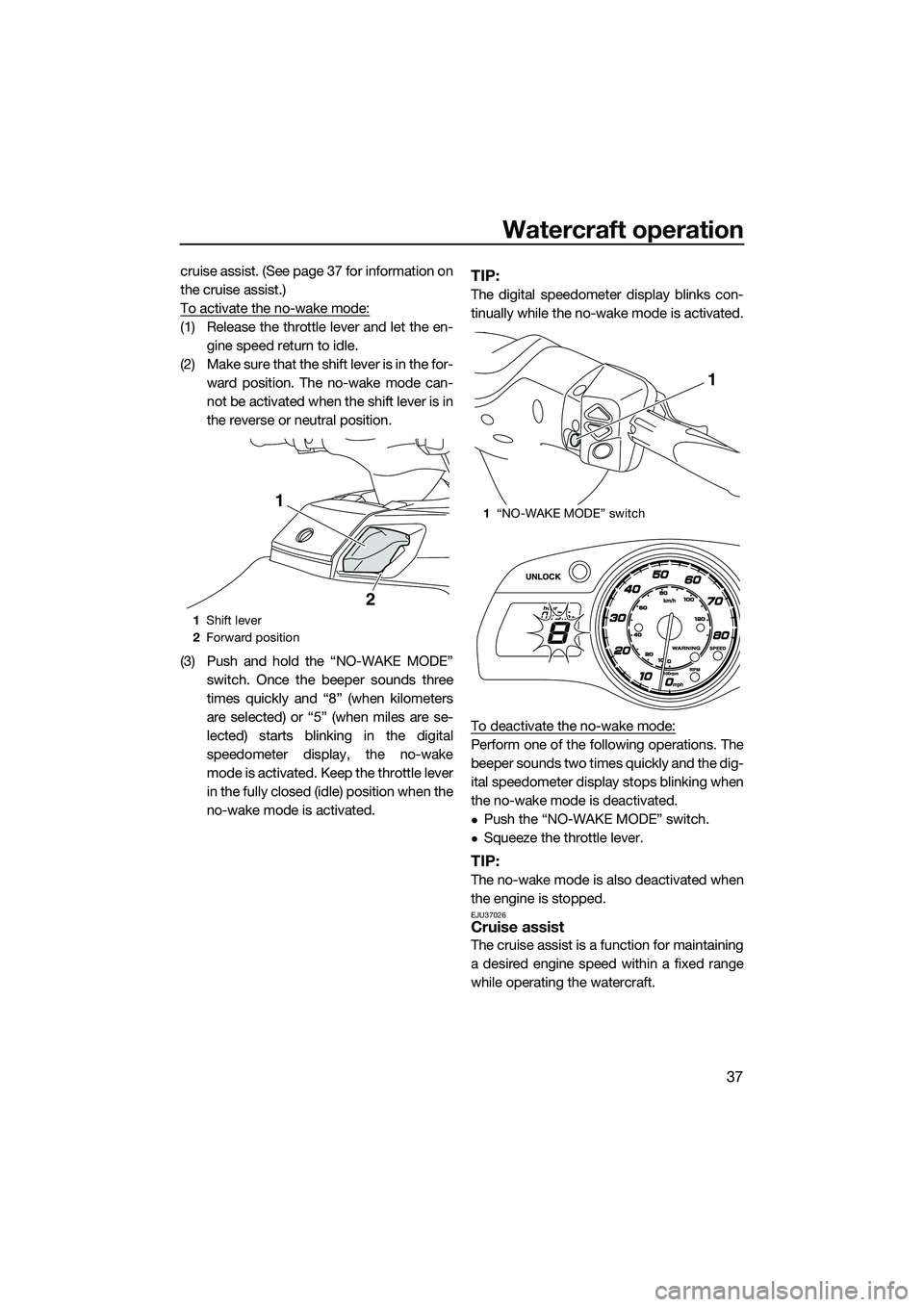
To activate the no-wake mode:
(1) Release the throttle lever and let the en-gine speed return to idle.
(2) Make sure that the shift lever is in the for- ward position. The no-wake mode can-
not be activated when the shift lever is in
the reverse or neutral position.
(3) Push and hold the “NO-WAKE MODE” switch. Once the beeper sounds three
times quickly and “8” (when kilometers
are selected) or “5” (when miles are se-
lected) starts blinking in the digital
speedometer display, the no-wake
mode is activated. Keep the throttle lever
in the fully closed (idle) position when the
no-wake mode is activated.
TIP:
The digital speedometer display blinks con-
tinually while the no-wake mode is activated.
To deactivate the no-wake mode:
Perform one of the following operations. The
beeper sounds two times quickly and the dig-
ital speedometer display stops blinking when
the no-wake mode is deactivated.
Push the “NO-WAKE MODE” switch.
Squeeze the throttle lever.
TIP:
The no-wake mode is also deactivated when
the engine is stopped.
EJU37026Cruise assist
The cruise assist is a function for maintaining
a desired engine speed within a fixed range
while operating the watercraft.
1Shift lever
2 Forward position
1
2
1“NO-WAKE MODE” switch
1
UF2T72E0.book Page 37 Monday, July 22, 2013 2:26 PM
Page 44 of 114
Watercraft operation
38
TIP:
The cruise assist can only be set between
engine speeds of approximately 3000
r/min and approximately 7000 r/min.
The cruise assist cannot be activated in the
Low RPM Mode. (See page 35 for Low
RPM Mode activation procedures.)
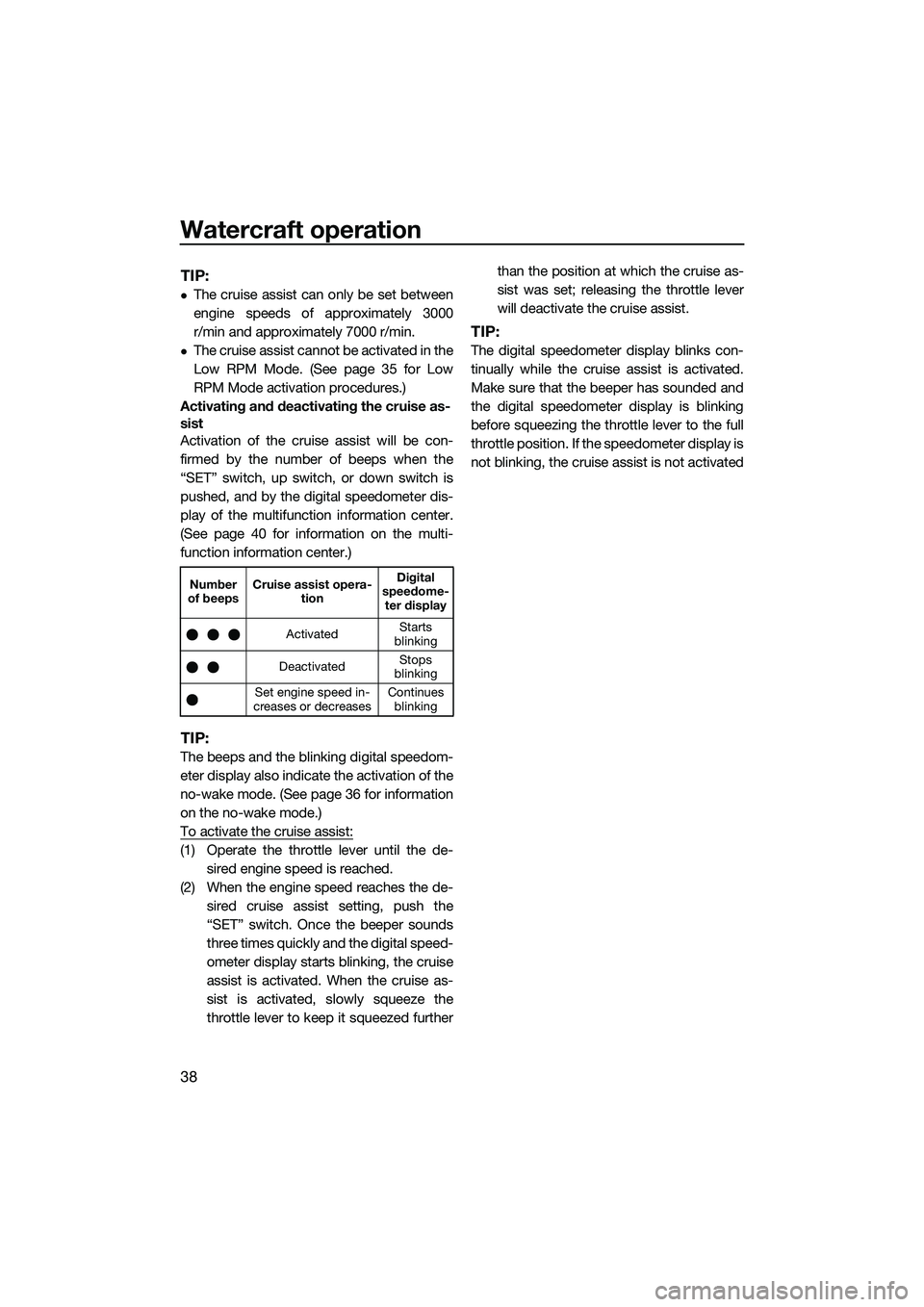
Activating and deactivating the cruise as-
sist
Activation of the cruise assist will be con-
firmed by the number of beeps when the
“SET” switch, up switch, or down switch is
pushed, and by the digital speedometer dis-
play of the multifunction information center.
(See page 40 for information on the multi-
function information center.)
TIP:
The beeps and the blinking digital speedom-
eter display also indicate the activation of the
no-wake mode. (See page 36 for information
on the no-wake mode.)
To activate the cruise assist:
(1) Operate the throttle lever until the de- sired engine speed is reached.
(2) When the engine speed reaches the de- sired cruise assist setting, push the
“SET” switch. Once the beeper sounds
three times quickly and the digital speed-
ometer display starts blinking, the cruise
assist is activated. When the cruise as-
sist is activated, slowly squeeze the
throttle lever to keep it squeezed further than the position at which the cruise as-
sist was set; releasing the throttle lever
will deactivate the cruise assist.
TIP:
The digital speedometer display blinks con-
tinually while the cruise assist is activated.
Make sure that the beeper has sounded and
the digital speedometer display is blinking
before squeezing the throttle lever to the full
throttle position. If the speedometer display is
not blinking, the cruise assist is not activated
Number
of beeps Cruise assist opera-
tion Digital
speedome- ter display
Activated Starts
blinking
Deactivated Stops
blinking
Set engine speed in-
creases or decreases Continues
blinking
UF2T72E0.book Page 38 Monday, July 22, 2013 2:26 PM
Page 46 of 114
Instrument operation
40
EJU42241
Multifunction information center
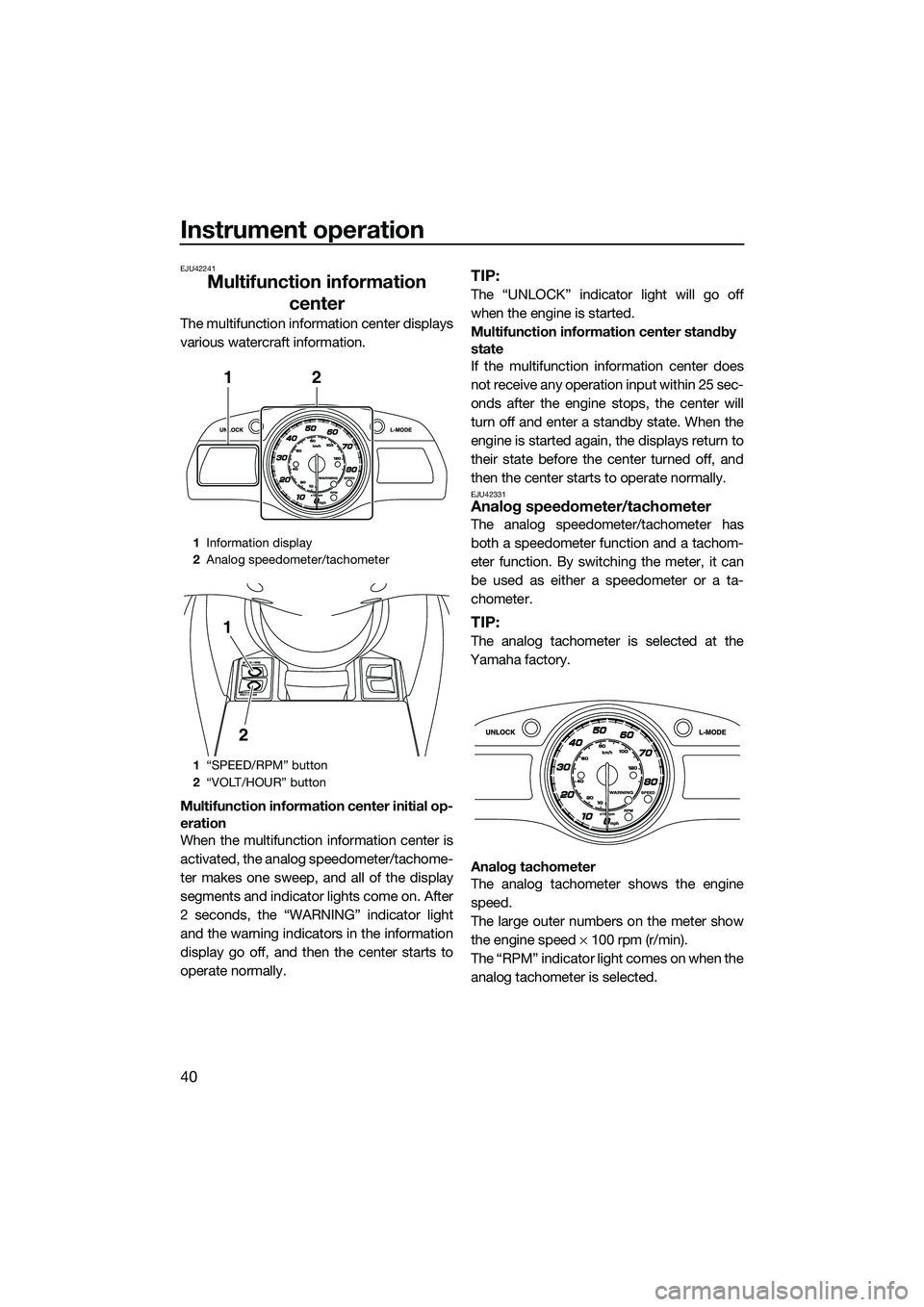
The multifunction information center displays
various watercraft information.
Multifunction information center initial op-
eration
When the multifunction information center is
activated, the analog speedometer/tachome-
ter makes one sweep, and all of the display
segments and indicator lights come on. After
2 seconds, the “WARNING” indicator light
and the warning indicators in the information
display go off, and then the center starts to
operate normally.
TIP:
The “UNLOCK” indicator light will go off
when the engine is started.
Multifunction information center standby
state
If the multifunction information center does
not receive any operation input within 25 sec-
onds after the engine stops, the center will
turn off and enter a standby state. When the
engine is started again, the displays return to
their state before the center turned off, and
then the center starts to operate normally.
EJU42331Analog speedometer/tachometer
The analog speedometer/tachometer has
both a speedometer function and a tachom-
eter function. By switching the meter, it can
be used as either a speedometer or a ta-
chometer.
TIP:
The analog tachometer is selected at the
Yamaha factory.
Analog tachometer
The analog tachometer shows the engine
speed.
The large outer numbers on the meter show
the engine speed × 100 rpm (r/min).
The “RPM” indicator light comes on when the
analog tachometer is selected.
1 Information display
2 Analog speedometer/tachometer
1 “SPEED/RPM” button
2 “VOLT/HOUR” button
12
1
2
UF2T72E0.book Page 40 Monday, July 22, 2013 2:26 PM
Page 50 of 114
Instrument operation
44
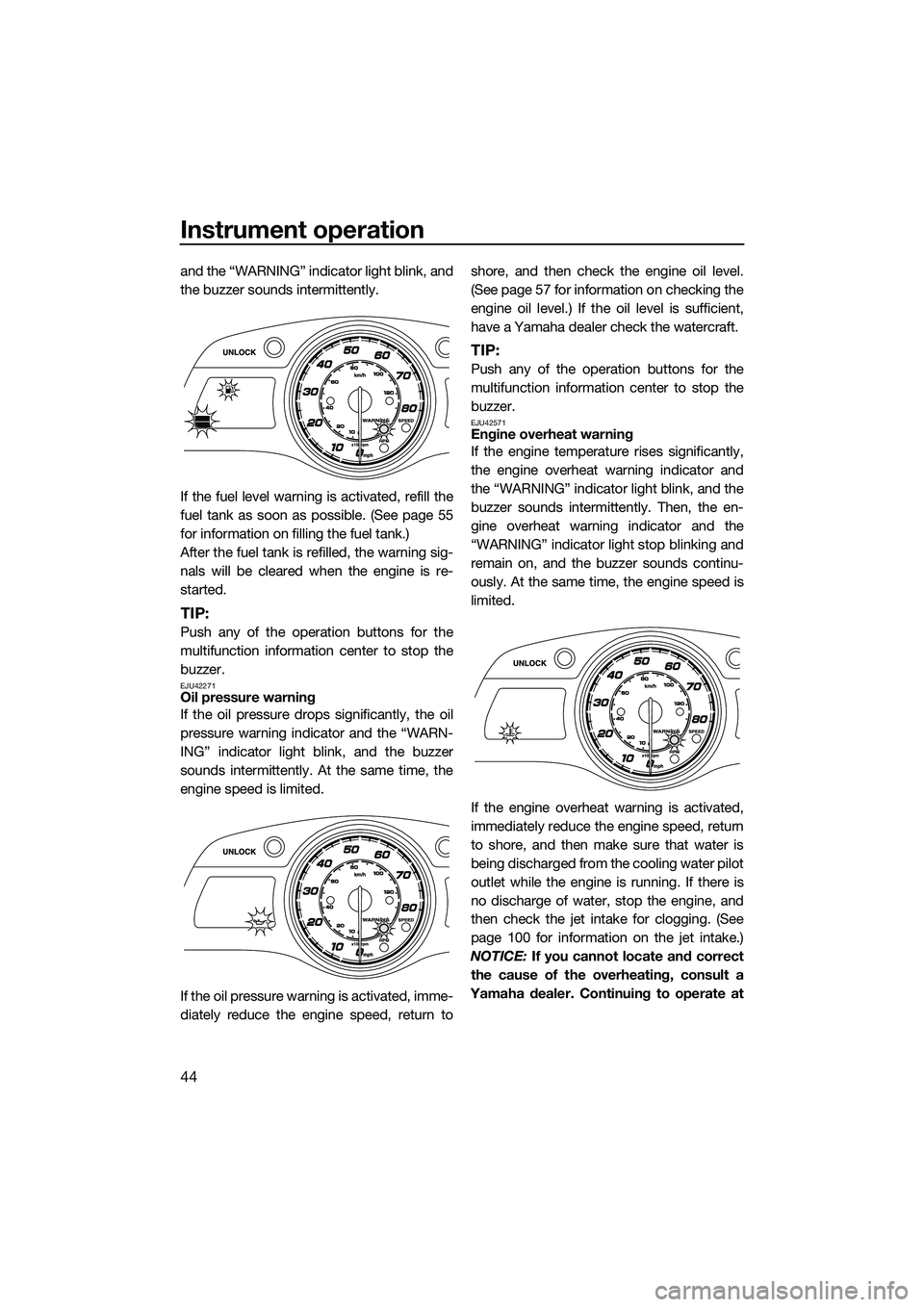
and the “WARNING” indicator light blink, and
the buzzer sounds intermittently.
If the fuel level warning is activated, refill the
fuel tank as soon as possible. (See page 55
for information on filling the fuel tank.)
After the fuel tank is refilled, the warning sig-
nals will be cleared when the engine is re-
started.
TIP:
Push any of the operation buttons for the
multifunction information center to stop the
buzzer.
EJU42271Oil pressure warning
If the oil pressure drops significantly, the oil
pressure warning indicator and the “WARN-
ING” indicator light blink, and the buzzer
sounds intermittently. At the same time, the
engine speed is limited.
If the oil pressure warning is activated, imme-
diately reduce the engine speed, return toshore, and then check the engine oil level.
(See page 57 for information on checking the
engine oil level.) If the oil level is sufficient,
have a Yamaha dealer check the watercraft.
TIP:
Push any of the operation buttons for the
multifunction information center to stop the
buzzer.
EJU42571Engine overheat warning
If the engine temperature rises significantly,
the engine overheat warning indicator and
the “WARNING” indicator light blink, and the
buzzer sounds intermittently. Then, the en-
gine overheat warning indicator and the
“WARNING” indicator light stop blinking and
remain on, and the buzzer sounds continu-
ously. At the same time, the engine speed is
limited.
If the engine overheat warning is activated,
immediately reduce the engine speed, return
to shore, and then make sure that water is
being discharged from the cooling water pilot
outlet while the engine is running. If there is
no discharge of water, stop the engine, and
then check the jet intake for clogging. (See
page 100 for information on the jet intake.)
NOTICE: If you cannot locate and correct
the cause of the overheating, consult a
Yamaha dealer. Continuing to operate at
UF2T72E0.book Page 44 Monday, July 22, 2013 2:26 PM
Page 65 of 114
Operation and handling requirements
59
maining moisture in the engine compart-
ment with a dry cloth.
(4) Securely install the stern drain plugs by tightening them until they stop. NOTICE:
Before installing the stern drain plugs,
clean the drain plug threads and the
O-rings on the plugs to remove any
foreign materials, such as dirt or sand.
Otherwise, the stern drain plugs could
be damaged, allowing water to enter
the engine compartment. Check the
O-rings on the stern drain plugs and
make sure that the plugs are tightened
securely before launching the water-
craft. Otherwise, water may flood the
engine compartment and cause the
watercraft to submerge.
[ECJ00363]
EJU42171
Draining the bilge water on water
A small quantity of bilge water will remain in
the engine compartment even after the bilge
water is drained on water. To completely
drain the bilge water, remove the watercraft
from the water and drain the bilge water on
land.
Jet vacuum bilge draining system
While the watercraft is operating, bilge water
in the engine compartment is drawn in by the
vacuum that is generated in the jet pump and
discharged from the watercraft through the
jet thrust nozzle.
To drain the bilge water on water:
Operate the watercraft as straight as possible
and above planing speed for at least 2 min-
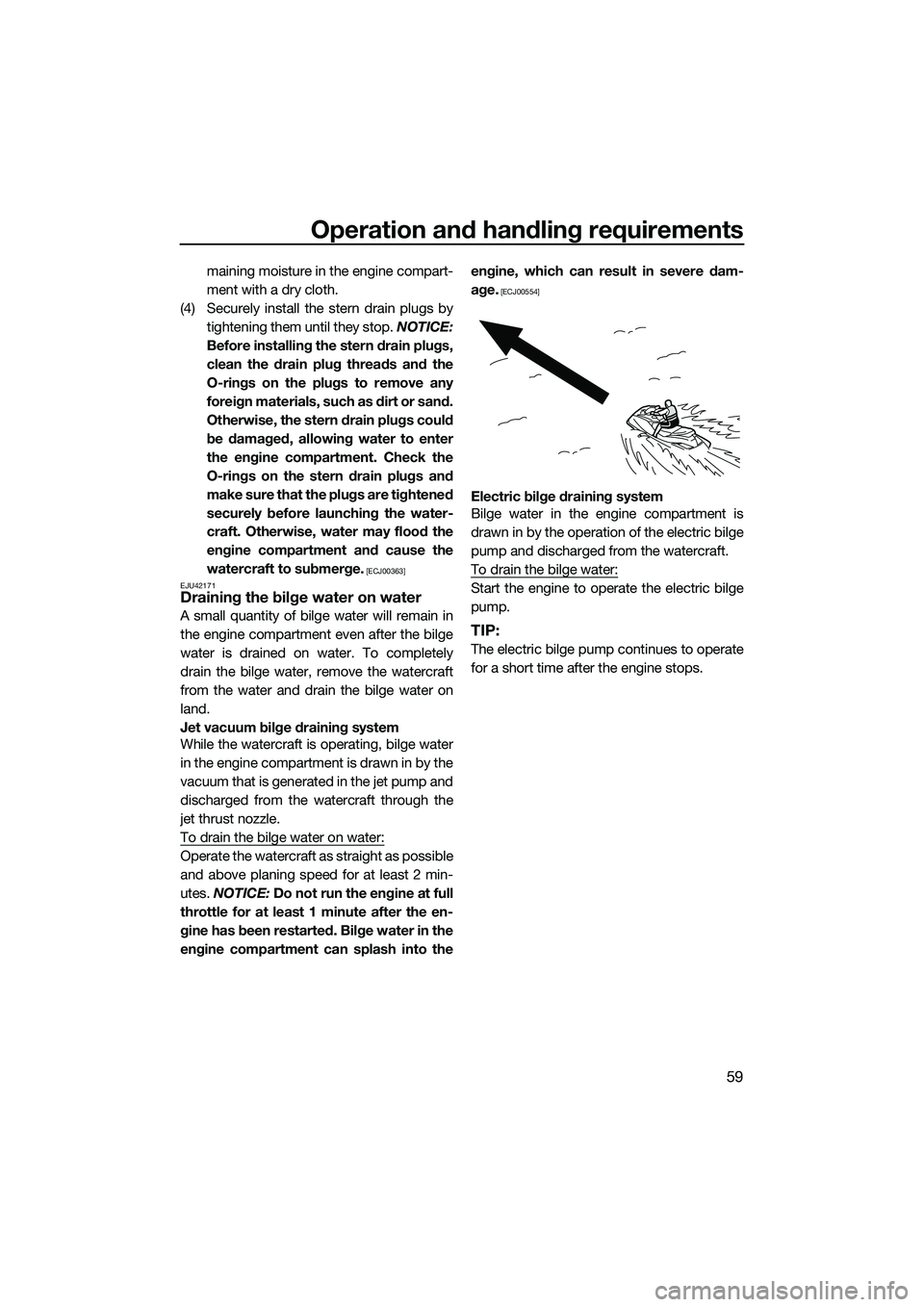
utes. NOTICE: Do not run the engine at full
throttle for at least 1 minute after the en-
gine has been restarted. Bilge water in the
engine compartment can splash into the engine, which can result in severe dam-
age.
[ECJ00554]
Electric bilge draining system
Bilge water in the engine compartment is
drawn in by the operation of the electric bilge
pump and discharged from the watercraft.
To drain the bilge water:
Start the engine to operate the electric bilge
pump.
TIP:
The electric bilge pump continues to operate
for a short time after the engine stops.
UF2T72E0.book Page 59 Monday, July 22, 2013 2:26 PM
Page 68 of 114
Pre-operation checks
62
EJU31982
WARNING
EWJ00412
Failure to inspect or maintain the watercraft properly increases the possibility of an ac-
cident or damage to the watercraft. Do not operate the watercraft if you find any prob-
lem. If a problem cannot be corrected by the procedures provided in this manual, have
the watercraft inspected by a Yamaha dealer.
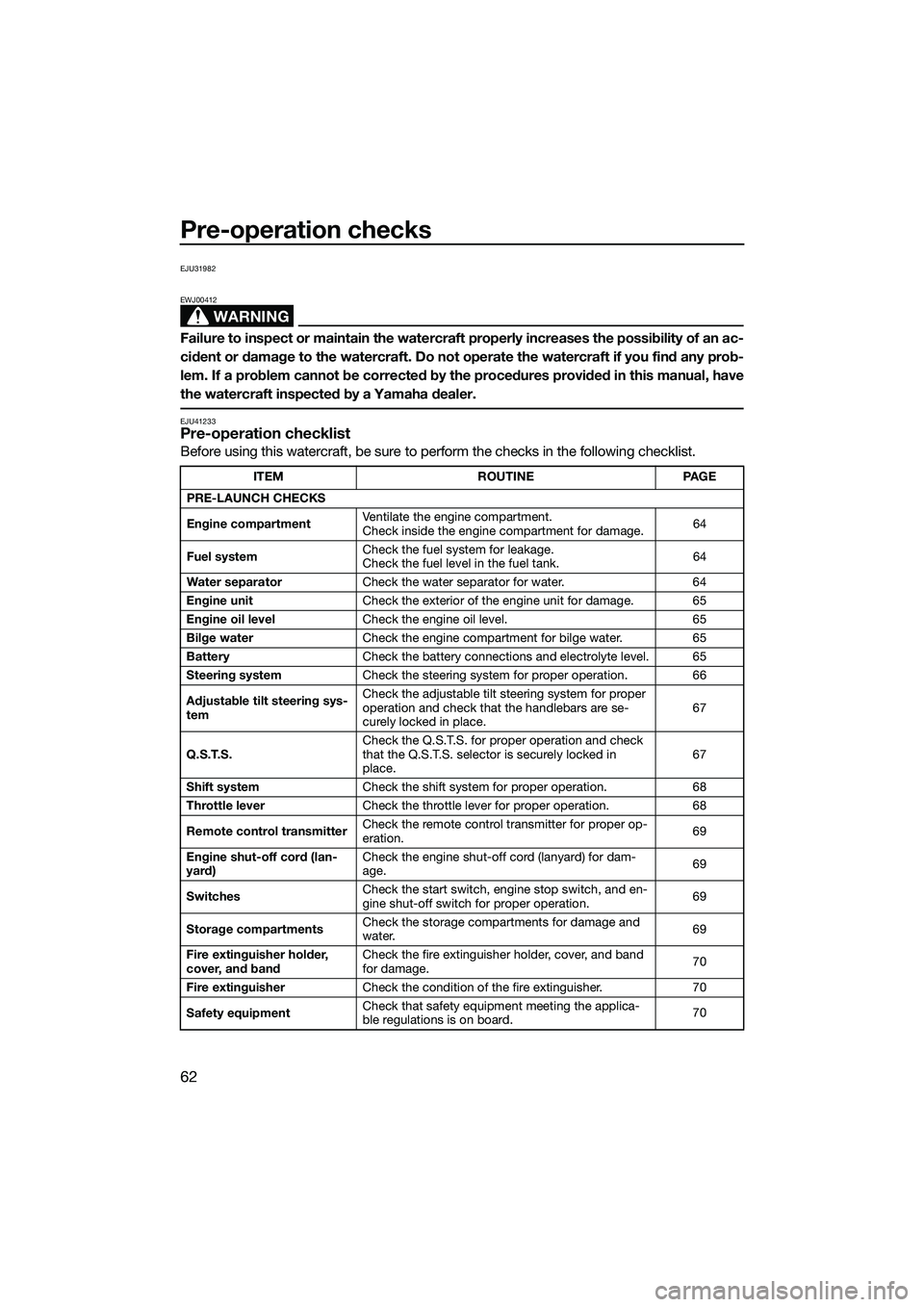
EJU41233Pre-operation checklist
Before using this watercraft, be sure to perform the checks in the following checklist.
ITEMROUTINEPAGE
PRE-LAUNCH CHECKS
Engine compartment Ventilate the engine compartment.
Check inside the engine compartment for damage.
64
Fuel system Check the fuel system for leakage.
Check the fuel level in the fuel tank.
64
Water separator Check the water separator for water. 64
Engine unit Check the exterior of the engine unit for damage. 65
Engine oil level Check the engine oil level. 65
Bilge water Check the engine compartment for bilge water. 65
Battery Check the battery connections and electrolyte level. 65
Steering system Check the steering system for proper operation. 66
Adjustable tilt steering sys-
tem Check the adjustable tilt steering system for proper
operation and check that the handlebars are se-
curely locked in place.
67
Q.S.T.S. Check the Q.S.T.S. for proper operation and check
that the Q.S.T.S. selector is securely locked in
place. 67
Shift system Check the shift system for proper operation. 68
Throttle lever Check the throttle lever for proper operation. 68
Remote control transmitter Check the remote control transmitter for proper op-
eration.
69
Engine shut-off cord (lan-
yard) Check the engine shut-off cord (lanyard) for dam-
age.
69
Switches Check the start switch, engine stop switch, and en-
gine shut-off switch for proper operation.
69
Storage compartments Check the storage compartments for damage and
water.
69
Fire extinguisher holder,
cover, and band Check the fire extinguisher holder, cover, and band
for damage.
70
Fire extinguisher Check the condition of the fire extinguisher. 70
Safety equipment Check that safety equipment meeting the applica-
ble regulations is on board.
70
UF2T72E0.book Page 62 Monday, July 22, 2013 2:26 PM
Page 75 of 114
Pre-operation checks
69
EJU40113Remote control transmitter check
Make sure that the remote control transmitter
operates properly. (See page 27 for Yamaha
Security System setting procedures and
page 35 for Low RPM Mode activation pro-
cedures.)
EJU32664Engine shut-off cord (lanyard) check
Make sure that the engine shut-off cord (lan-
yard) is not damaged. If the cord is damaged,
replace it. WARNING! Never try to repair
the engine shut-off cord (lanyard) or tie it
together. The engine shut-off cord (lan-
yard) may not pull free when the operator
falls off, allowing the watercraft to contin-
ue to run and cause an accident.
[EWJ01221]
EJU32676
Switch checks
NOTICE
ECJ01311
Do not run the engine over 4000 r/min on
land. Also, do not run the engine for more
than 15 seconds without supplying water,
otherwise the engine could overheat.
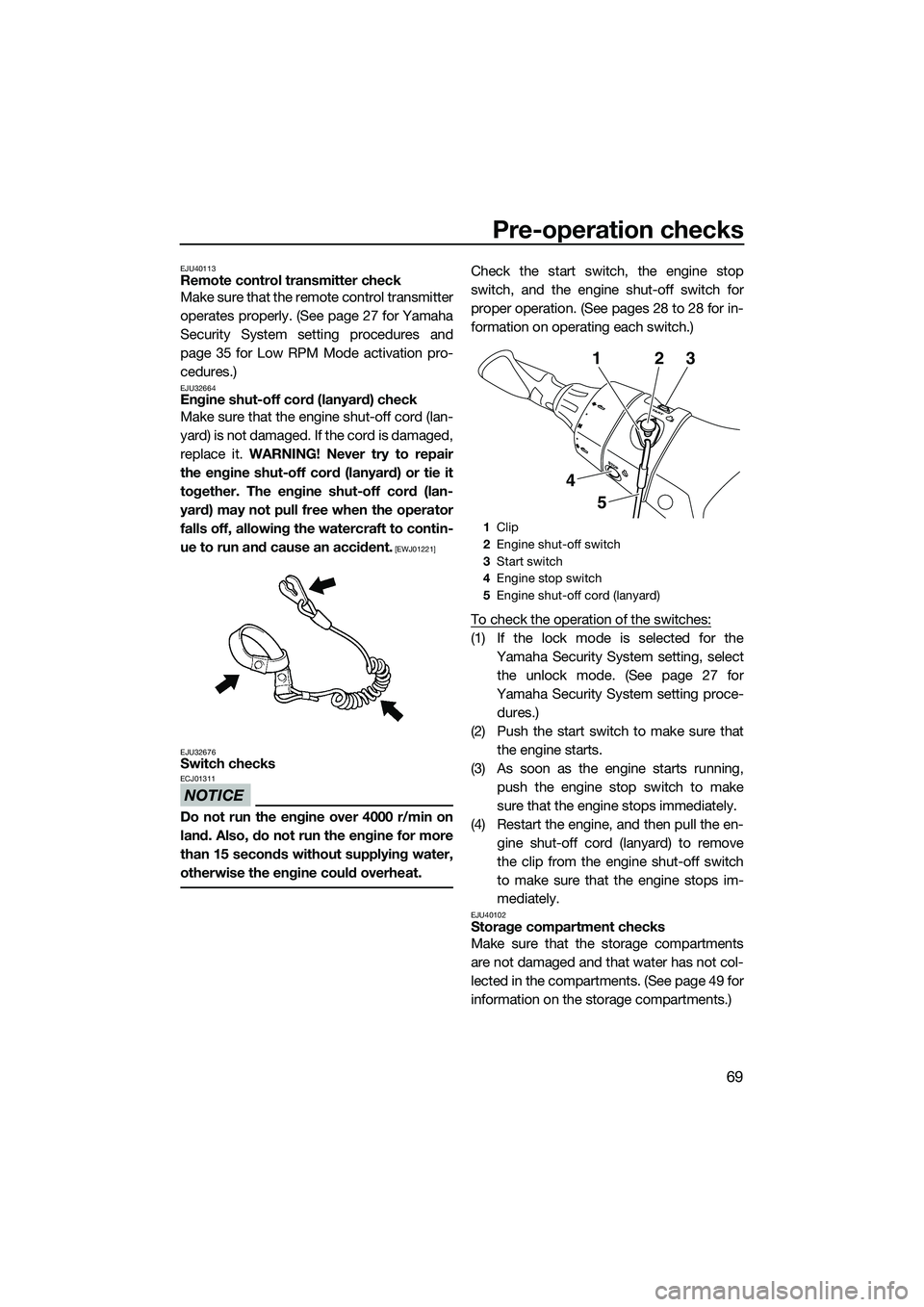
Check the start switch, the engine stop
switch, and the engine shut-off switch for
proper operation. (See pages 28 to 28 for in-
formation on operating each switch.)
To check the operation of the switches:
(1) If the lock mode is selected for the Yamaha Security System setting, selectthe unlock mode. (See page 27 for
Yamaha Security System setting proce- dures.)
(2) Push the start switch to make sure that the engine starts.
(3) As soon as the engine starts running, push the engine stop switch to make
sure that the engine stops immediately.
(4) Restart the engine, and then pull the en- gine shut-off cord (lanyard) to remove
the clip from the engine shut-off switch
to make sure that the engine stops im-
mediately.
EJU40102Storage compartment checks
Make sure that the storage compartments
are not damaged and that water has not col-
lected in the compartments. (See page 49 for
information on the storage compartments.)
1Clip
2 Engine shut-off switch
3 Start switch
4 Engine stop switch
5 Engine shut-off cord (lanyard)
132
5
4
UF2T72E0.book Page 69 Monday, July 22, 2013 2:26 PM
Page 81 of 114
Operation
75
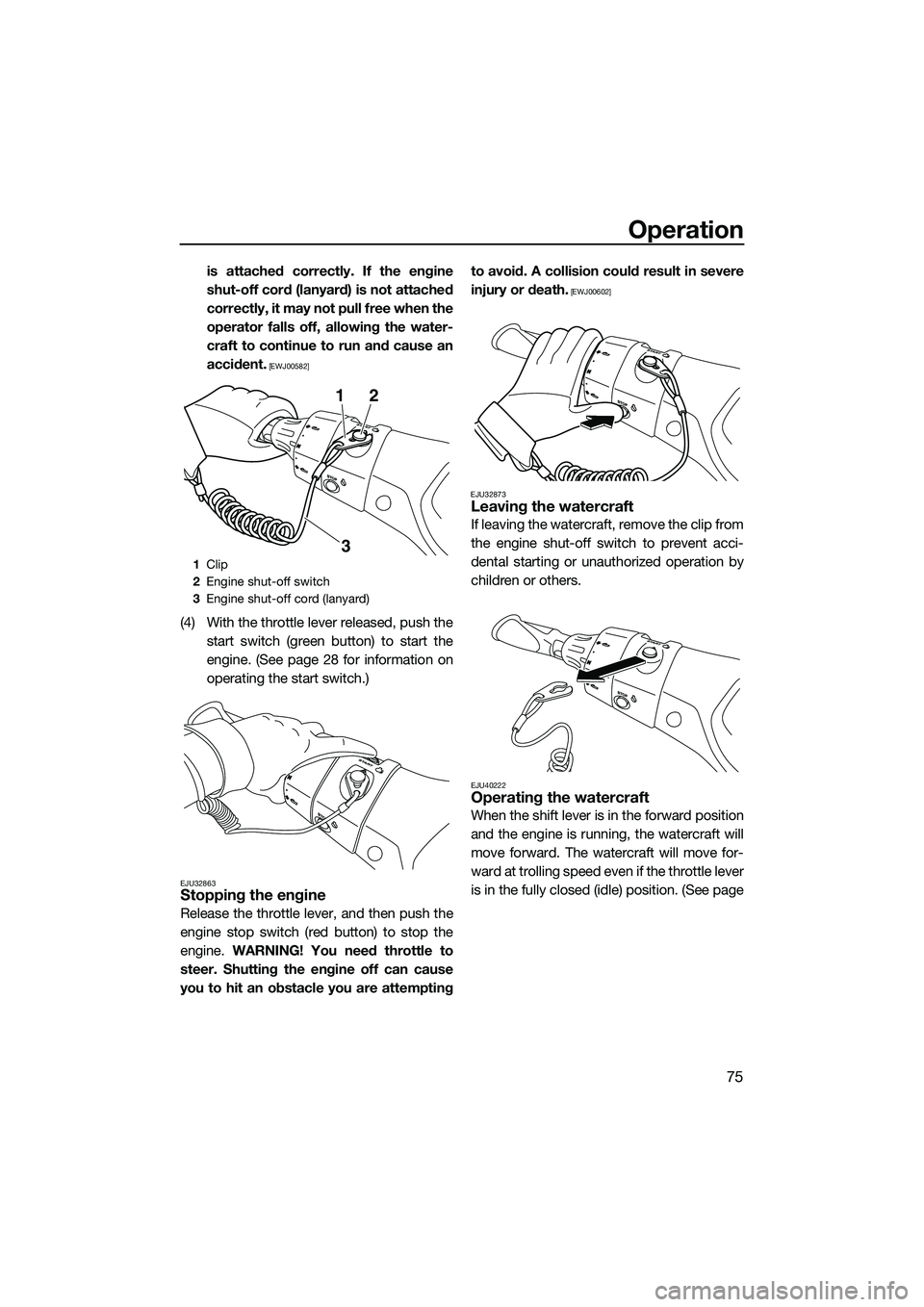
is attached correctly. If the engine
shut-off cord (lanyard) is not attached
correctly, it may not pull free when the
operator falls off, allowing the water-
craft to continue to run and cause an
accident.
[EWJ00582]
(4) With the throttle lever released, push thestart switch (green button) to start the
engine. (See page 28 for information on
operating the start switch.)
EJU32863Stopping the engine
Release the throttle lever, and then push the
engine stop switch (red button) to stop the
engine. WARNING! You need throttle to
steer. Shutting the engine off can cause
you to hit an obstacle you are attempting to avoid. A collision could result in severe
injury or death.
[EWJ00602]
EJU32873
Leaving the watercraft
If leaving the watercraft, remove the clip from
the engine shut-off switch to prevent acci-
dental starting or unauthorized operation by
children or others.
EJU40222Operating the watercraft
When the shift lever is in the forward position
and the engine is running, the watercraft will
move forward. The watercraft will move for-
ward at trolling speed even if the throttle lever
is in the fully closed (idle) position. (See page
1 Clip
2 Engine shut-off switch
3 Engine shut-off cord (lanyard)
12
3
UF2T72E0.book Page 75 Monday, July 22, 2013 2:26 PM
Page 90 of 114
![YAMAHA FX HO 2014 User Guide Operation
84
otherwise water can enter the engine,
which can result in severe damage.
[ECJ00542]
(3) Start the engine and operate the water-craft at planing speed to drain the bilge
water from the eng](/img/51/49764/w960_49764-89.png "YAMAHA FX HO 2014 User Guide Operation
84
otherwise water can enter the engine,
which can result in severe damage.
[ECJ00542]
(3) Start the engine and operate the water-craft at planing speed to drain the bilge
water from the eng")
Operation
84
otherwise water can enter the engine,
which can result in severe damage.
[ECJ00542]
(3) Start the engine and operate the water-craft at planing speed to drain the bilge
water from the engine compartment.
(See page 58 for information on draining
the bilge water. If the engine does not
start, see “Towing the watercraft” on
page 104 or “Submerged watercraft” on
page 105.) NOTICE: Do not run the en-
gine at full throttle for at least 1 minute
after the engine has been restarted.
Bilge water in the engine compart-
ment can splash into the engine,
which can result in severe damage.
[ECJ00554]
EJU42591
Beaching and docking the watercraft
To beach the watercraft:
(1) Make sure that there are no boats, swim- mers, or obstacles near the beach. (2) Release the throttle lever to reduce
speed about 110 m (360 ft) before you
reach the intended beaching area.
(3) Slowly approach the beach and stop the engine just before reaching land.
WARNING! You need throttle to steer. Shutting the engine off can cause you
to hit an obstacle you are attempting
to avoid. A collision could result in se-
vere injury or death.
[EWJ00602] NOTICE:
Never run the engine in water that is
less than 60 cm (2 ft) deep from the
bottom of the watercraft, otherwise
pebbles or sand could be sucked into
the jet intake, causing impeller dam-
age and engine overheating.
[ECJ00473]
( 4 ) G e t o f f t h e w a t e r c r a f t a n d p u l l i t u p o n t h e beach.
To dock the watercraft:
(1) Make sure that there are no boats, swim- mers, or obstacles near the dock.
(2) Release the throttle lever to reduce speed about 110 m (360 ft) away from
the dock.
(3) Slowly approach the dock and stop the engine just before coming alongside it.
WARNING! You need throttle to steer. Shutting the engine off can cause you
to hit an obstacle you are attempting
to avoid. A collision could result in se-
vere injury or death.
[EWJ00602]
(4) Come alongside the dock and get off the watercraft.
EJU37194Operating in weeded areas
Always avoid using your watercraft in areas
where weed growth is thick. If operating in
weeded areas is unavoidable, alternately
squeeze the throttle lever and relax your grip
on the throttle lever to vary the engine speed.
Weeds tend to become clogged more when
operating at a steady speed and at trolling
UF2T72E0.book Page 84 Monday, July 22, 2013 2:26 PM
Page 91 of 114
Operation
85
speed. If weeds may have clogged the intake
area, clean the jet intake. (See page 100 for
information on the jet intake.)
EJU40242After removing the watercraft from
the water
NOTICE
ECJ01311
Do not run the engine over 4000 r/min on
land. Also, do not run the engine for more
than 15 seconds without supplying water,
otherwise the engine could overheat.
After operating and removing the watercraft
from the water, promptly discharge the re-
maining water from the cooling water pas-
sages.
To discharge water from the cooling water
passages:
(1) Make sure that the area around the wa- tercraft is clear, and then start the en-
gine.
(2) Discharge the remaining water out of the cooling water passages by alternately
squeezing and releasing the throttle lever
quickly for 10 to 15 seconds.
(3) Stop the engine.
UF2T72E0.book Page 85 Monday, July 22, 2013 2:26 PM