cooling YAMAHA FX HO 2014 Owners Manual
[x] Cancel search | Manufacturer: YAMAHA, Model Year: 2014, Model line: FX HO, Model: YAMAHA FX HO 2014Pages: 114, PDF Size: 5.13 MB
Page 5 of 114
Table of contents
General and important labels ........... 1Identification numbers .................... 1
Primary Identification (PRI-ID)
number............................................ 1
Craft Identification Number (CIN) ....... 1
Engine serial number.......................... 1
Manufactured date label .................... 2
Model information ........................... 2
Builder’s plate .................................... 2
Important labels .............................. 4
Warning labels.................................... 5
Other labels ........................................ 9
Safety information ........................... 11 Limitations on who may operate the watercraft ............................. 11
Cruising limitations ........................ 12
Operation requirements ................ 13
Recommended equipment ........... 15
Hazard information........................ 16
Watercraft characteristics ............. 16
Water-skiing .................................. 18
Safe boating rules ......................... 19
Enjoy your watercraft responsibly ................................. 20
Description....................................... 21 Watercraft glossary ....................... 21
Location of main components ...... 22
Control function operation ............. 26 Watercraft control functions ......... 26
Remote control transmitter .............. 26
Yamaha Security System ................. 27
Engine stop switch .......................... 28
Engine shut-off switch .................... 28
Start switch ..................................... 28
Throttle lever .................................... 29
Steering system ............................... 29
Adjustable tilt steering system ......... 30
Cooling water pilot outlet ................. 30
Water separator................................ 31
Watercraft operation ...................... 32Watercraft operation functions ..... 32
Shift system...................................... 32
Quick Shift Trim System
(Q.S.T.S.) ....................................... 33
Watercraft operation modes ......... 35
Low RPM Mode ............................... 35
No-wake mode ................................. 36
Cruise assist ..................................... 37
Instrument operation ...................... 40Multifunction information center ... 40
Analog speedometer/tachometer..... 40
Information display ........................... 41
Equipment operation ...................... 46Equipment..................................... 46
Seats ................................................ 46
Handgrip........................................... 47
Reboarding grip................................ 47
Reboarding step ............................... 47
Bow eye............................................ 48
Stern eyes ........................................ 48
Cleat ................................................. 48
Pull-up cleats (FX Cruiser HO).......... 49
Storage compartments .................... 49
Fire extinguisher holder and cover ... 54
Operation and handling
requirements ................................... 55Fuel requirements ......................... 55
Fuel................................................... 55
Engine oil requirements ................ 57
Engine oil .......................................... 57
Draining the bilge water ................ 58
Draining the bilge water on land....... 58
Draining the bilge water on water .... 59
UF2T72E0.book Page 1 Monday, July 22, 2013 2:26 PM
Page 6 of 114
Table of contents
Transporting on a trailer ................ 60
First-time operation ........................ 61 Engine break-in ............................. 61
Pre-operation checks ..................... 62
Pre-operation checklist .................... 62
Pre-operation check points........... 64
Pre-launch checks ........................... 64
Post-launch checks ......................... 71
Operation ......................................... 73 Operating your watercraft ............. 73
Getting to know your watercraft ...... 73
Learning to operate your
watercraft ...................................... 73
Riding position ................................. 74
Launching the watercraft ................. 74
Starting the engine on water ............ 74
Stopping the engine ......................... 75
Leaving the watercraft...................... 75
Operating the watercraft .................. 75
Turning the watercraft ...................... 76
Stopping the watercraft ................... 77
Operating the watercraft in reverse or neutral....................................... 78
Boarding the watercraft ................... 79
Starting off........................................ 82
Capsized watercraft ......................... 83
Beaching and docking the
watercraft ...................................... 84
Operating in weeded areas .............. 84
After removing the watercraft from the water ....................................... 85
Care and storage............................. 86Post-operation care ...................... 86
Flushing the cooling water
passages....................................... 86
Cleaning the watercraft .................... 87
Battery care ...................................... 87
Long-term storage ........................ 90
Cleaning ........................................... 90
Lubrication ....................................... 90 Rustproofing ..................................... 91
Maintenance .................................... 92
Maintenance ................................. 92
Tool kit.............................................. 92
Removing and installing the engine
cover ............................................. 92
Periodic maintenance chart ............. 94
Engine oil and oil filter ...................... 95
Specifications .................................. 96 Specifications ............................... 96
Trouble recovery ............................. 97 Troubleshooting ............................ 97
Troubleshooting chart ...................... 97
Emergency procedures .............. 100
Cleaning the jet intake and
impeller ....................................... 100
Jumping the battery ....................... 101
Replacing the fuses ........................ 101
Replacing the bilge pump fuse ...... 103
Towing the watercraft..................... 104
Submerged watercraft ................... 105
UF2T72E0.book Page 2 Monday, July 22, 2013 2:26 PM
Page 28 of 114
Description
22
EJU31012
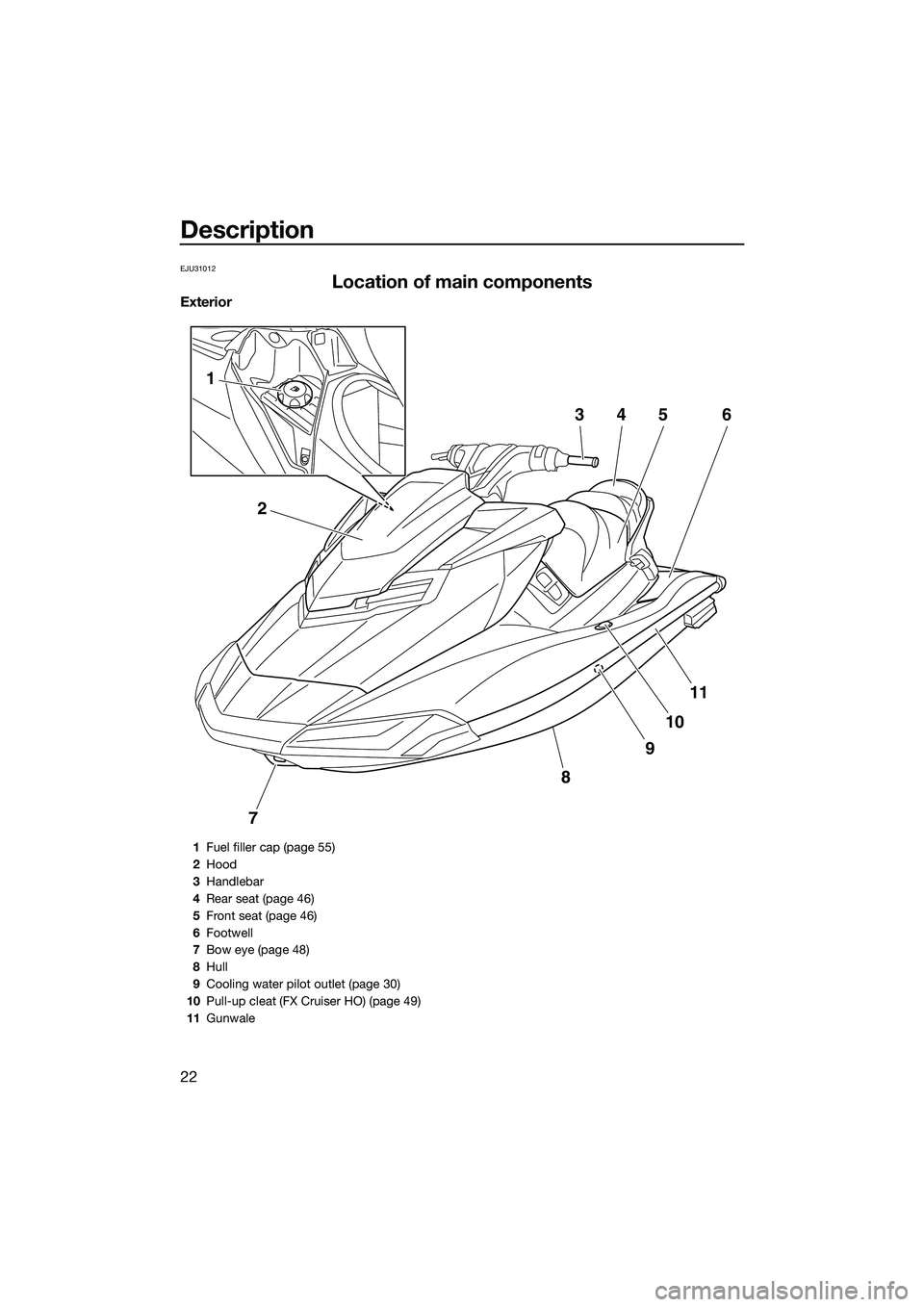
Location of main components
Exterior
7
8
9
10
11
2
1
3456
1Fuel filler cap (page 55)
2 Hood
3 Handlebar
4 Rear seat (page 46)
5 Front seat (page 46)
6 Footwell
7 Bow eye (page 48)
8 Hull
9 Cooling water pilot outlet (page 30)
10 Pull-up cleat (FX Cruiser HO) (page 49)
11 Gunwale
UF2T72E0.book Page 22 Monday, July 22, 2013 2:26 PM
Page 36 of 114
Control function operation
30
in response to handlebar input until you apply
throttle again or you reach trolling speed.
EJU31294Adjustable tilt steering system
The position of the handlebars can be adjust-
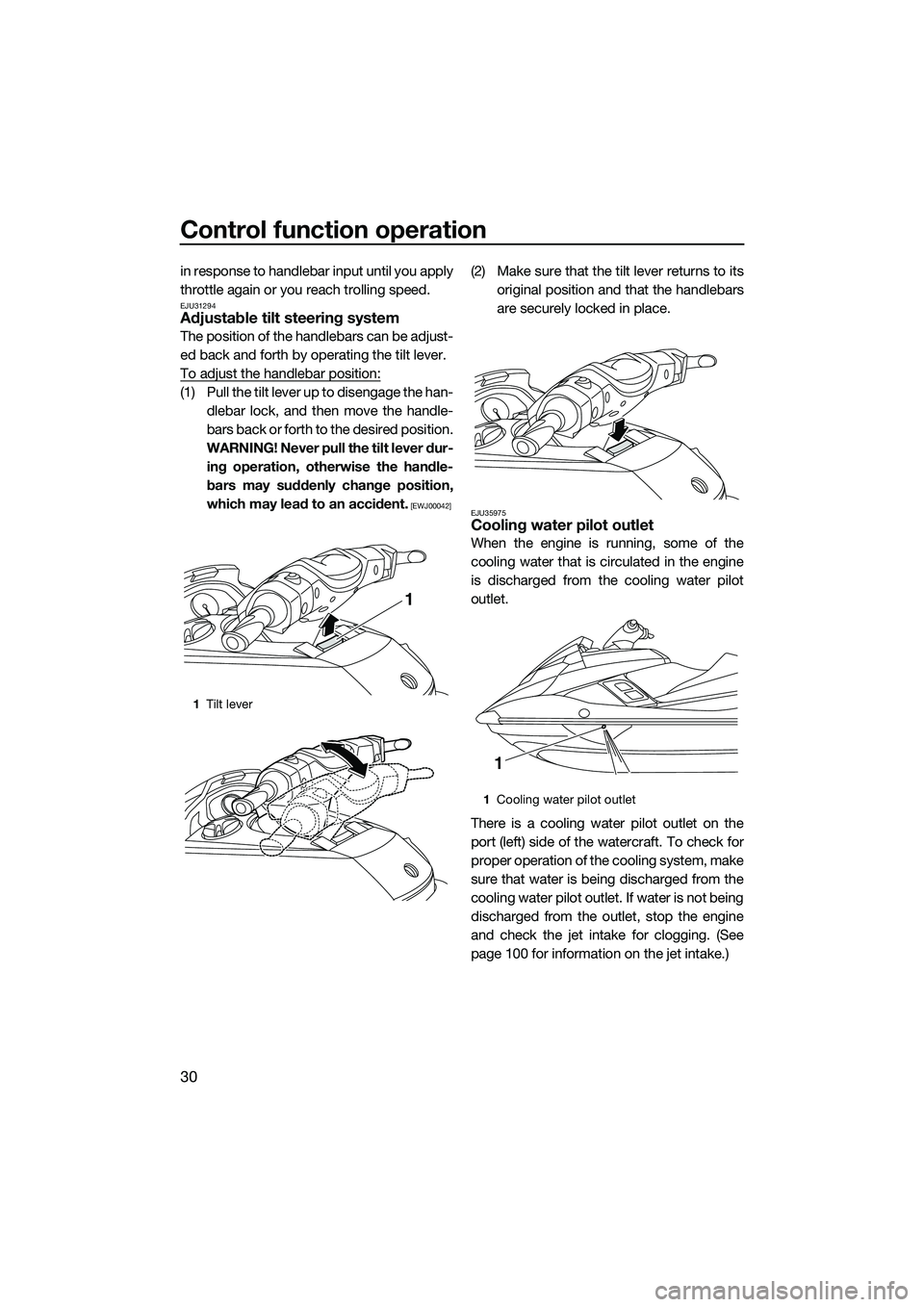
ed back and forth by operating the tilt lever.
To adjust the handlebar position:
(1) Pull the tilt lever up to disengage the han-dlebar lock, and then move the handle-
bars back or forth to the desired position.
WARNING! Never pull the tilt lever dur- ing operation, otherwise the handle-
bars may suddenly change position,
which may lead to an accident.
[EWJ00042]
(2) Make sure that the tilt lever returns to its original position and that the handlebars
are securely locked in place.
EJU35975Cooling water pilot outlet
When the engine is running, some of the
cooling water that is circulated in the engine
is discharged from the cooling water pilot
outlet.
There is a cooling water pilot outlet on the
port (left) side of the watercraft. To check for
proper operation of the cooling system, make
sure that water is being discharged from the
cooling water pilot outlet. If water is not being
discharged from the outlet, stop the engine
and check the jet intake for clogging. (See
page 100 for information on the jet intake.)
1Tilt lever
1
1Cooling water pilot outlet
1
UF2T72E0.book Page 30 Monday, July 22, 2013 2:26 PM
Page 50 of 114
Instrument operation
44
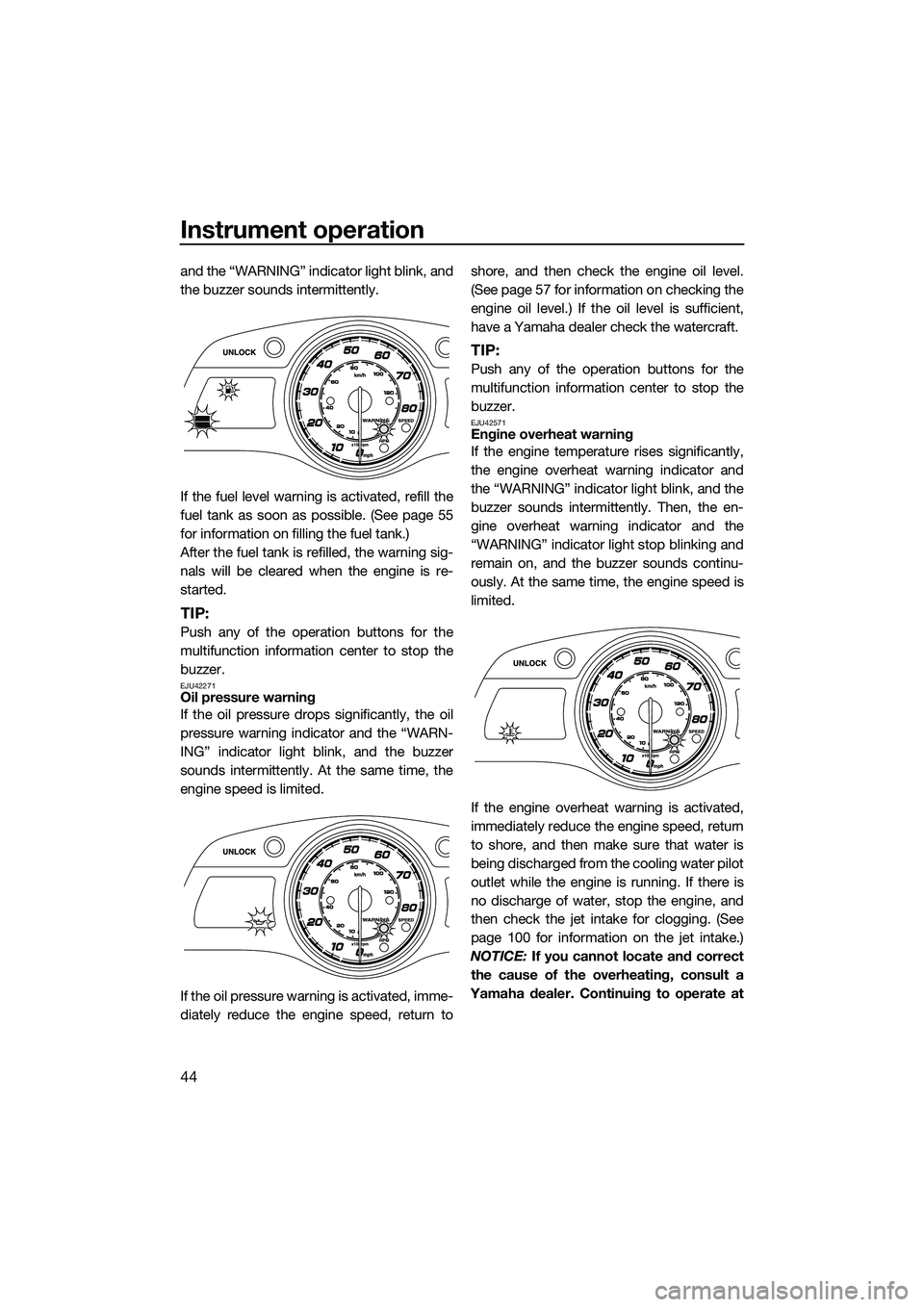
and the “WARNING” indicator light blink, and
the buzzer sounds intermittently.
If the fuel level warning is activated, refill the
fuel tank as soon as possible. (See page 55
for information on filling the fuel tank.)
After the fuel tank is refilled, the warning sig-
nals will be cleared when the engine is re-
started.
TIP:
Push any of the operation buttons for the
multifunction information center to stop the
buzzer.
EJU42271Oil pressure warning
If the oil pressure drops significantly, the oil
pressure warning indicator and the “WARN-
ING” indicator light blink, and the buzzer
sounds intermittently. At the same time, the
engine speed is limited.
If the oil pressure warning is activated, imme-
diately reduce the engine speed, return toshore, and then check the engine oil level.
(See page 57 for information on checking the
engine oil level.) If the oil level is sufficient,
have a Yamaha dealer check the watercraft.
TIP:
Push any of the operation buttons for the
multifunction information center to stop the
buzzer.
EJU42571Engine overheat warning
If the engine temperature rises significantly,
the engine overheat warning indicator and
the “WARNING” indicator light blink, and the
buzzer sounds intermittently. Then, the en-
gine overheat warning indicator and the
“WARNING” indicator light stop blinking and
remain on, and the buzzer sounds continu-
ously. At the same time, the engine speed is
limited.
If the engine overheat warning is activated,
immediately reduce the engine speed, return
to shore, and then make sure that water is
being discharged from the cooling water pilot
outlet while the engine is running. If there is
no discharge of water, stop the engine, and
then check the jet intake for clogging. (See
page 100 for information on the jet intake.)
NOTICE: If you cannot locate and correct
the cause of the overheating, consult a
Yamaha dealer. Continuing to operate at
UF2T72E0.book Page 44 Monday, July 22, 2013 2:26 PM
Page 69 of 114
Pre-operation checks
63
TIP:
To ensure safety and reliability, pre-operation checks should be made each time the water-
craft is used.
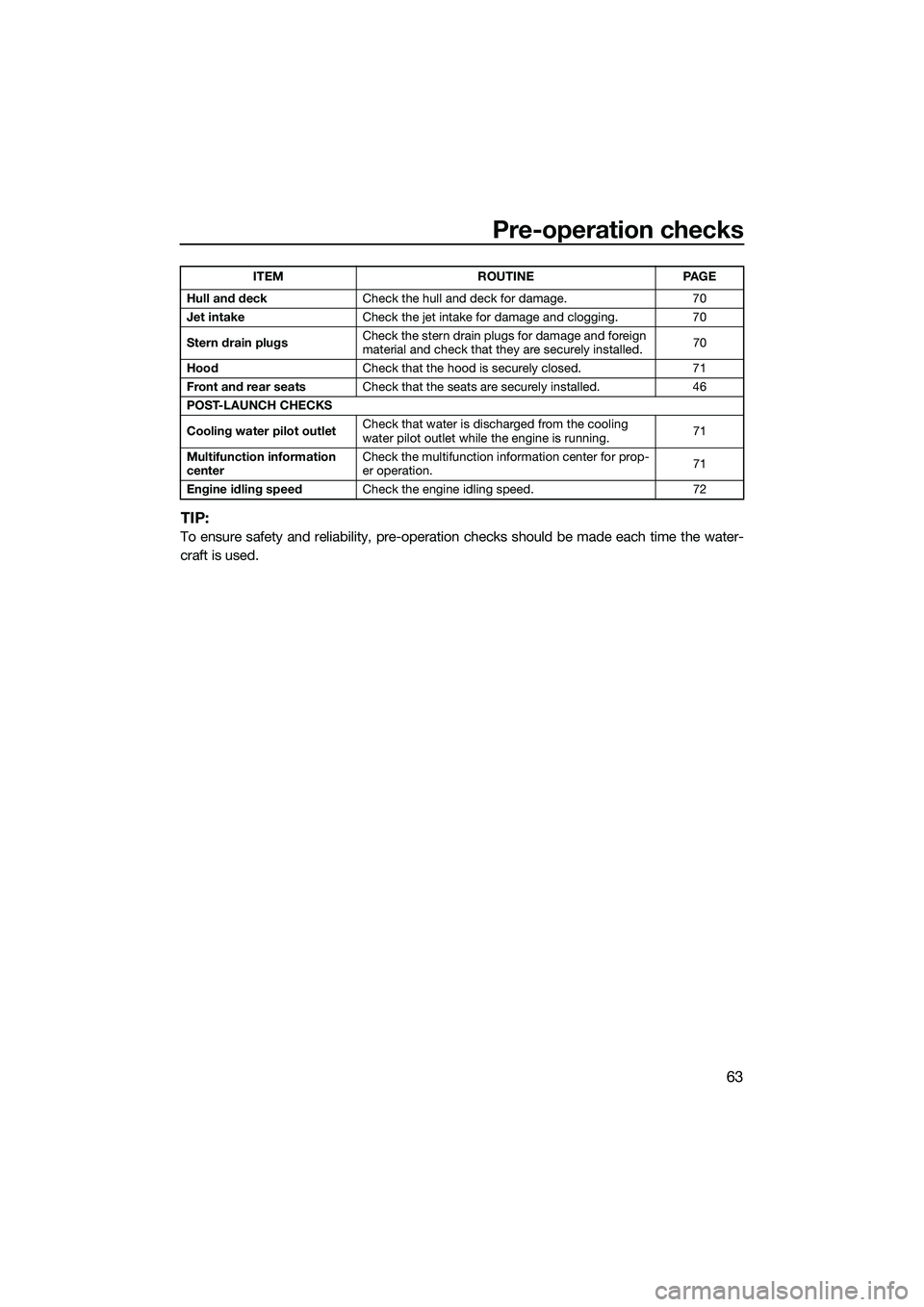
Hull and deck Check the hull and deck for damage. 70
Jet intake Check the jet intake for damage and clogging. 70
Stern drain plugs Check the stern drain plugs for damage and foreign
material and check that they are securely installed.
70
Hood Check that the hood is securely closed. 71
Front and rear seats Check that the seats are securely installed. 46
POST-LAUNCH CHECKS
Cooling water pilot outlet Check that water is discharged from the cooling
water pilot outlet while the engine is running.
71
Multifunction information
center Check the multifunction information center for prop-
er operation.
71
Engine idling speed Check the engine idling speed. 72
ITEM ROUTINE PAGE
UF2T72E0.book Page 63 Monday, July 22, 2013 2:26 PM
Page 77 of 114
Pre-operation checks
71
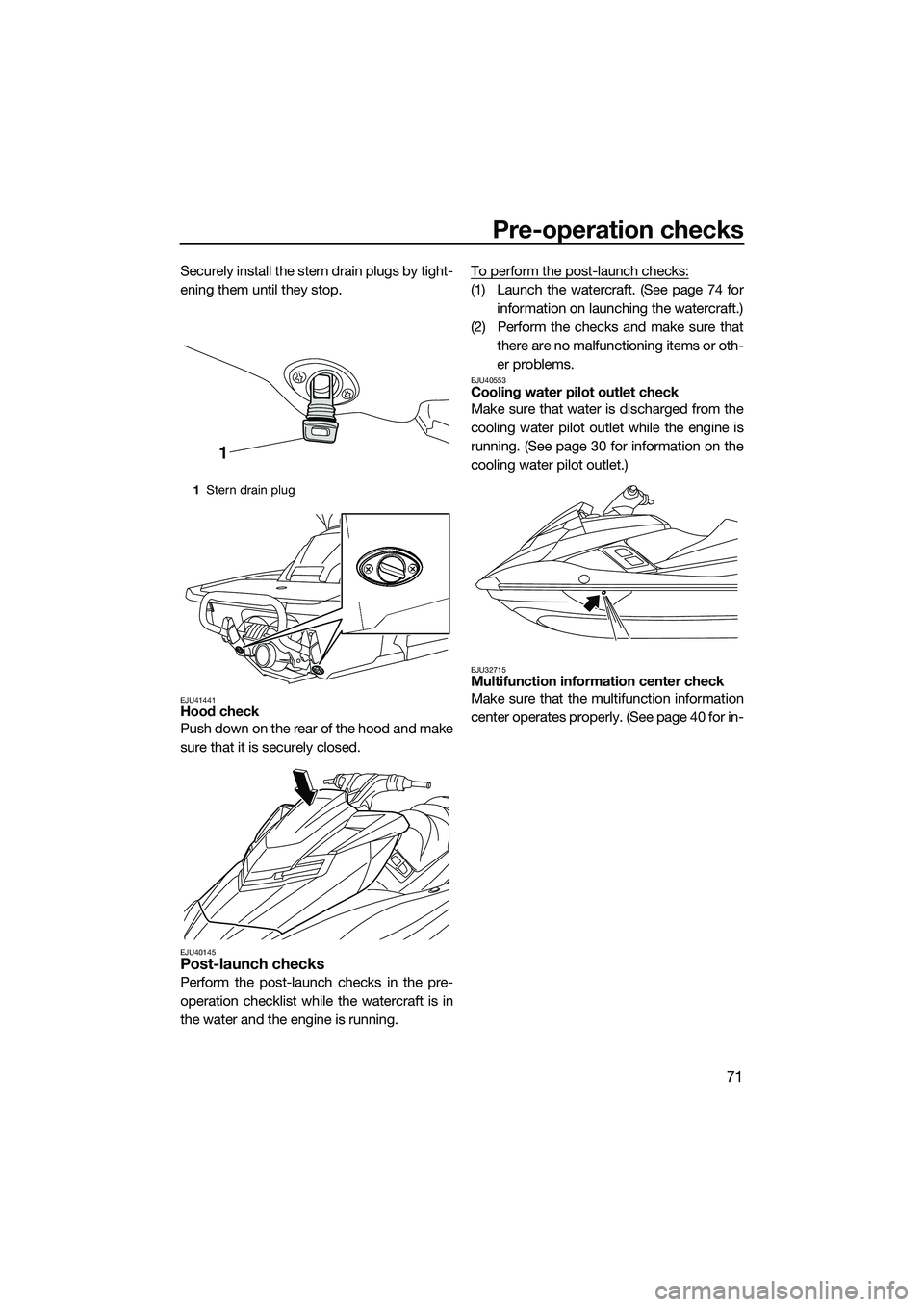
Securely install the stern drain plugs by tight-
ening them until they stop.
EJU41441Hood check
Push down on the rear of the hood and make
sure that it is securely closed.
EJU40145Post-launch checks
Perform the post-launch checks in the pre-
operation checklist while the watercraft is in
the water and the engine is running.To perform the post-launch checks:
(1) Launch the watercraft. (See page 74 for
information on launching the watercraft.)
(2) Perform the checks and make sure that there are no malfunctioning items or oth-
er problems.
EJU40553Cooling water pilot outlet check
Make sure that water is discharged from the
cooling water pilot outlet while the engine is
running. (See page 30 for information on the
cooling water pilot outlet.)
EJU32715Multifunction information center check
Make sure that the multifunction information
center operates properly. (See page 40 for in-
1Stern drain plug
1
UF2T72E0.book Page 71 Monday, July 22, 2013 2:26 PM
Page 91 of 114
Operation
85
speed. If weeds may have clogged the intake
area, clean the jet intake. (See page 100 for
information on the jet intake.)
EJU40242After removing the watercraft from
the water
NOTICE
ECJ01311
Do not run the engine over 4000 r/min on
land. Also, do not run the engine for more
than 15 seconds without supplying water,
otherwise the engine could overheat.
After operating and removing the watercraft
from the water, promptly discharge the re-
maining water from the cooling water pas-
sages.
To discharge water from the cooling water
passages:
(1) Make sure that the area around the wa- tercraft is clear, and then start the en-
gine.
(2) Discharge the remaining water out of the cooling water passages by alternately
squeezing and releasing the throttle lever
quickly for 10 to 15 seconds.
(3) Stop the engine.
UF2T72E0.book Page 85 Monday, July 22, 2013 2:26 PM
Page 92 of 114
Care and storage
86
EJU37146
Post-operation care
WARNING
EWJ00331
Always place the watercraft upright in a
horizontal position when storing it, other-
wise fuel could leak out into the engine or
engine compartment, which could create
a fire hazard.
After using the watercraft, always take it out
of the water, clean it, and store it. Leaving the
watercraft in the water for extended periods
will accelerate the rate of normal deteriora-
tion of the jet pump and hull. Marine organ-
isms and corrosion are some of the
conditions that can shorten the life of many
watercraft components.
EJU42221Flushing the cooling water passages
NOTICE
ECJ01311
Do not run the engine over 4000 r/min on
land. Also, do not run the engine for more
than 15 seconds without supplying water,
otherwise the engine could overheat.
Flush the cooling water passages to prevent
them from clogging with salt, sand, or dirt.
(1) Place the watercraft in a horizontal posi-tion.
(2) Remove the seats and removable water- tight storage compartment. (See page 46
for seat removal and installation proce-
dures and page 52 for information on the
removable watertight storage compart-
ment.)
(3) Open the stern storage compartment. (See page 51 for information on the stern
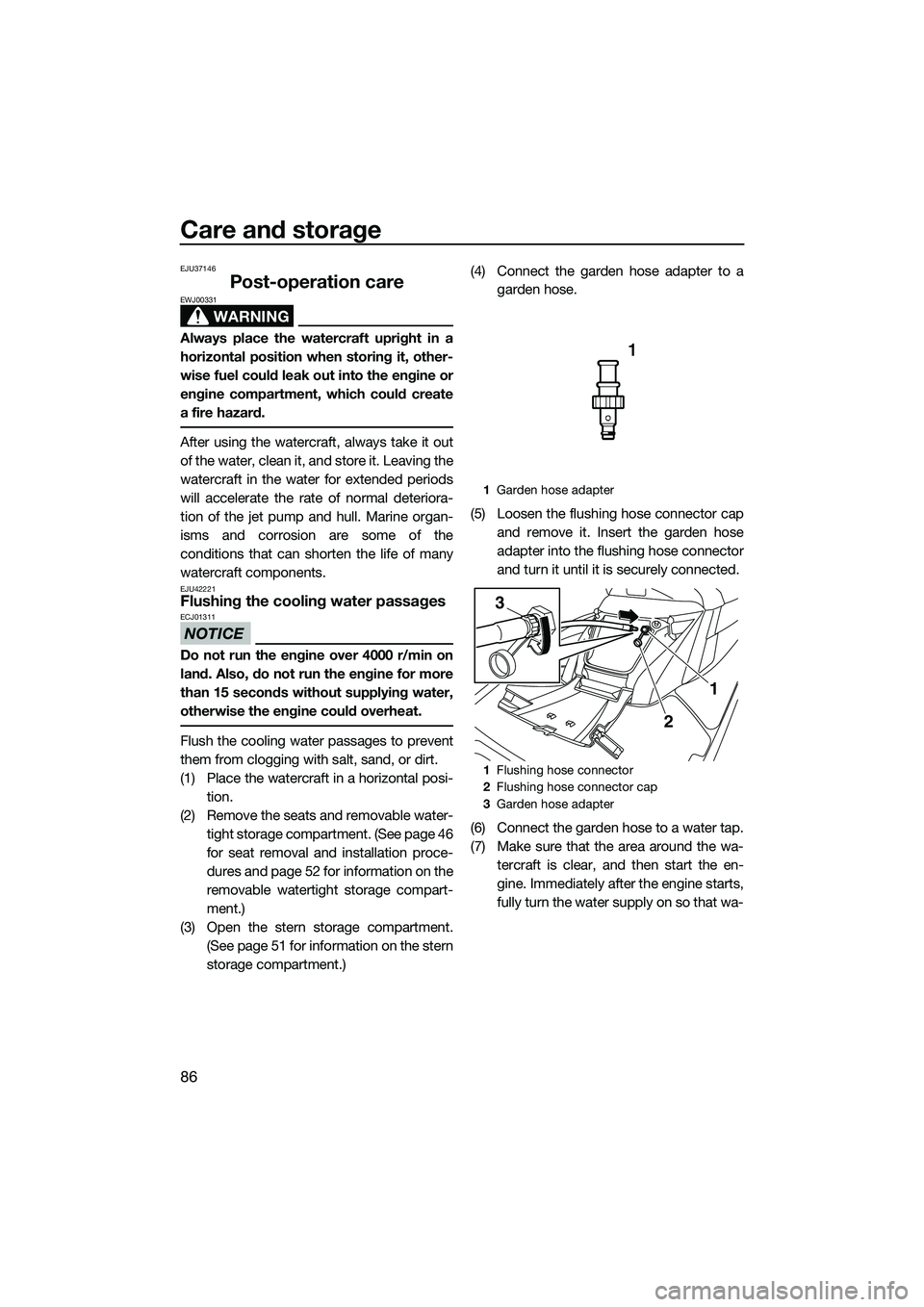
storage compartment.) (4) Connect the garden hose adapter to a
garden hose.
(5) Loosen the flushing hose connector cap and remove it. Insert the garden hose
adapter into the flushing hose connector
and turn it until it is securely connected.
(6) Connect the garden hose to a water tap.
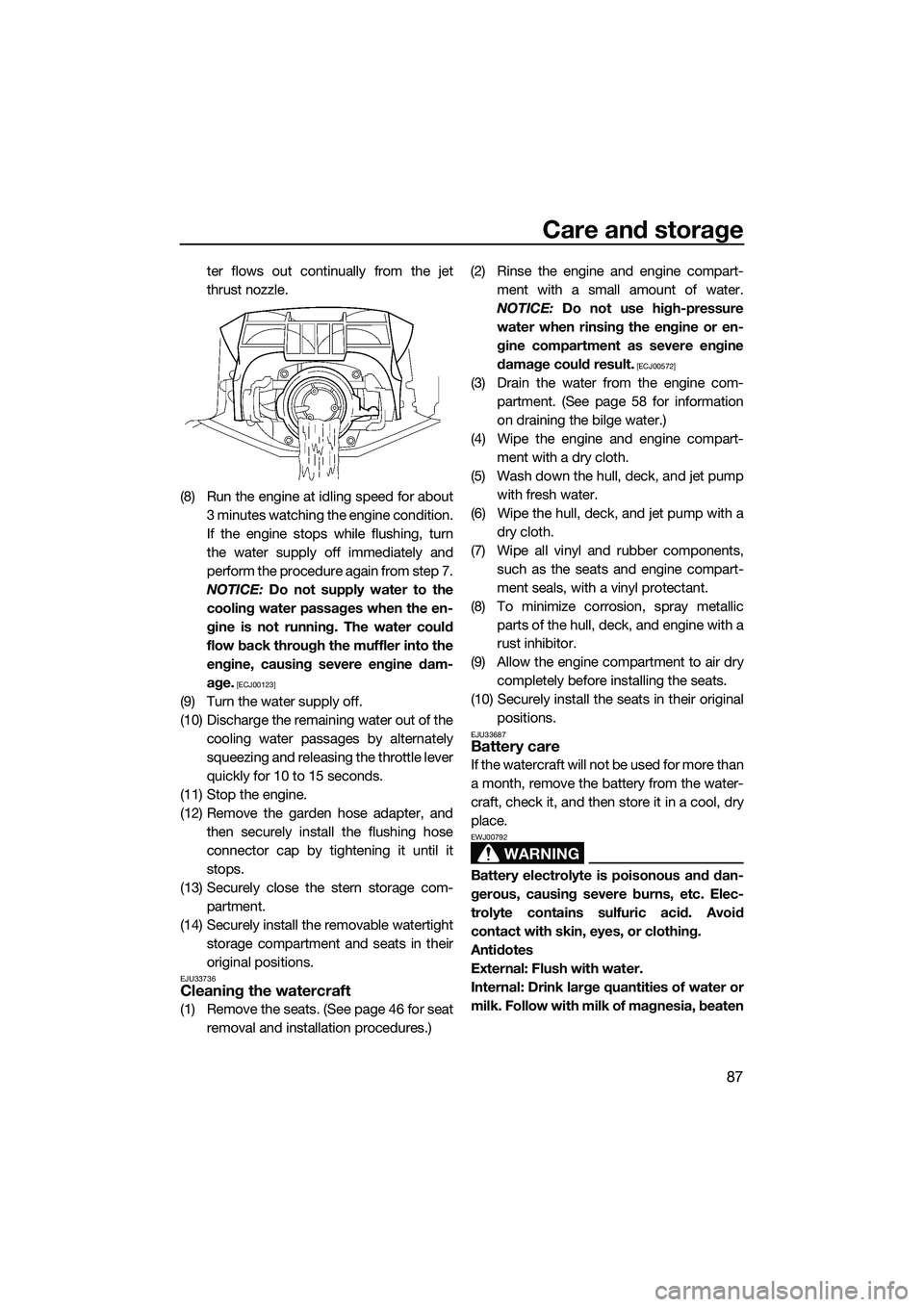
(7) Make sure that the area around the wa- tercraft is clear, and then start the en-
gine. Immediately after the engine starts,
fully turn the water supply on so that wa-
1Garden hose adapter
1 Flushing hose connector
2 Flushing hose connector cap
3 Garden hose adapter
1
3
2
UF2T72E0.book Page 86 Monday, July 22, 2013 2:26 PM
Page 93 of 114
Care and storage
87
ter flows out continually from the jet
thrust nozzle.
(8) Run the engine at idling speed for about 3 minutes watching the engine condition.
If the engine stops while flushing, turn
the water supply off immediately and
perform the procedure again from step 7.
NOTICE: Do not supply water to the
cooling water passages when the en-
gine is not running. The water could
flow back through the muffler into the
engine, causing severe engine dam-
age.
[ECJ00123]
(9) Turn the water supply off.
(10) Discharge the remaining water out of the cooling water passages by alternately
squeezing and releasing the throttle lever
quickly for 10 to 15 seconds.
(11) Stop the engine.
(12) Remove the garden hose adapter, and then securely install the flushing hose
connector cap by tightening it until it
stops.
(13) Securely close the stern storage com- partment.
(14) Securely install the removable watertight storage compartment and seats in their
original positions.
EJU33736Cleaning the watercraft
(1) Remove the seats. (See page 46 for seatremoval and installation procedures.) (2) Rinse the engine and engine compart-
ment with a small amount of water.
NOTICE: Do not use high-pressure
water when rinsing the engine or en-
gine compartment as severe engine
damage could result.
[ECJ00572]
(3) Drain the water from the engine com- partment. (See page 58 for information
on draining the bilge water.)
(4) Wipe the engine and engine compart- ment with a dry cloth.
(5) Wash down the hull, deck, and jet pump with fresh water.
(6) Wipe the hull, deck, and jet pump with a dry cloth.
(7) Wipe all vinyl and rubber components, such as the seats and engine compart-
ment seals, with a vinyl protectant.
(8) To minimize corrosion, spray metallic parts of the hull, deck, and engine with a
rust inhibitor.
(9) Allow the engine compartment to air dry completely before installing the seats.
(10) Securely install the seats in their original positions.
EJU33687Battery care
If the watercraft will not be used for more than
a month, remove the battery from the water-
craft, check it, and then store it in a cool, dry
place.
WARNING
EWJ00792
Battery electrolyte is poisonous and dan-
gerous, causing severe burns, etc. Elec-
trolyte contains sulfuric acid. Avoid
contact with skin, eyes, or clothing.
Antidotes
External: Flush with water.
Internal: Drink large quantities of water or
milk. Follow with milk of magnesia, beaten
UF2T72E0.book Page 87 Monday, July 22, 2013 2:26 PM