pin YAMAHA FX SVHO 2019 User Guide
[x] Cancel search | Manufacturer: YAMAHA, Model Year: 2019, Model line: FX SVHO, Model: YAMAHA FX SVHO 2019Pages: 116, PDF Size: 12.33 MB
Page 82 of 116
Operation
76
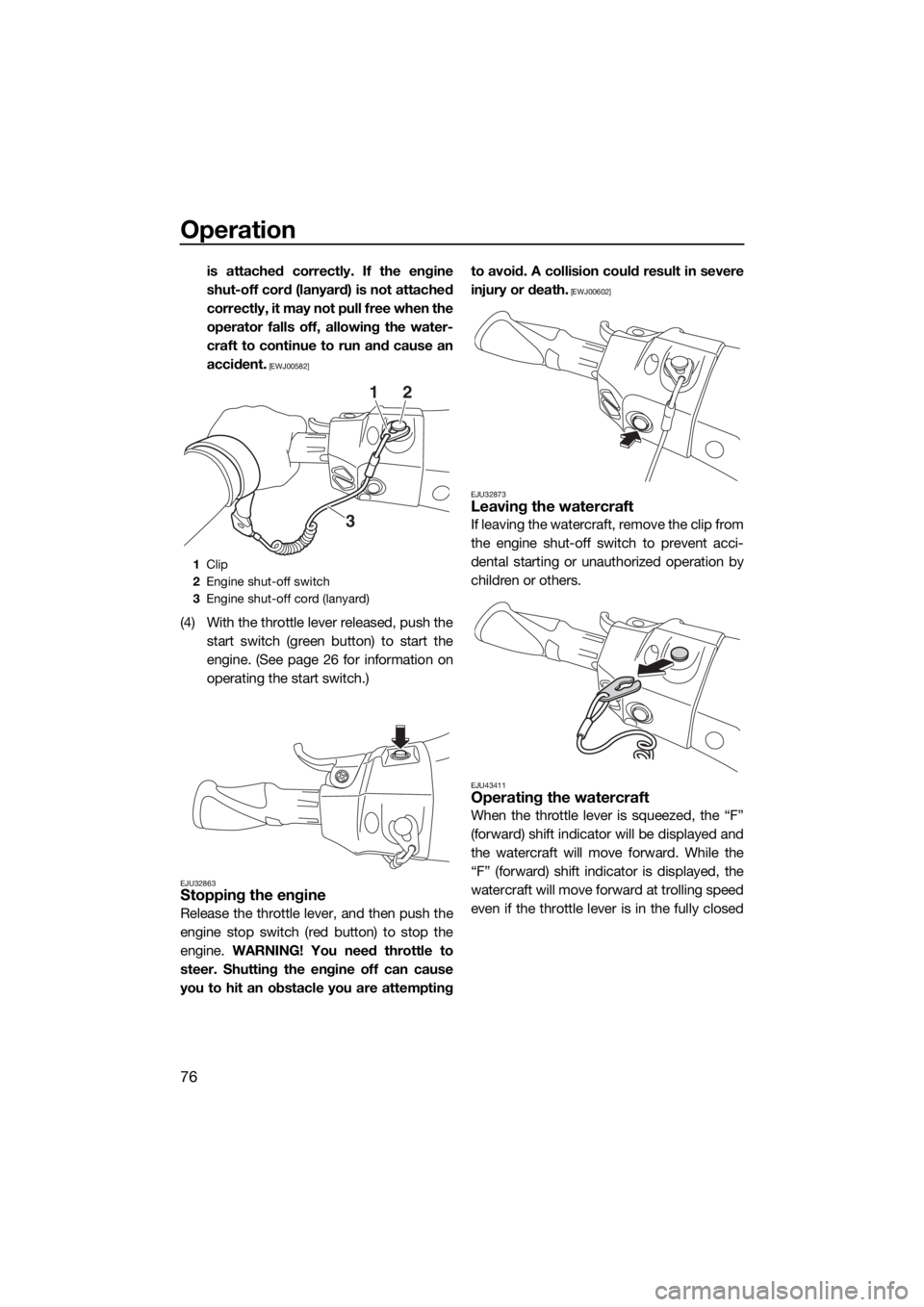
is attached correctly. If the engine
shut-off cord (lanyard) is not attached
correctly, it may not pull free when the
operator falls off, allowing the water-
craft to continue to run and cause an
accident.
[EWJ00582]
(4) With the throttle lever released, push the
start switch (green button) to start the
engine. (See page 26 for information on
operating the start switch.)
EJU32863Stopping the engine
Release the throttle lever, and then push the
engine stop switch (red button) to stop the
engine. WARNING! You need throttle to
steer. Shutting the engine off can cause
you to hit an obstacle you are attemptingto avoid. A collision could result in severe
injury or death.
[EWJ00602]
EJU32873
Leaving the watercraft
If leaving the watercraft, remove the clip from
the engine shut-off switch to prevent acci-
dental starting or unauthorized operation by
children or others.
EJU43411Operating the watercraft
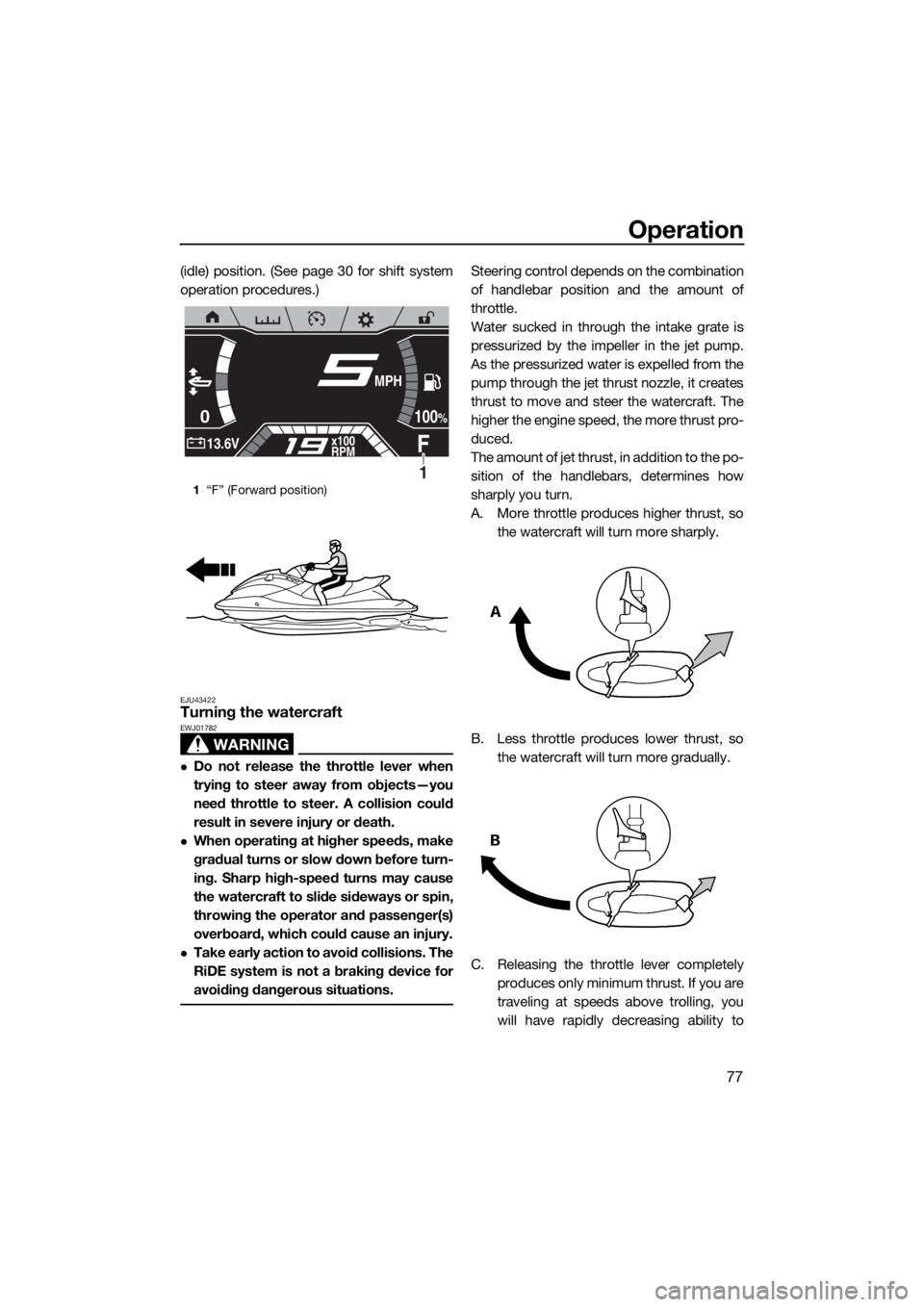
When the throttle lever is squeezed, the “F”
(forward) shift indicator will be displayed and
the watercraft will move forward. While the
“F” (forward) shift indicator is displayed, the
watercraft will move forward at trolling speed
even if the throttle lever is in the fully closed
1Clip
2Engine shut-off switch
3Engine shut-off cord (lanyard)
2
3
1
UF3X70E0.book Page 76 Friday, August 24, 2018 9:23 AM
Page 83 of 116
Operation
77
(idle) position. (See page 30 for shift system
operation procedures.)
EJU43422Turning the watercraft
WARNING
EWJ01782
Do not release the throttle lever when
trying to steer away from objects—you
need throttle to steer. A collision could
result in severe injury or death.
When operating at higher speeds, make
gradual turns or slow down before turn-
ing. Sharp high-speed turns may cause
the watercraft to slide sideways or spin,
throwing the operator and passenger(s)
overboard, which could cause an injury.
Take early action to avoid collisions. The
RiDE system is not a braking device for
avoiding dangerous situations.
Steering control depends on the combination
of handlebar position and the amount of
throttle.
Water sucked in through the intake grate is
pressurized by the impeller in the jet pump.
As the pressurized water is expelled from the
pump through the jet thrust nozzle, it creates
thrust to move and steer the watercraft. The
higher the engine speed, the more thrust pro-
duced.
The amount of jet thrust, in addition to the po-
sition of the handlebars, determines how
sharply you turn.
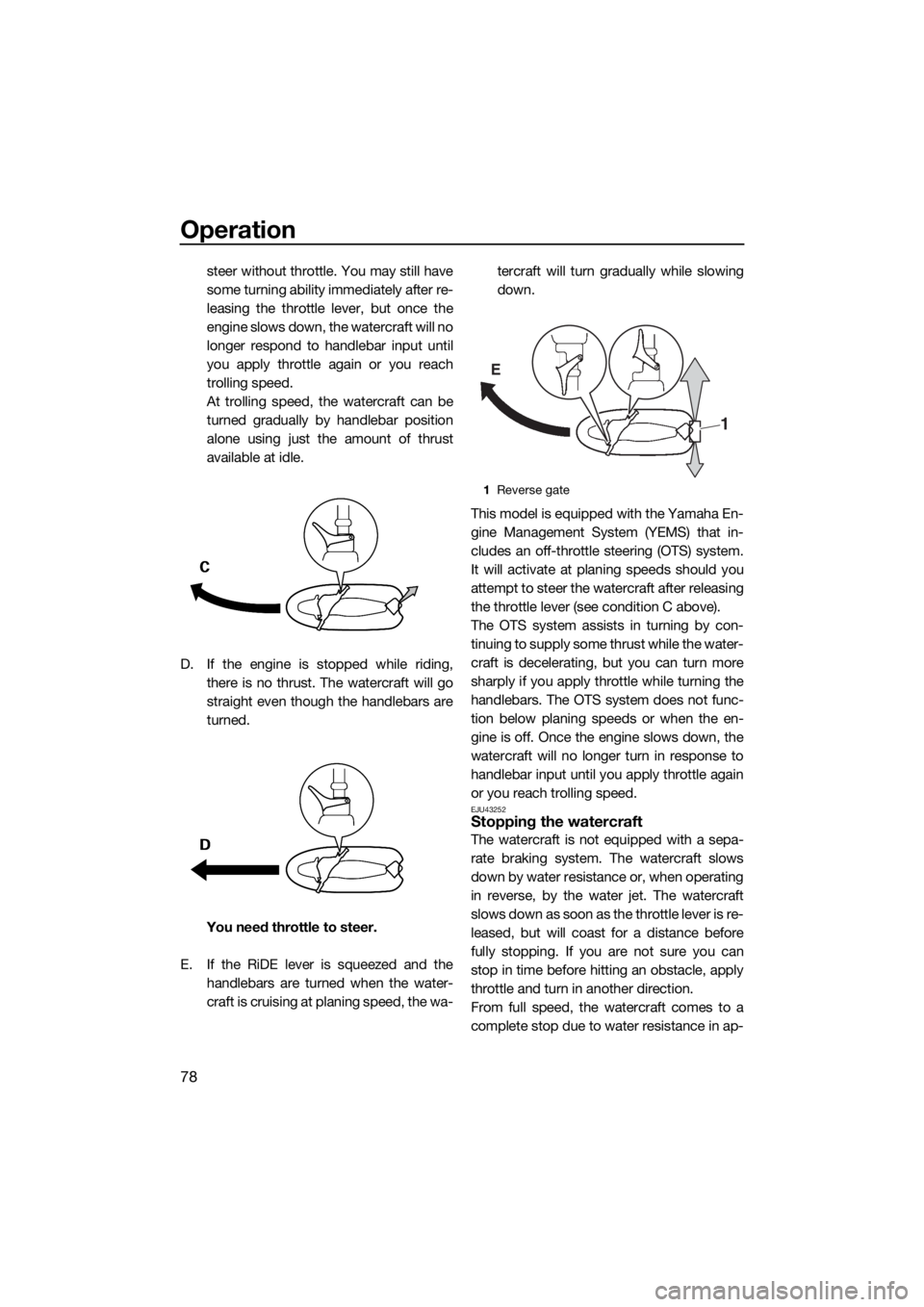
A. More throttle produces higher thrust, so
the watercraft will turn more sharply.
B. Less throttle produces lower thrust, so
the watercraft will turn more gradually.
C. Releasing the throttle lever completely
produces only minimum thrust. If you are
traveling at speeds above trolling, you
will have rapidly decreasing ability to
1“F” (Forward position)
0
F13.6Vx100
RPM
100%
MPH
1
UF3X70E0.book Page 77 Friday, August 24, 2018 9:23 AM
Page 84 of 116
Operation
78
steer without throttle. You may still have
some turning ability immediately after re-
leasing the throttle lever, but once the
engine slows down, the watercraft will no
longer respond to handlebar input until
you apply throttle again or you reach
trolling speed.
At trolling speed, the watercraft can be
turned gradually by handlebar position
alone using just the amount of thrust
available at idle.
D. If the engine is stopped while riding,
there is no thrust. The watercraft will go
straight even though the handlebars are
turned.
You need throttle to steer.
E. If the RiDE lever is squeezed and the
handlebars are turned when the water-
craft is cruising at planing speed, the wa-tercraft will turn gradually while slowing
down.
This model is equipped with the Yamaha En-
gine Management System (YEMS) that in-
cludes an off-throttle steering (OTS) system.
It will activate at planing speeds should you
attempt to steer the watercraft after releasing
the throttle lever (see condition C above).
The OTS system assists in turning by con-
tinuing to supply some thrust while the water-
craft is decelerating, but you can turn more
sharply if you apply throttle while turning the
handlebars. The OTS system does not func-
tion below planing speeds or when the en-
gine is off. Once the engine slows down, the
watercraft will no longer turn in response to
handlebar input until you apply throttle again
or you reach trolling speed.
EJU43252Stopping the watercraft
The watercraft is not equipped with a sepa-
rate braking system. The watercraft slows
down by water resistance or, when operating
in reverse, by the water jet. The watercraft
slows down as soon as the throttle lever is re-
leased, but will coast for a distance before
fully stopping. If you are not sure you can
stop in time before hitting an obstacle, apply
throttle and turn in another direction.
From full speed, the watercraft comes to a
complete stop due to water resistance in ap-
1Reverse gate
E
1
UF3X70E0.book Page 78 Friday, August 24, 2018 9:23 AM
Page 85 of 116
Operation
79
proximately 120 m (390 ft) after the throttle le-
ver is released or the engine is stopped,
although this distance will vary depending on
many factors, including gross weight, water
surface conditions, and wind direction.
If the RiDE lever is squeezed to slow down,
the stopping distance is approximately 30%
shorter than when the RiDE lever is not used.
However, this distance will vary depending
on many factors, including gross weight, wa-
ter surface conditions, and wind direction.
WARNING
EWJ01792
Allow adequate stopping distance.
Take early action to avoid collisions. Re-
member, watercraft and other boats do
not have brakes.
Operate defensively at safe speeds and
keep a safe distance away from people,
objects, and other watercraft to give you
time to stop.
Do not shut the engine off when slowing
down in case you need engine power to
steer away from a boat or other obstacle
that comes into your path.
To avoid rear-end collisions while oper-
ating the watercraft, check behind you
before using the RiDE lever to slow
down or stop the watercraft.
EJU43445Operating the watercraft in reverse or
neutral
Operating in reverse
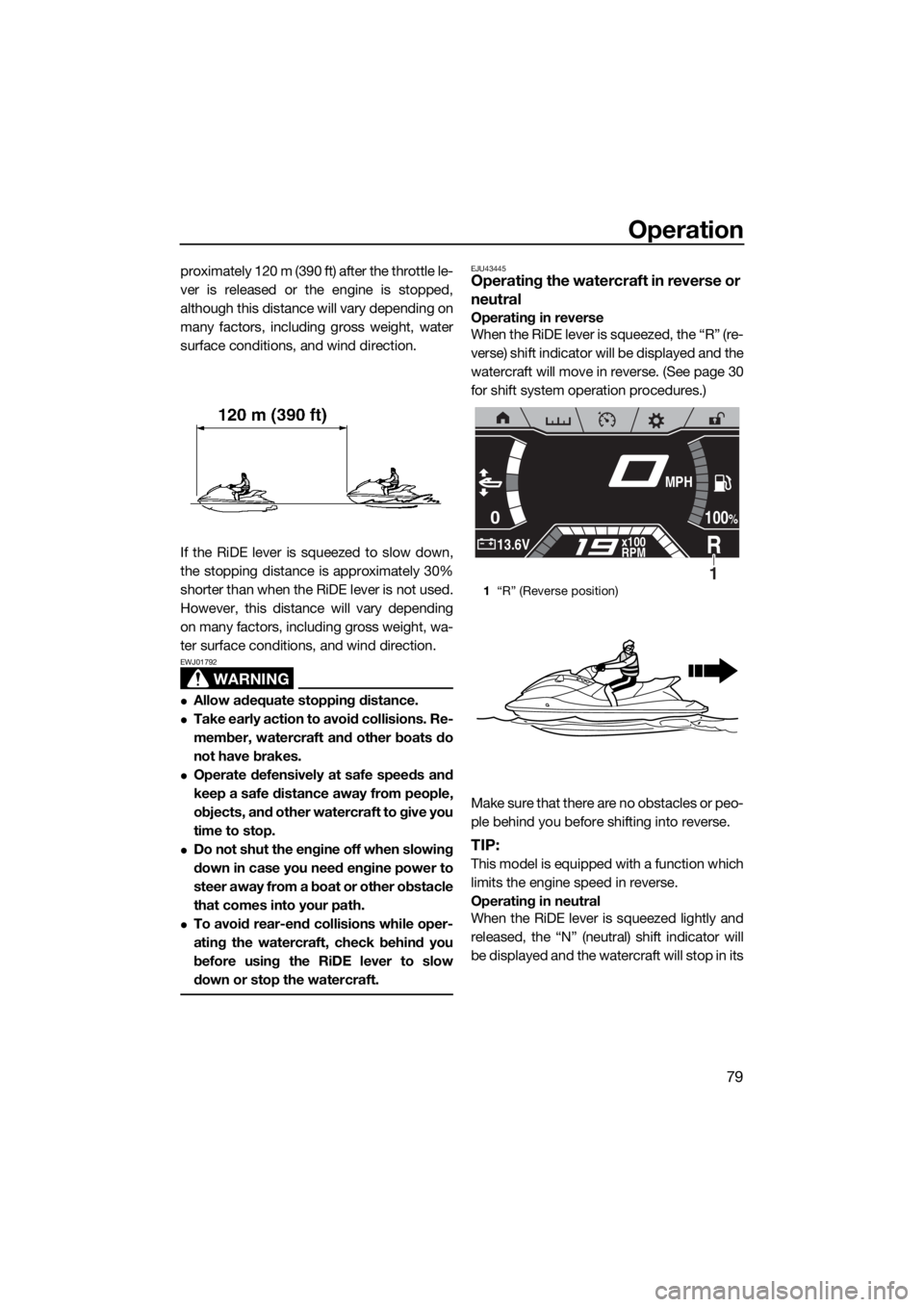
When the RiDE lever is squeezed, the “R” (re-
verse) shift indicator will be displayed and the
watercraft will move in reverse. (See page 30
for shift system operation procedures.)
Make sure that there are no obstacles or peo-
ple behind you before shifting into reverse.
TIP:
This model is equipped with a function which
limits the engine speed in reverse.
Operating in neutral
When the RiDE lever is squeezed lightly and
released, the “N” (neutral) shift indicator will
be displayed and the watercraft will stop in its
1“R” (Reverse position)
0
R13.6Vx100
RPM
100%
MPH
1
UF3X70E0.book Page 79 Friday, August 24, 2018 9:23 AM
Page 87 of 116
Operation
81
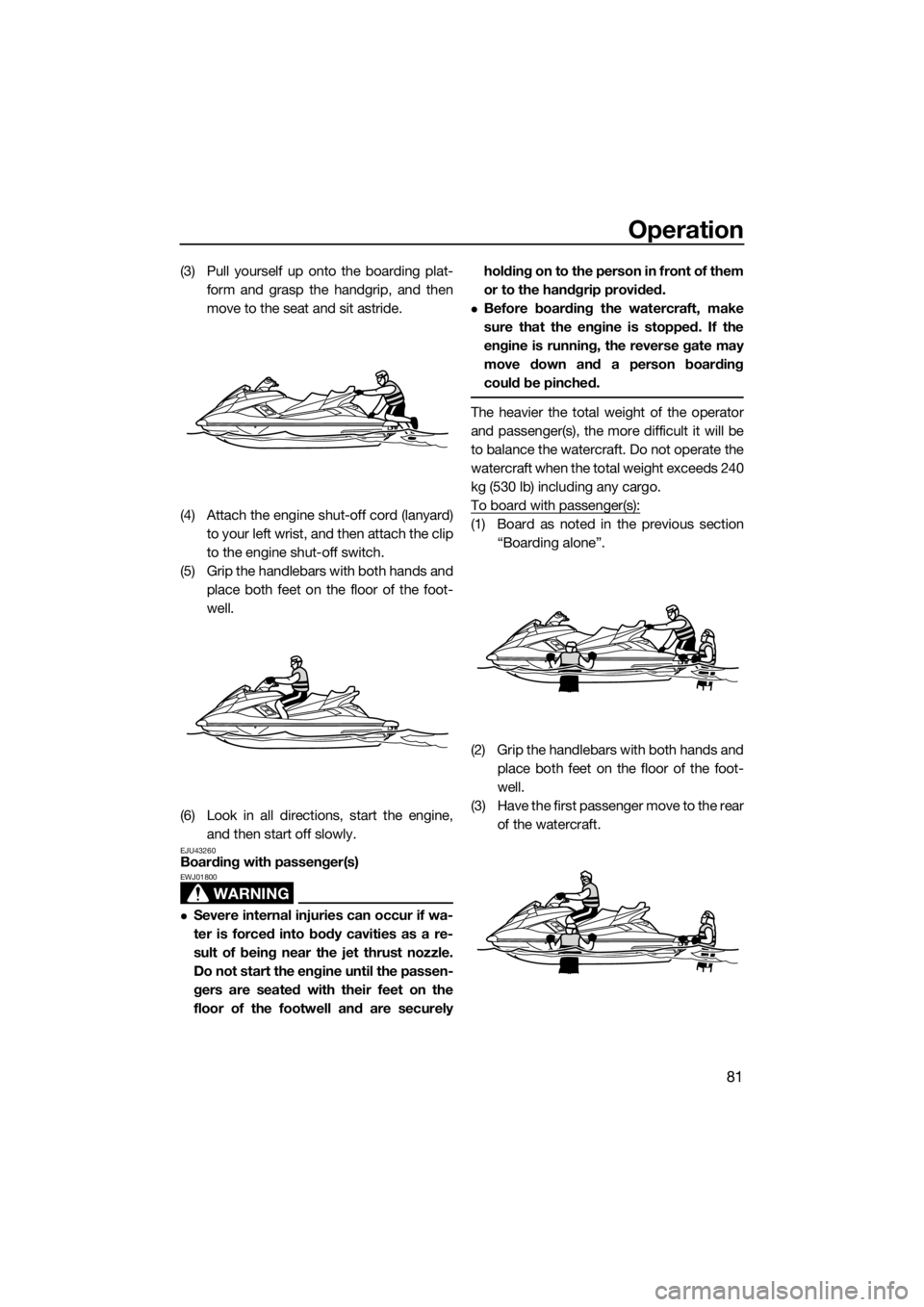
(3) Pull yourself up onto the boarding plat-
form and grasp the handgrip, and then
move to the seat and sit astride.
(4) Attach the engine shut-off cord (lanyard)
to your left wrist, and then attach the clip
to the engine shut-off switch.
(5) Grip the handlebars with both hands and
place both feet on the floor of the foot-
well.
(6) Look in all directions, start the engine,
and then start off slowly.
EJU43260Boarding with passenger(s)
WARNING
EWJ01800
Severe internal injuries can occur if wa-
ter is forced into body cavities as a re-
sult of being near the jet thrust nozzle.
Do not start the engine until the passen-
gers are seated with their feet on the
floor of the footwell and are securelyholding on to the person in front of them
or to the handgrip provided.
Before boarding the watercraft, make
sure that the engine is stopped. If the
engine is running, the reverse gate may
move down and a person boarding
could be pinched.
The heavier the total weight of the operator
and passenger(s), the more difficult it will be
to balance the watercraft. Do not operate the
watercraft when the total weight exceeds 240
kg (530 lb) including any cargo.
To board with passenger(s):
(1) Board as noted in the previous section
“Boarding alone”.
(2) Grip the handlebars with both hands and
place both feet on the floor of the foot-
well.
(3) Have the first passenger move to the rear
of the watercraft.
UF3X70E0.book Page 81 Friday, August 24, 2018 9:23 AM
Page 107 of 116
Trouble recovery
101
ler, jet pump housing, and jet thrust noz-
zle.
If debris is difficult to remove, consult a
Yamaha dealer.
EJU43472Raising the reverse gate
If the RiDE system malfunctions and the re-
verse gate remains in the lowered position,
the watercraft will not be able to move for-
ward.
After raising the reverse gate so that the wa-
tercraft can move forward, immediately re-
turn to shore and have a Yamaha dealer
service the watercraft.
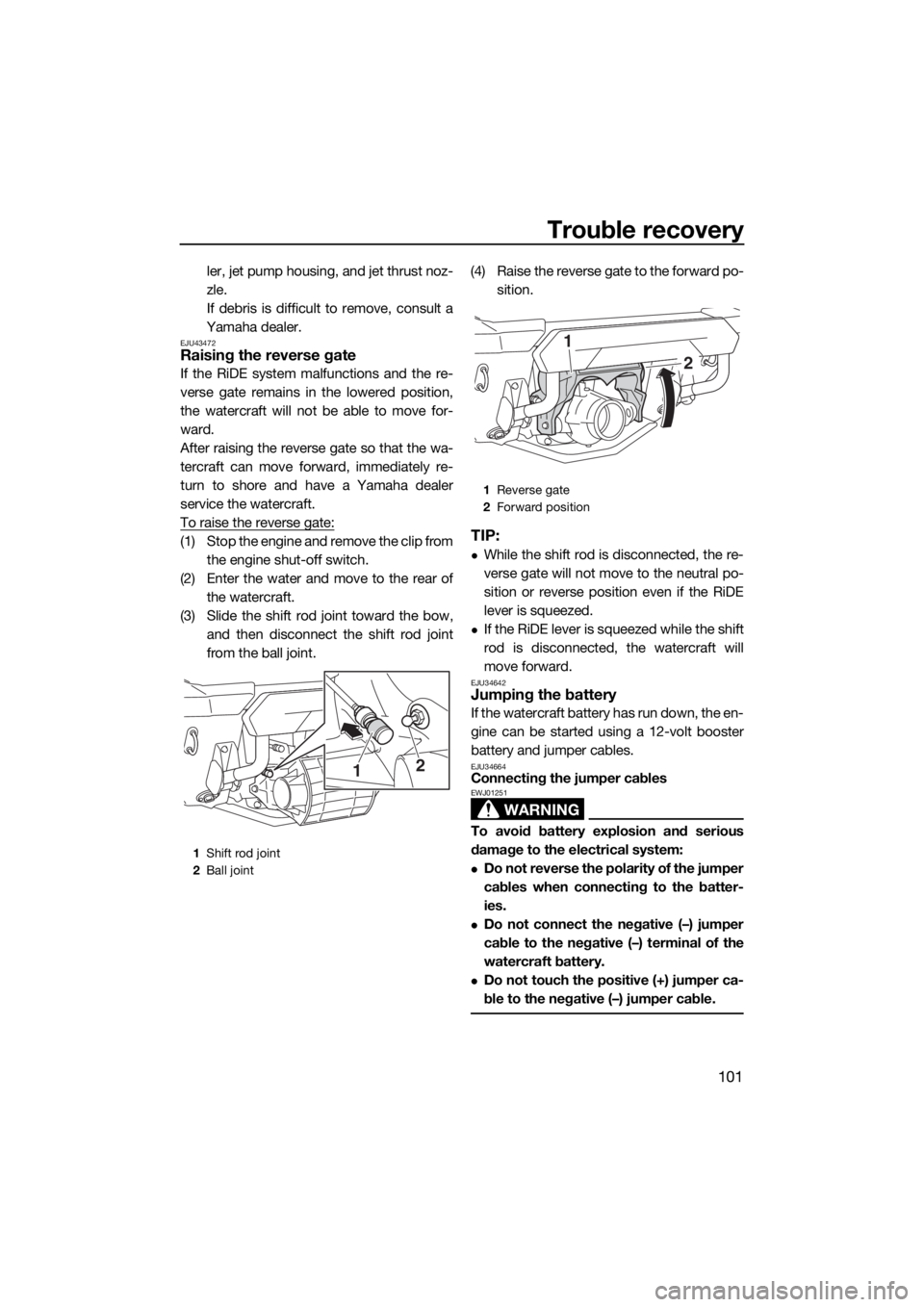
To raise the reverse gate:
(1) Stop the engine and remove the clip from
the engine shut-off switch.
(2) Enter the water and move to the rear of
the watercraft.
(3) Slide the shift rod joint toward the bow,
and then disconnect the shift rod joint
from the ball joint.(4) Raise the reverse gate to the forward po-
sition.TIP:
While the shift rod is disconnected, the re-
verse gate will not move to the neutral po-
sition or reverse position even if the RiDE
lever is squeezed.
If the RiDE lever is squeezed while the shift
rod is disconnected, the watercraft will
move forward.
EJU34642Jumping the battery
If the watercraft battery has run down, the en-
gine can be started using a 12-volt booster
battery and jumper cables.
EJU34664Connecting the jumper cables
WARNING
EWJ01251
To avoid battery explosion and serious
damage to the electrical system:
Do not reverse the polarity of the jumper
cables when connecting to the batter-
ies.
Do not connect the negative (–) jumper
cable to the negative (–) terminal of the
watercraft battery.
Do not touch the positive (+) jumper ca-
ble to the negative (–) jumper cable.
1Shift rod joint
2Ball joint
12
1Reverse gate
2Forward position
2
1
UF3X70E0.book Page 101 Friday, August 24, 2018 9:23 AM
Page 112 of 116

106
Index
A
Adjustable tilt steering system ................. 28
Adjustable tilt steering system checks .... 69
After removing the watercraft from the
water ..................................................... 85
B
Battery care.............................................. 87
Battery checks ......................................... 67
Battery, jumping ..................................... 101
Beaching and docking the watercraft ...... 84
Beverage holder ....................................... 55
Bilge water check..................................... 67
Bilge water, draining ................................ 60
Bilge water, draining on land ................... 60
Bilge water, draining on water ................. 61
Boarding alone ......................................... 80
Boarding and starting off from a dock ..... 83
Boarding the watercraft ........................... 80
Boarding with passenger(s) ..................... 81
Bow eye ................................................... 51
Bow storage compartment ...................... 52
Builder’s plate ............................................ 2
C
Capsized watercraft ................................. 83
Cleaning ................................................... 90
Cleaning the watercraft ............................ 87
Cleat ......................................................... 51
Cooling water pilot outlet check .............. 73
Cooling water pilot outlets ....................... 29
Craft Identification Number (CIN)............... 1
Cruise assist............................................. 38
Cruising limitations................................... 11
D
Drive control mode................................... 36
Drive control mode screen ....................... 44
E
Electric trim system.................................. 32
Electric trim system check ....................... 70
Emergency procedures .......................... 100
Engine break-in ........................................ 63
Engine compartment check ..................... 66
Engine cover, removing and installing ..... 91
Engine idling speed check ....................... 73
Engine lock screen ................................... 46
Engine oil ................................................. 59Engine oil and oil filter .............................. 95
Engine oil level check ............................... 67
Engine oil requirements ........................... 59
Engine serial number ................................. 1
Engine shut-off cord (lanyard) check ....... 70
Engine shut-off switch ............................. 26
Engine stop switch ................................... 26
Engine unit check ..................................... 67
Enjoy your watercraft responsibly ............ 19
Equipment ................................................ 49
F
Fire extinguisher check ............................ 71
Fire extinguisher holder and cover........... 56
Fire extinguisher holder, cover, and
band checks ......................................... 71
Flushing the cooling water passages....... 86
Fuel .......................................................... 57
Fuel level check........................................ 66
Fuel requirements .................................... 57
Fuel system checks ................................. 66
Fuses, replacing ..................................... 102
G
Getting to know your watercraft .............. 74
Glossary, watercraft ................................. 20
Glove compartment ................................. 53
H
Handgrip .................................................. 50
Hazard information................................... 15
Home screen ............................................ 42
Hood check .............................................. 72
Hull and deck check ................................ 71
I
Identification numbers ............................... 1
Information screen ................................... 43
J
Jet intake and impeller, cleaning............ 100
Jet intake checks ..................................... 71
Jet thrust nozzle and reverse gate
check .................................................... 71
Jumper cables, connecting .................... 101
L
Labels, important ....................................... 4
Labels, other .............................................. 8
Labels, warning .......................................... 5
Launching the watercraft ......................... 75
UF3X70E0.book Page 106 Friday, August 24, 2018 9:23 AM
Page 113 of 116

Index
107
Learning to operate your watercraft ........ 74
Leaving the watercraft ............................. 76
Limitations on who may operate the
watercraft.............................................. 10
Long-term storage ................................... 90
Lubrication ............................................... 90
M
Main components, location of ................. 21
Maintenance ............................................ 91
Manufactured date label ............................ 2
Model information ...................................... 2
Multifunction information center .............. 40
Multifunction information center check ... 73
N
No-wake mode ........................................ 35
O
Operating in weeded areas ...................... 84
Operating the watercraft .......................... 76
Operating the watercraft in reverse or
neutral ................................................... 79
Operating your watercraft ........................ 74
Operation buttons .................................... 41
Operation requirements ........................... 12
Optional part mounting bracket ............... 56
P
Periodic maintenance chart ..................... 93
Post-launch checks ................................. 72
Post-operation care ................................. 86
Pre-launch checks ................................... 66
Pre-operation check points ..................... 66
Pre-operation checklist ............................ 64
Primary Identification (PRI-ID) number ...... 1
Pull-up cleats (FX Cruiser SVHO /
FX Limited SVHO) ................................. 52
R
Raising the reverse gate ........................ 101
Reboarding grip ....................................... 50
Reboarding step ...................................... 50
Recommended equipment ...................... 14
Removable watertight storage
compartment ........................................ 55
Reverse assist .......................................... 34
RiDE lever................................................. 27
RiDE lever checks .................................... 69
Riding position ......................................... 75Rustproofing ............................................ 90
S
Safe boating rules .................................... 18
Safety equipment check .......................... 71
Seats ........................................................ 49
Setting menu screen ................................ 44
Shift system ............................................. 30
Shift system check ................................... 73
Start switch .............................................. 26
Starting off ............................................... 82
Starting off from a trailer .......................... 83
Starting the engine on water .................... 75
Status area ............................................... 42
Steering system ....................................... 27
Steering system checks ........................... 68
Stern drain plug checks ........................... 72
Stern eyes ................................................ 51
Stern storage compartment ..................... 54
Stopping the engine ................................. 76
Stopping the watercraft ........................... 78
Storage compartment checks.................. 71
Storage compartments ............................ 52
Submerged watercraft ........................... 104
Switch checks .......................................... 70
T
T.D.E. (thrust directional enhancer) .......... 34
Throttle lever ............................................ 27
Throttle lever checks ................................ 69
Tool kit ..................................................... 91
Touch screen ........................................... 41
Towing the watercraft ............................ 104
Transporting on a trailer ........................... 62
Troubleshooting ....................................... 97
Troubleshooting chart .............................. 97
Turning the watercraft .............................. 77
W
Wakeboarding and water-skiing .............. 17
Warning function ...................................... 46
Water separator ....................................... 29
Water separator check ............................. 67
Watercraft characteristics ........................ 15
Watercraft control functions..................... 25
Watercraft operation functions ................ 30
Watercraft operation modes .................... 34
UF3X70E0.book Page 107 Friday, August 24, 2018 9:23 AM