engine YAMAHA GRIZZLY 125 2013 Owner's Manual
[x] Cancel search | Manufacturer: YAMAHA, Model Year: 2013, Model line: GRIZZLY 125, Model: YAMAHA GRIZZLY 125 2013Pages: 134, PDF Size: 3.93 MB
Page 42 of 134
6-1
6
EBU19881
OPERATION
EBU19901Read the Owner’s Manual carefully before riding
the ATV. If there is a control or function you do not
understand, ask your Yamaha dealer.
WARNING
EWB00631Read the Owner’s Manual carefully to become
familiar with all controls in order to help pre-
vent any loss of control, which could cause an
accident or injury.EBU20034Starting a cold engine NOTICEECB00150See the “Engine break-in” section on page 6-4
prior to operating the engine for the first time.1. Set the parking brake.
2. Turn the fuel cock to “ON”.
3. Turn the key to “ON” and the engine stopswitch to “ ”. 4. Shift the drive select lever into the neutral po-
sition. The neutral indicator light should come
on. If the indicator light does not come on,
have a Yamaha dealer check the electrical cir-
cuit.
TIPThe engine can be started under the following con-
ditions:●The drive select lever is in the neutral position.●The rear brake lever is applied with the drive se-
lect lever in any position. However, it is recom-
mended to shift into the neutral position before
starting the engine.5. Use the starter (choke) in reference to the fig-ure:
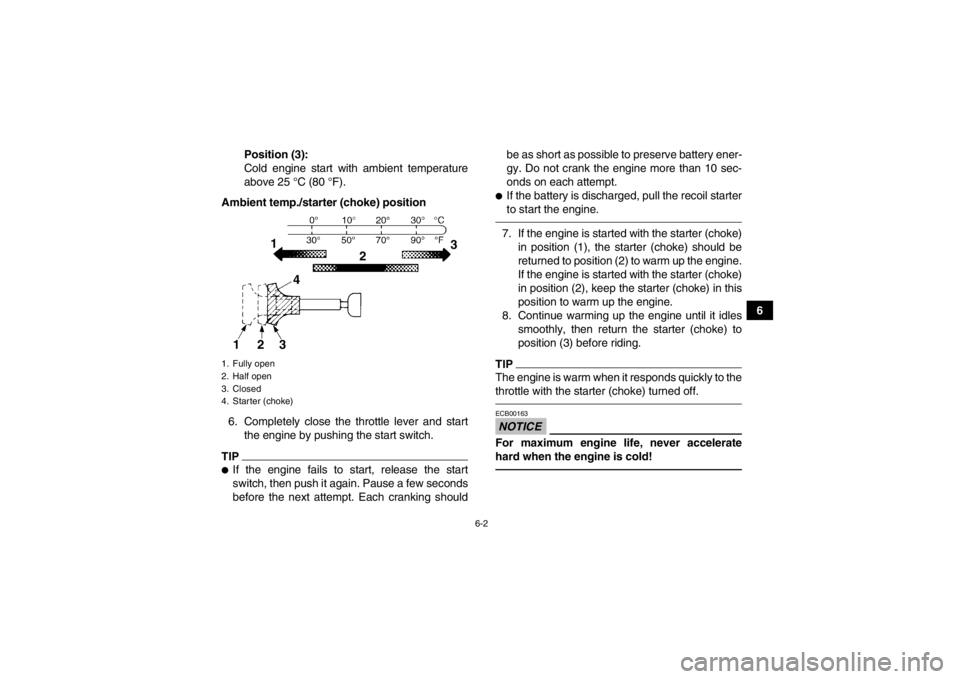
Position (1):
Cold engine start with ambient temperature
below 5 °C (40 °F).
Position (2):
Cold engine start with ambient temperature
between 0 °C (30 °F) and 30 °C (90 °F).
U1PY61E0.book Page 1 Wednesday, March 14, 2012 5:22 PM
Page 43 of 134
6-2
6
Position (3):
Cold engine start with ambient temperature
above 25 °C (80 °F).
Ambient temp./starter (choke) position
6. Completely close the throttle lever and start the engine by pushing the start switch.
TIP●If the engine fails to start, release the start
switch, then push it again. Pause a few seconds
before the next attempt. Each cranking should be as short as possible to preserve battery ener-
gy. Do not crank the engine more than 10 sec-
onds on each attempt.
●If the battery is discharged, pull the recoil starter
to start the engine.7. If the engine is started with the starter (choke)
in position (1), the starter (choke) should be
returned to position (2) to warm up the engine.
If the engine is started with the starter (choke)
in position (2), keep the starter (choke) in this
position to warm up the engine.
8. Continue warming up the engine until it idles smoothly, then return the starter (choke) to
position (3) before riding.TIPThe engine is warm when it responds quickly to the
throttle with the starter (choke) turned off.NOTICEECB00163For maximum engine life, never accelerate
hard when the engine is cold!
1. Fully open
2. Half open
3. Closed
4. Starter (choke)
1 2 3
123 4
U1PY61E0.book Page 2 Wednesday, March 14, 2012 5:22 PM
Page 44 of 134
6-3
6
EBU20291Starting a warm engine Follow the same procedure as for starting a cold
engine, with the exception that the starter (choke)
is not required when the engine is warm. Instead,
start the engine with the throttle slightly open.EBU20361Operating the drive select lever and
driving in reverse NOTICEECB00170Before shifting, stop the ATV, otherwise the
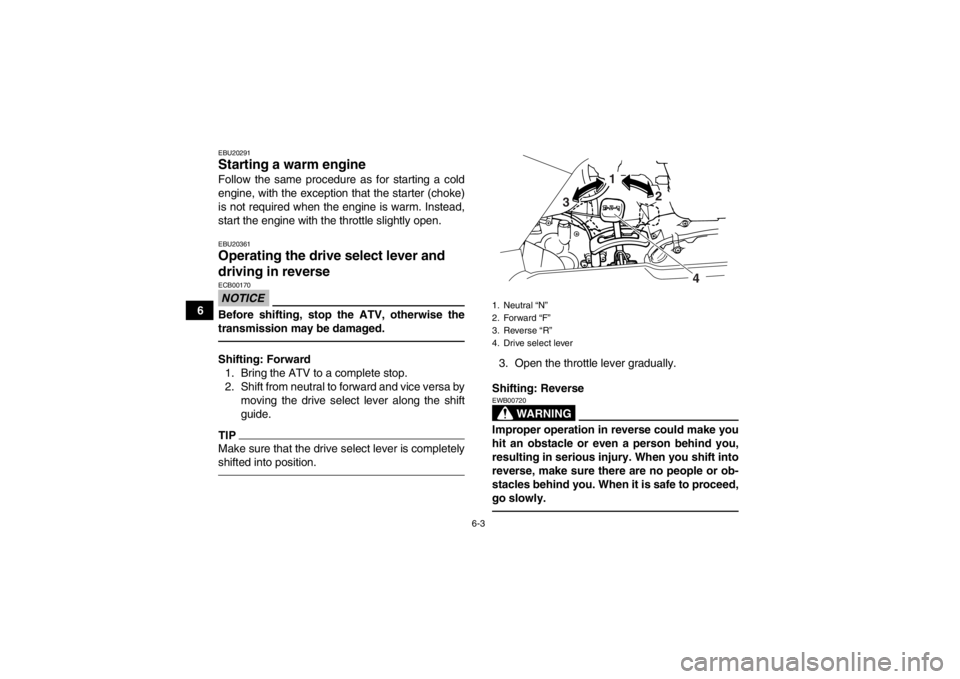
transmission may be damaged.Shifting: Forward1. Bring the ATV to a complete stop.
2. Shift from neutral to forward and vice versa by moving the drive select lever along the shift
guide.TIPMake sure that the drive select lever is completely
shifted into position.
3. Open the throttle lever gradually.
Shifting: Reverse
WARNING
EWB00720Improper operation in reverse could make you
hit an obstacle or even a person behind you,
resulting in serious injury. When you shift into
reverse, make sure there are no people or ob-
stacles behind you. When it is safe to proceed,
go slowly.1. Neutral “N”
2. Forward “F”
3. Reverse “R”
4. Drive select lever
1 2
3
4
U1PY61E0.book Page 3 Wednesday, March 14, 2012 5:22 PM
Page 45 of 134
6-4
6
1. Bring the ATV to a complete stop.
2. Apply the parking brake.
3. Shift from neutral to reverse and vice versa by
moving the drive select lever along the shift
guide.
TIPWhen in reverse, the reverse indicator light should
come on. If the indicator light does not come on,
have a Yamaha dealer check the electrical circuit.4. Check behind for people or obstacles, andthen release the parking brake.
5. Open the throttle lever gradually and continue to watch to the rear while backing.TIPIf the drive select lever is shifted into reverse while
the engine is running, the engine will stop unless
the rear brake lever or parking brake is applied.EBU20682Engine break-in TIP●For ATVs equipped with an odometer or an hour
meter, follow the figures given in km (mi) or the
figures given in hours.
●For ATVs not equipped with an odometer or
hour meter, follow the figures given in hours.There is never a more important period in the life of
your engine than the first 320 km (200 mi) or 20
hours of riding. For this reason, you should read
the following material carefully.
Since the engine is brand new, do not put an ex-
cessive load on it for the first 320 km (200 mi) or 20
hours. The various parts in the engine wear and
polish themselves to the correct operating clear-
ances. During this period, prolonged full-throttle
operation or any condition that might result in en-
gine overheating must be avoided.
0–160 km (0–100 mi) or 0–10 hours
Avoid prolonged operation above 1/2 throttle. Vary
the speed of the ATV regularly. Do not operate it at
one set throttle position.
160–320 km (100–200 mi) or 10–20 hours
Avoid prolonged operation above 3/4 throttle. Rev
the engine freely, but do not use full throttle at any
time.
320 km (200 mi) or 20 hours and beyond
The ATV can now be operated normally.
U1PY61E0.book Page 4 Wednesday, March 14, 2012 5:22 PM
Page 46 of 134
6-5
6
NOTICEECB00220If any engine trouble should occur during the
engine break-in period, immediately have a
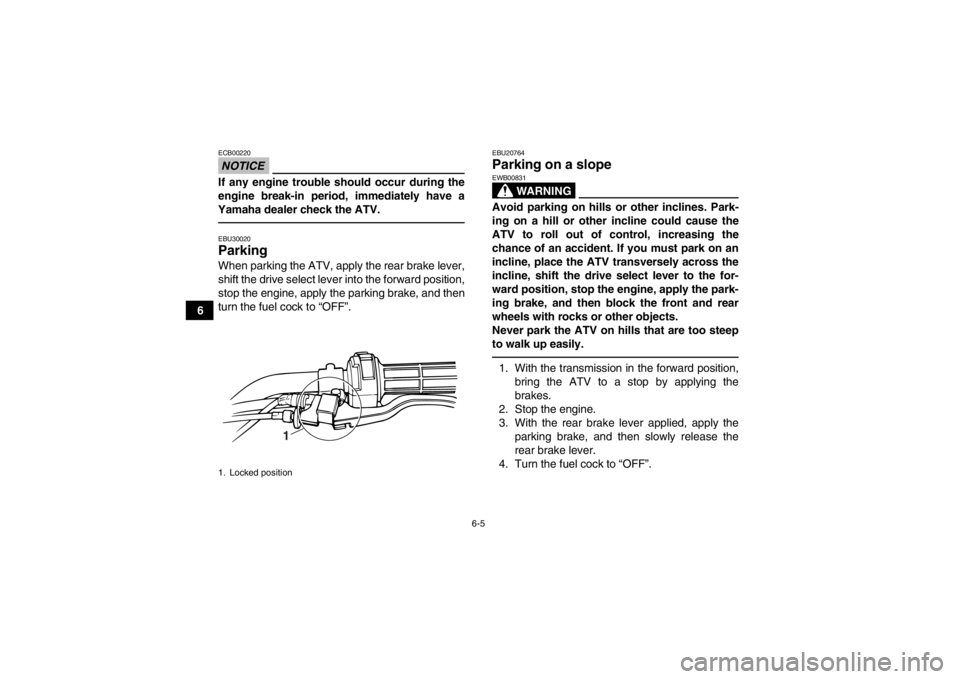
Yamaha dealer check the ATV.EBU30020Parking When parking the ATV, apply the rear brake lever,
shift the drive select lever into the forward position,
stop the engine, apply the parking brake, and then
turn the fuel cock to “OFF”.
EBU20764Parking on a slope
WARNING
EWB00831Avoid parking on hills or other inclines. Park-
ing on a hill or other incline could cause the
ATV to roll out of control, increasing the
chance of an accident. If you must park on an
incline, place the ATV transversely across the
incline, shift the drive select lever to the for-
ward position, stop the engine, apply the park-
ing brake, and then block the front and rear
wheels with rocks or other objects.
Never park the ATV on hills that are too steep
to walk up easily.1. With the transmission in the forward position, bring the ATV to a stop by applying the
brakes.
2. Stop the engine.
3. With the rear brake lever applied, apply the parking brake, and then slowly release the
rear brake lever.
4. Turn the fuel cock to “OFF”.
1. Locked position
1
U1PY61E0.book Page 5 Wednesday, March 14, 2012 5:22 PM
Page 52 of 134
7-3
7Riding your ATV requires skills acquired
through practice over a period of time.
Do not attempt to operate at maximum perfor-
mance until you are totally familiar with the ATV’s
handling and performance characteristics. Take
the time to learn the basic techniques well before
attempting more difficult maneuvers. Become fa-
miliar with this ATV at slow speeds first, even if you
are an experienced operator.
Not recommended for children under 16 years
of age.
WARNING
EWB01390A child under 16 should never operate an ATV
with engine size greater than 90 cc. Use by chil-
dren of ATVs that are not recommended for
their age can lead to severe injury or death of
the child.
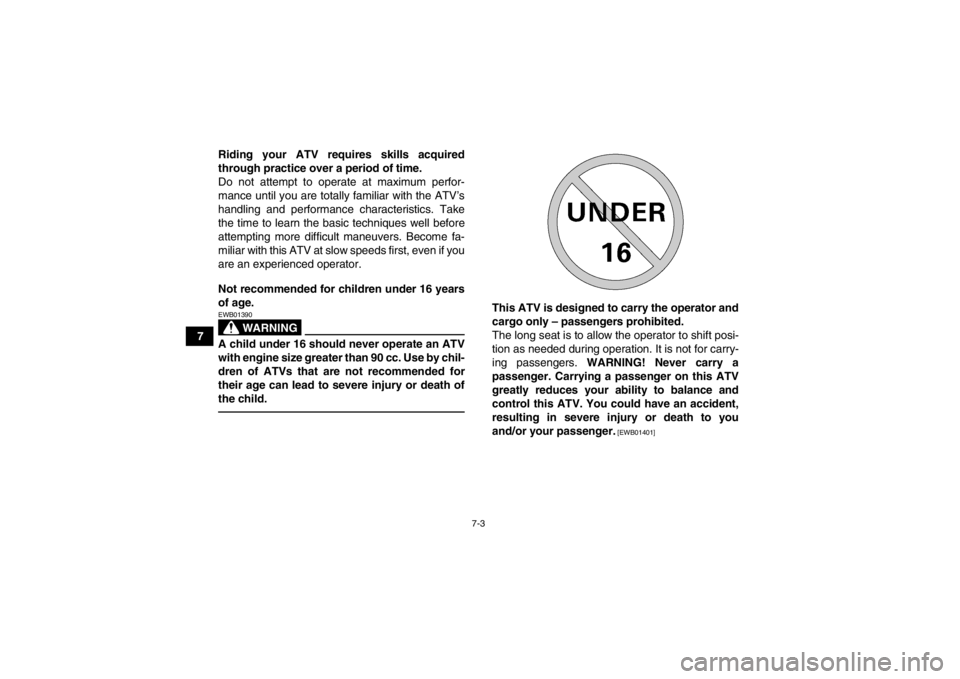
This ATV is designed to carry the operator and
cargo only – passengers prohibited.
The long seat is to allow the operator to shift posi-
tion as needed during operation. It is not for carry-
ing passengers.
WARNING! Never carry a
passenger. Carrying a passenger on this ATV
greatly reduces your ability to balance and
control this ATV. You could have an accident,
resulting in severe injury or death to you
and/or your passenger.
[EWB01401]
U1PY61E0.book Page 3 Wednesday, March 14, 2012 5:22 PM
Page 55 of 134
7-6
7
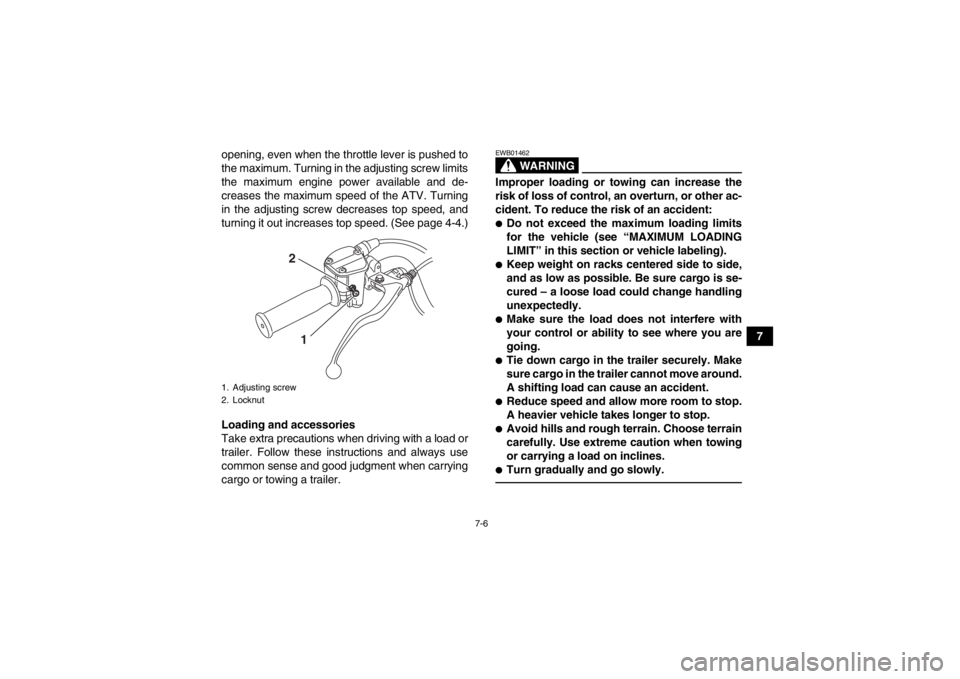
opening, even when the throttle lever is pushed to
the maximum. Turning in the adjusting screw limits
the maximum engine power available and de-
creases the maximum speed of the ATV. Turning
in the adjusting screw decreases top speed, and
turning it out increases top speed. (See page 4-4.)
Loading and accessories
Take extra precautions when driving with a load or
trailer. Follow these instructions and always use
common sense and good judgment when carrying
cargo or towing a trailer.
WARNING
EWB01462Improper loading or towing can increase the
risk of loss of control, an overturn, or other ac-
cident. To reduce the risk of an accident:●Do not exceed the maximum loading limits
for the vehicle (see “MAXIMUM LOADING
LIMIT” in this section or vehicle labeling).●Keep weight on racks centered side to side,
and as low as possible. Be sure cargo is se-
cured – a loose load could change handling
unexpectedly.●Make sure the load does not interfere with
your control or ability to see where you are
going.●Tie down cargo in the trailer securely. Make
sure cargo in the trailer cannot move around.
A shifting load can cause an accident.●Reduce speed and allow more room to stop.
A heavier vehicle takes longer to stop.●Avoid hills and rough terrain. Choose terrain
carefully. Use extreme caution when towing
or carrying a load on inclines.●Turn gradually and go slowly.
1. Adjusting screw
2. Locknut
2
1
U1PY61E0.book Page 6 Wednesday, March 14, 2012 5:22 PM
Page 57 of 134
7-8
7
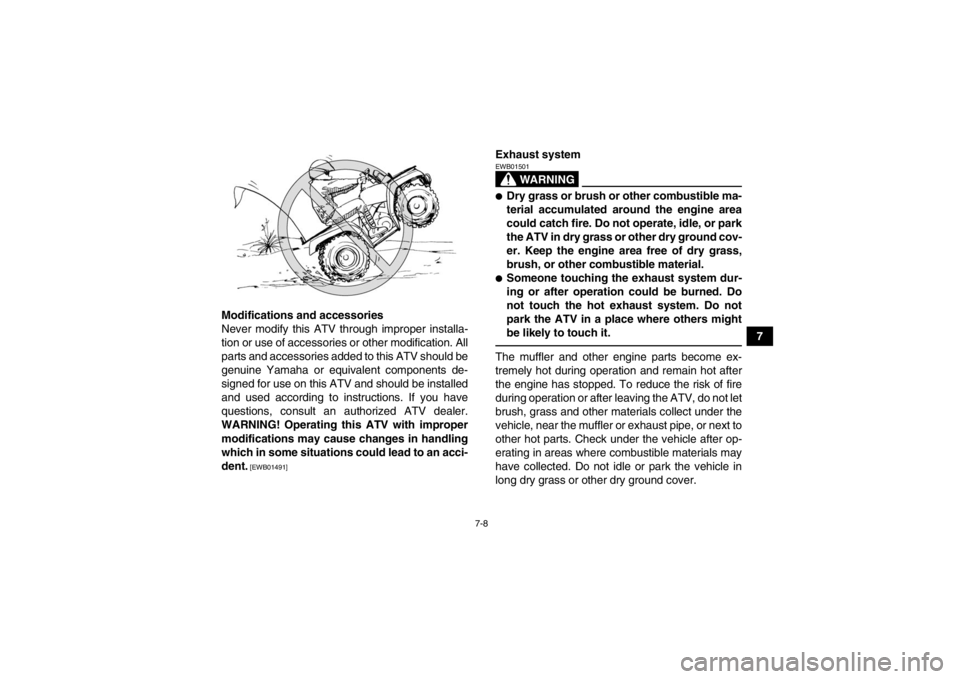
Modifications and accessories
Never modify this ATV through improper installa-
tion or use of accessories or other modification. All
parts and accessories added to this ATV should be
genuine Yamaha or equivalent components de-
signed for use on this ATV and should be installed
and used according to instructions. If you have
questions, consult an authorized ATV dealer.
WARNING! Operating this ATV with improper modifications may cause changes in handling
which in some situations could lead to an acci-
dent.
[EWB01491]
Exhaust system
WARNING
EWB01501●Dry grass or brush or other combustible ma-
terial accumulated around the engine area
could catch fire. Do not operate, idle, or park
the ATV in dry grass or other dry ground cov-
er. Keep the engine area free of dry grass,
brush, or other combustible material.●Someone touching the exhaust system dur-
ing or after operation could be burned. Do
not touch the hot exhaust system. Do not
park the ATV in a place where others might
be likely to touch it.The muffler and other engine parts become ex-
tremely hot during operation and remain hot after
the engine has stopped. To reduce the risk of fire
during operation or after leaving the ATV, do not let
brush, grass and other materials collect under the
vehicle, near the muffler or exhaust pipe, or next to
other hot parts. Check under the vehicle after op-
erating in areas where combustible materials may
have collected. Do not idle or park the vehicle in
long dry grass or other dry ground cover.
U1PY61E0.book Page 8 Wednesday, March 14, 2012 5:22 PM
Page 61 of 134
7-12
7
Select a large, flat, unpaved area to become famil-
iar with your ATV. Make sure that this area is free
of obstacles and other riders. You should practice
control of the throttle, brakes, shifting procedures,
and turning techniques in this area before trying
more difficult terrain.
Set the parking brake and follow the instruction on
page 6-1 to start the engine. Once it has warmed
up you are ready to begin riding your ATV. With the
engine idling, return the starter knob to the closed
position and shift the drive select lever into the for-
ward position, then release the parking brake. Ap-
ply the throttle slowly and smoothly.
The centrifugal clutch will engage and you will start
to accelerate. If the throttle is applied too abruptly,
the front wheels may lift off the ground, resulting in a loss of directional control. Avoid higher speeds
until you are thoroughly familiar with the operation
of your ATV.
When slowing down or stopping, release the throt-
tle and apply the brakes smoothly and evenly. Im-
proper use of the brakes can cause the tires to lose
traction, reducing control and increasing the possi-
bility of an accident.
TURNING YOUR ATV
WARNING
EWB01771Always follow proper procedures for turning
as described in this Owner’s Manual. Practice
turning at low speeds before attempting to turn
at faster speeds. Do not turn at speeds too fast
for your skills or the conditions. ATV could go
out of control, causing a collision or overturn.To achieve maximum traction on unpaved surfac-
es, the two rear wheels turn together at the same
speed. Therefore, unless the wheel on the inside
of the turn is allowed to slip or lose some traction,
the ATV will resist turning. A special turning tech-
nique must be used to allow the ATV to make turns
quickly and easily. It is essential that this skill be
learned first at low speed.
U1PY61E0.book Page 12 Wednesday, March 14, 2012 5:22 PM
Page 66 of 134

7-17
7When riding your ATV downhill, shift your weight
as far to the rear and uphill side of the ATV as pos-
sible. Move back on the seat and sit with your arms
straight. Engine compression will do most of the
braking for you.
Use caution while descending a hill with loose or
slippery surfaces. Braking ability and traction may
be adversely affected by these surfaces. Improper
braking may also cause a loss of traction. Gradual-
ly apply only the rear brake.
Whenever possible, ride your ATV straight down-
hill. Avoid sharp angles which could allow the ATV
to tip or roll over. Carefully choose your path and
ride no faster than you will be able to react to ob-
stacles which may appear.
CROSSING A SLOPE
WARNING
EWB01632Improperly crossing hills or turning on hills
could cause loss of control or cause the ATV to
overturn.●Always follow proper procedures as de-
scribed in the Owner’s Manual.●Avoid hills with excessively slippery or loose
surfaces.●Avoid crossing the side of a steep hill.
U1PY61E0.book Page 17 Wednesday, March 14, 2012 5:22 PM