check YAMAHA GRIZZLY 700 2017 Repair Manual
[x] Cancel search | Manufacturer: YAMAHA, Model Year: 2017, Model line: GRIZZLY 700, Model: YAMAHA GRIZZLY 700 2017Pages: 174, PDF Size: 4.45 MB
Page 149 of 174
8-53
8
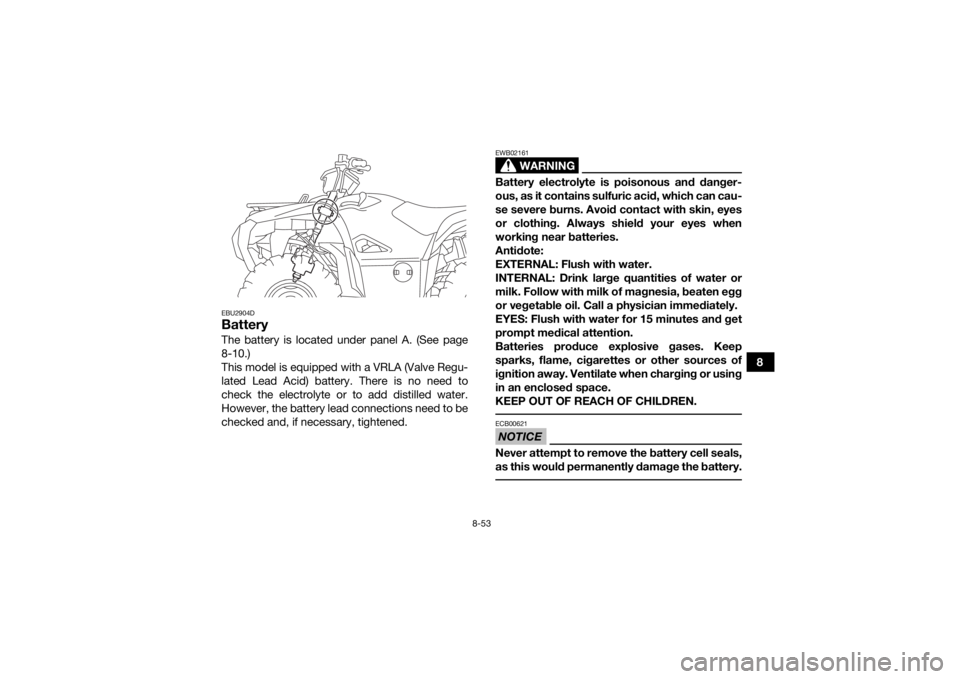
EBU2904DBatteryThe battery is located under panel A. (See page
8-10.)
This model is equipped with a VRLA (Valve Regu-
lated Lead Acid) battery. There is no need to
check the electrolyte or to add distilled water.
However, the battery lead connections need to be
checked and, if necessary, tightened.
WARNING
EWB02161Battery electrolyte is poisonous and danger-
ous, as it contains sulfuric acid, which can cau-
se severe burns. Avoid contact with skin, eyes
or clothing. Always shield your eyes when
working near batteries.
Antidote:
EXTERNAL: Flush with water.
INTERNAL: Drink large quantities of water or
milk. Follow with milk of magnesia, beaten egg
or vegetable oil. Call a physician immediately.
EYES: Flush with water for 15 minutes and get
prompt medical attention.
Batteries produce explosive gases. Keep
sparks, flame, cigarettes or other sources of
ignition away. Ventilate when charging or using
in an enclosed space.
KEEP OUT OF REACH OF CHILDREN. NOTICEECB00621Never attempt to remove the battery cell seals,
as this would permanently damage the battery.
U2UD61E0.book Page 53 Monday, April 25, 2016 10:55 AM
Page 151 of 174
8-55
8
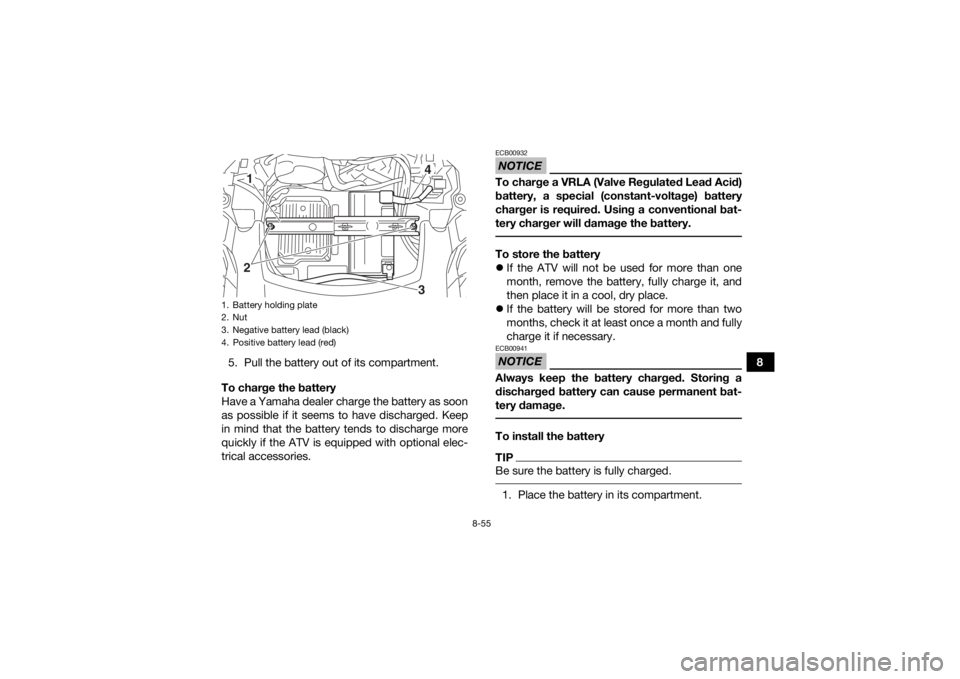
5. Pull the battery out of its compartment.
To charge the battery
Have a Yamaha dealer charge the battery as soon
as possible if it seems to have discharged. Keep
in mind that the battery tends to discharge more
quickly if the ATV is equipped with optional elec-
trical accessories.
NOTICEECB00932To charge a VRLA (Valve Regulated Lead Acid)
battery, a special (constant-voltage) battery
charger is required. Using a conventional bat-
tery charger will damage the battery. To store the battery
If the ATV will not be used for more than one
month, remove the battery, fully charge it, and
then place it in a cool, dry place.
If the battery will be stored for more than two
months, check it at least once a month and fully
charge it if necessary.NOTICEECB00941Always keep the battery charged. Storing a
discharged battery can cause permanent bat-
tery damage. To install the batteryTIPBe sure the battery is fully charged. 1. Place the battery in its compartment.
1. Battery holding plate
2. Nut
3. Negative battery lead (black)
4. Positive battery lead (red)
12
43
U2UD61E0.book Page 55 Monday, April 25, 2016 10:55 AM
Page 154 of 174
8-58
8
NOTICEECB00641To prevent accidental short-circuiting, turn off
the main switch when checking or replacing a
fuse. 2. Remove the blown fuse, and then install anew fuse of the specified amperage.
WARNING! Always use a fuse of the spec-
ified rating, and never use a substitute ob-
ject in place of the proper fuse. An
improper fuse or a substitute object can
cause damage to the electrical system,
which could lead to a fire.
[EWB02173]
3. Turn the key to “ ” (on) and turn on the elec-trical circuits to check if the devices operate.
4. If the fuse immediately blows again, have a Yamaha dealer check the electrical system.
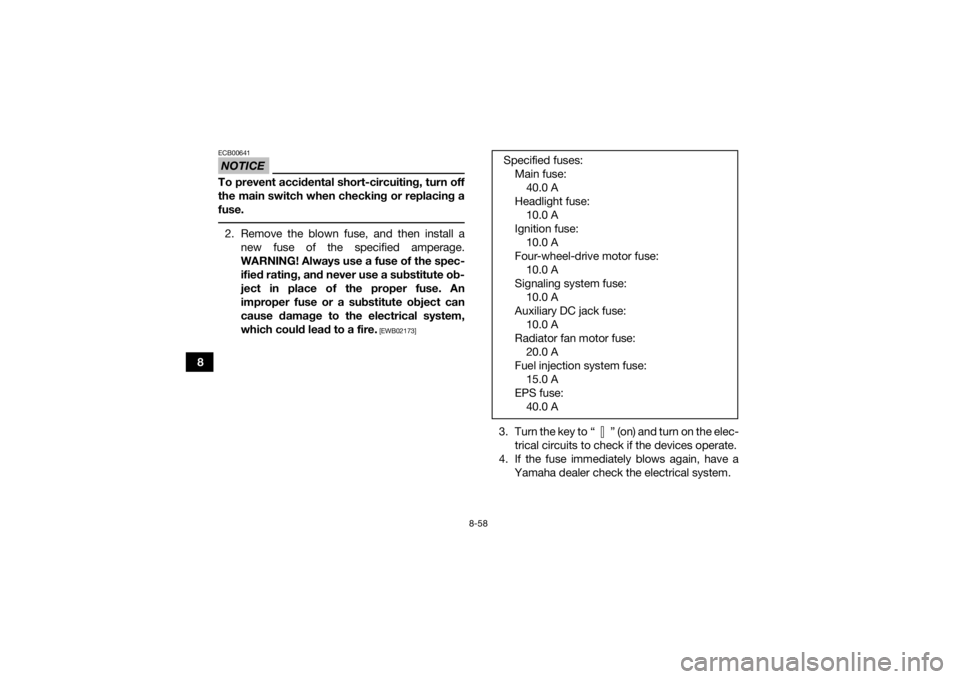
Specified fuses:
Main fuse:40.0 A
Headlight fuse: 10.0 A
Ignition fuse: 10.0 A
Four-wheel-drive motor fuse: 10.0 A
Signaling system fuse: 10.0 A
Auxiliary DC jack fuse: 10.0 A
Radiator fan motor fuse: 20.0 A
Fuel injection system fuse: 15.0 A
EPS fuse: 40.0 A
U2UD61E0.book Page 58 Monday, April 25, 2016 10:55 AM
Page 156 of 174
8-60
84. Remove the burnt-out bulb.
5. Place a new headlight bulb into position.
NOTICE: Do not touch the glass part of the
headlight bulb to keep it free from oil, oth-
erwise the transparency of the glass, the
luminosity of the bulb, and the bulb life will
be adversely affected. Thoroughly clean
off any dirt and fingerprints on the head-
light bulb using a cloth moistened with al-
cohol or thinner.
[ECB00652]
6. Install the socket by pushing it in and turning it clockwise. 7. Install the bulb cover.
NOTICE: Make sure
the bulb cover is securely fitted over the
socket and seated properly.
[ECB03320]
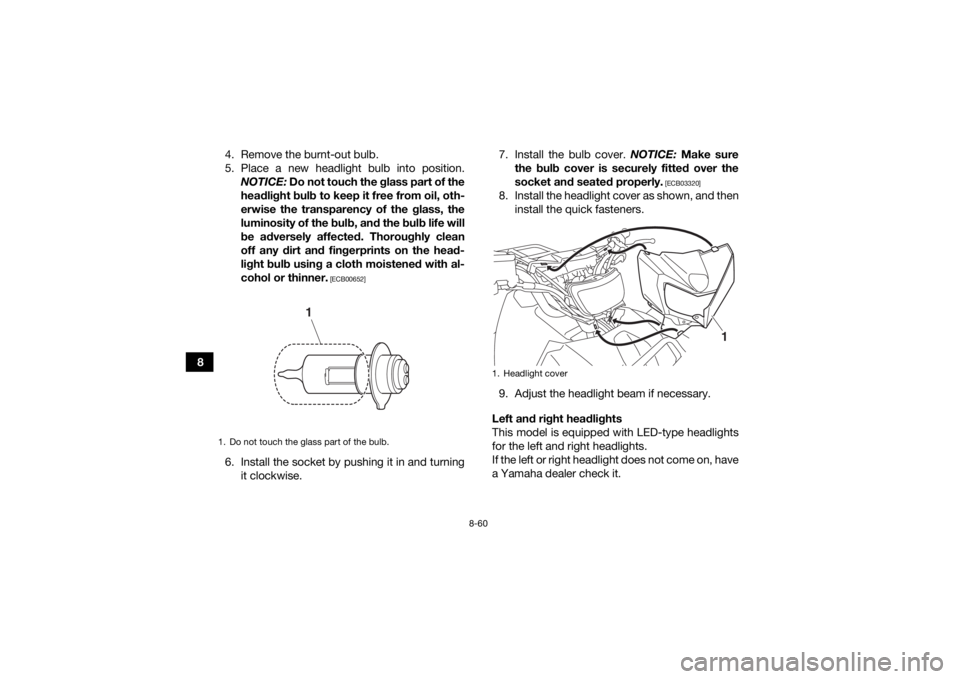
8. Install the headlight cover as shown, and then install the quick fasteners.
9. Adjust the headlight beam if necessary.
Left and right headlights
This model is equipped with LED-type headlights
for the left and right headlights.
If the left or right headlight does not come on, have
a Yamaha dealer check it.
1. Do not touch the glass part of the bulb.
1
1. Headlight cover
1
U2UD61E0.book Page 60 Monday, April 25, 2016 10:55 AM
Page 157 of 174
8-61
8
EBU25553Adjusting a headlight beamNOTICEECB00691It is advisable to have a Yamaha dealer make
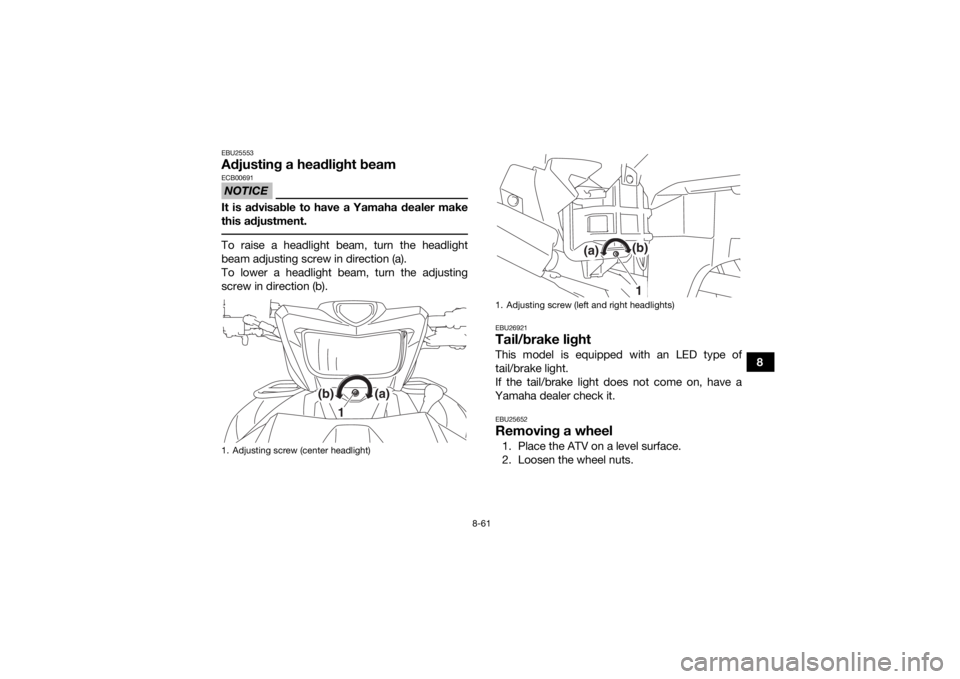
this adjustment. To raise a headlight beam, turn the headlight
beam adjusting screw in direction (a).
To lower a headlight beam, turn the adjusting
screw in direction (b).
EBU26921Tail/brake lightThis model is equipped with an LED type of
tail/brake light.
If the tail/brake light does not come on, have a
Yamaha dealer check it.EBU25652Removing a wheel1. Place the ATV on a level surface.
2. Loosen the wheel nuts.
1. Adjusting screw (center headlight)
(b)
(a)
1
1. Adjusting screw (left and right headlights)
(b)
(a)
1
U2UD61E0.book Page 61 Monday, April 25, 2016 10:55 AM
Page 159 of 174
8-63
8
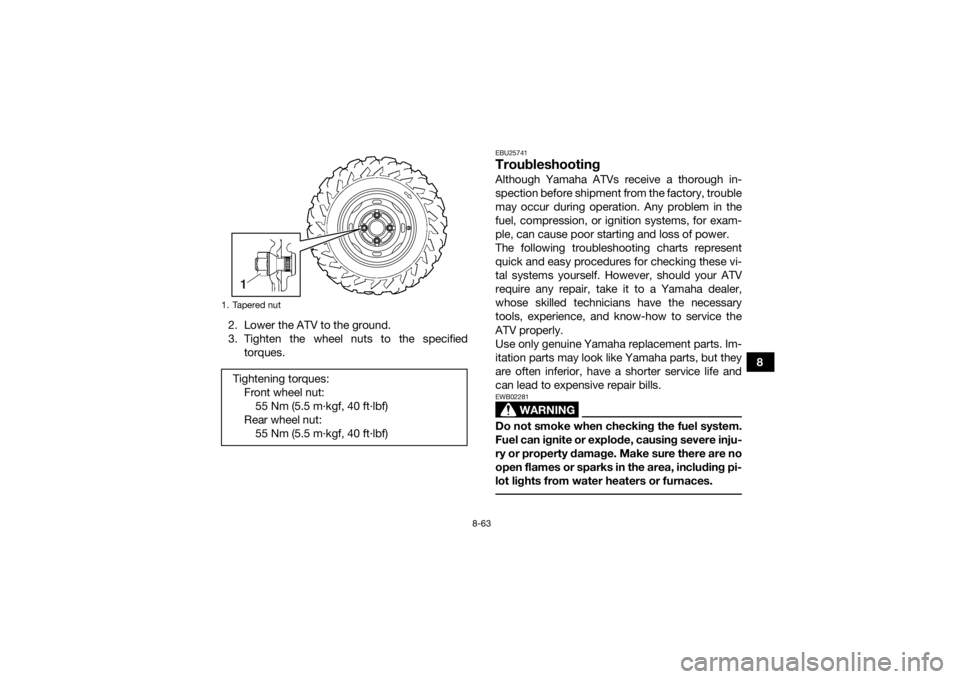
2. Lower the ATV to the ground.
3. Tighten the wheel nuts to the specified
torques.
EBU25741TroubleshootingAlthough Yamaha ATVs receive a thorough in-
spection before shipment from the factory, trouble
may occur during operation. Any problem in the
fuel, compression, or ignition systems, for exam-
ple, can cause poor starting and loss of power.
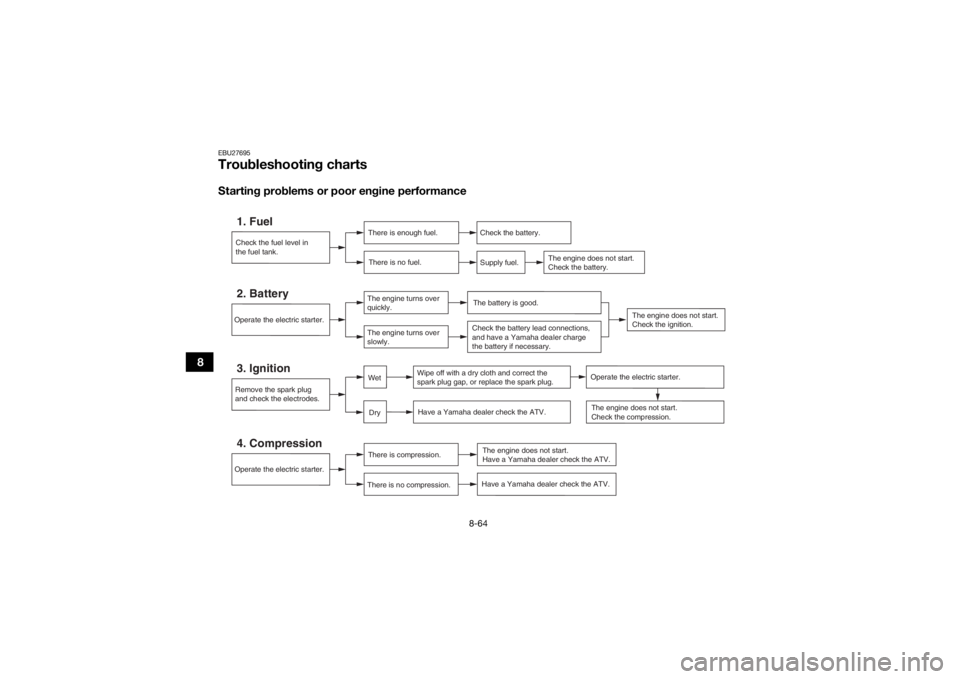
The following troubleshooting charts represent
quick and easy procedures for checking these vi-
tal systems yourself. However, should your ATV
require any repair, take it to a Yamaha dealer,
whose skilled technicians have the necessary
tools, experience, and know-how to service the
ATV properly.
Use only genuine Yamaha replacement parts. Im-
itation parts may look like Yamaha parts, but they
are often inferior, have a shorter service life and
can lead to expensive repair bills.
WARNING
EWB02281Do not smoke when checking the fuel system.
Fuel can ignite or explode, causing severe inju-
ry or property damage. Make sure there are no
open flames or sparks in the area, including pi-
lot lights from water heaters or furnaces.
1. Tapered nutTightening torques:Front wheel nut:55 Nm (5.5 m·kgf, 40 ft·lbf)
Rear wheel nut: 55 Nm (5.5 m·kgf, 40 ft·lbf)1
U2UD61E0.book Page 63 Monday, April 25, 2016 10:55 AM
Page 160 of 174
8-64
8
EBU27695Troubleshooting chartsStarting problems or poor engine performance
Check the fuel level in
the fuel tank.1. Fuel
There is enough fuel.There is no fuel.
Check the battery.
Supply fuel.
The engine does not start.
Check the battery.
Operate the electric starter.4. Compression
There is compression.
There is no compression.
The engine does not start.
Have a Yamaha dealer check the ATV.
Remove the spark plug
and check the electrodes.3. Ignition
Wipe off with a dry cloth and correct the
spark plug gap, or replace the spark plug. Have a Yamaha dealer check the ATV.
The engine does not start.
Check the compression.
DryWet
Operate the electric starter.
Have a Yamaha dealer check the ATV.
The engine does not start.
Check the ignition.
Operate the electric starter.2. Battery
The engine turns over
quickly.
The engine turns over
slowly.
The battery is good.Check the battery lead connections,
and have a Yamaha dealer charge
the battery if necessary.
U2UD61E0.book Page 64 Monday, April 25, 2016 10:55 AM
Page 161 of 174
8-65
8
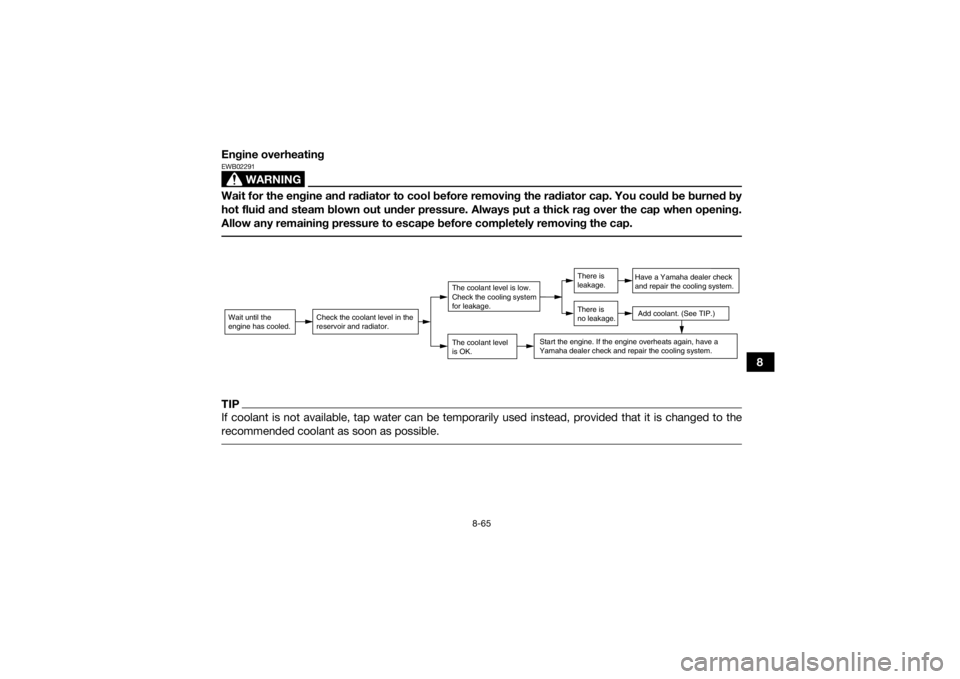
Engine overheating
WARNING
EWB02291Wait for the engine and radiator to cool before removing the radiator cap. You could be burned by
hot fluid and steam blown out under pressure. Always put a thick rag over the cap when opening.
Allow any remaining pressure to escape before completely removing the cap. TIPIf coolant is not available, tap water can be temporarily used instead, provided that it is changed to the
recommended coolant as soon as possible. Wait until the
engine has cooled.
Check the coolant level in the
reservoir and radiator.
The coolant level
is OK.The coolant level is low.
Check the cooling system
for leakage.
Have a Yamaha dealer check
and repair the cooling system.Add coolant. (See TIP.)
Start the engine. If the engine overheats again, have a
Yamaha dealer check and repair the cooling system.
There is
leakage.
There is
no leakage.
U2UD61E0.book Page 65 Monday, April 25, 2016 10:55 AM
Page 163 of 174

9-2
9
EBU27262StorageShort-term
Always store your ATV in a cool, dry place and, if
necessary, protect it against dust with a porous
cover. NOTICE: Storing the ATV in a poorly ven-
tilated room or covering it with a tarp while it is
still wet, will allow water and humidity to seep
in and cause rust. To prevent corrosion, avoid
damp cellars, stables (because of the presence
of ammonia) and areas where strong chemi-
cals are stored.
[ECB00722]
Long-term
Before storing your ATV for several months: 1. Follow all the instructions in the “Cleaning” section of this chapter.
2. Fill up the fuel tank and add fuel stabilizer (if available) to prevent the fuel from deteriorat-
ing. 3. Perform the following steps to protect the cyl-
inder, piston rings, etc. from corrosion.a. Remove the spark plug cap and spark plug.
b. Pour a teaspoonful of engine oil into the spark plug bore.
c. Install the spark plug cap onto the spark plug, and then place the spark plug on the
cylinder head so that the electrodes are
grounded. (This will limit sparking during
the next step.)
d. Turn the engine over several times with the starter. (This will coat the cylinder wall
with oil.)
e. Remove the spark plug cap from the spark plug, and then install the spark plug and
the spark plug cap.
4. Lubricate all control cables and the pivoting points of all levers and pedals.
5. Check and, if necessary, correct the tire air pressure, and then block up the ATV so that
all of its wheels are off the ground. Alterna-
tively, turn the wheels a little every month in
order to prevent the tires from becoming de-
graded in one spot.
Specified amount:
7.5 ml of stabilizer to each liter of fuel (or 1
oz of stabilizer to each gallon of fuel)U2UD61E0.book Page 2 Monday, April 25, 2016 10:55 AM
Page 172 of 174

12-1
12
INDEX
AAccessories and loading ................................................ 6-5
Accessories, auxiliary jack ........................................... 4-24
Air filter element, cleaning ............................................ 8-38
Axle boots .................................................................... 8-49BBattery .......................................................................... 8-53
Brake fluid, changing ...................................................8-46
Brake fluid level, checking ........................................... 8-44
Brake lever, front .......................................................... 4-15
Brake levers, checking and lubricating ........................ 8-50
Brake pads, checking the front and rear ..................... 8-43
Brake pedal and rear brake lever ................................. 4-15
Brake pedal, checking and lubricating ........................ 8-51
Brake pedal free play, adjusting .................................. 8-47
Brakes .......................................................................... 8-43
Brakes, front and rear .................................................... 5-3CCables, checking and lubricating ................................. 8-49
Carrier, front ................................................................. 4-23
Carrier, rear .................................................................. 4-23
Chassis fasteners ........................................................... 5-6
Cleaning ......................................................................... 9-1
Coolant ................................................................. 5-3, 8-30
Coolant temperature warning light ................................. 4-3DDifferential gear oil ............................................... 5-3, 8-28
Drive select lever .......................................................... 4-16
Drive select lever and driving in reverse ........................ 6-2
EEngine break-in .............................................................. 6-4
Engine oil ....................................................................... 5-3
Engine oil and oil filter cartridge .................................. 8-21
Engine stop switch ......................................................... 4-8
Engine trouble warning light .......................................... 4-3
EPS warning light ........................................................... 4-3FFinal gear oil ......................................................... 5-3, 8-25
Four-wheel-drive/differential gear lock indicator ........... 4-4
Front and rear brake lever free play, checking ............ 8-46
Fuel ...................................................................... 4-16, 5-3
Fuel tank cap ............................................................... 4-16
Fuses, replacing ........................................................... 8-57HHandlebar switches ....................................................... 4-8
Headlight beam, adjusting ........................................... 8-61
Headlight bulb, replacing ............................................. 8-59
High-range indicator light .............................................. 4-2
Horn switch .................................................................... 4-9IIdentification numbers ................................................. 11-1
Indicator lights and warning lights ................................. 4-2
Instruments, lights and switches ................................... 5-7LLabel locations ............................................................... 1-1
Light switch .................................................................... 4-8
Low-range indicator light ............................................... 4-2
U2UD61E0.book Page 1 Monday, April 25, 2016 10:55 AM