engine overheat YAMAHA JETBLASTER 2022 Owners Manual
[x] Cancel search | Manufacturer: YAMAHA, Model Year: 2022, Model line: JETBLASTER, Model: YAMAHA JETBLASTER 2022Pages: 98, PDF Size: 4.83 MB
Page 31 of 98

Control function operation
24
EJU31027
Watercraft control functionsEJU47111Engine start/stop switch “ / ”ECJ01311
Do not run the engine over 4000 r/min on
land. Also, do not run the engine for more
than 15 seconds without supplying water,
otherwise the engine could overheat.
The engine start/stop switch (red button)
starts the engine when the switch is pushed
while the engine is stopped, and stops the
engine when the switch is pushed while the
engine is running.
Release the engine start/stop switch as soon
as the engine starts to run. If the engine does
not start in 5 seconds, release the engine
start/stop switch, wait 15 seconds, and then
try again.
The engine will not start under any of the fol-
lowing conditions:
Clip is removed from the engine shut-off
switch.
Throttle lever is squeezed.
Throttle lever is malfunctioning.
RiDE lever is squeezed.
RiDE lever is malfunctioning.
EJU31164Engine shut-off switch “ ”
The engine shut-off switch automatically
stops the engine when the clip, on the end of
the engine shut-off cord (lanyard), is removed
from the switch, such as if the operator falls
off the watercraft.
Insert the clip under the engine shut-off
switch before starting the engine.
When the engine is not running, remove the
clip from the engine shut-off switch to pre-
vent accidental starting or unauthorized op-
eration by children or others.
EJU31212Throttle lever
The throttle lever increases the engine speed
when the lever is squeezed.
1Engine start/stop switch
1
1Engine shut-off switch
2 Clip
3 Engine shut-off cord (lanyard)
1
2
3
UF6C70E0.book Page 24 Wednesday, November 10, 2021 11:33 AM
Page 38 of 98
Instrument operation
31
EJU47200
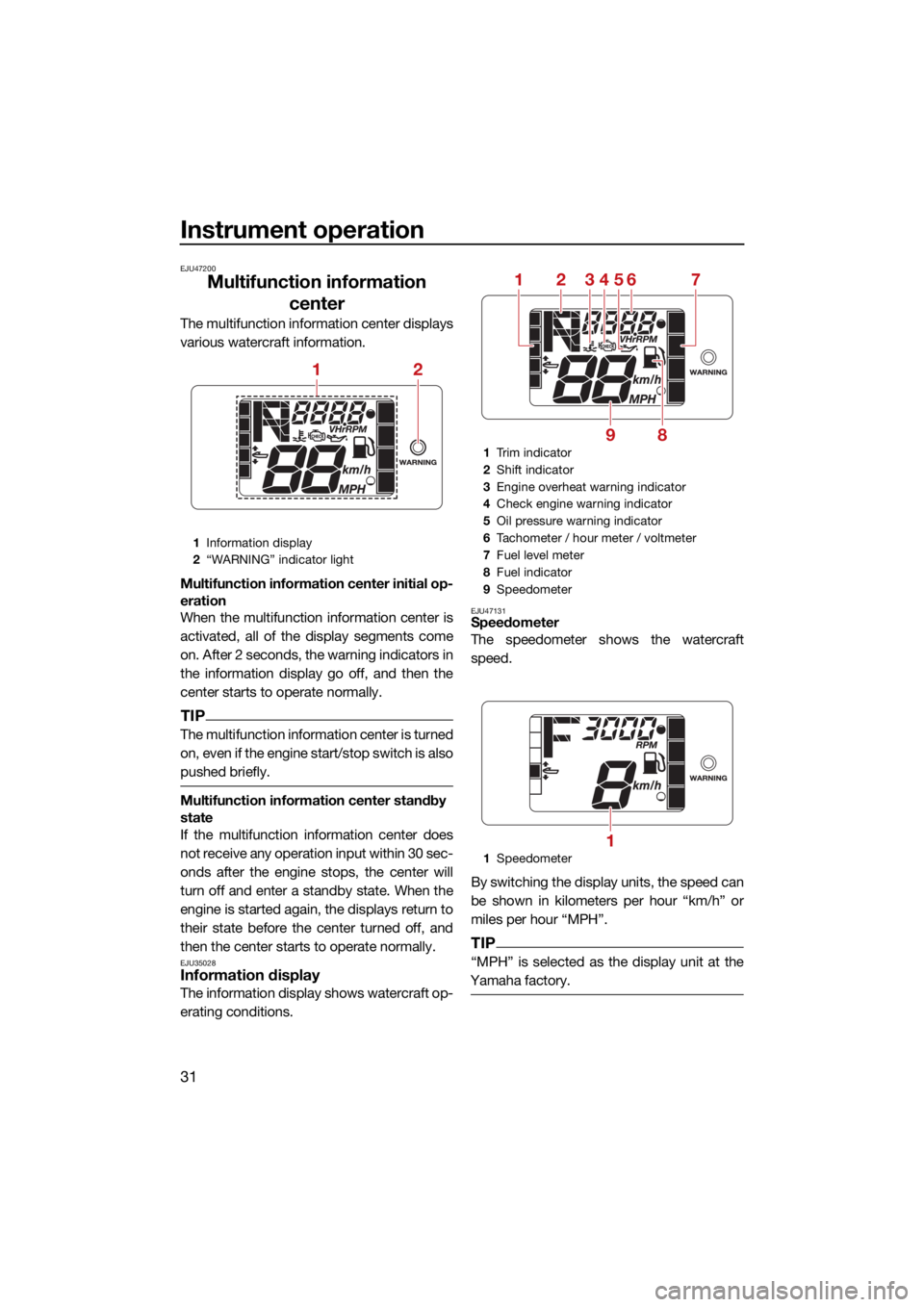
Multifunction information center
The multifunction information center displays
various watercraft information.
Multifunction information center initial op-
eration
When the multifunction information center is
activated, all of the display segments come
on. After 2 seconds, the warning indicators in
the information display go off, and then the
center starts to operate normally.
TIP
The multifunction information center is turned
on, even if the engine start/stop switch is also
pushed briefly.
Multifunction information center standby
state
If the multifunction information center does
not receive any operation input within 30 sec-
onds after the engine stops, the center will
turn off and enter a standby state. When the
engine is started again, the displays return to
their state before the center turned off, and
then the center starts to operate normally.
EJU35028Information display
The information display shows watercraft op-
erating conditions.
EJU47131Speedometer
The speedometer shows the watercraft
speed.
By switching the display units, the speed can
be shown in kilometers per hour “km/h” or
miles per hour “MPH”.
TIP
“MPH” is selected as the display unit at the
Yamaha factory.
1 Information display
2 “WARNING” indicator light
21
1Trim indicator
2 Shift indicator
3 Engine overheat warning indicator
4 Check engine warning indicator
5 Oil pressure warning indicator
6 Tachometer / hour meter / voltmeter
7 Fuel level meter
8 Fuel indicator
9 Speedometer
1 Speedometer
2345716
98
1
UF6C70E0.book Page 31 Wednesday, November 10, 2021 11:33 AM
Page 41 of 98

Instrument operation
34
EJU37272Fuel level meter
The fuel level meter shows the amount of fuel
remaining in the fuel tank. The amount of re-
maining fuel is shown using four display seg-
ments, which disappear one at a time as the
fuel level decreases.
TIP
The accuracy of the fuel level meter varies
depending on the operating conditions. Use
this function as a reference only.
EJU44711Fuel level warning
If the fuel remaining in the fuel tank drops to
about 8 L (2.1 US gal, 1.8 Imp.gal), the lowest
fuel level segment, the fuel level warning indi-
cator, and the “WARNING” indicator light
blink, and the buzzer sounds intermittently for
30 seconds.If the fuel level warning is activated, refill the
fuel tank as soon as possible. (See page 41
for information on filling the fuel tank.)
After the fuel tank is refilled, the warning sig-
nals will be cleared when the engine is re-
started.
EJU43721Oil pressure warning
If the oil pressure drops significantly, the oil
pressure warning indicator, the check engine
warning indicator, and the “WARNING” indi-
cator light blink, and the buzzer sounds inter-
mittently for 30 seconds. At the same time,
the maximum engine speed is limited.
If the oil pressure warning is activated, imme-
diately reduce the engine speed, return to
shore, and then check the engine oil level.
(See page 43 for information on checking the
engine oil level.) If the oil level is sufficient,
have a Yamaha dealer check the watercraft.
EJU43902Engine overheat warning
If the engine temperature rises significantly,
the engine overheat warning indicator, the
check engine warning indicator, and the
“WARNING” indicator light blink, and the
buzzer sounds intermittently. After 5 sec-
onds, the engine overheat warning indicator
and the “WARNING” indicator light stop
blinking and remain on, and the buzzer
sounds continuously. After 30 seconds, the
buzzer stops. While the engine overheat
1
Fuel level meter
1
UF6C70E0.book Page 34 Wednesday, November 10, 2021 11:33 AM
Page 42 of 98

Instrument operation
35
warning is activated, the maximum engine
speed is limited.
If the engine overheat warning is activated,
immediately reduce the engine speed, return
to shore, and then make sure that water is
being discharged from the cooling water pilot
outlet while the engine is running. If there is
no discharge of water, stop the engine, and
then check the jet intake for clogging. (See
page 84 for information on the jet intake.)
NOTICE: If you cannot locate and correct
the cause of the overheating, consult a
Yamaha dealer. Continuing to operate at higher speeds could result in severe en-
gine damage.
[ECJ00042]
EJU44691
Check engine warning
If a sensor malfunction or a short circuit is de-
tected, the check engine warning indicator
and the “WARNING” indicator light blink, and
the buzzer sounds intermittently for 30 sec-
onds. If the engine is stopped after the check en-
gine warning is activated, the tachometer
portion of the information display will show
the hour meter and error code alternately at
3-second intervals.
If the check engine warning is activated, im-
mediately reduce the engine speed, return to
shore, and have a Yamaha dealer check the
engine.
1
Error code
1
UF6C70E0.book Page 35 Wednesday, November 10, 2021 11:33 AM
Page 60 of 98

Pre-operation checks
53
EJU32666Engine shut-off cord (lanyard) check
Make sure that the engine shut-off cord (lan-
yard) is not damaged. If the cord is damaged,
replace it. WARNING! Never try to repair
the engine shut-off cord (lanyard) or tie it
together. The engine shut-off cord (lan-
yard) may not pull free when the operator
falls off, allowing the watercraft to conti-
nue to run and cause an accident.
[EWJ01222]
EJU47141
Switch checksECJ01311
Do not run the engine over 4000 r/min on
land. Also, do not run the engine for more
than 15 seconds without supplying water,
otherwise the engine could overheat.
Check the engine start/stop switch and the
engine shut-off switch for proper operation.
(See page 24 for information on operating
each switch.)
To check the operation of the switches:
(1) Push the engine start/stop switch to make sure that the engine starts.
(2) As soon as the engine starts running, push the engine start/stop switch to
make sure that the engine stops immedi-
ately.
(3) Restart the engine, and then pull the en- gine shut-off cord (lanyard) to remove
the clip from the engine shut-off switch
to make sure that the engine stops im-
mediately.
EJU47210Electric trim system check
Turn on the multifunction information center,
and then operate the “TRIM” switch. Check
that the jet thrust nozzle moves up and down
properly and that the trim indicator change
1Clip
2 Engine shut-off switch
3 Engine shut-off cord (lanyard)
1 Engine start/stop switch
12
3
1
UF6C70E0.book Page 53 Wednesday, November 10, 2021 11:33 AM
Page 65 of 98

Operation
58
EJU40212Riding position
Operator riding position
The operator should grip the handlebars firm-
ly with both hands and sit astride the seat
with both feet on the floor of the footwell.
Passenger riding position
The passenger(s) should hold on firmly, either
to the person in front of them or to the hand-
grip provided, and sit astride the seat with
their feet on the floor of the footwell. Never al-
low a passenger to ride in front of the opera-
tor. (See page 16 for information on the riding
position when pulling a wakeboarder or wa-
ter-skier.)
EJU32804Launching the watercraft
When launching the watercraft, make sure
that there are no obstacles around you.
If the watercraft is launched from a trailer,
someone should make sure that waves do
not push the watercraft into the trailer.
EJU47151Starting the engine on waterEWJ01532
Do not apply throttle when anyone is at the
rear of the watercraft. Turn the engine off
or keep it at idle. Water and debris exiting
the jet thrust nozzle can cause severe in-
jury.
To start the engine:
(1) Move the watercraft to an area that isfree from weeds and debris, and has a
water depth of at least 60 cm (2 ft) from
the bottom of the watercraft. NOTICE:
Never run the engine in water that is
less than 60 cm (2 ft) deep from the
bottom of the watercraft, otherwise
pebbles or sand could be sucked into
the jet intake, causing impeller dam-
age and engine overheating.
[ECJ00473]
(2) Attach the engine shut-off cord (lanyard) to your left wrist, and then attach the clip
to the engine shut-off switch. (See page
24 for information on operating the en-
gine shut-off switch.) WARNING! Check
that the engine shut-off cord (lanyard)
is attached correctly. If the engine
shut-off cord (lanyard) is not attached
correctly, it may not pull free when the
operator falls off, allowing the water-
UF6C70E0.book Page 58 Wednesday, November 10, 2021 11:33 AM
Page 70 of 98

Operation
63
EJU36088Boarding the watercraftEWJ01113
Be sure the operator and any passengers
have practiced boarding from the water
while still close to shore before riding. A
person who has made many unsuccessful
attempts to get back on the watercraft
may become fatigued and suffer from ex-
posure, increasing the risk of injury and
drowning.
Board the watercraft in water free from
weeds and debris and at least 60 cm (2 ft)
deep from the bottom of the watercraft.
NOTICE: Never run the engine in water
that is less than 60 cm (2 ft) deep from the
bottom of the watercraft, otherwise peb-
bles or sand could be sucked into the jet intake, causing impeller damage and en-
gine overheating.
[ECJ00473]
TIP
This watercraft is equipped with a reboarding
step, which can be lowered and used to as-
sist in reboarding. (See page 37 for informa-
tion on operating the reboarding step.)
EJU36354Boarding alone
(1) From the rear of the watercraft, place
both hands on the boarding platform,
pull yourself up, and then grasp the
handgrip with one hand.
(2) Pull yourself up to a kneeling position on the boarding platform, and then move to
the seat and sit astride.
1“N” (Neutral position)
1
60 cm (2 ft)
UF6C70E0.book Page 63 Wednesday, November 10, 2021 11:33 AM
Page 72 of 98

Operation
65
(5) Have the second passenger follow thesame procedure. When the second pas-
senger is boarding, try to balance the
watercraft together with the first passen-
ger.
(6) Make sure that the passenger(s) have their feet on the floor of the footwell and
are securely holding on to the person in
front of them or to the handgrip provided. (7) Attach the engine shut-off cord (lanyard)
to your left wrist, and then attach the clip
to the engine shut-off switch.
(8) Look in all directions, start the engine, and then start off slowly.
EJU33085Starting offEWJ00714
To avoid collisions:
Scan constantly for people, objects, and
other watercraft. Be alert for conditions
that limit your visibility or block your vi-
sion of others.
Operate defensively at safe speeds and
keep a safe distance away from people,
objects, and other watercraft.
Do not follow directly behind watercraft
or other boats. Do not go near others to
spray or splash them with water, go too
close to other boats, or go too fast for
the traffic conditions. Avoid sharp turns
or other maneuvers that make it hard for
others to avoid you or understand where
you are going. Avoid areas with sub-
merged objects or shallow water.
Take early action to avoid collisions. Re-
member, watercraft and other boats do
not have brakes. Do not release the
throttle lever when trying to steer away
from objects—as with other power-
boats, you need throttle to steer.
ECJ01341
Never run the engine in water that is less
than 60 cm (2 ft) deep from the bottom of
the watercraft, otherwise pebbles or sand
could be sucked into the jet intake, caus-
ing impeller damage and engine overheat-
ing.
UF6C70E0.book Page 65 Wednesday, November 10, 2021 11:33 AM
Page 74 of 98

Operation
67
(3) Start the engine and operate the water-craft at planing speed to drain the bilge
water from the engine compartment.
(See page 45 for information on draining
the bilge water. If the engine does not
start, see “Towing the watercraft” on
page 86 or “Submerged watercraft” on
page 86.) NOTICE: Do not run the en-
gine at full throttle for at least 1 minute
after the engine has been restarted.
Bilge water in the engine compart-
ment can splash into the engine,
which can result in severe damage.
[ECJ00554]
EJU43283
Beaching and docking the watercraft
To beach the watercraft:
(1) Make sure that there are no boats, swim- mers, or obstacles near the beach.
(2) Release the throttle lever to reduce speed about 100 m (330 ft) before you
reach the intended beaching area.
(3) Slowly approach the beach using the throttle lever and RiDE lever to control
the watercraft speed. NOTICE: Never
run the engine in water that is less
than 60 cm (2 ft) deep from the bottom
of the watercraft, otherwise pebbles
or sand could be sucked into the jet
intake, causing impeller damage and
engine overheating.
[ECJ00473]
(4) After reaching land, stop the engine, and then get off the watercraft and pull it up
on the beach.
To dock the watercraft:
(1) Make sure that there are no boats, swim-mers, or obstacles near the dock.
(2) Release the throttle lever to reduce speed about 100 m (330 ft) away from
the dock.
(3) Slowly approach the dock using the throttle lever and RiDE lever to control
the watercraft speed.
(4) After coming alongside the dock, stop the engine, and then get off the water-
craft.
EJU37194Operating in weeded areas
Always avoid using your watercraft in areas
where weed growth is thick. If operating in
weeded areas is unavoidable, alternately
squeeze the throttle lever and relax your grip
on the throttle lever to vary the engine speed.
Weeds tend to become clogged more when
operating at a steady speed and at trolling
speed. If weeds may have clogged the intake
area, clean the jet intake. (See page 84 for in-
formation on the jet intake.)
EJU40243After removing the watercraft from
the water
ECJ01311
Do not run the engine over 4000 r/min on
land. Also, do not run the engine for more
than 15 seconds without supplying water,
otherwise the engine could overheat.
After operating and removing the watercraft
from the water, promptly discharge the re-
maining water from th e cooling water pas-
sages.
UF6C70E0.book Page 67 Wednesday, November 10, 2021 11:33 AM
Page 76 of 98

Care and storage
69
EJU37148
Post-operation careEWJ00332
Always place the watercraft upright in a
horizontal position when storing it, other-
wise fuel could leak out into the engine or
engine compartment, which could create
a fire hazard.
After using the watercraft, always take it out
of the water, clean it, and store it. Leaving the
watercraft in the water for extended periods
will accelerate the rate of normal deteriora-
tion of the jet pump and hull. Marine organ-
isms and corrosion are some of the
conditions that can shorten the life of many
watercraft components.
EJU44560Flushing the cooling water passagesECJ01311
Do not run the engine over 4000 r/min on
land. Also, do not run the engine for more
than 15 seconds without supplying water,
otherwise the engine could overheat.
Flush the cooling water passages to prevent
them from clogging with salt, sand, or dirt.
(1) Place the watercraft in a horizontal posi-tion.
(2) Remove the seat and seat storage com- partment. (See page 36 for seat removal
and installation procedures and page 40
for information on the seat storage com-
partment.)
(3) Connect the garden hose adapter to a garden hose. (4) Loosen the flushing hose connector cap
and remove it. Insert the garden hose
adapter into the flushing hose connector
by pushing and twisting it until it is se-
curely connected.
(5) Connect the garden hose to a water tap.
(6) Make sure that the area around the wa- tercraft is clear, and then start the en-
gine. Immediately after the engine starts,
fully turn the water supply on so that wa-
ter flows out continually from the jet
thrust nozzle.
1Garden hose adapter
2 Garden hose
1 Flushing hose connector cap
2 Flushing hose connector
3 Garden hose adapter
12
32
1
UF6C70E0.book Page 69 Wednesday, November 10, 2021 11:33 AM