maintenance YAMAHA JOG50R 2012 User Guide
[x] Cancel search | Manufacturer: YAMAHA, Model Year: 2012, Model line: JOG50R, Model: YAMAHA JOG50R 2012Pages: 76, PDF Size: 1.51 MB
Page 45 of 76

6. Refill with the specified amount
of the recommended final trans-
mission oil, and then install and
tighten the oil filler cap. WAR-
NING! Make sure that no
foreign material enters the final
transmission case. Make sure
that no oil gets on the tire or
wheel.
[EWA11311]
7. Check the final transmission case
for oil leakage. If oil is leaking,
check for the cause.
EAUS1200
Coolant (CS50Z)
The coolant level should be checked
before each ride. In addition, the coo-
lant must be changed at the intervals
specified in the periodic maintenance
and lubrication chart.
EAUM2102
To check the coolant level
1. Place the vehicle on a level surfa-
ce and hold it in an upright posi-
tion.
TIP
●The coolant level must be chec-
ked on a cold engine since the
level varies with engine tempera-
ture.
●Make sure that the vehicle is
positioned straight up when
checking the coolant level. A
slight tilt to the side can result in
a false reading.
2. Check the coolant level through
the check window.
TIP
The coolant should be between the
minimum and maximum level marks.
1. Coolant level check window
2. Maximum level mark
3. Minimum level mark
3. If the coolant is at or below the
minimum level mark, remove the
cowling A. (See page 6-5).
4. Open the reservoir cap, and then
add coolant to the maximum
level mark. WARNING! Remove
only the coolant reservoir cap.
Never attempt to remove the
radiator cap when the engine is
hot.
[EWA15161]. NOTICE: If coolant
is not available, use distilled
MAX
MIN2
3
1
Recommended final transmission
oil:
See page 8-1
Oil quantity:
0.11 L (0.12 US qt, 0.10 Imp.qt)
Tightening torque:
Final transmission oil drain bolt:
18 Nm (1.8 m•kgf, 13.0 ft•lbf)
PERIODIC MAINTENANCE AND ADJUSTMENT
6-8
6
Page 46 of 76
water or soft tap water instead.
Do not use hard water or salt
water since it is harmful to the
engine. If water has been used
instead of coolant, replace it
with coolant as soon as possi-
ble, otherwise the cooling sys-
tem will not be protected
against frost and corrosion. If
water has been added to the
coolant, have a Yamaha dealer
check the antifreeze content of
the coolant as soon as possi-
ble, otherwise the effective-
ness of the coolant will be
reduced.
[ECA10472]
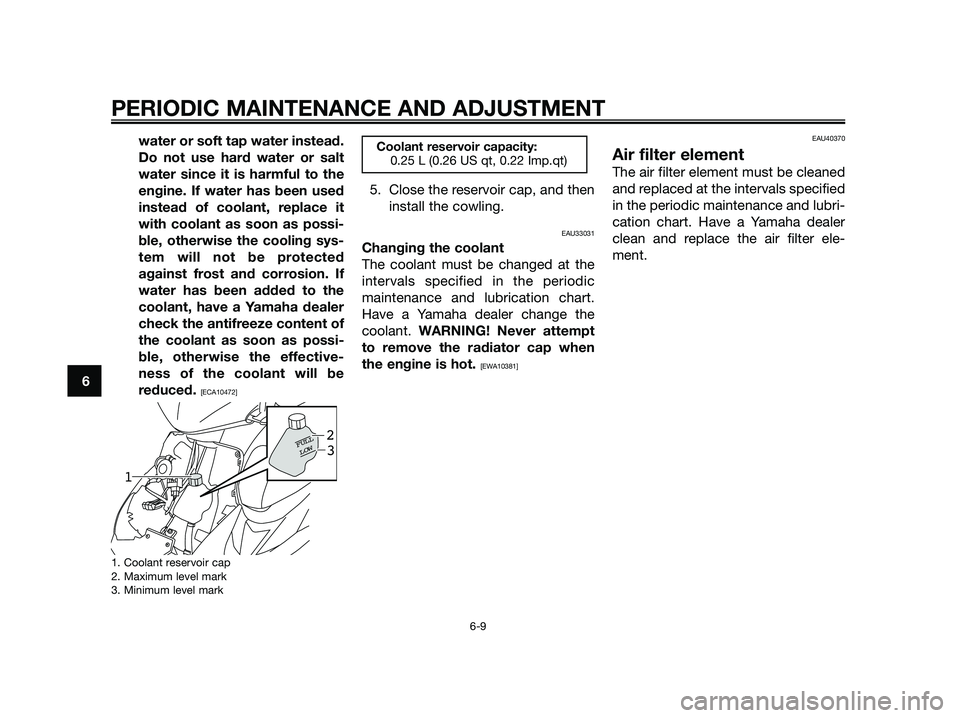
1. Coolant reservoir cap
2. Maximum level mark
3. Minimum level mark
5. Close the reservoir cap, and then
install the cowling.
EAU33031
Changing the coolant
The coolant must be changed at the
intervals specified in the periodic
maintenance and lubrication chart.
Have a Yamaha dealer change the
coolant. WARNING! Never attempt
to remove the radiator cap when
the engine is hot.
[EWA10381]EAU40370
Air filter element
The air filter element must be cleaned
and replaced at the intervals specified
in the periodic maintenance and lubri-
cation chart. Have a Yamaha dealer
clean and replace the air filter ele-
ment.
Coolant reservoir capacity:
0.25 L (0.26 US qt, 0.22 Imp.qt)
1
2
3FULL
LOW
PERIODIC MAINTENANCE AND ADJUSTMENT
6-9
6
Page 47 of 76
EAU21300
Adjusting the carburetor
The carburetor is an important part of
the engine and requires very sophisti-
cated adjustment. Therefore, all car-
buretor adjustments should be left to
a Yamaha dealer, who has the neces-
sary professional knowledge and
experience.
EAU21370
Adjusting the throttle cable
free play
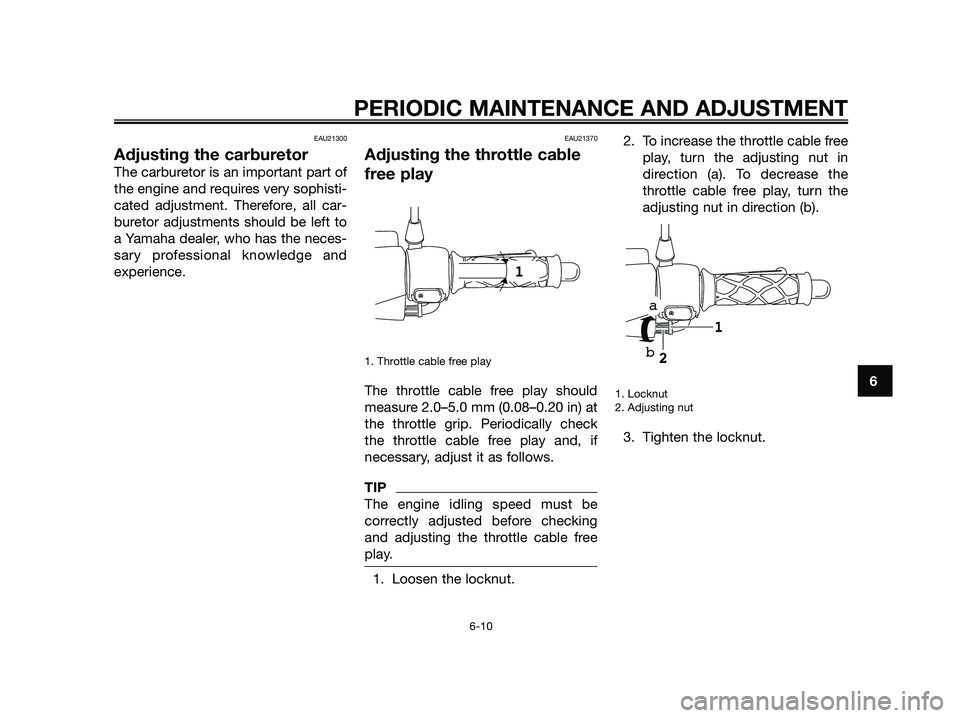
1. Throttle cable free play
The throttle cable free play should
measure 2.0–5.0 mm (0.08–0.20 in) at
the throttle grip. Periodically check
the throttle cable free play and, if
necessary, adjust it as follows.
TIP
The engine idling speed must be
correctly adjusted before checking
and adjusting the throttle cable free
play.
1. Loosen the locknut.2. To increase the throttle cable free
play, turn the adjusting nut in
direction (a). To decrease the
throttle cable free play, turn the
adjusting nut in direction (b).
1. Locknut
2. Adjusting nut
3. Tighten the locknut.
1
2
a
b
1
PERIODIC MAINTENANCE AND ADJUSTMENT
6-10
6
Page 48 of 76
EAU33601
Tires
To maximize the performance, durabi-
lity, and safe operation of your vehi-
cle, note the following points regar-
ding the specified tires.
Tire air pressure
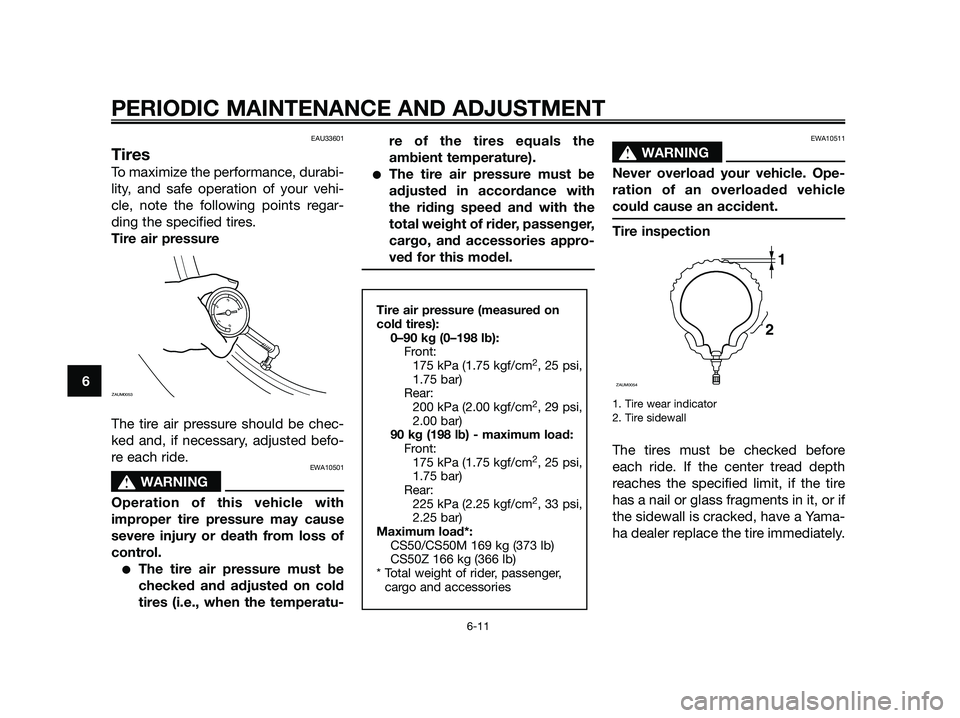
The tire air pressure should be chec-
ked and, if necessary, adjusted befo-
re each ride.
EWA10501
sWARNING
Operation of this vehicle with
improper tire pressure may cause
severe injury or death from loss of
control.
●The tire air pressure must be
checked and adjusted on cold
tires (i.e., when the temperatu-re of the tires equals the
ambient temperature).
●The tire air pressure must be
adjusted in accordance with
the riding speed and with the
total weight of rider, passenger,
cargo, and accessories appro-
ved for this model.
EWA10511
sWARNING
Never overload your vehicle. Ope-
ration of an overloaded vehicle
could cause an accident.
Tire inspection
1. Tire wear indicator
2. Tire sidewall
The tires must be checked before
each ride. If the center tread depth
reaches the specified limit, if the tire
has a nail or glass fragments in it, or if
the sidewall is cracked, have a Yama-
ha dealer replace the tire immediately.
1
2
ZAUM0054
Tire air pressure (measured on
cold tires):
0–90 kg (0–198 lb):
Front:
175 kPa (1.75 kgf/cm
2, 25 psi,
1.75 bar)
Rear:
200 kPa (2.00 kgf/cm
2, 29 psi,
2.00 bar)
90 kg (198 lb) - maximum load:
Front:
175 kPa (1.75 kgf/cm
2, 25 psi,
1.75 bar)
Rear:
225 kPa (2.25 kgf/cm
2, 33 psi,
2.25 bar)
Maximum load*:
CS50/CS50M 169 kg (373 lb)
CS50Z 166 kg (366 lb)
* Total weight of rider, passenger,
cargo and accessories
ZAUM0053
PERIODIC MAINTENANCE AND ADJUSTMENT
6-11
6
Page 49 of 76
TIP
The tire tread depth limits may differ
from country to country. Always
comply with the local regulations.
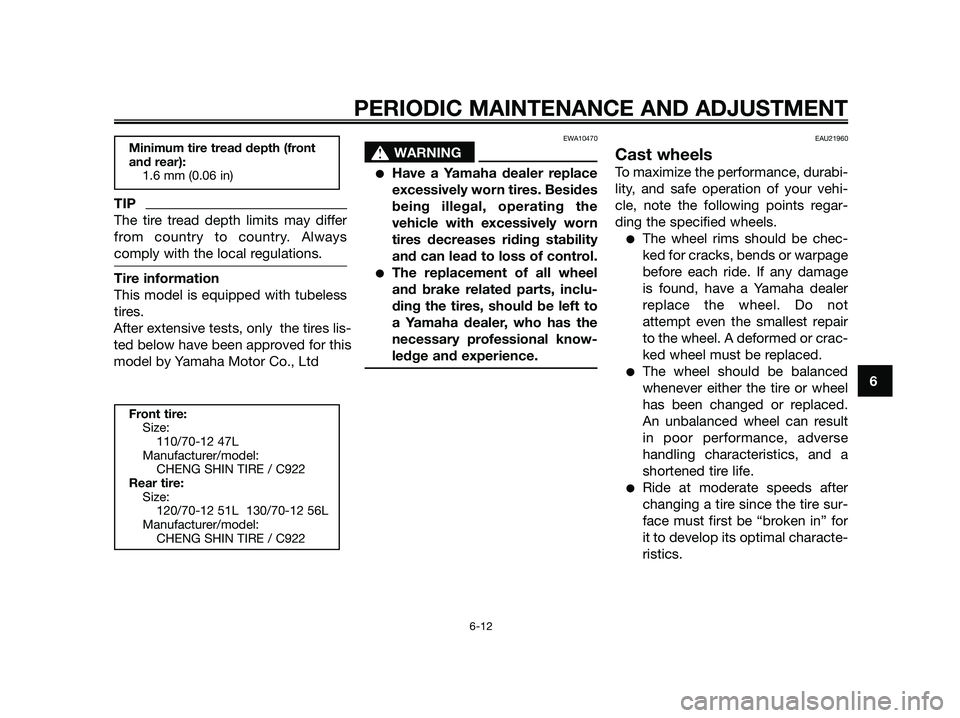
Tire information
This model is equipped with tubeless
tires.
After extensive tests, only the tires lis-
ted below have been approved for
this model by Yamaha Motor España,
S.A.
EWA10470
sWARNING
●Have a Yamaha dealer replace
excessively worn tires. Besides
being illegal, operating the
vehicle with excessively worn
tires decreases riding stability
and can lead to loss of control.
●The replacement of all wheel
and brake related parts, inclu-
ding the tires, should be left to
a Yamaha dealer, who has the
necessary professional know-
ledge and experience.
EAU21960
Cast wheels
To maximize the performance, durabi-
lity, and safe operation of your vehi-
cle, note the following points regar-
ding the specified wheels.
●The wheel rims should be chec-
ked for cracks, bends or warpage
before each ride. If any damage
is found, have a Yamaha dealer
replace the wheel. Do not
attempt even the smallest repair
to the wheel. A deformed or crac-
ked wheel must be replaced.
●The wheel should be balanced
whenever either the tire or wheel
has been changed or replaced.
An unbalanced wheel can result
in poor performance, adverse
handling characteristics, and a
shortened tire life.
●Ride at moderate speeds after
changing a tire since the tire sur-
face must first be “broken in” for
it to develop its optimal characte-
ristics.
Front tire:
Size:
110/70-12 47L
Manufacturer/model:
CHENG SHIN TIRE / C922
Rear tire:
Size:
120/70-12 51L 130/70-12 56L
Manufacturer/model:
CHENG SHIN TIRE / C922
Minimum tire tread depth (front
and rear):
1.6 mm (0.06 in)
PERIODIC MAINTENANCE AND ADJUSTMENT
6-12
6
After extensive tests, only the tires lis-
ted below have been approved for this
model by Yamaha Motor Co., Ltd
Page 50 of 76
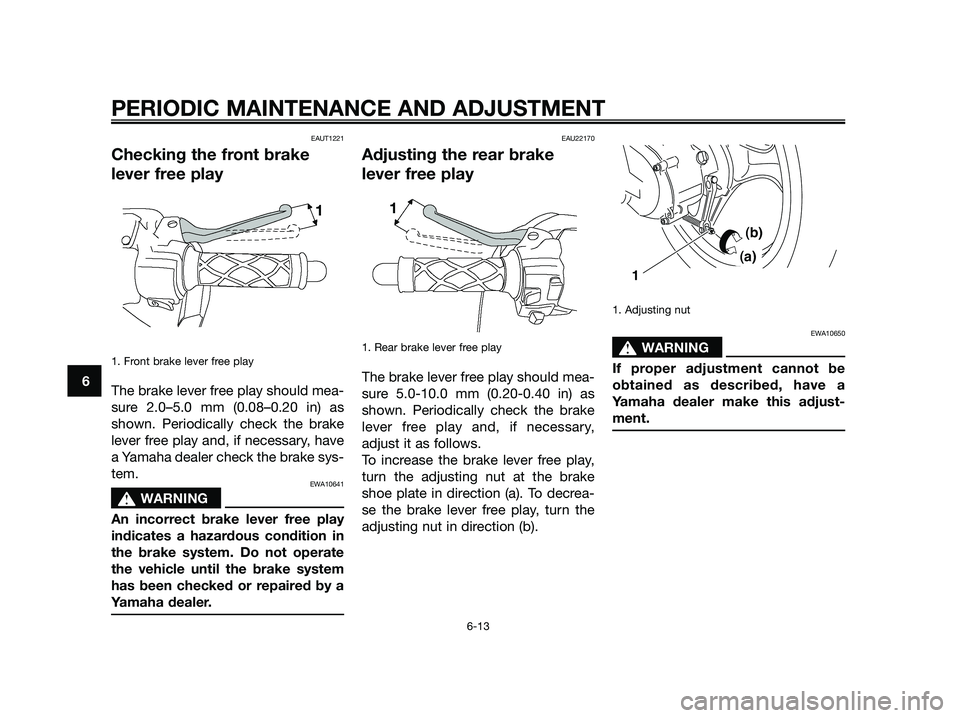
EAUT1221
Checking the front brake
lever free play
1. Front brake lever free play
The brake lever free play should mea-
sure 2.0–5.0 mm (0.08–0.20 in) as
shown. Periodically check the brake
lever free play and, if necessary, have
a Yamaha dealer check the brake sys-
tem.
EWA10641
sWARNING
An incorrect brake lever free play
indicates a hazardous condition in
the brake system. Do not operate
the vehicle until the brake system
has been checked or repaired by a
Yamaha dealer.
EAU22170
Adjusting the rear brake
lever free play
1. Rear brake lever free play
The brake lever free play should mea-
sure 5.0-10.0 mm (0.20-0.40 in) as
shown. Periodically check the brake
lever free play and, if necessary,
adjust it as follows.
To increase the brake lever free play,
turn the adjusting nut at the brake
shoe plate in direction (a). To decrea-
se the brake lever free play, turn the
adjusting nut in direction (b).
1. Adjusting nut
EWA10650
sWARNING
If proper adjustment cannot be
obtained as described, have a
Yamaha dealer make this adjust-
ment.
(a)
(b)
1
PERIODIC MAINTENANCE AND ADJUSTMENT
6-13
6
Page 51 of 76
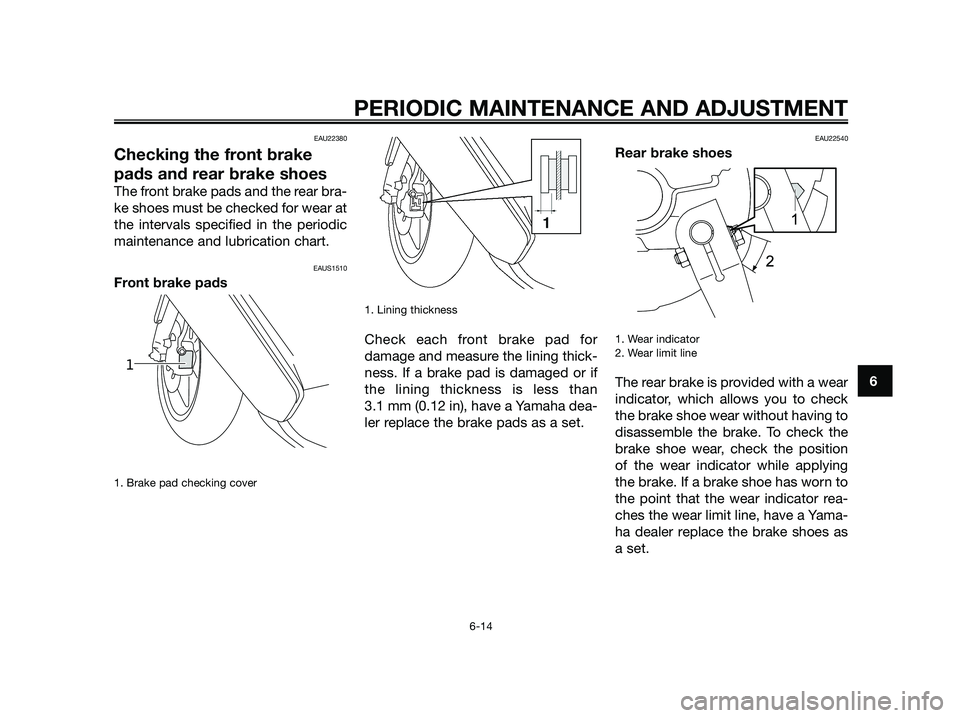
EAU22380
Checking the front brake
pads and rear brake shoes
The front brake pads and the rear bra-
ke shoes must be checked for wear at
the intervals specified in the periodic
maintenance and lubrication chart.
EAUS1510
Front brake pads
1. Brake pad checking cover
1. Lining thickness
Check each front brake pad for
damage and measure the lining thick-
ness. If a brake pad is damaged or if
the lining thickness is less than
3.1 mm (0.12 in), have a Yamaha dea-
ler replace the brake pads as a set.
EAU22540
Rear brake shoes
1. Wear indicator 2. Wear limit line
The rear brake is provided with a wear
indicator, which allows you to check
the brake shoe wear without having to
disassemble the brake. To check the
brake shoe wear, check the position
of the wear indicator while applying
the brake. If a brake shoe has worn to
the point that the wear indicator rea-
ches the wear limit line, have a Yama-
ha dealer replace the brake shoes as
a set.
1
PERIODIC MAINTENANCE AND ADJUSTMENT
6-14
6
Page 52 of 76
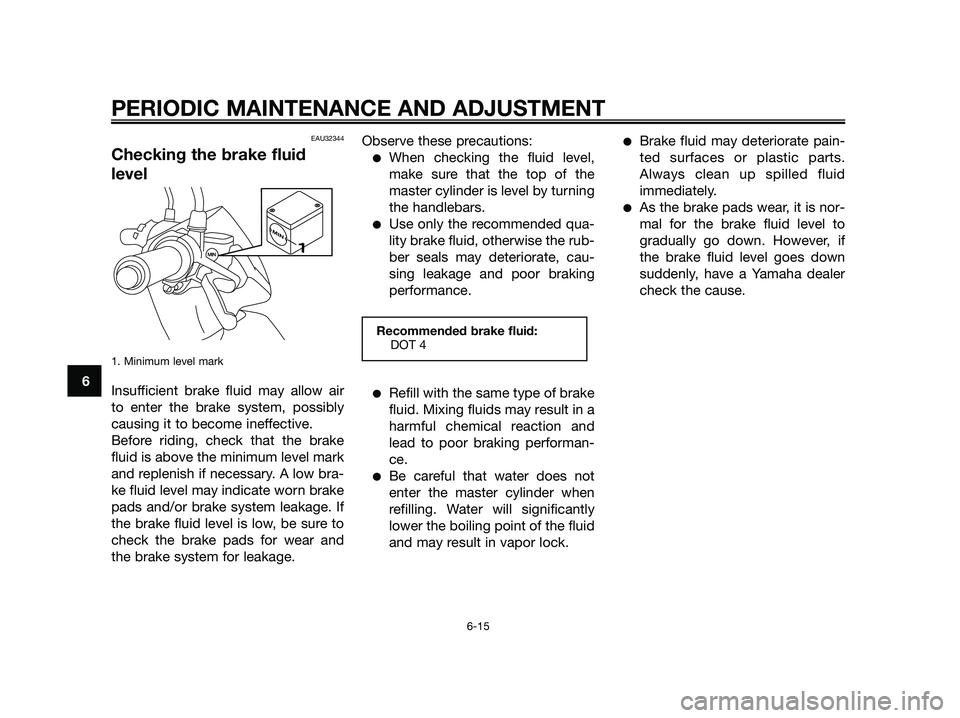
EAU32344
Checking the brake fluid
level
1. Minimum level mark
Insufficient brake fluid may allow air
to enter the brake system, possibly
causing it to become ineffective.
Before riding, check that the brake
fluid is above the minimum level mark
and replenish if necessary. A low bra-
ke fluid level may indicate worn brake
pads and/or brake system leakage. If
the brake fluid level is low, be sure to
check the brake pads for wear and
the brake system for leakage.Observe these precautions:
●When checking the fluid level,
make sure that the top of the
master cylinder is level by turning
the handlebars.
●Use only the recommended qua-
lity brake fluid, otherwise the rub-
ber seals may deteriorate, cau-
sing leakage and poor braking
performance.
●Refill with the same type of brake
fluid. Mixing fluids may result in a
harmful chemical reaction and
lead to poor braking performan-
ce.
●Be careful that water does not
enter the master cylinder when
refilling. Water will significantly
lower the boiling point of the fluid
and may result in vapor lock.
●Brake fluid may deteriorate pain-
ted surfaces or plastic parts.
Always clean up spilled fluid
immediately.
●As the brake pads wear, it is nor-
mal for the brake fluid level to
gradually go down. However, if
the brake fluid level goes down
suddenly, have a Yamaha dealer
check the cause.
Recommended brake fluid:
DOT 4
M
IN
1
PERIODIC MAINTENANCE AND ADJUSTMENT
6-15
6
Page 53 of 76
EAU22721
Changing the brake fluid
Have a Yamaha dealer change the
brake fluid at the intervals specified in
the TIP after the periodic maintenan-
ce and lubrication chart. In addition,
have the oil seals of the brake master
cylinder and caliper as well as the
brake hose replaced at the intervals
listed below or whenever they are
damaged or leaking.
●Oil seals: Replace every two
years.
●Brake hose: Replace every four
years.
EAU23111
Checking and lubricating the
throttle grip and cable
The operation of the throttle grip
should be checked before each ride.
In addition, the cable should be lubri-
cated at the intervals specified in the
periodic maintenance chart.
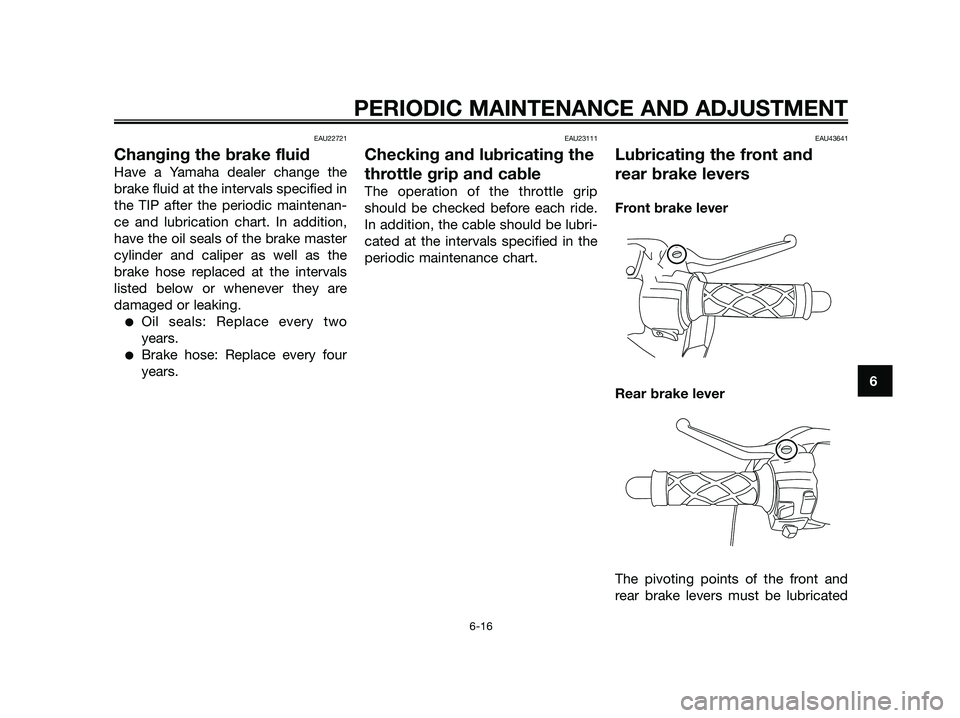
EAU43641
Lubricating the front and
rear brake levers
Front brake lever
Rear brake lever
The pivoting points of the front and
rear brake levers must be lubricated
PERIODIC MAINTENANCE AND ADJUSTMENT
6-16
6
Page 54 of 76
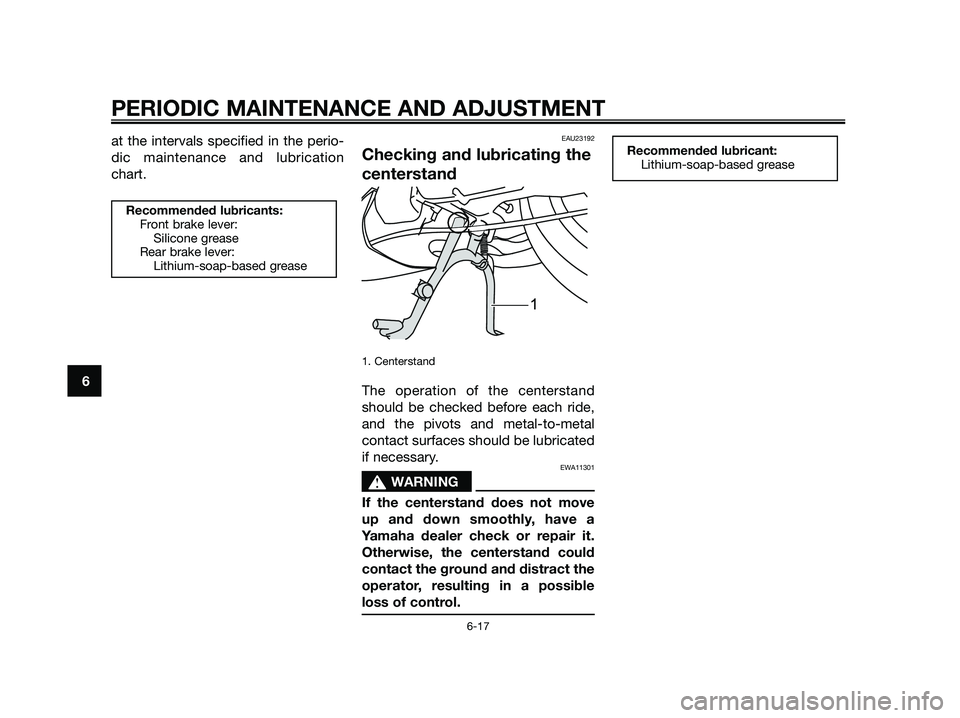
at the intervals specified in the perio-
dic maintenance and lubrication
chart.EAU23192
Checking and lubricating the
centerstand
1. Centerstand
The operation of the centerstand
should be checked before each ride,
and the pivots and metal-to-metal
contact surfaces should be lubricated
if necessary.
EWA11301
sWARNING
If the centerstand does not move
up and down smoothly, have a
Yamaha dealer check or repair it.
Otherwise, the centerstand could
contact the ground and distract the
operator, resulting in a possible
loss of control.
Recommended lubricant:
Lithium-soap-based grease
Recommended lubricants:
Front brake lever:
Silicone grease
Rear brake lever:
Lithium-soap-based grease
PERIODIC MAINTENANCE AND ADJUSTMENT
6-17
6