wheel YAMAHA KODIAK 700 2017 Owner's Manual
[x] Cancel search | Manufacturer: YAMAHA, Model Year: 2017, Model line: KODIAK 700, Model: YAMAHA KODIAK 700 2017Pages: 178, PDF Size: 4.61 MB
Page 90 of 178
7-17
7Use caution while descending a hill with loose or
slippery surfaces. Braking ability and traction may
be adversely affected by these surfaces. Improper
braking may also cause a loss of traction.
When this ATV is in “4WD”, all wheels (front and
rear) are interconnected by the drive train. This
means that applying either the front brake or the
rear brake will brake all wheels. When descending
hills, using either brake lever or the brake pedal
will brake the wheels on the downhill side. Avoid
sudden application of either the front or rear brake
because the wheels on the uphill side could come
off the ground. Apply both the front and rear
brakes gradually.
Whenever possible, ride your ATV straight down-
hill. Avoid sharp angles which could allow the ATV
to tip or roll over. Carefully choose your path and
ride no faster than you will be able to react to ob-
stacles which may appear.
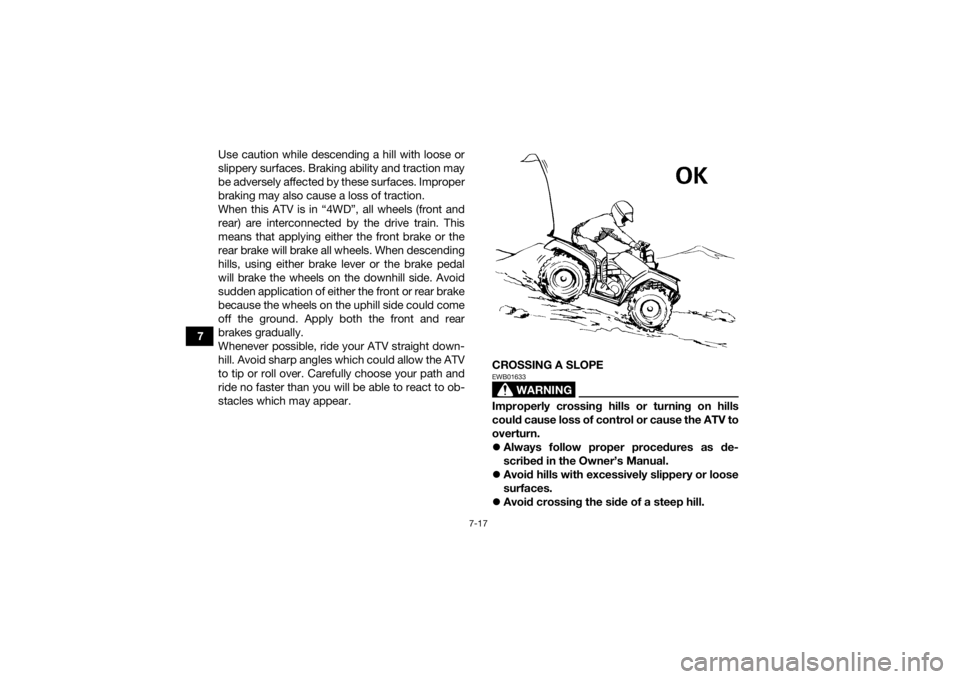
CROSSING A SLOPE
WARNING
EWB01633Improperly crossing hills or turning on hills
could cause loss of control or cause the ATV to
overturn.
Always follow proper procedures as de-
scribed in the Owner’s Manual.
Avoid hills with excessively slippery or loose
surfaces.
Avoid crossing the side of a steep hill.
UB1661E0.book Page 17 Thursday, May 12, 2016 2:47 PM
Page 91 of 178
7-18
7
Shift your weight to the uphill side of the ATV.
Never attempt to turn the ATV around on any
hill until you have mastered the turning tech-
nique as described in the Owner’s Manual on
level ground. Be very careful when turning
on any hill.
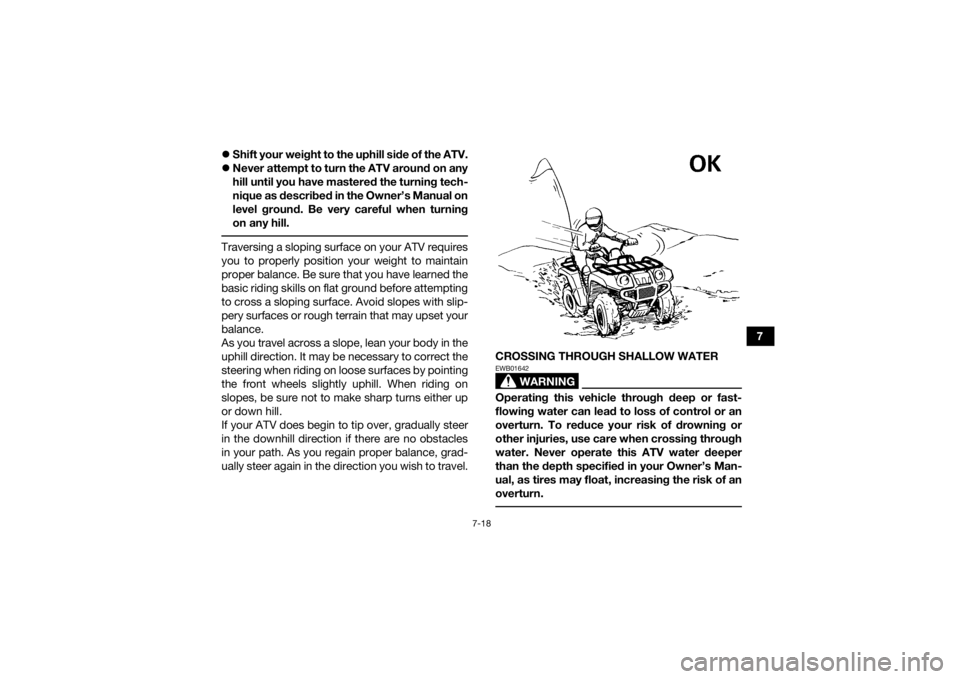
Traversing a sloping surface on your ATV requires
you to properly position your weight to maintain
proper balance. Be sure that you have learned the
basic riding skills on flat ground before attempting
to cross a sloping surface. Avoid slopes with slip-
pery surfaces or rough terrain that may upset your
balance.
As you travel across a slope, lean your body in the
uphill direction. It may be necessary to correct the
steering when riding on loose surfaces by pointing
the front wheels slightly uphill. When riding on
slopes, be sure not to make sharp turns either up
or down hill.
If your ATV does begin to tip over, gradually steer
in the downhill direction if there are no obstacles
in your path. As you regain proper balance, grad-
ually steer again in the direction you wish to travel. CROSSING THROUGH SHALLOW WATER
WARNING
EWB01642Operating this vehicle through deep or fast-
flowing water can lead to loss of control or an
overturn. To reduce your risk of drowning or
other injuries, use care when crossing through
water. Never operate this ATV water deeper
than the depth specified in your Owner’s Man-
ual, as tires may float, increasing the risk of an
overturn.
UB1661E0.book Page 18 Thursday, May 12, 2016 2:47 PM
Page 94 of 178
7-21
7accident. Be sure to keep your feet firmly mounted
on the footboards at all times. Avoid jumping the
ATV as loss of control and damage to the ATV may
result.
SLIDING AND SKIDDING
WARNING
EWB01663Skidding or sliding improperly may cause you
to lo s e c o n tr o l o f th is A T V . Y o u ma y a ls o r e g a i n
traction unexpectedly, which may cause the
ATV to overturn.
Learn to safely control skidding or sliding by
practicing at low speeds and on level,
smooth terrain.
On extremely slippery surfaces, such as ice,
go slowly and be very cautious in order to re-
duce the chance of skidding or sliding out of
control. Care should be used when riding on loose or slip-
pery surfaces since the ATV may slide. If unex-
pected and uncorrected, sliding could lead to an
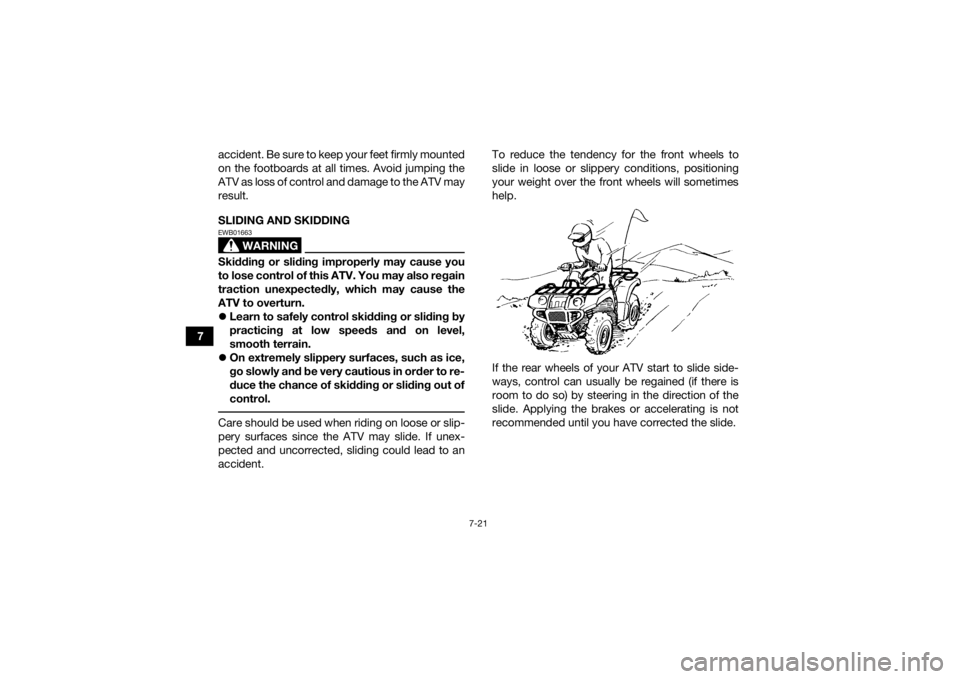
accident. To reduce the tendency for the front wheels to
slide in loose or slippery conditions, positioning
your weight over the front wheels will sometimes
help.
If the rear wheels of your ATV start to slide side-
ways, control can usually be regained (if there is
room to do so) by steering in the direction of the
slide. Applying the brakes or accelerating is not
recommended until you have corrected the slide.UB1661E0.book Page 21 Thursday, May 12, 2016 2:47 PM
Page 95 of 178
7-22
7
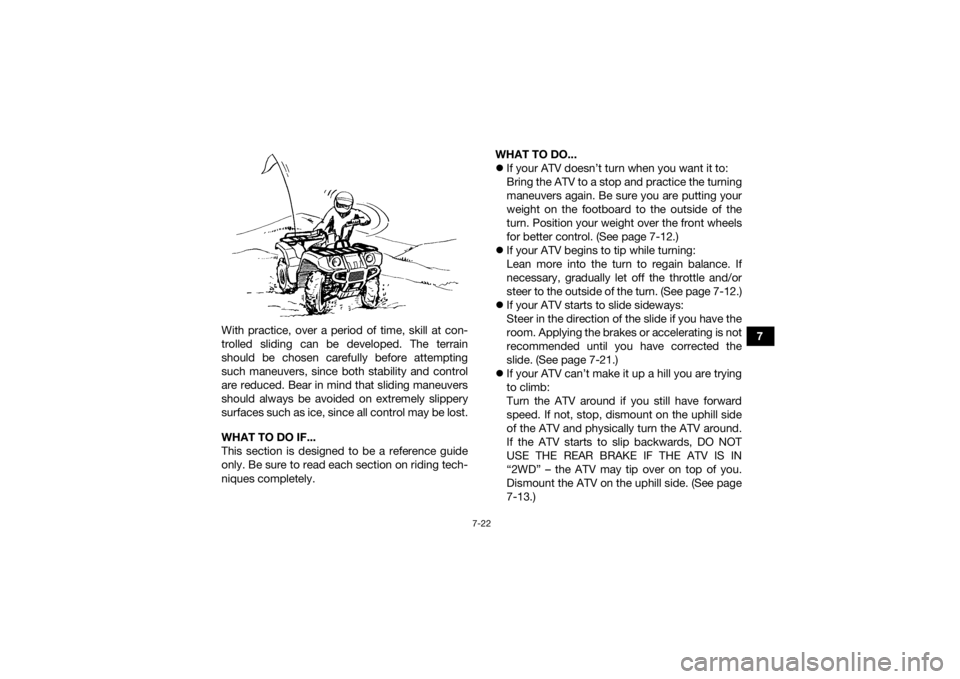
With practice, over a period of time, skill at con-
trolled sliding can be developed. The terrain
should be chosen carefully before attempting
such maneuvers, since both stability and control
are reduced. Bear in mind that sliding maneuvers
should always be avoided on extremely slippery
surfaces such as ice, since all control may be lost.
WHAT TO DO IF...
This section is designed to be a reference guide
only. Be sure to read each section on riding tech-
niques completely. WHAT TO DO...
If your ATV doesn’t turn when you want it to:
Bring the ATV to a stop and practice the turning
maneuvers again. Be sure you are putting your
weight on the footboard to the outside of the
turn. Position your weight over the front wheels
for better control. (See page 7-12.)
If your ATV begins to tip while turning:
Lean more into the turn to regain balance. If
necessary, gradually let off the throttle and/or
steer to the outside of the turn. (See page 7-12.)
If your ATV starts to slide sideways:
Steer in the direction of the slide if you have the
room. Applying the brakes or accelerating is not
recommended until you have corrected the
slide. (See page 7-21.)
If your ATV can’t make it up a hill you are trying
to climb:
Turn the ATV around if you still have forward
speed. If not, stop, dismount on the uphill side
of the ATV and physically turn the ATV around.
If the ATV starts to slip backwards, DO NOT
USE THE REAR BRAKE IF THE ATV IS IN
“2WD” – the ATV may tip over on top of you.
Dismount the ATV on the uphill side. (See page
7-13.)
UB1661E0.book Page 22 Thursday, May 12, 2016 2:47 PM
Page 102 of 178

8-6
8
4*Brake hoses • Check for cracks or other damage, and replace if
necessary. √√√√
• Replace. Every 4 years
5 *Brake fluid • Change. Every 2 years
6 *Wheels • Check runout and for damage, and replace if nec-
essary. √ √√√
7 *Tires • Check tread depth and for damage, and replace if
necessary.
• Check air pressure and balance, and correct if necessary. √ √√√
8 *Wheel hub bearings • Check for looseness or damage, and replace if
necessary. √ √√√
9 *V- b e l t • Check for wear, cracks or other damage, and re-
place if necessary. √ √√√
10 *Chassis fasteners • Make sure that all nuts, bolts, and screws are
properly tightened. √√√√√
11 *Shock absorber as-
semblies • Check operation and correct if necessary.
• Check for oil leakage and replace if necessary.
√√√
12 *Stabilizer bushes • Check for cracks or other damage, and replace if
necessary. √√√
13 *Rear knuckle pivots • Lubricate with lithium-soap-based grease. √√√
NO.
ITEM CHECK OR MAINTENANCE
JOB INITIAL
EVERY
Whichev-
er comes first month136612
km (mi) 320
(200) 1300
(800) 2500
(1600) 2500
(1600) 5000
(3200)
hours 20 80 160 160 320UB1661E0.book Page 6 Thursday, May 12, 2016 2:47 PM
Page 139 of 178
8-43
8
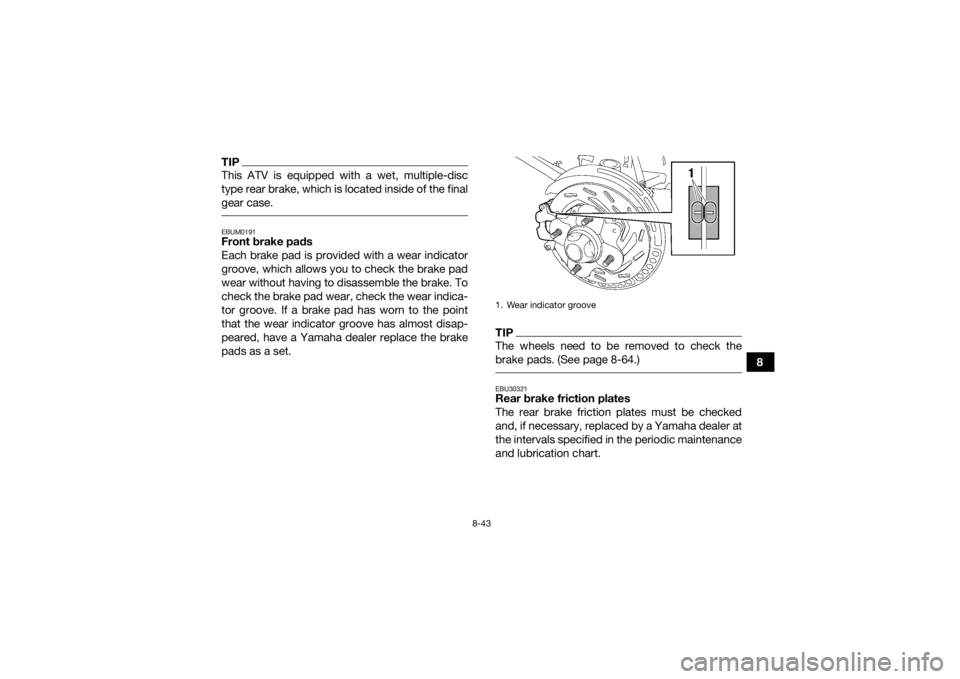
TIPThis ATV is equipped with a wet, multiple-disc
type rear brake, which is located inside of the final
gear case. EBUM0191Front brake pads
Each brake pad is provided with a wear indicator
groove, which allows you to check the brake pad
wear without having to disassemble the brake. To
check the brake pad wear, check the wear indica-
tor groove. If a brake pad has worn to the point
that the wear indicator groove has almost disap-
peared, have a Yamaha dealer replace the brake
pads as a set.
TIPThe wheels need to be removed to check the
brake pads. (See page 8-64.) EBU30321Rear brake friction plates
The rear brake friction plates must be checked
and, if necessary, replaced by a Yamaha dealer at
the intervals specified in the periodic maintenance
and lubrication chart.1. Wear indicator groove
UB1661E0.book Page 43 Thursday, May 12, 2016 2:47 PM
Page 147 of 178
8-51
8
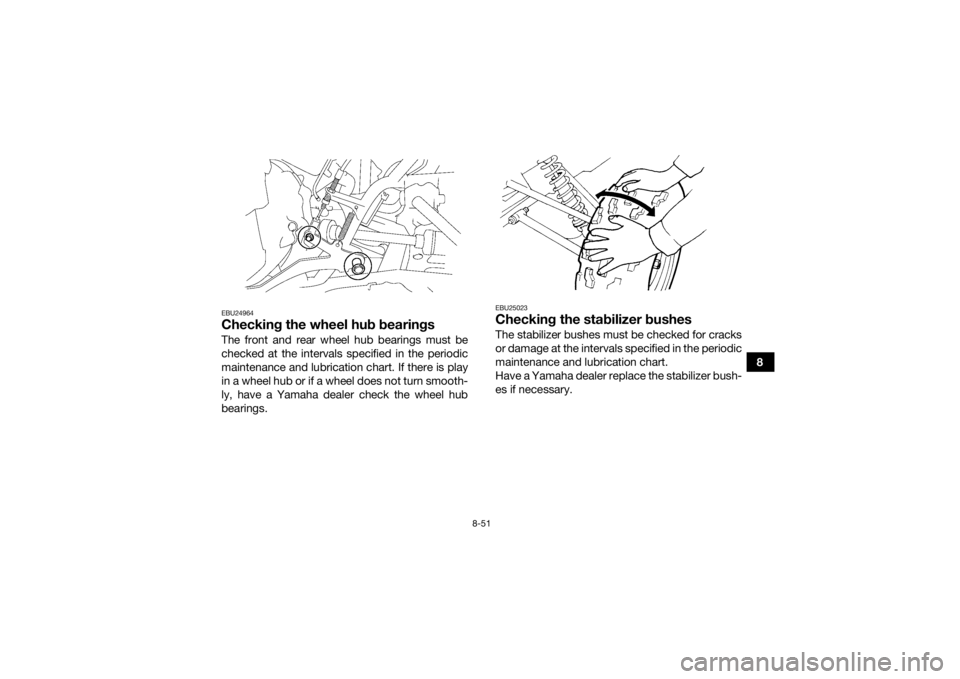
EBU24964Checking the wheel hub bearingsThe front and rear wheel hub bearings must be
checked at the intervals specified in the periodic
maintenance and lubrication chart. If there is play
in a wheel hub or if a wheel does not turn smooth-
ly, have a Yamaha dealer check the wheel hub
bearings.
EBU25023Checking the stabilizer bushesThe stabilizer bushes must be checked for cracks
or damage at the intervals specified in the periodic
maintenance and lubrication chart.
Have a Yamaha dealer replace the stabilizer bush-
es if necessary.
UB1661E0.book Page 51 Thursday, May 12, 2016 2:47 PM
Page 153 of 178
8-57
8
EBU30521Replacing a fuse
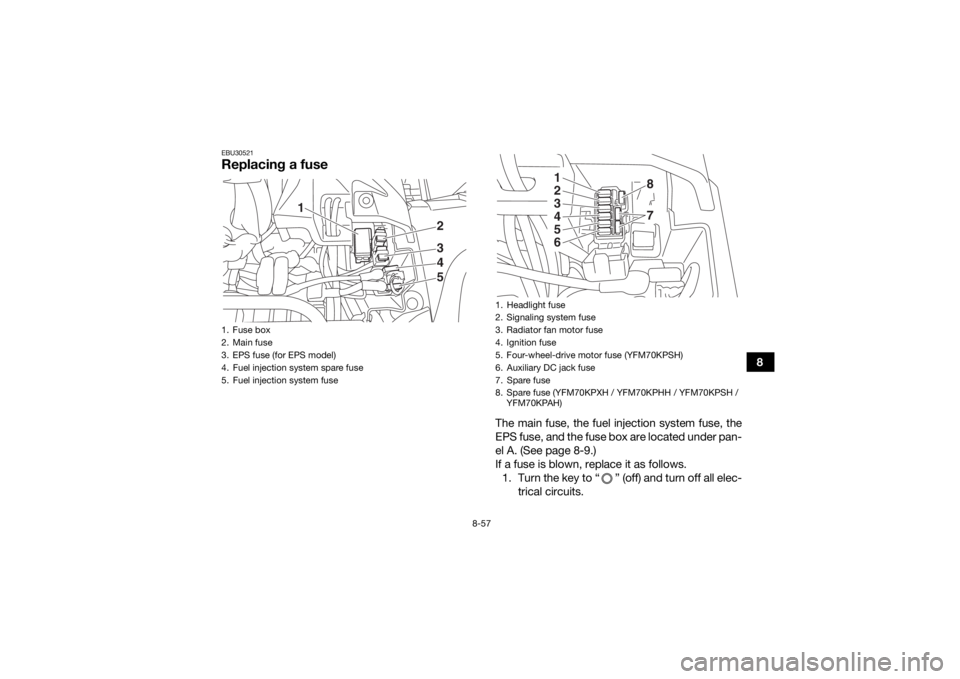
The main fuse, the fuel injection system fuse, the
EPS fuse, and the fuse box are located under pan-
el A. (See page 8-9.)
If a fuse is blown, replace it as follows.1. Turn the key to “ ” (off) and turn off all elec- trical circuits.
1. Fuse box
2. Main fuse
3. EPS fuse (for EPS model)
4. Fuel injection system spare fuse
5. Fuel injection system fuse
2345
1
1. Headlight fuse
2. Signaling system fuse
3. Radiator fan motor fuse
4. Ignition fuse
5. Four-wheel-drive motor fuse (YFM70KPSH)
6. Auxiliary DC jack fuse
7. Spare fuse
8. Spare fuse (YFM70KPXH / YFM70KPHH / YFM70KPSH / YFM70KPAH)
123456
87
UB1661E0.book Page 57 Thursday, May 12, 2016 2:47 PM
Page 154 of 178
8-58
8
NOTICEECB00641To prevent accidental short-circuiting, turn off
the main switch when checking or replacing a
fuse. 2. Remove the blown fuse, and then install anew fuse of the specified amperage.
WARNING! Always use a fuse of the spec-
ified rating, and never use a substitute ob-
ject in place of the proper fuse. An
improper fuse or a substitute object can
cause damage to the electrical system,
which could lead to a fire.
[EWB02173]
3. Turn the key to “ ” (on) and turn on the elec-trical circuits to check if the devices operate.
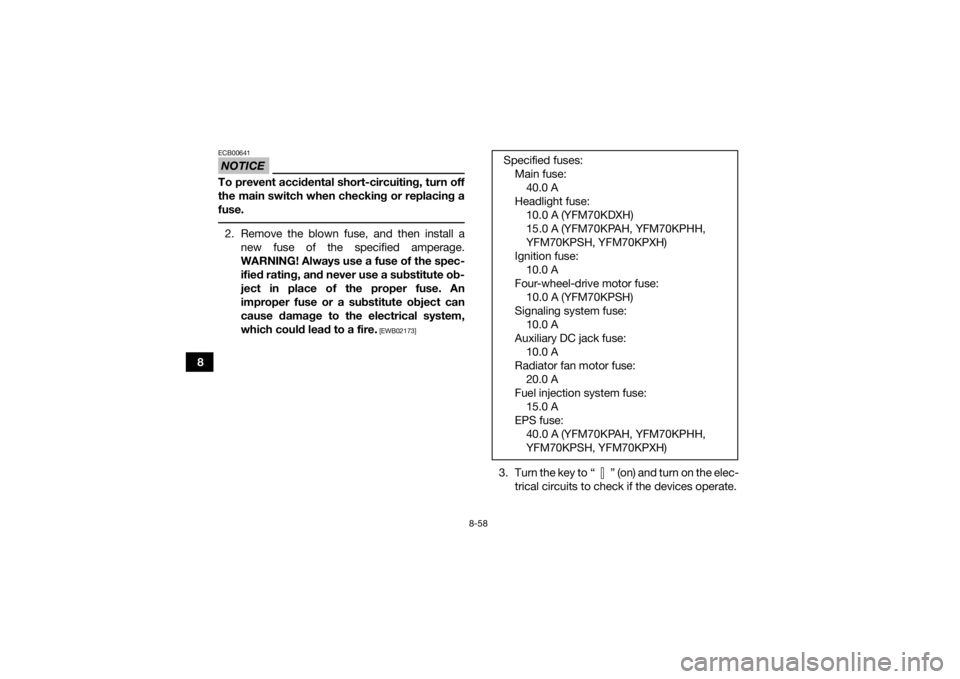
Specified fuses:
Main fuse:40.0 A
Headlight fuse: 10.0 A (YFM70KDXH)
15.0 A (YFM70KPAH, YFM70KPHH,
YFM70KPSH, YFM70KPXH)
Ignition fuse: 10.0 A
Four-wheel-drive motor fuse: 10.0 A (YFM70KPSH)
Signaling system fuse: 10.0 A
Auxiliary DC jack fuse: 10.0 A
Radiator fan motor fuse: 20.0 A
Fuel injection system fuse: 15.0 A
EPS fuse: 40.0 A (YFM70KPAH, YFM70KPHH,
YFM70KPSH, YFM70KPXH)
UB1661E0.book Page 58 Thursday, May 12, 2016 2:47 PM
Page 160 of 178
8-64
83. Insert a new bulb into the bulb holder, push it
in, and then turn it clockwise until it stops.
4. Install the bulb holder (together with the bulb) by turning it clockwise.
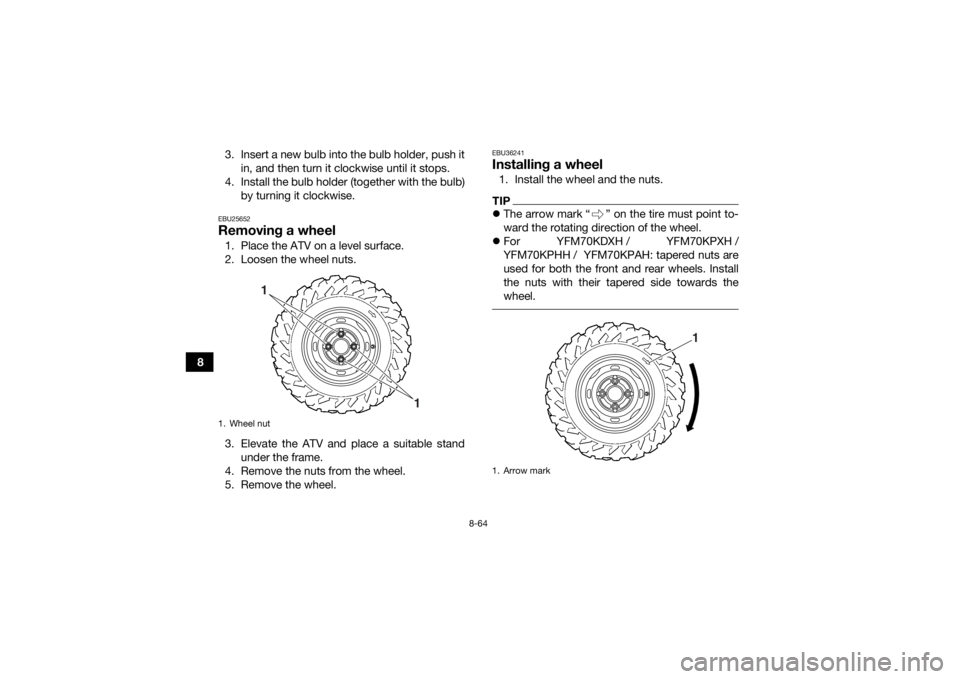
EBU25652Removing a wheel1. Place the ATV on a level surface.
2. Loosen the wheel nuts.
3. Elevate the ATV and place a suitable standunder the frame.
4. Remove the nuts from the wheel.
5. Remove the wheel.
EBU36241Installing a wheel1. Install the wheel and the nuts.TIP The arrow mark “ ” on the tire must point to-
ward the rotating direction of the wheel.
For YFM70KDXH / YFM70KPXH /
YFM70KPHH / YFM70KPAH: tapered nuts are
used for both the front and rear wheels. Install
the nuts with their tapered side towards the
wheel.
1. Wheel nut
1
1
1. Arrow mark
1
UB1661E0.book Page 64 Thursday, May 12, 2016 2:47 PM