brake YAMAHA KODIAK 700 2019 User Guide
[x] Cancel search | Manufacturer: YAMAHA, Model Year: 2019, Model line: KODIAK 700, Model: YAMAHA KODIAK 700 2019Pages: 180, PDF Size: 6.41 MB
Page 65 of 180
5-4
5
Brake fluid leakage (front brake)
Check to see if any brake fluid is leaking out of the
hose, joint or brake fluid reservoir of the front
brake. Apply the brake firmly for one minute. If the
lever moves slowly inward, there may be a leak in
the brake system. If there is any leakage, the brake
system should be checked by a Yamaha dealer.
Brake operation
Test the brakes at slow speed after starting out to
make sure they are working properly. If the brakes
do not provide proper braking performance,
check the brake pads and friction plates for wear.
(See page 8-42.)
EBU19762Throttle leverCheck the operation of the throttle lever. It must
open smoothly and spring back to the idle position
when released. Have a Yamaha dealer correct if
necessary.EBU38062TiresCheck and adjust the tire pressure before each
ride. Check tires for wear and damage. Tire pressure
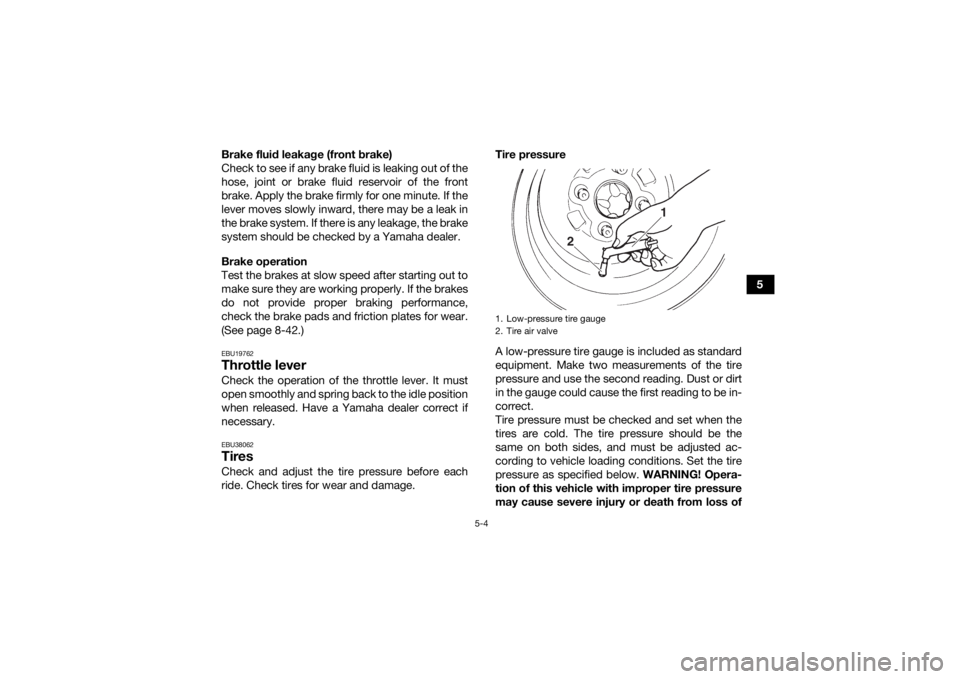
A low-pressure tire gauge is included as standard
equipment. Make two measurements of the tire
pressure and use the second reading. Dust or dirt
in the gauge could cause the first reading to be in-
correct.
Tire pressure must be checked and set when the
tires are cold. The tire pressure should be the
same on both sides, and must be adjusted ac-
cording to vehicle loading conditions. Set the tire
pressure as specified below.
WARNING! Opera-
tion of this vehicle with improper tire pressure
may cause severe injury or death from loss of
1. Low-pressure tire gauge
2. Tire air valve
2
1
UB5K60E0.book Page 4 Monday, May 28, 2018 11:35 AM
Page 69 of 180
6-1
6
EBU19882
OPERATION
EBU19902Read the Owner’s Manual carefully before riding
the ATV. If there is a control or function you do not
understand, ask your Yamaha dealer.
WARNING
EWB00632Read the Owner’s Manual carefully to become
familiar with all controls in order to help pre-
vent any loss of control, which could cause an
accident or injury. EBU38301Starting the engineThis model is equipped with an ignition circuit cut-
off system. To enable starting one of the following
conditions must be met:
The drive select lever is in the neutral or park po-
sition.
The rear brake lever or brake pedal is applied.TIPIt is recommended to shift into neutral or park and
apply the rear brake when starting the engine.
NOTICEECB00151See the “Engine break-in” section on page 6-4
prior to operating the engine for the first time. To start the engine
1. Turn the key to “ ” (on) and the engine stop switch to “ ” (run).
YFM70KDXK / YFM70KDHK
The coolant temperature warning light, the
engine trouble warning light, and the fuel level
warning light should come on for a few sec-
onds, then go off.
YFM70KPXK / YFM70KPAK /
YFM70KPHK / YFM70KPSK / YFM70KPLK
The battery voltage warning light, the cool-
ant temperature warning light, and the en-
gine trouble warning light should come on
for a few seconds, then go off.
The electric power steering warning light
should come on and stay on until the en-
gine is started.
UB5K60E0.book Page 1 Monday, May 28, 2018 11:35 AM
Page 70 of 180
6-2
6
NOTICEECB00826To avoid possible damage, do not operate the
ATV if a warning light does not work as de-
scribed above. 2. Apply the brake pedal, then shift the drive se-lect lever into the neutral or park position. The
corresponding indicator light should come
on. If the indicator light does not come on,
have a Yamaha dealer check the electrical
circuit.
3. Apply the rear brake lever or brake pedal.
4. Release the throttle lever, then push the start switch to crank the engine with the starter.
Release the start switch when the engine has
started.TIPIf the engine fails to start, release the start switch.
Wait a few seconds before the next cranking at-
tempt to allow battery voltage to restore. Do not
crank the engine more than 10 seconds on any
single attempt.
NOTICEECB00164For maximum engine life, never accelerate
hard when the engine is cold! EBU36230Operating the drive select lever and
driving in reverseNOTICEECB03330Do not shift without coming to a complete stop
and waiting for the engine to return to normal
idle speed. Damage to the engine or drivetrain
may occur. Shifting: Neutral to High-range and High-range
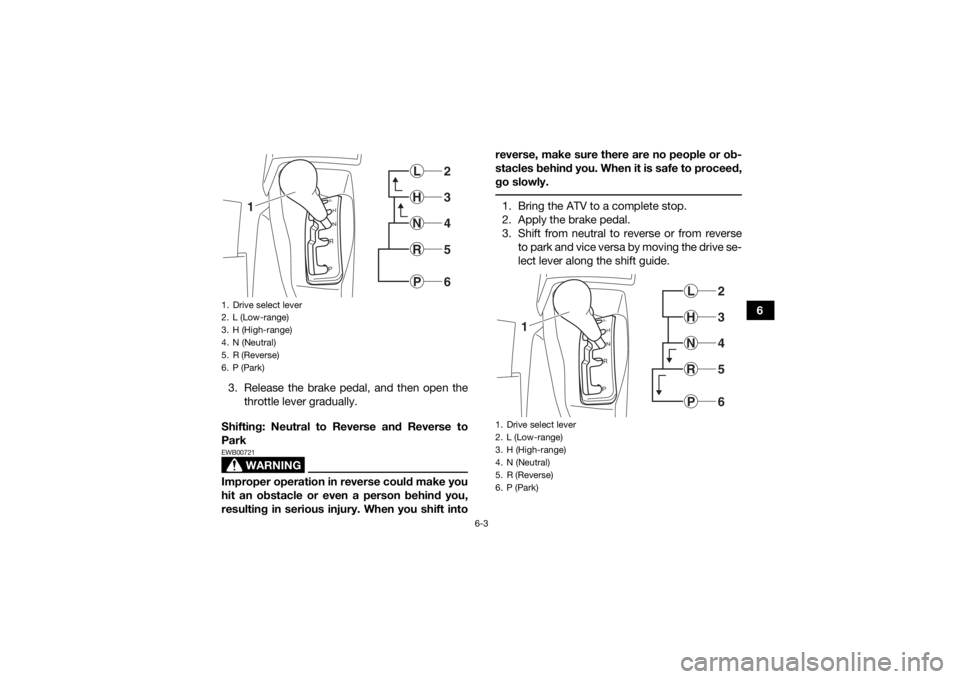
to Low-range1. Bring the ATV to a complete stop.
2. Apply the brake pedal, and then shift by mov- ing the drive select lever along the shift guide.TIPMake sure that the drive select lever is completely
shifted into position.
UB5K60E0.book Page 2 Monday, May 28, 2018 11:35 AM
Page 71 of 180
6-3
6
3. Release the brake pedal, and then open the throttle lever gradually.
Shifting: Neutral to Reverse and Reverse to
Park
WARNING
EWB00721Improper operation in reverse could make you
hit an obstacle or even a person behind you,
resulting in serious injury. When you shift into reverse, make sure there are no people or ob-
stacles behind you. When it is safe to proceed,
go slowly.
1. Bring the ATV to a complete stop.
2. Apply the brake pedal.
3. Shift from neutral to reverse or from reverse
to park and vice versa by moving the drive se-
lect lever along the shift guide.
1. Drive select lever
2. L (Low-range)
3. H (High-range)
4. N (Neutral)
5. R (Reverse)
6. P (Park)
1
23456
LHNRP
1. Drive select lever
2. L (Low-range)
3. H (High-range)
4. N (Neutral)
5. R (Reverse)
6. P (Park)
1
23456
LHNRP
UB5K60E0.book Page 3 Monday, May 28, 2018 11:35 AM
Page 72 of 180
6-4
6
TIPWhen in reverse, the reverse indicator light
should come on. If the indicator light does not
come on, have a Yamaha dealer check the elec-
trical circuit.
Due to the synchronizing mechanism in the en-
gine, the indicator light may not come on until
the ATV starts moving. 4. Check behind for people or obstacles, and
then release the brake pedal.
5. Open the throttle lever gradually and continue to watch to the rear while backing.EBU36861Engine break-inThere is never a more important period in the life
of your engine than the first 240 km (150 mi) or 20
hours of operation. For this reason, you should fol-
low the engine break-in instructions carefully.
Since the engine is brand new, do not put an ex-
cessive load on it for the first 240 km (150 mi) or
20 hours. During this period the various parts in
the engine wear and polish themselves to the cor-
rect operating clearances. Avoid prolonged full-
throttle operation or any condition that might re-
sult in engine overheating. 0–120 km (0–75 mi) or 0–10 hours
Avoid prolonged operation above 1/2 throttle.
Vary the speed of the ATV regularly. Do not oper-
ate it at one set throttle position.
120–240 km (75–150 mi) or 10–20 hours
Avoid prolonged operation above 3/4 throttle. Rev
the engine freely, but do not use full throttle at any
time.
240 km (150 mi) or 20 hours and beyond
The ATV can now be operated normally.
NOTICEECB00221If any engine trouble should occur during the
engine break-in period, immediately have a
Yamaha dealer check the ATV. EBU27322ParkingWhen parking the ATV, stop the engine, and shift
the drive select lever into the park position.
UB5K60E0.book Page 4 Monday, May 28, 2018 11:35 AM
Page 73 of 180
6-5
6
EBU29901Parking on a slope
WARNING
EWB00861Avoid parking on hills or other inclines. Parking
on a hill or other incline could cause the ATV to
roll out of control, increasing the chance of an
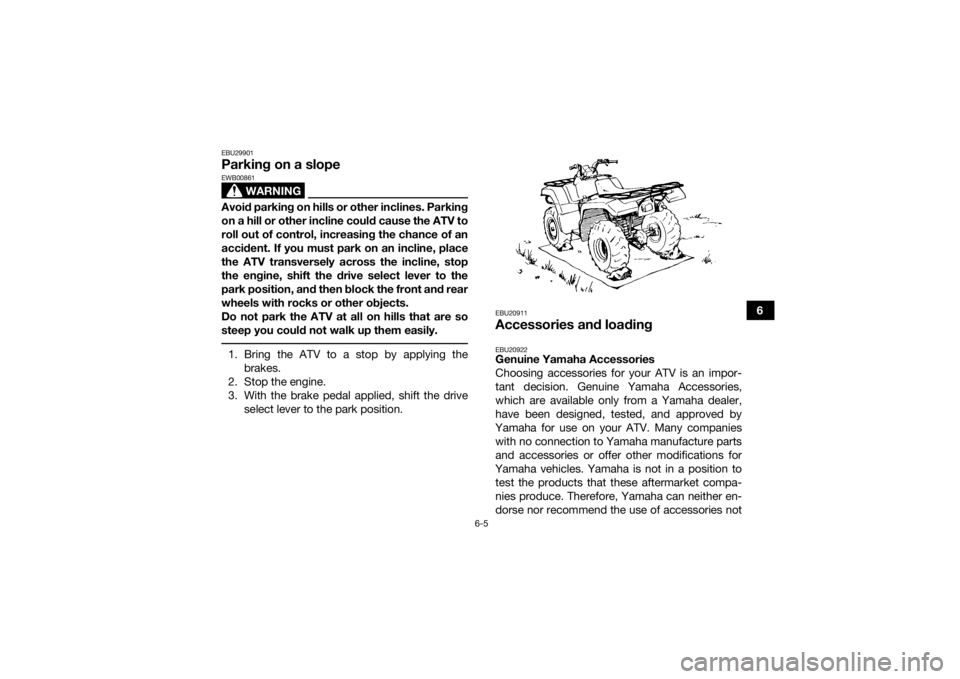
accident. If you must park on an incline, place
the ATV transversely across the incline, stop
the engine, shift the drive select lever to the
park position, and then block the front and rear
wheels with rocks or other objects.
Do not park the ATV at all on hills that are so
steep you could not walk up them easily. 1. Bring the ATV to a stop by applying thebrakes.
2. Stop the engine.
3. With the brake pedal applied, shift the drive select lever to the park position.
EBU20911Accessories and loadingEBU20922Genuine Yamaha Accessories
Choosing accessories for your ATV is an impor-
tant decision. Genuine Yamaha Accessories,
which are available only from a Yamaha dealer,
have been designed, tested, and approved by
Yamaha for use on your ATV. Many companies with no connection to Yamaha manufacture parts
and accessories or offer other modifications for
Yamaha vehicles. Yamaha is not in a position to test the products that these aftermarket compa-
nies produce. Therefore, Yamaha can neither en-
dorse nor recommend the use of accessories not
UB5K60E0.book Page 5 Monday, May 28, 2018 11:35 AM
Page 87 of 180
7-12
7
Select a large, flat, unpaved area to become famil-
iar with your ATV. Make sure that this area is free
of obstacles and other riders. You should practice
control of the throttle, brakes, shifting procedures,
and turning techniques in this area before trying
more difficult terrain.
Shift to the park position and follow the instruction
on page 6-1 to start the engine. Once it has
warmed up you are ready to begin riding your
ATV. With the engine idling, shift the drive select
lever into the low-range position or the high-range
position. Apply the throttle slowly and smoothly.
The centrifugal clutch will engage and you will
start to accelerate. If the throttle is applied too
abruptly, the front wheels may lift off the ground,
resulting in a loss of directional control. Avoid
higher speeds until you are thoroughly familiar
with the operation of your ATV.
When slowing down or stopping, release the
throttle and apply the brakes smoothly and evenly.
Improper use of the brakes can cause the tires to
lose traction, reducing control and increasing the
possibility of an accident.
NOTICEECB00252Do not shift from low-range to high-range or
vice versa without coming to a complete stop.
Damage to the engine or drive train may occur. TURNING YOUR ATV
WARNING
EWB01772Always follow proper procedures for turning as
described in this Owner’s Manual. Practice
turning at low speeds before attempting to turn
at faster speeds. Do not turn at speeds too fast
for your skills or the conditions. ATV could go
out of control, causing a collision or overturn. To achieve maximum traction on unpaved surfac-
es, the two rear wheels turn together at the same
speed. Therefore, unless the wheel on the inside
of the turn is allowed to slip or lose some traction,
the ATV will resist turning. A special turning tech-
nique must be used to allow the ATV to make
turns quickly and easily. It is essential that this skill
be learned first at low speed.
UB5K60E0.book Page 12 Monday, May 28, 2018 11:35 AM
Page 90 of 180

7-15
7Do not attempt to climb hills until you have mas-
tered basic maneuvers on flat ground. Always
check the terrain carefully before attempting any
hill. In all cases avoid inclines with slippery or
loose surfaces, or obstacles that might cause you
to lose control.
To climb a hill, you need traction, momentum, and
steady throttle. For more traction and control for
climbing steeper and/or rougher slopes, select
“4WD” or 4WD-LOCK (“DIFF. LOCK”)
(YFM70KPXK / YFM70KPAK / YFM70KPHK /
YFM70KPSK / YFM70KPLK). Travel fast enough
to maintain momentum, but not so fast that you
cannot react to changes in the terrain as you
climb.
It is important when climbing a hill to make sure
that your weight is transferred forward on the ATV.
This can be accomplished by leaning forward and,
on steeper inclines, standing on the footboards
and leaning forward over the handlebars. When-
ever possible, ride straight up hills.
Slow down when you reach the crest of the hill if
you cannot see clearly what is on the other side –
there could be another person, an obstacle, or a sharp drop-off. Use common sense and remem-
ber that some hills are too steep for you to climb
or descend.
If you are climbing a hill and you find that you have
not properly judged your ability to make it to the
top, you should turn the ATV around while you still
have forward motion (provided you have the room
to do so) and go down the hill.
If your ATV has stalled or stopped and you believe
you can continue up the hill, restart carefully to
make sure you do not lift the front wheels which
could cause you to lose control. If you are unable
to continue up the hill, dismount the ATV on the
uphill side. Physically turn the ATV around and
then descend the hill.
If you start to roll backwards, DO NOT apply either
brake abruptly. If you are in “2WD”, apply only the
front brake. When fully stopped, apply the rear
brake as well, and then shift to the park position. If
you are in “4WD”, because all wheels are inter-
connected by the drive train, applying either brake
will brake all wheels, therefore, avoid sudden ap-
plication of either the front or rear brake as the
wheels on the uphill side could come off the
ground. The ATV could easily tip over backwards.
Apply both the front and rear brakes gradually.
UB5K60E0.book Page 15 Monday, May 28, 2018 11:35 AM
Page 91 of 180
7-16
7
When fully stopped, lock shift to the park position
and dismount the ATV immediately on the uphill
side. Dismount on uphill side or to a side if pointed
straight uphill. Turn the ATV around and remount,
following the procedure described in the Owner’s
Manual.
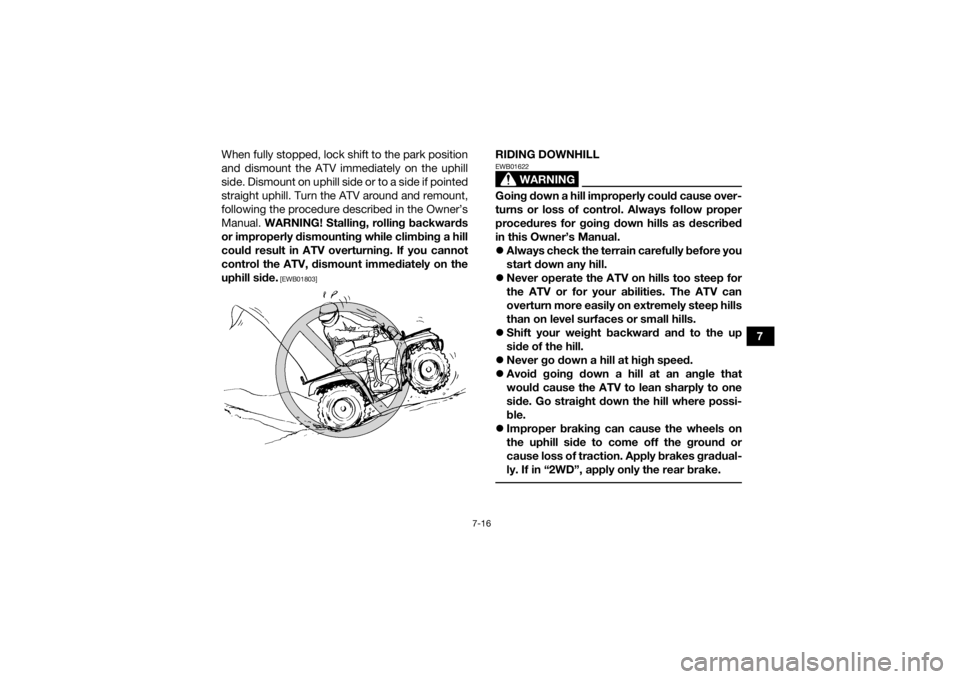
WARNING! Stalling, rolling backwards
or improperly dismounting while climbing a hill
could result in ATV overturning. If you cannot
control the ATV, dismount immediately on the
uphill side.
[EWB01803]
RIDING DOWNHILL
WARNING
EWB01622Going down a hill improperly could cause over-
turns or loss of control. Always follow proper
procedures for going down hills as described
in this Owner’s Manual.
Always check the terrain carefully before you
start down any hill.
Never operate the ATV on hills too steep for
the ATV or for your abilities. The ATV can
overturn more easily on extremely steep hills
than on level surfaces or small hills.
Shift your weight backward and to the up
side of the hill.
Never go down a hill at high speed.
Avoid going down a hill at an angle that
would cause the ATV to lean sharply to one
side. Go straight down the hill where possi-
ble.
Improper braking can cause the wheels on
the uphill side to come off the ground or
cause loss of traction. Apply brakes gradual-
ly. If in “2WD”, apply only the rear brake.
UB5K60E0.book Page 16 Monday, May 28, 2018 11:35 AM
Page 92 of 180
7-17
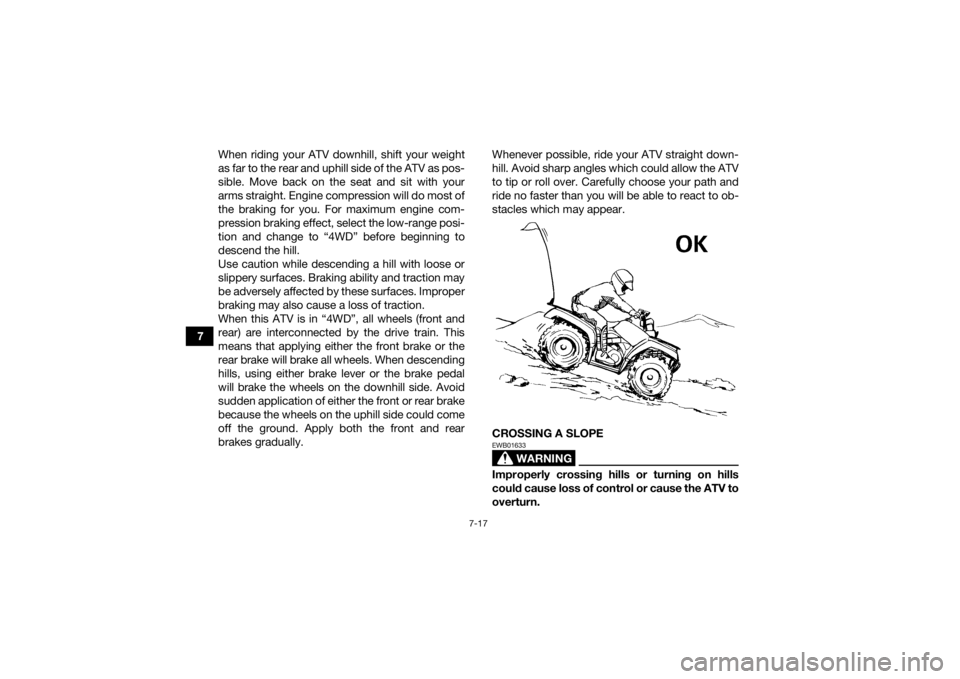
7When riding your ATV downhill, shift your weight
as far to the rear and uphill side of the ATV as pos-
sible. Move back on the seat and sit with your
arms straight. Engine compression will do most of
the braking for you. For maximum engine com-
pression braking effect, select the low-range posi-
tion and change to “4WD” before beginning to
descend the hill.
Use caution while descending a hill with loose or
slippery surfaces. Braking ability and traction may
be adversely affected by these surfaces. Improper
braking may also cause a loss of traction.
When this ATV is in “4WD”, all wheels (front and
rear) are interconnected by the drive train. This
means that applying either the front brake or the
rear brake will brake all wheels. When descending
hills, using either brake lever or the brake pedal
will brake the wheels on the downhill side. Avoid
sudden application of either the front or rear brake
because the wheels on the uphill side could come
off the ground. Apply both the front and rear
brakes gradually. Whenever possible, ride your ATV straight down-
hill. Avoid sharp angles which could allow the ATV
to tip or roll over. Carefully choose your path and
ride no faster than you will be able to react to ob-
stacles which may appear.
CROSSING A SLOPE
WARNING
EWB01633Improperly crossing hills or turning on hills
could cause loss of control or cause the ATV to
overturn.
UB5K60E0.book Page 17 Monday, May 28, 2018 11:35 AM