check engine YAMAHA MAJESTY 125 2009 Owners Manual
[x] Cancel search | Manufacturer: YAMAHA, Model Year: 2009, Model line: MAJESTY 125, Model: YAMAHA MAJESTY 125 2009Pages: 84, PDF Size: 2.83 MB
Page 6 of 84
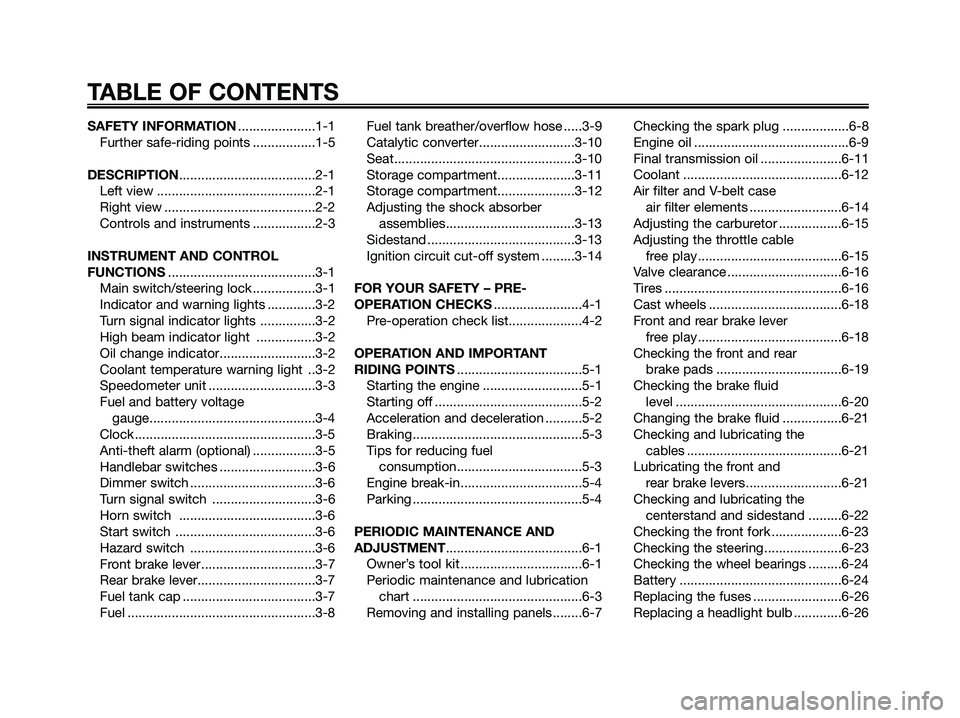
SAFETY INFORMATION.....................1-1
Further safe-riding points .................1-5
DESCRIPTION.....................................2-1
Left view ...........................................2-1
Right view .........................................2-2
Controls and instruments .................2-3
INSTRUMENT AND CONTROL
FUNCTIONS........................................3-1
Main switch/steering lock .................3-1
Indicator and warning lights .............3-2
Turn signal indicator lights ...............3-2
High beam indicator light ................3-2
Oil change indicator..........................3-2
Coolant temperature warning light ..3-2
Speedometer unit .............................3-3
Fuel and battery voltage
gauge.............................................3-4
Clock .................................................3-5
Anti-theft alarm (optional) .................3-5
Handlebar switches ..........................3-6
Dimmer switch ..................................3-6
Turn signal switch ............................3-6
Horn switch .....................................3-6
Start switch ......................................3-6
Hazard switch ..................................3-6
Front brake lever...............................3-7
Rear brake lever................................3-7
Fuel tank cap ....................................3-7
Fuel ...................................................3-8Fuel tank breather/overflow hose .....3-9
Catalytic converter..........................3-10
Seat.................................................3-10
Storage compartment.....................3-11
Storage compartment.....................3-12
Adjusting the shock absorber
assemblies...................................3-13
Sidestand ........................................3-13
Ignition circuit cut-off system .........3-14
FOR YOUR SAFETY – PRE-
OPERATION CHECKS........................4-1
Pre-operation check list....................4-2
OPERATION AND IMPORTANT
RIDING POINTS..................................5-1
Starting the engine ...........................5-1
Starting off ........................................5-2
Acceleration and deceleration ..........5-2
Braking..............................................5-3
Tips for reducing fuel
consumption..................................5-3
Engine break-in.................................5-4
Parking ..............................................5-4
PERIODIC MAINTENANCE AND
ADJUSTMENT.....................................6-1
Owner’s tool kit .................................6-1
Periodic maintenance and lubrication
chart ..............................................6-3
Removing and installing panels........6-7Checking the spark plug ..................6-8
Engine oil ..........................................6-9
Final transmission oil ......................6-11
Coolant ...........................................6-12
Air filter and V-belt case
air filter elements .........................6-14
Adjusting the carburetor .................6-15
Adjusting the throttle cable
free play .......................................6-15
Valve clearance ...............................6-16
Tires ................................................6-16
Cast wheels ....................................6-18
Front and rear brake lever
free play .......................................6-18
Checking the front and rear
brake pads ..................................6-19
Checking the brake fluid
level .............................................6-20
Changing the brake fluid ................6-21
Checking and lubricating the
cables ..........................................6-21
Lubricating the front and
rear brake levers..........................6-21
Checking and lubricating the
centerstand and sidestand .........6-22
Checking the front fork ...................6-23
Checking the steering.....................6-23
Checking the wheel bearings .........6-24
Battery ............................................6-24
Replacing the fuses ........................6-26
Replacing a headlight bulb .............6-26
TABLE OF CONTENTS
5D8-F8199-E1.QXD 10/7/08 07:39 Página 6
Page 10 of 84
●Do not run engine in poorly venti-
lated or partially enclosed areas
such as barns, garages, or car-
ports.
●Do not run engine outdoors whe-
re engine exhaust can be drawn
into a building through openings
such as windows and doors.
Loading
Adding accessories or cargo to your
scooter can adversely affect stability
and handling if the weight distribution
of the scooter is changed. To avoid
the possibility of an accident, use
extreme caution when adding cargo
or accessories to your scooter. Use
extra care when riding a scooter that
has added cargo or accessories.
Here, along with the information
about accessories below, are some
general guidelines to follow if loading
cargo to your scooter:
The total weight of the operator, pas-
senger, accessories and cargo must
not exceed the maximum load limit.
Operation of an overloaded vehicle
could cause an accident.When loading within this weight limit,
keep the following in mind:
●Cargo and accessory weight
should be kept as low and close
to the scooter as possible. Secu-
rely pack your heaviest items as
close to the center of the vehicle
as possible and make sure to dis-
tribute the weight as evenly as
possible on both sides of the
scooter to minimize imbalance or
instability.
●Shifting weights can create a
sudden imbalance. Make sure
that accessories and cargo are
securely attached to the scooter
before riding. Check accessory
mounts and cargo restraints fre-
quently.
• Properly adjust the suspension
for your load (suspension-
adjustable models only), and
check the condition and pres-
sure of your tires.• Never attach any large or
heavy items to the handlebar,
front fork, or front fender. Such
items can create unstable
handling or a slow steering res-
ponse.
●This vehicle is not designed to
pull a trailer or to be attached
to a sidecar.
Genuine Yamaha Accessories
Choosing accessories for your vehicle
is an important decision. Genuine
Yamaha accessories, which are avai-
lable only from a Yamaha dealer, have
been designed, tested, and approved
by Yamaha for use on your vehicle.
Many companies with no connection
to Yamaha manufacture parts and
accessories or offer other modifica-
tions for Yamaha vehicles. Yamaha is
not in a position to test the products
that these aftermarket companies
produce. Therefore, Yamaha can neit-
her endorse nor recommend the use
of accessories not sold by Yamaha or
modifications not specifically recom-
mended by Yamaha, even if sold and
installed by a Yamaha dealer.
Maximum load:
177 kg (390 lb)
1
SAFETY INFORMATION
1-3
5D8-F8199-E1.QXD 10/7/08 07:39 Página 10
Page 17 of 84
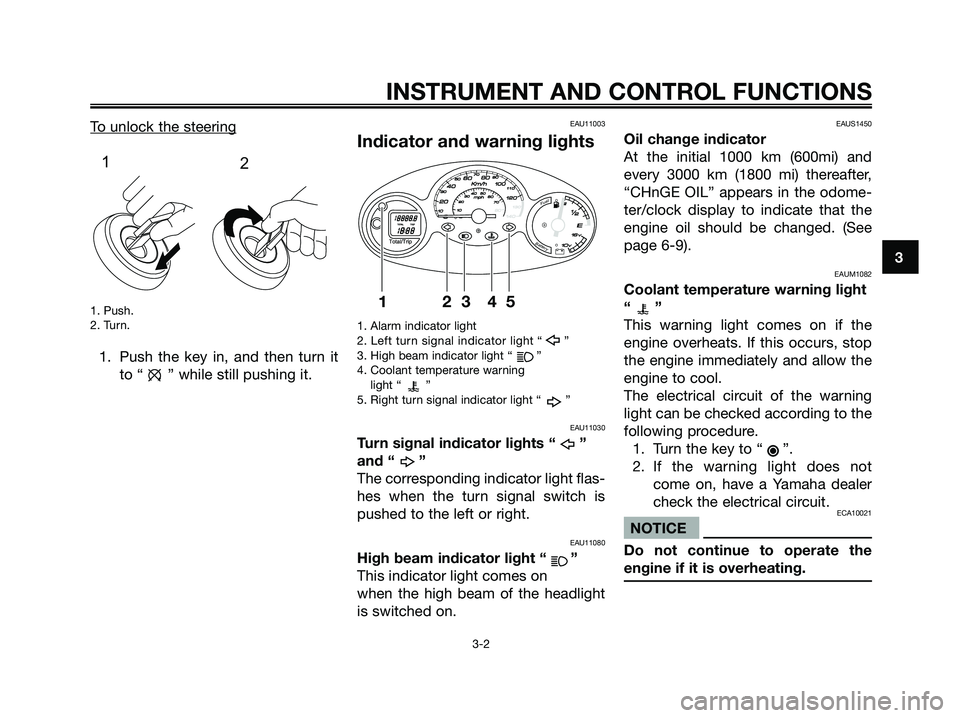
To unlock the steering
1. Push.
2. Turn.
1. Push the key in, and then turn it
to “ ” while still pushing it.
EAU11003
Indicator and warning lights
1. Alarm indicator light
2. Left turn signal indicator light “ ”
3. High beam indicator light “ ”
4. Coolant temperature warning
light “ ”
5. Right turn signal indicator light “ ”
EAU11030
Turn signal indicator lights “ ”
and “ ”
The corresponding indicator light flas-
hes when the turn signal switch is
pushed to the left or right.
EAU11080
High beam indicator light “ ”
This indicator light comes on
when the high beam of the headlight
is switched on.
EAUS1450
Oil change indicator
At the initial 1000 km (600mi) and
every 3000 km (1800 mi) thereafter,
“CHnGE OIL” appears in the odome-
ter/clock display to indicate that the
engine oil should be changed. (See
page 6-9).
EAUM1082
Coolant temperature warning light
“”
This warning light comes on if the
engine overheats. If this occurs, stop
the engine immediately and allow the
engine to cool.
The electrical circuit of the warning
light can be checked according to the
following procedure.
1. Turn the key to “ ”.
2. If the warning light does not
come on, have a Yamaha dealer
check the electrical circuit.
ECA10021
NOTICE
Do not continue to operate the
engine if it is overheating.
Fuel
Battery
TOTALTRIP
123 45
1
2
INSTRUMENT AND CONTROL FUNCTIONS
3-2
3
5D8-F8199-E1.QXD 10/7/08 07:39 Página 17
Page 24 of 84
eyes, see your doctor immediately.
If gasoline spills on your skin, wash
with soap and water. If gasoline
spills on your clothing, change your
clothes.
EAU13320
ECA11400
NOTICE
Use only unleaded gasoline. The
use of leaded gasoline will cause
severe damage to internal engine
parts, such as the valves and piston
rings, as well as to the exhaust sys-
tem.
Your Yamaha engine has been desig-
ned to use regular unleaded gasoline
with a research octane number of 91
or higher. If knocking (or pinging)
occurs, use a gasoline of a different
brand or premium unleaded fuel. Use
of unleaded fuel will extend spark
plug life and reduce maintenance
costs.EAU39451
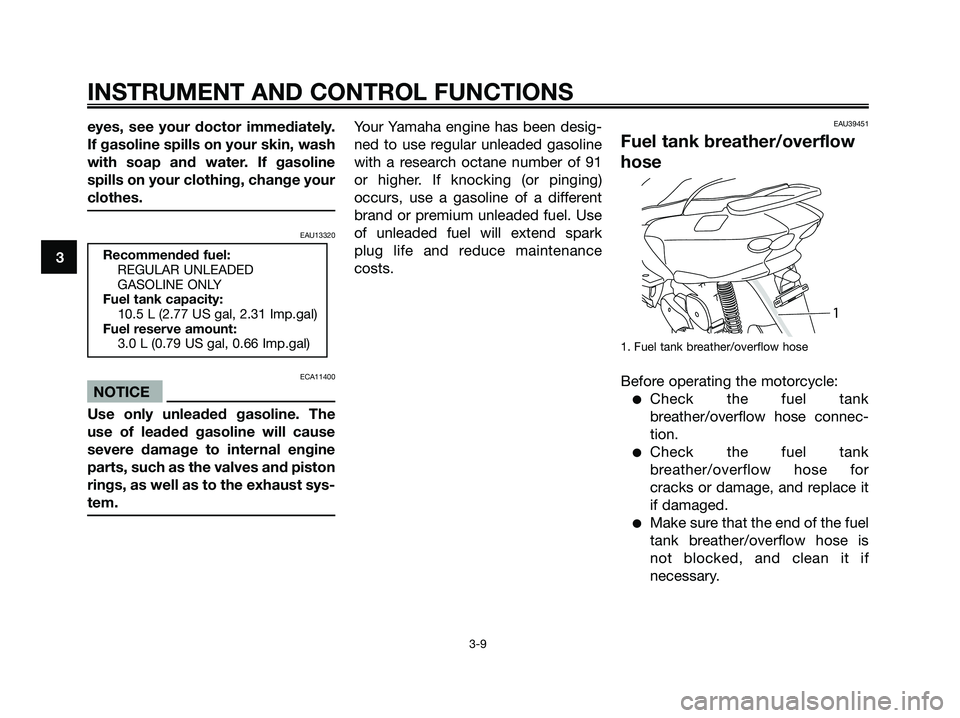
Fuel tank breather/overflow
hose
1. Fuel tank breather/overflow hose
Before operating the motorcycle:
●Check the fuel tank
breather/overflow hose connec-
tion.
●Check the fuel tank
breather/overflow hose for
cracks or damage, and replace it
if damaged.
●Make sure that the end of the fuel
tank breather/overflow hose is
not blocked, and clean it if
necessary.
1
Recommended fuel:
REGULAR UNLEADED
GASOLINE ONLY
Fuel tank capacity:
10.5 L (2.77 US gal, 2.31 Imp.gal)
Fuel reserve amount:
3.0 L (0.79 US gal, 0.66 Imp.gal)
INSTRUMENT AND CONTROL FUNCTIONS
3-9
3
5D8-F8199-E1.QXD 10/7/08 07:39 Página 24
Page 29 of 84
EWA10240
s s
WARNING
The vehicle must not be ridden with
the sidestand down, or if the sides-
tand cannot be properly moved up
(or does not stay up), otherwise the
sidestand could contact the ground
and distract the operator, resulting
in a possible loss of control. Yama-
ha’s ignition circuit cut-off system
has been designed to assist the
operator in fulfilling the responsibi-
lity of raising the sidestand before
starting off. Therefore, check this
system regularly as described
below and have a Yamaha dealer
repair it if it does not function pro-
perly.
EAU15362
Ignition circuit cut-off
system
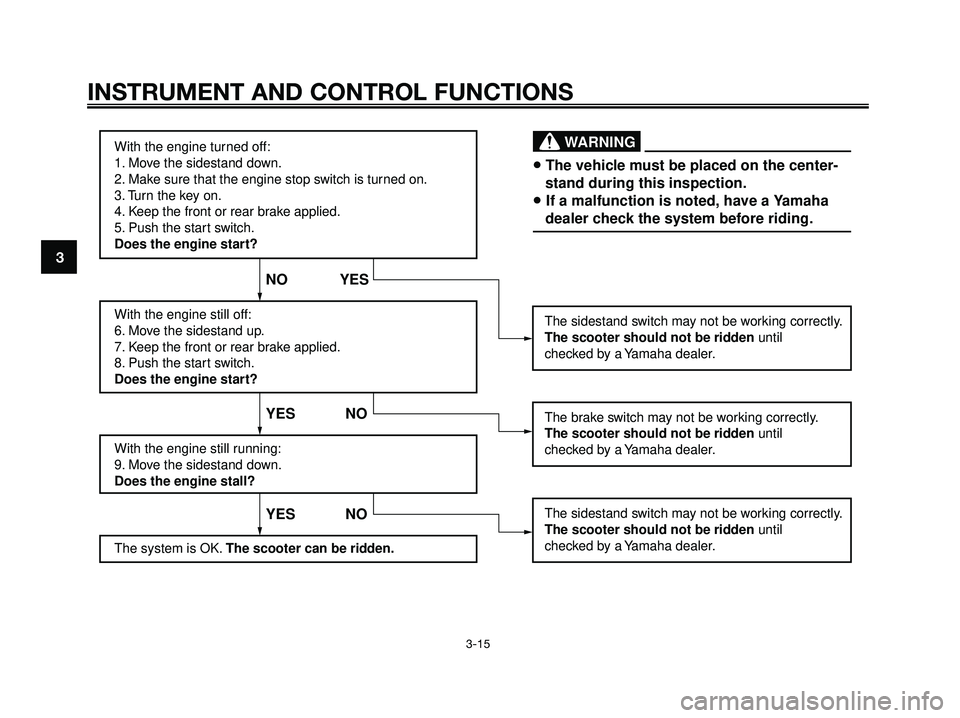
The ignition circuit cut-off system
(comprising the sidestand switch and
brake light switches) has the following
functions.
●It prevents starting when the
sidestand is up, but neither brake
is applied.
●It prevents starting when either
brake is applied, but the sides-
tand is still down.
●It cuts the running engine when
the sidestand is moved down.
Periodically check the operation of
the ignition circuit cut-off system
according to the following procedure.
TIP
This check is most reliable if perfor-
med with a warmed-up engine.
INSTRUMENT AND CONTROL FUNCTIONS
3-14
3
5D8-F8199-E1.QXD 10/7/08 07:39 Página 29
Page 30 of 84
With the engine turned off:
1. Move the sidestand down.
2. Make sure that the engine stop switch is turned on.
3. Turn the key on.
4. Keep the front or rear brake applied.
5. Push the start switch.
Does the engine start?
With the engine still off:
6. Move the sidestand up.
7. Keep the front or rear brake applied.
8. Push the start switch.
Does the engine start?
With the engine still running:
9. Move the sidestand down.
Does the engine stall?
The system is OK. The scooter can be ridden.The sidestand switch may not be working correctly.
The scooter should not be ridden until
checked by a Yamaha dealer.
The sidestand switch may not be working correctly.
The scooter should not be ridden until
checked by a Yamaha dealer.
YES NO YES NO NO YES
The brake switch may not be working correctly.
The scooter should not be ridden until
checked by a Yamaha dealer.
• The vehicle must be placed on the center-
stand during this inspection.
• If a malfunction is noted, have a Yamaha
dealer check the system before riding.
WARNING
INSTRUMENT AND CONTROL FUNCTIONS
3-15
3
5D8-F8199-E1.QXD 10/7/08 07:39 Página 30
Page 32 of 84
FOR YOUR SAFETY – PRE-OPERATION CHECKS
4-2
4
EAU15605
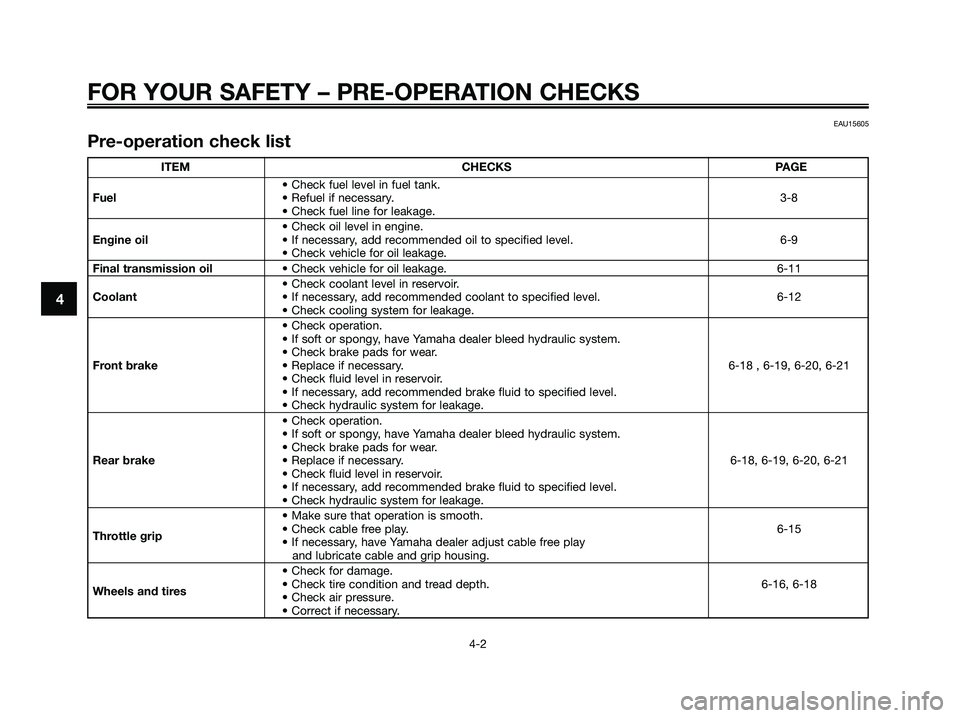
Pre-operation check list
ITEM CHECKS PAGE
• Check fuel level in fuel tank.
Fuel• Refuel if necessary.3-8
• Check fuel line for leakage.
• Check oil level in engine.
Engine oil• If necessary, add recommended oil to specified level. 6-9
• Check vehicle for oil leakage.
Final transmission oil• Check vehicle for oil leakage. 6-11
• Check coolant level in reservoir.
Coolant• If necessary, add recommended coolant to specified level. 6-12
• Check cooling system for leakage.
• Check operation.
• If soft or spongy, have Yamaha dealer bleed hydraulic system.
• Check brake pads for wear.
Front brake• Replace if necessary. 6-18 , 6-19, 6-20, 6-21
• Check fluid level in reservoir.
• If necessary, add recommended brake fluid to specified level.
• Check hydraulic system for leakage.
• Check operation.
• If soft or spongy, have Yamaha dealer bleed hydraulic system.
• Check brake pads for wear.
Rear brake• Replace if necessary. 6-18, 6-19, 6-20, 6-21
• Check fluid level in reservoir.
• If necessary, add recommended brake fluid to specified level.
• Check hydraulic system for leakage.
• Make sure that operation is smooth.
Throttle grip• Check cable free play. 6-15
• If necessary, have Yamaha dealer adjust cable free play
and lubricate cable and grip housing.
• Check for damage.
Wheels and tires• Check tire condition and tread depth. 6-16, 6-18
• Check air pressure.
• Correct if necessary.
5D8-F8199-E1.QXD 10/7/08 07:39 Página 32
Page 35 of 84
EAU16761
Starting off
TIP
Before starting off, allow the engine to
warm up.
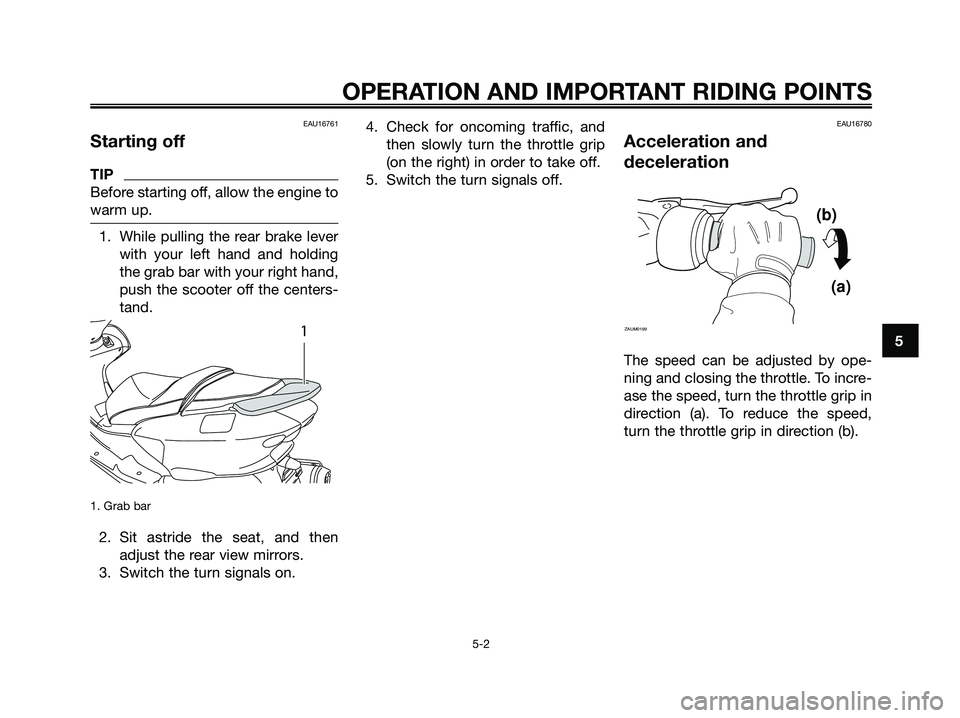
1. While pulling the rear brake lever
with your left hand and holding
the grab bar with your right hand,
push the scooter off the centers-
tand.
1. Grab bar
2. Sit astride the seat, and then
adjust the rear view mirrors.
3. Switch the turn signals on.4. Check for oncoming traffic, and
then slowly turn the throttle grip
(on the right) in order to take off.
5. Switch the turn signals off.
EAU16780
Acceleration and
deceleration
The speed can be adjusted by ope-
ning and closing the throttle. To incre-
ase the speed, turn the throttle grip in
direction (a). To reduce the speed,
turn the throttle grip in direction (b).
(b)
(a)
ZAUM01991
OPERATION AND IMPORTANT RIDING POINTS
5-2
5
5D8-F8199-E1.QXD 10/7/08 07:39 Página 35
Page 37 of 84
EAU16830
Engine break-in
There is never a more important
period in the life of your engine than
the period between 0 and 1000 km
(600 mi). For this reason, you should
read the following material carefully.
Since the engine is brand new, do not
put an excessive load on it for the first
1000 km (600 mi). The various parts in
the engine wear and polish themsel-
ves to the correct operating clearan-
ces. During this period, prolonged
full-throttle operation or any condition
that might result in engine overhea-
ting must be avoided.
EAU16951
0–150 km (0–90 mi)
●Avoid prolonged operation above
1/3 throttle.
●After every hour of operation,
stop the engine, and then let it
cool for five to ten minutes.
●Vary the engine speed from time
to time. Do not operate the engi-
ne at one set throttle position.150–500 km (90–300 mi)
●Avoid prolonged operation above
1/2 throttle.
●Rev the engine freely through the
gears, but do not use full throttle
at any time.
500–1000 km (300–600 mi)
●Avoid prolonged operation above
3/4 throttle. NOTICE: After 1000
km (600 mi) of operation, the
engine oil must be changed
and the oil strainer cleaned.
[ECA10351]
1000 km (600 mi) and beyond
●Avoid prolonged full-throttle ope-
ration. Vary the speed occasio-
nally.
ECA10270
NOTICE
If any engine trouble should occur
during the engine break-in period,
immediately have a Yamaha dealer
check the vehicle.
EAU17201
Parking
When parking, stop the engine, and
then remove the key from the main
switch.
EWA10311
s s
WARNING
●Since the engine and exhaust
system can become very hot,
park in a place where pedes-
trians or children are not likely
to touch them and be burned.
●Do not park on a slope or on
soft ground, otherwise the
vehicle may overturn, increa-
sing the risk of a fuel leak and
fire.
●Do not park near grass or other
flammable materials which
might catch fire.
OPERATION AND IMPORTANT RIDING POINTS
5-4
5
5D8-F8199-E1.QXD 10/7/08 07:39 Página 37
Page 42 of 84
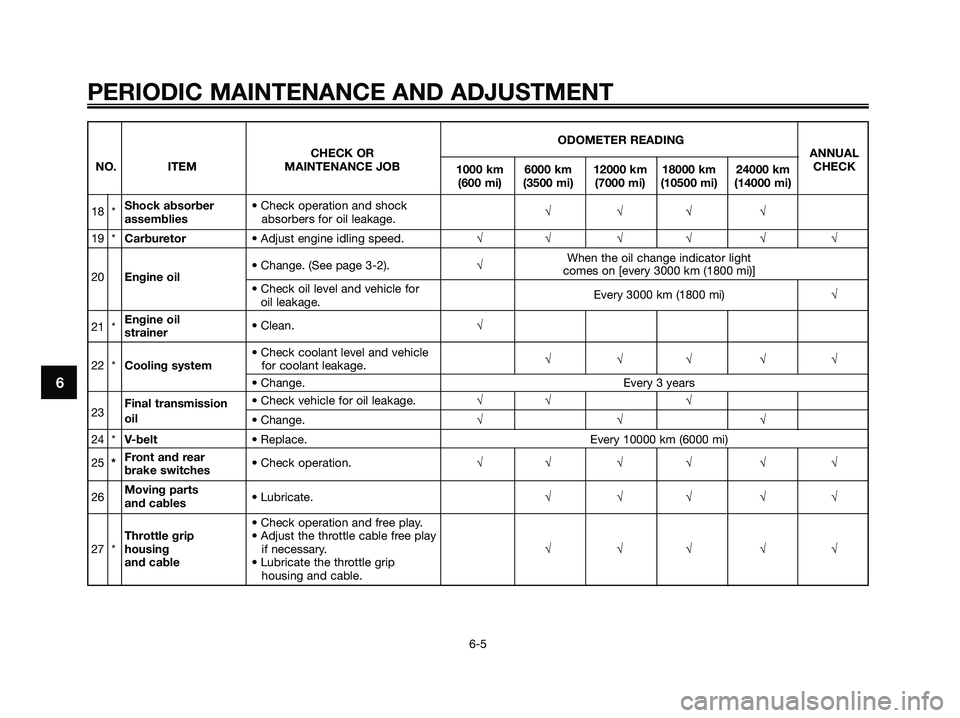
PERIODIC MAINTENANCE AND ADJUSTMENT
6-5
6
ODOMETER READING
CHECK OR ANNUAL
NO. ITEM MAINTENANCE JOB
1000 km 6000 km 12000 km 18000 km 24000 kmCHECK
(600 mi) (3500 mi) (7000 mi) (10500 mi) (14000 mi)
Shock absorber• Check operation and shock
√√√ √
18 *
assembliesabsorbers for oil leakage.
19 *Carburetor• Adjust engine idling speed.√√ √√ √ √
• Change. (See page 3-2). √When the oil change indicator light
20Engine oilcomes on [every 3000 km (1800 mi)]
• Check oil level and vehicle for
oil leakage.Every 3000 km (1800 mi)√
21 *Engine oil
strainer• Clean.√
• Check coolant level and vehicle
√√√ √√
22 *Cooling systemfor coolant leakage.
• Change. Every 3 years
Final transmission• Check vehicle for oil leakage.√√ √23
oil
• Change.√√ √
24 *V-belt• Replace. Every 10000 km (6000 mi)
Front and rear
25*
brake switches• Check operation.√√ √√ √ √
26Moving parts
• Lubricate.√√√ √√
and cables
• Check operation and free play.
Throttle grip • Adjust the throttle cable free play
27 *housingif necessary.√√√ √√
and cable• Lubricate the throttle grip
housing and cable.
5D8-F8199-E1.QXD 10/7/08 07:39 Página 42