fuel cap YAMAHA MT-03 2020 Owners Manual
[x] Cancel search | Manufacturer: YAMAHA, Model Year: 2020, Model line: MT-03, Model: YAMAHA MT-03 2020Pages: 94, PDF Size: 6.88 MB
Page 5 of 94
Table of contents
Safety information............................1-1
Description........................................2-1
Left view ..........................................2-1
Right view........................................2-2
Controls and instruments ................2-3
Instrument and control functions....3-1
Main switch/steering lock ...............3-1
Indicator lights and warning
lights ............................................3-2
Multi-function meter unit .................3-4
Handlebar switches.......................3-10
Clutch lever ...................................3-11
Shift pedal .....................................3-12
Brake lever ....................................3-12
Brake pedal ...................................3-13
ABS ...............................................3-13
Fuel tank cap.................................3-14
Fuel................................................3-15
Fuel tank overflow hose ................3-16
Catalytic converter ........................3-17
Seats .............................................3-17
Helmet holders ..............................3-19
Storage compartment ...................3-20
Adjusting the shock absorber
assembly....................................3-20
Luggage strap holders ..................3-21
Sidestand ......................................3-22
Ignition circuit cut-off system........3-22
For your safety – pre-operation
checks...............................................4-1
Operation and important riding
points.................................................5-1
Engine break-in ...............................5-1
Starting the engine ..........................5-2
Shifting ............................................5-3
Tips for reducing fuel
consumption ................................5-4
Parking ............................................5-5
Periodic maintenance and
adjustment........................................6-1
Tool kit.............................................6-2Periodic maintenance charts .......... 6-3
Periodic maintenance chart for
the emission control system........ 6-3
General maintenance and
lubrication chart........................... 6-4
Checking the spark plugs ............... 6-7
Canister........................................... 6-8
Engine oil and oil filter cartridge ..... 6-8
Why Yamalube .............................. 6-11
Coolant ......................................... 6-12
Replacing the air filter element
and cleaning the check hose..... 6-13
Checking the throttle grip
free play ..................................... 6-15
Valve clearance ............................. 6-15
Tires .............................................. 6-16
Cast wheels .................................. 6-18
Adjusting the clutch lever
free play ..................................... 6-18
Checking the brake lever
free play ..................................... 6-19
Brake light switches ...................... 6-20
Checking the front and rear
brake pads................................. 6-20
Checking the brake fluid level....... 6-21
Changing the brake fluid............... 6-22
Drive chain slack ........................... 6-23
Cleaning and lubricating the
drive chain ................................. 6-24
Checking and lubricating the
cables ........................................ 6-25
Checking and lubricating the
throttle grip and cable ............... 6-25
Checking and lubricating the
brake and shift pedals ............... 6-26
Checking and lubricating the
brake and clutch levers ............. 6-26
Checking and lubricating the
sidestand ................................... 6-27
Lubricating the swingarm pivots... 6-27
Checking the front fork ................. 6-28
Checking the steering ................... 6-28
Checking the wheel bearings ....... 6-29
Battery .......................................... 6-29
Replacing the fuses ...................... 6-31
Vehicle lights ................................. 6-33
UB6WE0E0.book Page 1 Friday, March 27, 2020 11:37 AM
Page 11 of 94
Safety information
1-5
1 operator and may limit control
ability, therefore, such accesso-
ries are not recommended.
Use caution when adding electri-
cal accessories. If electrical ac-
cessories exceed the capacity of
the motorcycle’s electrical sys-
tem, an electric failure could re-
sult, which could cause a
dangerous loss of lights or engine
power.
Aftermarket Tires and Rims
The tires and rims that came with your
motorcycle were designed to match
the performance capabilities and to
provide the best combination of han-
dling, braking, and comfort. Other
tires, rims, sizes, and combinations
may not be appropriate. See page 6-16
for tire specifications and for informa-
tion on servicing and replacing your
tires.
Transporting the Motorcycle
Be sure to observe following instruc-
tions before transporting the motorcy-
cle in another vehicle.
Remove all loose items from the
motorcycle.
Check that the fuel cock (if
equipped) is in the off position and
that there are no fuel leaks.
Shift the transmission into gear
(for models with a manual trans-
mission).
Secure the motorcycle with tie-
downs or suitable straps that are
attached to solid parts of the mo-
torcycle, such as the frame or up-
per front fork triple clamp (and not,
for example, to rubber-mountedhandlebars or turn signals, or
parts that could break). Choose
the location for the straps carefully
so the straps will not rub against
painted surfaces during transport.
The suspension should be com-
pressed somewhat by the tie-
downs, if possible, so that the mo-
torcycle will not bounce exces-
sively during transport.
UB6WE0E0.book Page 5 Friday, March 27, 2020 11:37 AM
Page 13 of 94

Description
2-2
2
EAU63391
Right view
12
10 9 8 7 6345
1. Fuse box (page 6-31)
2. Battery (page 6-29)
3. Fuel tank cap (page 3-14)
4. Auxiliary light
5. Headlight (page 6-33)
6. Engine oil filler cap (page 6-8)
7. Engine oil level check window (page 6-8)
8. Brake pedal (page 3-13)
9. Rear brake light switch (page 6-20)
10.Rear brake fluid reservoir (page 6-21)
UB6WE0E0.book Page 2 Friday, March 27, 2020 11:37 AM
Page 28 of 94
Instrument and control functions
3-14
3This ABS has a test mode which
allows the owner to experience
the pulsation at the brake lever or
brake pedal when the ABS is op-
erating. However, special tools are
required, so please consult your
Yamaha dealer.
NOTICE
ECA20100
Be careful not to damage the wheel
sensor or wheel sensor rotor; other-
wise, improper performance of the
ABS will result.
EAU13076
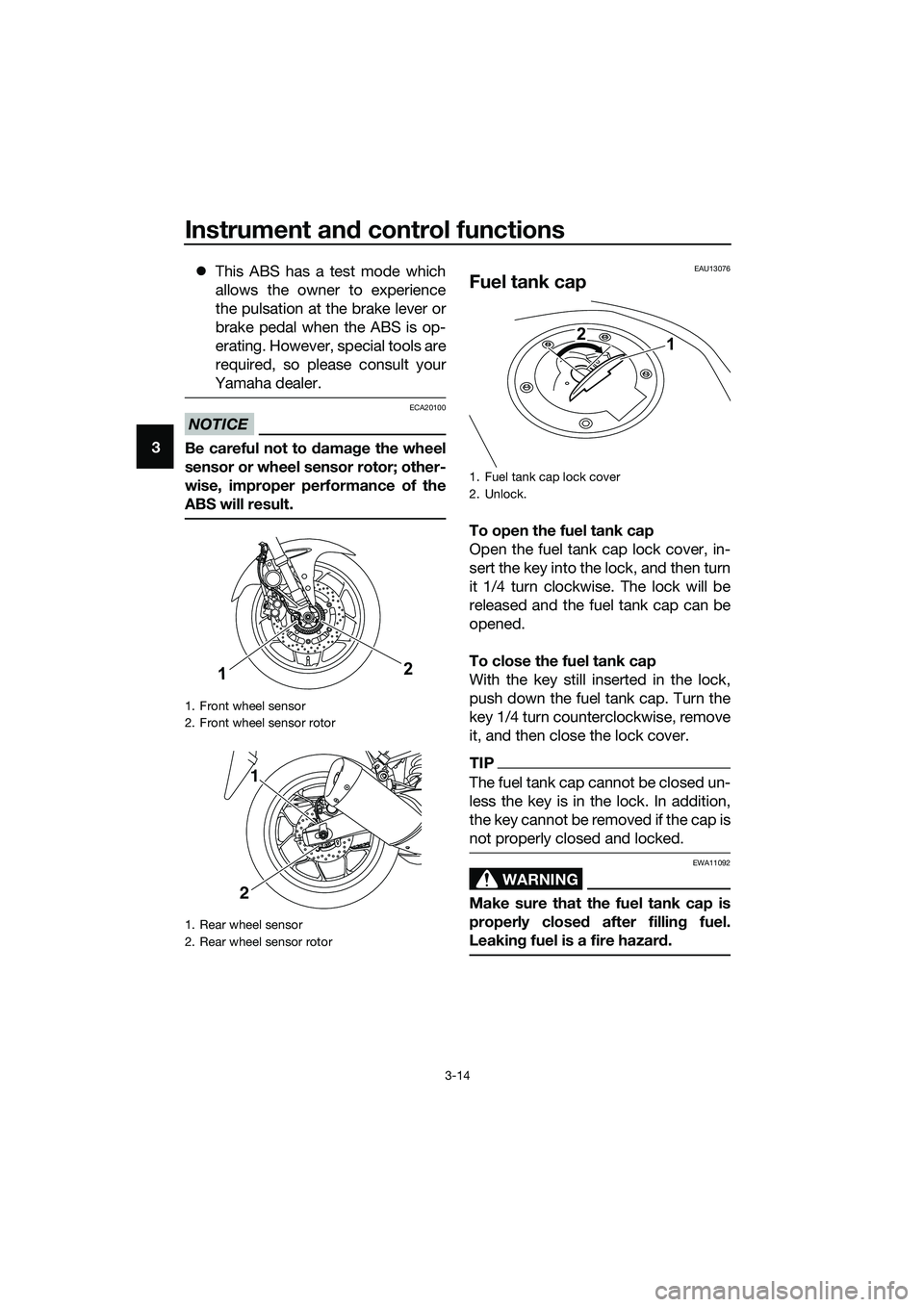
Fuel tank cap
To open the fuel tank cap
Open the fuel tank cap lock cover, in-
sert the key into the lock, and then turn
it 1/4 turn clockwise. The lock will be
released and the fuel tank cap can be
opened.
To close the fuel tank cap
With the key still inserted in the lock,
push down the fuel tank cap. Turn the
key 1/4 turn counterclockwise, remove
it, and then close the lock cover.
TIP
The fuel tank cap cannot be closed un-
less the key is in the lock. In addition,
the key cannot be removed if the cap is
not properly closed and locked.
WARNING
EWA11092
Make sure that the fuel tank cap is
properly closed after filling fuel.
Leaking fuel is a fire hazard.
1. Front wheel sensor
2. Front wheel sensor rotor
1. Rear wheel sensor
2. Rear wheel sensor rotor
12
1
2
1. Fuel tank cap lock cover
2. Unlock.
1 2
UB6WE0E0.book Page 14 Friday, March 27, 2020 11:37 AM
Page 29 of 94
Instrument and control functions
3-15
3
EAU13222
Fuel
Make sure there is sufficient gasoline in
the tank.
WARNING
EWA10882
Gasoline and gasoline vapors are
extremely flammable. To avoid fires
and explosions and to reduce the
risk of injury when refueling, follow
these instructions.
1. Before refueling, turn off the en-
gine and be sure that no one is sit-
ting on the vehicle. Never refuel
while smoking, or while in the vi-
cinity of sparks, open flames, or
other sources of ignition such as
the pilot lights of water heaters
and clothes dryers.
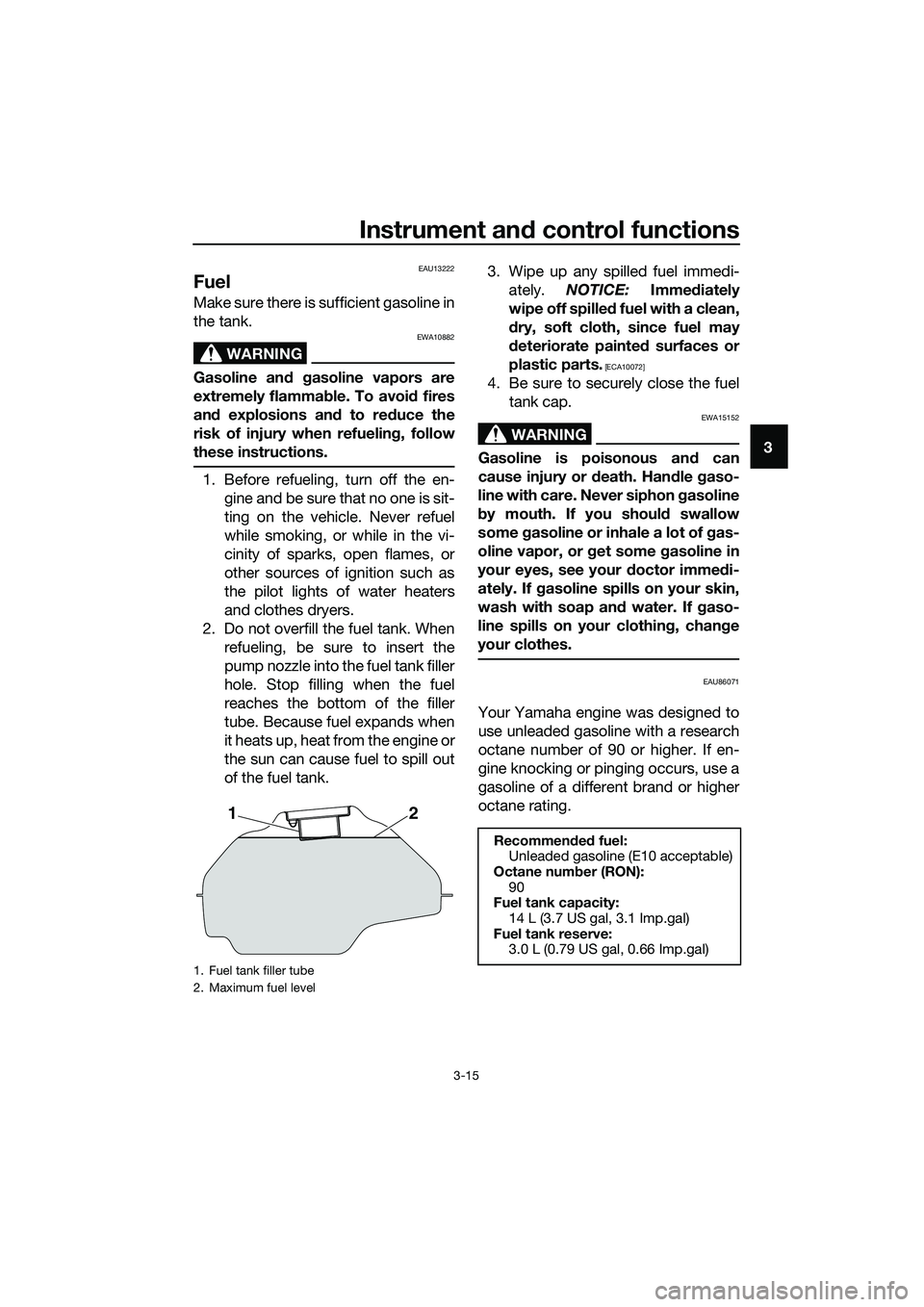
2. Do not overfill the fuel tank. When
refueling, be sure to insert the
pump nozzle into the fuel tank filler
hole. Stop filling when the fuel
reaches the bottom of the filler
tube. Because fuel expands when
it heats up, heat from the engine or
the sun can cause fuel to spill out
of the fuel tank.3. Wipe up any spilled fuel immedi-
ately. NOTICE: Immediately
wipe off spilled fuel with a clean,
dry, soft cloth, since fuel may
deteriorate painted surfaces or
plastic parts.
[ECA10072]
4. Be sure to securely close the fuel
tank cap.
WARNING
EWA15152
Gasoline is poisonous and can
cause injury or death. Handle gaso-
line with care. Never siphon gasoline
by mouth. If you should swallow
some gasoline or inhale a lot of gas-
oline vapor, or get some gasoline in
your eyes, see your doctor immedi-
ately. If gasoline spills on your skin,
wash with soap and water. If gaso-
line spills on your clothing, change
your clothes.
EAU86071
Your Yamaha engine was designed to
use unleaded gasoline with a research
octane number of 90 or higher. If en-
gine knocking or pinging occurs, use a
gasoline of a different brand or higher
octane rating.
1. Fuel tank filler tube
2. Maximum fuel level
21
Recommended fuel:
Unleaded gasoline (E10 acceptable)
Octane number (RON):
90
Fuel tank capacity:
14 L (3.7 US gal, 3.1 Imp.gal)
Fuel tank reserve:
3.0 L (0.79 US gal, 0.66 Imp.gal)
UB6WE0E0.book Page 15 Friday, March 27, 2020 11:37 AM
Page 52 of 94
Periodic maintenance and adjustment
6-8
6
EAU36112
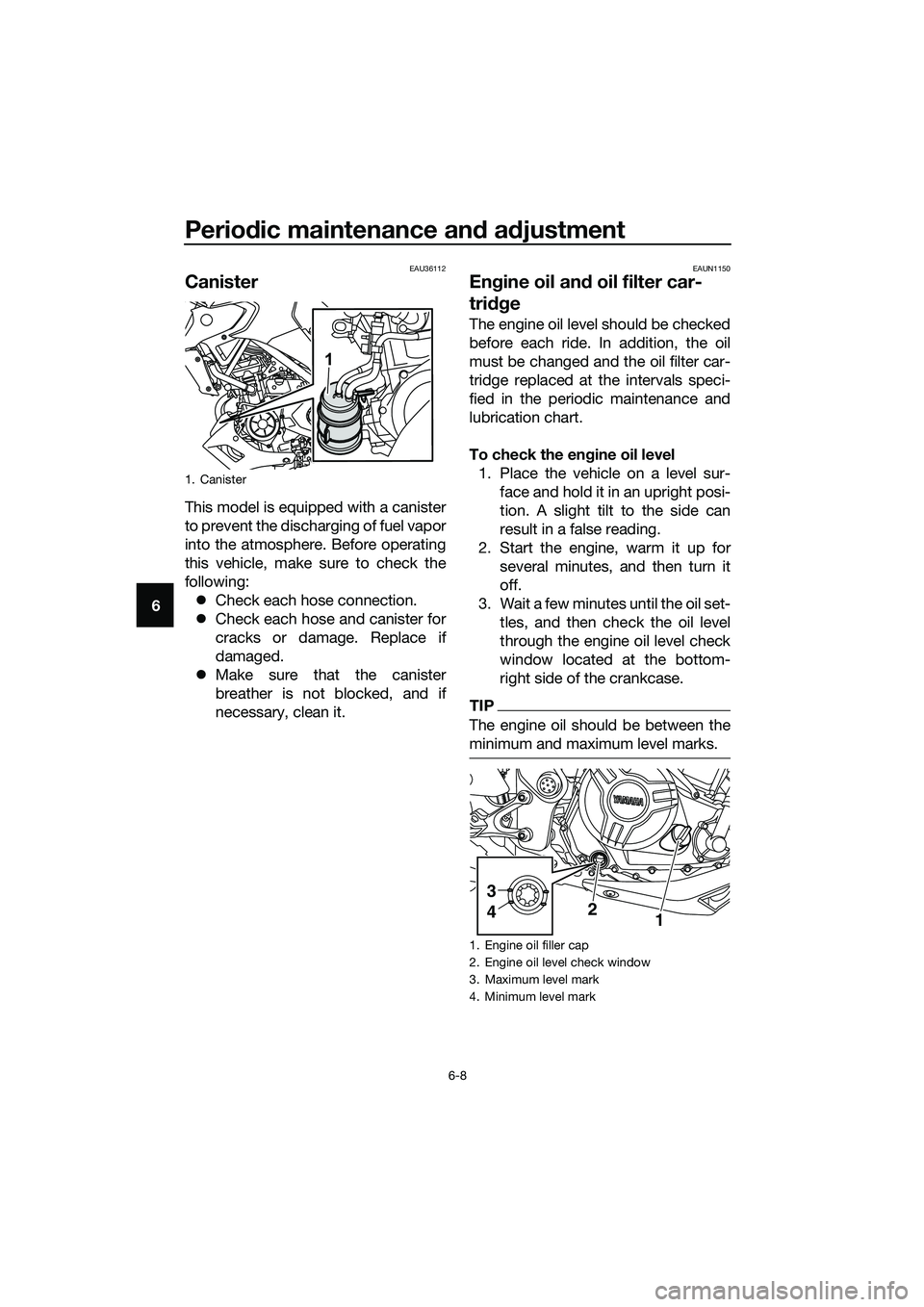
Canister
This model is equipped with a canister
to prevent the discharging of fuel vapor
into the atmosphere. Before operating
this vehicle, make sure to check the
following:
Check each hose connection.
Check each hose and canister for
cracks or damage. Replace if
damaged.
Make sure that the canister
breather is not blocked, and if
necessary, clean it.
EAUN1150
Engine oil and oil filter car-
tridge
The engine oil level should be checked
before each ride. In addition, the oil
must be changed and the oil filter car-
tridge replaced at the intervals speci-
fied in the periodic maintenance and
lubrication chart.
To check the engine oil level
1. Place the vehicle on a level sur-
face and hold it in an upright posi-
tion. A slight tilt to the side can
result in a false reading.
2. Start the engine, warm it up for
several minutes, and then turn it
off.
3. Wait a few minutes until the oil set-
tles, and then check the oil level
through the engine oil level check
window located at the bottom-
right side of the crankcase.
TIP
The engine oil should be between the
minimum and maximum level marks.
1. Canister
1
1. Engine oil filler cap
2. Engine oil level check window
3. Maximum level mark
4. Minimum level mark
3
4
1 2
UB6WE0E0.book Page 8 Friday, March 27, 2020 11:37 AM
Page 85 of 94

Motorcycle care and storage
7-4
7
EAU83472
Storage
Always store the vehicle in a cool, dry
place. If necessary, protect it against
dust with a porous cover. Be sure the
engine and the exhaust system are
cool before covering the vehicle. If the
vehicle often sits for weeks at a time
between uses, the use of a quality fuel
stabilizer is recommended after each
fill-up.
NOTICE
ECA21170
Storing the vehicle in a poorly
ventilated room or covering it
with a tarp, while it is still wet,
will allow water and humidity to
seep in and cause rust.
To prevent corrosion, avoid
damp cellars, stables (because
of the presence of ammonia)
and areas where strong chemi-
cals are stored.
Long term storage
Before storing the vehicle long term (60
days or more):
1. Make all necessary repairs and
perform any outstanding mainte-
nance.
2. Follow all instructions in the Care
section of this chapter.
3. Fill up the fuel tank, adding fuel
stabilizer according to product in-
structions. Run the engine for 5
minutes to distribute treated fuel
through the fuel system.
4. For vehicles equipped with a fuel
cock: Turn the fuel cock lever to
the off position.5. For vehicles with a carburetor: To
prevent fuel deposits from build-
ing up, drain the fuel in the carbu-
retor float chamber into a clean
container. Retighten the drain bolt
and pour the fuel back into the fuel
tank.
6. Use a quality engine fogging oil
according to product instructions
to protect internal engine compo-
nents from corrosion. If engine
fogging oil is not available, per-
form the following steps for each
cylinder:
a. Remove the spark plug cap
and spark plug.
b. Pour a teaspoonful of engine
oil into the spark plug bore.
c. Install the spark plug cap onto
the spark plug, and then place
the spark plug on the cylinder
head so that the electrodes are
grounded. (This will limit spark-
ing during the next step.)
d. Turn the engine over several
times with the starter. (This will
coat the cylinder wall with oil.)
WARNING! To prevent dam-
age or injury from sparking,
make sure to ground the
spark plug electrodes while
turning the engine over.
[EWA10952]
e. Remove the spark plug cap
from the spark plug, and then
install the spark plug and the
spark plug cap.
7. Lubricate all control cables, piv-
ots, levers and pedals, as well as
the sidestand and centerstand (if
equipped).
UB6WE0E0.book Page 4 Friday, March 27, 2020 11:37 AM
Page 87 of 94
Specifications
8-1
8
*Dimensions:
Overall length:
2090 mm (82.3 in)
Overall width:
755 mm (29.7 in)
Overall height:
1070 mm (42.1 in)
Seat height:
780 mm (30.7 in)
Wheelbase:
1380 mm (54.3 in)
Ground clearance:
160 mm (6.30 in)
Minimum turning radius:
2.9 m (9.51 ft)
*Weight:
Curb weight:
169 kg (373 lb)
*Engine:
Combustion cycle:
4-stroke
Cooling system:
Liquid cooled
Valve train:
DOHC
Cylinder arrangement:
Inline
Number of cylinders:
2-cylinder
Displacement:
321 cm3
Bore × stroke:
68.0 × 44.1 mm (2.68 × 1.74 in)
Starting system:
Electric starter
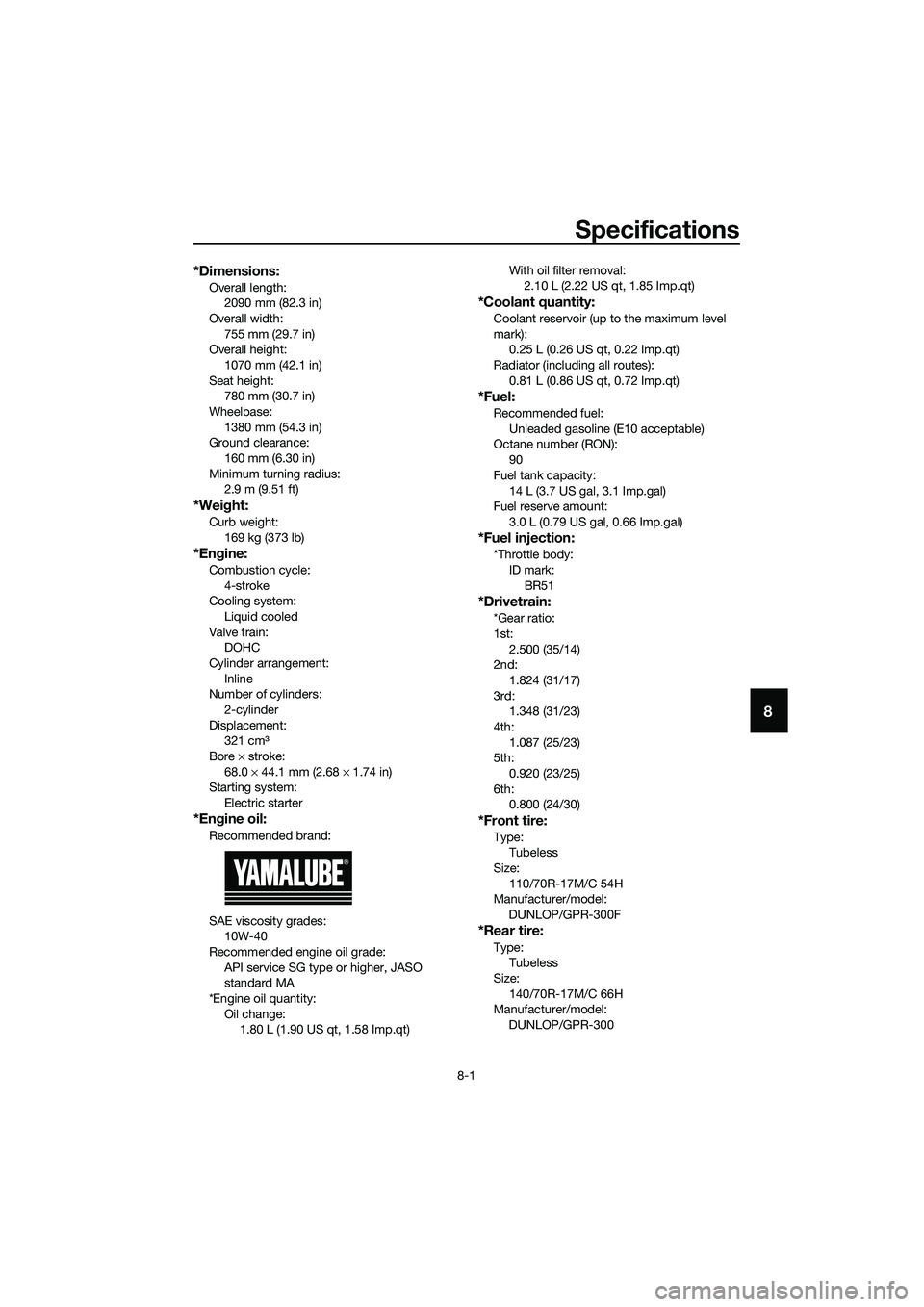
*Engine oil:
Recommended brand:
SAE viscosity grades:
10W-40
Recommended engine oil grade:
API service SG type or higher, JASO
standard MA
*Engine oil quantity:
Oil change:
1.80 L (1.90 US qt, 1.58 Imp.qt)With oil filter removal:
2.10 L (2.22 US qt, 1.85 Imp.qt)
*Coolant quantity:
Coolant reservoir (up to the maximum level
mark):
0.25 L (0.26 US qt, 0.22 Imp.qt)
Radiator (including all routes):
0.81 L (0.86 US qt, 0.72 Imp.qt)
*Fuel:
Recommended fuel:
Unleaded gasoline (E10 acceptable)
Octane number (RON):
90
Fuel tank capacity:
14 L (3.7 US gal, 3.1 Imp.gal)
Fuel reserve amount:
3.0 L (0.79 US gal, 0.66 Imp.gal)
*Fuel injection:
*Throttle body:
ID mark:
BR51
*Drivetrain:
*Gear ratio:
1st:
2.500 (35/14)
2nd:
1.824 (31/17)
3rd:
1.348 (31/23)
4th:
1.087 (25/23)
5th:
0.920 (23/25)
6th:
0.800 (24/30)
*Front tire:
Type:
Tubeless
Size:
110/70R-17M/C 54H
Manufacturer/model:
DUNLOP/GPR-300F
*Rear tire:
Type:
Tubeless
Size:
140/70R-17M/C 66H
Manufacturer/model:
DUNLOP/GPR-300
UB6WE0E0.book Page 1 Friday, March 27, 2020 11:37 AM
Page 91 of 94
10-1
10
Index
A
ABS ...................................................... 3-13
ABS warning light ................................... 3-3
Air filter element and check hose,
replacing and cleaning ....................... 6-13
B
Battery .................................................. 6-29
Brake and clutch levers,
checking and lubricating .................... 6-26
Brake and shift pedals,
checking and lubricating .................... 6-26
Brake fluid, changing ........................... 6-22
Brake fluid level, checking ................... 6-21
Brake lever ........................................... 3-12
Brake lever free play, checking ............ 6-19
Brake light switches ............................. 6-20
Brake pedal .......................................... 3-13
C
Cables, checking and lubricating ......... 6-25
Canister .................................................. 6-8
Care ........................................................ 7-1
Catalytic converter ............................... 3-17
Clock ...................................................... 3-5
Clutch lever .......................................... 3-11
Clutch lever free play, adjusting ........... 6-18
Coolant ................................................. 6-12
Coolant temperature meter .................... 3-5
D
Data recording, vehicle .......................... 9-2
Diagnostic connector ............................. 9-2
Dimmer switch ..................................... 3-10
Display units, switching.......................... 3-4
Drive chain, cleaning and lubricating ... 6-24
Drive chain slack .................................. 6-23
E
Engine break-in ...................................... 5-1
Engine oil and oil filter cartridge ............. 6-8
Engine overheating............................... 6-37
Engine serial number.............................. 9-1
Engine trouble warning light................... 3-3
F
Front and rear brake pads, checking ... 6-20
Front fork, checking ............................. 6-28
Fuel....................................................... 3-15
Fuel consumption, tips for reducing ...... 5-4
Fuel meter .............................................. 3-4
Fuel tank cap........................................ 3-14
Fuel tank overflow hose ....................... 3-16
Fuses, replacing ................................... 6-31
H
Handlebar switches .............................. 3-10
Hazard switch ....................................... 3-10
Helmet holders...................................... 3-19
High beam indicator light........................ 3-2
Horn switch........................................... 3-10
I
Identification numbers ............................ 9-1
Ignition circuit cut-off system ............... 3-22
Indicator lights and warning lights .......... 3-2
L
License plate light bulb, replacing ........ 6-33
Luggage strap holders .......................... 3-21
M
Main switch/steering lock ....................... 3-1
Maintenance and lubrication, periodic ... 6-4
Maintenance, emission control
system .................................................. 6-3
Matte color, caution ................................ 7-1
Model label ............................................. 9-1
Multi-function display ............................. 3-6
Multi-function meter unit ........................ 3-4
N
Neutral indicator light.............................. 3-2
O
Oil pressure warning light ....................... 3-2
P
Parking .................................................... 5-5
Part locations .......................................... 2-1
Pass switch........................................... 3-10
S
Safety information................................... 1-1
Seats ..................................................... 3-17
Shift indicator light .................................. 3-3
Shift indicator light control mode ........... 3-8
Shifting .................................................... 5-3
Shift pedal............................................. 3-12
Shock absorber assembly, adjusting ... 3-20
Sidestand .............................................. 3-22
Sidestand, checking and lubricating .... 6-27
Spark plugs, checking ............................ 6-7
Specifications ......................................... 8-1
Speedometer .......................................... 3-4
Start/Engine stop switch ...................... 3-10
Starting the engine.................................. 5-2
Steering, checking ................................ 6-28
Storage ................................................... 7-4
Storage compartment ........................... 3-20
Supporting the motorcycle ................... 6-34
Swingarm pivots, lubricating ................ 6-27
UB6WE0E0.book Page 1 Friday, March 27, 2020 11:37 AM