clutch YAMAHA MT-09 2017 Owners Manual
[x] Cancel search | Manufacturer: YAMAHA, Model Year: 2017, Model line: MT-09, Model: YAMAHA MT-09 2017Pages: 106, PDF Size: 7.05 MB
Page 6 of 106

Table of contentsSafety information........................... 1-1
Description ....................................... 2-1
Left view ......................................... 2-1
Right view ....................................... 2-2
Controls and instruments................ 2-3
Special features ............................... 3-1
D-mode (drive mode)...................... 3-1
Traction control system .................. 3-1
Quick shift system ...... .................... 3-3
Instrument and co ntrol functions... 4-1
Immobilizer system ..... .................... 4-1
Main switch/steering lock................ 4-2
Handlebar switches ........................ 4-4
Indicator lights and warning lights ............................................ 4-5
Multi-function meter unit ................. 4-8
Clutch lever................................... 4-14
Shift pedal..... ............................ .... 4-14
Brake lever ................................... 4-14
Brake pedal .................................. 4-15
ABS .............................................. 4-15
Fuel tank cap ................................ 4-16
Fuel............................................... 4-17
Fuel tank overflow hose................ 4-19
Catalytic converter ........................ 4-19
Seat .............................................. 4-20
Storage compartment ................... 4-20
Adjusting the front fork.................. 4-21 Adjusting the shock absorber
assembly................................... 4-23
Luggage strap holders . ................ 4-24
Auxiliary DC connectors ............... 4-25
Sidestand ..................................... 4-25
Ignition circuit cut- off system ........ 4-26
For your safety – pre-operation
checks .............................................. 5-1
Operation and important riding
points ................................................ 6-1
Starting the engine ......................... 6-1
Shifting ........................................... 6-2
Tips for reducing fuel consumption ............................... 6-3
Engine break-in .............................. 6-3
Parking ........................................... 6-4
Periodic maintenance and
adjustment ....................................... 7-1
Owner’s tool kit............................... 7-2
Periodic maintenance chart for the
emission control system ............. 7-3
General maintenance and
lubrication chart .......................... 7-5
Removing and installing panels ..... 7-9
Checking the spark plugs ............. 7-10
Canister ........................................ 7-11
Engine oil and oil filter cartridge ... 7-12
Coolant ......................................... 7-15 Air filter element ........................... 7-18
Checking the engine idling
speed............ ............................ 7-18
Checking the throttle grip free play ........................................... 7-19
Valve clearance ........................... 7-19
Tires ............................................. 7-19
Cast wheels ................................. 7-22
Adjusting the clutch lever free play ........................................... 7-22
Checking the brake lever free
play ........................................... 7-23
Brake light switches ..................... 7-23
Checking the front and rear
brake pads................................ 7-24
Checking the brake fluid level ...... 7-24
Changing the brake fluid .............. 7-26
Drive chain slack.......................... 7-26
Cleaning and lubricating the drive chain ................................ 7-28
Checking and lubricating the cables ....................................... 7-28
Checking and lubricating the
throttle grip and cable ............... 7-29
Checking and lubricating the
brake and shift pedals .............. 7-29
Checking and lubricating the brake and clutch levers ............ 7-30
Checking and lubricating the sidestand .................................. 7-30BS2-9-E0.book 1 ページ 2016年9月8日 木曜日 午前11時0分
Page 15 of 106
Description
2-3
123
4
5
6
7
8
9
10
11
12
EAU10431
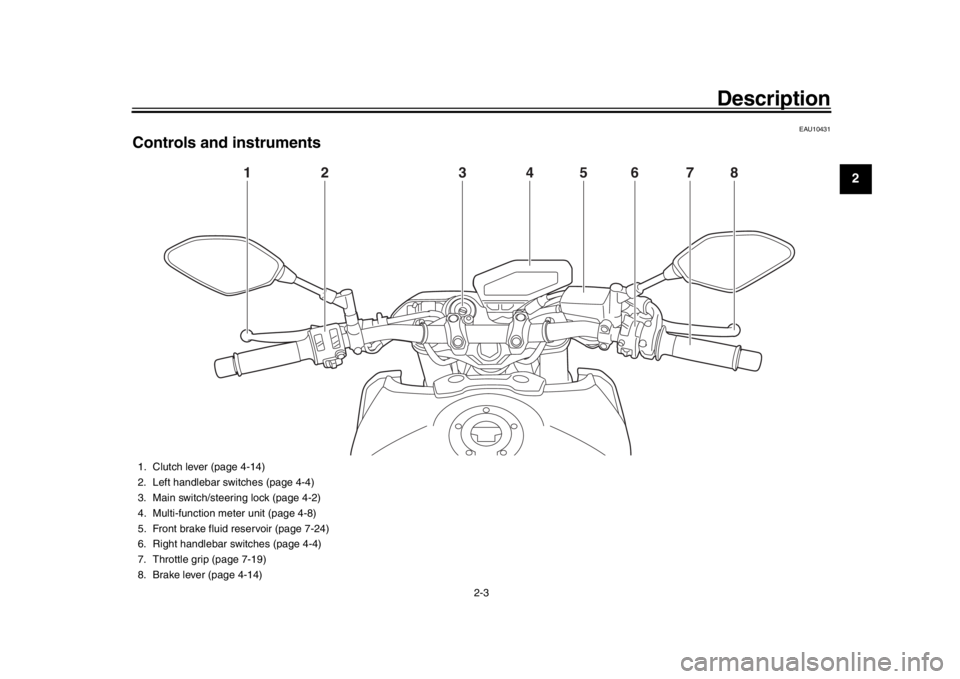
Controls and instruments
1
2
3
4
5
6
7
8
1. Clutch lever (page 4-14)
2. Left handlebar switches (page 4-4)
3. Main switch/steering lock (page 4-2)
4. Multi-function meter unit (page 4-8)
5. Front brake fluid reservoir (page 7-24)
6. Right handlebar switches (page 4-4)
7. Throttle grip (page 7-19)
8. Brake lever (page 4-14)
BS2-9-E0.book 3 ページ 2016年9月8日 木曜日 午前11時0分
Page 18 of 106

Special features
3-3
1
23
4
5
6
7
8
9
10
11
12 Resetting the traction control sys-
tem
The traction control system will auto-
matically disable when:
the front wheel or rear wheel
comes off the ground while riding.
excessive rear wheel spin is de-
tected while riding.
either wheel is rotated with the key
turned to “ON” (such as when per-
forming maintenance).
If the traction control system is dis-
abled, both the “ ” indicator light and
the “ ” warning light will come on.
Should this occur, try resetting the sys-
tem as follows. 1. Stop the vehicle and turn the key to “OFF”.
2. Wait a few seconds and then turn the key back to “ON”.
3. The “ ” indicator light should turn off and the system be enabled.
TIPIf the “ ” indicator light remains on af-
ter resetting, the vehicle may still be rid-
den; however, have a Yamaha dealercheck the vehicle as soon as possible.
4. Have a Yamaha dealer check the vehicle and turn off the “ ” warn-
ing light.
EAU76401
Quick shift systemThe quick shift system (QS) allows for
full-throttle, clutch lever-less, electroni-
cally-assisted upshifts. When the shift
switch detects motion in the shift pedal
(page 4-14), engine power and drive
torque are momentarily adjusted to al-
low the upshift to occur.TIP
The quick shift system operates
when traveling at least 20 km/h (12
mi/h) with an engine speed of 2300
r/min or higher, and only when ac-
celerating.
It does not operate when the clutchlever is pulled.
BS2-9-E0.book 3 ページ 2016年9月8日 木曜日 午前11時0分
Page 32 of 106

Instrument and control functions
4-14
1
2
34
5
6
7
8
9
10
11
12
EAU12822
Clutch leverThe clutch lever is located on the left
side of the handlebar. To disengage
the clutch, pull the lever toward the
handlebar grip. To engage the clutch,
release the lever. The lever should be
pulled rapidly and released slowly for
smooth clutch operation.
The clutch lever is equipped with a
clutch switch, which is part of the igni-
tion circuit cut-off system. (See
page 4-26.)
EAU76301
Shift pedalThe shift pedal is located on the left
side of the motorcycle and is used in
combination with the clutch lever when
shifting the gears of the 6-speed con-
stant-mesh transmission.
When the quick shift system is turned
on, the shift switch senses shift pedal
movement and allows for upshifting
without operating the clutch lever. (See
page 3-3.)
EAU26825
Brake leverThe brake lever is located on the right
side of the handlebar. To apply the front
brake, pull the lever toward the throttle
grip.
The brake lever is equipped with a
brake lever position adjusting dial. To
adjust the distance between the brake
lever and the throttle grip, turn the ad-
justing dial while holding the lever
pushed away from the throttle grip.
Make sure that the appropriate setting
on the adjusting dial is aligned with the
1. Clutch lever
1
1. Shift pedal
2. Shift switch
12
1. Brake lever
2. Distance between brake lever and throttle grip
3. Brake lever position adjusting dial
4. “ ” mark
5 4 3 2 1
1
2
43
BS2-9-E0.book 14 ページ 2016年9月8日 木曜日 午前11時0分
Page 44 of 106

Instrument and control functions
4-26
1
2
34
5
6
7
8
9
10
11
12
EAU57950
Ignition circuit cut-off systemThe ignition circuit cut-off system (com-
prising the sidestand switch, clutch
switch and neutral switch) has the fol-
lowing functions.
It prevents starting when the trans-
mission is in gear and the sides-
tand is up, but the clutch lever is
not pulled.
It prevents starting when the trans-
mission is in gear and the clutch le-
ver is pulled, but the sidestand is
still down.
It cuts the running engine when the
transmission is in gear and the sid-
estand is moved down.
Periodically check the operation of the
ignition circuit cut-off system according
to the following procedure.
BS2-9-E0.book 26 ページ 2016年9月8日 木曜日 午前11時0分
Page 45 of 106

Instrument and control functions
4-27
1
2
345
6
7
8
9
10
11
12
With the engine turned off:
1. Move the sidestand down.
2. Make sure that the start/engine stop switch is set to “ ”.
3. Turn the key on.
4. Shift the transmission into the neutral position.
5. Push the “ ” side of the start/engine stop switch.
Does the engine start?
With the engine still running:
6. Move the sidestand up.
7. Keep the clutch lever pulled.
8. Shift the transmission into gear.
9. Move the sidestand down.
Does the engine stall?
After the engine has stalled:
10. Move the sidestand up.
11. Keep the clutch lever pulled.
12. Push the “ ” side of the start/engine stop switch.
Does the engine start?
The system is OK. The motorcycle can be ridden.
YES NO YES NO YES NO
The neutral switch may not be working correctly.
The motorcycle should not be ridden until
checked by a Yamaha dealer.
The clutch switch may not be working correctly.
The motorcycle should not be ridden until
checked by a Yamaha dealer.The sidestand switch may not be working correctly.
The motorcycle should not be ridden until
checked by a Yamaha dealer.If a malfunction is noted, have a Yamaha
dealer check the system before riding.
WARNING
BS2-9-E0.book 27 ページ 2016年9月8日 木曜日 午前11時0分
Page 47 of 106

For your safety – pre-operation checks
5-2
1
2
3
456
7
8
9
10
11
12
Rear brake Check operation.
If soft or spongy, have Yamaha dealer bleed hydraulic system.
Check brake pads for wear.
Replace if necessary.
Check fluid level in reservoir.
If necessary, add specified brake fluid to specified level.
Check hydraulic system for leakage. 7-24
Clutch Check operation.
Lubricate cable if necessary.
Check lever free play.
Adjust if necessary. 7-22
Throttle grip Make sure that operation is smooth.
Check throttle grip free play.
If necessary, have Yamaha dealer adjust th
rottle grip free play and lubricate cable
and grip housing. 7-19, 7-29
Control cables Make sure that operation is smooth.
Lubricate if necessary. 7-28
Drive chain Check chain slack.
Adjust if necessary.
Check chain condition.
Lubricate if necessary. 7-26, 7-28
Wheels and tires Check for damage.
Check tire condition and tread depth.
Check air pressure.
Correct if necessary. 7-19, 7-22
Brake and shift pedals Make sure that operation is smooth.
Lubricate pedal pivoting points if necessary. 7-29
Brake and clutch levers Make sure that operation is smooth.
Lubricate lever pivoting points if necessary. 7-30
Sidestand Make sure that operation is smooth.
Lubricate pivot if necessary. 7-30
Chassis fasteners Make sure that all nuts, bolts and screws are properly tightened.
Tighten if necessary. —
ITEM CHECKS PAGE
BS2-9-E0.book 2 ページ 2016年9月8日 木曜日 午前11時0分
Page 49 of 106

6-1
1
2
3
4
567
8
9
10
11
12
Operation and important riding points
EAU15952
Read the Owner’s Manual carefully to
become familiar with all controls. If
there is a control or function you do not
understand, ask your Yamaha dealer.
WARNING
EWA10272
Failure to familiarize yourself with
the controls can lead to loss of con-
trol, which could cause an accidentor injury.
EAUM3631
TIPThis model is equipped with:
a lean angle sensor to stop the en-
gine in case of a turnover. In this
case, the engine trouble warning
light will come on, but this is not a
malfunction. Turn the key to “OFF”
and then to “ON” to turn off the
warning light. Failing to do so will
prevent the engine from starting
even though the engine will crank
when pushing the start switch.
an engine auto-stop system. The
engine stops automatically if left
idling for 20 minutes. If the engine
stops, simply push the start switchto restart the engine.
EAU77060
Starting the engineIn order for the ignition circuit cut-off
system to enable starting, one of the
following conditions must be met:
The transmission is in the neutral
position.
The transmission is in gear with
the clutch lever pulled and the sid-
estand up.
See page 4-26 for more informa-
tion.
1. Turn the key to “ON” and make sure that the start/engine stop
switch is set to “ ”.
The following warning lights and
indicator light should come on for a
few seconds, then go off.
Oil level warning light
Coolant temperature warning
light
Engine trouble warning light
Traction control system indica-
tor light
Immobilizer system indicator
light
The ABS warning light should
come on when the key is turned to
“ON”, and then go off after travel-
BS2-9-E0.book 1 ページ 2016年9月8日 木曜日 午前11時0分
Page 51 of 106
Operation and important riding points
6-3
1
2
3
4
567
8
9
10
11
12
NOTICE
ECA23990
Even with the transmission in
the neutral position, do not
coast for long periods of time
with the engine off, and do not
tow the motorcycle for long dis-
tances. The transmission is
properly lubricated only when
the engine is running. Inade-
quate lubrication may damage
the transmission.
Except when upshifting with the
quick shift system, always use
the clutch while changing gears
to avoid damaging the engine,
transmission, and drive train,
which are not designed to with-
stand the shock of forced shift-ing.
EAU16811
Tips for reducing fuel
consumptionFuel consumption depends largely on
your riding style. Consider the following
tips to reduce fuel consumption:
Shift up swiftly, and avoid high en-
gine speeds during acceleration.
Do not rev the engine while shifting
down, and avoid high engine
speeds with no load on the engine.
Turn the engine off instead of let-
ting it idle for an extended length of
time (e.g., in traffic jams, at traffic
lights or at railroad crossings).
EAU16842
Engine break-inThere is never a more important period
in the life of your engine than the period
between 0 and 1600 km (1000 mi). For
this reason, you should read the follow-
ing material carefully.
Since the engine is brand new, do not
put an excessive load on it for the first
1600 km (1000 mi). The various parts in
the engine wear and polish themselves
to the correct operating clearances.
During this period, prolonged full-throt-
tle operation or any condition that might
result in engine overheating must be
avoided.
EAU17094
0–1000 km (0–600 mi)
Avoid prolonged operation above 5600
r/min. NOTICE: After 1000 km (600
mi) of operation, the engine oil must
be changed and the oil filter car-
tridge or element replaced.
[ECA10303]
1000–1600 km (600–1000 mi)
Avoid prolonged operation above 6800
BS2-9-E0.book 3 ページ 2016年9月8日 木曜日 午前11時0分
Page 57 of 106

Periodic maintenance and adjustment
7-5
1
2
3
4
5
678
9
10
11
12
EAU71351
General maintenance an d lubrication chartNO. ITEM CHECK OR MAINTENANCE JOB ODOMETER READING
ANNUAL
CHECK
1000 km
(600 mi) 10000 km
(6000 mi) 20000 km
(12000 mi) 30000 km
(18000 mi) 40000 km
(24000 mi)
1 *Diagnostic system
check Perform dynamic inspection using
Yamaha diagnostic tool.
Check the error codes.
2 *Air filter element Replace. Every 40000 km (24000 mi)
3Clutch Check operation.
Adjust.
4 *Front brake Check operation, fluid level, and
for fluid leakage.
Replace brake pads if necessary.
5 *Rear brake Check operation, fluid level, and
for fluid leakage.
Replace brake pads if necessary.
6 *Brake hoses Check for cracks or damage.
Replace. Every 4 years
7 *Brake fluid Change. Every 2 years
8 *Wheels Check runout and for damage.
Replace if necessary.
9 *Tires Check tread depth and for
damage.
Replace if necessary.
Check air pressure.
Correct if necessary.
10 *Wheel bearings Check bearing for looseness or
damage.
11 *Swingarm pivot
bearings Check operation and for
excessive play.
Lubricate with lithium-soap-based grease. Every 50000 km (30000 mi)
BS2-9-E0.book 5 ページ 2016年9月8日 木曜日 午前11時0分