oil YAMAHA NMAX 125 2020 User Guide
[x] Cancel search | Manufacturer: YAMAHA, Model Year: 2020, Model line: NMAX 125, Model: YAMAHA NMAX 125 2020Pages: 114, PDF Size: 10.63 MB
Page 68 of 114
Periodic maintenance and adjustment
9-5
9
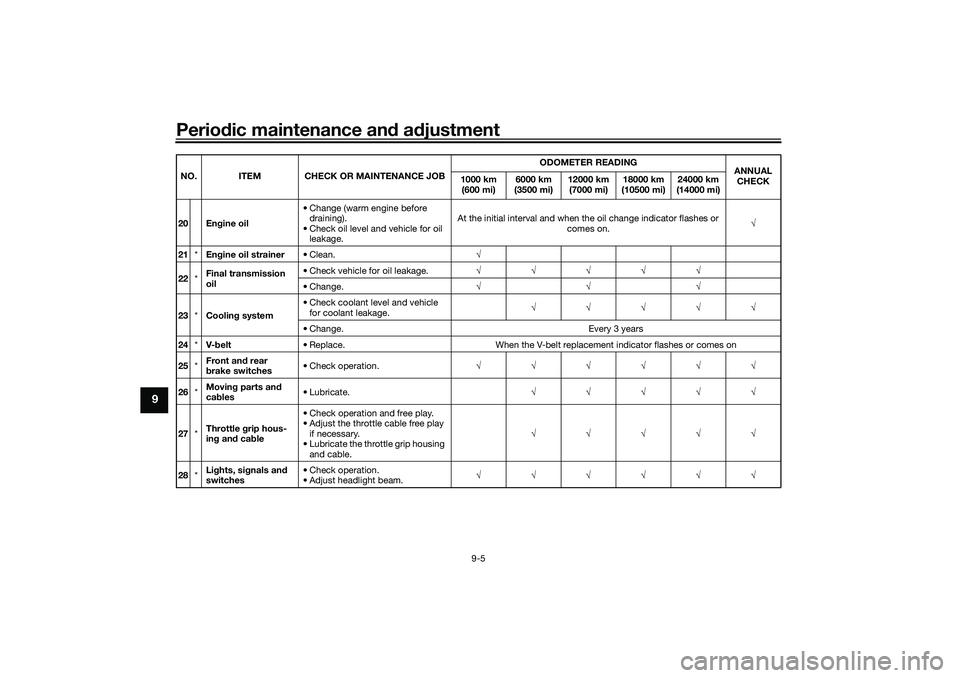
20 Engine oil• Change (warm engine before
draining).
• Check oil level and vehicle for oil
leakage.At the initial interval and when the oil change indicator flashes or
comes on.√
21*Engine oil strainer• Clean.√
22*Final transmission
oil• Check vehicle for oil leakage.√√√√√
• Change.√√√
23*Cooling system• Check coolant level and vehicle
for coolant leakage.√√√√√
• Change. Every 3 years
24*V-belt• Replace. When the V-belt replacement indicator flashes or comes on
25*Front and rear
brake switches• Check operation.√√√√√√
26*Moving parts and
cables• Lubricate.√√√√√
27*Throttle grip hous-
ing and cable• Check operation and free play.
• Adjust the throttle cable free play
if necessary.
• Lubricate the throttle grip housing
and cable.√√√√√
28*Lights, signals and
switches• Check operation.
• Adjust headlight beam.√√√√√√ NO. ITEM CHECK OR MAINTENANCE JOBODOMETER READING
ANNUAL
CHECK 1000 km
(600 mi)6000 km
(3500 mi)12000 km
(7000 mi)18000 km
(10500 mi)24000 km
(14000 mi)
UBALE0E0.book Page 5 Wednesday, September 30, 2020 1:37 PM
Page 69 of 114
Periodic maintenance and adjustment
9-6
9
EAU72790
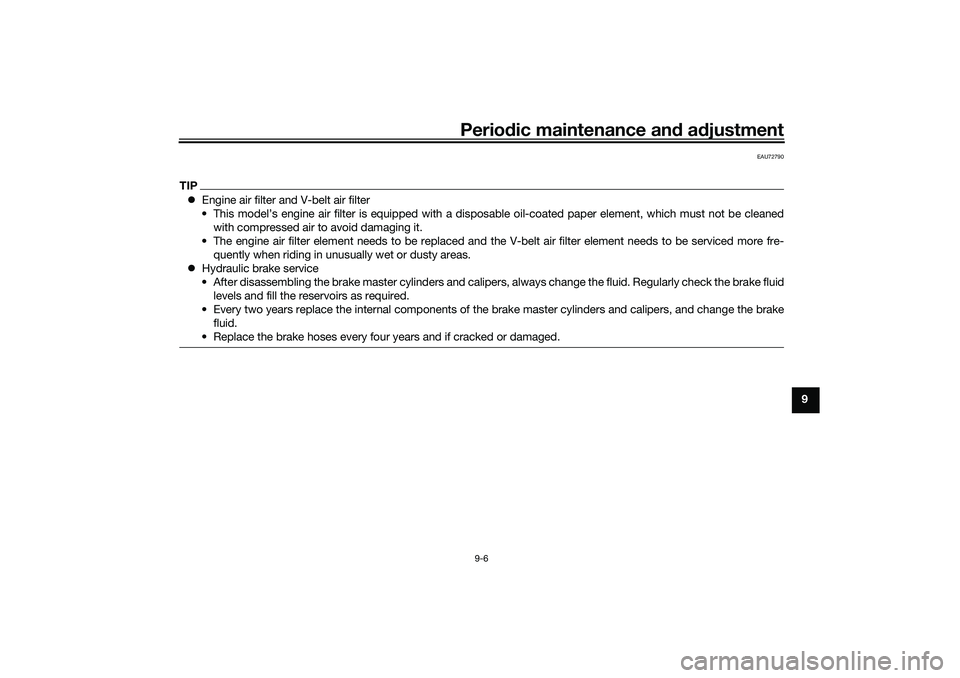
TIPEngine air filter and V-belt air filter
• This model’s engine air filter is equipped with a disposable oil-coated paper element, which must not be cleaned
with compressed air to avoid damaging it.
• The engine air filter element needs to be replaced and the V-belt air filter element needs to be serviced more fre-
quently when riding in unusually wet or dusty areas.
Hydraulic brake service
• After disassembling the brake master cylinders and calipers, always change the fluid. Regularly check the brake fluid
levels and fill the reservoirs as required.
• Every two years replace the internal components of the brake master cylinders and calipers, and change the brake
fluid.
• Replace the brake hoses every four years and if cracked or damaged.
UBALE0E0.book Page 6 Wednesday, September 30, 2020 1:37 PM
Page 74 of 114
Periodic maintenance and adjustment
9-11
9
EAU36112
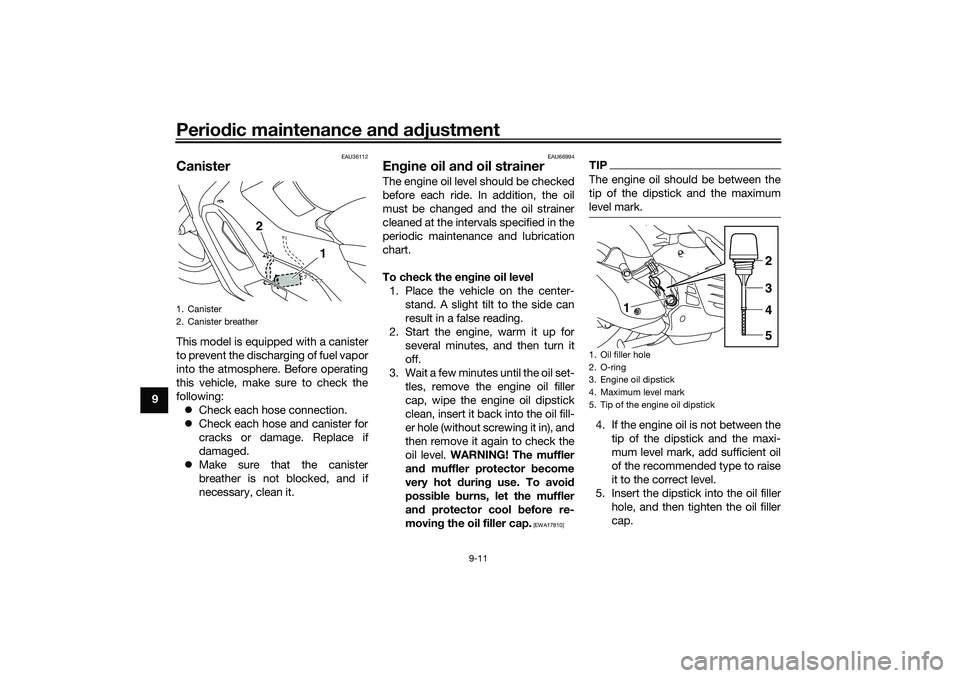
CanisterThis model is equipped with a canister
to prevent the discharging of fuel vapor
into the atmosphere. Before operating
this vehicle, make sure to check the
following:
Check each hose connection.
Check each hose and canister for
cracks or damage. Replace if
damaged.
Make sure that the canister
breather is not blocked, and if
necessary, clean it.
EAU66994
Engine oil and oil strainerThe engine oil level should be checked
before each ride. In addition, the oil
must be changed and the oil strainer
cleaned at the intervals specified in the
periodic maintenance and lubrication
chart.
To check the engine oil level
1. Place the vehicle on the center-
stand. A slight tilt to the side can
result in a false reading.
2. Start the engine, warm it up for
several minutes, and then turn it
off.
3. Wait a few minutes until the oil set-
tles, remove the engine oil filler
cap, wipe the engine oil dipstick
clean, insert it back into the oil fill-
er hole (without screwing it in), and
then remove it again to check the
oil level. WARNING! The muffler
and muffler protector become
very hot during use. To avoid
possible burns, let the muffler
and protector cool before re-
moving the oil filler cap.
[EWA17810]
TIPThe engine oil should be between the
tip of the dipstick and the maximum
level mark.4. If the engine oil is not between the
tip of the dipstick and the maxi-
mum level mark, add sufficient oil
of the recommended type to raise
it to the correct level.
5. Insert the dipstick into the oil filler
hole, and then tighten the oil filler
cap.
1. Canister
2. Canister breather
2
1
1. Oil filler hole
2. O-ring
3. Engine oil dipstick
4. Maximum level mark
5. Tip of the engine oil dipstick
3245
1
UBALE0E0.book Page 11 Wednesday, September 30, 2020 1:37 PM
Page 75 of 114
Periodic maintenance and adjustment
9-12
9 To change the engine oil and clean
the oil strainer
1. Start the engine, warm it up for
several minutes, and then turn it
off.
2. Place an oil pan under the engine
to collect the used oil.
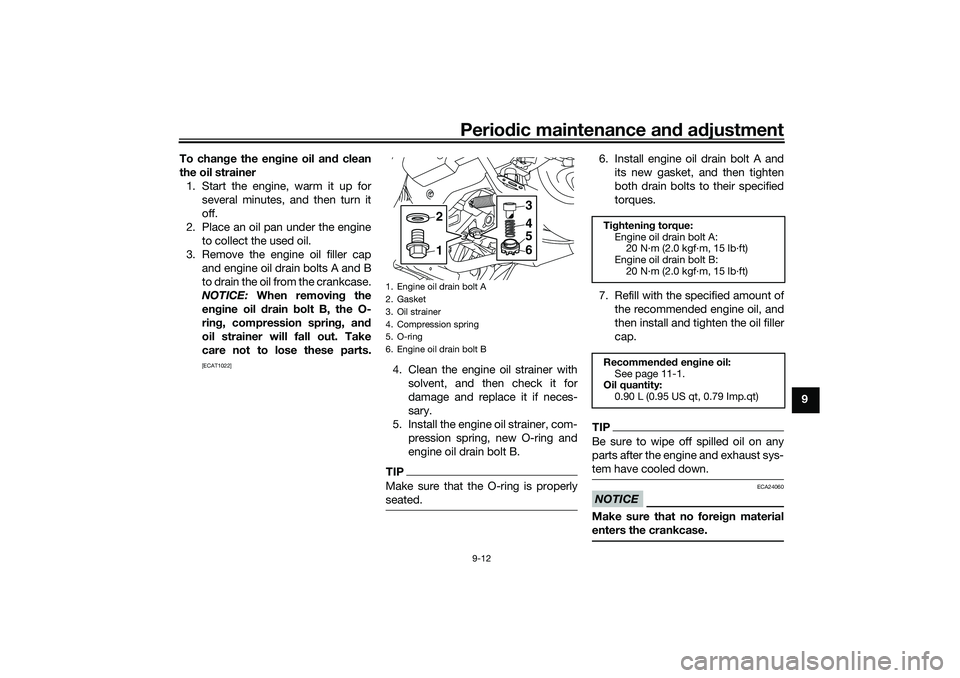
3. Remove the engine oil filler cap
and engine oil drain bolts A and B
to drain the oil from the crankcase.
NOTICE: When removing the
engine oil drain bolt B, the O-
ring, compression spring, and
oil strainer will fall out. Take
care not to lose these parts.
[ECAT1022]
4. Clean the engine oil strainer with
solvent, and then check it for
damage and replace it if neces-
sary.
5. Install the engine oil strainer, com-
pression spring, new O-ring and
engine oil drain bolt B.TIPMake sure that the O-ring is properly
seated.
6. Install engine oil drain bolt A and
its new gasket, and then tighten
both drain bolts to their specified
torques.
7. Refill with the specified amount of
the recommended engine oil, and
then install and tighten the oil filler
cap.TIPBe sure to wipe off spilled oil on any
parts after the engine and exhaust sys-
tem have cooled down.NOTICE
ECA24060
Make sure that no foreign material
enters the crankcase.
1. Engine oil drain bolt A
2. Gasket
3. Oil strainer
4. Compression spring
5. O-ring
6. Engine oil drain bolt B
23
4
5
6
1
Tightening torque:
Engine oil drain bolt A:
20 N·m (2.0 kgf·m, 15 lb·ft)
Engine oil drain bolt B:
20 N·m (2.0 kgf·m, 15 lb·ft)
Recommended engine oil:
See page 11-1.
Oil quantity:
0.90 L (0.95 US qt, 0.79 Imp.qt)
UBALE0E0.book Page 12 Wednesday, September 30, 2020 1:37 PM
Page 76 of 114
Periodic maintenance and adjustment
9-13
98. Start the engine, and then let it idle
for several minutes while checking
it for oil leakage. If oil is leaking,
immediately turn the engine off
and check for the cause.
9. Turn the engine off, and then
check the oil level and correct it if
necessary.
10. Reset the oil change tripmeter and
oil change indicator “OIL”. (See
page 6-7 for reset procedures.)
EAU85450
Why YamalubeYAMALUBE oil is a Genuine YAMAHA
Part born of the engineers’ passion
and belief that engine oil is an impor-
tant liquid engine component. We form
teams of specialists in the fields of me-
chanical engineering, chemistry, elec-
tronics and track testing, and have
them develop the engine together with
the oil it will use. Yamalube oils take full
advantage of the base oil’s qualities
and blend in the ideal balance of addi-
tives to make sure the final oil clears
our performance standards. Thus,
Yamalube mineral, semisynthetic and
synthetic oils have their own distinct
characters and value. Yamaha’s expe-
rience gained over many years of re-
search and development into oil since
the 1960’s helps make Yamalube the
best choice for your Yamaha engine.
EAU67822
Final transmission oilThe final transmission case must be
checked for oil leakage before each
ride. If any leakage is found, have a
Yamaha dealer check and repair your
motorcycle. In addition, the final trans-
mission oil must be changed as follows
at the intervals specified in the periodic
maintenance and lubrication chart.
1. Start the engine and warm up the
final transmission oil by riding the
motorcycle for several minutes.
2. Stop the engine and then place
the motorcycle on the center-
stand.
3. Place an oil pan under the final
transmission case to collect the
used oil.
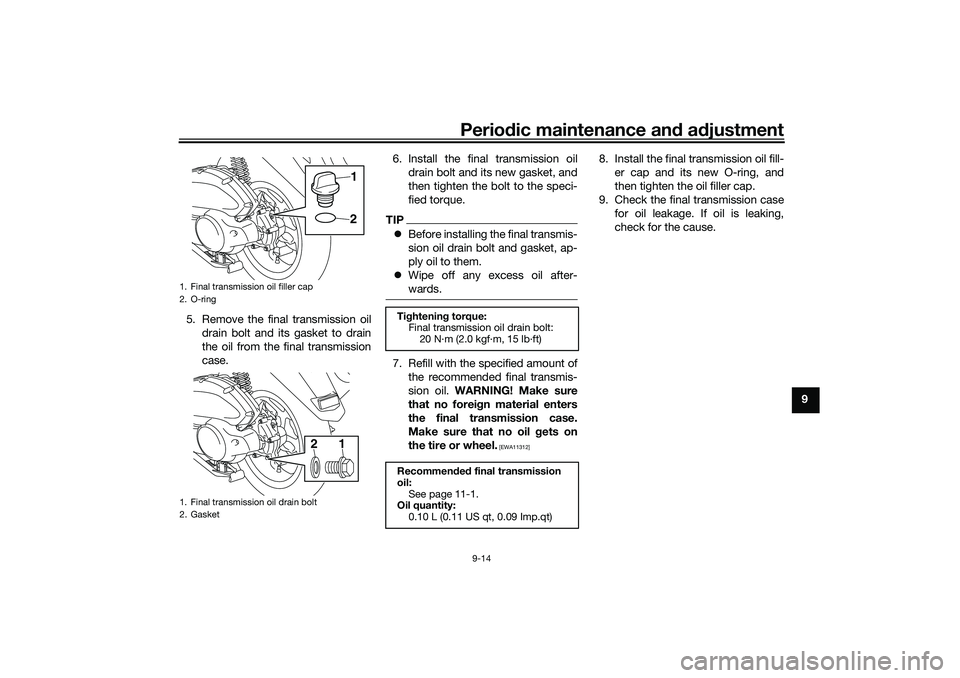
4. Remove the final transmission oil
filler cap and its O-ring from the fi-
nal transmission case.
UBALE0E0.book Page 13 Wednesday, September 30, 2020 1:37 PM
Page 77 of 114
Periodic maintenance and adjustment
9-14
9 5. Remove the final transmission oil
drain bolt and its gasket to drain
the oil from the final transmission
case.6. Install the final transmission oil
drain bolt and its new gasket, and
then tighten the bolt to the speci-
fied torque.
TIPBefore installing the final transmis-
sion oil drain bolt and gasket, ap-
ply oil to them.
Wipe off any excess oil after-
wards.7. Refill with the specified amount of
the recommended final transmis-
sion oil. WARNING! Make sure
that no foreign material enters
the final transmission case.
Make sure that no oil gets on
the tire or wheel.
[EWA11312]
8. Install the final transmission oil fill-
er cap and its new O-ring, and
then tighten the oil filler cap.
9. Check the final transmission case
for oil leakage. If oil is leaking,
check for the cause.
1. Final transmission oil filler cap
2. O-ring
1. Final transmission oil drain bolt
2. Gasket
1
2
1 2
Tightening torque:
Final transmission oil drain bolt:
20 N·m (2.0 kgf·m, 15 lb·ft)
Recommended final transmission
oil:
See page 11-1.
Oil quantity:
0.10 L (0.11 US qt, 0.09 Imp.qt)
UBALE0E0.book Page 14 Wednesday, September 30, 2020 1:37 PM
Page 81 of 114
Periodic maintenance and adjustment
9-18
9
TIPIf dirt or water was found in the check
hose, be sure to check the V-belt case
air filter element for excessive dirt or
damage and clean or replace it if nec-
essary.Cleaning the V-belt case air filter el-
ement
1. Place the vehicle on the center-
stand.
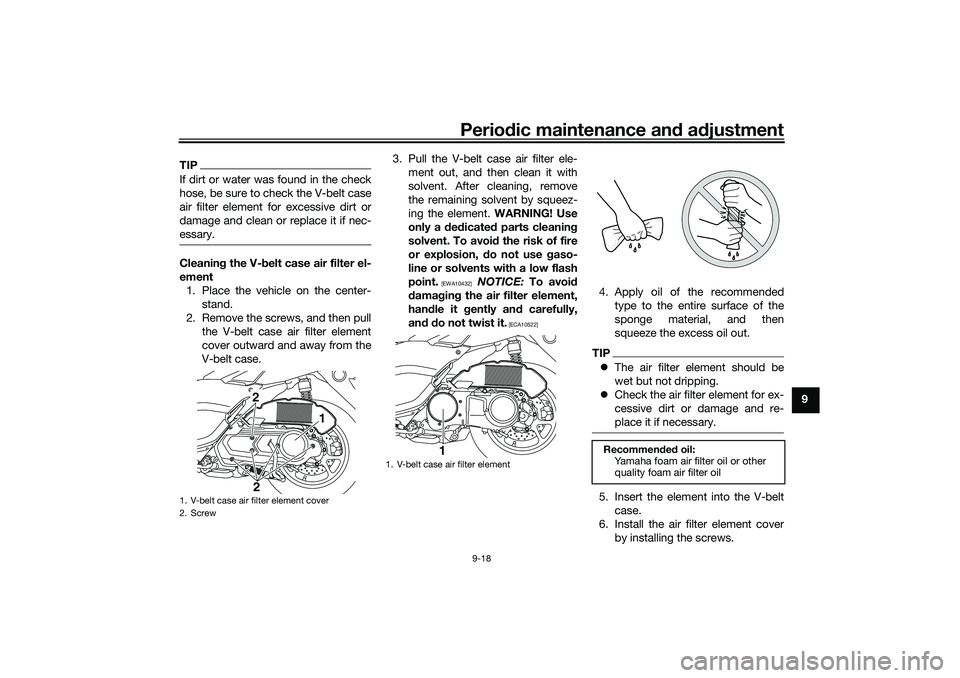
2. Remove the screws, and then pull
the V-belt case air filter element
cover outward and away from the
V-belt case.3. Pull the V-belt case air filter ele-
ment out, and then clean it with
solvent. After cleaning, remove
the remaining solvent by squeez-
ing the element. WARNING! Use
only a dedicated parts cleaning
solvent. To avoid the risk of fire
or explosion, do not use gaso-
line or solvents with a low flash
point.
[EWA10432]
NOTICE: To avoid
damaging the air filter element,
handle it gently and carefully,
and do not twist it.
[ECA10522]
4. Apply oil of the recommended
type to the entire surface of the
sponge material, and then
squeeze the excess oil out.TIPThe air filter element should be
wet but not dripping.
Check the air filter element for ex-
cessive dirt or damage and re-
place it if necessary.5. Insert the element into the V-belt
case.
6. Install the air filter element cover
by installing the screws.
1. V-belt case air filter element cover
2. Screw
2
1
2
1. V-belt case air filter element
1
Recommended oil:
Yamaha foam air filter oil or other
quality foam air filter oil
UBALE0E0.book Page 18 Wednesday, September 30, 2020 1:37 PM
Page 86 of 114
Periodic maintenance and adjustment
9-23
9
EAU40262
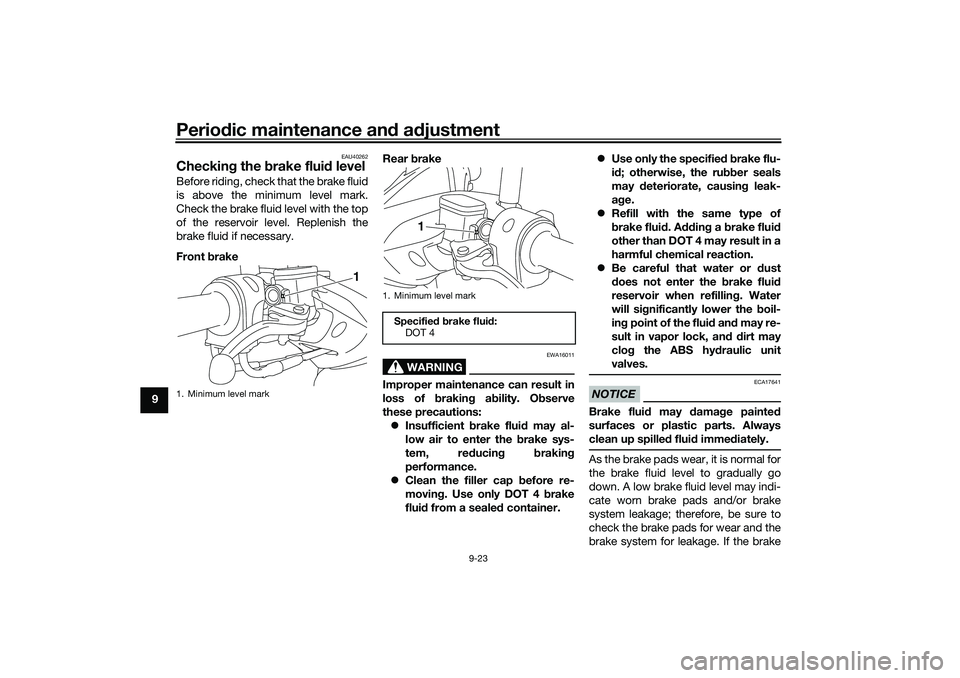
Checking the brake fluid levelBefore riding, check that the brake fluid
is above the minimum level mark.
Check the brake fluid level with the top
of the reservoir level. Replenish the
brake fluid if necessary.
Front brakeRear brake
WARNING
EWA16011
Improper maintenance can result in
loss of braking ability. Observe
these precautions:
Insufficient brake fluid may al-
low air to enter the brake sys-
tem, reducing braking
performance.
Clean the filler cap before re-
moving. Use only DOT 4 brake
fluid from a sealed container.Use only the specified brake flu-
id; otherwise, the rubber seals
may deteriorate, causing leak-
age.
Refill with the same type of
brake fluid. Adding a brake fluid
other than DOT 4 may result in a
harmful chemical reaction.
Be careful that water or dust
does not enter the brake fluid
reservoir when refilling. Water
will significantly lower the boil-
ing point of the fluid and may re-
sult in vapor lock, an
d dirt may
clog the ABS hydraulic unit
valves.
NOTICE
ECA17641
Brake fluid may damage painted
surfaces or plastic parts. Always
clean up spilled fluid immediately.As the brake pads wear, it is normal for
the brake fluid level to gradually go
down. A low brake fluid level may indi-
cate worn brake pads and/or brake
system leakage; therefore, be sure to
check the brake pads for wear and the
brake system for leakage. If the brake
1. Minimum level mark
1
1. Minimum level markSpecified brake fluid:
DOT 4
1
UBALE0E0.book Page 23 Wednesday, September 30, 2020 1:37 PM
Page 90 of 114
Periodic maintenance and adjustment
9-27
9
EAU23273
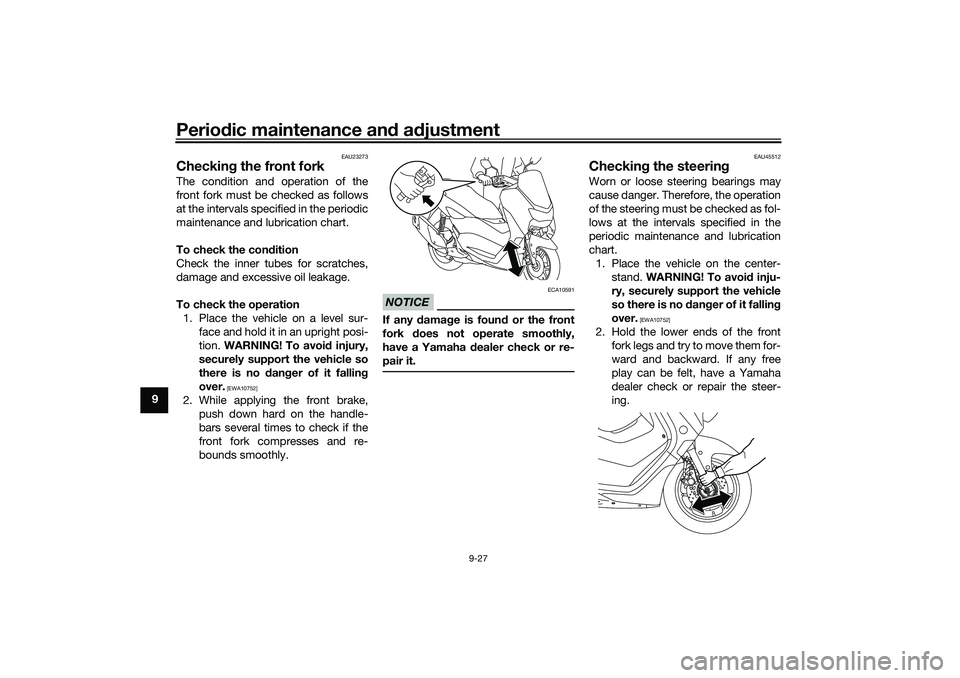
Checking the front forkThe condition and operation of the
front fork must be checked as follows
at the intervals specified in the periodic
maintenance and lubrication chart.
To check the condition
Check the inner tubes for scratches,
damage and excessive oil leakage.
To check the operation
1. Place the vehicle on a level sur-
face and hold it in an upright posi-
tion. WARNING! To avoid injury,
securely support the vehicle so
there is no danger of it falling
over.
[EWA10752]
2. While applying the front brake,
push down hard on the handle-
bars several times to check if the
front fork compresses and re-
bounds smoothly.
NOTICE
ECA10591
If any damage is found or the front
fork does not operate smoothly,
have a Yamaha dealer check or re-
pair it.
EAU45512
Checking the steeringWorn or loose steering bearings may
cause danger. Therefore, the operation
of the steering must be checked as fol-
lows at the intervals specified in the
periodic maintenance and lubrication
chart.
1. Place the vehicle on the center-
stand. WARNING! To avoid inju-
ry, securely support the vehicle
so there is no danger of it falling
over.
[EWA10752]
2. Hold the lower ends of the front
fork legs and try to move them for-
ward and backward. If any free
play can be felt, have a Yamaha
dealer check or repair the steer-
ing.
UBALE0E0.book Page 27 Wednesday, September 30, 2020 1:37 PM
Page 104 of 114
Motorcycle care and storage
10-2
10chemicals such as, solvents,
gasoline, rust removers, brake
fluid, or antifreeze, etc.
Before washing
1. Park the vehicle out of direct sun-
light and allow it to cool. This will
help avoid water spots.
2. Make sure all caps, covers, elec-
trical couplers and connectors are
tightly installed.
3. Cover the muffler end with a plas-
tic bag and a strong rubber band.
4. Pre-soak stubborn stains like in-
sects or bird droppings with a wet
towel for a few minutes.
5. Remove road grime and oil stains
with a quality degreasing agent
and a plastic-bristle brush or
sponge. NOTICE: Do not use
degreasing agent on areas re-
quiring lubrication such as
seals, gaskets, and wheel axles.
Follow product instructions.
[ECA26290]
Washing
1. Rinse off any degreaser and spray
down the vehicle with a garden
hose. Use only enough pressure
to do the job. Avoid spraying wa-
ter directly into the muffler, instru-
ment panel, air inlet, or other inner
areas such as underseat storage
compartments.
2. Wash the vehicle with a quality au-
tomotive-type detergent mixed
with cool water and a soft, clean
towel or sponge. Use an old tooth-
brush or plastic-bristle brush for
hard-to-reach places. NOTICE:
Use cold water if the vehicle has
been exposed to salt. Warm wa-
ter will increase salt’s corrosive
properties.
[ECA26301]
3. For windshield-equipped vehicles:
Clean the windshield with a soft
towel or sponge dampened with
water and a pH neutral detergent.
If necessary, use a high-quality
windshield cleaner or polish for
motorcycles. NOTICE: Never use
any strong chemicals to clean
the windshield. Additionally,
some cleaning compounds forplastic may scratch the wind-
shield, so be sure to test all
cleaning products before gen-
eral application.
[ECA26310]
4. Rinse off thoroughly with clean
water. Be sure to remove all deter-
gent residues, as they can be
harmful to plastic parts.
After washing
1. Dry the vehicle with a chamois or
absorbent towel, preferably mi-
crofiber terrycloth.
2. For drive chain-equipped models:
Dry and then lubricate the drive
chain to prevent rust.
3. Use a chrome polish to shine
chrome, aluminum, and stainless
steel parts. Often the thermally in-
duced discoloring of stainless
steel exhaust systems can be re-
moved through polishing.
4. Apply a corrosion protection spray
on all metal parts including
chrome or nickel-plated surfaces.
WARNING! Do not apply sili-
cone or oil spray to seats, hand
grips, rubber foot pegs or tire
treads. Otherwise these parts
UBALE0E0.book Page 2 Wednesday, September 30, 2020 1:37 PM