wheel YAMAHA NMAX 125 2020 User Guide
[x] Cancel search | Manufacturer: YAMAHA, Model Year: 2020, Model line: NMAX 125, Model: YAMAHA NMAX 125 2020Pages: 114, PDF Size: 10.63 MB
Page 67 of 114
Periodic maintenance and adjustment
9-4
9
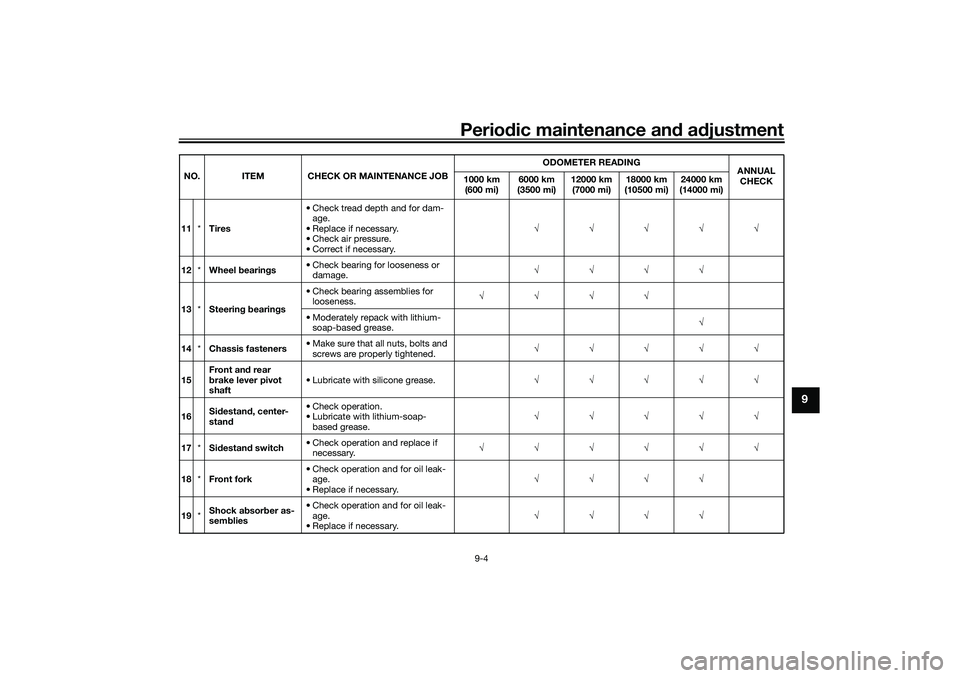
11*Tires• Check tread depth and for dam-
age.
• Replace if necessary.
• Check air pressure.
• Correct if necessary.√√√√√
12*Wheel bearings• Check bearing for looseness or
damage.√√√√
13*Steering bearings• Check bearing assemblies for
looseness.√√√√
• Moderately repack with lithium-
soap-based grease.√
14*Chassis fasteners• Make sure that all nuts, bolts and
screws are properly tightened.√√√√√
15Front and rear
brake lever pivot
shaft• Lubricate with silicone grease.√√√√√
16Sidestand, center-
stand• Check operation.
• Lubricate with lithium-soap-
based grease.√√√√√
17*Sidestand switch• Check operation and replace if
necessary.√√√√√√
18*Front fork• Check operation and for oil leak-
age.
• Replace if necessary.√√√√
19*Shock absorber as-
semblies• Check operation and for oil leak-
age.
• Replace if necessary.√√√√ NO. ITEM CHECK OR MAINTENANCE JOBODOMETER READING
ANNUAL
CHECK 1000 km
(600 mi)6000 km
(3500 mi)12000 km
(7000 mi)18000 km
(10500 mi)24000 km
(14000 mi)
UBALE0E0.book Page 4 Wednesday, September 30, 2020 1:37 PM
Page 77 of 114
Periodic maintenance and adjustment
9-14
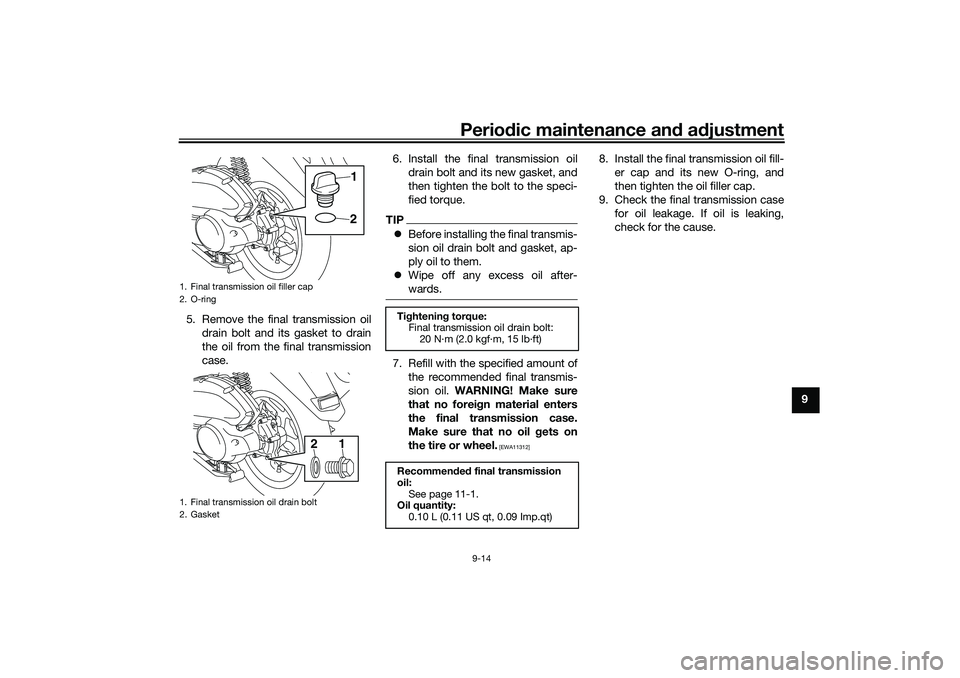
9 5. Remove the final transmission oil
drain bolt and its gasket to drain
the oil from the final transmission
case.6. Install the final transmission oil
drain bolt and its new gasket, and
then tighten the bolt to the speci-
fied torque.
TIPBefore installing the final transmis-
sion oil drain bolt and gasket, ap-
ply oil to them.
Wipe off any excess oil after-
wards.7. Refill with the specified amount of
the recommended final transmis-
sion oil. WARNING! Make sure
that no foreign material enters
the final transmission case.
Make sure that no oil gets on
the tire or wheel.
[EWA11312]
8. Install the final transmission oil fill-
er cap and its new O-ring, and
then tighten the oil filler cap.
9. Check the final transmission case
for oil leakage. If oil is leaking,
check for the cause.
1. Final transmission oil filler cap
2. O-ring
1. Final transmission oil drain bolt
2. Gasket
1
2
1 2
Tightening torque:
Final transmission oil drain bolt:
20 N·m (2.0 kgf·m, 15 lb·ft)
Recommended final transmission
oil:
See page 11-1.
Oil quantity:
0.10 L (0.11 US qt, 0.09 Imp.qt)
UBALE0E0.book Page 14 Wednesday, September 30, 2020 1:37 PM
Page 83 of 114
Periodic maintenance and adjustment
9-20
9 weight of rider, passenger, car-
go, and accessories approved
for this model.
WARNING
EWA10512
Never overload your vehicle. Opera-
tion of an overloaded vehicle could
cause an accident.
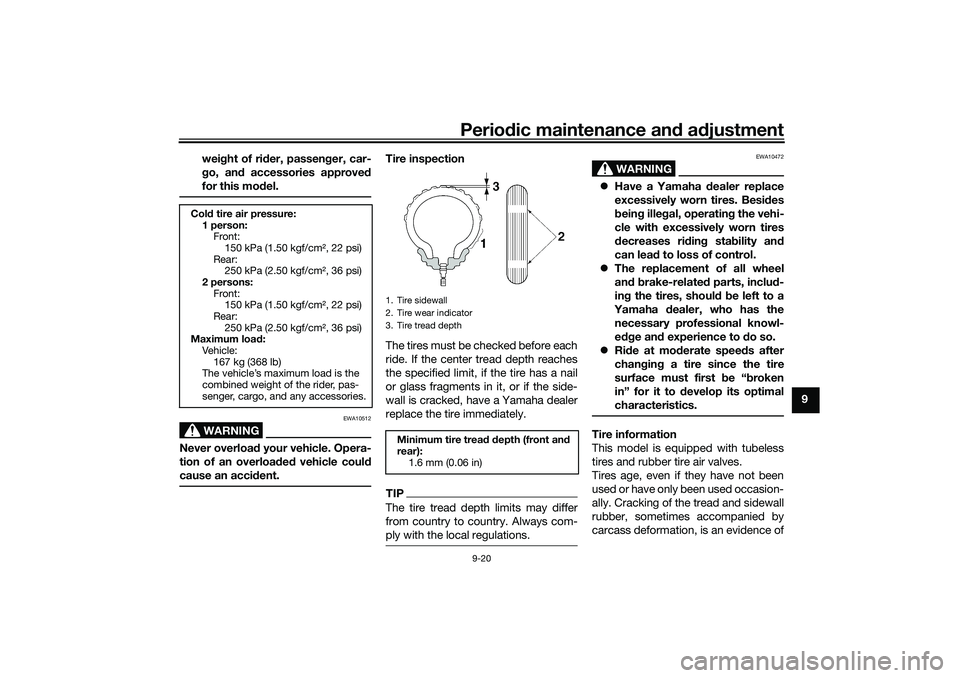
Tire inspection
The tires must be checked before each
ride. If the center tread depth reaches
the specified limit, if the tire has a nail
or glass fragments in it, or if the side-
wall is cracked, have a Yamaha dealer
replace the tire immediately.TIPThe tire tread depth limits may differ
from country to country. Always com-
ply with the local regulations.
WARNING
EWA10472
Have a Yamaha dealer replace
excessively worn tires. Besides
being illegal, operating the vehi-
cle with excessively worn tires
decreases riding stability and
can lead to loss of control.
The replacement of all wheel
and brake-related parts, includ-
ing the tires, should be left to a
Yamaha dealer, who has the
necessary professional knowl-
edge and experience to do so.
Ride at moderate speeds after
changing a tire since the tire
surface must first be “broken
in” for it to develop its optimal
characteristics.Tire information
This model is equipped with tubeless
tires and rubber tire air valves.
Tires age, even if they have not been
used or have only been used occasion-
ally. Cracking of the tread and sidewall
rubber, sometimes accompanied by
carcass deformation, is an evidence of
Cold tire air pressure:
1 person:
Front:
150 kPa (1.50 kgf/cm2, 22 psi)
Rear:
250 kPa (2.50 kgf/cm2, 36 psi)
2 persons:
Front:
150 kPa (1.50 kgf/cm2, 22 psi)
Rear:
250 kPa (2.50 kgf/cm2, 36 psi)
Maximum load:
Veh ic le:
167 kg (368 lb)
The vehicle’s maximum load is the
combined weight of the rider, pas-
senger, cargo, and any accessories.
1. Tire sidewall
2. Tire wear indicator
3. Tire tread depth
Minimum tire tread depth (front and
rear):
1.6 mm (0.06 in)
UBALE0E0.book Page 20 Wednesday, September 30, 2020 1:37 PM
Page 84 of 114
Periodic maintenance and adjustment
9-21
9ageing. Old and aged tires shall be
checked by tire specialists to ascertain
their suitability for further use.
WARNING
EWA10462
The front and rear tires should be of
the same make and design, other-
wise the handling characteristics of
the vehicle may be different, which
could lead to an accident.After extensive tests, only the tires list-
ed below have been approved for this
model by Yamaha.
EAU21963
Cast wheelsTo maximize the performance, durabil-
ity, and safe operation of your vehicle,
note the following points regarding the
specified wheels.
The wheel rims should be
checked for cracks, bends, warp-
age or other damage before each
ride. If any damage is found, have
a Yamaha dealer replace the
wheel. Do not attempt even the
smallest repair to the wheel. A de-
formed or cracked wheel must be
replaced.
The wheel should be balanced
whenever either the tire or wheel
has been changed or replaced. An
unbalanced wheel can result in
poor performance, adverse han-
dling characteristics, and a short-
ened tire life.
EAU50861
Checking the front and rear
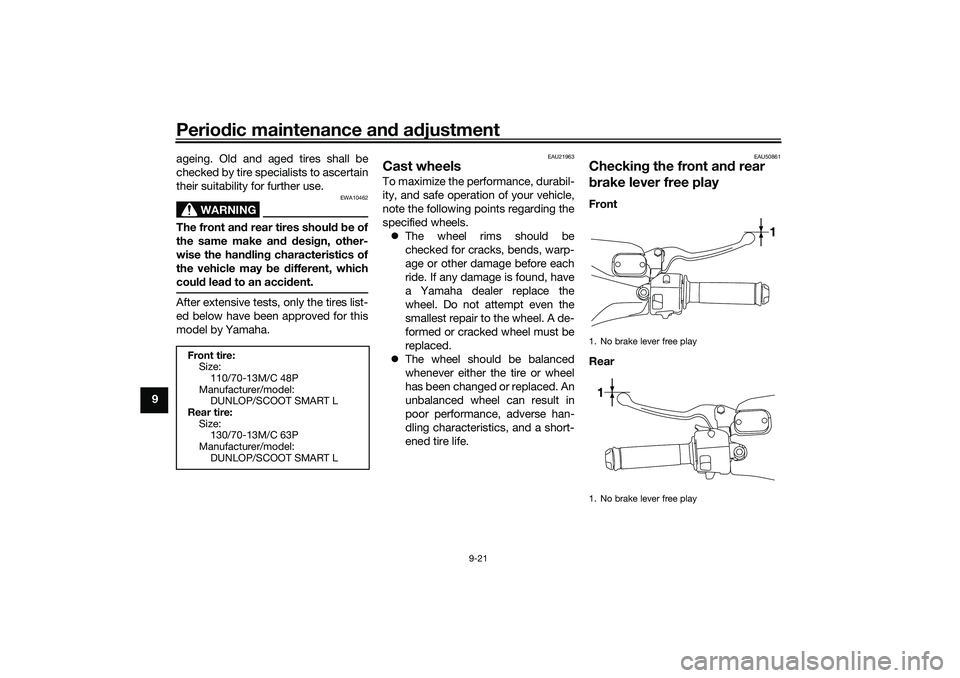
brake lever free playFront
Rear
Front tire:
Size:
110/70-13M/C 48P
Manufacturer/model:
DUNLOP/SCOOT SMART L
Rear tire:
Size:
130/70-13M/C 63P
Manufacturer/model:
DUNLOP/SCOOT SMART L
1. No brake lever free play
1. No brake lever free play
1
1
UBALE0E0.book Page 21 Wednesday, September 30, 2020 1:37 PM
Page 91 of 114
Periodic maintenance and adjustment
9-28
9
EAU23292
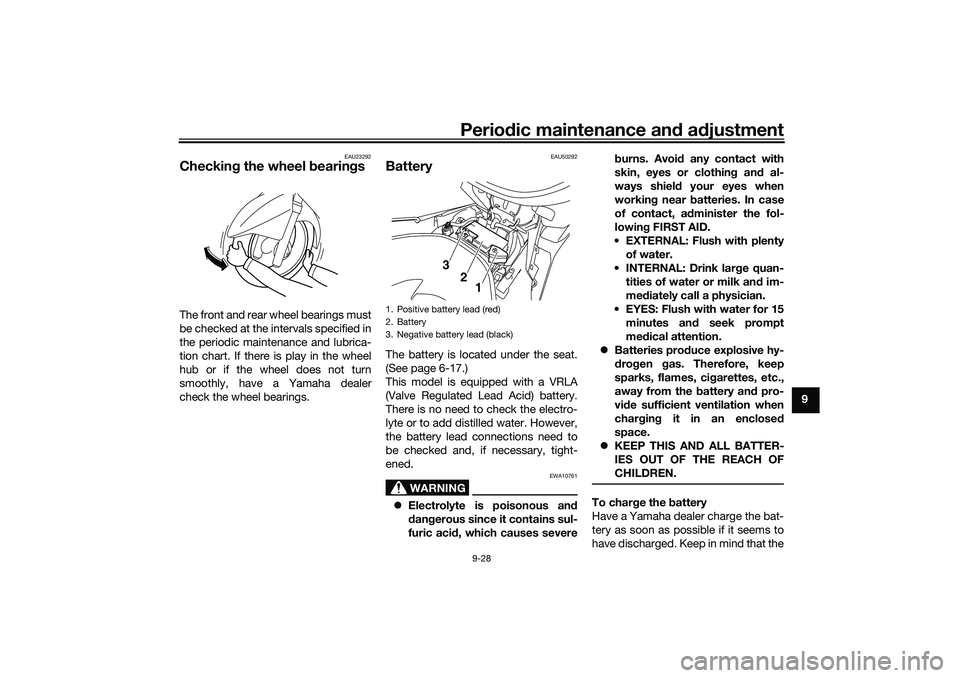
Checking the wheel bearingsThe front and rear wheel bearings must
be checked at the intervals specified in
the periodic maintenance and lubrica-
tion chart. If there is play in the wheel
hub or if the wheel does not turn
smoothly, have a Yamaha dealer
check the wheel bearings.
EAU50292
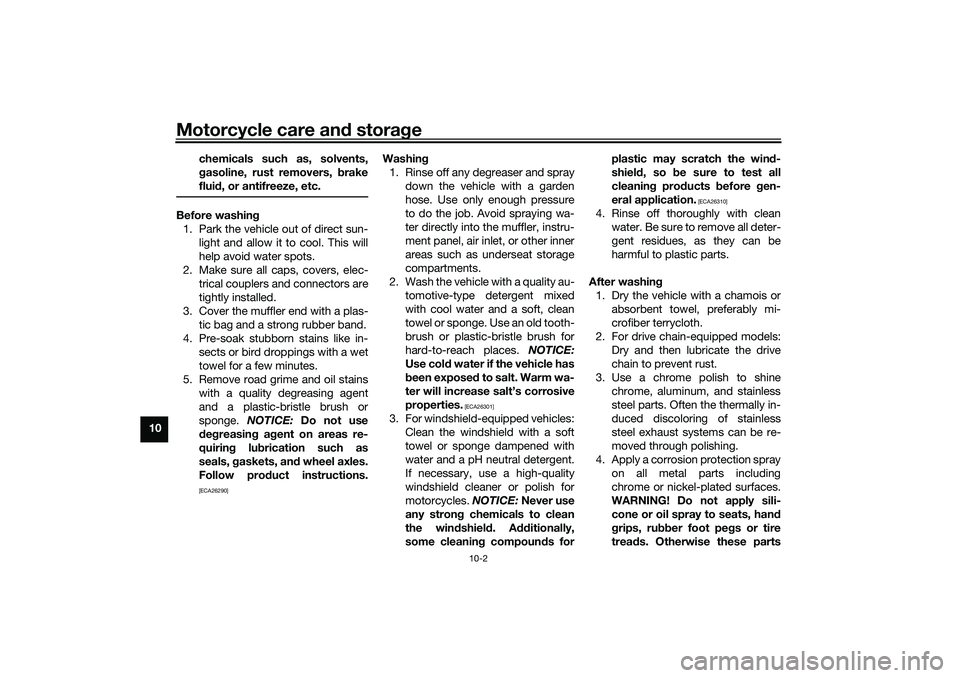
BatteryThe battery is located under the seat.
(See page 6-17.)
This model is equipped with a VRLA
(Valve Regulated Lead Acid) battery.
There is no need to check the electro-
lyte or to add distilled water. However,
the battery lead connections need to
be checked and, if necessary, tight-
ened.
WARNING
EWA10761
Electrolyte is poisonous and
dangerous since it contains sul-
furic acid, which causes severeburns. Avoid any contact with
skin, eyes or clothing and al-
ways shield your eyes when
working near batteries. In case
of contact, administer the fol-
lowing FIRST AID.
EXTERNAL: Flush with plenty
of water.
INTERNAL: Drink large quan-
tities of water or milk and im-
mediately call a physician.
EYES: Flush with water for 15
minutes and seek prompt
medical attention.
Batteries produce explosive hy-
drogen gas. Therefore, keep
sparks, flames, cigarettes, etc.,
away from the battery and pro-
vide sufficient ventilation when
charging it in an enclosed
space.
KEEP THIS AND ALL BATTER-
IES OUT OF THE REACH OF
CHILDREN.
To charge the battery
Have a Yamaha dealer charge the bat-
tery as soon as possible if it seems to
have discharged. Keep in mind that the
1. Positive battery lead (red)
2. Battery
3. Negative battery lead (black)
3
2
1
UBALE0E0.book Page 28 Wednesday, September 30, 2020 1:37 PM
Page 103 of 114

Motorcycle care and storage
10-1
10
EAU37834
Matte color cautionNOTICE
ECA15193
Some models are equipped with
matte colored finished parts. Be
sure to consult a Yamaha dealer for
advice on what products to use be-
fore cleaning the vehicle. Using a
brush, harsh chemical products or
cleaning compounds when cleaning
these parts will scratch or damage
their surface. Wax also should not
be applied to any matte colored fin-
ished parts.
EAU83443
CareFrequent, thorough cleaning of the ve-
hicle will not only enhance its appear-
ance but also will improve its general
performance and extend the useful life
of many components. Washing, clean-
ing, and polishing will also give you a
chance to inspect the condition of the
vehicle more frequently. Be sure to
wash the vehicle after riding in the rain
or near the sea, because salt is corro-
sive to metals.TIPThe roads of heavy snowfall areas
may be sprayed with salt as a de-
icing method. This salt can stay on
the roads well into spring, so be
sure to wash the underside and
chassis parts after riding in such
areas.
Genuine Yamaha care and main-
tenance products are sold under
the YAMALUBE brand in many
markets worldwide.
See your Yamaha dealer for addi-
tional cleaning tips.
NOTICE
ECA26280
Improper cleaning can cause cos-
metic and mechanical damage. Do
not use:
high-pressure washers or
steam-jet cleaners. Excessive
water pressure may cause wa-
ter seepage and deterioration of
wheel bearings, brakes, trans-
mission seals and electrical de-
vices. Avoid high-pressure
detergent applications such as
those available in coin-operated
car washers.
harsh chemicals, including
strong acidic wheel cleaners,
especially on spoke or magne-
sium wheels.
harsh chemicals, abrasive
cleaning compounds, or wax on
matte-finished parts. Brushes
can scratch and damage the
matte-finish, use soft sponge or
towel only.
towels, sponges, or brushes
contaminated with abrasive
cleaning products or stron
g
UBALE0E0.book Page 1 Wednesday, September 30, 2020 1:37 PM
Page 104 of 114
Motorcycle care and storage
10-2
10chemicals such as, solvents,
gasoline, rust removers, brake
fluid, or antifreeze, etc.
Before washing
1. Park the vehicle out of direct sun-
light and allow it to cool. This will
help avoid water spots.
2. Make sure all caps, covers, elec-
trical couplers and connectors are
tightly installed.
3. Cover the muffler end with a plas-
tic bag and a strong rubber band.
4. Pre-soak stubborn stains like in-
sects or bird droppings with a wet
towel for a few minutes.
5. Remove road grime and oil stains
with a quality degreasing agent
and a plastic-bristle brush or
sponge. NOTICE: Do not use
degreasing agent on areas re-
quiring lubrication such as
seals, gaskets, and wheel axles.
Follow product instructions.
[ECA26290]
Washing
1. Rinse off any degreaser and spray
down the vehicle with a garden
hose. Use only enough pressure
to do the job. Avoid spraying wa-
ter directly into the muffler, instru-
ment panel, air inlet, or other inner
areas such as underseat storage
compartments.
2. Wash the vehicle with a quality au-
tomotive-type detergent mixed
with cool water and a soft, clean
towel or sponge. Use an old tooth-
brush or plastic-bristle brush for
hard-to-reach places. NOTICE:
Use cold water if the vehicle has
been exposed to salt. Warm wa-
ter will increase salt’s corrosive
properties.
[ECA26301]
3. For windshield-equipped vehicles:
Clean the windshield with a soft
towel or sponge dampened with
water and a pH neutral detergent.
If necessary, use a high-quality
windshield cleaner or polish for
motorcycles. NOTICE: Never use
any strong chemicals to clean
the windshield. Additionally,
some cleaning compounds forplastic may scratch the wind-
shield, so be sure to test all
cleaning products before gen-
eral application.
[ECA26310]
4. Rinse off thoroughly with clean
water. Be sure to remove all deter-
gent residues, as they can be
harmful to plastic parts.
After washing
1. Dry the vehicle with a chamois or
absorbent towel, preferably mi-
crofiber terrycloth.
2. For drive chain-equipped models:
Dry and then lubricate the drive
chain to prevent rust.
3. Use a chrome polish to shine
chrome, aluminum, and stainless
steel parts. Often the thermally in-
duced discoloring of stainless
steel exhaust systems can be re-
moved through polishing.
4. Apply a corrosion protection spray
on all metal parts including
chrome or nickel-plated surfaces.
WARNING! Do not apply sili-
cone or oil spray to seats, hand
grips, rubber foot pegs or tire
treads. Otherwise these parts
UBALE0E0.book Page 2 Wednesday, September 30, 2020 1:37 PM
Page 106 of 114
Motorcycle care and storage
10-4
101. Make all necessary repairs and
perform any outstanding mainte-
nance.
2. Follow all instructions in the Care
section of this chapter.
3. Fill up the fuel tank, adding fuel
stabilizer according to product in-
structions. Run the engine for 5
minutes to distribute treated fuel
through the fuel system.
4. For vehicles equipped with a fuel
cock: Turn the fuel cock lever to
the off position.
5. For vehicles with a carburetor: To
prevent fuel deposits from build-
ing up, drain the fuel in the carbu-
retor float chamber into a clean
container. Retighten the drain bolt
and pour the fuel back into the fuel
tank.
6. Use a quality engine fogging oil
according to product instructions
to protect internal engine compo-
nents from corrosion. If engine
fogging oil is not available, per-
form the following steps for each
cylinder:
a. Remove the spark plug cap
and spark plug.b. Pour a teaspoonful of engine
oil into the spark plug bore.
c. Install the spark plug cap onto
the spark plug, and then place
the spark plug on the cylinder
head so that the electrodes are
grounded. (This will limit spark-
ing during the next step.)
d. Turn the engine over several
times with the starter. (This will
coat the cylinder wall with oil.)
WARNING! To prevent dam-
age or injury from sparking,
make sure to ground the
spark plug electrodes while
turning the engine over.
[EWA10952]
e. Remove the spark plug cap
from the spark plug, and then
install the spark plug and the
spark plug cap.
7. Lubricate all control cables, piv-
ots, levers and pedals, as well as
the sidestand and centerstand (if
equipped).
8. Check and correct the tire air
pressure, and then lift the vehicle
so that all wheels are off the
ground. Otherwise, turn thewheels a little once a month in or-
der to prevent the tires from be-
coming degraded in one spot.
9. Cover the muffler outlet with a
plastic bag to prevent moisture
from entering it.
10. Remove the battery and fully
charge it, or attach a maintenance
charger to keep the battery opti-
mally charged. NOTICE: Confirm
that the battery and its charger
are compatible. Do not charge a
VRLA battery with a convention-
al charger.
[ECA26330]
TIPIf the battery will be removed,
charge it once a month and store
it in a temperate location between
0-30 °C (32-90 °F).
See page 9-28 for more informa-
tion on charging and storing the
battery.
UBALE0E0.book Page 4 Wednesday, September 30, 2020 1:37 PM
Page 107 of 114
Specifications
11-1
11
Dimensions:Overall length:
1935 mm (76.2 in)
Overall width:
740 mm (29.1 in)
Overall height:
1160 mm (45.7 in)
Seat height:
765 mm (30.1 in)
Wheelbase:
1340 mm (52.8 in)
Ground clearance:
125 mm (4.92 in)
Minimum turning radius:
2.0 m (6.56 ft)Weight:Curb weight:
131 kg (289 lb)Engine:Combustion cycle:
4-stroke
Cooling system:
Liquid cooled
Valve train:
SOHC
Number of cylinders:
Single cylinder
Displacement:
125 cm3
Bore × stroke:
52.0 × 58.7 mm (2.05 × 2.31 in)
Starting system:
Electric starter
Engine oil:Recommended brand:
SAE viscosity grades:
10W-40
Recommended engine oil grade:
API service SG type or higher, JASO
standard MA or MB
Engine oil quantity:
Oil change:
0.90 L (0.95 US qt, 0.79 Imp.qt)Final transmission oil:Type:
Motor oil SAE 10W-40 type SG or higher
Quantity:
0.10 L (0.11 US qt, 0.09 Imp.qt)Coolant quantity:Coolant reservoir (up to the maximum level
mark):
0.13 L (0.14 US qt, 0.11 Imp.qt)
Radiator (including all routes):
0.46 L (0.49 US qt, 0.40 Imp.qt)Fuel:Recommended fuel:
Unleaded gasoline only
Octane number (RON):
90
Fuel tank capacity:
7.1 L (1.9 US gal, 1.6 Imp.gal)
Fuel reserve amount:
1.7 L (0.45 US gal, 0.37 Imp.gal)
Fuel injection:Throttle body:
ID mark:
B2T1Front tire:Type:
Tubeless
Size:
110/70-13M/C 48P
Manufacturer/model:
DUNLOP/SCOOT SMART LRear tire:Type:
Tubeless
Size:
130/70-13M/C 63P
Manufacturer/model:
DUNLOP/SCOOT SMART LLoading:Maximum load:
167 kg (368 lb)
(Total weight of rider, passenger, cargo and
accessories)Front brake:Type:
Hydraulic single disc brakeRear brake:Type:
Hydraulic single disc brakeFront suspension:Type:
Telescopic fork
UBALE0E0.book Page 1 Wednesday, September 30, 2020 1:37 PM
Page 113 of 114
Index
13-2
13
Starting off .............................................. 8-2
Starting the engine ................................. 8-2
Start switch........................................... 6-10
Steering, checking ................................ 9-27
Stop and Start System ........................... 4-1
Stop and Start System indicator light .... 6-2
Stop and Start System operation ........... 4-1
Stop and Start System switch .............. 6-10
Stop and Start System
troubleshooting .................................. 9-34
Storage ................................................. 10-3
Storage compartments......................... 6-18TThrottle grip and cable,
checking and lubricating .................... 9-25
Throttle grip free play, checking ........... 9-19
Tires ...................................................... 9-19
Tool kit .................................................... 9-1
Traction control system ........................ 6-12
Traction control system indicator light ... 6-2
Troubleshooting.................................... 9-33
Troubleshooting chart .......................... 9-36
Turn signal indicator lights ..................... 6-1
Turn signal light bulb (front),
replacing............................................. 9-31
Turn signal light bulb (rear),
replacing............................................. 9-32
Turn signal switch................................. 6-10VValve clearance .................................... 9-19
V-belt, checking.................................... 9-24
Vehicle identification number ............... 12-1
Vehicle lights ........................................ 9-31
VVA indicator .......................................... 6-5
WWheel bearings, checking .................... 9-28
Wheels ................................................. 9-21YYamalube ............................................. 9-13
UBALE0E0.book Page 2 Wednesday, September 30, 2020 1:37 PM