brake YAMAHA NMAX 125 2020 Owner's Manual
[x] Cancel search | Manufacturer: YAMAHA, Model Year: 2020, Model line: NMAX 125, Model: YAMAHA NMAX 125 2020Pages: 114, PDF Size: 10.63 MB
Page 84 of 114
Periodic maintenance and adjustment
9-21
9ageing. Old and aged tires shall be
checked by tire specialists to ascertain
their suitability for further use.
WARNING
EWA10462
The front and rear tires should be of
the same make and design, other-
wise the handling characteristics of
the vehicle may be different, which
could lead to an accident.After extensive tests, only the tires list-
ed below have been approved for this
model by Yamaha.
EAU21963
Cast wheelsTo maximize the performance, durabil-
ity, and safe operation of your vehicle,
note the following points regarding the
specified wheels.
The wheel rims should be
checked for cracks, bends, warp-
age or other damage before each
ride. If any damage is found, have
a Yamaha dealer replace the
wheel. Do not attempt even the
smallest repair to the wheel. A de-
formed or cracked wheel must be
replaced.
The wheel should be balanced
whenever either the tire or wheel
has been changed or replaced. An
unbalanced wheel can result in
poor performance, adverse han-
dling characteristics, and a short-
ened tire life.
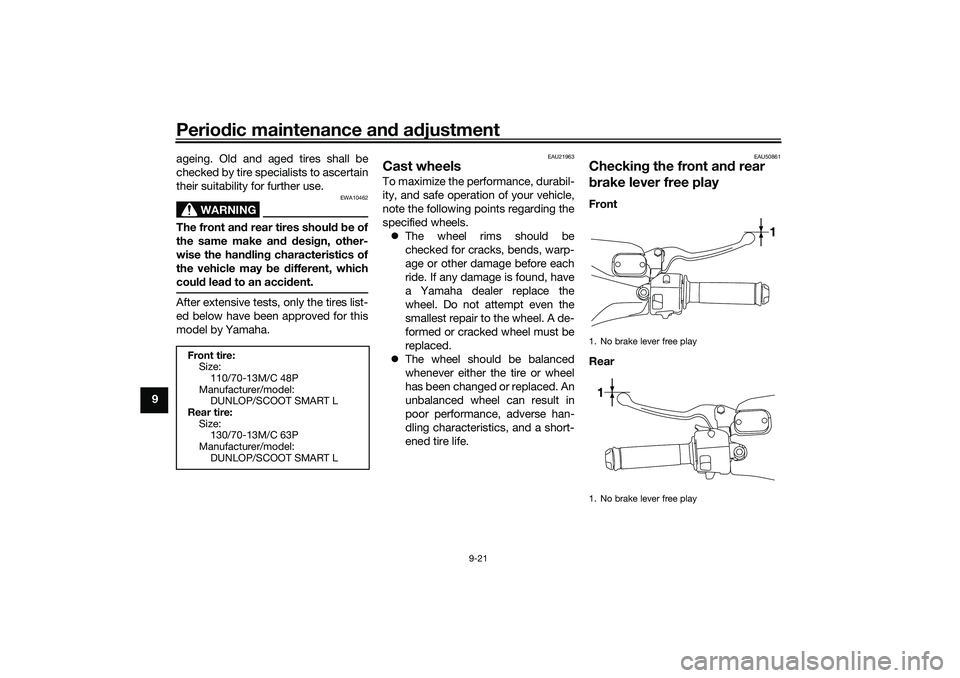
EAU50861
Checking the front and rear
brake lever free playFront
Rear
Front tire:
Size:
110/70-13M/C 48P
Manufacturer/model:
DUNLOP/SCOOT SMART L
Rear tire:
Size:
130/70-13M/C 63P
Manufacturer/model:
DUNLOP/SCOOT SMART L
1. No brake lever free play
1. No brake lever free play
1
1
UBALE0E0.book Page 21 Wednesday, September 30, 2020 1:37 PM
Page 85 of 114

Periodic maintenance and adjustment
9-22
9 There should be no free play at the
brake lever ends. If there is free play,
have a Yamaha dealer inspect the
brake system.
WARNING
EWA14212
A soft or spongy feeling in the brake
lever can indicate the presence of
air in the hydraulic system. If there is
air in the hydraulic system, have a
Yamaha dealer bleed the system be-
fore operating the vehicle. Air in the
hydraulic system will diminish the
braking performance, which may re-
sult in loss of control and an acci-
dent.
EAU22393
Checking the front and rear
brake padsThe front and rear brake pads must be
checked for wear at the intervals spec-
ified in the periodic maintenance and
lubrication chart.
EAU22434
Front brake pads
Each front brake pad is provided with
wear indicator grooves, which allow
you to check the brake pad wear with-
out having to disassemble the brake.
To check the brake pad wear, check
the wear indicator grooves. If a brake
pad has worn to the point that the wearindicator grooves have almost disap-
peared, have a Yamaha dealer replace
the brake pads as a set.
EAU22461
Rear brake pads
Each rear brake pad is provided with a
wear indicator, which allows you to
check the brake pad wear without hav-
ing to disassemble the brake. To check
the brake pad wear, check the position
of the wear indicator while applying the
brake. If a brake pad has worn to the
point that the wear indicator almost
touches the brake disc, have a
Yamaha dealer replace the brake pads
as a set.
1. Brake pad wear indicator groove
1
1
1. Brake pad wear indicator
1
UBALE0E0.book Page 22 Wednesday, September 30, 2020 1:37 PM
Page 86 of 114
Periodic maintenance and adjustment
9-23
9
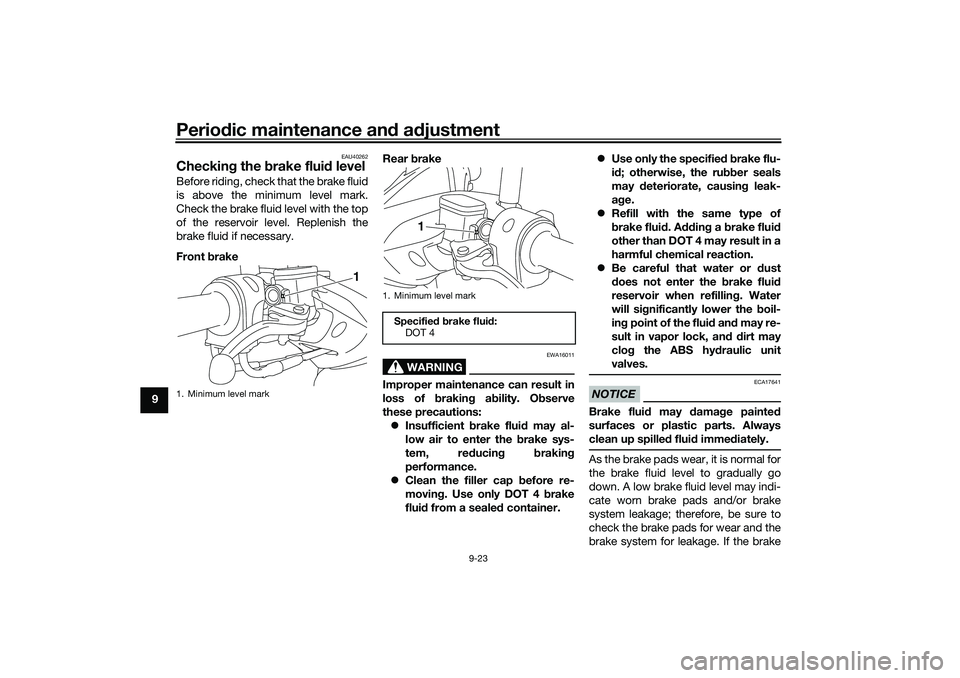
EAU40262
Checking the brake fluid levelBefore riding, check that the brake fluid
is above the minimum level mark.
Check the brake fluid level with the top
of the reservoir level. Replenish the
brake fluid if necessary.
Front brakeRear brake
WARNING
EWA16011
Improper maintenance can result in
loss of braking ability. Observe
these precautions:
Insufficient brake fluid may al-
low air to enter the brake sys-
tem, reducing braking
performance.
Clean the filler cap before re-
moving. Use only DOT 4 brake
fluid from a sealed container.Use only the specified brake flu-
id; otherwise, the rubber seals
may deteriorate, causing leak-
age.
Refill with the same type of
brake fluid. Adding a brake fluid
other than DOT 4 may result in a
harmful chemical reaction.
Be careful that water or dust
does not enter the brake fluid
reservoir when refilling. Water
will significantly lower the boil-
ing point of the fluid and may re-
sult in vapor lock, an
d dirt may
clog the ABS hydraulic unit
valves.
NOTICE
ECA17641
Brake fluid may damage painted
surfaces or plastic parts. Always
clean up spilled fluid immediately.As the brake pads wear, it is normal for
the brake fluid level to gradually go
down. A low brake fluid level may indi-
cate worn brake pads and/or brake
system leakage; therefore, be sure to
check the brake pads for wear and the
brake system for leakage. If the brake
1. Minimum level mark
1
1. Minimum level markSpecified brake fluid:
DOT 4
1
UBALE0E0.book Page 23 Wednesday, September 30, 2020 1:37 PM
Page 87 of 114

Periodic maintenance and adjustment
9-24
9 fluid level goes down suddenly, have a
Yamaha dealer check the cause before
further riding.
EAU22734
Changing the brake fluidHave a Yamaha dealer change the
brake fluid every 2 years. In addition,
have the seals of the master cylinders
and brake calipers, as well as the brake
hoses replaced at the intervals listed
below or sooner if they are damaged or
leaking.
Brake seals: every 2 years
Brake hoses: every 4 years
EAUU0311
Checking the V-beltThe V-belt must be checked and re-
placed by a Yamaha dealer at the inter-
vals specified in the periodic
maintenance and lubrication chart.
UBALE0E0.book Page 24 Wednesday, September 30, 2020 1:37 PM
Page 88 of 114

Periodic maintenance and adjustment
9-25
9
EAU23098
Checking and lubricating the
cablesThe operation of all control cables and
the condition of the cables should be
checked before each ride, and the ca-
bles and cable ends should be lubri-
cated if necessary. If a cable is
damaged or does not move smoothly,
have a Yamaha dealer check or re-
place it. WARNING! Damage to the
outer housing of cables may result
in internal rusting and cause inter-
ference with cable movement. Re-
place damaged cables as soon as
possible to prevent unsafe condi-
tions.
[EWA10712]EAU49921
Checking and lubricating the
throttle grip and cableThe operation of the throttle grip
should be checked before each ride. In
addition, the cable should be lubricat-
ed by a Yamaha dealer at the intervals
specified in the periodic maintenance
chart.
EAU23173
Lubricating the front and rear
brake leversFront brake lever
Rear brake lever
The pivoting points of the front and rear
brake levers must be lubricated at the
intervals specified in the periodic main-
tenance and lubrication chart.
Recommended lubricant:
Yamaha cable lubricant or other
suitable cable lubricant
UBALE0E0.book Page 25 Wednesday, September 30, 2020 1:37 PM
Page 90 of 114
Periodic maintenance and adjustment
9-27
9
EAU23273
Checking the front forkThe condition and operation of the
front fork must be checked as follows
at the intervals specified in the periodic
maintenance and lubrication chart.
To check the condition
Check the inner tubes for scratches,
damage and excessive oil leakage.
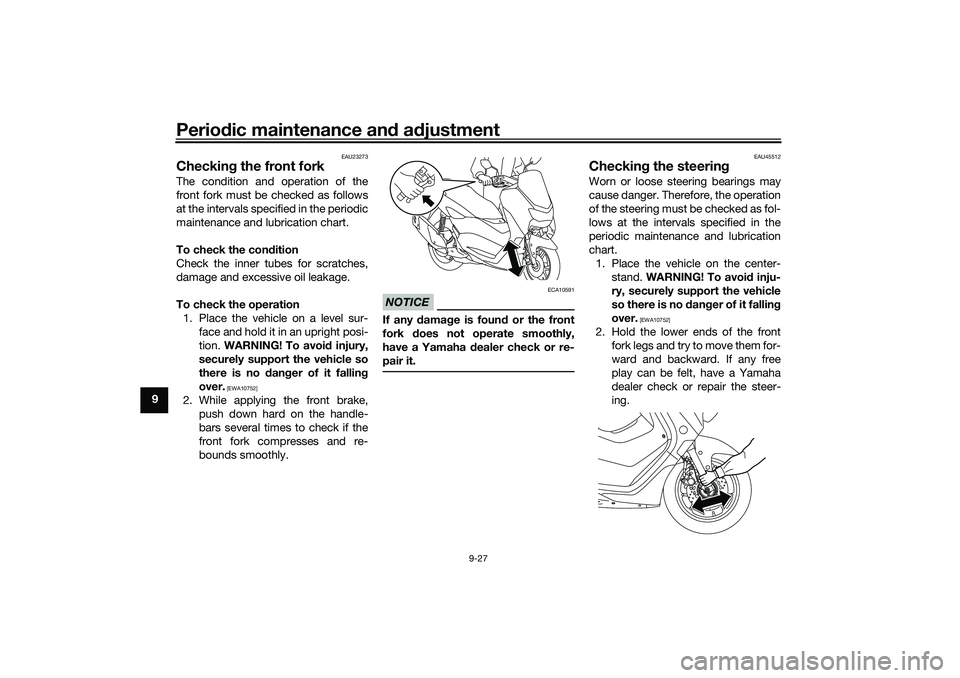
To check the operation
1. Place the vehicle on a level sur-
face and hold it in an upright posi-
tion. WARNING! To avoid injury,
securely support the vehicle so
there is no danger of it falling
over.
[EWA10752]
2. While applying the front brake,
push down hard on the handle-
bars several times to check if the
front fork compresses and re-
bounds smoothly.
NOTICE
ECA10591
If any damage is found or the front
fork does not operate smoothly,
have a Yamaha dealer check or re-
pair it.
EAU45512
Checking the steeringWorn or loose steering bearings may
cause danger. Therefore, the operation
of the steering must be checked as fol-
lows at the intervals specified in the
periodic maintenance and lubrication
chart.
1. Place the vehicle on the center-
stand. WARNING! To avoid inju-
ry, securely support the vehicle
so there is no danger of it falling
over.
[EWA10752]
2. Hold the lower ends of the front
fork legs and try to move them for-
ward and backward. If any free
play can be felt, have a Yamaha
dealer check or repair the steer-
ing.
UBALE0E0.book Page 27 Wednesday, September 30, 2020 1:37 PM
Page 94 of 114
Periodic maintenance and adjustment
9-31
9
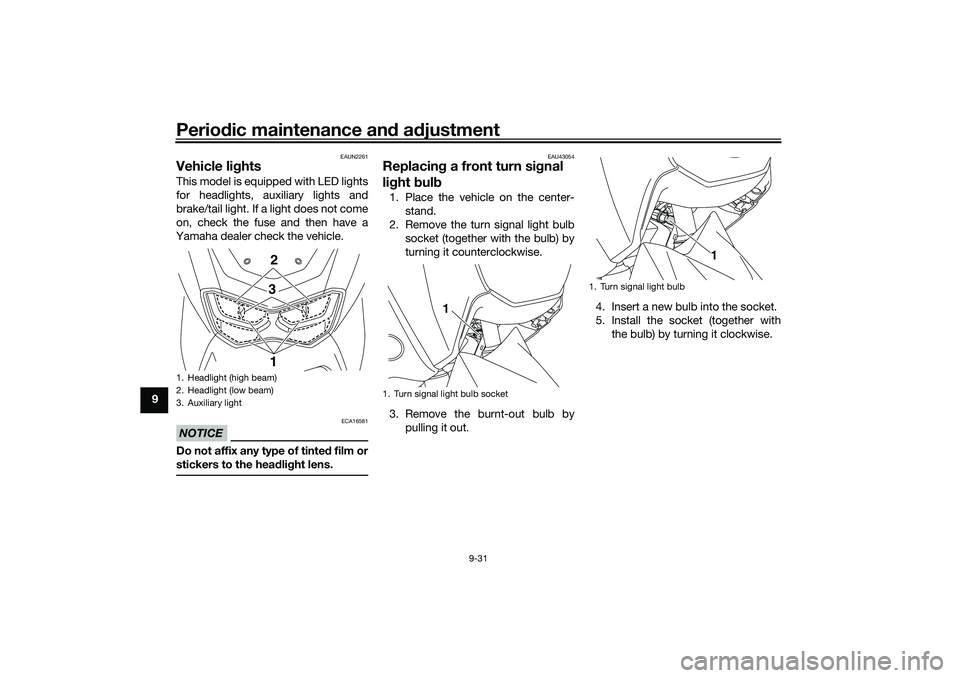
EAUN2261
Vehicle lightsThis model is equipped with LED lights
for headlights, auxiliary lights and
brake/tail light. If a light does not come
on, check the fuse and then have a
Yamaha dealer check the vehicle.NOTICE
ECA16581
Do not affix any type of tinted film or
stickers to the headlight lens.
EAU43054
Replacing a front turn signal
light bulb1. Place the vehicle on the center-
stand.
2. Remove the turn signal light bulb
socket (together with the bulb) by
turning it counterclockwise.
3. Remove the burnt-out bulb by
pulling it out.4. Insert a new bulb into the socket.
5. Install the socket (together with
the bulb) by turning it clockwise.
1. Headlight (high beam)
2. Headlight (low beam)
3. Auxiliary light
2
3
1
1. Turn signal light bulb socket
1
1. Turn signal light bulb
1
UBALE0E0.book Page 31 Wednesday, September 30, 2020 1:37 PM
Page 103 of 114

Motorcycle care and storage
10-1
10
EAU37834
Matte color cautionNOTICE
ECA15193
Some models are equipped with
matte colored finished parts. Be
sure to consult a Yamaha dealer for
advice on what products to use be-
fore cleaning the vehicle. Using a
brush, harsh chemical products or
cleaning compounds when cleaning
these parts will scratch or damage
their surface. Wax also should not
be applied to any matte colored fin-
ished parts.
EAU83443
CareFrequent, thorough cleaning of the ve-
hicle will not only enhance its appear-
ance but also will improve its general
performance and extend the useful life
of many components. Washing, clean-
ing, and polishing will also give you a
chance to inspect the condition of the
vehicle more frequently. Be sure to
wash the vehicle after riding in the rain
or near the sea, because salt is corro-
sive to metals.TIPThe roads of heavy snowfall areas
may be sprayed with salt as a de-
icing method. This salt can stay on
the roads well into spring, so be
sure to wash the underside and
chassis parts after riding in such
areas.
Genuine Yamaha care and main-
tenance products are sold under
the YAMALUBE brand in many
markets worldwide.
See your Yamaha dealer for addi-
tional cleaning tips.
NOTICE
ECA26280
Improper cleaning can cause cos-
metic and mechanical damage. Do
not use:
high-pressure washers or
steam-jet cleaners. Excessive
water pressure may cause wa-
ter seepage and deterioration of
wheel bearings, brakes, trans-
mission seals and electrical de-
vices. Avoid high-pressure
detergent applications such as
those available in coin-operated
car washers.
harsh chemicals, including
strong acidic wheel cleaners,
especially on spoke or magne-
sium wheels.
harsh chemicals, abrasive
cleaning compounds, or wax on
matte-finished parts. Brushes
can scratch and damage the
matte-finish, use soft sponge or
towel only.
towels, sponges, or brushes
contaminated with abrasive
cleaning products or stron
g
UBALE0E0.book Page 1 Wednesday, September 30, 2020 1:37 PM
Page 104 of 114
Motorcycle care and storage
10-2
10chemicals such as, solvents,
gasoline, rust removers, brake
fluid, or antifreeze, etc.
Before washing
1. Park the vehicle out of direct sun-
light and allow it to cool. This will
help avoid water spots.
2. Make sure all caps, covers, elec-
trical couplers and connectors are
tightly installed.
3. Cover the muffler end with a plas-
tic bag and a strong rubber band.
4. Pre-soak stubborn stains like in-
sects or bird droppings with a wet
towel for a few minutes.
5. Remove road grime and oil stains
with a quality degreasing agent
and a plastic-bristle brush or
sponge. NOTICE: Do not use
degreasing agent on areas re-
quiring lubrication such as
seals, gaskets, and wheel axles.
Follow product instructions.
[ECA26290]
Washing
1. Rinse off any degreaser and spray
down the vehicle with a garden
hose. Use only enough pressure
to do the job. Avoid spraying wa-
ter directly into the muffler, instru-
ment panel, air inlet, or other inner
areas such as underseat storage
compartments.
2. Wash the vehicle with a quality au-
tomotive-type detergent mixed
with cool water and a soft, clean
towel or sponge. Use an old tooth-
brush or plastic-bristle brush for
hard-to-reach places. NOTICE:
Use cold water if the vehicle has
been exposed to salt. Warm wa-
ter will increase salt’s corrosive
properties.
[ECA26301]
3. For windshield-equipped vehicles:
Clean the windshield with a soft
towel or sponge dampened with
water and a pH neutral detergent.
If necessary, use a high-quality
windshield cleaner or polish for
motorcycles. NOTICE: Never use
any strong chemicals to clean
the windshield. Additionally,
some cleaning compounds forplastic may scratch the wind-
shield, so be sure to test all
cleaning products before gen-
eral application.
[ECA26310]
4. Rinse off thoroughly with clean
water. Be sure to remove all deter-
gent residues, as they can be
harmful to plastic parts.
After washing
1. Dry the vehicle with a chamois or
absorbent towel, preferably mi-
crofiber terrycloth.
2. For drive chain-equipped models:
Dry and then lubricate the drive
chain to prevent rust.
3. Use a chrome polish to shine
chrome, aluminum, and stainless
steel parts. Often the thermally in-
duced discoloring of stainless
steel exhaust systems can be re-
moved through polishing.
4. Apply a corrosion protection spray
on all metal parts including
chrome or nickel-plated surfaces.
WARNING! Do not apply sili-
cone or oil spray to seats, hand
grips, rubber foot pegs or tire
treads. Otherwise these parts
UBALE0E0.book Page 2 Wednesday, September 30, 2020 1:37 PM
Page 105 of 114
![YAMAHA NMAX 125 2020 Owners Manual Motorcycle care and storage
10-3
10 will become slippery, which
could cause loss of control.
Thoroughly clean the surfaces
of these parts before operating
the vehicle.
[EWA20650]
5. Treat rubber, vin](/img/51/51065/w960_51065-104.png "YAMAHA NMAX 125 2020 Owners Manual Motorcycle care and storage
10-3
10 will become slippery, which
could cause loss of control.
Thoroughly clean the surfaces
of these parts before operating
the vehicle.
[EWA20650]
5. Treat rubber, vin")
Motorcycle care and storage
10-3
10 will become slippery, which
could cause loss of control.
Thoroughly clean the surfaces
of these parts before operating
the vehicle.
[EWA20650]
5. Treat rubber, vinyl, and unpainted
plastic parts with a suitable care
product.
6. Touch up minor paint damage
caused by stones, etc.
7. Wax all painted surfaces using a
non-abrasive wax or use a detail
spray for motorcycles.
8. When finished cleaning, start the
engine and let it idle for several
minutes to help dry any remaining
moisture.
9. If the headlight lens has fogged
up, start the engine and turn on
the headlight to help remove the
moisture.
10. Let the vehicle dry completely be-
fore storing or covering it.NOTICE
ECA26320
Do not apply wax to rubber or
unpainted plastic parts.Do not use abrasive polishing
compounds as they will wear
away the paint.
Apply sprays and wax sparingly.
Wipe off excess afterwards.
WARNING
EWA20660
Contaminants left on the brakes or
tires can cause loss of control.
Make sure there is no lubricant
or wax on the brakes or tires.
If necessary, wash the tires with
warm water and a mild deter-
gent.
If necessary, clean the brake
discs and pads with brake
cleaner or acetone.
Before riding at higher speeds,
test the vehicle’s braking per-
formance and cornering behav-
ior.
EAU83472
StorageAlways store the vehicle in a cool, dry
place. If necessary, protect it against
dust with a porous cover. Be sure the
engine and the exhaust system are
cool before covering the vehicle. If the
vehicle often sits for weeks at a time
between uses, the use of a quality fuel
stabilizer is recommended after each
fill-up.NOTICE
ECA21170
Storing the vehicle in a poorly
ventilated room or covering it
with a tarp, while it is still wet,
will allow water and humidity to
seep in and cause rust.
To prevent corrosion, avoid
damp cellars, stables (because
of the presence of ammonia)
and areas where strong chemi-
cals are stored.Long term storage
Before storing the vehicle long term (60
days or more):
UBALE0E0.book Page 3 Wednesday, September 30, 2020 1:37 PM