warning YAMAHA RHINO 700 2013 Owner's Guide
[x] Cancel search | Manufacturer: YAMAHA, Model Year: 2013, Model line: RHINO 700, Model: YAMAHA RHINO 700 2013Pages: 188, PDF Size: 4.9 MB
Page 143 of 188
8-30
6. Wash the sponge material gently butthoroughly in parts cleaning solvent.
WARNING! Using gasoline or other
flammable solvents to clean the air fil-
ter element can cause a fire or explo-
sion, which could lead to serious
injury.
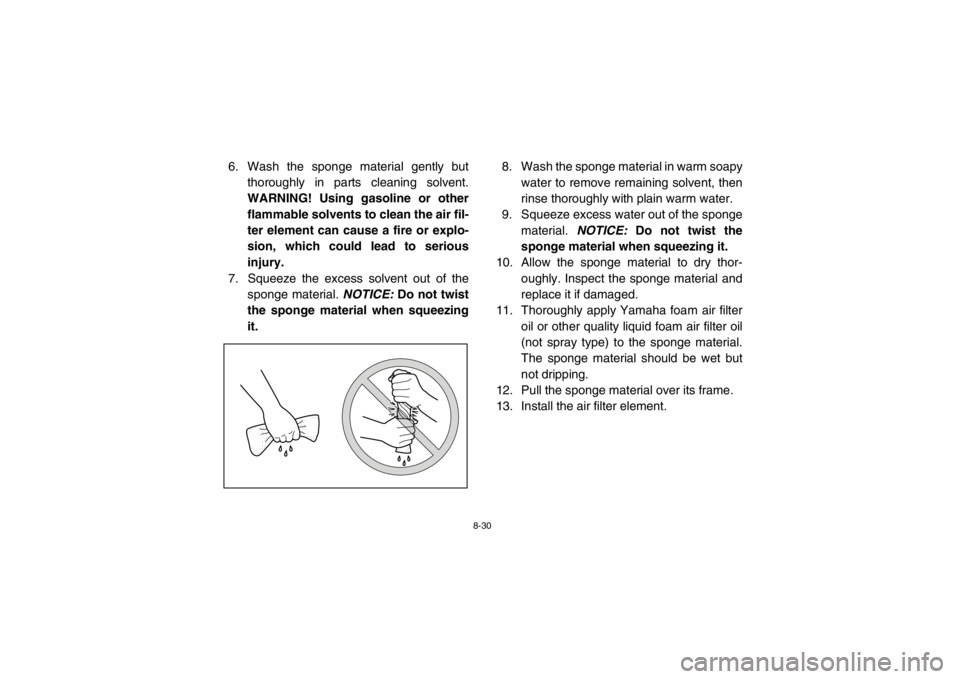
7. Squeeze the excess solvent out of the sponge material. NOTICE: Do not twist
the sponge material when squeezing
it. 8. Wash the sponge material in warm soapy
water to remove remaining solvent, then
rinse thoroughly with plain warm water.
9. Squeeze excess water out of the sponge material. NOTICE: Do not twist the
sponge material when squeezing it.
10. Allow the sponge material to dry thor- oughly. Inspect the sponge material and
replace it if damaged.
11. Thoroughly apply Yamaha foam air filter oil or other quality liquid foam air filter oil
(not spray type) to the sponge material.
The sponge material should be wet but
not dripping.
12. Pull the sponge material over its frame.
13. Install the air filter element.
1RB7A_EE.book Page 30 Tuesday, April 24, 2012 9:07 AM
Page 146 of 188
8-33
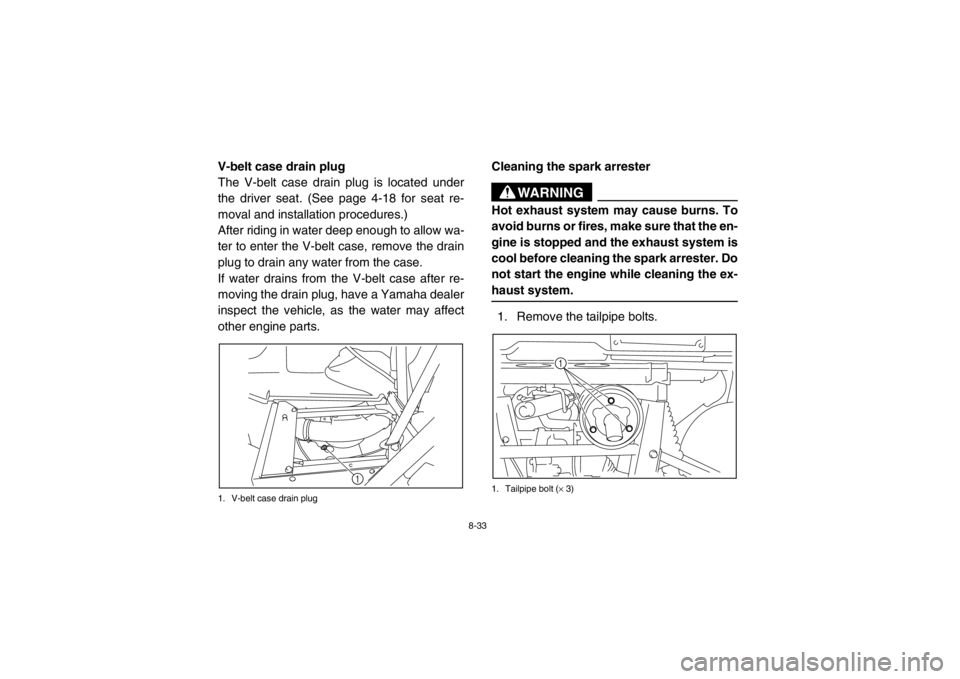
EVU00780V-belt case drain plug
The V-belt case drain plug is located under
the driver seat. (See page 4-18 for seat re-
moval and installation procedures.)
After riding in water deep enough to allow wa-
ter to enter the V-belt case, remove the drain
plug to drain any water from the case.
If water drains from the V-belt case after re-
moving the drain plug, have a Yamaha dealer
inspect the vehicle, as the water may affect
other engine parts.1. V-belt case drain plug
5B410018Cleaning the spark arrester
WARNING
Hot exhaust system may cause burns. To
avoid burns or fires, make sure that the en-
gine is stopped and the exhaust system is
cool before cleaning the spark arrester. Do
not start the engine while cleaning the ex-
haust system.1. Remove the tailpipe bolts.1. Tailpipe bolt (× 3)
1
1
1RB7A_EE.book Page 33 Tuesday, April 24, 2012 9:07 AM
Page 148 of 188
8-35
Brakes
Replacement of brake components requires
professional knowledge. Brake service should
be performed by a Yamaha dealer.
WARNING
Operating with improperly serviced or ad-
justed brakes could lead to a loss in brak-
ing ability and an accident.5B410019Checking the front and rear brake pads
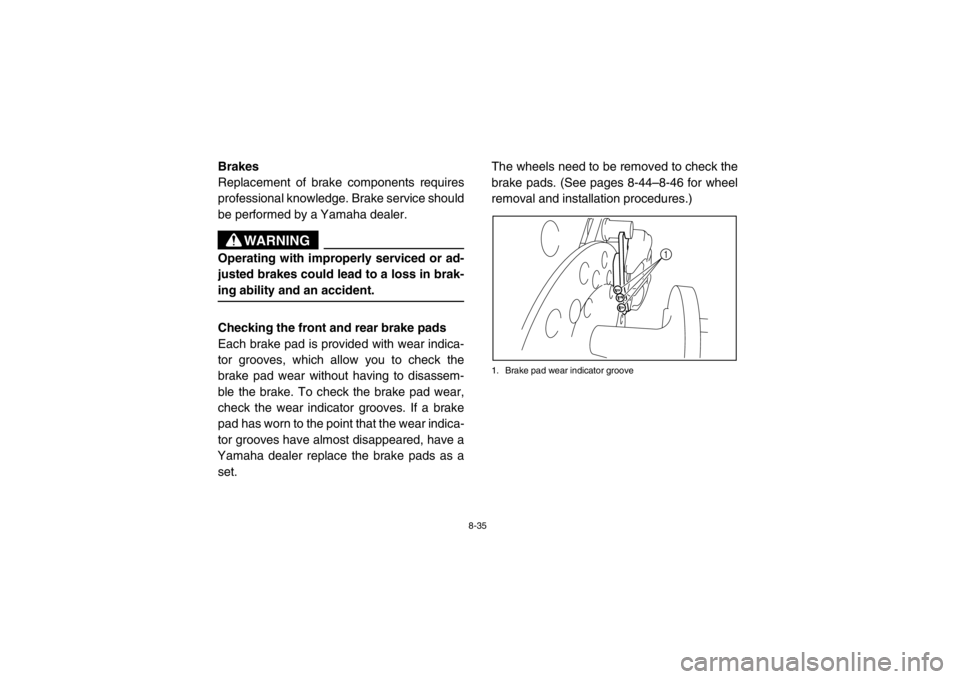
Each brake pad is provided with wear indica-
tor grooves, which allow you to check the
brake pad wear without having to disassem-
ble the brake. To check the brake pad wear,
check the wear indicator grooves. If a brake
pad has worn to the point that the wear indica-
tor grooves have almost disappeared, have a
Yamaha dealer replace the brake pads as a
set. The wheels need to be removed to check the
brake pads. (See pages 8-44–8-46 for wheel
removal and installation procedures.)
1. Brake pad wear indicator groove
1
1RB7A_EE.book Page 35 Tuesday, April 24, 2012 9:07 AM
Page 150 of 188
8-37
WARNING
Improper maintenance can result in loss of
braking ability. Observe these precautions:●
Insufficient brake fluid may allow air to
enter the brake system, reducing brak-
ing performance.
●
Clean the filler cap before removing.
Use only DOT 4 brake fluid from a
sealed container.
●
Use only the specified brake fluid; oth-
erwise, the rubber seals may deterio-
rate, causing leakage.
●
Refill with the same type of brake fluid.
Adding a brake fluid other than DOT 4
may result in a harmful chemical reac-
tion.
●
Be careful that water does not enter
the brake fluid reservoir when refilling.
Water will significantly lower the boil-
ing point of the fluid and may result in
vapor lock.
NOTICEBrake fluid may damage painted surfaces
or plastic parts. Always clean up spilled
fluid immediately.As the brake pads wear, it is normal for the
brake fluid level to gradually go down. A low
brake fluid level may indicate worn brake
pads and/or brake system leakage; therefore,
be sure to check the brake pads for wear and
the brake system for leakage. If the brake fluid
level goes down suddenly, have a Yamaha
dealer check the cause before further riding.EVU00860Brake fluid replacement
Complete fluid replacement should be done
only by trained Yamaha service personnel.
Have a Yamaha dealer replace the following
components during periodic maintenance or
when they are damaged or leaking.●
Replace the oil seals every two years.
●
Replace the brake hoses every four years.
1RB7A_EE.book Page 37 Tuesday, April 24, 2012 9:07 AM
Page 154 of 188
8-41
EVU00890Cable inspection and lubrication
WARNING
Damaged cables could restrict operation,
which may cause an accident or injury. In-
spect control cables frequently and re-
place damaged cables. Corrosion can
result when the outer covering of control
cables becomes damaged. Cables can
also become frayed or kinked.Lubricate the cable ends. If the cables do not
operate smoothly, ask a Yamaha dealer to re-
place them.
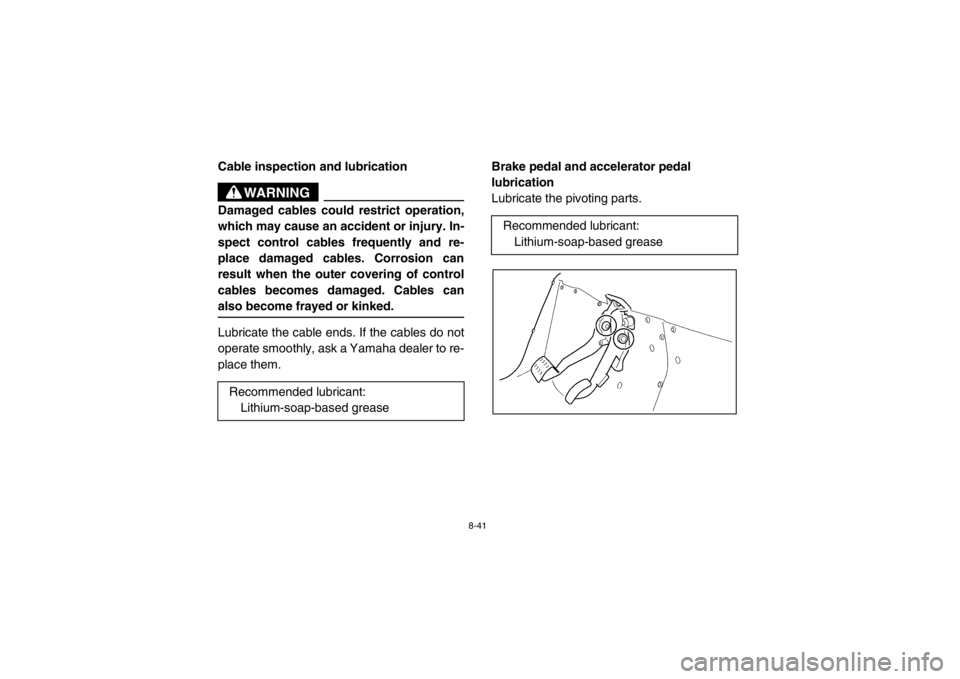
EVU00900Brake pedal and accelerator pedal
lubrication
Lubricate the pivoting parts.
Recommended lubricant: Lithium-soap-based grease
Recommended lubricant:
Lithium-soap-based grease
1RB7A_EE.book Page 41 Tuesday, April 24, 2012 9:07 AM
Page 157 of 188
8-44
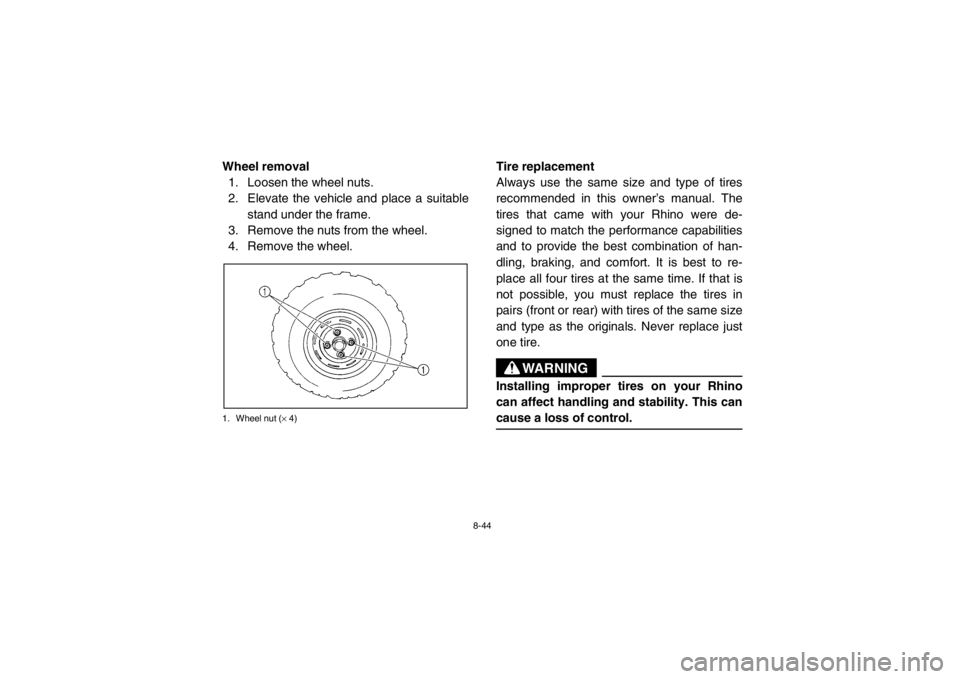
EVU00930Wheel removal1. Loosen the wheel nuts.
2. Elevate the vehicle and place a suitable stand under the frame.
3. Remove the nuts from the wheel.
4. Remove the wheel.1. Wheel nut ( × 4)
Tire replacement
Always use the same size and type of tires
recommended in this owner’s manual. The
tires that came with your Rhino were de-
signed to match the performance capabilities
and to provide the best combination of han-
dling, braking, and comfort. It is best to re-
place all four tires at the same time. If that is
not possible, you must replace the tires in
pairs (front or rear) with tires of the same size
and type as the originals. Never replace just
one tire.
WARNING
Installing improper tires on your Rhino
can affect handling and stability. This can
cause a loss of control.
1RB7A_EE.book Page 44 Tuesday, April 24, 2012 9:07 AM
Page 158 of 188
8-45
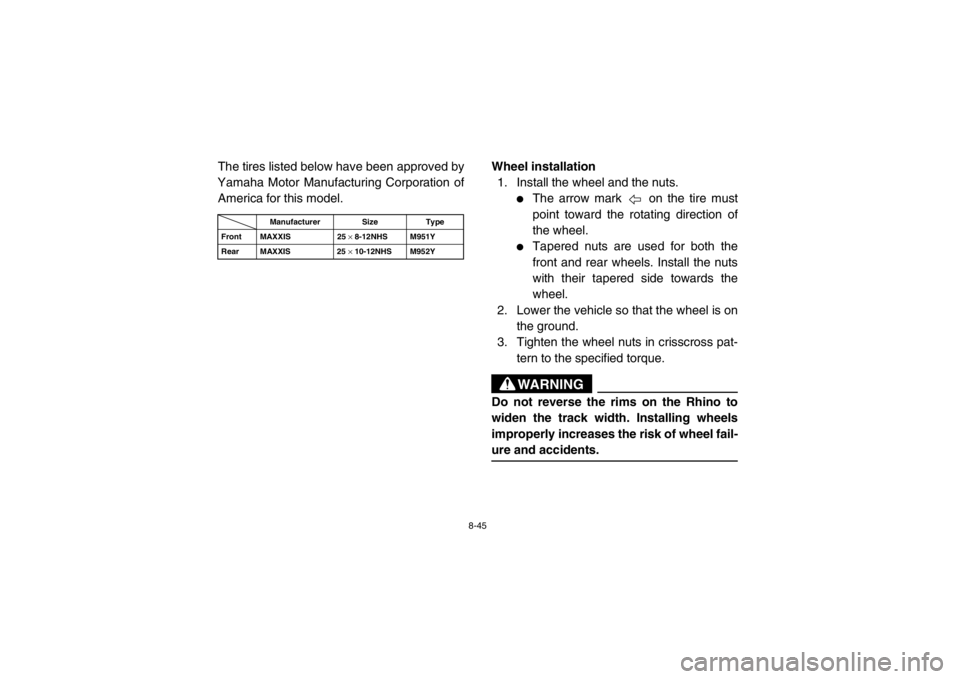
The tires listed below have been approved by
Yamaha Motor Manufacturing Corporation of America for this model.
EVU00940Wheel installation
1. Install the wheel and the nuts.
●
The arrow mark on the tire must
point toward the rotating direction of
the wheel.
●
Tapered nuts are used for both the
front and rear wheels. Install the nuts
with their tapered side towards the
wheel.
2. Lower the vehicle so that the wheel is on the ground.
3. Tighten the wheel nuts in crisscross pat-
tern to the specified torque.
WARNING
Do not reverse the rims on the Rhino to
widen the track width. Installing wheels
improperly increases the risk of wheel fail-
ure and accidents.
Manufacturer SizeType
Front MAXXIS 25 × 8-12NHS M951Y
Rear MAXXIS 25 × 10-12NHS M952Y
1RB7A_EE.book Page 45 Tuesday, April 24, 2012 9:07 AM
Page 160 of 188
8-47
EVU00950Battery
The battery is located under the hood. (See
pages 8-7–8-8 for hood opening and closing
procedures.)
This model is equipped with a VRLA (Valve
Regulated Lead Acid) battery. There is no
need to check the electrolyte or to add distilled
water. However, the battery lead connections
need to be checked and, if necessary, tight-
ened.
WARNING
Avoid battery contact with skin, eyes, or
clothing. Shield eyes when working near
batteries. Keep out of reach of children.
You could be poisoned or severely burned
by the sulfuric acid in battery electrolyte.
In case of accidental contact with battery
electrolyte:
EXTERNAL: Flush with water.
INTERNAL: Drink large quantities of water
or milk. Follow with milk of magnesia,
beaten egg, or vegetable oil. Get prompt
medical attention.
EYES: Flush with water for 15 minutes and
get prompt medical attention.
WARNING
Batteries may produce explosive gases.
Ventilate when charging or using in a
closed space. Keep batteries away from
sparks, flames, cigarettes, or other sourc-
es of ignition.
1RB7A_EE.book Page 47 Tuesday, April 24, 2012 9:07 AM
Page 164 of 188
8-51
5B410022Jump-starting
Jump-starting the vehicle should be avoided.
The battery should be removed and charged
instead.
WARNING
To avoid battery explosion and/or serious
damage to the electrical system:●
Do not connect the negative lead of
the jumper cable to the negative termi-
nal of the battery.
●
Do not touch the positive lead of the
jumper cable to the negative lead.
●
Do not reverse the polarity of the
jumper cables when connecting to the
batteries.
However, if the vehicle must be jump-started,
proceed as follows.1. Turn the key to “OFF”.
2. Open the hood. (See pages 8-7–8-8 for
hood opening and closing procedures.)
3. Remove the battery compartment cover.
(See pages 8-48–8-50 for battery com-
partment cover removal and installation
procedures.)
4. Remove the console. (See page 8-9 for console removal and installation proce-
dures.)
5. Using a charged 12-volt battery, connect the positive lead of the jumper cable to
the positive terminal of the battery in the
vehicle and the other end of the positive
lead to the positive terminal of the
charged battery.
1RB7A_EE.book Page 51 Tuesday, April 24, 2012 9:07 AM
Page 167 of 188
8-54
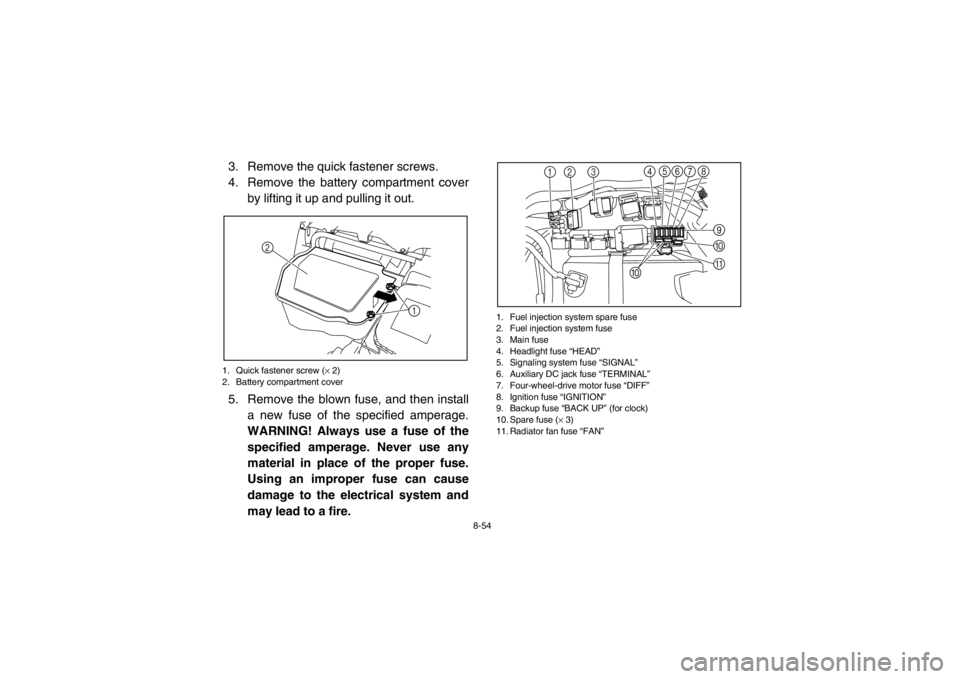
3. Remove the quick fastener screws.
4. Remove the battery compartment coverby lifting it up and pulling it out.1. Quick fastener screw ( × 2)
2. Battery compartment cover5. Remove the blown fuse, and then install
a new fuse of the specified amperage.
WARNING! Always use a fuse of the
specified amperage. Never use any
material in place of the proper fuse.
Using an improper fuse can cause
damage to the electrical system and
may lead to a fire.
1. Fuel injection system spare fuse
2. Fuel injection system fuse
3. Main fuse
4. Headlight fuse “HEAD”
5. Signaling system fuse “SIGNAL”
6. Auxiliary DC jack fuse “TERMINAL”
7. Four-wheel-drive motor fuse “DIFF”
8. Ignition fuse “IGNITION”
9. Backup fuse “BACK UP” (for clock)
10. Spare fuse ( × 3)
11. Radiator fan fuse “FAN”
1
2
12 3 7
9
456 8
A
@
0
1RB7A_EE.book Page 54 Tuesday, April 24, 2012 9:07 AM