warning YAMAHA RHINO 700 2013 Owner's Manual
[x] Cancel search | Manufacturer: YAMAHA, Model Year: 2013, Model line: RHINO 700, Model: YAMAHA RHINO 700 2013Pages: 188, PDF Size: 4.9 MB
Page 76 of 188

5-9
EVU00500Tires
Check tire pressure regularly to make sure it
is at the recommended specifications. Also
check for wear and damage.EVU00510Tire pressure
Use the tire pressure gauge to check and ad-
just tire pressures when the tires are cold. Tire
pressures must be equal on both sides.
WARNING! Operation of this vehicle with improper tire pressure may cause severe
injury or death from loss of control or roll-
over. Tire pressure below the minimum
specified could also cause the tire to dis-
lodge from the rim under severe riding
conditions. Set tire pressures to the following specifica-
tions:
ACE-02EThe tire pressure gauge is included as stan-
dard equipment. Make two measurements of
the tire pressure and use the second reading.
Dust or dirt in the gauge could cause the first
reading to be incorrect.
Recommended pressure Minimum
Front 70 kPa
(0.70 kgf/cm
2, 10 psi) 63 kPa
(0.63 kgf/cm
2, 9 psi)
Rear 98 kPa
(0.98 kgf/cm
2, 14 psi) 91 kPa
(0.91 kgf/cm
2, 13 psi)
1RB7A_EE.book Page 9 Tuesday, April 24, 2012 9:07 AM
Page 78 of 188
6-1
EVU00530
1-OPERATION
Read the Owner’s Manual carefully to be-
come familiar with all controls. If there is a
control or function you do not understand, ask
your Yamaha dealer.
WARNING
Failure to familiarize yourself with the con-
trols can lead to loss of control, which
could cause an accident or injury.
Engine break-in
There is never a more important period in the
life of your vehicle than the period between 0
and 20 hours.
For this reason, we ask that you read the fol-
lowing material carefully. Because the engine
is brand new, you must not put an excessive
load on it for the first several hours of opera-
tion. During the first 20 hours, the various
parts in the engine wear and polish them-
selves to achieve the correct operating clear-
ances.
During this period, prolonged full-throttle oper-
ation or any condition that might result in ex-
cessive engine heating must be avoided.
However, momentary (2–3 seconds maxi-
mum) full-throttle operation under load does
not harm the engine.
1RB7A_EE.book Page 1 Tuesday, April 24, 2012 9:07 AM
Page 79 of 188
6-2
1
2
3
4
56
7
8
9
10
11
12
13
14
Each full-throttle acceleration sequence
should be followed with a substantial rest pe-
riod for the engine, by cruising at lower r/min
so the engine can rid itself of the temporary
build-up of heat. If any abnormality is noticed
during this period, consult a Yamaha dealer.
0–10 hours:
Avoid continuous operation above half-throt-
tle. Allow a cooling-off period of 5 to 10 min-
utes after every hour of operation. Vary the
speed of the vehicle from time to time. Do not
operate it at one set throttle position.
10–20 hours:
Avoid prolonged operation above three-quar-
ter throttle.
After break-in:
The vehicle may now be operated normally.
5B410007Starting the engine1. Turn the key to “ON”.NOTICEThe coolant temperature warning light and
engine trouble warning light should come
on, then go off.
If a warning light does not go off, see pag-
es 4-4–4-5 for the corresponding warning
light circuit check.2. Apply the brake pedal.
3. Shift the drive select lever into the neutral position.
●
When the drive select lever is in the
neutral position, the neutral indicator
light should come on. If the neutral in-
dicator light does not come on, ask a
Yamaha dealer to inspect the electric circuit.
1RB7A_EE.book Page 2 Tuesday, April 24, 2012 9:07 AM
Page 82 of 188
6-5
Shifting: neutral to reverse
WARNING
Before you shift into reverse, make sure
there are no obstacles or people behind
you. When it is safe to proceed, go slowly.
Hitting an obstacle or person could result
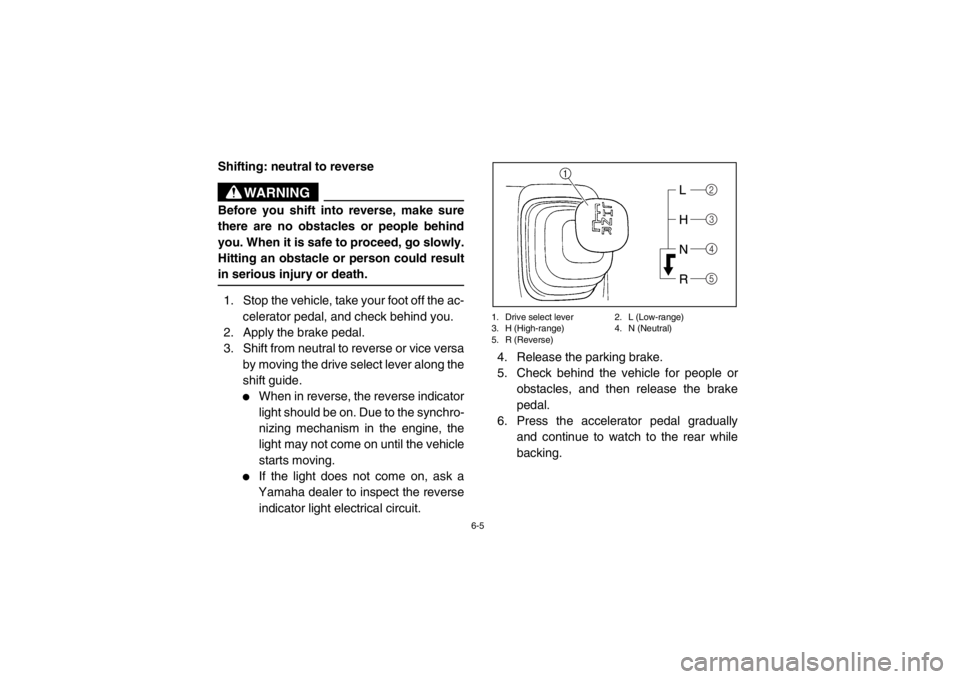
in serious injury or death.1. Stop the vehicle, take your foot off the ac-celerator pedal, and check behind you.
2. Apply the brake pedal.
3. Shift from neutral to reverse or vice versa
by moving the drive select lever along the
shift guide.
●
When in reverse, the reverse indicator
light should be on. Due to the synchro-
nizing mechanism in the engine, the
light may not come on until the vehicle
starts moving.
●
If the light does not come on, ask a
Yamaha dealer to inspect the reverse
indicator light electrical circuit.
1. Drive select lever 2. L (Low-range)
3. H (High-range) 4. N (Neutral)
5. R (Reverse)4. Release the parking brake.
5. Check behind the vehicle for people or obstacles, and then release the brake
pedal.
6. Press the accelerator pedal gradually
and continue to watch to the rear while
backing.
2
5 4
3
1RB7A_EE.book Page 5 Tuesday, April 24, 2012 9:07 AM
Page 86 of 188
6-9
EVU00630Loading
Take extra precautions when driving with a
load or trailer. Follow these instructions and
always use common sense and good judg-
ment when carrying cargo or towing a trailer.
Prepare your load or trailer
WARNING
Improper loading or towing can increase
the risk of loss of control, an overturn, or
other accident:●
Do not exceed the Maximum Loading
Limits for the vehicle (see page 6-10
and vehicle labeling).
●
Keep weight in the cargo bed centered
side to side, and as low and as far for-
ward as possible. Top-heavy loads in-
crease the risk of overturn. Be sure
cargo is secured – a loose load could
change handling unexpectedly or
strike occupants.
●
Do not exceed the maximum tongue
weight.
●
Make sure the load does not interfere
with your control or ability to see
where you are going.
●
Tie down cargo in the trailer securely.
Make sure cargo in the trailer cannot
move around. A shifting load can
cause an accident.
Use the hooks equipped on the cargo bed to
tie down loads.
Choose a trailer hitch drawbar designed for
use with a 5 cm (2 in) receiver. (See page
4-36 for more information.)
1RB7A_EE.book Page 9 Tuesday, April 24, 2012 9:07 AM
Page 87 of 188
6-10
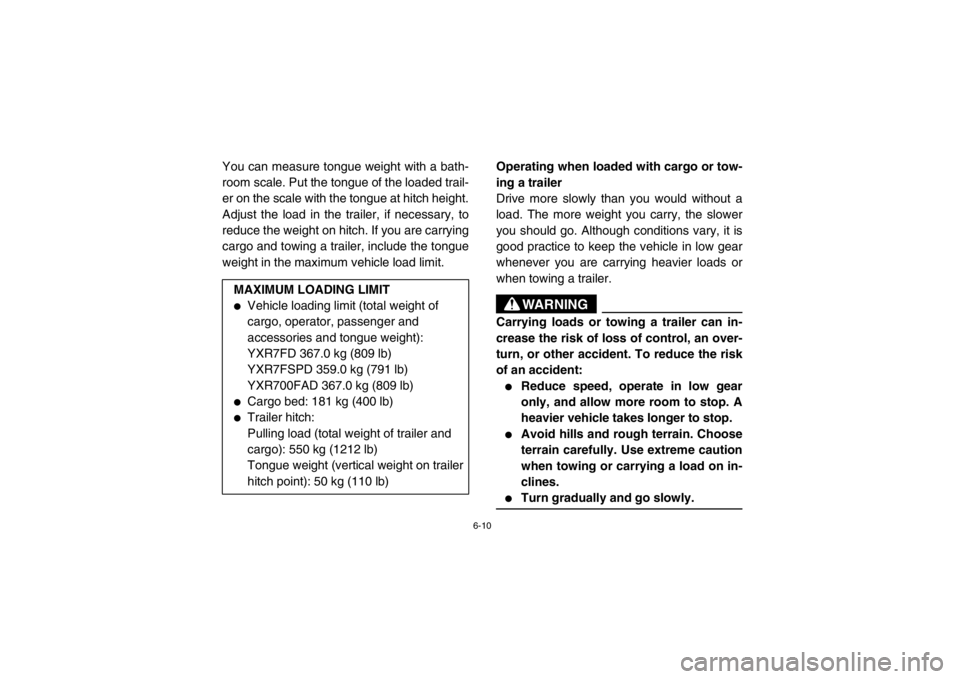
You can measure tongue weight with a bath-
room scale. Put the tongue of the loaded trail-
er on the scale with the tongue at hitch height.
Adjust the load in the trailer, if necessary, to
reduce the weight on hitch. If you are carrying
cargo and towing a trailer, include the tongue
weight in the maximum vehicle load limit.Operating when loaded with cargo or tow-
ing a trailer
Drive more slowly than you would without a
load. The more weight you carry, the slower
you should go. Although conditions vary, it is
good practice to keep the vehicle in low gear
whenever you are carrying heavier loads or
when towing a trailer.
WARNING
Carrying loads or towing a trailer can in-
crease the risk of loss of control, an over-
turn, or other accident. To reduce the risk
of an accident:●
Reduce speed, operate in low gear
only, and allow more room to stop. A
heavier vehicle takes longer to stop.
●
Avoid hills and rough terrain. Choose
terrain carefully. Use extreme caution
when towing or carrying a load on in-
clines.
●
Turn gradually and go slowly.
MAXIMUM LOADING LIMIT●
Vehicle loading limit (total weight of
cargo, operator, passenger and
accessories and tongue weight):
YXR7FD 367.0 kg (809 lb)
YXR7FSPD 359.0 kg (791 lb)
YXR700FAD 367.0 kg (809 lb)
●
Cargo bed: 181 kg (400 lb)
●
Trailer hitch:
Pulling load (total weight of trailer and
cargo): 550 kg (1212 lb)
Tongue weight (vertical weight on trailer
hitch point): 50 kg (110 lb)
1RB7A_EE.book Page 10 Tuesday, April 24, 2012 9:07 AM
Page 88 of 188

6-11
Pulling something other than a trailer
Yamaha recommends that loads be transport- ed in the bed or in a trailer. If you need to
move an object a short distance use a winch
and follow the winch manufacturer’s instruc-
tions.
If you choose to use something other than a
winch use extreme caution, follow the manu-
facturer’s instructions for that product, and
only attach to the hitch or hitch bracket of the
Rhino. WARNING! Improperly pulling can
cause serious injury or death. Never ex-
ceed the Pulling Load limit of the Rhino.
Avoid pulling on inclines.
Pulling objects on the ground can be more
hazardous than pulling a trailer. It may be dif-
ficult to predict how the load will affect vehicle
operation. That effect could also change de-
pending upon terrain or what obstacles might
be in the object’s path.1RB7A_EE.book Page 11 Tuesday, April 24, 2012 9:07 AM
Page 89 of 188
7-1
1
2
3
4
5
67
8
9
10
11
12
13
14
5B470010
1-
BASIC GUIDE FOR SAFE USE
As a Rhino owner you are responsible for the
safe and proper operation of this vehicle.
Read this chapter and review the safety in-
structions in Chapter 2 before operating the
vehicle. Use these chapters and the labels on
the vehicle to instruct new operators and pas-
sengers. Do not allow anyone else to operate
the vehicle or ride as a passenger if you are
unsure that he/she is willing and able to follow
these instructions.
WARNING
Follow these instructions to reduce your
risk of an accident and to reduce the risk
of serious injury or death in the event of an
accident.
KNOW YOUR VEHICLE
This off-road vehicle will handle and maneu-
ver differently from cars, ATVs, go-carts, golf-
cars and grounds-keeping vehicles. The
Rhino has higher ground clearance and other features to handle rugged terrain, and, as a
result, can overturn in situations where some
vehicles may not. This would include vehicles
made primarily for pavement, roads, im-
proved paths, or grounds-keeping. If you do
not use care in maneuvering the Rhino, you
can cause it to roll over even on flat, open ar-
eas.
1RB7A_EE.book Page 1 Tuesday, April 24, 2012 9:07 AM
Page 92 of 188
7-4
Passenger requirements
This vehicle is designed for the operator and
one passenger. Allowing passengers to ride
improperly can lead to serious injury or death.
As the operator, you are responsible for your
passenger.●
Your passenger must be able to place both
feet on the floorboard while seated upright
with his/her back against the backrest.
●
Your passenger must be able to reach and
hold the handholds.
●
Allow only one passenger in the vehicle
and only in the designated passenger seat.
Do not carry any other passengers. Do not
carry passengers in the cargo bed.
●
Do not allow someone to ride as a passen-
ger who has been using drugs or alcohol.
●
Do not allow children who need child safety
seats or booster seats in the Rhino. The
seat belt is not designed to restrain auto-
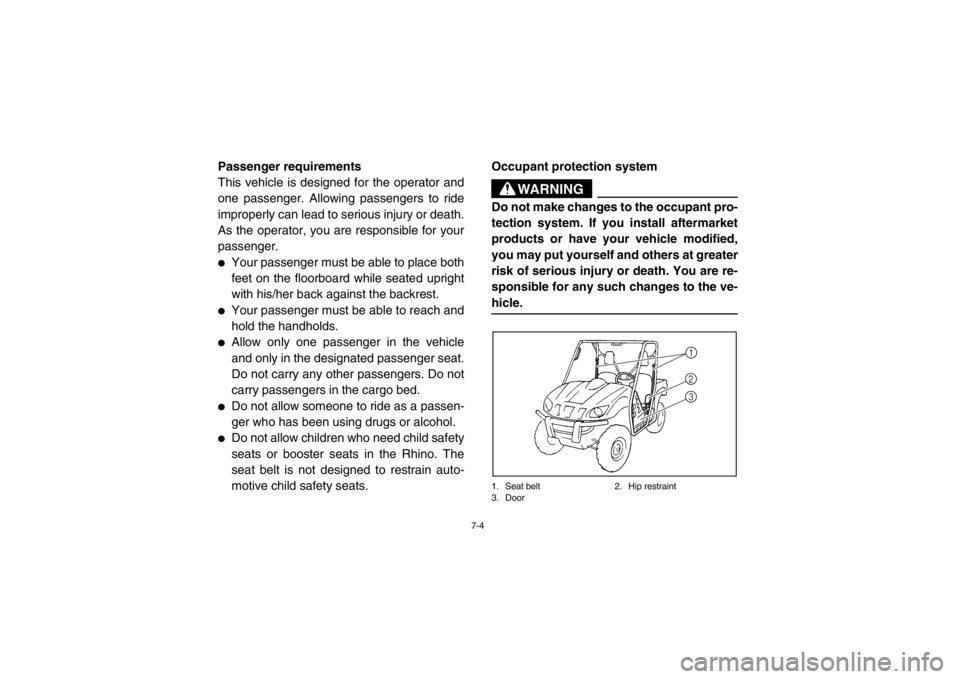
motive child safety seats.Occupant protection system
WARNING
Do not make changes to the occupant pro-
tection system. If you install aftermarket
products or have your vehicle modified,
you may put yourself and others at greater
risk of serious injury or death. You are re-
sponsible for any such changes to the ve-
hicle.1. Seat belt
2. Hip restraint
3. Door
1
32
1RB7A_EE.book Page 4 Tuesday, April 24, 2012 9:07 AM
Page 114 of 188
8-1
EVU006501-PERIODIC MAINTENANCE AND ADJUSTMENTPeriodic inspection, adjustment, and lubrica-
tion will keep your vehicle in the safest and
most efficient condition possible.
Safety is an obligation of the vehicle owner/
operator. The most important points of vehicle
inspection, adjustment, and lubrication are ex-
plained on the following pages.
WARNING
Failure to properly maintain the vehicle or
performing maintenance activities incor-
rectly may increase your risk of injury or
death during service or while using the ve-
hicle. If you are not familiar with vehicle
service, have a Yamaha dealer perform
service.
WARNING
Turn off the engine when performing main-
tenance unless otherwise specified.●
A running engine has moving parts
that can catch on body parts or cloth-
ing and electrical parts that can cause
shocks or fires.
●
Running the engine while servicing
can lead to eye injury, burns, fire, or
carbon monoxide poisoning – possi-
bly leading to death. See page 2-7 for
more information about carbon mon-
oxide.WARNING
Brake discs, calipers, drums, and linings
can become very hot during use. To avoid
possible burns, let brake components cool
before touching them.
1RB7A_EE.book Page 1 Tuesday, April 24, 2012 9:07 AM