warning YAMAHA RHINO 700 2013 Service Manual
[x] Cancel search | Manufacturer: YAMAHA, Model Year: 2013, Model line: RHINO 700, Model: YAMAHA RHINO 700 2013Pages: 188, PDF Size: 4.9 MB
Page 174 of 188
8-61
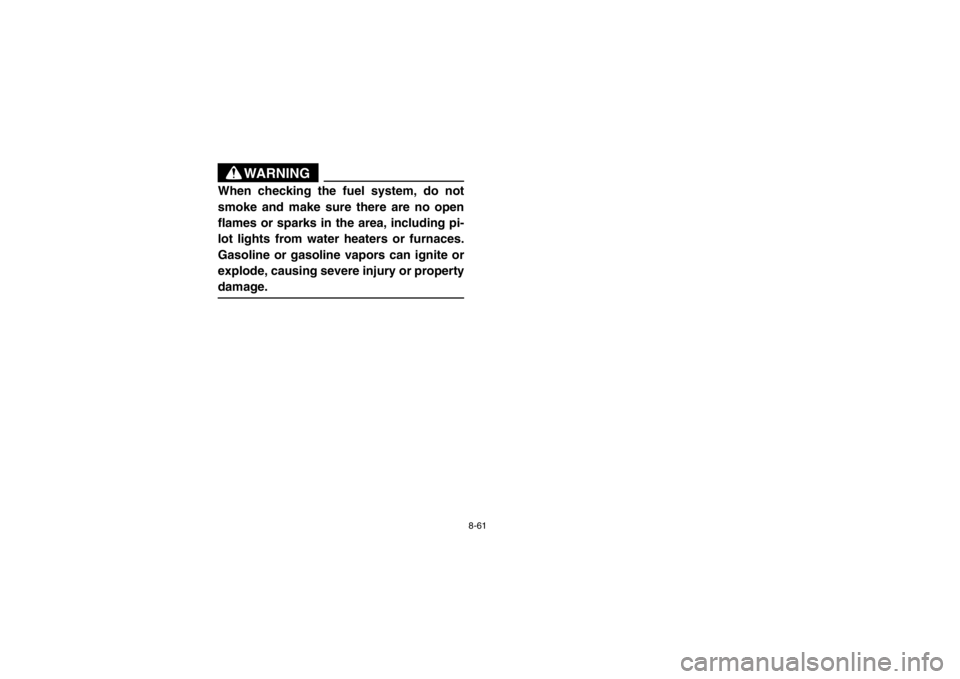
WARNING
When checking the fuel system, do not
smoke and make sure there are no open
flames or sparks in the area, including pi-
lot lights from water heaters or furnaces.
Gasoline or gasoline vapors can ignite or
explode, causing severe injury or property
damage.1RB7A_EE.book Page 61 Tuesday, April 24, 2012 9:07 AM
Page 176 of 188
8-63
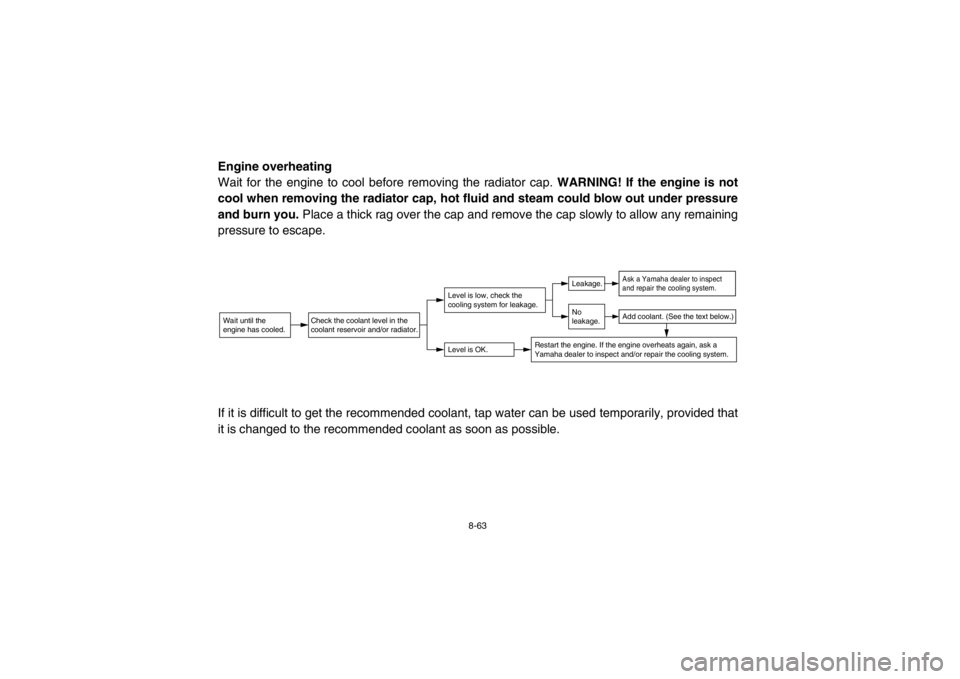
Engine overheating
Wait for the engine to cool before removing the radiator cap. WARNING! If the engine is not
cool when removing the radiator cap, hot fluid and steam could blow out under pressure
and burn you. Place a thick rag over the cap and remove the cap slowly to allow any remaining
pressure to escape.
If it is difficult to get the recommended coolant , tap water can be used temporarily, provided that
it is changed to the recommended coolant as soon as possible.Wait until the
engine has cooled.
Check the coolant level in the
coolant reservoir and/or radiator.
Level is OK.Level is low, check the
cooling system for leakage.
No
leakage.Leakage.
Ask a Yamaha dealer to inspect
and repair the cooling system.Add coolant. (See the text below.)
Restart the engine. If the engine overheats again, ask a
Yamaha dealer to inspect and/or repair the cooling system.
1RB7A_EE.book Page 63 Tuesday, April 24, 2012 9:07 AM
Page 177 of 188
9-1
1
2
3
4
5
6
7
89
10
11
12
13
14
EVU01030
1-CLEANING AND STORAGE
A. Cleaning
Frequent, thorough cleaning of your vehicle
will not only enhance its appearance but will
improve its general performance and extend
the useful life of many components.1. Before cleaning the vehicle:
a. Block off the end of the exhaust pipeto prevent water entry. A plastic bag
and strong rubber band may be used.
b. Make sure the spark plug and all filler caps are properly installed.
2. If the engine case is excessively greasy,
apply degreaser with a paint brush. Do
not apply degreaser to the wheel axles. 3. Rinse the dirt and degreaser off with a
garden hose. Use only enough pressure
to do the job. WARNING! Test the
brakes after washing. Apply the
brakes several times at slow speeds
to let friction dry out the linings. Wet
brakes may have reduced stopping
ability, increasing the chance of an ac-
cident. NOTICE: Excessive water
pressure may cause water seepage
and deterioration of wheel bearings,
brakes, transmission seals and elec-
trical devices. Many expensive repair
bills have resulted from improper
high-pressure detergent applications,
such as those available in coin-oper-
ated car washers.1RB7A_EE.book Page 1 Tuesday, April 24, 2012 9:07 AM
Page 184 of 188

10-5
Coolant temperature warning light:
LED
Engine trouble warning light: LED
Parking brake indicator light:
LED
On-Command four-wheel-drive/differential gear lock indica-
tor:
LCD
High-range indicator light: LED
Low-range indicator light: LED
Differential gear lock indicator light:
LED
Helmet/Seat belt indicator light: 14 V, 1.7 W
Fuses:Main fuse:
40.0 A
Fuel injection system fuse: 10.0 A
Headlight fuse: 15.0 A
Signaling system fuse:
10.0 A
Ignition fuse: 10.0 A
Auxiliary DC jack fuse: 10.0 A
Backup fuse:
10.0 A Four-wheel-drive motor fuse:
10.0 A
Radiator fan fuse: 25.0 A
For Europe only
The figures quoted are emission levels and are not
necessarily safe working levels. Whilst there is a
correlation between the emission and exposure
levels, this cannot be used reliably to determine
whether or not further precautions are required.
Factors that influence the actual level of exposure
of work-force include the characteristics of the
work room, the other sources of noise, etc. i.e. the
number of machines and other adjacent process-
es, and the length of time for which an operator is
exposed to the noise. Also the permissible expo-
sure level can vary from country. This information,
however, will enable the user of the machine to
make a better evaluation of the hazard and risk.
1RB7A_EE.book Page 5 Tuesday, April 24, 2012 9:07 AM