check oil YAMAHA SLIDER 50 2013 User Guide
[x] Cancel search | Manufacturer: YAMAHA, Model Year: 2013, Model line: SLIDER 50, Model: YAMAHA SLIDER 50 2013Pages: 66, PDF Size: 1.58 MB
Page 50 of 66
PERIODIC MAINTENANCE AND ADJUSTMENT
6-18
6
EAU23272
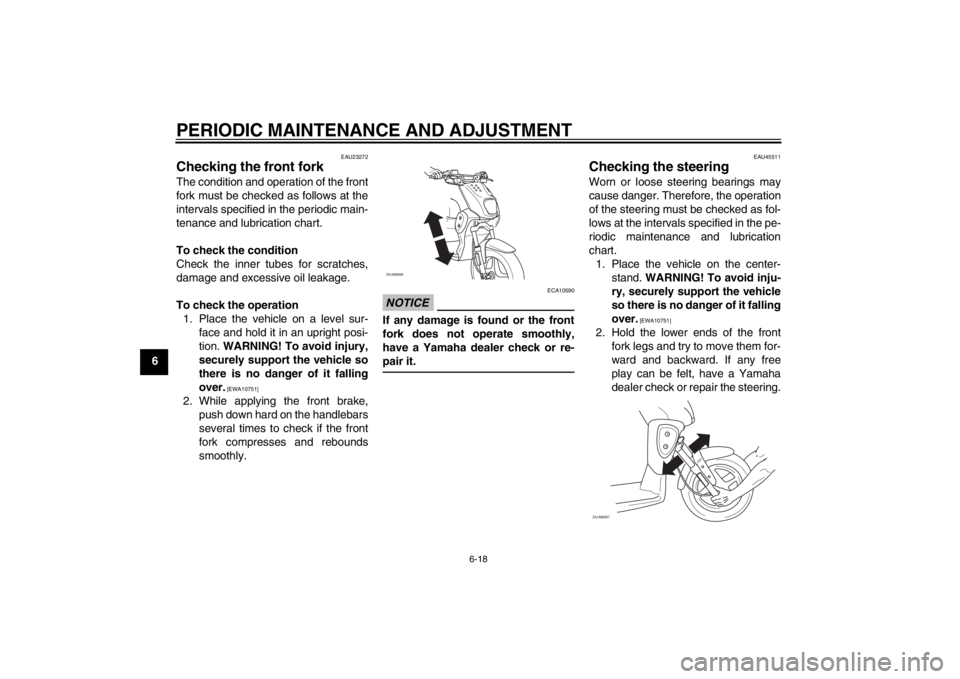
Checking the front fork The condition and operation of the front
fork must be checked as follows at the
intervals specified in the periodic main-
tenance and lubrication chart.
To check the condition
Check the inner tubes for scratches,
damage and excessive oil leakage.
To check the operation
1. Place the vehicle on a level sur-
face and hold it in an upright posi-
tion. WARNING! To avoid injury,
securely support the vehicle so
there is no danger of it falling
over.
[EWA10751]
2. While applying the front brake,
push down hard on the handlebars
several times to check if the front
fork compresses and rebounds
smoothly.
NOTICE
ECA10590
If any damage is found or the front
fork does not operate smoothly,
have a Yamaha dealer check or re-
pair it.
EAU45511
Checking the steering Worn or loose steering bearings may
cause danger. Therefore, the operation
of the steering must be checked as fol-
lows at the intervals specified in the pe-
riodic maintenance and lubrication
chart.
1. Place the vehicle on the center-
stand. WARNING! To avoid inju-
ry, securely support the vehicle
so there is no danger of it falling
over.
[EWA10751]
2. Hold the lower ends of the front
fork legs and try to move them for-
ward and backward. If any free
play can be felt, have a Yamaha
dealer check or repair the steering.
ZAUM0896
ZAUM0897
U1S0E1E0.book Page 18 Wednesday, November 7, 2012 3:32 PM
Page 60 of 66

SCOOTER CARE AND STORAGE
7-4
72. Drain the carburetor float chamber
by loosening the drain bolt; this will
prevent fuel deposits from building
up. Pour the drained fuel into the
fuel tank.
3. Fill up the fuel tank and add fuel
stabilizer (if available) to prevent
the fuel tank from rusting and the
fuel from deteriorating.
4. Perform the following steps to pro-
tect the cylinder, piston rings, etc.
from corrosion.
a. Remove the spark plug cap
and spark plug.
b. Pour a teaspoonful of engine oil
into the spark plug bore.
c. Install the spark plug cap onto
the spark plug, and then place
the spark plug on the cylinder
head so that the electrodes are
grounded. (This will limit spark-
ing during the next step.)
d. Turn the engine over several
times with the starter. (This will
coat the cylinder wall with oil.)
WARNING! To prevent dam-
age or injury from sparking,
make sure to ground thespark plug electrodes while
turning the engine over.
[EWA10951]
e. Remove the spark plug cap
from the spark plug, and then
install the spark plug and the
spark plug cap.
5. Lubricate all control cables and the
pivoting points of all levers and
pedals as well as of the side-
stand/centerstand.
6. Check and, if necessary, correct
the tire air pressure, and then lift
the scooter so that both of its
wheels are off the ground. Alterna-
tively, turn the wheels a little every
month in order to prevent the tires
from becoming degraded in one
spot.
7. Cover the muffler outlet with a
plastic bag to prevent moisture
from entering it.
8. Remove the battery and fully
charge it. Store it in a cool, dry
place and charge it once a month.
Do not store the battery in an ex-
cessively cold or warm place [less
than 0 °C (30 °F) or more than 30°C (90 °F)]. For more information
on storing the battery, see page
6-19.
TIPMake any necessary repairs before
storing the scooter.
U1S0E1E0.book Page 4 Wednesday, November 7, 2012 3:32 PM
Page 64 of 66

INDEXAAcceleration and deceleration................. 5-3
Air filter element, cleaning....................... 6-9
Anti-theft device housing......................... 3-8BBattery................................................... 6-19
Brake fluid, changing ............................ 6-15
Brake fluid level, checking .................... 6-14
Brake lever, front..................................... 3-4
Brake lever, rear ..................................... 3-4
Brake levers, lubricating........................ 6-16
Brake pads and shoes, checking .......... 6-14
Braking .................................................... 5-3CCables, checking and lubricating .......... 6-16
Carburetor,adjusting ............................. 6-10
Care ........................................................ 7-1
Catalytic converter .................................. 3-6
Centerstand, checking and
lubricating ........................................... 6-17
Cowling and panel, removing and
installing................................................ 6-6DDimmer switch ........................................ 3-4EEngine break-in ....................................... 5-4
Engine oil ................................................ 3-7
Engine, starting a warm .......................... 5-2FFinal transmission oil .............................. 6-8
Front brake lever free play, checking .... 6-13
Front fork, checking .............................. 6-18
Fuel ......................................................... 3-5
Fuel and 2-stroke engine oil tank caps ... 3-5Fuel consumption, tips for reducing........ 5-4
Fuel level warning light ........................... 3-2
Fuse, replacing ..................................... 6-21
HHandlebar switches ................................ 3-3
Headlight bulb, replacing ...................... 6-21
High beam indicator light ........................ 3-2
Horn switch ............................................. 3-4IIdentification numbers ............................ 9-1
Indicator lights and warning light ............ 3-2KKickstarter............................................... 3-8LLuggage hook ......................................... 3-9MMain switch/steering lock........................ 3-1
Maintenance and lubrication, periodic .... 6-3
Maintenance, emission control system... 6-2
Matte color, caution ................................ 7-1
Model label ............................................. 9-1OOil level warning light.............................. 3-2PParking ................................................... 5-5
Part locations .......................................... 2-1RRear brake lever free play, adjusting .... 6-13SSafe-riding points.................................... 1-5
Safety information................................... 1-1
Seat ........................................................ 3-8
Spark plug, checking .............................. 6-7
Specifications ......................................... 8-1Speedometer unit .................................... 3-3
Starter (choke) lever................................ 3-7
Starting a cold engine ............................. 5-1
Starting off ............................................... 5-2
Start switch.............................................. 3-4
Steering, checking................................. 6-18
Storage.................................................... 7-3
TTail/brake light bulb, replacing .............. 6-22
Throttle grip and cable, checking and
lubricating ........................................... 6-16
Throttle grip free play, checking ............ 6-10
Tires ...................................................... 6-10
Troubleshooting .................................... 6-23
Troubleshooting chart ........................... 6-24
Turn signal indicator light ........................ 3-2
Turn signal light bulb, replacing ............ 6-22
Turn signal switch ................................... 3-4VVehicle identification number .................. 9-1WWheel bearings, checking ..................... 6-19
Wheels .................................................. 6-12
U1S0E1E0.book Page 1 Wednesday, November 7, 2012 3:32 PM