check oil YAMAHA SLIDER 50 2013 Owners Manual
[x] Cancel search | Manufacturer: YAMAHA, Model Year: 2013, Model line: SLIDER 50, Model: YAMAHA SLIDER 50 2013Pages: 66, PDF Size: 1.58 MB
Page 6 of 66

TABLE OF CONTENTSSAFETY INFORMATION ..................1-1
Further safe-riding points ................1-5
DESCRIPTION ..................................2-1
Left view ..........................................2-1
Right view ........................................2-2
Controls and instruments.................2-3
INSTRUMENT AND CONTROL
FUNCTIONS.......................................3-1
Main switch/steering lock ................3-1
Indicator lights and warning light ....3-2
Speedometer unit ...........................3-3
Handlebar switches ........................3-3
Front brake lever ............................3-4
Rear brake lever .............................3-4
Fuel and 2-stroke engine oil tank
caps .............................................3-5
Fuel .................................................3-5
Catalytic converter ..........................3-6
2-stroke engine oil ..........................3-7
Starter (choke) lever .......................3-7
Kickstarter .......................................3-8
Seat ................................................3-8
Anti-theft device housing ................3-8
Luggage hook .................................3-9FOR YOUR SAFETY –
PRE-OPERATION CHECKS............. 4-1
OPERATION AND IMPORTANT
RIDING POINTS................................. 5-1
Starting a cold engine .................... 5-1
Starting a warm engine .................. 5-2
Starting off ...................................... 5-2
Acceleration and deceleration ........ 5-3
Braking ........................................... 5-3
Tips for reducing fuel
consumption ............................... 5-4
Engine break-in .............................. 5-4
Parking ........................................... 5-5
PERIODIC MAINTENANCE AND
ADJUSTMENT................................... 6-1
Periodic maintenance chart for the
emission control system ............. 6-2
General maintenance and
lubrication chart .......................... 6-3
Removing and installing the cowling
and panel .................................... 6-6
Checking the spark plug ................. 6-7
Final transmission oil ...................... 6-8
Cleaning the air filter element ........ 6-9
Adjusting the carburetor ............... 6-10
Checking the throttle grip free
play ........................................... 6-10
Tires ............................................. 6-10
Cast wheels .................................. 6-12Checking the front brake lever free
play ........................................... 6-13
Adjusting the rear brake lever free
play ........................................... 6-13
Checking the front brake pads and
rear brake shoes ...................... 6-14
Checking the brake fluid level ...... 6-14
Changing the brake fluid .............. 6-15
Checking and lubricating the
cables ....................................... 6-16
Checking and lubricating the
throttle grip and cable ............... 6-16
Lubricating the front and rear
brake levers .............................. 6-16
Checking and lubricating the
centerstand ............................... 6-17
Checking the front fork ................. 6-18
Checking the steering .................. 6-18
Checking the wheel bearings ....... 6-19
Battery ......................................... 6-19
Replacing the fuse ....................... 6-21
Replacing the headlight bulb ....... 6-21
Replacing the tail/brake light
bulb ........................................... 6-22
Replacing a turn signal light
bulb ........................................... 6-22
Troubleshooting ........................... 6-23
Troubleshooting chart .................. 6-24
SCOOTER CARE AND STORAGE... 7-1
Matte color caution ........................ 7-1U1S0E1E0.book Page 1 Wednesday, November 7, 2012 3:32 PM
Page 17 of 66
INSTRUMENT AND CONTROL FUNCTIONS
3-1
3
EAU10461
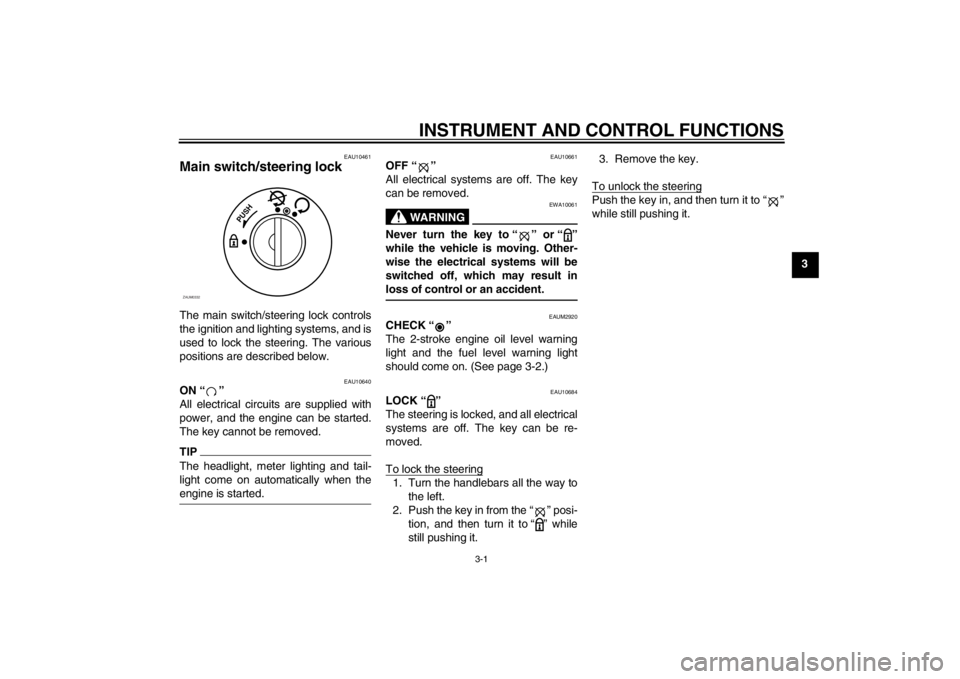
Main switch/steering lock The main switch/steering lock controls
the ignition and lighting systems, and is
used to lock the steering. The various
positions are described below.
EAU10640
ON “ ”
All electrical circuits are supplied with
power, and the engine can be started.
The key cannot be removed.TIPThe headlight, meter lighting and tail-
light come on automatically when the
engine is started.
EAU10661
OFF “ ”
All electrical systems are off. The key
can be removed.
WARNING
EWA10061
Never turn the key to “ ” or “ ”
while the vehicle is moving. Other-
wise the electrical systems will be
switched off, which may result in
loss of control or an accident.
EAUM2920
CHECK “ ”
The 2-stroke engine oil level warning
light and the fuel level warning light
should come on. (See page 3-2.)
EAU10684
LOCK “ ”
The steering is locked, and all electrical
systems are off. The key can be re-
moved.
To lock the steering1. Turn the handlebars all the way to
the left.
2. Push the key in from the “ ” posi-
tion, and then turn it to “ ” while
still pushing it.3. Remove the key.
To unlock the steering
Push the key in, and then turn it to “ ”
while still pushing it.
P
U
S
H
ZAUM0332
U1S0E1E0.book Page 1 Wednesday, November 7, 2012 3:32 PM
Page 18 of 66
INSTRUMENT AND CONTROL FUNCTIONS
3-2
3
EAU11006
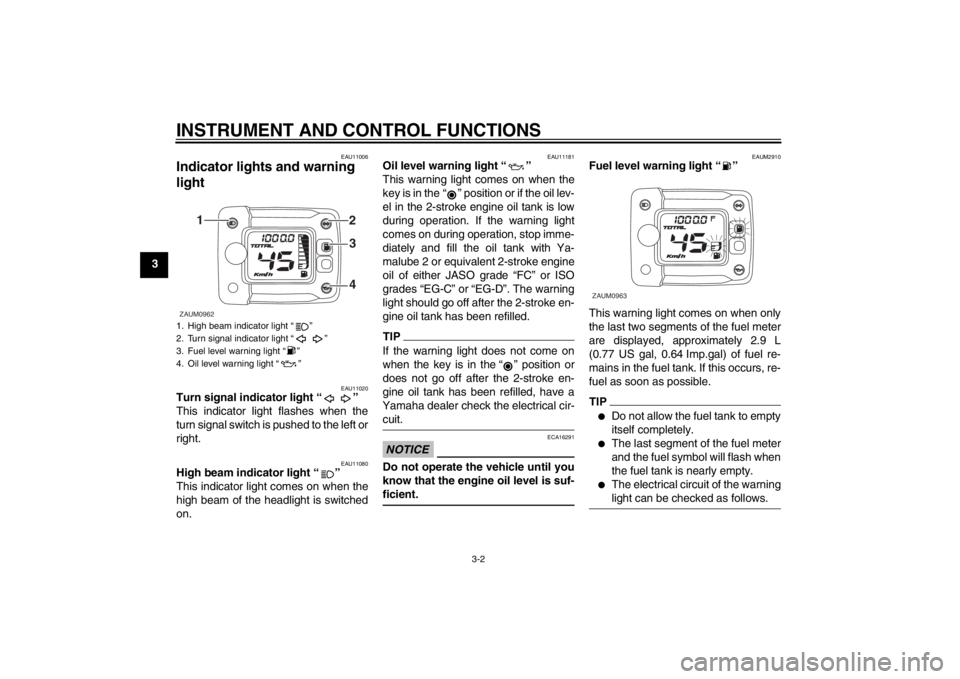
Indicator lights and warning
light
EAU11020
Turn signal indicator light “ ”
This indicator light flashes when the
turn signal switch is pushed to the left or
right.
EAU11080
High beam indicator light “ ”
This indicator light comes on when the
high beam of the headlight is switched
on.
EAU11181
Oil level warning light “ ”
This warning light comes on when the
key is in the “ ” position or if the oil lev-
el in the 2-stroke engine oil tank is low
during operation. If the warning light
comes on during operation, stop imme-
diately and fill the oil tank with Ya-
malube 2 or equivalent 2-stroke engine
oil of either JASO grade “FC” or ISO
grades “EG-C” or “EG-D”. The warning
light should go off after the 2-stroke en-
gine oil tank has been refilled.TIPIf the warning light does not come on
when the key is in the “ ” position or
does not go off after the 2-stroke en-
gine oil tank has been refilled, have a
Yamaha dealer check the electrical cir-
cuit.NOTICE
ECA16291
Do not operate the vehicle until you
know that the engine oil level is suf-
ficient.
EAUM2910
Fuel level warning light “ ”
This warning light comes on when only
the last two segments of the fuel meter
are displayed, approximately 2.9 L
(0.77 US gal, 0.64 Imp.gal) of fuel re-
mains in the fuel tank. If this occurs, re-
fuel as soon as possible.TIP●
Do not allow the fuel tank to empty
itself completely.
●
The last segment of the fuel meter
and the fuel symbol will flash when
the fuel tank is nearly empty.
●
The electrical circuit of the warning
light can be checked as follows.
1. High beam indicator light “ ”
2. Turn signal indicator light “ ”
3. Fuel level warning light “ ”
4. Oil level warning light “ ”ZAUM0962
3
42 1
ZAUM0963
U1S0E1E0.book Page 2 Wednesday, November 7, 2012 3:32 PM
Page 26 of 66
FOR YOUR SAFETY – PRE-OPERATION CHECKS
4-1
4
EAU15597
Inspect your vehicle each time you use it to make sure the vehicle is in safe operating condition. Always follow the inspection
and maintenance procedures and schedules described in the Owner’s Manual.
WARNING
EWA11151
Failure to inspect or maintain the vehicle properly increases the possibility of an accident or equipment damage.
Do not operate the vehicle if you find any problem. If a problem cannot be corrected by the procedures provided in
this manual, have the vehicle inspected by a Yamaha dealer.Before using this vehicle, check the following points:
ITEM CHECKS PAGE
Fuel Check fuel level in fuel tank.
Refuel if necessary.
Check fuel line for leakage.3-5
2-stroke engine oil Check oil level in oil tank.
If necessary, add recommended oil to specified level.
Check vehicle for oil leakage.3-7
Final transmission oil Check vehicle for oil leakage. 6-8
Front brake Check operation.
If soft or spongy, have Yamaha dealer bleed hydraulic system.
Check brake pads for wear.
Replace if necessary.
Check fluid level in reservoir.
If necessary, add specified brake fluid to specified level.
Check hydraulic system for leakage.6-14, 6-14
Rear brake Check operation.
Lubricate cable if necessary.
Check lever free play.
Adjust if necessary.6-13, 6-14
U1S0E1E0.book Page 1 Wednesday, November 7, 2012 3:32 PM
Page 28 of 66
OPERATION AND IMPORTANT RIDING POINTS
5-1
5
EAU15951
Read the Owner’s Manual carefully to
become familiar with all controls. If
there is a control or function you do not
understand, ask your Yamaha dealer.
WARNING
EWA10271
Failure to familiarize yourself with
the controls can lead to loss of con-
trol, which could cause an accident
or injury.
EAUM2126
Starting a cold engine NOTICE
ECA10250
See page 5-4 for engine break-in in-
structions prior to operating the ve-
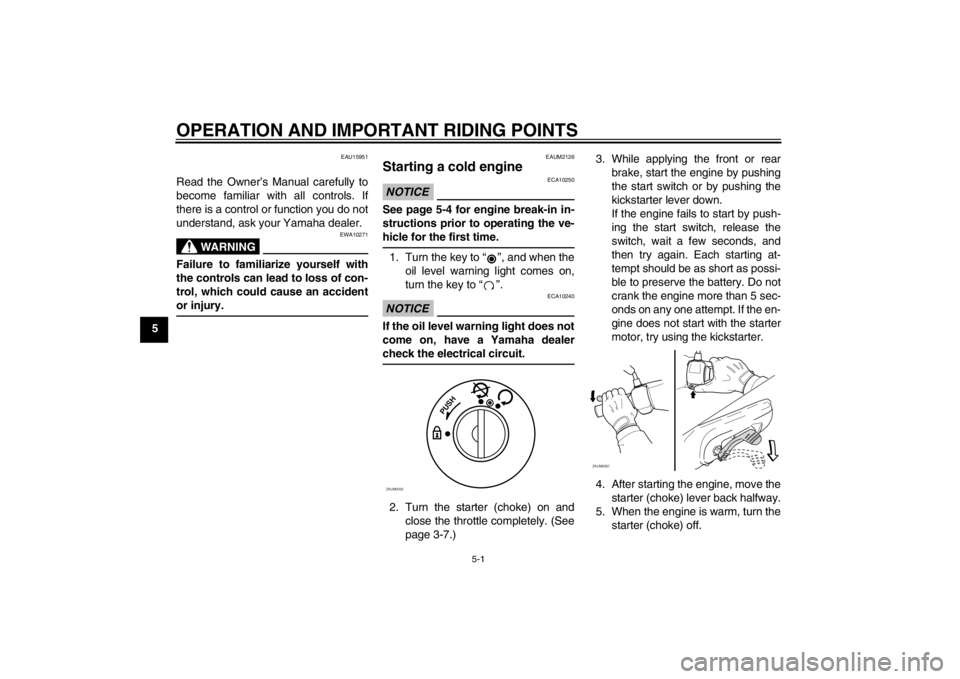
hicle for the first time.1. Turn the key to “ ”, and when the
oil level warning light comes on,
turn the key to “ ”.NOTICE
ECA10240
If the oil level warning light does not
come on, have a Yamaha dealer
check the electrical circuit.2. Turn the starter (choke) on and
close the throttle completely. (See
page 3-7.)3. While applying the front or rear
brake, start the engine by pushing
the start switch or by pushing the
kickstarter lever down.
If the engine fails to start by push-
ing the start switch, release the
switch, wait a few seconds, and
then try again. Each starting at-
tempt should be as short as possi-
ble to preserve the battery. Do not
crank the engine more than 5 sec-
onds on any one attempt. If the en-
gine does not start with the starter
motor, try using the kickstarter.
4. After starting the engine, move the
starter (choke) lever back halfway.
5. When the engine is warm, turn the
starter (choke) off.
P
U
S
H
ZAUM0332
ZAUM0367
U1S0E1E0.book Page 1 Wednesday, November 7, 2012 3:32 PM
Page 31 of 66
OPERATION AND IMPORTANT RIDING POINTS
5-4
5
EAU16820
Tips for reducing fuel con-
sumption Fuel consumption depends largely on
your riding style. Consider the following
tips to reduce fuel consumption:●
Avoid high engine speeds during
acceleration.
●
Avoid high engine speeds with no
load on the engine.
●
Turn the engine off instead of let-
ting it idle for an extended length of
time (e.g., in traffic jams, at traffic
lights or at railroad crossings).
EAU16830
Engine break-in There is never a more important period
in the life of your engine than the period
between 0 and 1000 km (600 mi). For
this reason, you should read the follow-
ing material carefully.
Since the engine is brand new, do not
put an excessive load on it for the first
1000 km (600 mi). The various parts in
the engine wear and polish themselves
to the correct operating clearances.
During this period, prolonged full-throt-
tle operation or any condition that might
result in engine overheating must be
avoided.
EAUM2091
0–150 km (0–90 mi)
Avoid prolonged operation above 1/3
throttle. Vary the speed of the scooter
from time to time. Do not operate it at
one set throttle position.
150–500 km (90–300 mi)
Avoid prolonged operation above 1/2
throttle.
500–1000 km (300–600 mi)
Avoid cruising speeds in excess of 3/4
throttle.1000 km (600 mi) and beyond
Avoid prolonged full throttle operation.
Vary speeds occasionally. NOTICE:
After 1000 km (600 mi) of operation,
the final transmission oil must be
changed.
[ECAM1071]
NOTICE
ECA10270
If any engine trouble should occur
during the engine break-in period,
immediately have a Yamaha dealer
check the vehicle.
U1S0E1E0.book Page 4 Wednesday, November 7, 2012 3:32 PM
Page 36 of 66

PERIODIC MAINTENANCE AND ADJUSTMENT
6-4
6
9*Steering bearings Check bearing play and steering
for roughness.√√√√√
Lubricate with lithium-soap-based
grease.Every 24000 km (14000 mi)
10*Chassis fasteners Make sure that all nuts, bolts and
screws are properly tightened.√√√√√
11Front brake lever
pivot shaft Lubricate with silicone grease.√√√√√
12Rear brake lever
pivot shaft Lubricate with lithium-soap-based
grease.√√√√√
13 Centerstand Check operation.
Lubricate.√√√√√
14*Front fork Check operation and for oil leak-
age.√√√√
15*Shock absorber as-
sembly Check operation and shock ab-
sorber for oil leakage.√√√√
16*Autolube pump Check operation.
Bleed if necessary.√√√√
17Final transmission
oil Check vehicle for oil leakage.√√ √
Change.√√√
18*V- b e l t Replace. Every 10000 km (6000 mi)
19*Front and rear brake
switches Check operation.√√√√√√
20Moving parts and
cables Lubricate.√√√√√ NO. ITEM CHECK OR MAINTENANCE JOBODOMETER READING
ANNUAL
CHECK 1000 km
(600 mi)6000 km
(3500 mi)12000 km
(7000 mi)18000 km
(10500 mi)24000 km
(14000 mi)
U1S0E1E0.book Page 4 Wednesday, November 7, 2012 3:32 PM
Page 40 of 66
PERIODIC MAINTENANCE AND ADJUSTMENT
6-8
6
EAU20066
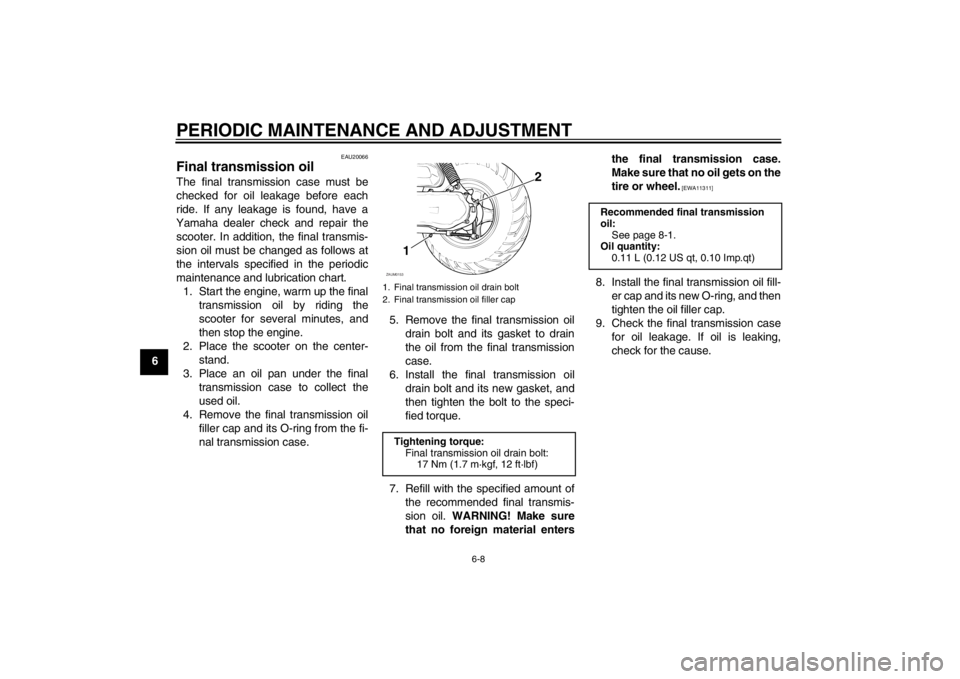
Final transmission oil The final transmission case must be
checked for oil leakage before each
ride. If any leakage is found, have a
Yamaha dealer check and repair the
scooter. In addition, the final transmis-
sion oil must be changed as follows at
the intervals specified in the periodic
maintenance and lubrication chart.
1. Start the engine, warm up the final
transmission oil by riding the
scooter for several minutes, and
then stop the engine.
2. Place the scooter on the center-
stand.
3. Place an oil pan under the final
transmission case to collect the
used oil.
4. Remove the final transmission oil
filler cap and its O-ring from the fi-
nal transmission case.5. Remove the final transmission oil
drain bolt and its gasket to drain
the oil from the final transmission
case.
6. Install the final transmission oil
drain bolt and its new gasket, and
then tighten the bolt to the speci-
fied torque.
7. Refill with the specified amount of
the recommended final transmis-
sion oil. WARNING! Make sure
that no foreign material entersthe final transmission case.
Make sure that no oil gets on the
tire or wheel.
[EWA11311]
8. Install the final transmission oil fill-
er cap and its new O-ring, and then
tighten the oil filler cap.
9. Check the final transmission case
for oil leakage. If oil is leaking,
check for the cause.
1. Final transmission oil drain bolt
2. Final transmission oil filler capTightening torque:
Final transmission oil drain bolt:
17 Nm (1.7 m·kgf, 12 ft·lbf)12
ZAUM0153
Recommended final transmission
oil:
See page 8-1.
Oil quantity:
0.11 L (0.12 US qt, 0.10 Imp.qt)
U1S0E1E0.book Page 8 Wednesday, November 7, 2012 3:32 PM
Page 47 of 66
PERIODIC MAINTENANCE AND ADJUSTMENT
6-15
6
●
Insufficient brake fluid may al-
low air to enter the brake sys-
tem, reducing braking
performance.
●
Clean the filler cap before re-
moving. Use only DOT 3 or DOT
4 brake fluid from a sealed con-
tainer.
●
Use only the specified brake flu-
id; otherwise, the rubber seals
may deteriorate, causing leak-
age.
●
Refill with the same type of
brake fluid. Adding a brake fluid
other than DOT 3 or DOT 4 may
result in a harmful chemical re-
action.
●
Be careful that water does not
enter the brake fluid reservoir
when refilling. Water will signifi-
cantly lower the boiling point of
the fluid and may result in vapor
lock.
NOTICE
ECA17640
Brake fluid may damage painted sur-
faces or plastic parts. Always clean
up spilled fluid immediately.
As the brake pads wear, it is normal for
the brake fluid level to gradually go
down. A low brake fluid level may indi-
cate worn brake pads and/or brake sys-
tem leakage; therefore, be sure to
check the brake pads for wear and the
brake system for leakage. If the brake
fluid level goes down suddenly, have a
Yamaha dealer check the cause before
further riding.
EAUM1360
Changing the brake fluid Have a Yamaha dealer change the
brake fluid at the intervals specified in
the periodic maintenance and lubrica-
tion chart. In addition, have the brake
hose replaced every four years or
whenever it is damaged or leaking.
U1S0E1E0.book Page 15 Wednesday, November 7, 2012 3:32 PM
Page 48 of 66
PERIODIC MAINTENANCE AND ADJUSTMENT
6-16
6
EAU50800
Checking and lubricating the
cables The operation of all control cables and
the condition of the cables should be
checked before each ride, and the ca-
bles and cable ends should be lubricat-
ed if necessary. If a cable is damaged
or does not move smoothly, have a
Yamaha dealer check or replace it.
WARNING! Damage to the outer
housing of cables may result in in-
ternal rusting and cause interfer-
ence with cable movement. Replace
damaged cables as soon as possi-
ble to prevent unsafe conditions.[EWA10711]EAU23114
Checking and lubricating the
throttle grip and cable The operation of the throttle grip should
be checked before each ride. In addi-
tion, the cable should be lubricated by a
Yamaha dealer at the intervals speci-
fied in the periodic maintenance chart.
The throttle cable is equipped with a
rubber cover. Make sure that the cover
is securely installed. Even though the
cover is installed correctly, it does not
completely protect the cable from water
entry. Therefore, use care not to pour
water directly onto the cover or cable
when washing the vehicle. If the cable
or cover becomes dirty, wipe clean with
a moist cloth.
EAU43642
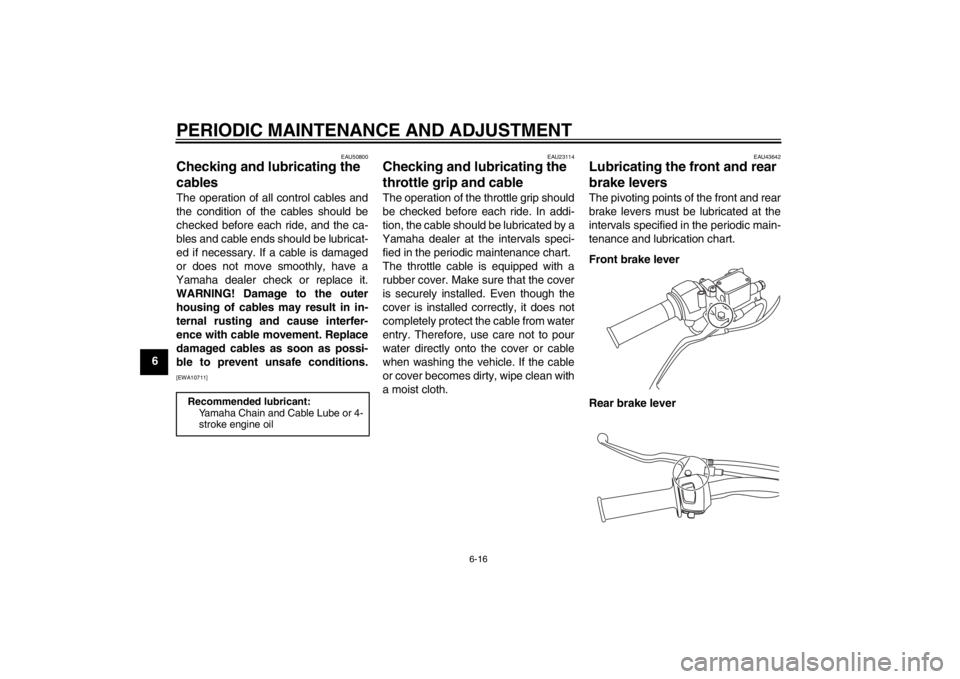
Lubricating the front and rear
brake levers The pivoting points of the front and rear
brake levers must be lubricated at the
intervals specified in the periodic main-
tenance and lubrication chart.
Front brake lever
Rear brake lever
Recommended lubricant:
Yamaha Chain and Cable Lube or 4-
stroke engine oil
U1S0E1E0.book Page 16 Wednesday, November 7, 2012 3:32 PM