fuel YAMAHA SUPERJET 2010 Owner's Manual
[x] Cancel search | Manufacturer: YAMAHA, Model Year: 2010, Model line: SUPERJET, Model: YAMAHA SUPERJET 2010Pages: 78, PDF Size: 4.6 MB
Page 66 of 78
Maintenance
59
EJU41180Lubrication points
Lubricate moving parts with water-resistant
grease. (See page 53 for information on the
main lubrication points.)
Intermediate housing
Fill the intermediate housing with water-resis-
tant grease through the grease nipple using a
grease gun.
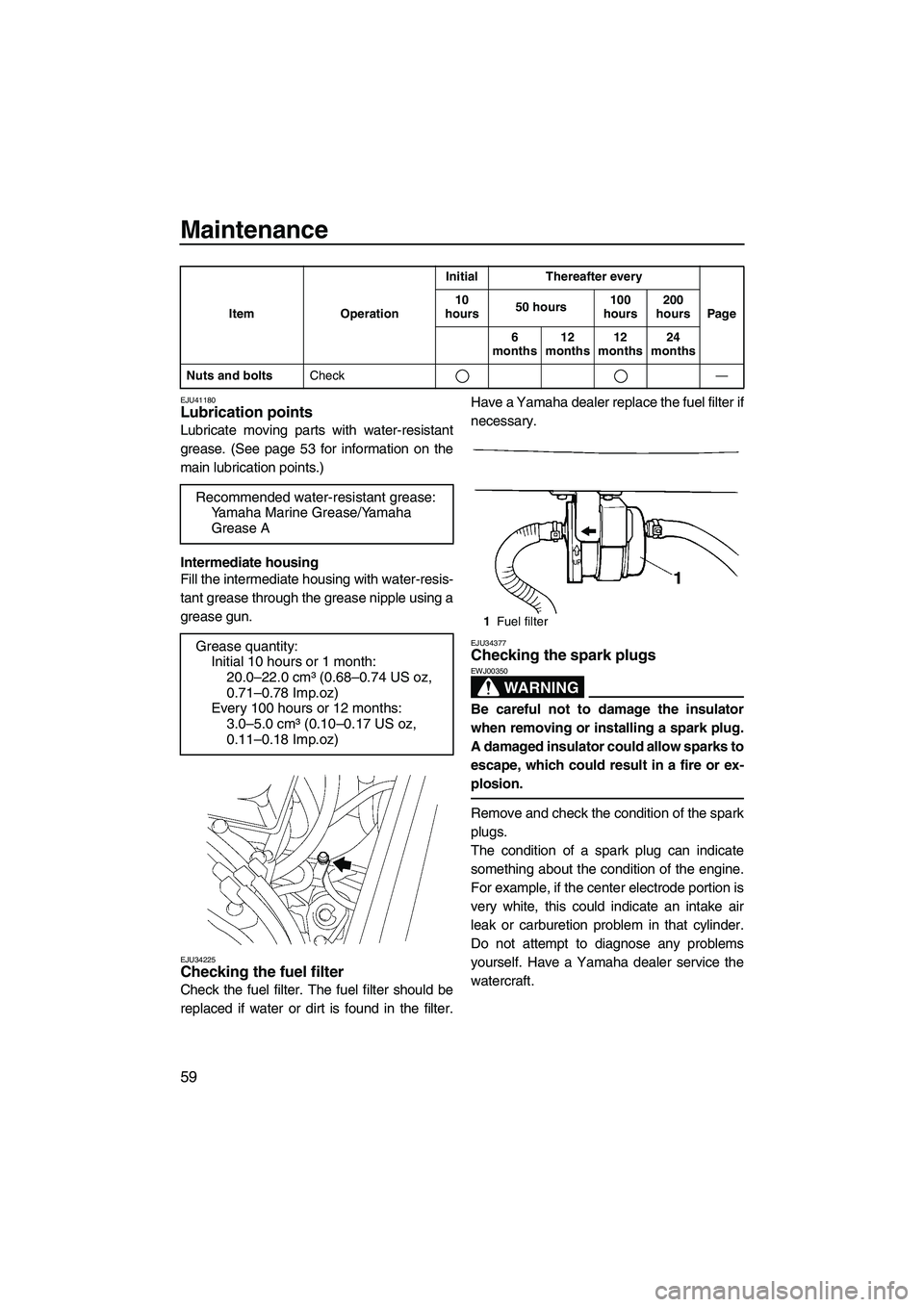
EJU34225Checking the fuel filter
Check the fuel filter. The fuel filter should be
replaced if water or dirt is found in the filter.Have a Yamaha dealer replace the fuel filter if
necessary.
EJU34377Checking the spark plugs
WARNING
EWJ00350
Be careful not to damage the insulator
when removing or installing a spark plug.
A damaged insulator could allow sparks to
escape, which could result in a fire or ex-
plosion.
Remove and check the condition of the spark
plugs.
The condition of a spark plug can indicate
something about the condition of the engine.
For example, if the center electrode portion is
very white, this could indicate an intake air
leak or carburetion problem in that cylinder.
Do not attempt to diagnose any problems
yourself. Have a Yamaha dealer service the
watercraft.
Nuts and boltsCheck— Item OperationInitial Thereafter every
Page 10
hours50 hours100
hours200
hours
6
months12
months12
months24
months
Recommended water-resistant grease:
Yamaha Marine Grease/Yamaha
Grease A
Grease quantity:
Initial 10 hours or 1 month:
20.0–22.0 cm³ (0.68–0.74 US oz,
0.71–0.78 Imp.oz)
Every 100 hours or 12 months:
3.0–5.0 cm³ (0.10–0.17 US oz,
0.11–0.18 Imp.oz)
1Fuel filter
UF2F72E0.book Page 59 Friday, May 22, 2009 5:11 PM
Page 69 of 78
Specifications
62
EJU34542
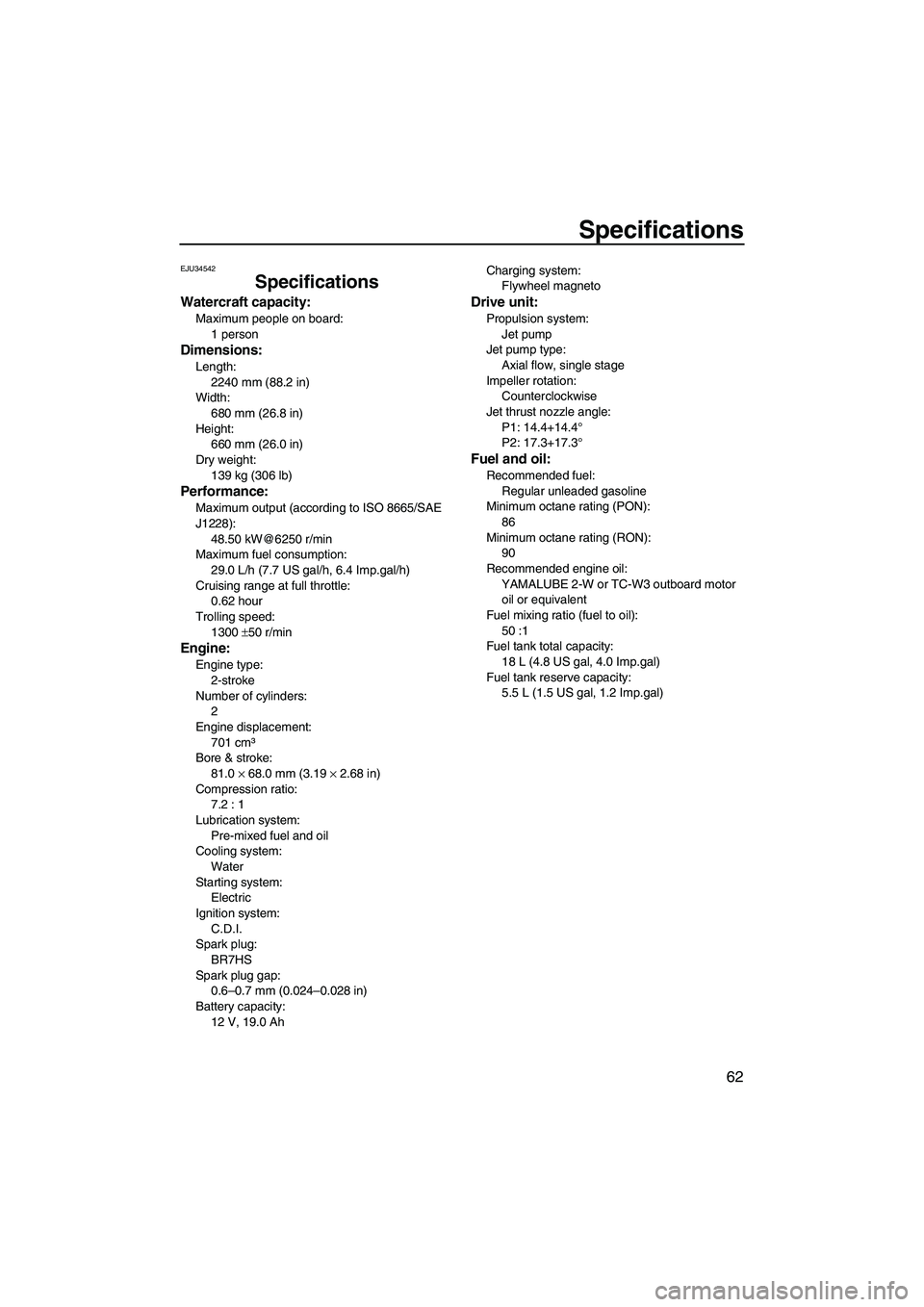
Specifications
Watercraft capacity:
Maximum people on board:
1 person
Dimensions:
Length:
2240 mm (88.2 in)
Width:
680 mm (26.8 in)
Height:
660 mm (26.0 in)
Dry weight:
139 kg (306 lb)
Performance:
Maximum output (according to ISO 8665/SAE
J1228):
48.50 kW@6250 r/min
Maximum fuel consumption:
29.0 L/h (7.7 US gal/h, 6.4 Imp.gal/h)
Cruising range at full throttle:
0.62 hour
Trolling speed:
1300 ±50 r/min
Engine:
Engine type:
2-stroke
Number of cylinders:
2
Engine displacement:
701 cm³
Bore & stroke:
81.0 × 68.0 mm (3.19 × 2.68 in)
Compression ratio:
7.2 : 1
Lubrication system:
Pre-mixed fuel and oil
Cooling system:
Water
Starting system:
Electric
Ignition system:
C.D.I.
Spark plug:
BR7HS
Spark plug gap:
0.6–0.7 mm (0.024–0.028 in)
Battery capacity:
12 V, 19.0 AhCharging system:
Flywheel magneto
Drive unit:
Propulsion system:
Jet pump
Jet pump type:
Axial flow, single stage
Impeller rotation:
Counterclockwise
Jet thrust nozzle angle:
P1: 14.4+14.4°
P2: 17.3+17.3°
Fuel and oil:
Recommended fuel:
Regular unleaded gasoline
Minimum octane rating (PON):
86
Minimum octane rating (RON):
90
Recommended engine oil:
YAMALUBE 2-W or TC-W3 outboard motor
oil or equivalent
Fuel mixing ratio (fuel to oil):
50 :1
Fuel tank total capacity:
18 L (4.8 US gal, 4.0 Imp.gal)
Fuel tank reserve capacity:
5.5 L (1.5 US gal, 1.2 Imp.gal)
UF2F72E0.book Page 62 Friday, May 22, 2009 5:11 PM
Page 70 of 78
Trouble recovery
63
EJU34561
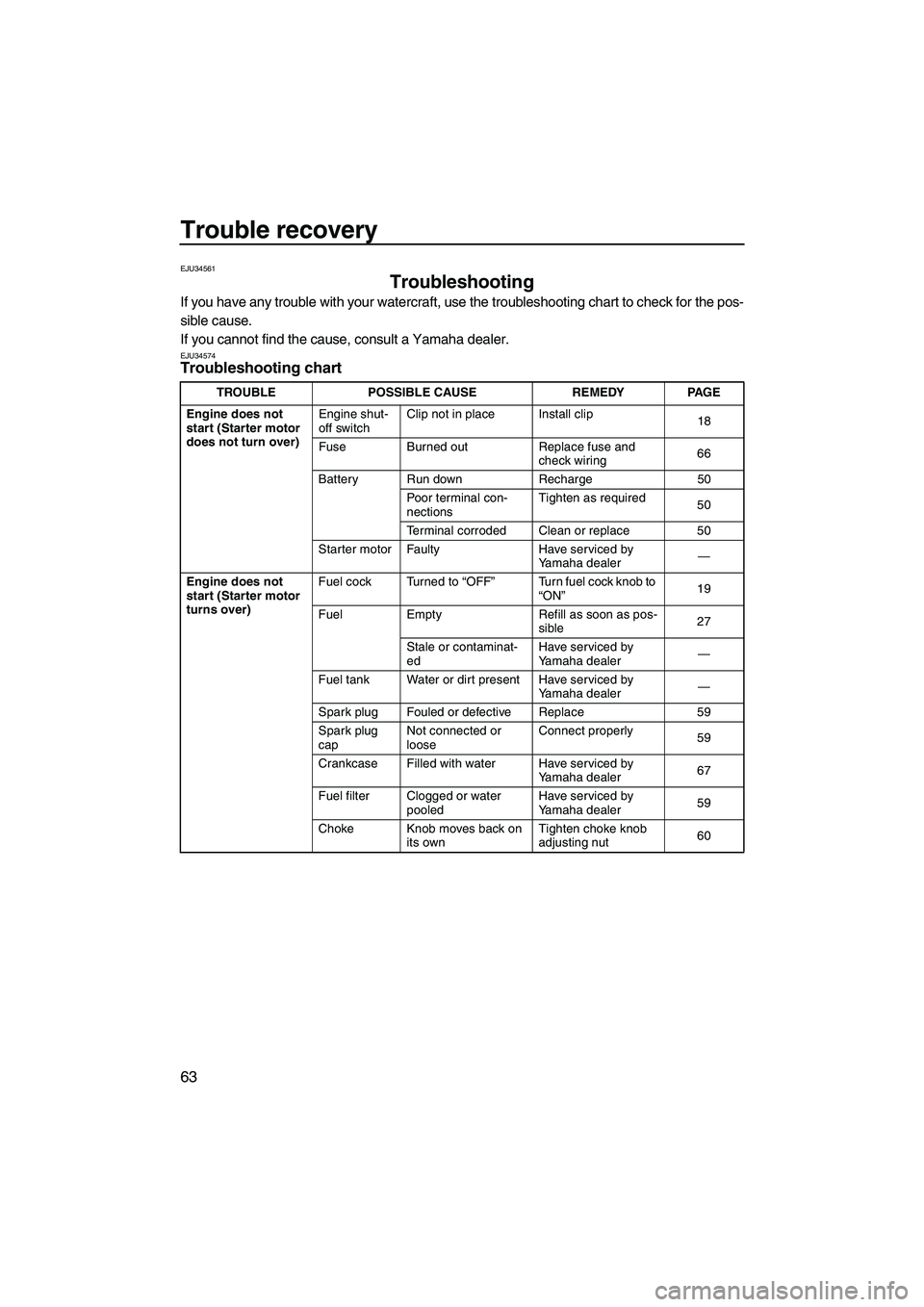
Troubleshooting
If you have any trouble with your watercraft, use the troubleshooting chart to check for the pos-
sible cause.
If you cannot find the cause, consult a Yamaha dealer.
EJU34574Troubleshooting chart
TROUBLE POSSIBLE CAUSE REMEDY PAGE
Engine does not
start (Starter motor
does not turn over)Engine shut-
off switchClip not in place Install clip
18
Fuse Burned out Replace fuse and
check wiring66
Battery Run down Recharge 50
Poor terminal con-
nectionsTighten as required
50
Terminal corroded Clean or replace 50
Starter motor Faulty Have serviced by
Yamaha dealer—
Engine does not
start (Starter motor
turns over)Fuel cock Turned to “OFF”Turn fuel cock knob to
“ON”19
Fuel Empty Refill as soon as pos-
sible27
Stale or contaminat-
edHave serviced by
Yamaha dealer—
Fuel tank Water or dirt present Have serviced by
Yamaha dealer—
Spark plug Fouled or defective Replace 59
Spark plug
capNot connected or
looseConnect properly
59
Crankcase Filled with water Have serviced by
Yamaha dealer67
Fuel filter Clogged or water
pooledHave serviced by
Yamaha dealer59
Choke Knob moves back on
its ownTighten choke knob
adjusting nut60
UF2F72E0.book Page 63 Friday, May 22, 2009 5:11 PM
Page 71 of 78
Trouble recovery
64
Engine runs irregu-
larly or stallsFuel Empty Refill as soon as pos-
sible27
Stale or contaminat-
edHave serviced by
Yamaha dealer—
Too much oil in fuel
mixing ratioCorrect fuel-to-oil ra-
tio to 50:126
Choke Knob is left pulled Push fully in 20
Fuel filter Clogged or water
pooledHave serviced by
Yamaha dealer59
Fuel tank Water or dirt present Have serviced by
Yamaha dealer—
Spark plug Fouled or defective Replace 59
Incorrect heat range Replace 59
Gap incorrect Replace 59
Spark plug
capLoose Connect properly 59
Cracked, torn or dam-
agedHave serviced by
Yamaha dealer—
Electrical wir-
ingLoose electrical con-
nectionsHave serviced by
Yamaha dealer—
Carburetor Incorrect idle adjust-
mentHave serviced by
Yamaha dealer—
Clogged Have serviced by
Yamaha dealer61
Watercraft slow or
loses powerCavitation Jet intake clogged Clean 65
Impeller damaged or
wornHave serviced by
Yamaha dealer65
Engine over-
heatedJet intake clogged Clean
65
Fuel filter Clogged Have serviced by
Yamaha dealer59
Spark plug Fouled or defective Replace 59
Incorrect heat range Replace 59
Gap incorrect Replace 59
Spark plug
capsLoose Connect properly
59
Fuel Stale or contaminat-
edHave serviced by
Yamaha dealer— TROUBLE POSSIBLE CAUSE REMEDY PAGE
UF2F72E0.book Page 64 Friday, May 22, 2009 5:11 PM
Page 75 of 78
Trouble recovery
68
(2) Turn the fuel cock knob to “OFF”.
(3) Turn the watercraft over far enough to
drain the water from the engine compart-
ment. NOTICE: Turning the watercraft
on its side with the hood removed
could cause damage to the steering
pole. Use two people to provide
enough support to make sure that the
steering pole is not damaged.
[ECJ00701]
(4) Turn the watercraft upright again.
(5) Have the watercraft serviced by a
Yamaha dealer as soon as possible.
NOTICE: Be sure to have a Yamaha
dealer inspect the watercraft. Other-
wise, serious engine damage could re-
sult.
[ECJ00791]
UF2F72E0.book Page 68 Friday, May 22, 2009 5:11 PM
Page 76 of 78
Index
2-stroke engine oil .................................... 26
A
After removing the watercraft from the
water ..................................................... 48
B
Battery care .............................................. 50
Battery checks.......................................... 34
Battery, jumping ....................................... 66
Beaching the watercraft ........................... 48
Bilge water check ..................................... 34
Bilge water, draining................................. 28
Bilge water, draining on water .................. 28
Boarding and starting in deep water ........ 46
Boarding and starting in shallow water .... 45
Bow rope hole .......................................... 23
C
Capsized watercraft ................................. 47
Carburetor, adjusting................................ 61
Choke cable, adjusting ............................. 60
Choke knob .............................................. 20
Cleaning ................................................... 53
Cleaning the watercraft ............................ 50
Cooling water pilot outlet .......................... 20
Cooling water pilot outlet check ............... 38
Craft Identification Number (CIN) ............... 1
Cruising limitations ..................................... 8
E
Emergency procedures ............................ 65
Engine break-in ........................................ 30
Engine compartment check...................... 33
Engine idling speed, adjusting ................. 61
Engine overheat warning system ............. 21
Engine serial number ................................. 1
Engine shut-off cord (lanyard) check ....... 36
Engine shut-off switch .............................. 18
Engine stop switch ................................... 18
Engine unit check ..................................... 34
Enjoy your watercraft responsibly ............ 14
Equipment ................................................ 22
F
Fire extinguisher check ............................ 37
Fire extinguisher container ....................... 24
Fire extinguisher container checks........... 37
Flushing the cooling water passages ....... 49Fuel .......................................................... 26
Fuel and engine oil requirements ............. 26
Fuel cock knob ......................................... 19
Fuel filter, checking .................................. 59
Fuel level check ....................................... 33
Fuel system checks .................................. 33
Fuel tank, filling ........................................ 27
Fuse, replacing ......................................... 66
G
Getting to know your watercraft ............... 39
Glossary, watercraft ................................. 15
H
Hazard information ................................... 12
Hood ......................................................... 22
Hood check .............................................. 37
Hull and deck check ................................. 37
I
Identification numbers ................................ 1
J
Jet intake and impeller, cleaning .............. 65
Jet intake checks ...................................... 37
Jet thrust nozzle angle, adjusting ............. 56
Jumper cables, connecting ...................... 66
L
Labels, important ........................................ 2
Labels, other .............................................. 6
Labels, warning .......................................... 3
Launching the watercraft .......................... 40
Learning to operate your watercraft ......... 39
Leaving the watercraft .............................. 42
Limitations on who may operate the
watercraft ................................................ 7
Long-term storage .................................... 53
Lubrication................................................ 53
Lubrication points ..................................... 59
M
Main components, location of .................. 16
Maintenance ............................................. 55
Mixing fuel and oil .................................... 26
O
Operating in weeded areas ...................... 48
Operating positions .................................. 39
Operating the watercraft ........................... 42
Operating your watercraft ......................... 39
Operation requirements ............................. 9
UF2F72E0.book Page 1 Friday, May 22, 2009 5:11 PM