check engine YAMAHA SUPERJET 2012 User Guide
[x] Cancel search | Manufacturer: YAMAHA, Model Year: 2012, Model line: SUPERJET, Model: YAMAHA SUPERJET 2012Pages: 78, PDF Size: 4.55 MB
Page 44 of 78
Pre-operation checks
38
pouch is securely installed. (See page 24 for
information on the storage pouch.)
EJU41071Fire extinguisher container checks
Make sure that the fire extinguisher container
is not damaged and is securely held in place.
(See page 25 for information on the fire extin-
guisher container.)
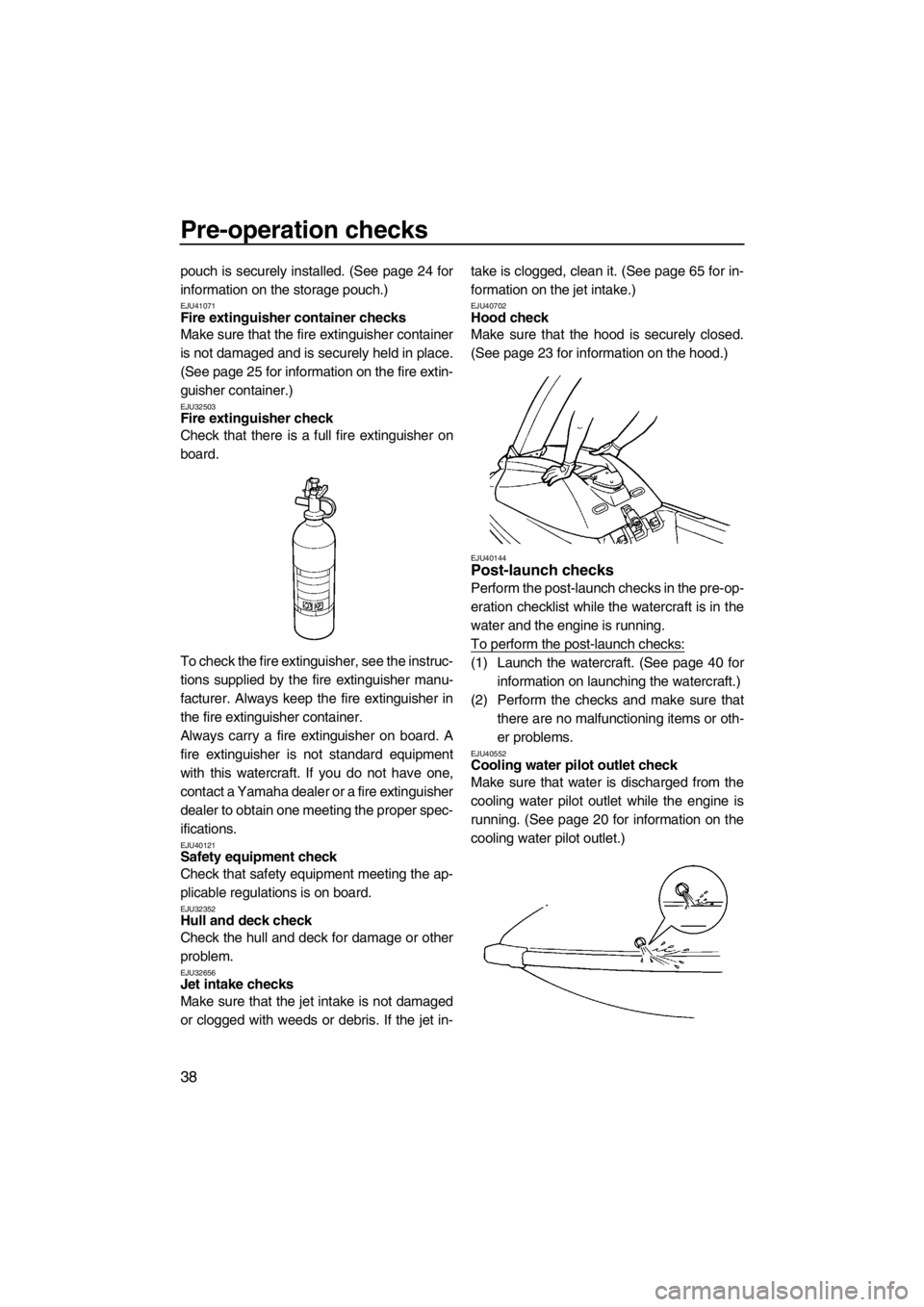
EJU32503Fire extinguisher check
Check that there is a full fire extinguisher on
board.
To check the fire extinguisher, see the instruc-
tions supplied by the fire extinguisher manu-
facturer. Always keep the fire extinguisher in
the fire extinguisher container.
Always carry a fire extinguisher on board. A
fire extinguisher is not standard equipment
with this watercraft. If you do not have one,
contact a Yamaha dealer or a fire extinguisher
dealer to obtain one meeting the proper spec-
ifications.
EJU40121Safety equipment check
Check that safety equipment meeting the ap-
plicable regulations is on board.
EJU32352Hull and deck check
Check the hull and deck for damage or other
problem.
EJU32656Jet intake checks
Make sure that the jet intake is not damaged
or clogged with weeds or debris. If the jet in-take is clogged, clean it. (See page 65 for in-
formation on the jet intake.)
EJU40702Hood check
Make sure that the hood is securely closed.
(See page 23 for information on the hood.)
EJU40144Post-launch checks
Perform the post-launch checks in the pre-op-
eration checklist while the watercraft is in the
water and the engine is running.
To perform the post-launch checks:
(1) Launch the watercraft. (See page 40 for
information on launching the watercraft.)
(2) Perform the checks and make sure that
there are no malfunctioning items or oth-
er problems.
EJU40552Cooling water pilot outlet check
Make sure that water is discharged from the
cooling water pilot outlet while the engine is
running. (See page 20 for information on the
cooling water pilot outlet.)
UF2F74E0.book Page 38 Tuesday, May 24, 2011 8:42 AM
Page 47 of 78
Operation
41
(2) Turn the fuel cock knob to “ON”.
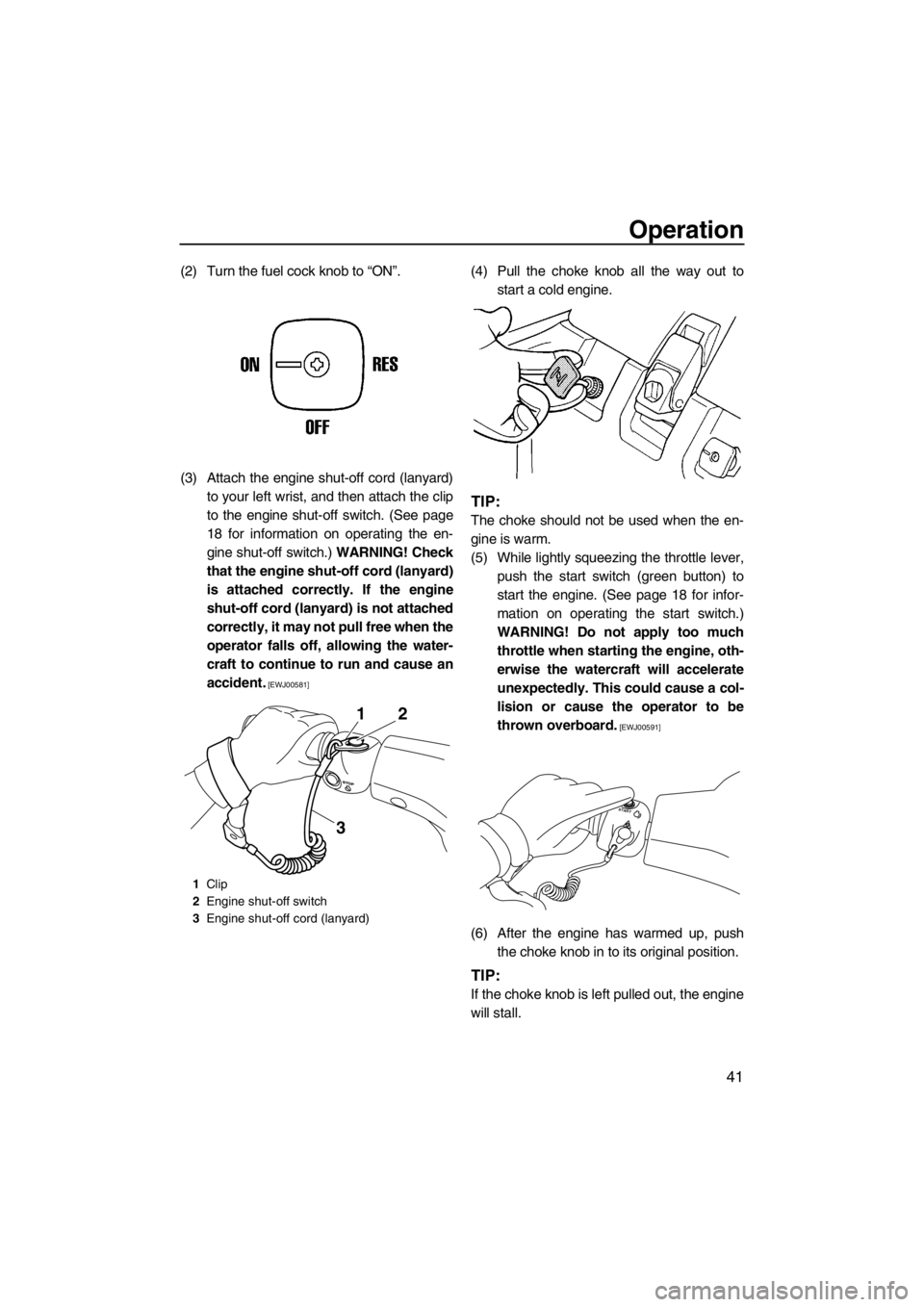
(3) Attach the engine shut-off cord (lanyard)
to your left wrist, and then attach the clip
to the engine shut-off switch. (See page
18 for information on operating the en-
gine shut-off switch.) WARNING! Check
that the engine shut-off cord (lanyard)
is attached correctly. If the engine
shut-off cord (lanyard) is not attached
correctly, it may not pull free when the
operator falls off, allowing the water-
craft to continue to run and cause an
accident.
[EWJ00581]
(4) Pull the choke knob all the way out to
start a cold engine.
TIP:
The choke should not be used when the en-
gine is warm.
(5) While lightly squeezing the throttle lever,
push the start switch (green button) to
start the engine. (See page 18 for infor-
mation on operating the start switch.)
WARNING! Do not apply too much
throttle when starting the engine, oth-
erwise the watercraft will accelerate
unexpectedly. This could cause a col-
lision or cause the operator to be
thrown overboard.
[EWJ00591]
(6) After the engine has warmed up, push
the choke knob in to its original position.
TIP:
If the choke knob is left pulled out, the engine
will stall.
1Clip
2Engine shut-off switch
3Engine shut-off cord (lanyard)
12
3
START
UF2F74E0.book Page 41 Tuesday, May 24, 2011 8:42 AM
Page 56 of 78
Care and storage
50
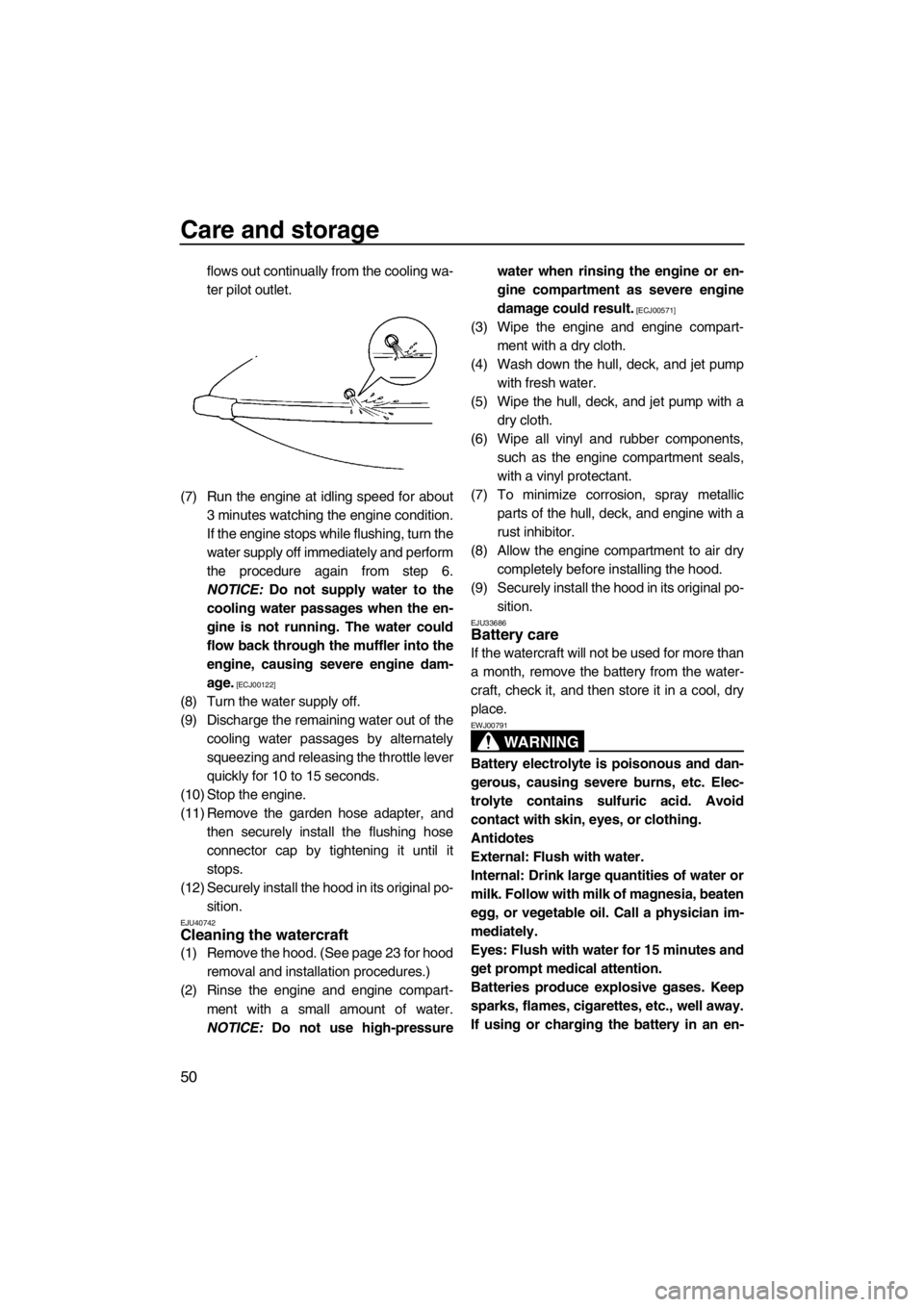
flows out continually from the cooling wa-
ter pilot outlet.
(7) Run the engine at idling speed for about
3 minutes watching the engine condition.
If the engine stops while flushing, turn the
water supply off immediately and perform
the procedure again from step 6.
NOTICE: Do not supply water to the
cooling water passages when the en-
gine is not running. The water could
flow back through the muffler into the
engine, causing severe engine dam-
age.
[ECJ00122]
(8) Turn the water supply off.
(9) Discharge the remaining water out of the
cooling water passages by alternately
squeezing and releasing the throttle lever
quickly for 10 to 15 seconds.
(10) Stop the engine.
(11) Remove the garden hose adapter, and
then securely install the flushing hose
connector cap by tightening it until it
stops.
(12) Securely install the hood in its original po-
sition.
EJU40742Cleaning the watercraft
(1) Remove the hood. (See page 23 for hood
removal and installation procedures.)
(2) Rinse the engine and engine compart-
ment with a small amount of water.
NOTICE: Do not use high-pressurewater when rinsing the engine or en-
gine compartment as severe engine
damage could result.
[ECJ00571]
(3) Wipe the engine and engine compart-
ment with a dry cloth.
(4) Wash down the hull, deck, and jet pump
with fresh water.
(5) Wipe the hull, deck, and jet pump with a
dry cloth.
(6) Wipe all vinyl and rubber components,
such as the engine compartment seals,
with a vinyl protectant.
(7) To minimize corrosion, spray metallic
parts of the hull, deck, and engine with a
rust inhibitor.
(8) Allow the engine compartment to air dry
completely before installing the hood.
(9) Securely install the hood in its original po-
sition.
EJU33686Battery care
If the watercraft will not be used for more than
a month, remove the battery from the water-
craft, check it, and then store it in a cool, dry
place.
WARNING
EWJ00791
Battery electrolyte is poisonous and dan-
gerous, causing severe burns, etc. Elec-
trolyte contains sulfuric acid. Avoid
contact with skin, eyes, or clothing.
Antidotes
External: Flush with water.
Internal: Drink large quantities of water or
milk. Follow with milk of magnesia, beaten
egg, or vegetable oil. Call a physician im-
mediately.
Eyes: Flush with water for 15 minutes and
get prompt medical attention.
Batteries produce explosive gases. Keep
sparks, flames, cigarettes, etc., well away.
If using or charging the battery in an en-
UF2F74E0.book Page 50 Tuesday, May 24, 2011 8:42 AM
Page 61 of 78
Maintenance
55
EJU33768
Maintenance
Periodic checks and lubrication will keep your
watercraft in the safest and most efficient con-
dition possible. Therefore, make sure to carry
out the periodic maintenance. Safety is an ob-
ligation of the watercraft owner. Proper main-
tenance must be carried out to keep the
exhaust emission and sound levels within the
regulated limits. The most important points of
watercraft inspection and lubrication are ex-
plained on the following pages.
See a Yamaha dealer for genuine Yamaha re-
placement parts and optional accessories de-
signed for your watercraft.
Remember, failures that are the result of the
installation of parts or accessories which are
not qualitatively equivalent to genuine
Yamaha parts are not covered by the limited
warranty.
Maintenance, replacement, or repair of the
emission control devices and system may
be performed by any marine SI engine re-
pair establishment or individual. Warranty
repair, however, must be performed at an
authorized Yamaha marine dealership.
WARNING
EWJ00311
Be sure to turn off the engine when you
perform maintenance unless otherwise
specified. If you are not familiar with ma-
chine servicing, this work should be done
by a Yamaha dealer or other qualified me-
chanic.
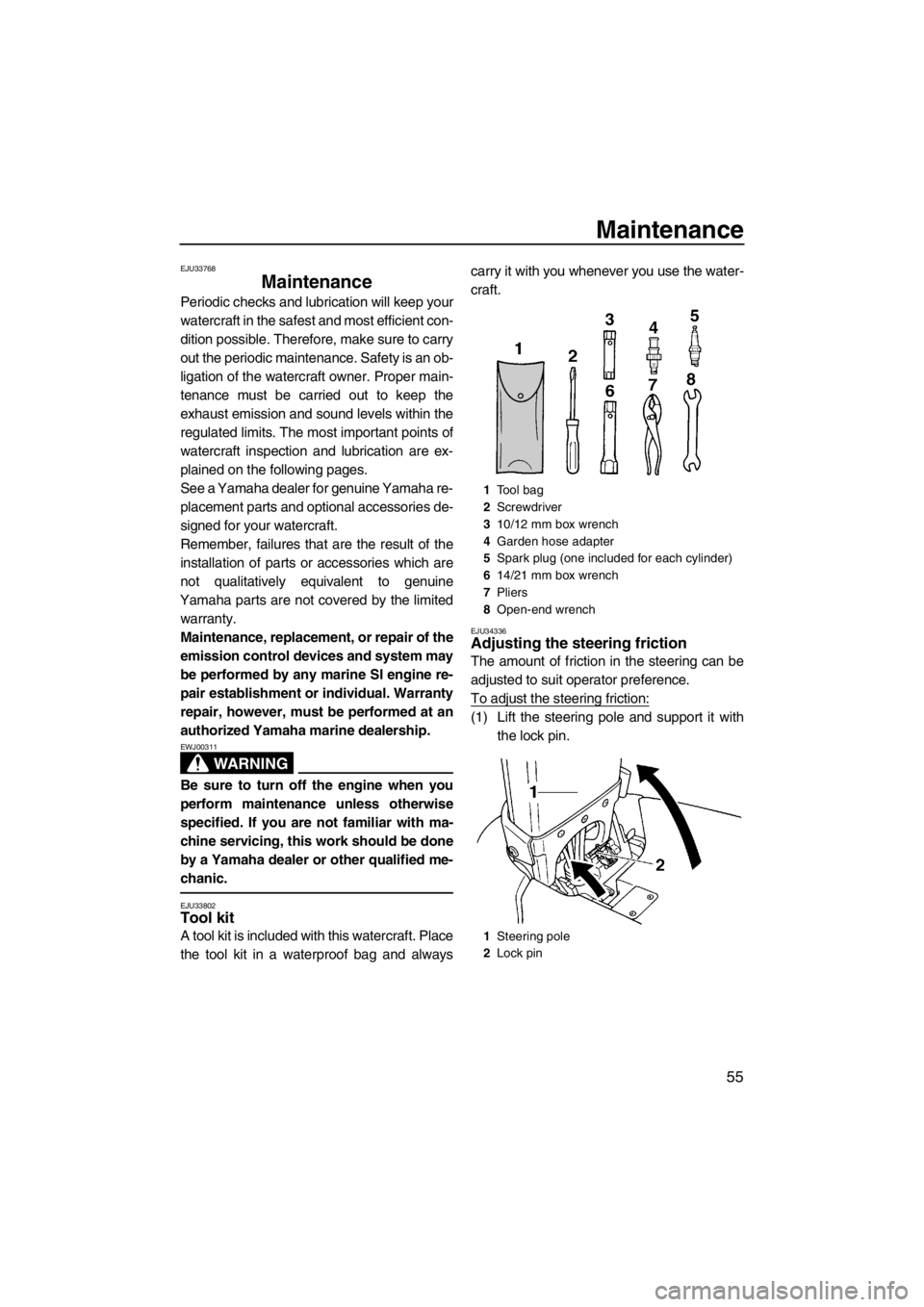
EJU33802Tool kit
A tool kit is included with this watercraft. Place
the tool kit in a waterproof bag and alwayscarry it with you whenever you use the water-
craft.
EJU34336Adjusting the steering friction
The amount of friction in the steering can be
adjusted to suit operator preference.
To adjust the steering friction:
(1) Lift the steering pole and support it with
the lock pin.
1Tool bag
2Screwdriver
310/12 mm box wrench
4Garden hose adapter
5Spark plug (one included for each cylinder)
614/21 mm box wrench
7Pliers
8Open-end wrench
1Steering pole
2Lock pin
UF2F74E0.book Page 55 Tuesday, May 24, 2011 8:42 AM
Page 64 of 78

Maintenance
58
EJU40830Periodic maintenance chart
The periodic maintenance chart gives general guidelines for periodic maintenance. Have a
Yamaha dealer perform the checks in the following chart. However, maintenance may need to
be performed more frequently depending on your operating conditions. If you have any ques-
tions, consult a Yamaha dealer.
This“” mark indicates maintenance that you may do yourself.
This“” mark indicates items to be checked and serviced by a Yamaha dealer.
Item OperationInitial Thereafter every
Page 10
hours50 hours100
hours200
hours
6
months12
months12
months24
months
Spark plugsCheck, clean, replace 59
Lubrication pointsLubricate 53
Intermediate hous-
ingLubricate 60
Fuel systemCheck—
Fuel filterCheck 60
Check, replace—
Fuel tankCheck, clean—
CarburetorCheck, adjust—
Engine idling
speedCheck, adjust 61
Carburetor throt-
tle shaftCheck—
Bilge strainerClean—
ImpellerCheck—
Jet thrust nozzle
angleCheck, adjust—
Handlebar pivot
shaftCheck, adjust—
Steering frictionCheck, adjust—
Throttle cableCheck, adjust—
Choke cableCheck, adjust 60
BatteryCheck, charge—
Rubber couplingCheck—
Engine mountCheck—
UF2F74E0.book Page 58 Tuesday, May 24, 2011 8:42 AM
Page 65 of 78
Maintenance
59
EJU34378Checking the spark plugs
WARNING
EWJ00350
Be careful not to damage the insulator
when removing or installing a spark plug.
A damaged insulator could allow sparks to
escape, which could result in a fire or ex-
plosion.
Remove and check the condition of the spark
plugs.
The condition of a spark plug can indicate
something about the condition of the engine.
For example, if the center electrode portion is
very white, this could indicate an intake air
leak or carburetion problem in that cylinder.
Do not attempt to diagnose any problems
yourself. Have a Yamaha dealer service the
watercraft.
To remove a spark plug:
(1) Remove the hood. (See page 23 for hood
removal and installation procedures.)
(2) Remove the spark plug cap.
(3) Remove the spark plug, and then check
the condition of the spark plug and the
spark plug gap. If the electrode portion is
significantly discolored, if electrode ero-
sion becomes excessive, if carbon and
other deposits are excessive, or if the
spark plug gap is not within the specified
range, replace the spark plug.
TIP:
When the engine is operating normally, the
color of the spark plug electrode portion will
be a medium-to-light tan.
To install a spark plug:
(1) Wipe off any dirt from the threads, insula-
tor, and gasket surface of the spark plug.
(2) Install the spark plug, and then tighten it
to the specified torque.
TIP:
If a torque wrench is not available when you
are installing a spark plug, a good estimate of
Nuts and boltsCheck— Item OperationInitial Thereafter every
Page 10
hours50 hours100
hours200
hours
6
months12
months12
months24
months
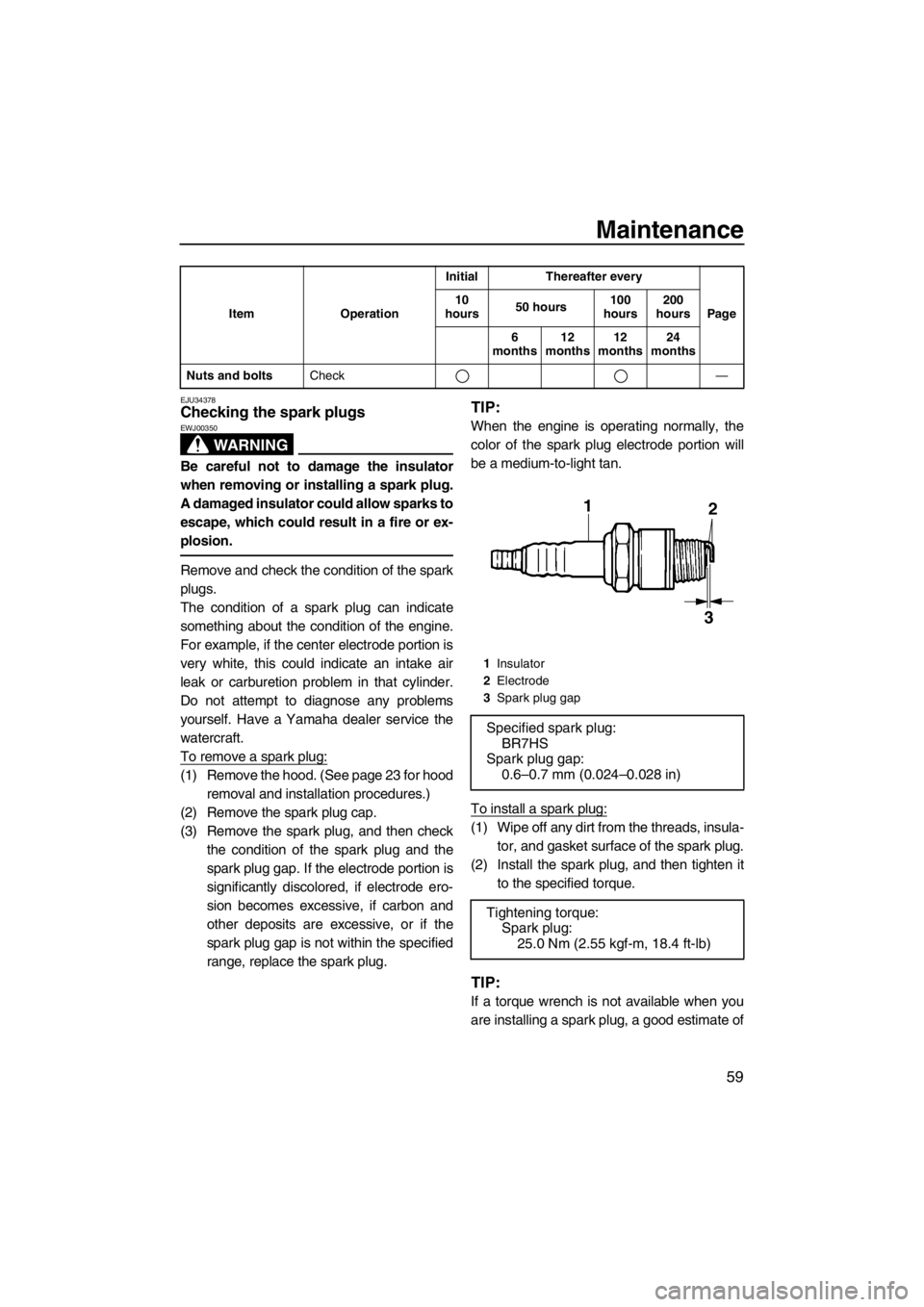
1Insulator
2Electrode
3Spark plug gap
Specified spark plug:
BR7HS
Spark plug gap:
0.6–0.7 mm (0.024–0.028 in)
Tightening torque:
Spark plug:
25.0 Nm (2.55 kgf-m, 18.4 ft-lb)
UF2F74E0.book Page 59 Tuesday, May 24, 2011 8:42 AM
Page 69 of 78

Trouble recovery
63
EJU34561
Troubleshooting
If you have any trouble with your watercraft, use the troubleshooting chart to check for the pos-
sible cause.
If you cannot find the cause, consult a Yamaha dealer.
EJU34575Troubleshooting chart
TROUBLE POSSIBLE CAUSE REMEDY PAGE
Engine does not
start (Starter motor
does not turn over)Engine shut-
off switchClip not in place Install clip
18
Fuse Burned out Replace fuse and
check wiring66
Battery Run down Recharge 50
Poor terminal con-
nectionsTighten as required
50
Terminal corroded Clean or replace 50
Starter motor Faulty Have serviced by
Yamaha dealer—
Engine does not
start (Starter motor
turns over)Fuel cock Turned to “OFF”Turn fuel cock knob to
“ON”20
Fuel Empty Refill as soon as pos-
sible28
Stale or contaminat-
edHave serviced by
Yamaha dealer—
Fuel tank Water or dirt present Have serviced by
Yamaha dealer—
Spark plug Fouled or defective Replace 59
Spark plug
capNot connected or
looseConnect properly
59
Crankcase Filled with water Have serviced by
Yamaha dealer67
Fuel filter Clogged or water
pooledHave serviced by
Yamaha dealer60
Choke Knob moves back on
its ownTighten choke knob
adjusting nut60
UF2F74E0.book Page 63 Tuesday, May 24, 2011 8:42 AM
Page 71 of 78
Trouble recovery
65
EJU34623
Emergency procedures EJU34634Cleaning the jet intake and impeller
WARNING
EWJ00782
Before attempting to remove weeds or de-
bris from the jet intake or impeller area,
shut the engine off and remove the clip
from the engine shut-off switch. Severe in-
jury or death could result from coming in
contact with the rotating parts of the jet
pump.
If weeds or debris gets caught in the jet intake
or impeller, cavitation can occur, causing jet
thrust to decrease even though engine speed
rises. If this condition is allowed to continue,
the engine will overheat and may seize.
NOTICE: If weeds or debris gets caught in
the jet intake, do not operate the watercraft
above trolling speed until they have been
removed.
[ECJ00653]
If there is any sign that the jet intake or impel-
ler is clogged with weeds or debris, return to
shore and check the intake and impeller. Al-ways stop the engine before beaching the wa-
tercraft.
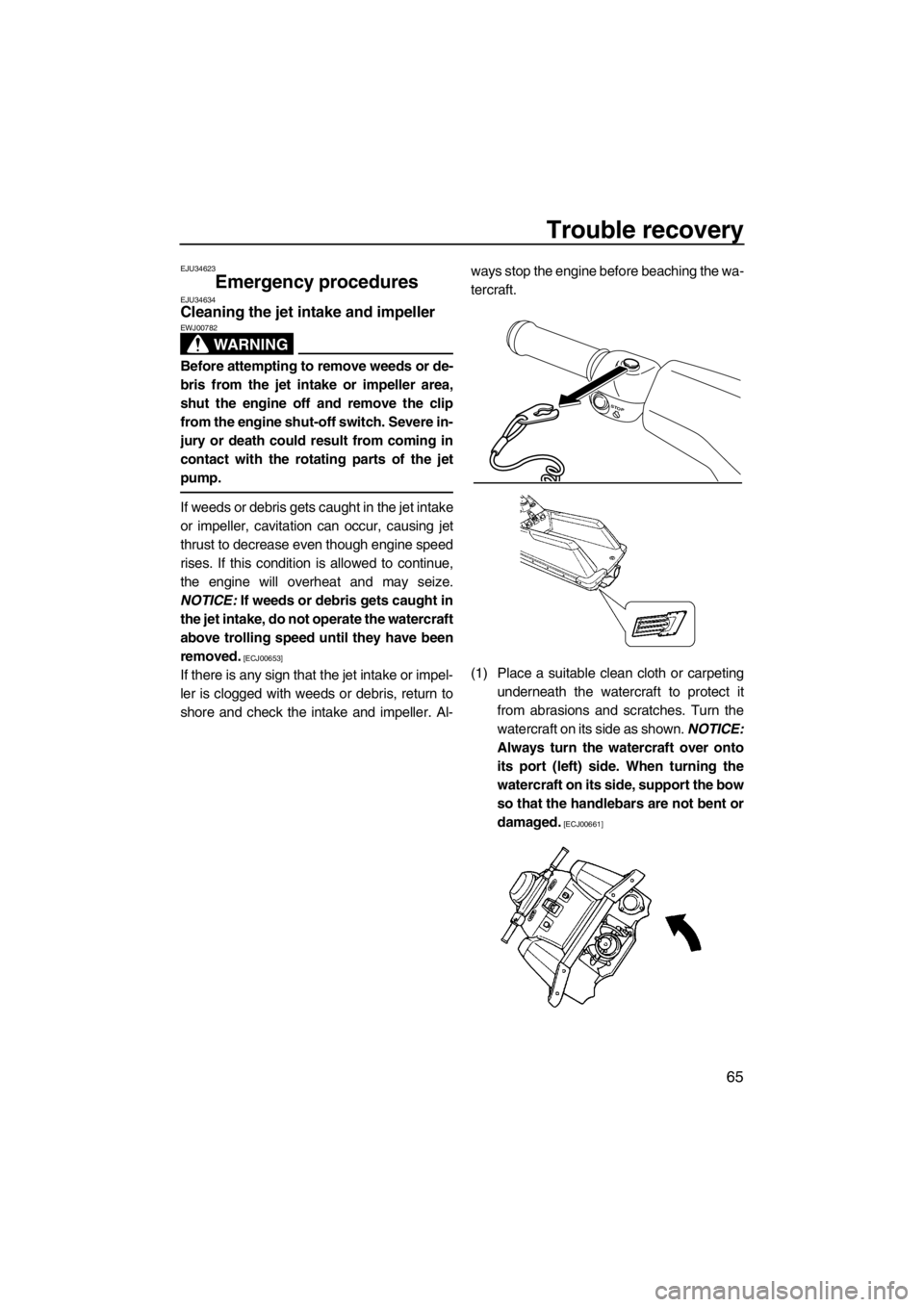
(1) Place a suitable clean cloth or carpeting
underneath the watercraft to protect it
from abrasions and scratches. Turn the
watercraft on its side as shown. NOTICE:
Always turn the watercraft over onto
its port (left) side. When turning the
watercraft on its side, support the bow
so that the handlebars are not bent or
damaged.
[ECJ00661]
STOP
UF2F74E0.book Page 65 Tuesday, May 24, 2011 8:42 AM
Page 75 of 78

Index
2-stroke engine oil .................................... 27
A
After removing the watercraft
from the water ....................................... 48
B
Battery care .............................................. 50
Battery checks.......................................... 35
Battery, jumping ....................................... 66
Beaching the watercraft ........................... 48
Bilge water check ..................................... 35
Bilge water, draining................................. 29
Bilge water, draining on water .................. 29
Boarding and starting in deep water ........ 46
Boarding and starting in shallow water .... 45
Bow rope hole .......................................... 24
C
Capsized watercraft ................................. 47
Carburetor, adjusting................................ 61
Choke cable, adjusting ............................. 60
Choke knob .............................................. 20
Cleaning ................................................... 53
Cleaning the watercraft ............................ 50
Cooling water pilot outlet .......................... 20
Cooling water pilot outlet check ............... 38
Craft Identification Number (CIN) ............... 1
Cruising limitations ..................................... 8
E
Emergency procedures ............................ 65
Engine break-in ........................................ 31
Engine compartment check...................... 34
Engine idling speed, adjusting ................. 61
Engine overheat warning system ............. 21
Engine serial number ................................. 1
Engine shut-off cord (lanyard) check ....... 37
Engine shut-off switch .............................. 18
Engine stop switch ................................... 18
Engine unit check ..................................... 35
Enjoy your watercraft responsibly ............ 14
Equipment ................................................ 23
F
Fire extinguisher check ............................ 38
Fire extinguisher container ....................... 25
Fire extinguisher container checks........... 38
Flushing the cooling water passages ....... 49Fuel .......................................................... 27
Fuel and engine oil requirements ............. 27
Fuel cock knob ......................................... 20
Fuel filter, checking .................................. 60
Fuel level check ....................................... 34
Fuel system checks .................................. 34
Fuel tank, filling ........................................ 28
Fuse, replacing ......................................... 66
G
Getting to know your watercraft ............... 39
Glossary, watercraft ................................. 15
H
Hazard information ................................... 12
Hood ......................................................... 23
Hood check .............................................. 38
Hull and deck check ................................. 38
I
Identification numbers ................................ 1
J
Jet intake and impeller, cleaning .............. 65
Jet intake checks ...................................... 38
Jet thrust nozzle angle, adjusting ............. 56
Jumper cables, connecting ...................... 66
L
Labels, important ........................................ 2
Labels, other .............................................. 6
Labels, warning .......................................... 3
Launching the watercraft .......................... 40
Learning to operate your watercraft ......... 39
Leaving the watercraft .............................. 42
Limitations on who may operate
the watercraft .......................................... 7
Long-term storage .................................... 53
Lubrication................................................ 53
Lubrication points ..................................... 60
M
Main components, location of .................. 16
Maintenance ............................................. 55
Mixing fuel and oil .................................... 27
O
Operating in weeded areas ...................... 48
Operating positions .................................. 39
Operating the watercraft ........................... 42
Operating your watercraft ......................... 39
Operation requirements ............................. 9
UF2F74E0.book Page 1 Tuesday, May 24, 2011 8:42 AM
Page 76 of 78

Index
P
Periodic maintenance chart...................... 58
Post-launch checks .................................. 38
Post-operation care .................................. 49
Pre-launch checks.................................... 34
Pre-operation check points ...................... 34
Pre-operation checklist............................. 32
Primary Identification (PRI-ID) number ...... 1
R
Recommended equipment ....................... 11
Rustproofing ............................................. 54
S
Safe boating rules .................................... 13
Safety equipment check ........................... 38
Spark plugs, checking .............................. 59
Start switch............................................... 18
Starting off ................................................ 44
Starting the engine on water .................... 40
Steering friction, adjusting ........................ 55
Steering pole ............................................ 19
Steering pole check.................................. 36
Steering system ....................................... 19
Steering system checks ........................... 35
Stern rope hole......................................... 24
Stopping the engine ................................. 42
Stopping the watercraft ............................ 44
Storage pouch .......................................... 24
Storage pouch checks.............................. 37
Submerged watercraft .............................. 67
Switch checks .......................................... 37
T
Throttle lever ............................................ 19
Throttle lever checks ................................ 36
Tool kit...................................................... 55
Towing the watercraft ............................... 67
Transporting ............................................. 30
Troubleshooting ....................................... 63
Troubleshooting chart .............................. 63
Turning the watercraft .............................. 42
W
Water separator ....................................... 21
Water separator check ............................. 35
Watercraft characteristics......................... 12
Watercraft control functions ..................... 18
UF2F74E0.book Page 2 Tuesday, May 24, 2011 8:42 AM