engine overheat YAMAHA SUPERJET 2012 User Guide
[x] Cancel search | Manufacturer: YAMAHA, Model Year: 2012, Model line: SUPERJET, Model: YAMAHA SUPERJET 2012Pages: 78, PDF Size: 4.55 MB
Page 71 of 78
Trouble recovery
65
EJU34623
Emergency procedures EJU34634Cleaning the jet intake and impeller
WARNING
EWJ00782
Before attempting to remove weeds or de-
bris from the jet intake or impeller area,
shut the engine off and remove the clip
from the engine shut-off switch. Severe in-
jury or death could result from coming in
contact with the rotating parts of the jet
pump.
If weeds or debris gets caught in the jet intake
or impeller, cavitation can occur, causing jet
thrust to decrease even though engine speed
rises. If this condition is allowed to continue,
the engine will overheat and may seize.
NOTICE: If weeds or debris gets caught in
the jet intake, do not operate the watercraft
above trolling speed until they have been
removed.
[ECJ00653]
If there is any sign that the jet intake or impel-
ler is clogged with weeds or debris, return to
shore and check the intake and impeller. Al-ways stop the engine before beaching the wa-
tercraft.
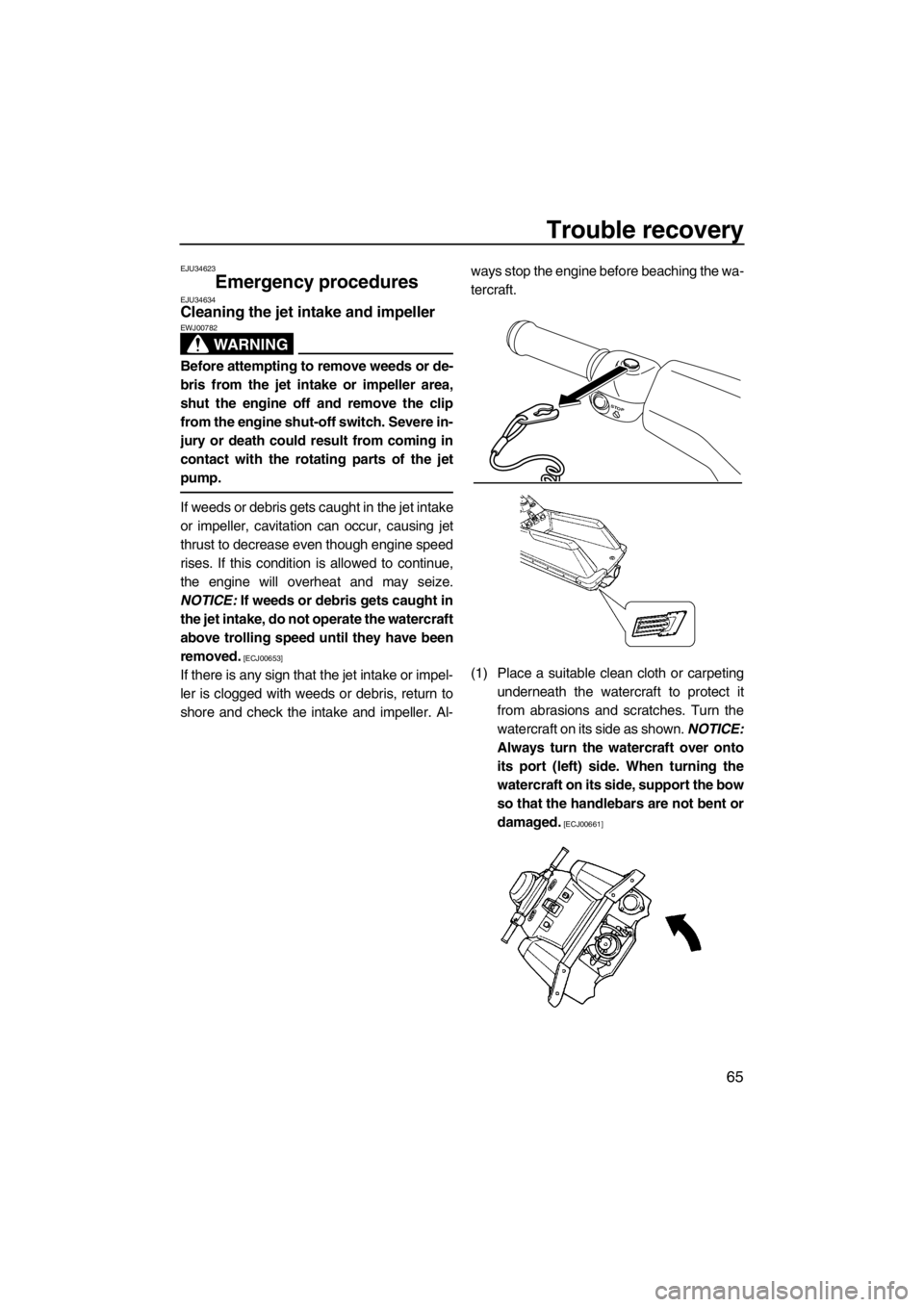
(1) Place a suitable clean cloth or carpeting
underneath the watercraft to protect it
from abrasions and scratches. Turn the
watercraft on its side as shown. NOTICE:
Always turn the watercraft over onto
its port (left) side. When turning the
watercraft on its side, support the bow
so that the handlebars are not bent or
damaged.
[ECJ00661]
STOP
UF2F74E0.book Page 65 Tuesday, May 24, 2011 8:42 AM
Page 75 of 78

Index
2-stroke engine oil .................................... 27
A
After removing the watercraft
from the water ....................................... 48
B
Battery care .............................................. 50
Battery checks.......................................... 35
Battery, jumping ....................................... 66
Beaching the watercraft ........................... 48
Bilge water check ..................................... 35
Bilge water, draining................................. 29
Bilge water, draining on water .................. 29
Boarding and starting in deep water ........ 46
Boarding and starting in shallow water .... 45
Bow rope hole .......................................... 24
C
Capsized watercraft ................................. 47
Carburetor, adjusting................................ 61
Choke cable, adjusting ............................. 60
Choke knob .............................................. 20
Cleaning ................................................... 53
Cleaning the watercraft ............................ 50
Cooling water pilot outlet .......................... 20
Cooling water pilot outlet check ............... 38
Craft Identification Number (CIN) ............... 1
Cruising limitations ..................................... 8
E
Emergency procedures ............................ 65
Engine break-in ........................................ 31
Engine compartment check...................... 34
Engine idling speed, adjusting ................. 61
Engine overheat warning system ............. 21
Engine serial number ................................. 1
Engine shut-off cord (lanyard) check ....... 37
Engine shut-off switch .............................. 18
Engine stop switch ................................... 18
Engine unit check ..................................... 35
Enjoy your watercraft responsibly ............ 14
Equipment ................................................ 23
F
Fire extinguisher check ............................ 38
Fire extinguisher container ....................... 25
Fire extinguisher container checks........... 38
Flushing the cooling water passages ....... 49Fuel .......................................................... 27
Fuel and engine oil requirements ............. 27
Fuel cock knob ......................................... 20
Fuel filter, checking .................................. 60
Fuel level check ....................................... 34
Fuel system checks .................................. 34
Fuel tank, filling ........................................ 28
Fuse, replacing ......................................... 66
G
Getting to know your watercraft ............... 39
Glossary, watercraft ................................. 15
H
Hazard information ................................... 12
Hood ......................................................... 23
Hood check .............................................. 38
Hull and deck check ................................. 38
I
Identification numbers ................................ 1
J
Jet intake and impeller, cleaning .............. 65
Jet intake checks ...................................... 38
Jet thrust nozzle angle, adjusting ............. 56
Jumper cables, connecting ...................... 66
L
Labels, important ........................................ 2
Labels, other .............................................. 6
Labels, warning .......................................... 3
Launching the watercraft .......................... 40
Learning to operate your watercraft ......... 39
Leaving the watercraft .............................. 42
Limitations on who may operate
the watercraft .......................................... 7
Long-term storage .................................... 53
Lubrication................................................ 53
Lubrication points ..................................... 60
M
Main components, location of .................. 16
Maintenance ............................................. 55
Mixing fuel and oil .................................... 27
O
Operating in weeded areas ...................... 48
Operating positions .................................. 39
Operating the watercraft ........................... 42
Operating your watercraft ......................... 39
Operation requirements ............................. 9
UF2F74E0.book Page 1 Tuesday, May 24, 2011 8:42 AM