fuel YAMAHA SUPERJET 2013 Owners Manual
[x] Cancel search | Manufacturer: YAMAHA, Model Year: 2013, Model line: SUPERJET, Model: YAMAHA SUPERJET 2013Pages: 78, PDF Size: 3.29 MB
Page 5 of 78

Table of contents
General and important labels ........... 1Identification numbers .................... 1
Primary Identification (PRI-ID)
number ........................................... 1
Craft Identification Number (CIN) ...... 1
Engine serial number ........................ 1
Manufactured date label .................... 2
Important labels .............................. 3
Warning labels ................................... 4
Other labels ....................................... 7
Safety information ............................. 8 Limitations on who may operate the watercraft .............................. 8
Cruising limitations ......................... 9
Operation requirements ............... 10
Recommended equipment ........... 12
Hazard information ....................... 13
Watercraft characteristics ............. 13
Safe boating rules ........................ 14
Enjoy your watercraft responsibly ................................ 15
Description....................................... 16 Watercraft glossary ...................... 16
Location of main components ...... 17
Control function operation ............. 19 Watercraft control functions ......... 19
Engine stop switch .......................... 19
Engine shut-off switch ..................... 19
Start switch ...................................... 19
Throttle lever ................................... 20
Steering system ............................... 20
Steering pole ................................... 20
Fuel cock knob ................................ 21
Choke knob ..................................... 21
Cooling water pilot outlet ................. 21
Water separator ............................... 22
Engine overheat warning system .... 22
Equipment operation ...................... 24Equipment .................................... 24
Hood ................................................ 24
Bow rope hole ................................. 25
Stern rope hole ................................ 25
Storage pouch ................................. 25
Fire extinguisher container .............. 26
Operation and handling
requirements ................................... 28Fuel and engine oil requirements ............................. 28
Fuel ................................................. 28
2-stroke engine oil ........................... 28
Mixing fuel and oil ............................ 28
Filling the fuel tank .......................... 29
Draining the bilge water ............... 30
Draining the bilge water on water .... 30
Transporting ................................. 31
First-time operation ........................ 32 Engine break-in ............................ 32
Pre-operation checks ..................... 33
Pre-operation checklist .................... 33
Pre-operation check points .......... 35
Pre-launch checks ........................... 35
Post-launch checks ......................... 39
Operation ......................................... 40 Operating your watercraft ............ 40
Getting to know your watercraft ....... 40
Learning to operate your
watercraft ..................................... 40
Operating positions ......................... 40
Launching the watercraft ................. 41
Starting the engine on water ........... 41
Stopping the engine ........................ 43
Leaving the watercraft ..................... 43
Operating the watercraft .................. 43
Turning the watercraft ..................... 43
Stopping the watercraft ................... 45
Starting off ....................................... 45
UF2F75E0.book Page 1 Thursday, July 5, 2012 8:50 AM
Page 6 of 78

Table of contents
Capsized watercraft ......................... 48
Beaching the watercraft ................... 49
Operating in weeded areas ............. 49
After removing the watercraft from the water ...................................... 49
Care and storage ............................. 50Post-operation care ...................... 50
Flushing the cooling water
passages ...................................... 50
Cleaning the watercraft ................... 51
Battery care ..................................... 51
Long-term storage ........................ 54
Cleaning .......................................... 54
Lubrication ....................................... 54
Rustproofing .................................... 55
Maintenance..................................... 56 Maintenance ................................. 56
Tool kit ............................................. 56
Adjusting the steering friction .......... 56
Adjusting the jet thrust nozzle
angle ............................................ 57
Periodic maintenance chart ............. 59
Checking the spark plugs ................ 60
Lubrication points ............................ 61
Checking the fuel filter ..................... 61
Adjusting the choke cable ............... 61
Adjusting the carburetor .................. 62
Specifications .................................. 63 Specifications ................................ 63
Trouble recovery ............................. 64 Troubleshooting ........................... 64
Troubleshooting chart ...................... 64
Emergency procedures ................ 66
Cleaning the jet intake and
impeller ........................................ 66
Jumping the battery ......................... 67
Replacing the fuse ........................... 67
Towing the watercraft ...................... 68
Submerged watercraft ..................... 68
UF2F75E0.book Page 2 Thursday, July 5, 2012 8:50 AM
Page 19 of 78
Safety information
13
EJU30850
Hazard information
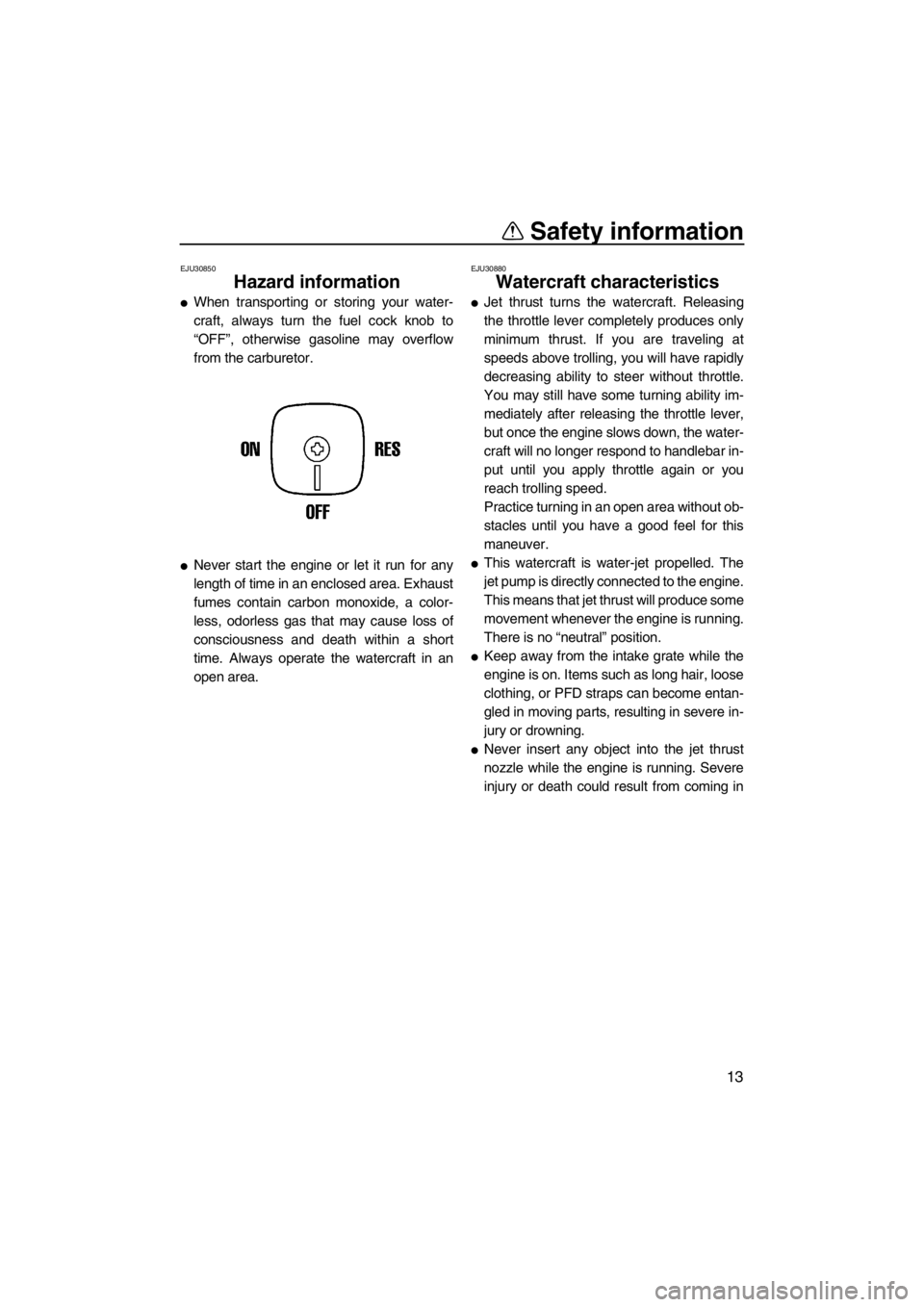
●When transporting or storing your water-
craft, always turn the fuel cock knob to
“OFF”, otherwise gasoline may overflow
from the carburetor.
●Never start the engine or let it run for any
length of time in an enclosed area. Exhaust
fumes contain carbon monoxide, a color-
less, odorless gas that may cause loss of
consciousness and death within a short
time. Always operate the watercraft in an
open area.
EJU30880
Watercraft characteristics
●Jet thrust turns the watercraft. Releasing
the throttle lever completely produces only
minimum thrust. If you are traveling at
speeds above trolling, you will have rapidly
decreasing ability to steer without throttle.
You may still have some turning ability im-
mediately after releasing the throttle lever,
but once the engine slows down, the water-
craft will no longer respond to handlebar in-
put until you apply throttle again or you
reach trolling speed.
Practice turning in an open area without ob-
stacles until you have a good feel for this
maneuver.
●This watercraft is water-jet propelled. The
jet pump is directly connected to the engine.
This means that jet thrust will produce some
movement whenever the engine is running.
There is no “neutral” position.
●Keep away from the intake grate while the
engine is on. Items such as long hair, loose
clothing, or PFD straps can become entan-
gled in moving parts, resulting in severe in-
jury or drowning.
●Never insert any object into the jet thrust
nozzle while the engine is running. Severe
injury or death could result from coming in
UF2F75E0.book Page 13 Thursday, July 5, 2012 8:50 AM
Page 21 of 78

Safety information
15
EJU30991
Enjoy your watercraft responsibly
You share the areas you enjoy when riding
your watercraft with others and with nature.
So your enjoyment includes a responsibility to
treat these other people, and the lands, wa-
ters, and wildlife with respect and courtesy.
Whenever and wherever you ride, think of
yourself as the guest of those around you. Re-
member, for example, that the sound of your
watercraft may be music to you, but it could be
just noise to others. And the exciting splash of
your wake can make waves others won’t en-
joy.
Avoid riding close to shoreline homes and wa-
terfowl nesting areas or other wildlife areas,
and keep a respectful distance from fisher-
men, other boats, swimmers, and populated
beaches. When travel in areas like these is
unavoidable, ride slowly and obey all laws.
Proper maintenance is necessary to ensure
that the exhaust emission and sound levels of
your watercraft will continue to be within regu-
lated limits. You have the responsibility to
make sure that the recommended mainte-
nance in this owner’s/operator’s manual is
carried out.
Remember, pollution can be harmful to the
environment. Do not refuel or add oil where a
spill could cause damage to nature. Remove
your watercraft from the water and move it
away from the shoreline before refueling. Dis-
pose of water and any fuel and oil residue in
the engine compartment according to local
regulations. And keep your surroundings
pleasant for the people and wildlife that share
the waterways: don’t litter.
When you ride responsibly, with respect and
courtesy for others, you help ensure that our waterways stay open for the enjoyment of a
variety of recreational opportunities.
UF2F75E0.book Page 15 Thursday, July 5, 2012 8:50 AM
Page 23 of 78
Description
17
EJU31011
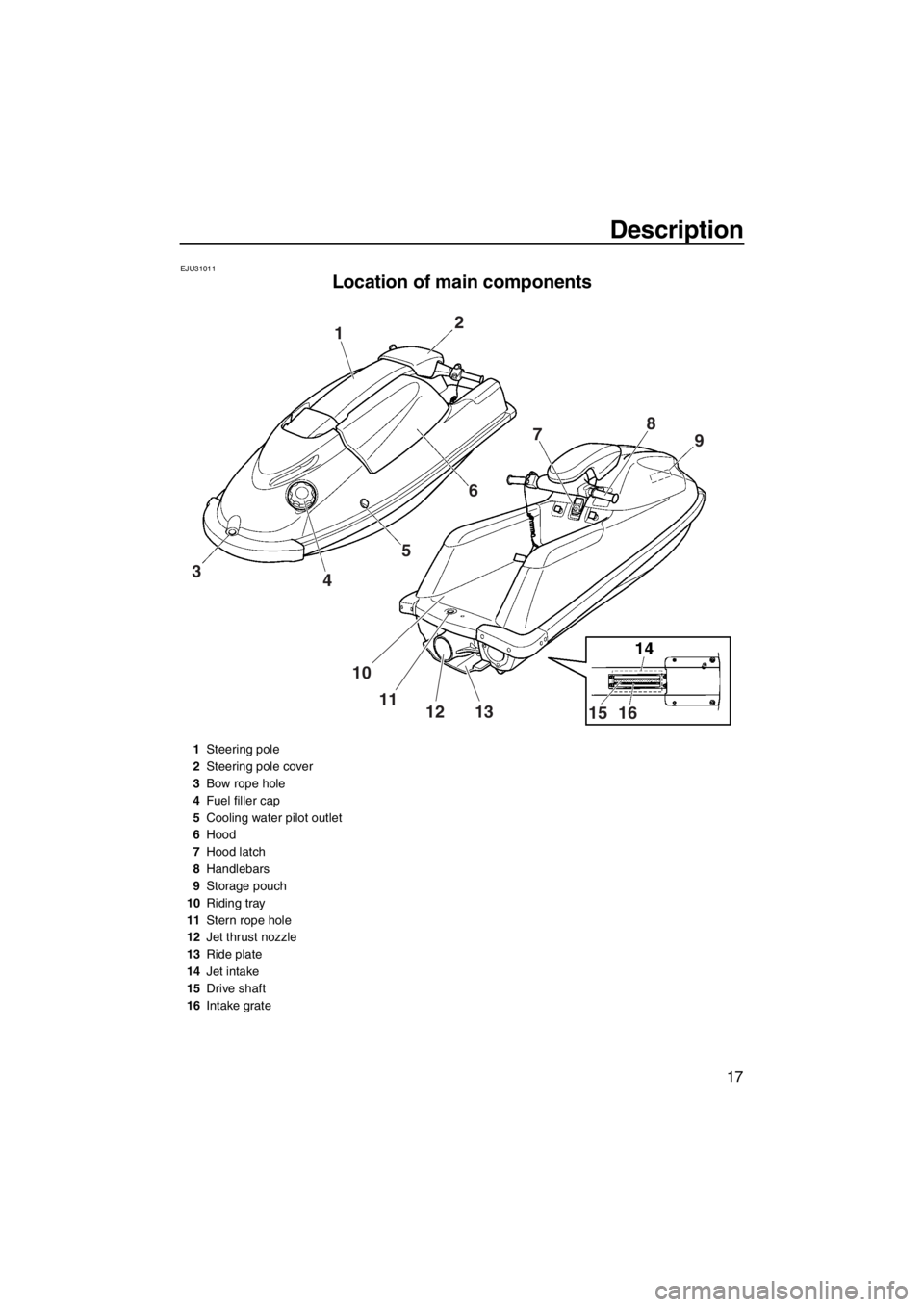
Location of main components
2
1
3 456
7
8
9
10 11 12 13 15 16
1Steering pole
2 Steering pole cover
3 Bow rope hole
4 Fuel filler cap
5 Cooling water pilot outlet
6 Hood
7 Hood latch
8 Handlebars
9 Storage pouch
10 Riding tray
11 Stern rope hole
12 Jet thrust nozzle
13 Ride plate
14 Jet intake
15 Drive shaft
16 Intake grate
UF2F75E0.book Page 17 Thursday, July 5, 2012 8:50 AM
Page 24 of 78
Description
18
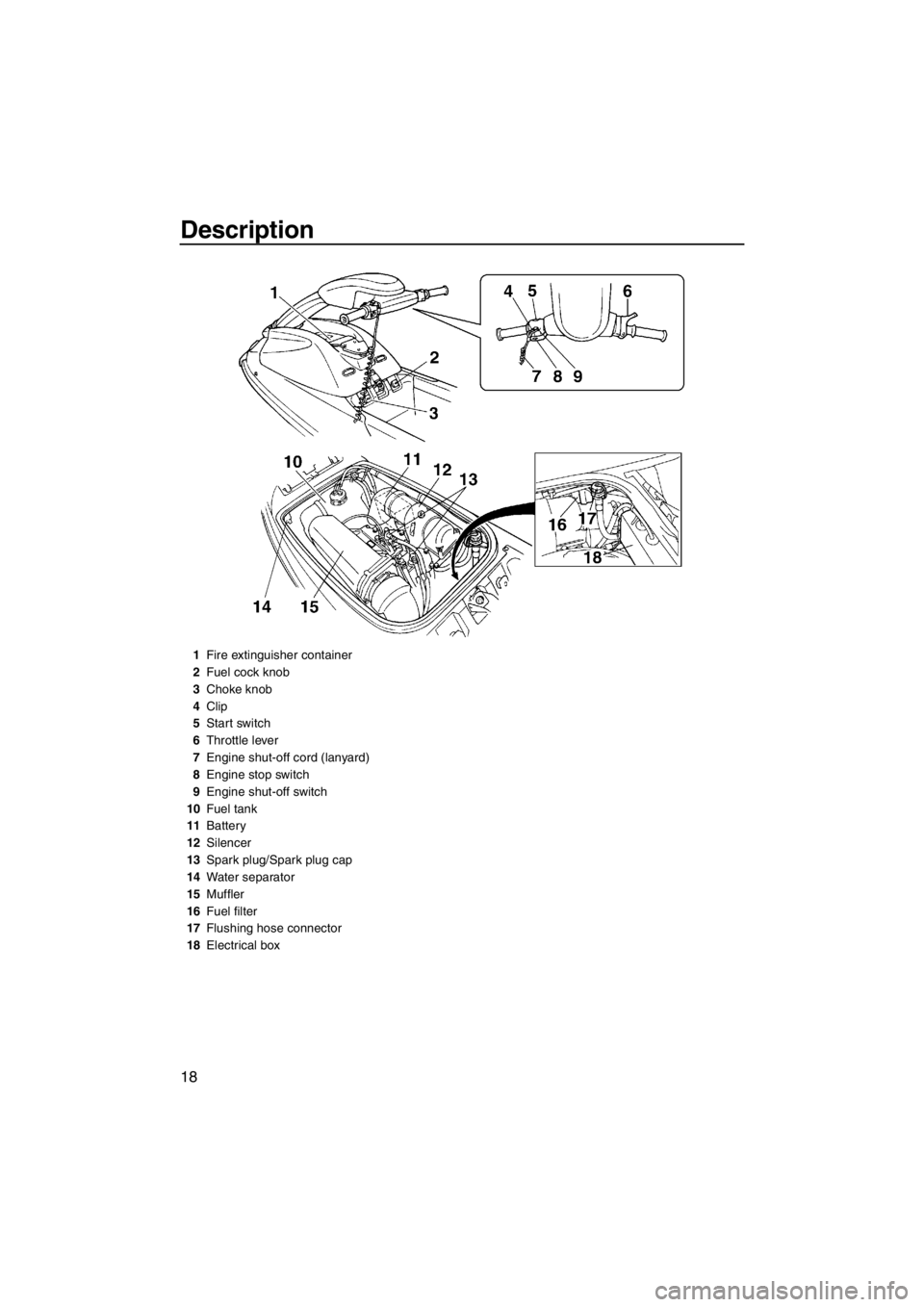
1Fire extinguisher container
2 Fuel cock knob
3 Choke knob
4 Clip
5 Start switch
6 Throttle lever
7 Engine shut-off cord (lanyard)
8 Engine stop switch
9 Engine shut-off switch
10 Fuel tank
11 Battery
12 Silencer
13 Spark plug/Spark plug cap
14 Water separator
15 Muffler
16 Fuel filter
17 Flushing hose connector
18 Electrical box
UF2F75E0.book Page 18 Thursday, July 5, 2012 8:50 AM
Page 27 of 78
Control function operation
21
EJU31123Fuel cock knob
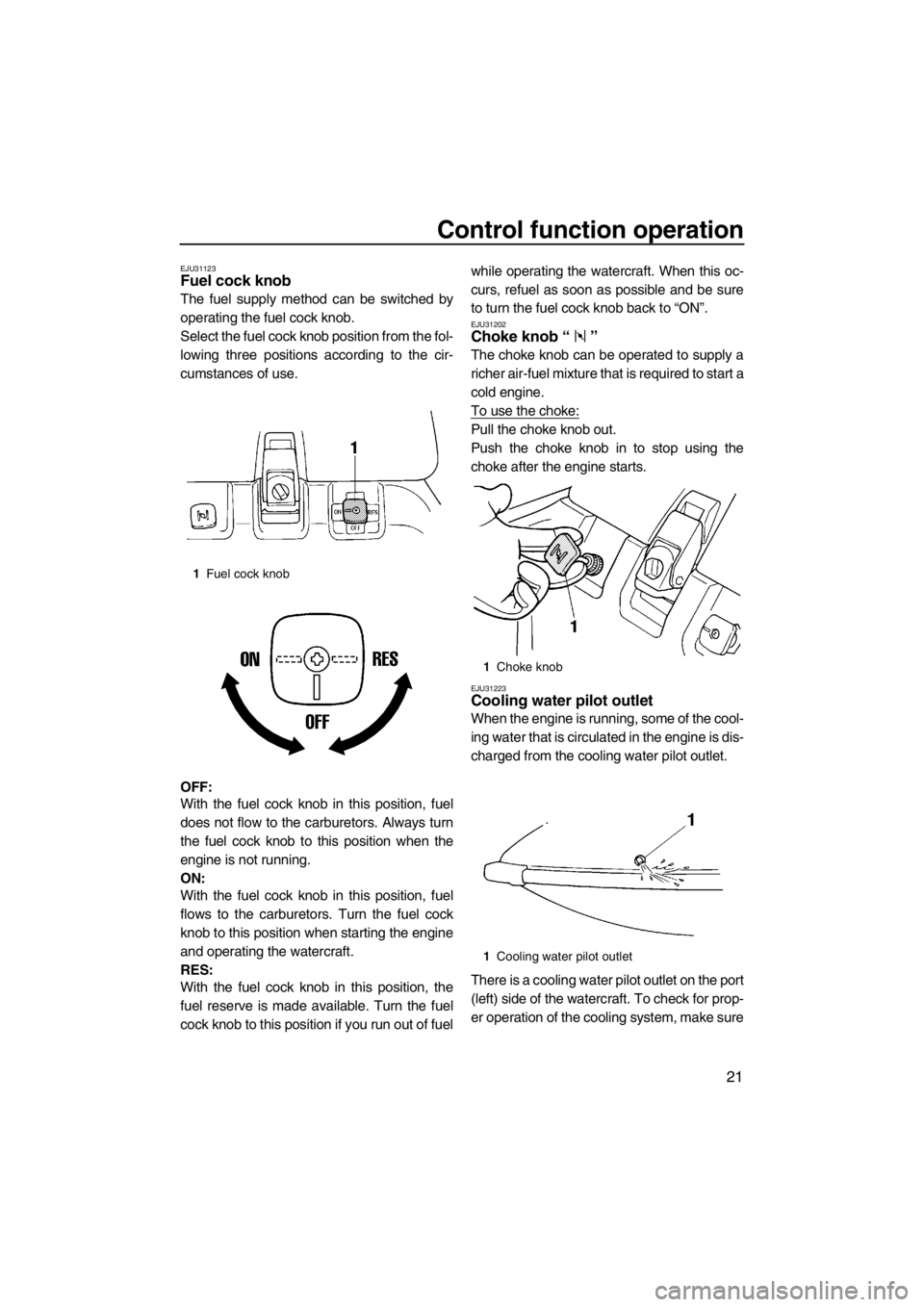
The fuel supply method can be switched by
operating the fuel cock knob.
Select the fuel cock knob position from the fol-
lowing three positions according to the cir-
cumstances of use.
OFF:
With the fuel cock knob in this position, fuel
does not flow to the carburetors. Always turn
the fuel cock knob to this position when the
engine is not running.
ON:
With the fuel cock knob in this position, fuel
flows to the carburetors. Turn the fuel cock
knob to this position when starting the engine
and operating the watercraft.
RES:
With the fuel cock knob in this position, the
fuel reserve is made available. Turn the fuel
cock knob to this position if you run out of fuelwhile operating the watercraft. When this oc-
curs, refuel as soon as possible and be sure
to turn the fuel cock knob back to “ON”.
EJU31202Choke knob “ ”
The choke knob can be operated to supply a
richer air-fuel mixture that is required to start a
cold engine.
To use the choke:
Pull the choke knob out.
Push the choke knob in to stop using the
choke after the engine starts.
EJU31223Cooling water pilot outlet
When the engine is running, some of the cool-
ing water that is circulated in the engine is dis-
charged from the cooling water pilot outlet.
There is a cooling water pilot outlet on the port
(left) side of the watercraft. To check for prop-
er operation of the cooling system, make sure
1
Fuel cock knob
1Choke knob
1 Cooling water pilot outlet
UF2F75E0.book Page 21 Thursday, July 5, 2012 8:50 AM
Page 28 of 78
Control function operation
22
that water is being discharged from the cool-
ing water pilot outlet. If water is not being dis-
charged from the outlet, stop the engine and
check the jet intake for clogging. (See page
66 for information on the jet intake.)
TIP:
●It will take about 20 seconds for the water to
reach the outlet after the engine is started.
●Water discharge may not be constant when
the engine is running at idling speed. If this
occurs, apply a little throttle to make sure
that water discharges properly.
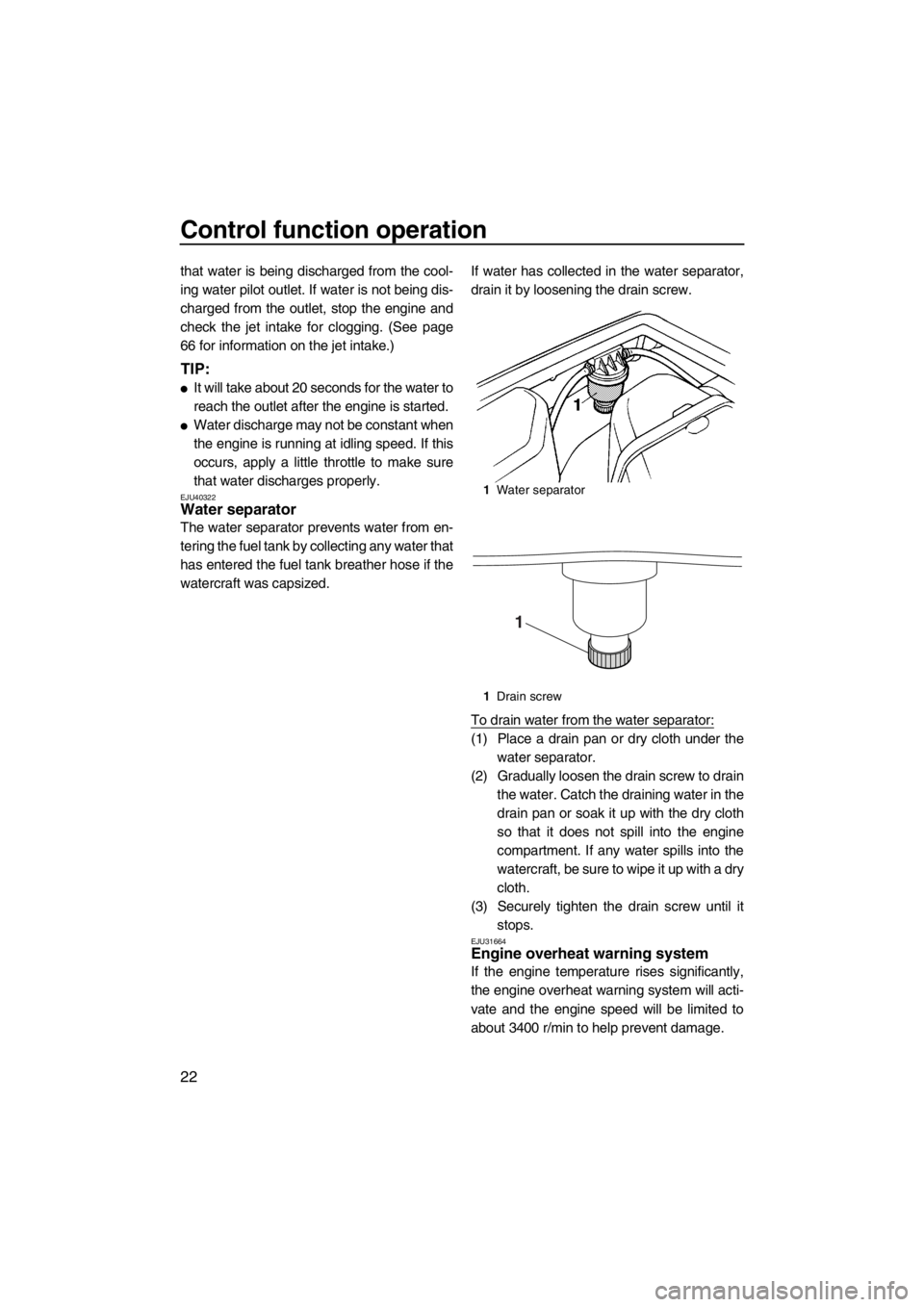
EJU40322Water separator
The water separator prevents water from en-
tering the fuel tank by collecting any water that
has entered the fuel tank breather hose if the
watercraft was capsized.If water has collected in the water separator,
drain it by loosening the drain screw.
To drain water from the water separator:
(1) Place a drain pan or dry cloth under the
water separator.
(2) Gradually loosen the drain screw to drain the water. Catch the draining water in the
drain pan or soak it up with the dry cloth
so that it does not spill into the engine
compartment. If any water spills into the
watercraft, be sure to wipe it up with a dry
cloth.
(3) Securely tighten the drain screw until it stops.
EJU31664Engine overheat warning system
If the engine temperature rises significantly,
the engine overheat warning system will acti-
vate and the engine speed will be limited to
about 3400 r/min to help prevent damage.
1Water separator
1 Drain screw
1
UF2F75E0.book Page 22 Thursday, July 5, 2012 8:50 AM
Page 34 of 78
Operation and handling requirements
28
EJU31792
Fuel and engine oil requirements
EJU31833Fuel
WARNING
EWJ00282
●Gasoline and gasoline vapors are ex-
tremely flammable. To avoid fires and
explosions and to reduce the risk of in-
jury when refueling, follow these in-
structions.
●Gasoline is poisonous and can cause in-
jury or death. Handle gasoline with care.
Never siphon gasoline by mouth. If you
should swallow some gasoline, inhale a
lot of gasoline vapor, or get some gaso-
line in your eyes, see your doctor imme-
diately. If gasoline spills on your skin,
wash with soap and water. If gasoline
spills on your clothing, change your
clothes.
NOTICE
ECJ00321
●Do not use leaded gasoline. Leaded gas-
oline can seriously damage the engine.
●Avoid getting water and contaminants in
the fuel tank. Contaminated fuel can
cause poor performance and engine
damage. Use only fresh gasoline that
has been stored in clean containers.
Gasohol
There are two types of gasohol: gasohol con-
taining ethanol and that containing methanol. Gasohol containing ethanol can be used if
ethanol content does not exceed 10% and the
fuel meets the minimum octane ratings. E-85
is a fuel blend containing 85% ethanol and
therefore must not be used in this watercraft.
All ethanol blends containing more than 10%
ethanol can cause fuel system damage or en-
gine performance problems.
Yamaha does not recommend gasohol con- taining methanol because it can cause fuel
system damage and engine performance
problems.
EJU318722-stroke engine oil
If YAMALUBE 2-W engine oil is not available,
another 2-stroke engine oil with an NMMA-
certified TC-W3 rating may be used.
EJU31902Mixing fuel and oil
NOTICE
ECJ00331
Make sure that the gasoline and oil are
thoroughly mixed in the correct ratio, oth-
erwise severe engine damage could re-
sult.
To mix gasoline and engine oil:
(1) Pour 2-stroke engine oil into a clean con- tainer, and then add gasoline.
Recommended fuel: Regular unleaded gasoline with a
minimum octane rating of
86
(Pump octane number) = (R + M)/2
90 (Research octane number)
Recommended engine oil:YAMALUBE 2-W or TC-W3 outboard
motor oil or equivalent
Fuel-to-oil ratios (gasoline to oil) Break-in period (first two tankfuls): 25:1
After break-in: 50 :1
UF2F75E0.book Page 28 Thursday, July 5, 2012 8:50 AM
Page 35 of 78
Operation and handling requirements
29
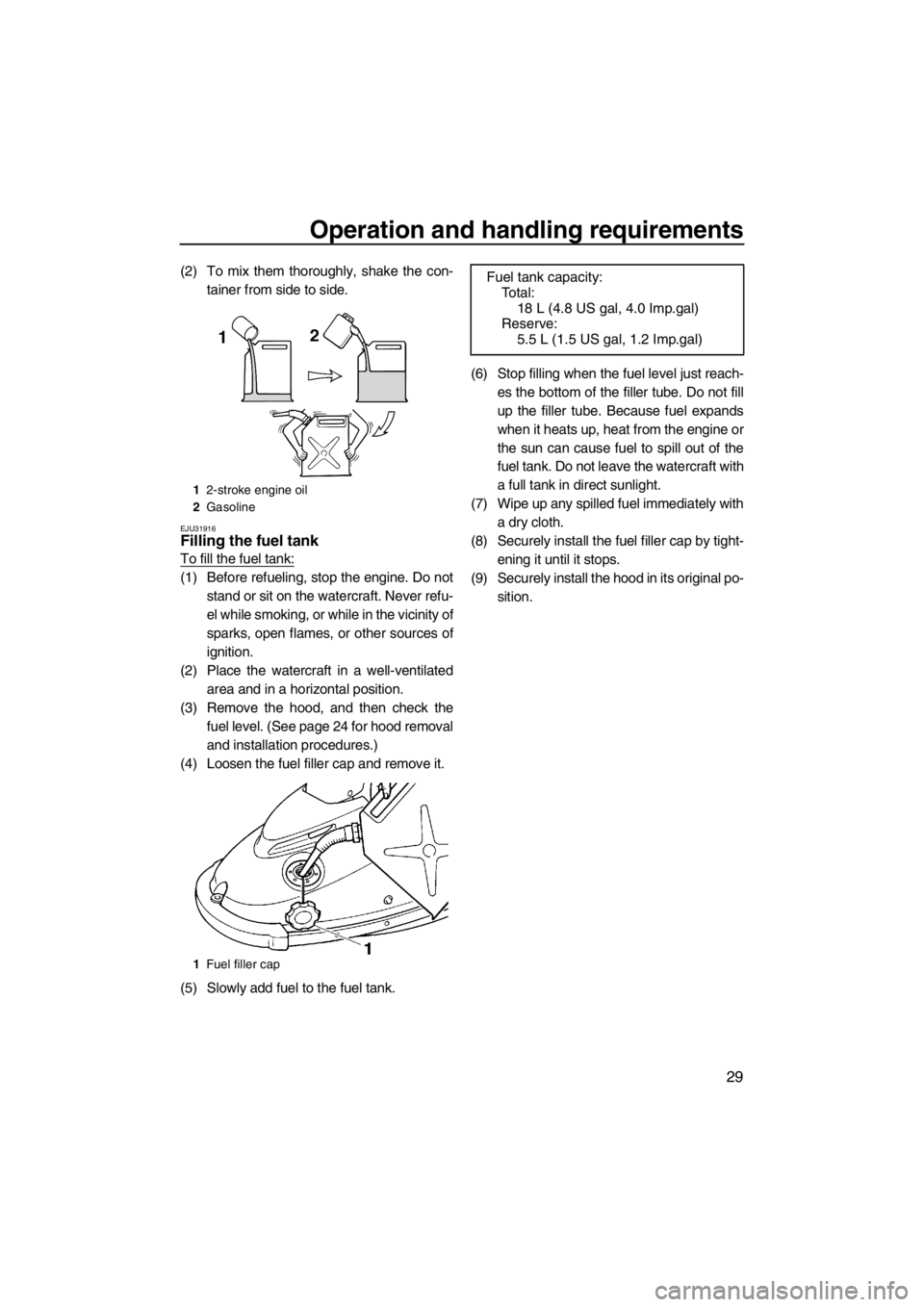
(2) To mix them thoroughly, shake the con-tainer from side to side.
EJU31916Filling the fuel tank
To fill the fuel tank:
(1) Before refueling, stop the engine. Do notstand or sit on the watercraft. Never refu-
el while smoking, or while in the vicinity of
sparks, open flames, or other sources of
ignition.
(2) Place the watercraft in a well-ventilated area and in a horizontal position.
(3) Remove the hood, and then check the fuel level. (See page 24 for hood removal
and installation procedures.)
(4) Loosen the fuel filler cap and remove it.
(5) Slowly add fuel to the fuel tank. (6) Stop filling when the fuel level just reach-
es the bottom of the filler tube. Do not fill
up the filler tube. Because fuel expands
when it heats up, heat from the engine or
the sun can cause fuel to spill out of the
fuel tank. Do not leave the watercraft with
a full tank in direct sunlight.
(7) Wipe up any spilled fuel immediately with a dry cloth.
(8) Securely install the fuel filler cap by tight- ening it until it stops.
(9) Securely install the hood in its original po- sition.
12-stroke engine oil
2 Gasoline
1 Fuel filler cap
Fuel tank capacity:
To t a l :
18 L (4.8 US gal, 4.0 Imp.gal)
Reserve: 5.5 L (1.5 US gal, 1.2 Imp.gal)
UF2F75E0.book Page 29 Thursday, July 5, 2012 8:50 AM