lock YAMAHA SUPERJET 2013 Owners Manual
[x] Cancel search | Manufacturer: YAMAHA, Model Year: 2013, Model line: SUPERJET, Model: YAMAHA SUPERJET 2013Pages: 78, PDF Size: 3.29 MB
Page 15 of 78
Safety information
9
EJU30761
Cruising limitations
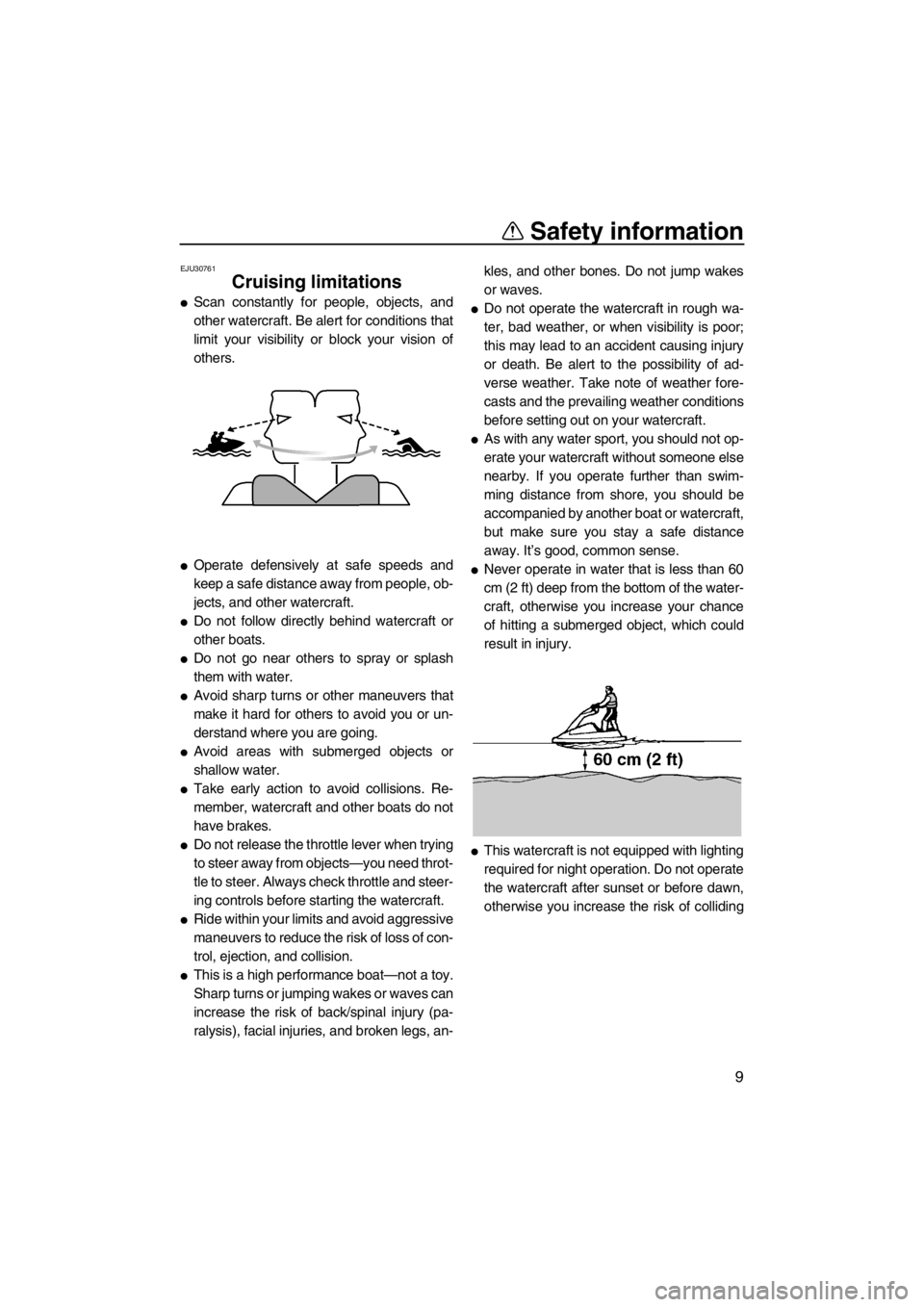
●Scan constantly for people, objects, and
other watercraft. Be alert for conditions that
limit your visibility or block your vision of
others.
●Operate defensively at safe speeds and
keep a safe distance away from people, ob-
jects, and other watercraft.
●Do not follow directly behind watercraft or
other boats.
●Do not go near others to spray or splash
them with water.
●Avoid sharp turns or other maneuvers that
make it hard for others to avoid you or un-
derstand where you are going.
●Avoid areas with submerged objects or
shallow water.
●Take early action to avoid collisions. Re-
member, watercraft and other boats do not
have brakes.
●Do not release the throttle lever when trying
to steer away from objects—you need throt-
tle to steer. Always check throttle and steer-
ing controls before starting the watercraft.
●Ride within your limits and avoid aggressive
maneuvers to reduce the risk of loss of con-
trol, ejection, and collision.
●This is a high performance boat—not a toy.
Sharp turns or jumping wakes or waves can
increase the risk of back/spinal injury (pa-
ralysis), facial injuries, and broken legs, an-kles, and other bones. Do not jump wakes
or waves.
●Do not operate the watercraft in rough wa-
ter, bad weather, or when visibility is poor;
this may lead to an accident causing injury
or death. Be alert to the possibility of ad-
verse weather. Take note of weather fore-
casts and the prevailing weather conditions
before setting out on your watercraft.
●As with any water sport, you should not op-
erate your watercraft without someone else
nearby. If you operate further than swim-
ming distance from shore, you should be
accompanied by another boat or watercraft,
but make sure you stay a safe distance
away. It’s good, common sense.
●Never operate in water that is less than 60
cm (2 ft) deep from the bottom of the water-
craft, otherwise you increase your chance
of hitting a submerged object, which could
result in injury.
●This watercraft is not equipped with lighting
required for night operation. Do not operate
the watercraft after sunset or before dawn,
otherwise you increase the risk of colliding
UF2F75E0.book Page 9 Thursday, July 5, 2012 8:50 AM
Page 30 of 78
Equipment operation
24
EJU40333
Equipment EJU31056Hood
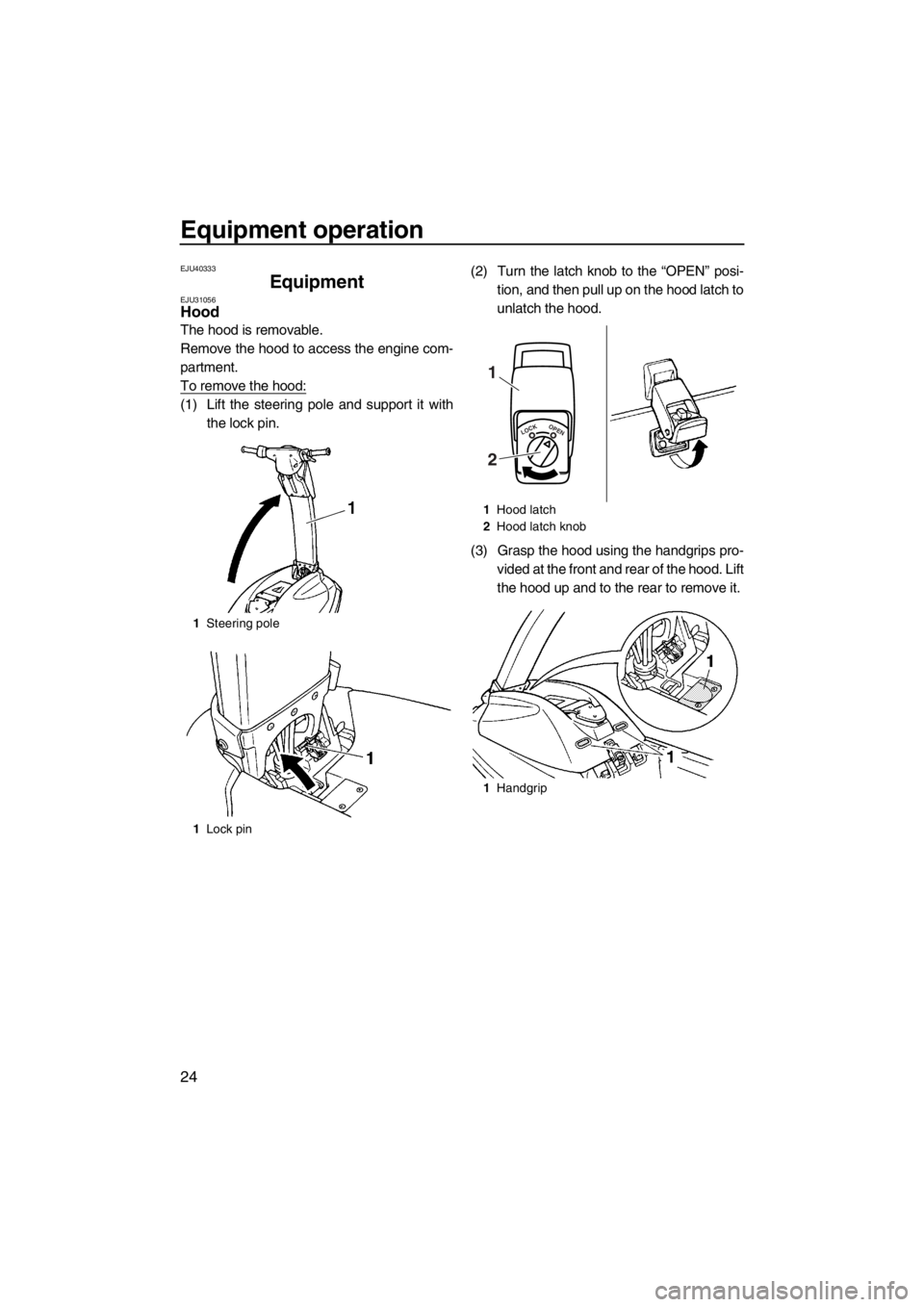
The hood is removable.
Remove the hood to access the engine com-
partment.
To remove the hood:
(1) Lift the steering pole and support it withthe lock pin. (2) Turn the latch knob to the “OPEN” posi-
tion, and then pull up on the hood latch to
unlatch the hood.
(3) Grasp the hood using the handgrips pro- vided at the front and rear of the hood. Lift
the hood up and to the rear to remove it.
1Steering pole
1 Lock pin
1Hood latch
2 Hood latch knob
1 Handgrip
LOC KOPEN
1
2
UF2F75E0.book Page 24 Thursday, July 5, 2012 8:50 AM
Page 31 of 78
Equipment operation
25
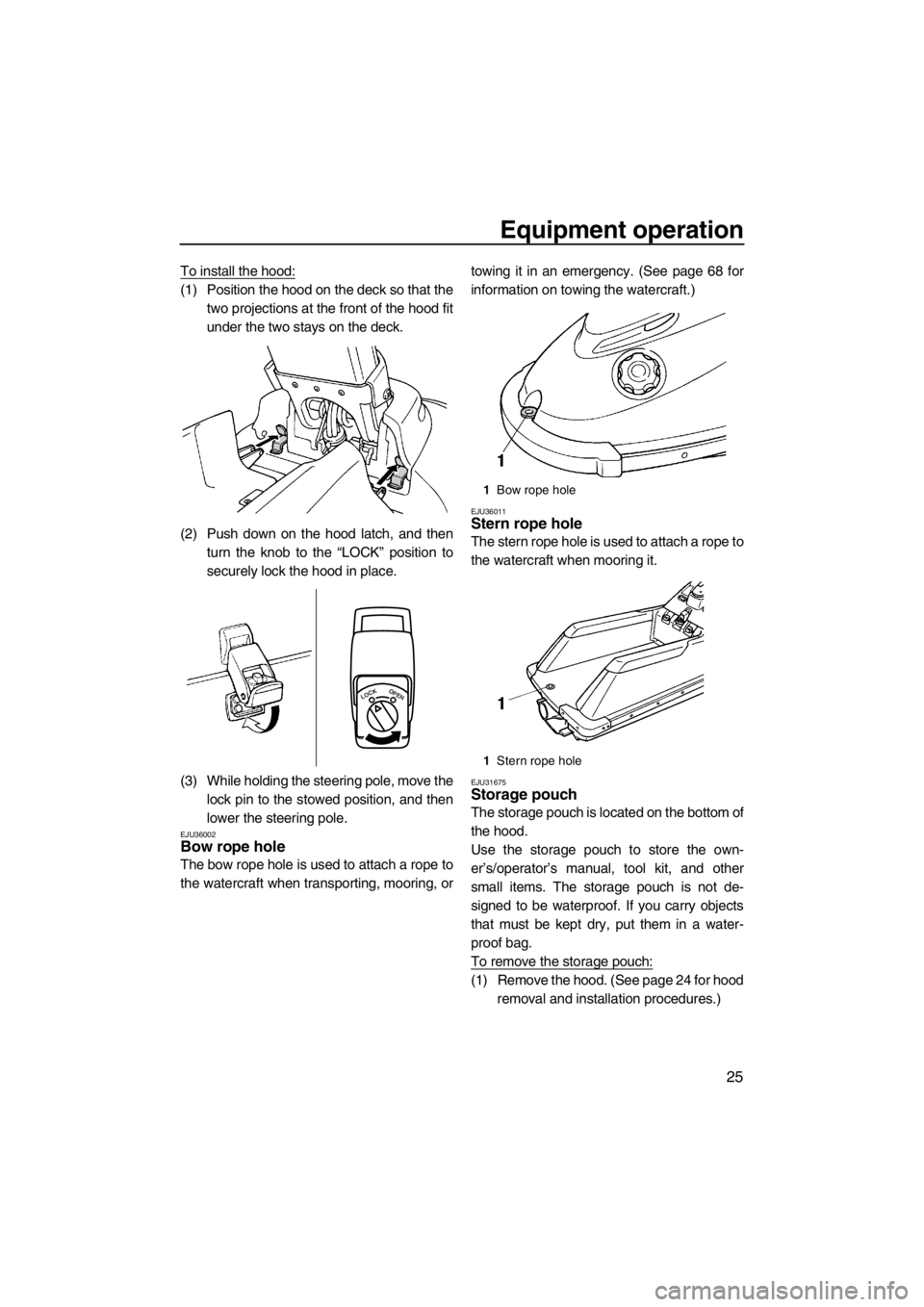
To install the hood:
(1) Position the hood on the deck so that thetwo projections at the front of the hood fit
under the two stays on the deck.
(2) Push down on the hood latch, and then turn the knob to the “LOCK” position to
securely lock the hood in place.
(3) While holding the steering pole, move the lock pin to the stowed position, and then
lower the steering pole.
EJU36002Bow rope hole
The bow rope hole is used to attach a rope to
the watercraft when transporting, mooring, or towing it in an emergency. (See page 68 for
information on towing the watercraft.)
EJU36011Stern rope hole
The stern rope hole is used to attach a rope to
the watercraft when mooring it.
EJU31675Storage pouch
The storage pouch is located on the bottom of
the hood.
Use the storage pouch to store the own-
er’s/operator’s manual, tool kit, and other
small items. The storage pouch is not de-
signed to be waterproof. If you carry objects
that must be kept dry, put them in a water-
proof bag.
To remove the storage pouch:
(1) Remove the hood. (See page 24 for hood
removal and installation procedures.)
LOCKOPEN
1 Bow rope hole
1 Stern rope hole
UF2F75E0.book Page 25 Thursday, July 5, 2012 8:50 AM
Page 32 of 78
Equipment operation
26
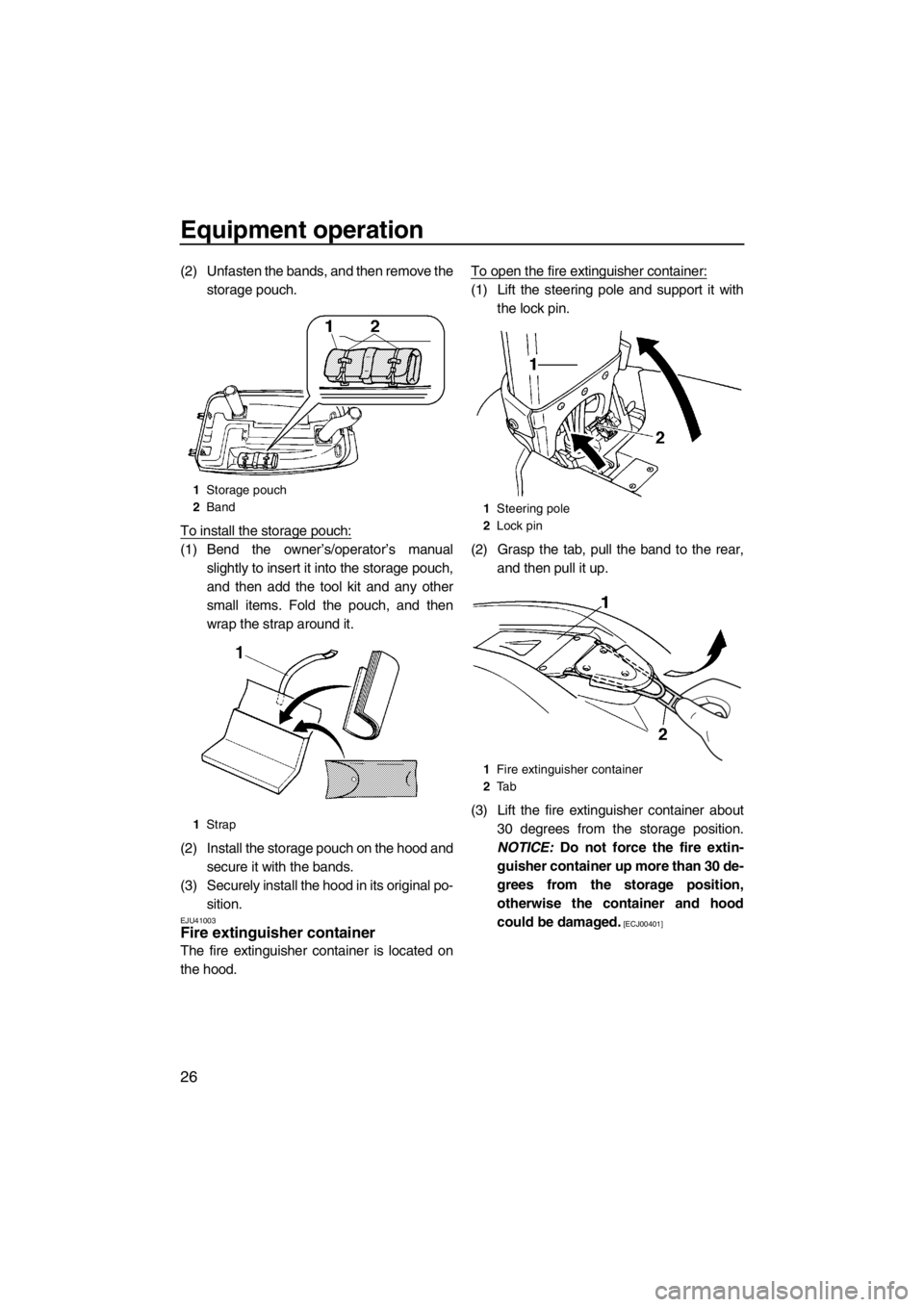
(2) Unfasten the bands, and then remove thestorage pouch.
To install the storage pouch:
(1) Bend the owner’s/operator’s manual slightly to insert it into the storage pouch,
and then add the tool kit and any other
small items. Fold the pouch, and then
wrap the strap around it.
(2) Install the storage pouch on the hood and secure it with the bands.
(3) Securely install the hood in its original po- sition.
EJU41003Fire extinguisher container
The fire extinguisher container is located on
the hood. To open the fire extinguisher container:
(1) Lift the steering pole and support it with
the lock pin.
(2) Grasp the tab, pull the band to the rear, and then pull it up.
(3) Lift the fire extinguisher container about 30 degrees from the storage position.
NOTICE: Do not force the fire extin-
guisher container up more than 30 de-
grees from the storage position,
otherwise the container and hood
could be damaged.
[ECJ00401]
1 Storage pouch
2 Band
1 Strap
1Steering pole
2 Lock pin
1 Fire extinguisher container
2 Ta b
UF2F75E0.book Page 26 Thursday, July 5, 2012 8:50 AM
Page 33 of 78
Equipment operation
27
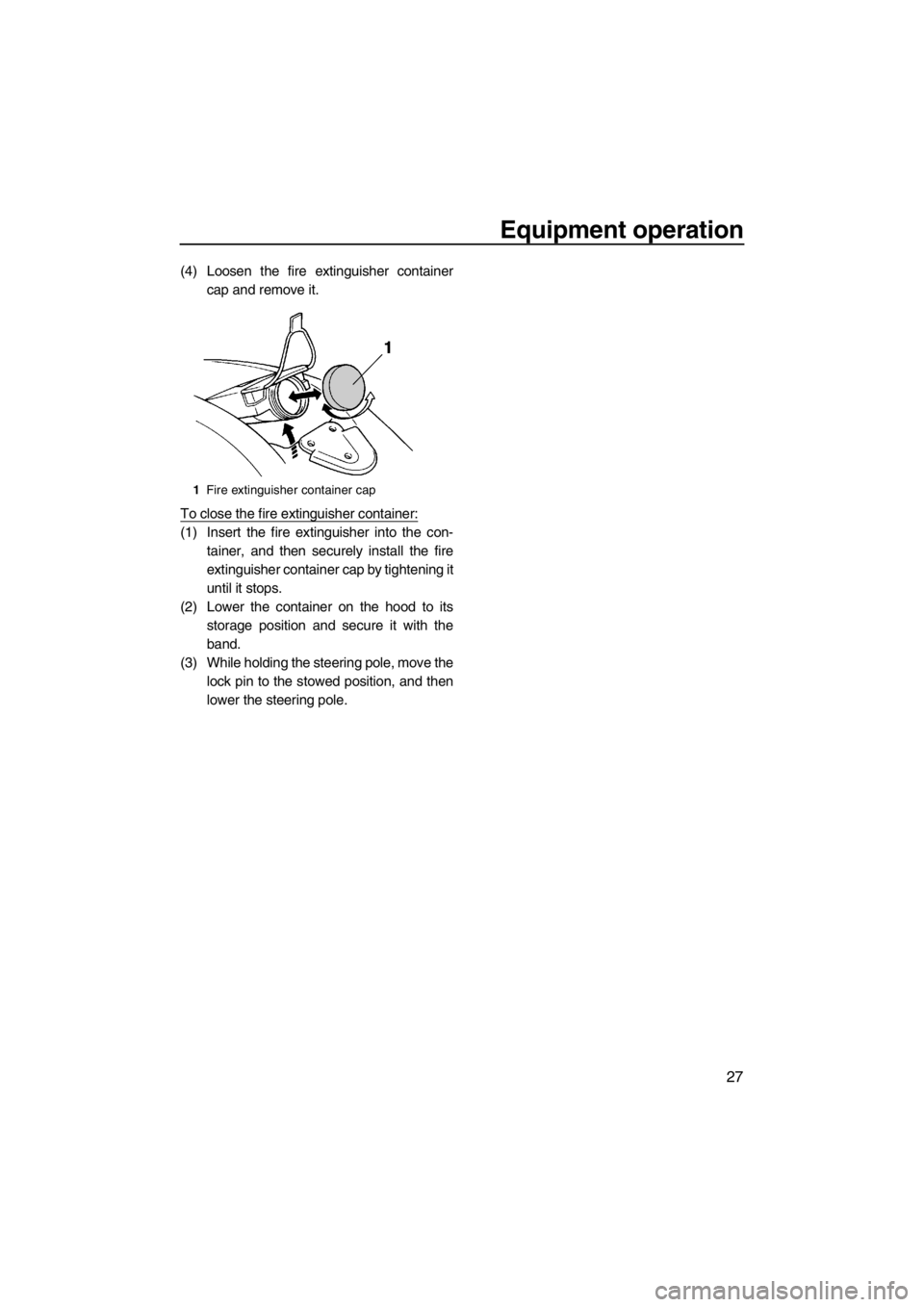
(4) Loosen the fire extinguisher containercap and remove it.
To close the fire extinguisher container:
(1) Insert the fire extinguisher into the con- tainer, and then securely install the fire
extinguisher container cap by tightening it
until it stops.
(2) Lower the container on the hood to its storage position and secure it with the
band.
(3) While holding the steering pole, move the lock pin to the stowed position, and then
lower the steering pole.
1Fire extinguisher container cap
UF2F75E0.book Page 27 Thursday, July 5, 2012 8:50 AM
Page 46 of 78
Operation
40
EJU32902
Operating your watercraft
WARNING
EWJ00510
Before operating your watercraft, become
familiar with all of the controls. Consult a
Yamaha dealer about any control or func- tion that you do not fully understand. Fail-
ure to understand how the controls work
could cause an accident or prevent you
from avoiding an accident.
EJU32923Getting to know your watercraft
Operating your watercraft requires skills ac-
quired through practice over a period of time.
Take the time to learn the basic techniques
well before attempting more difficult maneu-
vers.
Operating your new watercraft can be a very
enjoyable activity, providing you with hours of
pleasure. However, it is essential to familiar-
ize yourself with the operation of the water-
craft to achieve the skill level necessary to
enjoy riding safely.
Before operating this watercraft, read this
owner’s/operator’s manual, the Riding Prac-
tice Guide, the Riding Instruction card, and all
labels on the watercraft. Pay particular atten-
tion to the safety information beginning on
page 8. These materials should give you an
understanding of the watercraft and its opera-
tion.
Remember: This watercraft is designed to
carry the operator only. Never have more than
one person on the watercraft at any time.
EJU32984Learning to operate your watercraft
Before operating the watercraft, always per-
form the pre-operation checks listed on page
33. The short time spent checking the water-
craft will reward you with added safety and re-
liability. Check local laws before operating your water-
craft.
Operate defensively at safe speeds and keep
a safe distance away from people, objects,
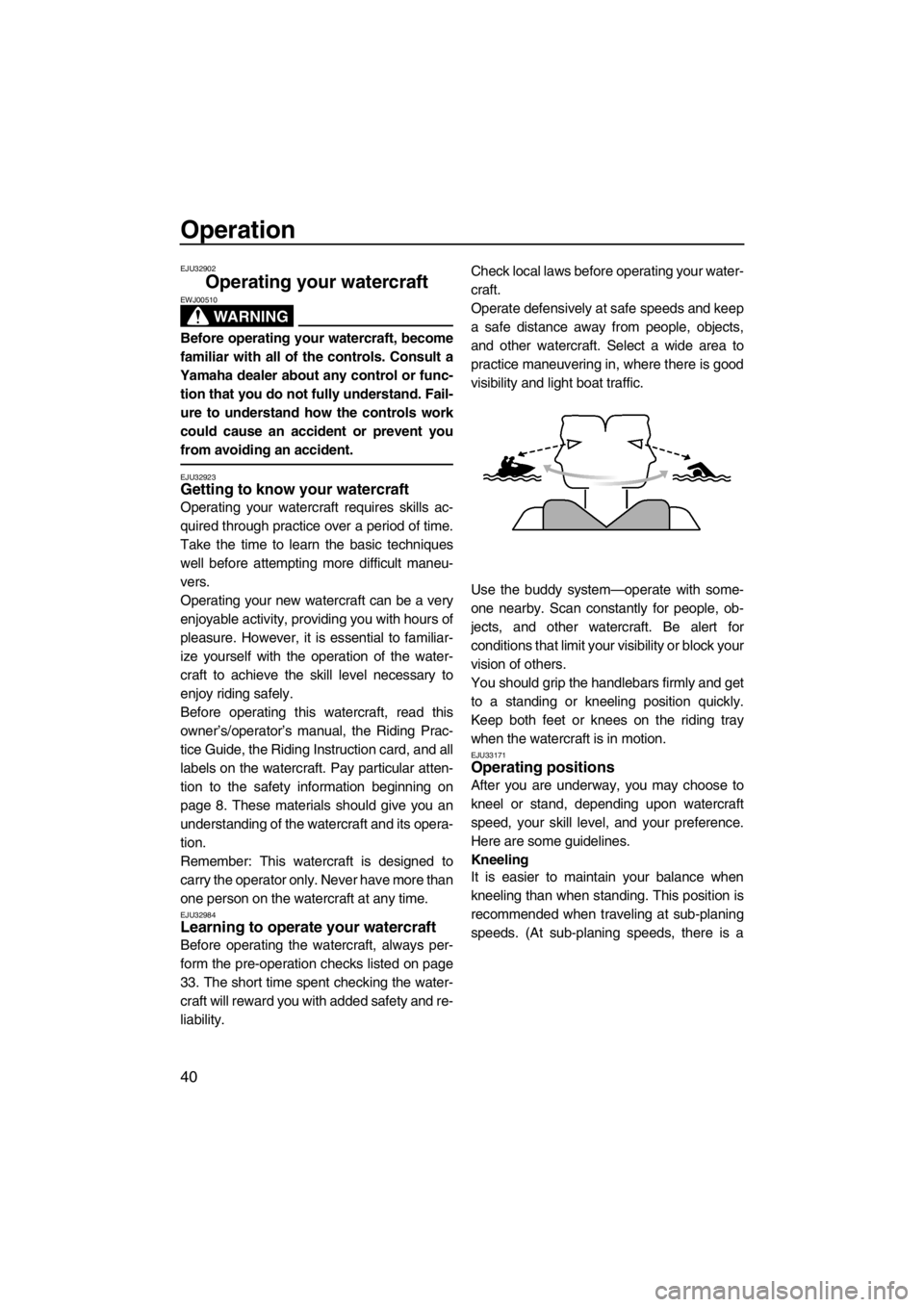
and other watercraft. Select a wide area to
practice maneuvering in, where there is good
visibility and light boat traffic.
Use the buddy system—operate with some-
one nearby. Scan constantly for people, ob-
jects, and other watercraft. Be alert for
conditions that limit your visibility or block your
vision of others.
You should grip the handlebars firmly and get
to a standing or kneeling position quickly.
Keep both feet or knees on the riding tray
when the watercraft is in motion.
EJU33171Operating positions
After you are underway, you may choose to
kneel or stand, depending upon watercraft
speed, your skill level,
and your preference.
Here are some guidelines.
Kneeling
It is easier to maintain your balance when
kneeling than when standing. This position is
recommended when traveling at sub-planing
speeds. (At sub-planing speeds, there is a
UF2F75E0.book Page 40 Thursday, July 5, 2012 8:50 AM
Page 51 of 78
Operation
45
general, the higher the speed or the sharper
the turn, the more you lean.
EJU33272Stopping the watercraft
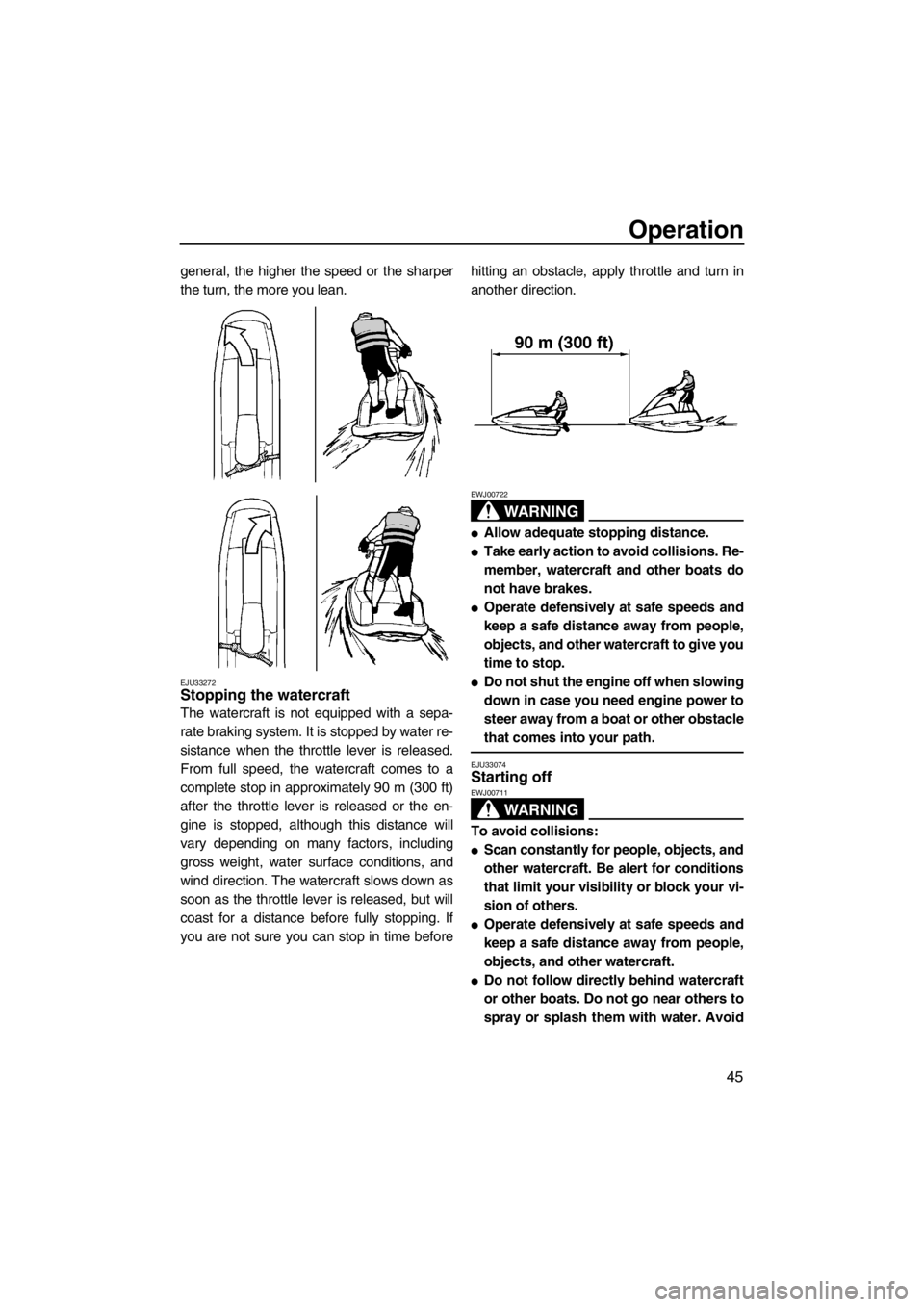
The watercraft is not equipped with a sepa-
rate braking system. It is stopped by water re-
sistance when the throttle lever is released.
From full speed, the watercraft comes to a
complete stop in approximately 90 m (300 ft)
after the throttle lever is released or the en-
gine is stopped, although this distance will
vary depending on many factors, including
gross weight, water surface conditions, and
wind direction. The watercraft slows down as
soon as the throttle lever is released, but will
coast for a distance before fully stopping. If
you are not sure you can stop in time beforehitting an obstacle, apply throttle and turn in
another direction.
WARNING
EWJ00722
●Allow adequate stopping distance.
●Take early action to avoid collisions. Re-
member, watercraft and other boats do
not have brakes.
●Operate defensively at safe speeds and
keep a safe distance away from people,
objects, and other watercraft to give you
time to stop.
●Do not shut the engine off when slowing
down in case you need engine power to
steer away from a boat or other obstacle
that comes into your path.
EJU33074Starting off
WARNING
EWJ00711
To avoid collisions:
●Scan constantly for people, objects, and
other watercraft. Be alert for conditions
that limit your visibility or block your vi-
sion of others.
●Operate defensively at safe speeds and
keep a safe distance away from people,
objects, and other watercraft.
●Do not follow directly behind watercraft
or other boats. Do not go near others to
spray or splash them with water. Avoid
UF2F75E0.book Page 45 Thursday, July 5, 2012 8:50 AM
Page 54 of 78
Operation
48
(5) Bring your knees up onto the riding trayand change to a kneeling position as
soon as you can do so.
(6) Move as far forward as possible without interfering with the movement of the han-
dlebars. Keep your body perpendicular to
the water, with your weight forward and
low.
(7) Once the bow drops, and the watercraft has leveled out in the water and reached
planing speed, back off the throttle and
select your desired speed.
TIP:
●The watercraft will become easier to bal-
ance as the speed increases, because jet
thrust provides stability as well as direction-
al control.
●It will take longer for a heavy operator to
reach planing speed than it will for a light
operator.
EJU33204Capsized watercraft
WARNING
EWJ00671
Improper uprighting can cause injury.
●Be sure to shut the engine off by pulling
on the engine shut-off cord (lanyard) to
remove the clip from the engine shut-off
switch.
●Do not put your hands in the intake
grate.
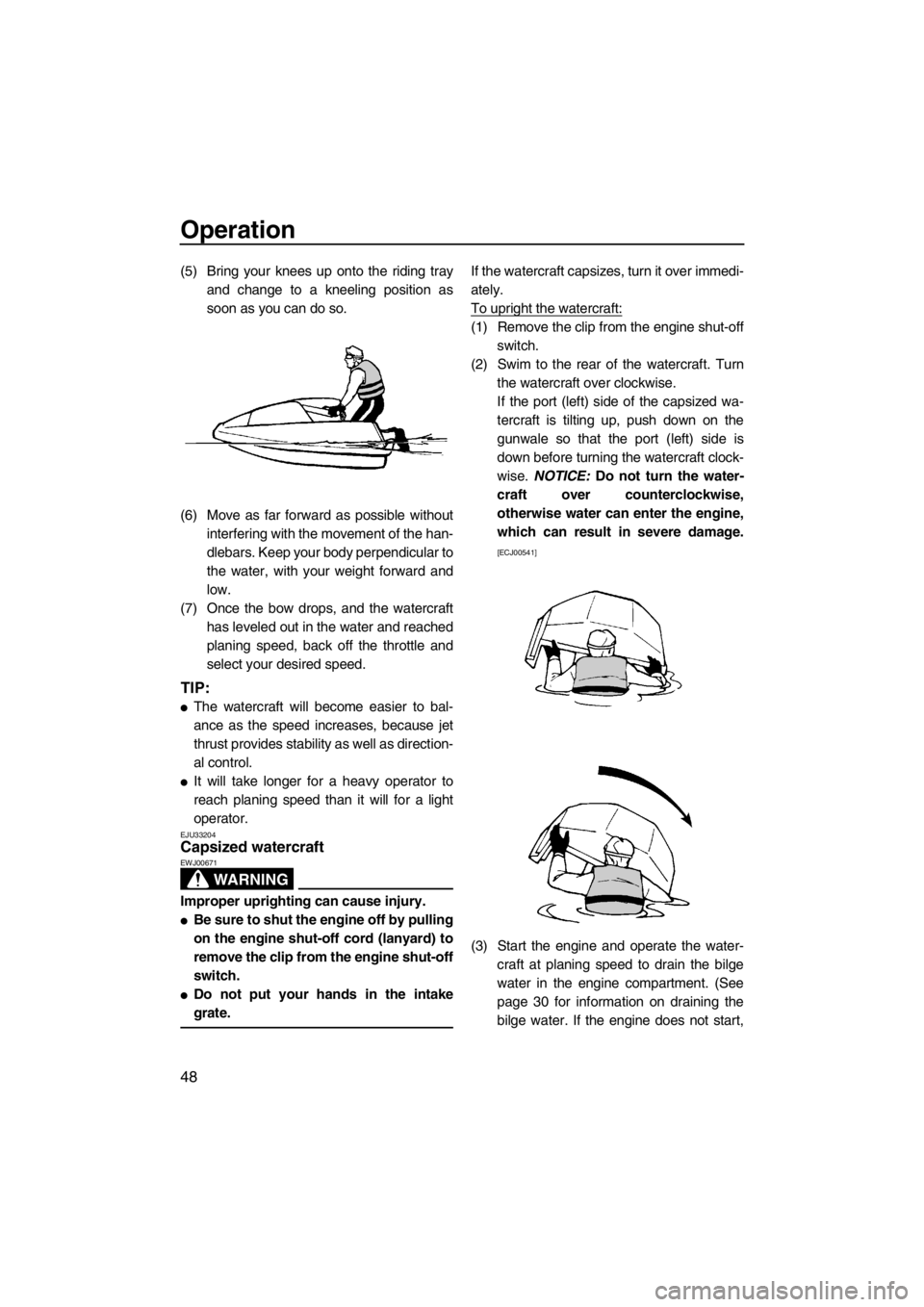
If the watercraft capsizes, turn it over immedi-
ately.
To upright the watercraft:
(1) Remove the clip from the engine shut-offswitch.
(2) Swim to the rear of the watercraft. Turn the watercraft over clockwise.
If the port (left) side of the capsized wa-
tercraft is tilting up, push down on the
gunwale so that the port (left) side is
down before turning the watercraft clock-
wise. NOTICE: Do not turn the water-
craft over counterclockwise,
otherwise water can enter the engine,
which can result in severe damage.
[ECJ00541]
(3) Start the engine and operate the water- craft at planing speed to drain the bilge
water in the engine compartment. (See
page 30 for information on draining the
bilge water. If the engine does not start,
UF2F75E0.book Page 48 Thursday, July 5, 2012 8:50 AM
Page 62 of 78
Maintenance
56
EJU33768
Maintenance
Periodic checks and lubrication will keep your
watercraft in the safest and most efficient con-
dition possible. Therefore, make sure to carry
out the periodic maintenance. Safety is an ob-
ligation of the watercraft owner. Proper main-
tenance must be carried out to keep the
exhaust emission and sound levels within the
regulated limits. The most important points of
watercraft inspection and lubrication are ex-
plained on the following pages.
See a Yamaha dealer for genuine Yamaha re-
placement parts and optional accessories de-
signed for your watercraft.
Remember, failures that are the result of the
installation of parts or accessories which are
not qualitatively equivalent to genuine
Yamaha parts are not covered by the limited warranty.
Maintenance, replacement, or repair of the
emission control devices and system may
be performed by any marine SI engine re-
pair establishment or individual. Warranty
repair, however, must be performed at an
authorized Yamaha marine dealership.
WARNING
EWJ00311
Be sure to turn off the engine when you
perform maintenance unless otherwise
specified. If you are not familiar with ma-
chine servicing, this work should be done
by a Yamaha dealer or other qualified me-
chanic.
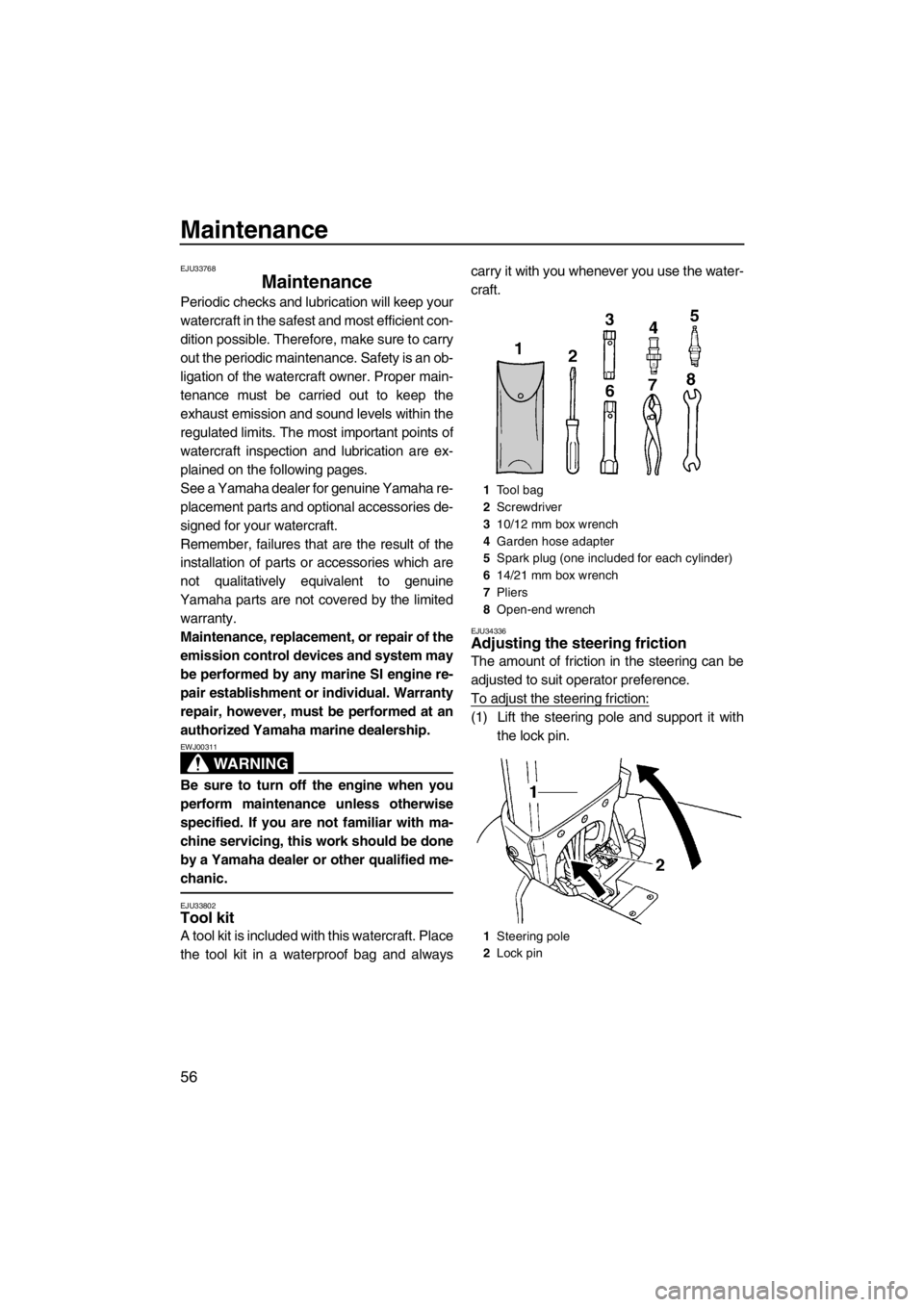
EJU33802Tool kit
A tool kit is included with this watercraft. Place
the tool kit in a waterproof bag and always carry it with you whenever you use the water-
craft.
EJU34336Adjusting the steering friction
The amount of friction in the steering can be
adjusted to suit operator preference.
To adjust the steering friction:
(1) Lift the steering pole and support it with
the lock pin.
1Tool bag
2 Screwdriver
3 10/12 mm box wrench
4 Garden hose adapter
5 Spark plug (one included for each cylinder)
6 14/21 mm box wrench
7 Pliers
8 Open-end wrench
1 Steering pole
2 Lock pin
UF2F75E0.book Page 56 Thursday, July 5, 2012 8:50 AM
Page 63 of 78
Maintenance
57
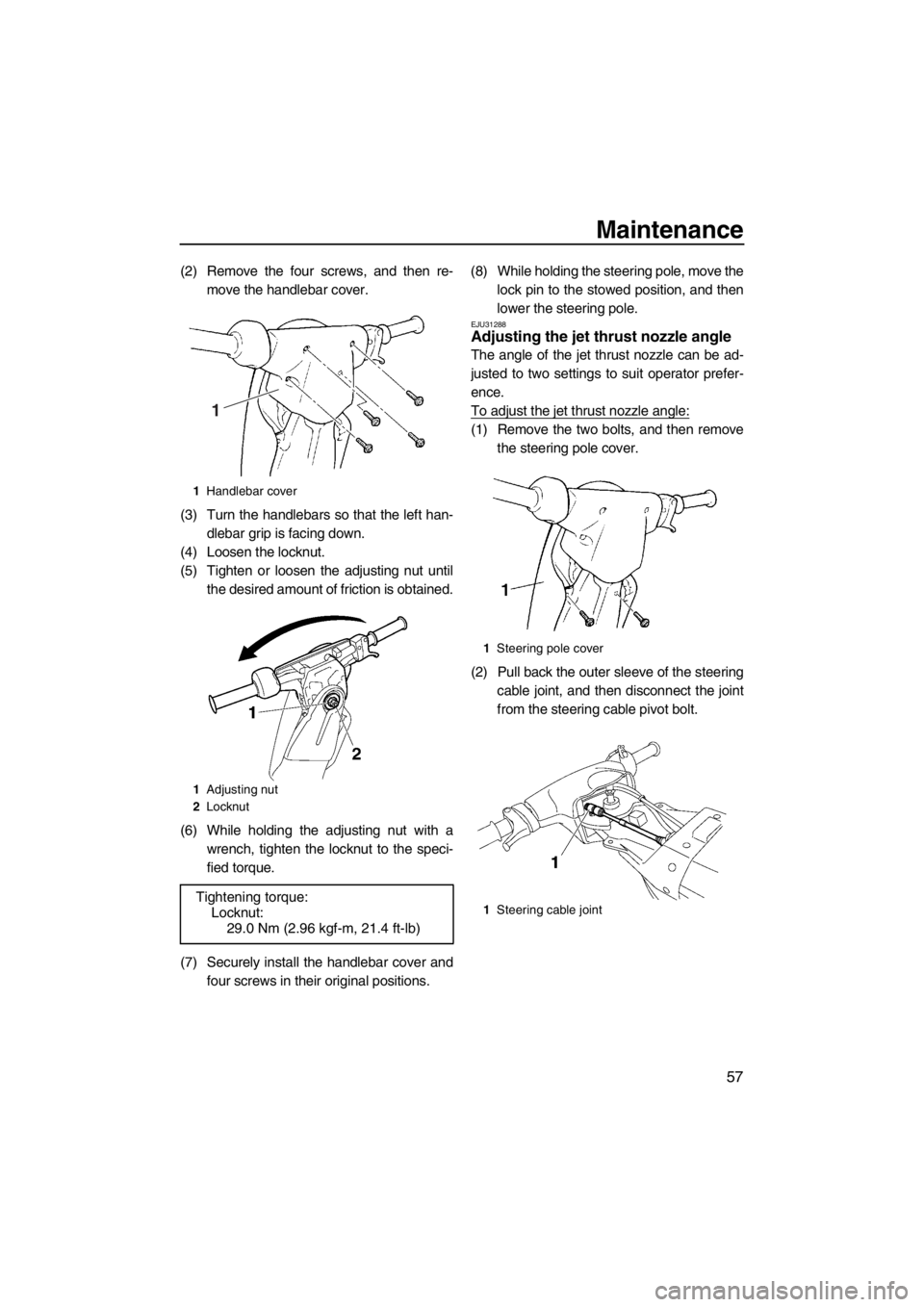
(2) Remove the four screws, and then re-move the handlebar cover.
(3) Turn the handlebars so that the left han- dlebar grip is facing down.
(4) Loosen the locknut.
(5) Tighten or loosen the adjusting nut until the desired amount of friction is obtained.
(6) While holding the adjusting nut with a wrench, tighten the locknut to the speci-
fied torque.
(7) Securely install the handlebar cover and four screws in their original positions. (8) While holding the steering pole, move the
lock pin to the stowed position, and then
lower the steering pole.
EJU31288Adjusting the jet thrust nozzle angle
The angle of the jet thrust nozzle can be ad-
justed to two settings to suit operator prefer-
ence.
To adjust the jet thrust nozzle angle:
(1) Remove the two bolts, and then removethe steering pole cover.
(2) Pull back the outer sleeve of the steering cable joint, and then disconnect the joint
from the steering cable pivot bolt.
1Handlebar cover
1 Adjusting nut
2 Locknut
Tightening torque:
Locknut:29.0 Nm (2.96 kgf-m, 21.4 ft-lb)
1
1Steering pole cover
1 Steering cable joint
UF2F75E0.book Page 57 Thursday, July 5, 2012 8:50 AM