engine YAMAHA TDM 900 2003 User Guide
[x] Cancel search | Manufacturer: YAMAHA, Model Year: 2003, Model line: TDM 900, Model: YAMAHA TDM 900 2003Pages: 110, PDF Size: 7.38 MB
Page 25 of 110
3-11
INSTRUMENT AND CONTROL FUNCTIONS
32. Turn the key counterclockwise to
the original position, remove it,
and then close the lock cover.
NOTE:
The fuel tank cap cannot be closed
unless the key is in the lock. In addi-
tion, the key cannot be removed if the
cap is not properly closed and
locked.
EWA00025
w
Make sure that the fuel tank cap is
properly closed before riding.
EAU03753
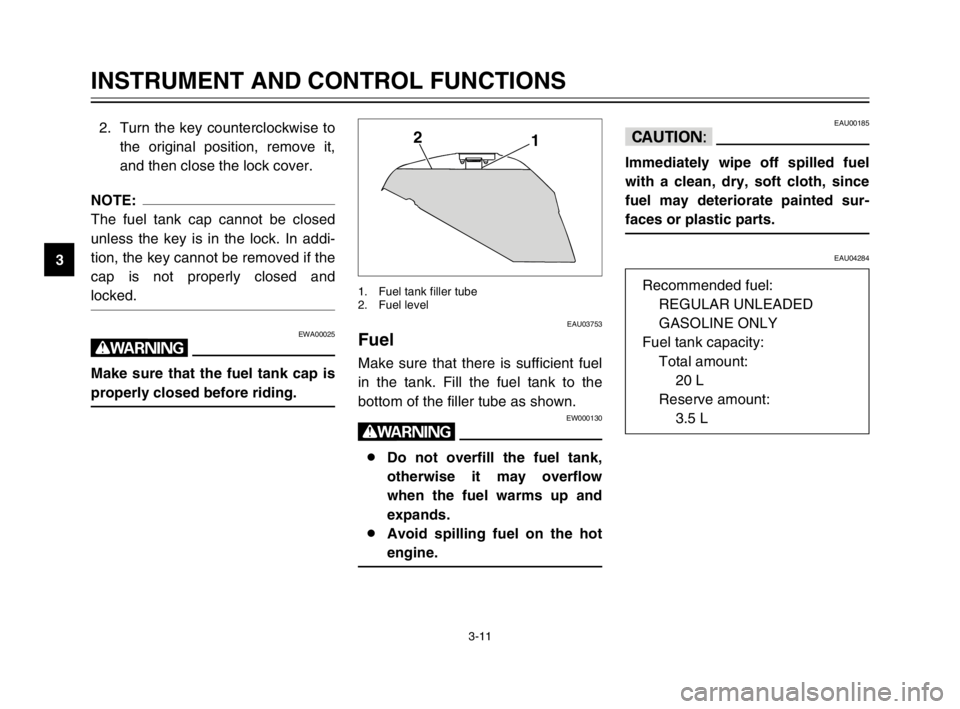
FuelFuelMake sure that there is sufficient fuel
in the tank. Fill the fuel tank to the
bottom of the filler tube as shown.
EW000130
w
8Do not overfill the fuel tank,
otherwise it may overflow
when the fuel warms up and
expands.
8Avoid spilling fuel on the hot
engine.
1 2
1. Fuel tank filler tube
2. Fuel level
EAU00185
cC
Immediately wipe off spilled fuel
with a clean, dry, soft cloth, since
fuel may deteriorate painted sur-
faces or plastic parts.
EAU04284
Recommended fuel:
REGULAR UNLEADED
GASOLINE ONLY
Fuel tank capacity:
Total amount:
20 L
Reserve amount:
3.5 L
5PS-28199-E1 8/29/02 9:16 AM Page 24
Page 26 of 110
3-12
INSTRUMENT AND CONTROL FUNCTIONS
3
ECA00104
cC
Use only unleaded gasoline. The
use of leaded gasoline will cause
severe damage to internal engine
parts, such as the valves and pis-
ton rings, as well as to the exhaust
system.
Your Yamaha engine has been
designed to use regular unleaded
gasoline with a research octane num-
ber of 91 or higher. If knocking (or
pinging) occurs, use a gasoline of a
different brand or premium unleaded
fuel. Use of unleaded fuel will extend
spark plug life and reduce mainte-
nance costs.EAU02955
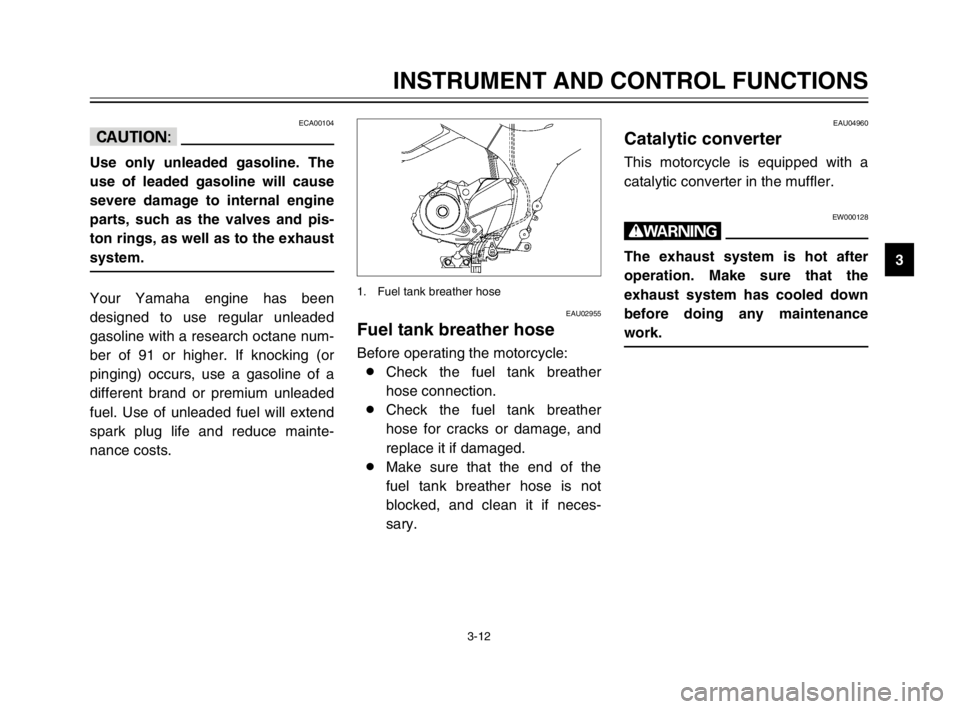
Fuel tank breather hoseFuel tank breather hoseBefore operating the motorcycle:
8Check the fuel tank breather
hose connection.
8Check the fuel tank breather
hose for cracks or damage, and
replace it if damaged.
8Make sure that the end of the
fuel tank breather hose is not
blocked, and clean it if neces-
sary.
1. Fuel tank breather hose
EAU04960
Catalytic converterCatalytic converterThis motorcycle is equipped with a
catalytic converter in the muffler.
EW000128
w
The exhaust system is hot after
operation. Make sure that the
exhaust system has cooled down
before doing any maintenance
work.
5PS-28199-E1 8/29/02 9:16 AM Page 25
Page 27 of 110
3-13
INSTRUMENT AND CONTROL FUNCTIONS
3
EC000114
cC
The following precautions must be
observed to prevent a fire hazard
or other damages.
8Use only unleaded gasoline.
The use of leaded gasoline will
cause unrepairable damage to
the catalytic converter.
8Never park the motorcycle
near possible fire hazards
such as grass or other materi-
als that easily burn.
8Do not allow the engine to idle
too long.
EAU02925
Seat
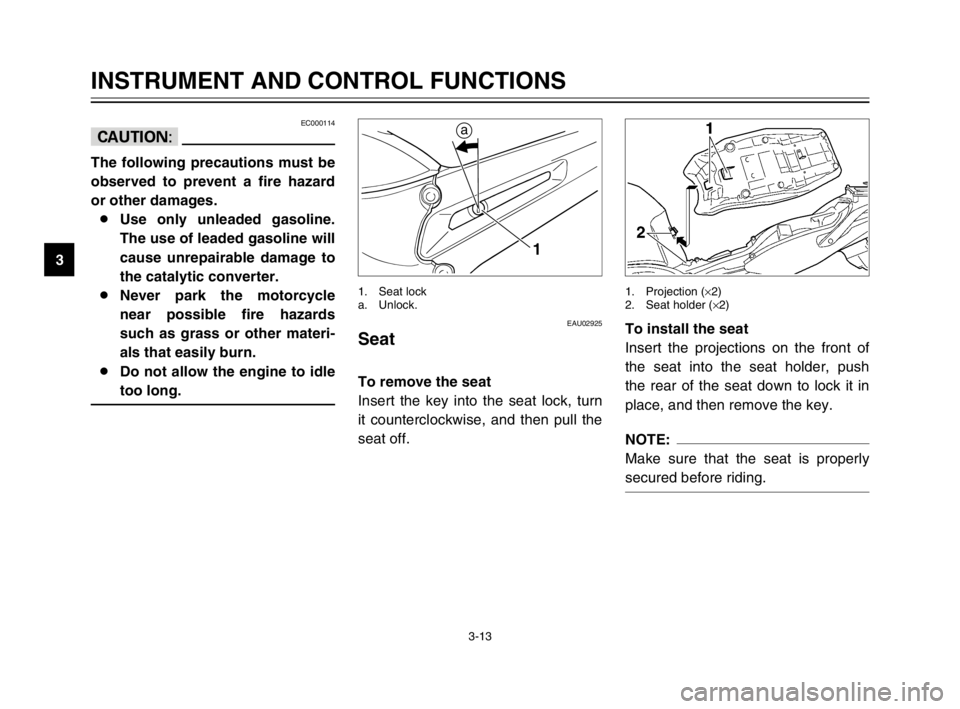
SeatTo remove the seat
Insert the key into the seat lock, turn
it counterclockwise, and then pull the
seat off.
1 a
1. Seat lock
a. Unlock.
To install the seat
Insert the projections on the front of
the seat into the seat holder, push
the rear of the seat down to lock it in
place, and then remove the key.
NOTE:
Make sure that the seat is properly
secured before riding.
1. Projection (×2)
2. Seat holder (×2)
5PS-28199-E1 8/29/02 9:16 AM Page 26
Page 33 of 110

3-19
INSTRUMENT AND CONTROL FUNCTIONS
3
EW000044
w
The motorcycle must not be ridden
with the sidestand down, or if the
sidestand cannot be properly
moved up (or does not stay up),
otherwise the sidestand could con-
tact the ground and distract the
operator, resulting in a possible
loss of control. Yamaha’s ignition
circuit cut-off system has been
designed to assist the operator in
fulfilling the responsibility of rais-
ing the sidestand before starting
off. Therefore, check this system
regularly as described below and
have a Yamaha dealer repair it if it
does not function properly.
EAU03720
Ignition circuit cut-off
system
Ignition circuit cut-off systemThe ignition circuit cut-off system
(comprising the sidestand switch,
clutch switch and neutral switch) has
the following functions.
8It prevents starting when the
transmission is in gear and the
sidestand is up, but the clutch
lever is not pulled.
8It prevents starting when the
transmission is in gear and the
clutch lever is pulled, but the
sidestand is still down.
8It cuts the running engine when
the transmission is in gear and
the sidestand is moved down.
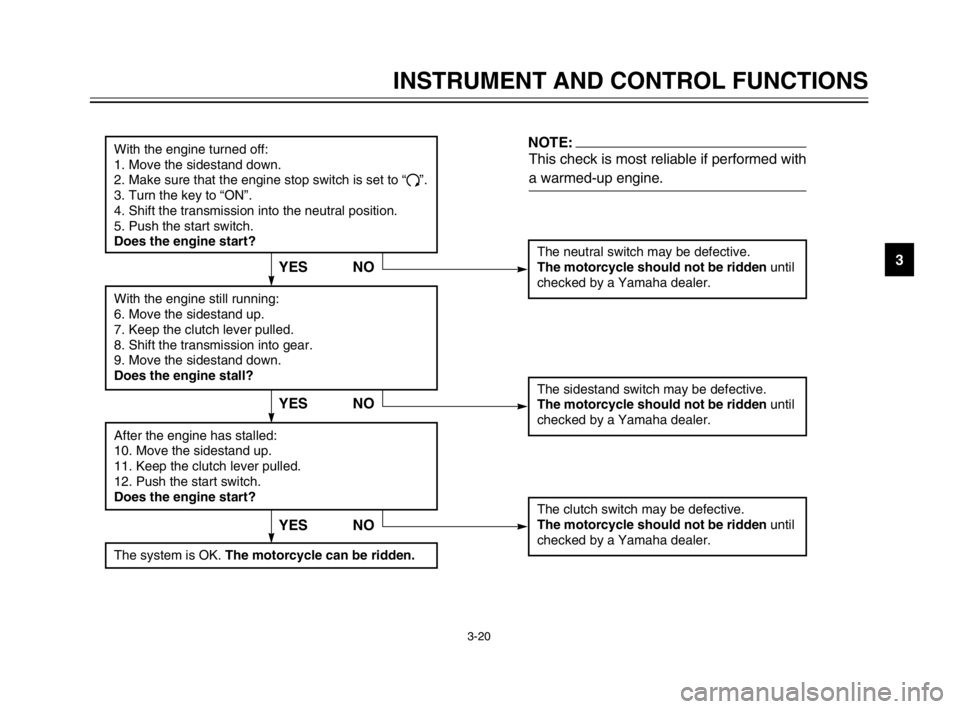
Periodically check the operation of
the ignition circuit cut-off system
according to the following procedure.
EW000045
w
If a malfunction is noted, have a
Yamaha dealer check the system
before riding.
5PS-28199-E1 8/29/02 9:16 AM Page 32
Page 34 of 110
3-20
INSTRUMENT AND CONTROL FUNCTIONS
3
With the engine turned off:
1. Move the sidestand down.
2. Make sure that the engine stop switch is set to “
#”.
3. Turn the key to “ON”.
4. Shift the transmission into the neutral position.
5. Push the start switch.
Does the engine start?
The neutral switch may be defective.
The motorcycle should not be ridden until
checked by a Yamaha dealer.
With the engine still running:
6. Move the sidestand up.
7. Keep the clutch lever pulled.
8. Shift the transmission into gear.
9. Move the sidestand down.
Does the engine stall?
After the engine has stalled:
10. Move the sidestand up.
11. Keep the clutch lever pulled.
12. Push the start switch.
Does the engine start?
The sidestand switch may be defective.
The motorcycle should not be ridden until
checked by a Yamaha dealer.
The clutch switch may be defective.
The motorcycle should not be ridden until
checked by a Yamaha dealer.
NO
NOTE:
This check is most reliable if performed with
a warmed-up engine.
YES
YES NO
The system is OK. The motorcycle can be ridden.
YES NO
5PS-28199-E1 8/29/02 9:16 AM Page 33
Page 37 of 110

4-1
EAU01114
PRE-OPERATION CHECKS
4The condition of a vehicle is the owner’s responsibility. Vital components can start to deteriorate quickly and unexpect-
edly, even if the vehicle remains unused (for example, as a result of exposure to the elements). Any damage, fluid leak-
age or loss of tire air pressure could have serious consequences. Therefore, it is very important, in addition to a thor-
ough visual inspection, to check the following points before each ride.
EAU03439
Pre-operation check listPre-operation check list
ITEM CHECKS PAGE
Fuel•Check fuel level in fuel tank.
•Refuel if necessary.
•Check fuel line for leakage.3-10–3-12
Engine oil•Check oil level in engine.
•If necessary, add recommended oil to specified level.
•Check vehicle for oil leakage.6-8–6-11
Coolant•Check coolant level in reservoir.
•If necessary, add recommended coolant to specified level.
•Check cooling system for leakage.6-11–6-15
Front brake•Check operation.
•If soft or spongy, have Yamaha dealer bleed hydraulic system.
•Check fluid level in reservoir.
•If necessary, add recommended brake fluid to specified level.
•Check hydraulic system for leakage.3-9–3-10, 6-24–6-26
Rear brake•Check operation.
•If soft or spongy, have Yamaha dealer bleed hydraulic system.
•Check fluid level in reservoir.
•If necessary, add recommended brake fluid to specified level.
•Check hydraulic system for leakage.3-10, 6-23–6-26
Clutch•Check operation.
•Lubricate cable if necessary.
•Check lever free play.
•Adjust if necessary.3-9, 6-22–6-23
5PS-28199-E1 8/29/02 9:16 AM Page 36
Page 40 of 110
OPERATION AND IMPORTANT RIDING POINTS
Starting the engine ............................................................................5-1
Shifting ...............................................................................................5-2
Recommended shift points (for Switzerland only) .............................5-3
Tips for reducing fuel consumption ....................................................5-3
Engine break-in .................................................................................5-3
Parking ..............................................................................................5-4
5
5PS-28199-E1 8/29/02 9:16 AM Page 39
Page 41 of 110
5-1
EAU00372
OPERATION AND IMPORTANT RIDING POINTS
5
EAU00373
w
8Become thoroughly familiar
with all operating controls and
their functions before riding.
Consult a Yamaha dealer
regarding any control or func-
tion that you do not thorough-
ly understand.
8Never start the engine or oper-
ate it in a closed area for any
length of time. Exhaust fumes
are poisonous, and inhaling
them can cause loss of con-
sciousness and death within a
short time. Always make sure
that there is adequate ventila-
tion.
8Before starting out, make sure
that the sidestand is up. If the
sidestand is not raised com-
pletely, it could contact the
ground and distract the opera-
tor, resulting in a possible loss
of control.
EAU03951
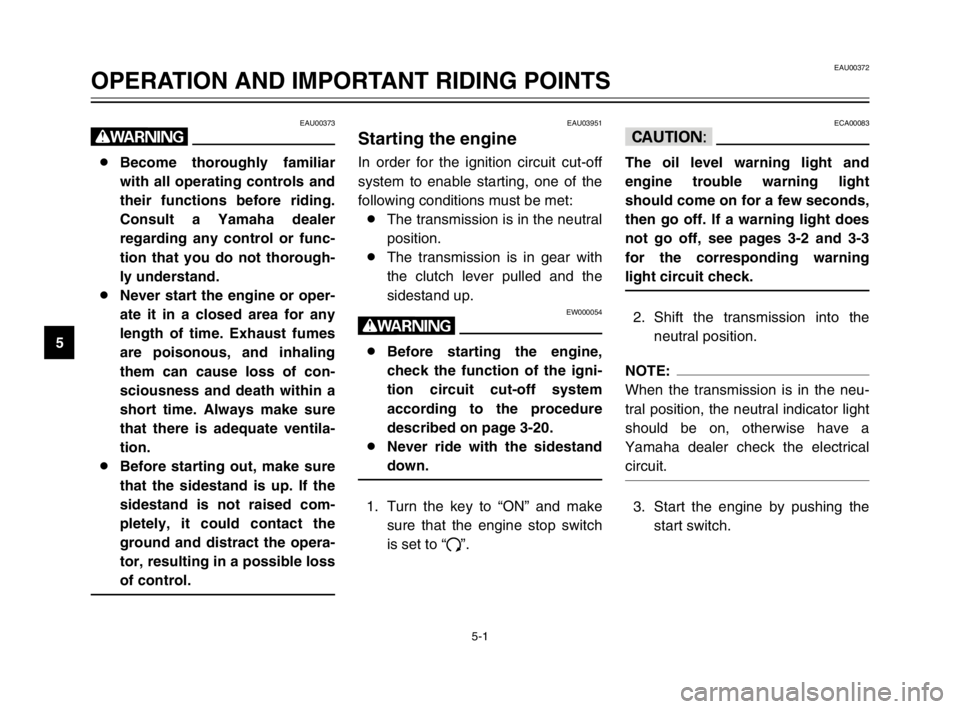
Starting the engineStarting the engineIn order for the ignition circuit cut-off
system to enable starting, one of the
following conditions must be met:
8The transmission is in the neutral
position.
8The transmission is in gear with
the clutch lever pulled and the
sidestand up.
EW000054
w
8Before starting the engine,
check the function of the igni-
tion circuit cut-off system
according to the procedure
described on page 3-20.
8Never ride with the sidestand
down.
1. Turn the key to “ON” and make
sure that the engine stop switch
is set to “#”.
ECA00083
cC
The oil level warning light and
engine trouble warning light
should come on for a few seconds,
then go off. If a warning light does
not go off, see pages 3-2 and 3-3
for the corresponding warning
light circuit check.
2. Shift the transmission into the
neutral position.
NOTE:
When the transmission is in the neu-
tral position, the neutral indicator light
should be on, otherwise have a
Yamaha dealer check the electrical
circuit.
3. Start the engine by pushing the
start switch.
5PS-28199-E1 8/29/02 9:16 AM Page 40
Page 42 of 110

5-2
OPERATION AND IMPORTANT RIDING POINTS
5
NOTE:
If the engine fails to start, release the
start switch, wait a few seconds, and
then try again. Each starting attempt
should be as short as possible to pre-
serve the battery. Do not crank the
engine more than 10 seconds on any
one attempt.
ECA00045
cC
For maximum engine life, never
accelerate hard when the engine is
cold!
NOTE:
The engine is warm when it quickly
responds to the throttle.
EC000048
cC
8Even with the transmission in
the neutral position, do not
coast for long periods of time
with the engine off, and do not
tow the motorcycle for long
distances. The transmission is
properly lubricated only when
the engine is running.
Inadequate lubrication may
damage the transmission.
8Always use the clutch while
changing gears to avoid dam-
aging the engine, transmis-
sion, and drive train, which are
not designed to withstand the
shock of forced shifting.
EAU00423
ShiftingShiftingShifting gears lets you control the
amount of engine power available for
starting off, accelerating, climbing
hills, etc.
The gear positions are shown in the
illustration.
NOTE:
To shift the transmission into the neu-
tral position, press the shift pedal
down repeatedly until it reaches the
end of its travel, and then slightly
raise it.
1. Shift pedal
N. Neutral position
5PS-28199-E1 8/29/02 9:16 AM Page 41
Page 43 of 110

5-3
OPERATION AND IMPORTANT RIDING POINTS
5
EAU02937
Recommended shift points
(for Switzerland only)
Shift points (for Switzerland only)The recommended shift points during
acceleration are shown in the table
below.
NOTE:
When shifting down two gears at a
time, reduce the speed accordingly
(e.g., down to 35 km/h when shifting
from 5th to 3rd gear).
EAU04754
Tips for reducing fuel
consumption
Fuel consumption, tips for reducingFuel consumption depends largely on
your riding style. Consider the follow-
ing tips to reduce fuel consumption:
8Shift up swiftly, and avoid high
engine speeds during accelera-
tion.
8Do not rev the engine while shift-
ing down, and avoid high engine
speeds with no load on the
engine.
8Turn the engine off instead of let-
ting it idle for an extended length
of time (e.g., in traffic jams, at
traffic lights or at railroad cross-
ings).
EAU01128
Engine break-inEngine break-inThere is never a more important peri-
od in the life of your engine than the
period between 0 and 1,600 km. For
this reason, you should read the fol-
lowing material carefully.
Since the engine is brand new, do
not put an excessive load on it for the
first 1,600 km. The various parts in
the engine wear and polish them-
selves to the correct operating clear-
ances. During this period, prolonged
full-throttle operation or any condition
that might result in engine overheat-
ing must be avoided.
Shift point
(km/h)
1st→2nd
2nd→3rd
3rd→4th
4th→5th
5th→6th20
30
40
50
60
5PS-28199-E1 8/29/02 9:16 AM Page 42