engine YAMAHA TDM 900 2003 Owner's Manual
[x] Cancel search | Manufacturer: YAMAHA, Model Year: 2003, Model line: TDM 900, Model: YAMAHA TDM 900 2003Pages: 110, PDF Size: 7.38 MB
Page 44 of 110

5-4
OPERATION AND IMPORTANT RIDING POINTS
5
EAU04315
0–1,000 km
Avoid prolonged operation above
4,000 r/min.
1,000–1,600 km
Avoid prolonged operation above
6,000 r/min.
ECA00058
cC
After 1,000 km of operation, the
engine oil must be changed, and
the oil filter element replaced.
1,600 km and beyond
The vehicle can now be operated
normally.
EC000053
cC
8Keep the engine speed out of
the tachometer red zone.
8If any engine trouble should
occur during the engine break-
in period, immediately have a
Yamaha dealer check the vehi-
cle.
EAU00460
ParkingParkingWhen parking, stop the engine, and
then remove the key from the main
switch.
EW000058
w
8Since the engine and exhaust
system can become very hot,
park in a place where pedestri-
ans or children are not likely
to touch them.
8Do not park on a slope or on
soft ground, otherwise the
motorcycle may overturn.
5PS-28199-E1 8/29/02 9:16 AM Page 43
Page 46 of 110
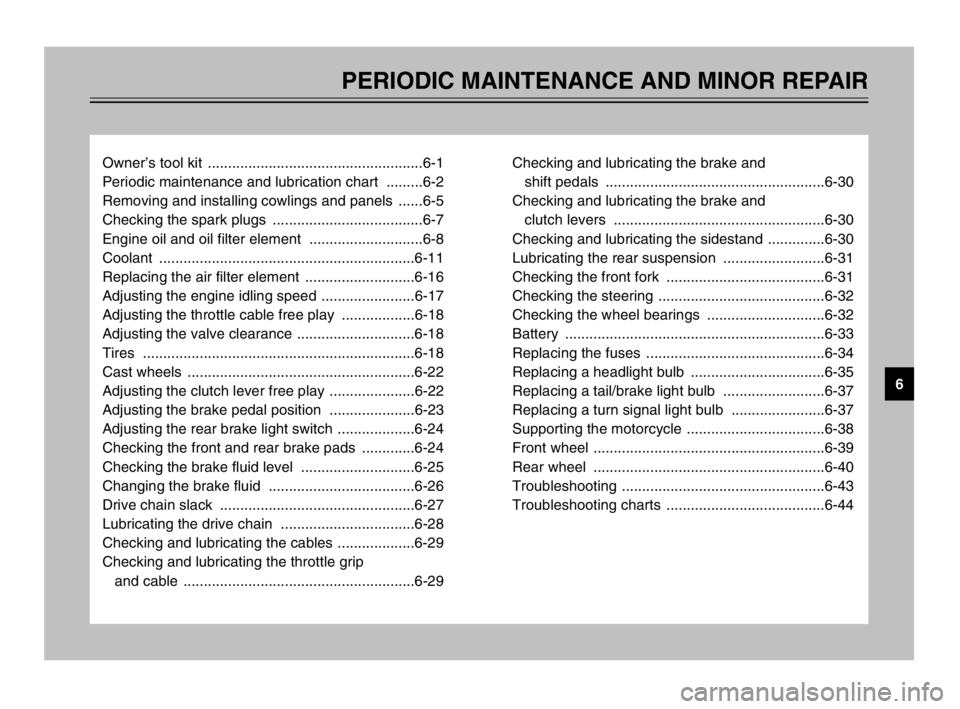
PERIODIC MAINTENANCE AND MINOR REPAIR
Owner’s tool kit .....................................................6-1
Periodic maintenance and lubrication chart .........6-2
Removing and installing cowlings and panels ......6-5
Checking the spark plugs .....................................6-7
Engine oil and oil filter element ............................6-8
Coolant ...............................................................6-11
Replacing the air filter element ...........................6-16
Adjusting the engine idling speed .......................6-17
Adjusting the throttle cable free play ..................6-18
Adjusting the valve clearance .............................6-18
Tires ...................................................................6-18
Cast wheels ........................................................6-22
Adjusting the clutch lever free play .....................6-22
Adjusting the brake pedal position .....................6-23
Adjusting the rear brake light switch ...................6-24
Checking the front and rear brake pads .............6-24
Checking the brake fluid level ............................6-25
Changing the brake fluid ....................................6-26
Drive chain slack ................................................6-27
Lubricating the drive chain .................................6-28
Checking and lubricating the cables ...................6-29
Checking and lubricating the throttle grip
and cable .........................................................6-29Checking and lubricating the brake and
shift pedals ......................................................6-30
Checking and lubricating the brake and
clutch levers ....................................................6-30
Checking and lubricating the sidestand ..............6-30
Lubricating the rear suspension .........................6-31
Checking the front fork .......................................6-31
Checking the steering .........................................6-32
Checking the wheel bearings .............................6-32
Battery ................................................................6-33
Replacing the fuses ............................................6-34
Replacing a headlight bulb .................................6-35
Replacing a tail/brake light bulb .........................6-37
Replacing a turn signal light bulb .......................6-37
Supporting the motorcycle ..................................6-38
Front wheel .........................................................6-39
Rear wheel .........................................................6-40
Troubleshooting ..................................................6-43
Troubleshooting charts .......................................6-44
6
5PS-28199-E1 8/29/02 9:16 AM Page 45
Page 49 of 110
6-3
PERIODIC MAINTENANCE AND MINOR REPAIR
6
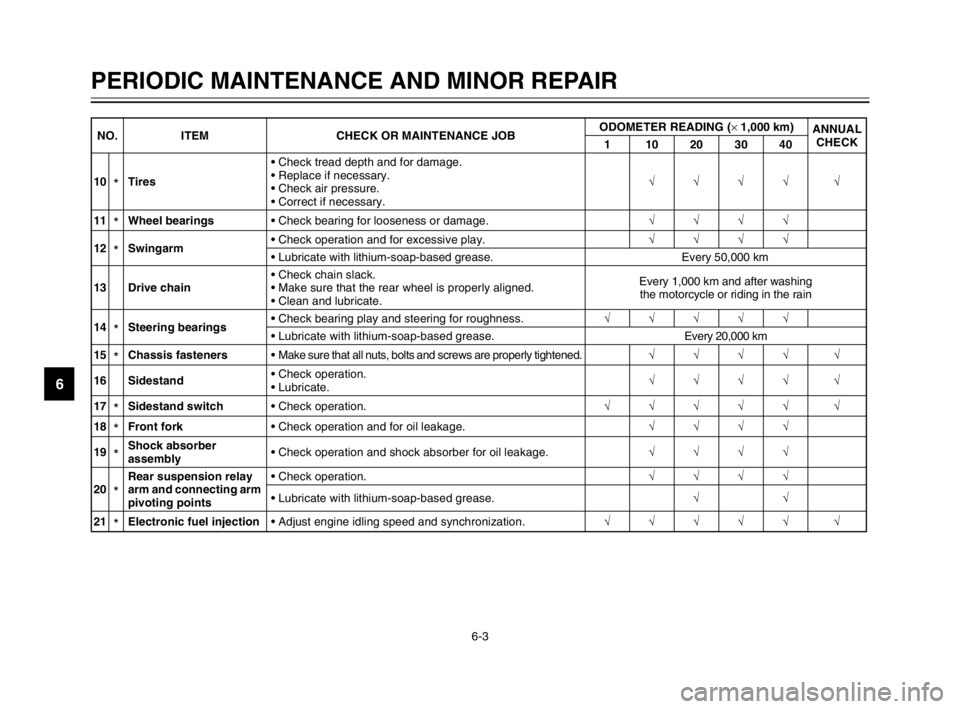
10*Tires•Check tread depth and for damage.
•Replace if necessary.
•Check air pressure.
•Correct if necessary.√√√√ √
11
*Wheel bearings•Check bearing for looseness or damage.√√√√
12
*Swingarm•Check operation and for excessive play.√√√√
•Lubricate with lithium-soap-based grease. Every 50,000 km
13 Drive chain•Check chain slack.
•Make sure that the rear wheel is properly aligned.
•Clean and lubricate.Every 1,000 km and after washing
the motorcycle or riding in the rain
14
*Steering bearings•Check bearing play and steering for roughness.√√√√√
•Lubricate with lithium-soap-based grease.Every 20,000 km
15
*Chassis fasteners•Make sure that all nuts, bolts and screws are properly tightened.√√√√ √
16 Sidestand•Check operation.
•Lubricate.√√√√ √
17
*Sidestand switch•Check operation.√√√√√ √
18
*Front fork•Check operation and for oil leakage.√√√√
19
*Shock absorber
assembly•Check operation and shock absorber for oil leakage.√√√√
20
*
Rear suspension relay
arm and connecting arm
pivoting points•Check operation.√√√√
•Lubricate with lithium-soap-based grease.√√
21
*Electronic fuel injection•Adjust engine idling speed and synchronization.√√√√√ √ NO. ITEM CHECK OR MAINTENANCE JOBODOMETER READING (× 1,000 km)
ANNUAL
CHECK
1 10203040
5PS-28199-E1 8/29/02 9:16 AM Page 48
Page 50 of 110

6-4
PERIODIC MAINTENANCE AND MINOR REPAIR
6
EAU03884
NOTE:
8The air filter needs more frequent service if you are riding in unusually wet or dusty areas.
8Hydraulic brake service
9Regularly check and, if necessary, correct the brake fluid level.
9Every two years replace the internal components of the brake master cylinders and calipers, and change the
brake fluid.
9Replace the brake hoses every four years and if cracked or damaged.
22 Engine oil•Change.
•Check oil level and vehicle for oil leakage.√√√√√ √
23 Engine oil filter element•Replace.√√√
24
*Cooling system•Check coolant level and vehicle for coolant leakage.√√√√ √
•Change.Every 3 years
25
*Front and rear brake
switches•Check operation.√√√√√ √
26 Moving parts and cables•Lubricate.√√√√ √
27
*Throttle grip housing
and cable•Check operation and free play.
•Adjust the throttle cable free play if necessary.
•Lubricate the throttle grip housing and cable.√√√√ √
28
*Air induction system•Check the air cut-off valve, reed valve, and hose for
damage.
•Replace the entire air induction system if necessary.√√√√ √
29
*Muffler and exhaust pipe•Check the screw clamp for looseness.√√√√√
30
*Lights, signals and
switches•Check operation.
•Adjust headlight beam.√√√√√ √ NO. ITEM CHECK OR MAINTENANCE JOBODOMETER READING (× 1,000 km)
ANNUAL
CHECK
1 10203040
5PS-28199-E1 8/29/02 9:16 AM Page 49
Page 53 of 110
6-7
PERIODIC MAINTENANCE AND MINOR REPAIR
6
EAU01880
Checking the spark plugsSpark plugs, checkingThe spark plugs are important engine
components, which should be
checked periodically, preferably by a
Yamaha dealer. Since heat and
deposits will cause any spark plug to
slowly erode, they should be
removed and checked in accordance
with the periodic maintenance and
lubrication chart. In addition, the con-
dition of the spark plugs can reveal
the condition of the engine.
The porcelain insulator around the
center electrode of each spark plug
should be a medium-to-light tan (the
ideal color when the motorcycle is rid-
den normally), and all spark plugs
installed in the engine should have
the same color. If any spark plug
shows a distinctly different color, the
engine could be defective. Do not
attempt to diagnose such problems
yourself. Instead, have a Yamaha
dealer check the motorcycle.Clean the surface of the spark plug
gasket and its mating surface, and
then wipe off any grime from the
spark plug threads.
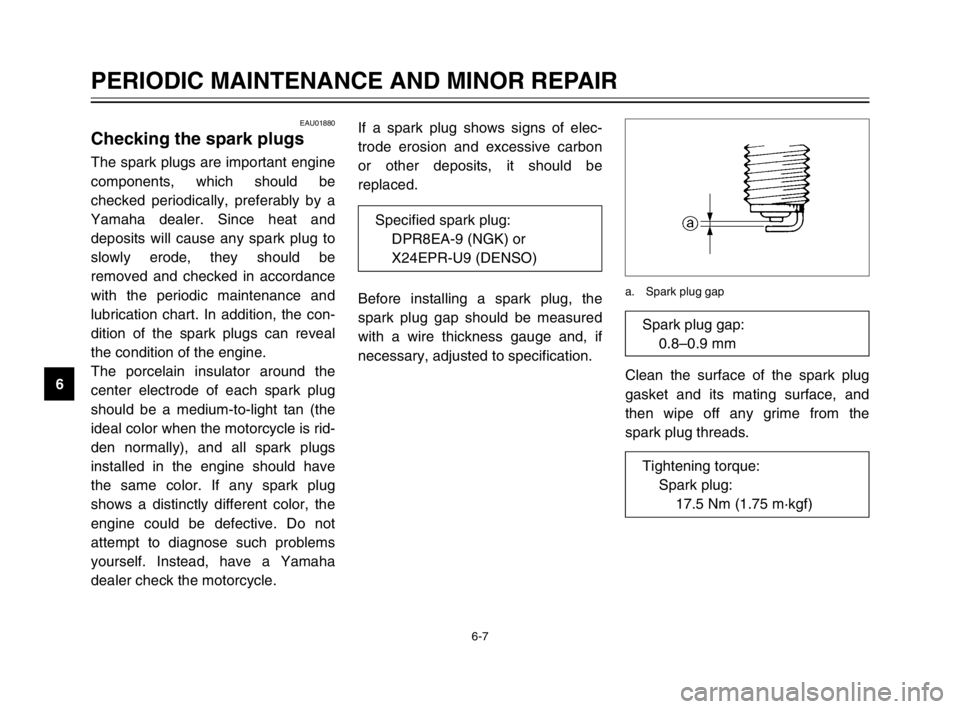
a. Spark plug gap
If a spark plug shows signs of elec-
trode erosion and excessive carbon
or other deposits, it should be
replaced.
Before installing a spark plug, the
spark plug gap should be measured
with a wire thickness gauge and, if
necessary, adjusted to specification.
Tightening torque:
Spark plug:
17.5 Nm (1.75 m·kgf)
Specified spark plug:
DPR8EA-9 (NGK) or
X24EPR-U9 (DENSO)
Spark plug gap:
0.8–0.9 mm
5PS-28199-E1 8/29/02 9:16 AM Page 52
Page 54 of 110
6-8
PERIODIC MAINTENANCE AND MINOR REPAIR
6
NOTE:
If a torque wrench is not available
when installing a spark plug, a good
estimate of the correct torque is
1/4–1/2 turn past finger tight.
However, the spark plug should be
tightened to the specified torque as
soon as possible.
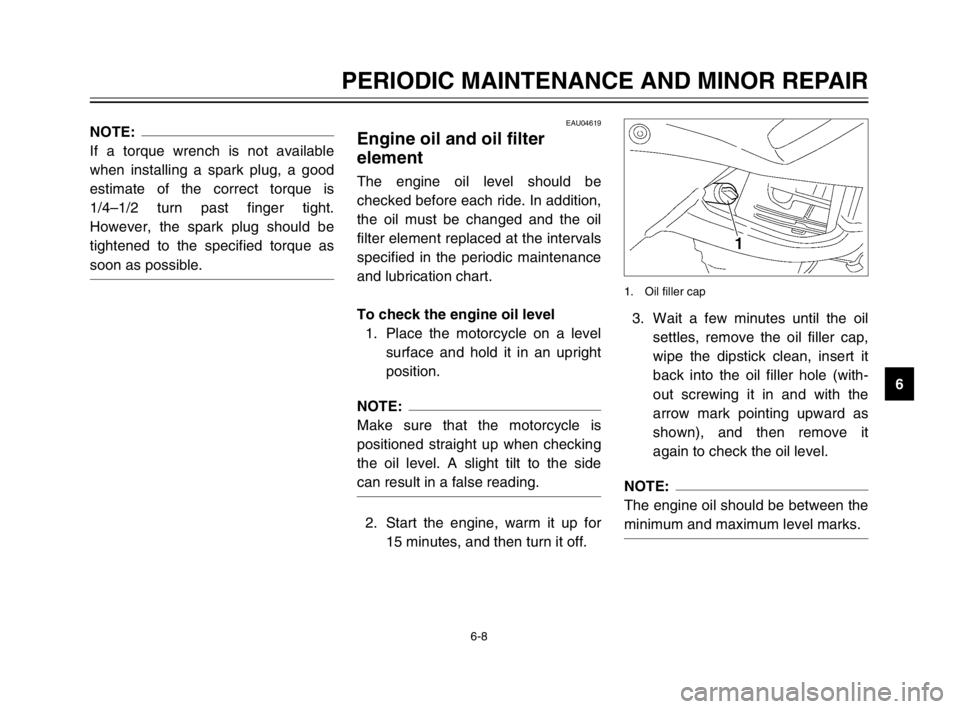
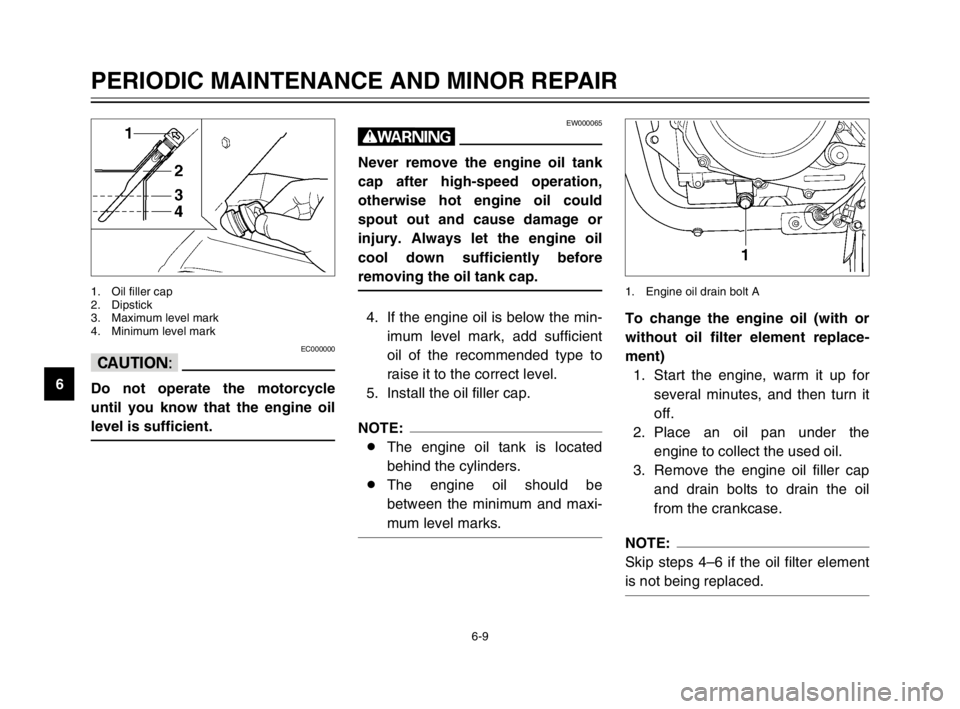
3. Wait a few minutes until the oil
settles, remove the oil filler cap,
wipe the dipstick clean, insert it
back into the oil filler hole (with-
out screwing it in and with the
arrow mark pointing upward as
shown), and then remove it
again to check the oil level.
NOTE:
The engine oil should be between the
minimum and maximum level marks.
1. Oil filler cap
EAU04619
Engine oil and oil filter
element
Engine oil and oil filter elementThe engine oil level should be
checked before each ride. In addition,
the oil must be changed and the oil
filter element replaced at the intervals
specified in the periodic maintenance
and lubrication chart.
To check the engine oil level
1. Place the motorcycle on a level
surface and hold it in an upright
position.
NOTE:
Make sure that the motorcycle is
positioned straight up when checking
the oil level. A slight tilt to the side
can result in a false reading.
2. Start the engine, warm it up for
15 minutes, and then turn it off.
5PS-28199-E1 8/29/02 9:16 AM Page 53
Page 55 of 110
6-9
PERIODIC MAINTENANCE AND MINOR REPAIR
6
EC000000
cC
Do not operate the motorcycle
until you know that the engine oil
level is sufficient.
1. Oil filler cap
2. Dipstick
3. Maximum level mark
4. Minimum level mark
To change the engine oil (with or
without oil filter element replace-
ment)
1. Start the engine, warm it up for
several minutes, and then turn it
off.
2. Place an oil pan under the
engine to collect the used oil.
3. Remove the engine oil filler cap
and drain bolts to drain the oil
from the crankcase.
NOTE:
Skip steps 4–6 if the oil filter element
is not being replaced.
1. Engine oil drain bolt A
EW000065
w
Never remove the engine oil tank
cap after high-speed operation,
otherwise hot engine oil could
spout out and cause damage or
injury. Always let the engine oil
cool down sufficiently before
removing the oil tank cap.
4. If the engine oil is below the min-
imum level mark, add sufficient
oil of the recommended type to
raise it to the correct level.
5. Install the oil filler cap.
NOTE:
8The engine oil tank is located
behind the cylinders.
8The engine oil should be
between the minimum and maxi-
mum level marks.
5PS-28199-E1 8/29/02 9:16 AM Page 54
Page 56 of 110
6-10
PERIODIC MAINTENANCE AND MINOR REPAIR
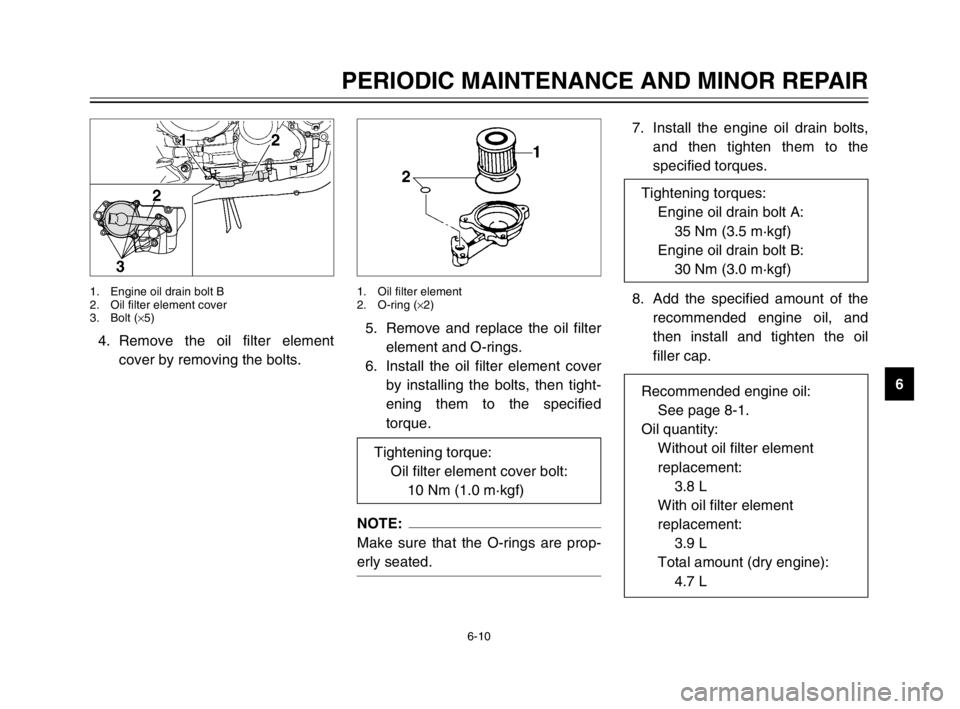
6 4. Remove the oil filter element
cover by removing the bolts.
1. Engine oil drain bolt B
2. Oil filter element cover
3. Bolt (×5)
7. Install the engine oil drain bolts,
and then tighten them to the
specified torques.
8. Add the specified amount of the
recommended engine oil, and
then install and tighten the oil
filler cap. 5. Remove and replace the oil filter
element and O-rings.
6. Install the oil filter element cover
by installing the bolts, then tight-
ening them to the specified
torque.
NOTE:
Make sure that the O-rings are prop-
erly seated.
1. Oil filter element
2. O-ring (×2)
Tightening torque:
Oil filter element cover bolt:
10 Nm (1.0 m·kgf)
Tightening torques:
Engine oil drain bolt A:
35 Nm (3.5 m·kgf)
Engine oil drain bolt B:
30 Nm (3.0 m·kgf)
Recommended engine oil:
See page 8-1.
Oil quantity:
Without oil filter element
replacement:
3.8 L
With oil filter element
replacement:
3.9 L
Total amount (dry engine):
4.7 L
5PS-28199-E1 8/29/02 9:16 AM Page 55
Page 57 of 110
6-11
PERIODIC MAINTENANCE AND MINOR REPAIR
6
ECA00133
cC
8In order to prevent clutch slip-
page (since the engine oil also
lubricates the clutch), do not
mix any chemical additives.
Do not use oils with a diesel
specification of “CD” or oils of
a higher quality than specified.
In addition, do not use oils
labeled “ENERGY CONSERV-
ING II” or higher.
8Make sure that no foreign
material enters the crankcase.
9. Start the engine, and then let it
idle for several minutes while
checking it for oil leakage. If oil is
leaking, immediately turn the
engine off and check for the
cause.
10. Turn the engine off, and then
check the oil level and correct it if
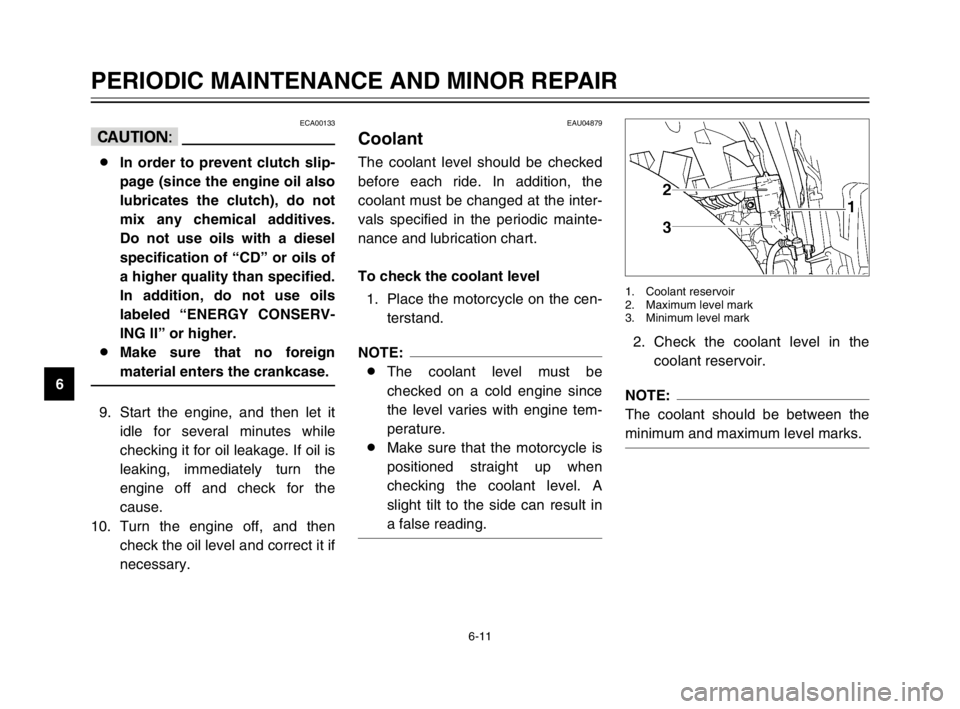
necessary.2. Check the coolant level in the
coolant reservoir.
NOTE:
The coolant should be between the
minimum and maximum level marks.
1. Coolant reservoir
2. Maximum level mark
3. Minimum level mark
EAU04879
CoolantCoolantThe coolant level should be checked
before each ride. In addition, the
coolant must be changed at the inter-
vals specified in the periodic mainte-
nance and lubrication chart.
To check the coolant level
Checking1. Place the motorcycle on the cen-
terstand.
NOTE:
8The coolant level must be
checked on a cold engine since
the level varies with engine tem-
perature.
8Make sure that the motorcycle is
positioned straight up when
checking the coolant level. A
slight tilt to the side can result in
a false reading.
5PS-28199-E1 8/29/02 9:16 AM Page 56
Page 58 of 110
6-12
PERIODIC MAINTENANCE AND MINOR REPAIR
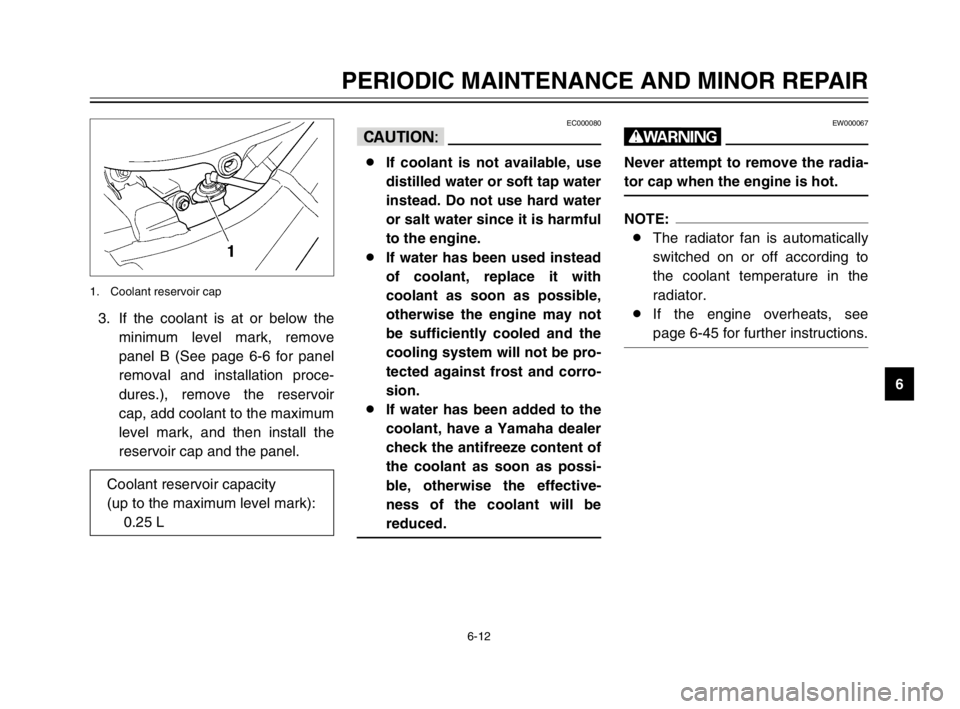
6 3. If the coolant is at or below the
minimum level mark, remove
panel B (See page 6-6 for panel
removal and installation proce-
dures.), remove the reservoir
cap, add coolant to the maximum
level mark, and then install the
reservoir cap and the panel.
1. Coolant reservoir cap
EW000067
w
Never attempt to remove the radia-
tor cap when the engine is hot.
NOTE:
8The radiator fan is automatically
switched on or off according to
the coolant temperature in the
radiator.
8If the engine overheats, see
page 6-45 for further instructions.
EC000080
cC
8If coolant is not available, use
distilled water or soft tap water
instead. Do not use hard water
or salt water since it is harmful
to the engine.
8If water has been used instead
of coolant, replace it with
coolant as soon as possible,
otherwise the engine may not
be sufficiently cooled and the
cooling system will not be pro-
tected against frost and corro-
sion.
8If water has been added to the
coolant, have a Yamaha dealer
check the antifreeze content of
the coolant as soon as possi-
ble, otherwise the effective-
ness of the coolant will be
reduced.
Coolant reservoir capacity
(up to the maximum level mark):
0.25 L
5PS-28199-E1 8/29/02 9:16 AM Page 57