ESP YAMAHA TDM 900 2003 Owners Manual
[x] Cancel search | Manufacturer: YAMAHA, Model Year: 2003, Model line: TDM 900, Model: YAMAHA TDM 900 2003Pages: 110, PDF Size: 7.38 MB
Page 17 of 110
3-3
INSTRUMENT AND CONTROL FUNCTIONS
3
EAU04877
Oil level warning light “7”Oil level warning lightThis warning light comes on when
the engine oil level is low.
The electrical circuit of the warning
light can be checked by turning the
key to “ON”.
If the warning light does not come on
for a few seconds, then go off, have a
Yamaha dealer check the electrical
circuit.
NOTE:
Even if the oil level is sufficient, the
warning light may flicker when riding
on a slope or during sudden acceler-
ation or deceleration, but this is not a
malfunction.
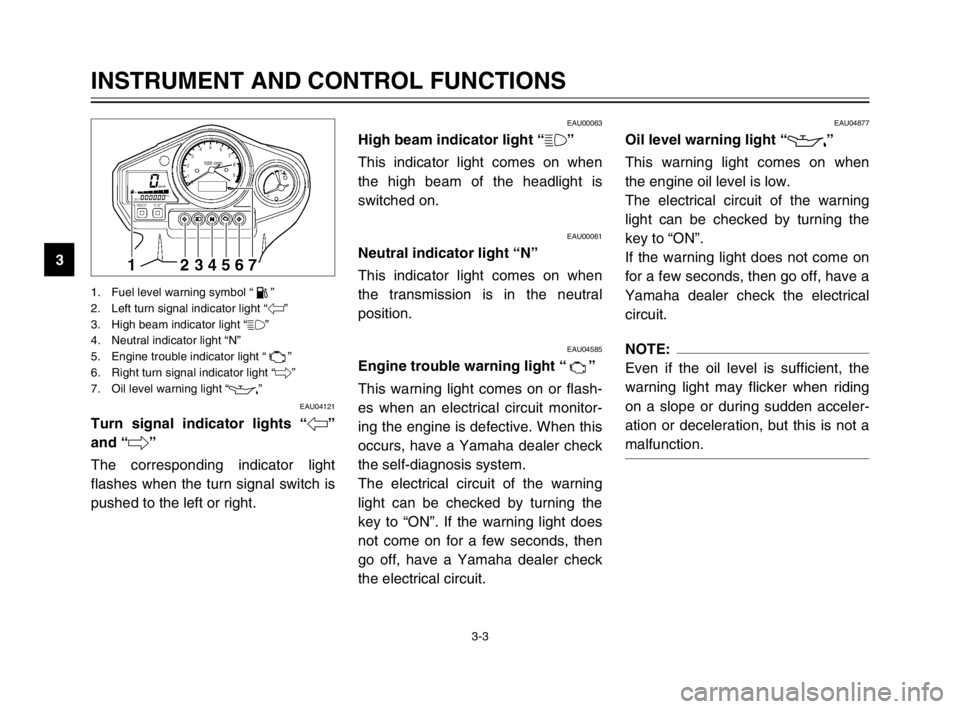
1. Fuel level warning symbol “ ”
2. Left turn signal indicator light “4”
3. High beam indicator light “&”
4. Neutral indicator light “N”
5. Engine trouble indicator light “ ”
6. Right turn signal indicator light “6”
7. Oil level warning light “
7”
EAU04121
Turn signal indicator lights “4”
and “6”
Turn signal indicator lightsThe corresponding indicator light
flashes when the turn signal switch is
pushed to the left or right.
EAU00063
High beam indicator light “&”High beam indicator lightThis indicator light comes on when
the high beam of the headlight is
switched on.
EAU00061
Neutral indicator light “N”Neutral indicator lightThis indicator light comes on when
the transmission is in the neutral
position.
EAU04585
Engine trouble warning light “”Engine trouble warning lightThis warning light comes on or flash-
es when an electrical circuit monitor-
ing the engine is defective. When this
occurs, have a Yamaha dealer check
the self-diagnosis system.
The electrical circuit of the warning
light can be checked by turning the
key to “ON”. If the warning light does
not come on for a few seconds, then
go off, have a Yamaha dealer check
the electrical circuit.
5PS-28199-E1 8/29/02 9:16 AM Page 16
Page 32 of 110
3-18
INSTRUMENT AND CONTROL FUNCTIONS
3
EAU00315
w
This shock absorber contains
highly pressurized nitrogen gas.
For proper handling, read and
understand the following informa-
tion before handling the shock
absorber. The manufacturer can-
not be held responsible for proper-
ty damage or personal injury that
may result from improper han-
dling.
8Do not tamper with or attempt
to open the gas cylinder.
8Do not subject the shock
absorber to an open flame or
other high heat sources, other-
wise it may explode due to
excessive gas pressure.
8Do not deform or damage the
gas cylinder in any way, as
this will result in poor damp-
ing performance.
8Always have a Yamaha dealer
service the shock absorber.
EAU00324
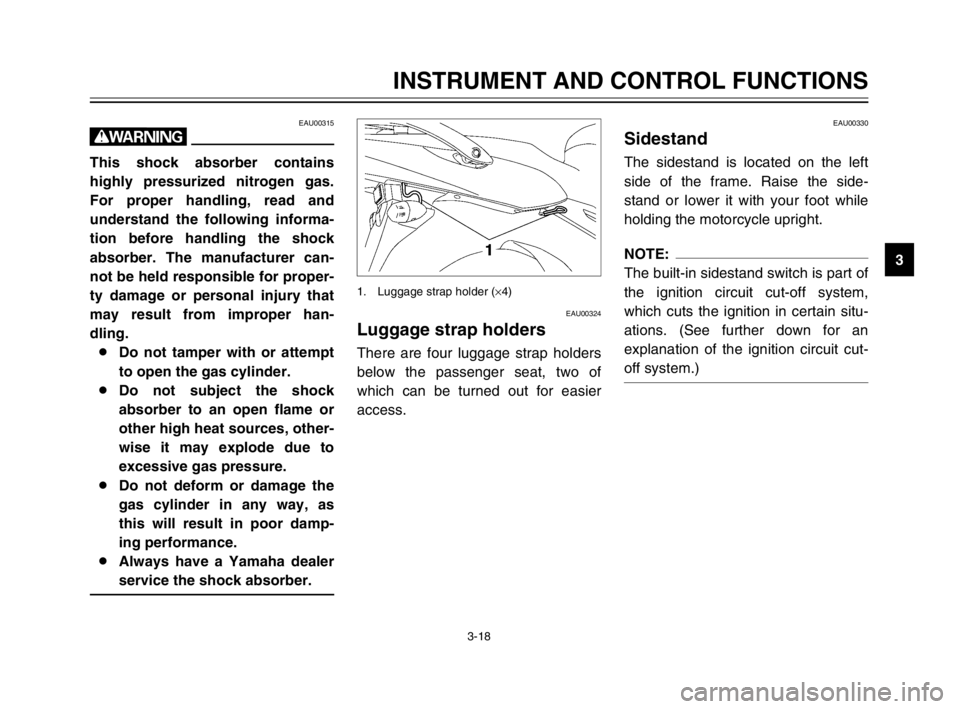
Luggage strap holdersLuggage strap holdersThere are four luggage strap holders
below the passenger seat, two of
which can be turned out for easier
access.
1. Luggage strap holder (×4)
EAU00330
SidestandSidestandThe sidestand is located on the left
side of the frame. Raise the side-
stand or lower it with your foot while
holding the motorcycle upright.
NOTE:
The built-in sidestand switch is part of
the ignition circuit cut-off system,
which cuts the ignition in certain situ-
ations. (See further down for an
explanation of the ignition circuit cut-
off system.)
5PS-28199-E1 8/29/02 9:16 AM Page 31
Page 33 of 110

3-19
INSTRUMENT AND CONTROL FUNCTIONS
3
EW000044
w
The motorcycle must not be ridden
with the sidestand down, or if the
sidestand cannot be properly
moved up (or does not stay up),
otherwise the sidestand could con-
tact the ground and distract the
operator, resulting in a possible
loss of control. Yamaha’s ignition
circuit cut-off system has been
designed to assist the operator in
fulfilling the responsibility of rais-
ing the sidestand before starting
off. Therefore, check this system
regularly as described below and
have a Yamaha dealer repair it if it
does not function properly.
EAU03720
Ignition circuit cut-off
system
Ignition circuit cut-off systemThe ignition circuit cut-off system
(comprising the sidestand switch,
clutch switch and neutral switch) has
the following functions.
8It prevents starting when the
transmission is in gear and the
sidestand is up, but the clutch
lever is not pulled.
8It prevents starting when the
transmission is in gear and the
clutch lever is pulled, but the
sidestand is still down.
8It cuts the running engine when
the transmission is in gear and
the sidestand is moved down.
Periodically check the operation of
the ignition circuit cut-off system
according to the following procedure.
EW000045
w
If a malfunction is noted, have a
Yamaha dealer check the system
before riding.
5PS-28199-E1 8/29/02 9:16 AM Page 32
Page 37 of 110

4-1
EAU01114
PRE-OPERATION CHECKS
4The condition of a vehicle is the owner’s responsibility. Vital components can start to deteriorate quickly and unexpect-
edly, even if the vehicle remains unused (for example, as a result of exposure to the elements). Any damage, fluid leak-
age or loss of tire air pressure could have serious consequences. Therefore, it is very important, in addition to a thor-
ough visual inspection, to check the following points before each ride.
EAU03439
Pre-operation check listPre-operation check list
ITEM CHECKS PAGE
Fuel•Check fuel level in fuel tank.
•Refuel if necessary.
•Check fuel line for leakage.3-10–3-12
Engine oil•Check oil level in engine.
•If necessary, add recommended oil to specified level.
•Check vehicle for oil leakage.6-8–6-11
Coolant•Check coolant level in reservoir.
•If necessary, add recommended coolant to specified level.
•Check cooling system for leakage.6-11–6-15
Front brake•Check operation.
•If soft or spongy, have Yamaha dealer bleed hydraulic system.
•Check fluid level in reservoir.
•If necessary, add recommended brake fluid to specified level.
•Check hydraulic system for leakage.3-9–3-10, 6-24–6-26
Rear brake•Check operation.
•If soft or spongy, have Yamaha dealer bleed hydraulic system.
•Check fluid level in reservoir.
•If necessary, add recommended brake fluid to specified level.
•Check hydraulic system for leakage.3-10, 6-23–6-26
Clutch•Check operation.
•Lubricate cable if necessary.
•Check lever free play.
•Adjust if necessary.3-9, 6-22–6-23
5PS-28199-E1 8/29/02 9:16 AM Page 36
Page 41 of 110
5-1
EAU00372
OPERATION AND IMPORTANT RIDING POINTS
5
EAU00373
w
8Become thoroughly familiar
with all operating controls and
their functions before riding.
Consult a Yamaha dealer
regarding any control or func-
tion that you do not thorough-
ly understand.
8Never start the engine or oper-
ate it in a closed area for any
length of time. Exhaust fumes
are poisonous, and inhaling
them can cause loss of con-
sciousness and death within a
short time. Always make sure
that there is adequate ventila-
tion.
8Before starting out, make sure
that the sidestand is up. If the
sidestand is not raised com-
pletely, it could contact the
ground and distract the opera-
tor, resulting in a possible loss
of control.
EAU03951
Starting the engineStarting the engineIn order for the ignition circuit cut-off
system to enable starting, one of the
following conditions must be met:
8The transmission is in the neutral
position.
8The transmission is in gear with
the clutch lever pulled and the
sidestand up.
EW000054
w
8Before starting the engine,
check the function of the igni-
tion circuit cut-off system
according to the procedure
described on page 3-20.
8Never ride with the sidestand
down.
1. Turn the key to “ON” and make
sure that the engine stop switch
is set to “#”.
ECA00083
cC
The oil level warning light and
engine trouble warning light
should come on for a few seconds,
then go off. If a warning light does
not go off, see pages 3-2 and 3-3
for the corresponding warning
light circuit check.
2. Shift the transmission into the
neutral position.
NOTE:
When the transmission is in the neu-
tral position, the neutral indicator light
should be on, otherwise have a
Yamaha dealer check the electrical
circuit.
3. Start the engine by pushing the
start switch.
5PS-28199-E1 8/29/02 9:16 AM Page 40
Page 42 of 110

5-2
OPERATION AND IMPORTANT RIDING POINTS
5
NOTE:
If the engine fails to start, release the
start switch, wait a few seconds, and
then try again. Each starting attempt
should be as short as possible to pre-
serve the battery. Do not crank the
engine more than 10 seconds on any
one attempt.
ECA00045
cC
For maximum engine life, never
accelerate hard when the engine is
cold!
NOTE:
The engine is warm when it quickly
responds to the throttle.
EC000048
cC
8Even with the transmission in
the neutral position, do not
coast for long periods of time
with the engine off, and do not
tow the motorcycle for long
distances. The transmission is
properly lubricated only when
the engine is running.
Inadequate lubrication may
damage the transmission.
8Always use the clutch while
changing gears to avoid dam-
aging the engine, transmis-
sion, and drive train, which are
not designed to withstand the
shock of forced shifting.
EAU00423
ShiftingShiftingShifting gears lets you control the
amount of engine power available for
starting off, accelerating, climbing
hills, etc.
The gear positions are shown in the
illustration.
NOTE:
To shift the transmission into the neu-
tral position, press the shift pedal
down repeatedly until it reaches the
end of its travel, and then slightly
raise it.
1. Shift pedal
N. Neutral position
5PS-28199-E1 8/29/02 9:16 AM Page 41
Page 52 of 110
6-6
PERIODIC MAINTENANCE AND MINOR REPAIR
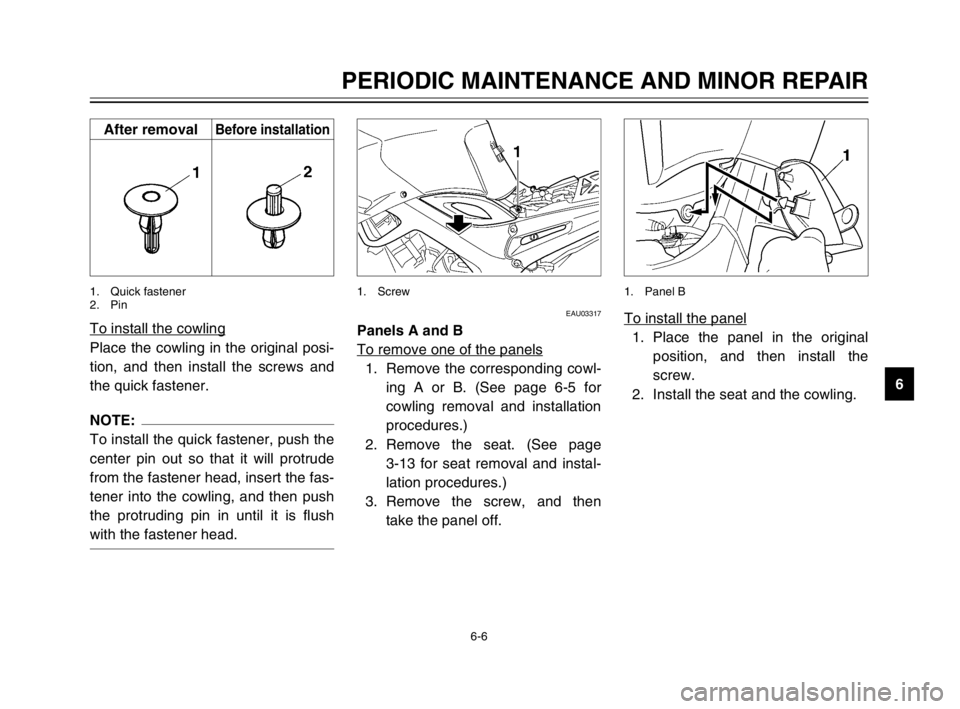
6 To install the cowling
Place the cowling in the original posi-
tion, and then install the screws and
the quick fastener.
NOTE:
To install the quick fastener, push the
center pin out so that it will protrude
from the fastener head, insert the fas-
tener into the cowling, and then push
the protruding pin in until it is flush
with the fastener head.
1. Quick fastener
2. Pin
To install the panel
1. Place the panel in the original
position, and then install the
screw.
2. Install the seat and the cowling.
1. Panel B
EAU03317
Panels A and B
To remove one of the panels
1. Remove the corresponding cowl-
ing A or B. (See page 6-5 for
cowling removal and installation
procedures.)
2. Remove the seat. (See page
3-13 for seat removal and instal-
lation procedures.)
3. Remove the screw, and then
take the panel off.
1. Screw
After removalBefore installation
5PS-28199-E1 8/29/02 9:16 AM Page 51
Page 63 of 110
6-17
PERIODIC MAINTENANCE AND MINOR REPAIR
67. Install the air filter case cover by
installing the screws.
8. Place the fuel tank in the original
position and install the bolts.
EWA00067
w
8Before installing the fuel tank,
make sure that the fuel hoses
are not damaged. If any fuel
hose is damaged, do not start
the engine but have a Yamaha
dealer replace the hose, other-
wise fuel may leak.
8Make sure that the fuel hoses
are properly connected and
routed, and not pinched.
8Be sure to place the fuel tank
breather hose and the fuel
tank overflow hose in the orig-
inal position.
9. Install the panels and cowlings.
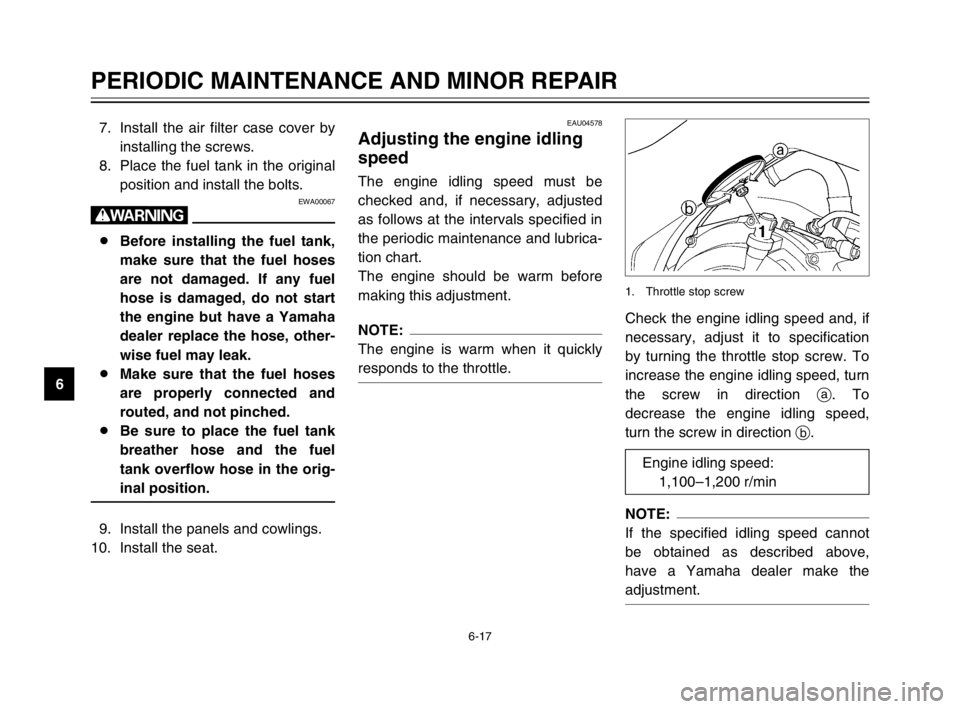
10. Install the seat.Check the engine idling speed and, if
necessary, adjust it to specification
by turning the throttle stop screw. To
increase the engine idling speed, turn
the screw in direction a. To
decrease the engine idling speed,
turn the screw in direction b.
NOTE:
If the specified idling speed cannot
be obtained as described above,
have a Yamaha dealer make the
adjustment.
1. Throttle stop screw
EAU04578
Adjusting the engine idling
speed
Engine idling speedThe engine idling speed must be
checked and, if necessary, adjusted
as follows at the intervals specified in
the periodic maintenance and lubrica-
tion chart.
The engine should be warm before
making this adjustment.
NOTE:
The engine is warm when it quickly
responds to the throttle.
Engine idling speed:
1,100–1,200 r/min
5PS-28199-E1 8/29/02 9:16 AM Page 62
Page 74 of 110
6-28
PERIODIC MAINTENANCE AND MINOR REPAIR
6
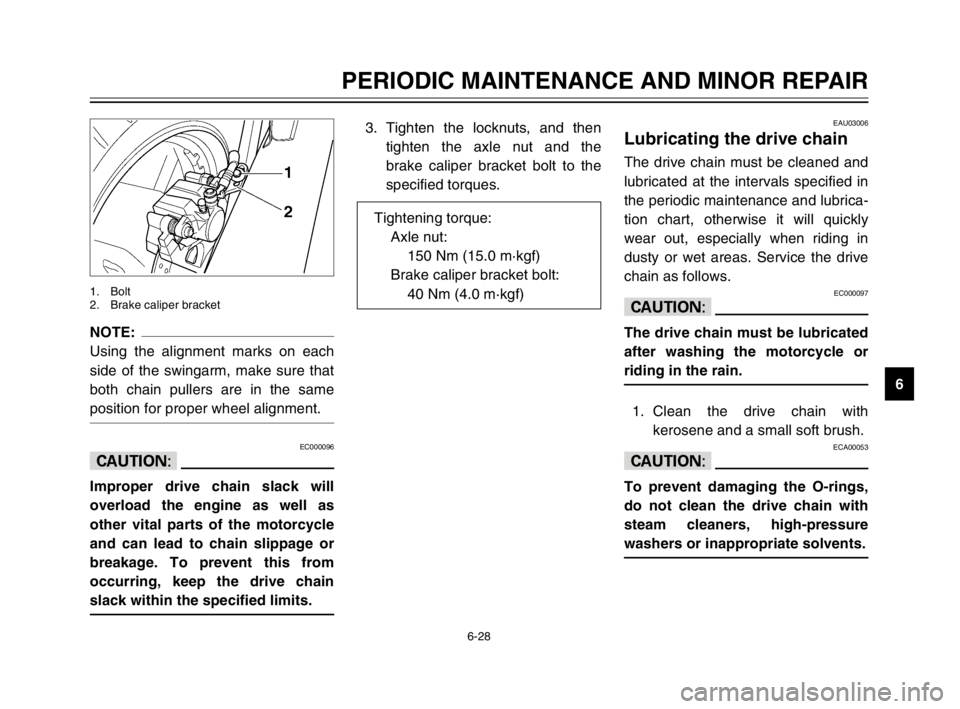
NOTE:
Using the alignment marks on each
side of the swingarm, make sure that
both chain pullers are in the same
position for proper wheel alignment.
EC000096
cC
Improper drive chain slack will
overload the engine as well as
other vital parts of the motorcycle
and can lead to chain slippage or
breakage. To prevent this from
occurring, keep the drive chain
slack within the specified limits.
1. Bolt
2. Brake caliper bracket
EAU03006
Lubricating the drive chainDrive chain, lubricatingThe drive chain must be cleaned and
lubricated at the intervals specified in
the periodic maintenance and lubrica-
tion chart, otherwise it will quickly
wear out, especially when riding in
dusty or wet areas. Service the drive
chain as follows.
EC000097
cC
The drive chain must be lubricated
after washing the motorcycle or
riding in the rain.
1. Clean the drive chain with
kerosene and a small soft brush.
ECA00053
cC
To prevent damaging the O-rings,
do not clean the drive chain with
steam cleaners, high-pressure
washers or inappropriate solvents.
3. Tighten the locknuts, and then
tighten the axle nut and the
brake caliper bracket bolt to the
specified torques.
Tightening torque:
Axle nut:
150 Nm (15.0 m·kgf)
Brake caliper bracket bolt:
40 Nm (4.0 m·kgf)
5PS-28199-E1 8/29/02 9:16 AM Page 73
Page 93 of 110
7
7-1
EAU04454
MOTORCYCLE CARE AND STORAGE
CareCareWhile the open design of a motorcy-
cle reveals the attractiveness of the
technology, it also makes it more vul-
nerable. Rust and corrosion can
develop even if high-quality compo-
nents are used. A rusty exhaust pipe
may go unnoticed on a car, however,
it detracts from the overall appear-
ance of a motorcycle. Frequent and
proper care does not only comply
with the terms of the warranty, but it
will also keep your motorcycle looking
good, extend its life and optimize its
performance.Before cleaning
1. Cover the muffler outlets with
plastic bags after the engine has
cooled down.
2. Make sure that all caps and cov-
ers as well as all electrical cou-
plers and connectors, including
the spark plug caps, are tightly
installed.
3. Remove extremely stubborn dirt,
like oil burnt onto the crankcase,
with a degreasing agent and a
brush, but never apply such
products onto seals, gaskets,
sprockets, the drive chain and
wheel axles. Always rinse the dirt
and degreaser off with water.Cleaning
ECA00010
cC
8Avoid using strong acidic
wheel cleaners, especially on
spoked wheels. If such prod-
ucts are used on hard-to-
remove dirt, do not leave the
cleaner on the affected area
any longer than instructed.
Also, thoroughly rinse the area
off with water, immediately dry
it, and then apply a corrosion
protection spray.
8Improper cleaning can damage
windshields, cowlings, panels
and other plastic parts. Use
only a soft, clean cloth or
sponge with mild detergent
and water to clean plastic.
5PS-28199-E1 8/29/02 9:17 AM Page 92