lock YAMAHA TDM 900 2009 User Guide
[x] Cancel search | Manufacturer: YAMAHA, Model Year: 2009, Model line: TDM 900, Model: YAMAHA TDM 900 2009Pages: 94, PDF Size: 3.75 MB
Page 29 of 94

INSTRUMENT AND CONTROL FUNCTIONS
3-13
2
34
5
6
7
8
9
EAU13091
Fuel tank cap
To open the fuel tank cap
Open the fuel tank cap lock cover, in-
sert the key into the lock, and then turn
it 1/8 turn clockwise. The lock will be re-
leased and the fuel tank cap can be
opened.
To close the fuel tank cap
1. Push the fuel tank cap into position
with the key inserted in the lock.
2. Turn the key counterclockwise to
the original position, remove it, and
then close the lock cover.
TIP
The fuel tank cap cannot be closed un-
less the key is in the lock. In addition,
the key cannot be removed if the cap is
not properly closed and locked.
WARNING
EWA11091
Make sure that the fuel tank cap is
properly closed after filling fuel.
Leaking fuel is a fire hazard.
1. Rear wheel hub
1
1. Fuel tank cap lock cover
2. Unlock.
1
2
Page 31 of 94
INSTRUMENT AND CONTROL FUNCTIONS
3-15
2
34
5
6
7
8
9
or premium unleaded fuel. Use of un-
leaded fuel will extend spark plug life
and reduce maintenance costs.
EAU13412
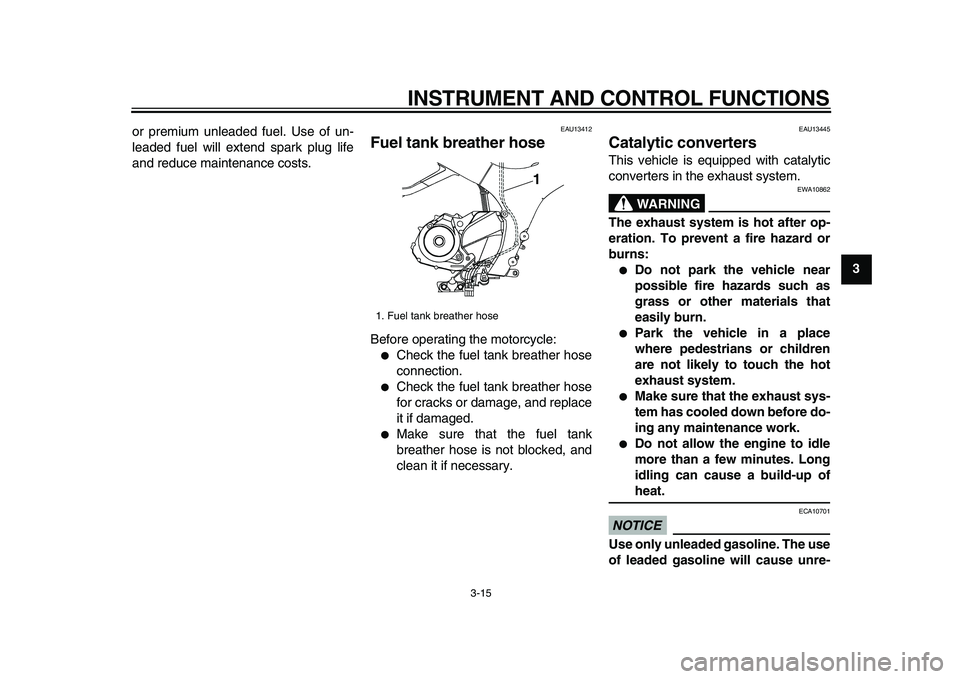
Fuel tank breather hose
Before operating the motorcycle:
●
Check the fuel tank breather hose
connection.
●
Check the fuel tank breather hose
for cracks or damage, and replace
it if damaged.
●
Make sure that the fuel tank
breather hose is not blocked, and
clean it if necessary.
EAU13445
Catalytic converters
This vehicle is equipped with catalytic
converters in the exhaust system.
WARNING
EWA10862
The exhaust system is hot after op-
eration. To prevent a fire hazard or
burns:
●
Do not park the vehicle near
possible fire hazards such as
grass or other materials that
easily burn.
●
Park the vehicle in a place
where pedestrians or children
are not likely to touch the hot
exhaust system.
●
Make sure that the exhaust sys-
tem has cooled down before do-
ing any maintenance work.
●
Do not allow the engine to idle
more than a few minutes. Long
idling can cause a build-up of
heat.
NOTICE
ECA10701
Use only unleaded gasoline. The use
of leaded gasoline will cause unre-
1. Fuel tank breather hose
1
Page 32 of 94
INSTRUMENT AND CONTROL FUNCTIONS
3-16
1
2
3
4
5
6
7
8
9pairable damage to the catalytic
converter.
EAU13861
Seat
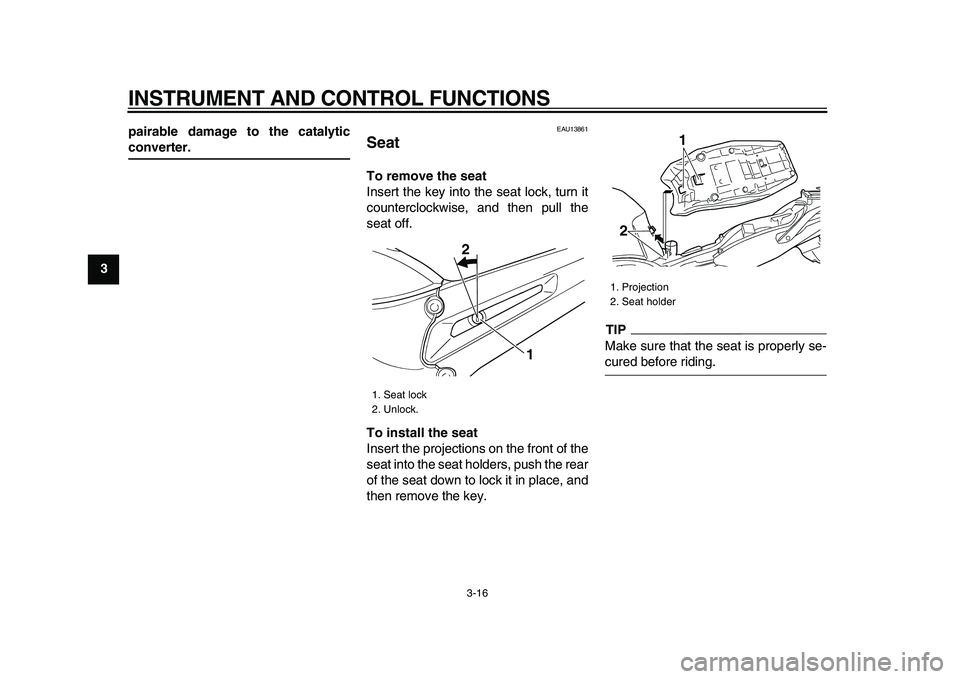
To remove the seat
Insert the key into the seat lock, turn it
counterclockwise, and then pull the
seat off.
To install the seat
Insert the projections on the front of the
seat into the seat holders, push the rear
of the seat down to lock it in place, and
then remove the key.
TIP
Make sure that the seat is properly se-
cured before riding.
1. Seat lock
2. Unlock.
1
2
1. Projection
2. Seat holder
1
2
Page 33 of 94
INSTRUMENT AND CONTROL FUNCTIONS
3-17
2
34
5
6
7
8
9
EAU14413
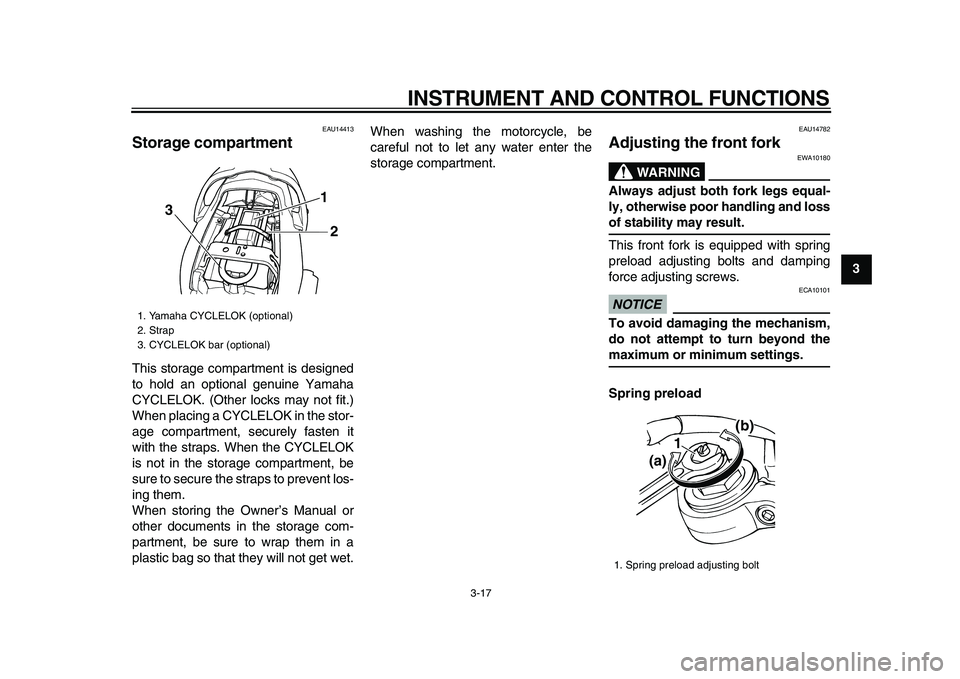
Storage compartment
This storage compartment is designed
to hold an optional genuine Yamaha
CYCLELOK. (Other locks may not fit.)
When placing a CYCLELOK in the stor-
age compartment, securely fasten it
with the straps. When the CYCLELOK
is not in the storage compartment, be
sure to secure the straps to prevent los-
ing them.
When storing the Owner’s Manual or
other documents in the storage com-
partment, be sure to wrap them in a
plastic bag so that they will not get wet.When washing the motorcycle, be
careful not to let any water enter the
storage compartment.
EAU14782
Adjusting the front fork
WARNING
EWA10180
Always adjust both fork legs equal-
ly, otherwise poor handling and loss
of stability may result.
This front fork is equipped with spring
preload adjusting bolts and damping
force adjusting screws.
NOTICE
ECA10101
To avoid damaging the mechanism,
do not attempt to turn beyond the
maximum or minimum settings.
Spring preload
1. Yamaha CYCLELOK (optional)
2. Strap
3. CYCLELOK bar (optional)
3
2 1
1. Spring preload adjusting bolt
1
(a)(b)
Page 63 of 94
PERIODIC MAINTENANCE AND ADJUSTMENT
6-18
2
3
4
5
67
8
9
EAU21960
Cast wheels
To maximize the performance, durabil-
ity, and safe operation of your vehicle,
note the following points regarding the
specified wheels.
●
The wheel rims should be checked
for cracks, bends or warpage be-
fore each ride. If any damage is
found, have a Yamaha dealer re-
place the wheel. Do not attempt
even the smallest repair to the
wheel. A deformed or cracked
wheel must be replaced.
●
The wheel should be balanced
whenever either the tire or wheel
has been changed or replaced. An
unbalanced wheel can result in
poor performance, adverse han-
dling characteristics, and a short-
ened tire life.
●
Ride at moderate speeds after
changing a tire since the tire sur-
face must first be “broken in” for it
to develop its optimal characteris-
tics.
EAU22042
Adjusting the clutch lever free
play
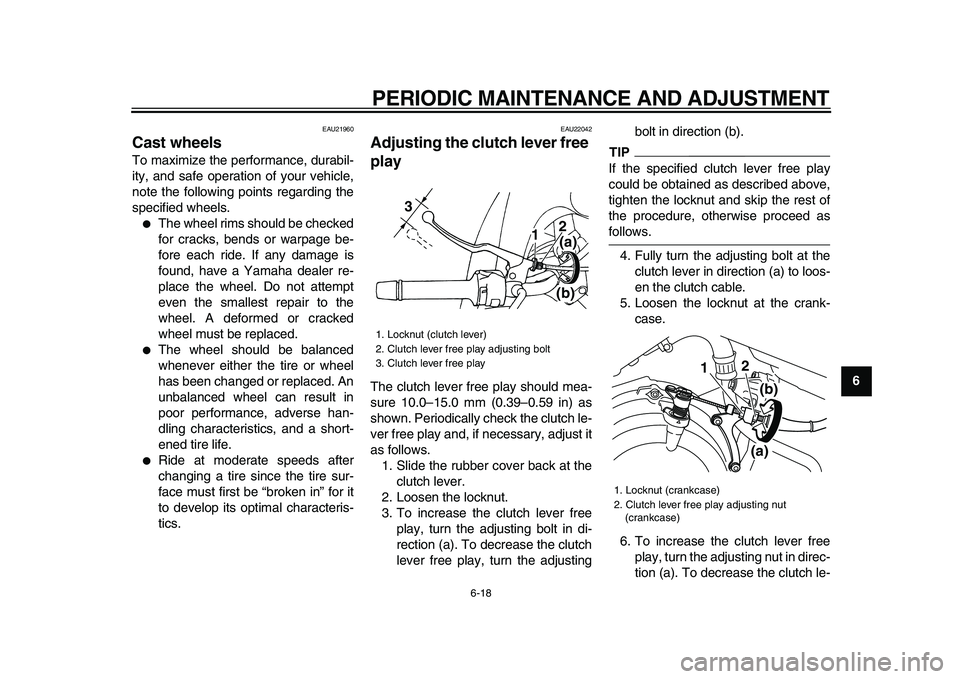
The clutch lever free play should mea-
sure 10.0–15.0 mm (0.39–0.59 in) as
shown. Periodically check the clutch le-
ver free play and, if necessary, adjust it
as follows.
1. Slide the rubber cover back at the
clutch lever.
2. Loosen the locknut.
3. To increase the clutch lever free
play, turn the adjusting bolt in di-
rection (a). To decrease the clutch
lever free play, turn the adjustingbolt in direction (b).
TIP
If the specified clutch lever free play
could be obtained as described above,
tighten the locknut and skip the rest of
the procedure, otherwise proceed as
follows.
4. Fully turn the adjusting bolt at the
clutch lever in direction (a) to loos-
en the clutch cable.
5. Loosen the locknut at the crank-
case.
6. To increase the clutch lever free
play, turn the adjusting nut in direc-
tion (a). To decrease the clutch le-
1. Locknut (clutch lever)
2. Clutch lever free play adjusting bolt
3. Clutch lever free play
12
3
(a)
(b)
1. Locknut (crankcase)
2. Clutch lever free play adjusting nut
(crankcase)
12
(a)(b)
Page 64 of 94
PERIODIC MAINTENANCE AND ADJUSTMENT
6-19
1
2
3
4
5
6
7
8
9
ver free play, turn the adjusting nut
in direction (b).
7. Tighten the locknut at the clutch le-
ver and the crankcase.
8. Slide the rubber cover to its origi-
nal position.
EAU22272
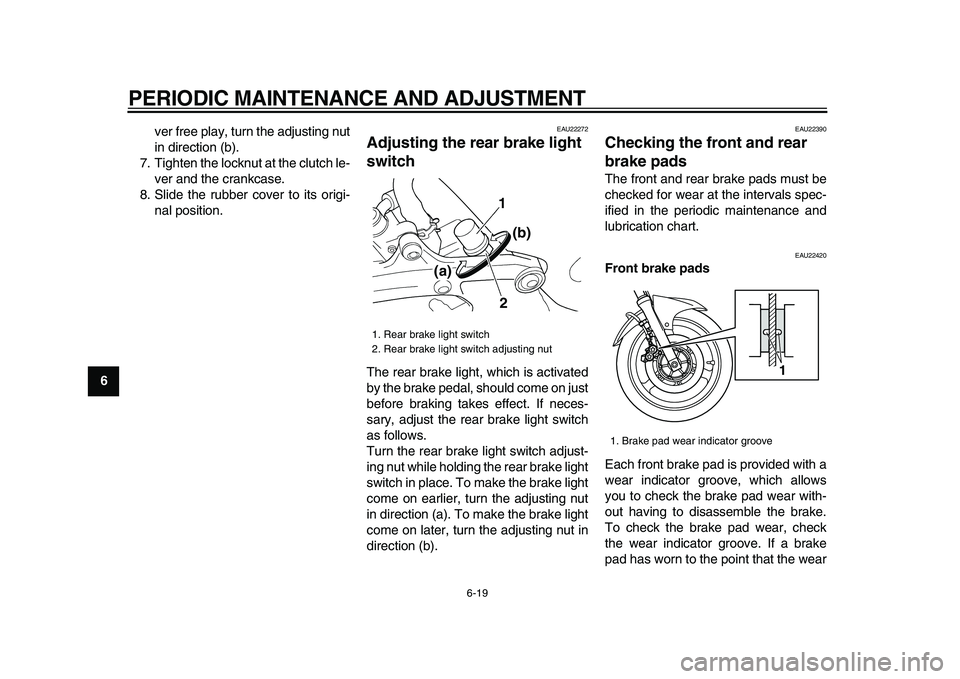
Adjusting the rear brake light
switch
The rear brake light, which is activated
by the brake pedal, should come on just
before braking takes effect. If neces-
sary, adjust the rear brake light switch
as follows.
Turn the rear brake light switch adjust-
ing nut while holding the rear brake light
switch in place. To make the brake light
come on earlier, turn the adjusting nut
in direction (a). To make the brake light
come on later, turn the adjusting nut in
direction (b).
EAU22390
Checking the front and rear
brake pads
The front and rear brake pads must be
checked for wear at the intervals spec-
ified in the periodic maintenance and
lubrication chart.
EAU22420
Front brake pads
Each front brake pad is provided with a
wear indicator groove, which allows
you to check the brake pad wear with-
out having to disassemble the brake.
To check the brake pad wear, check
the wear indicator groove. If a brake
pad has worn to the point that the wear
1. Rear brake light switch
2. Rear brake light switch adjusting nut
1
2 (a)(b)
1. Brake pad wear indicator groove
1
Page 66 of 94
PERIODIC MAINTENANCE AND ADJUSTMENT
6-21
1
2
3
4
5
6
7
8
9
Observe these precautions:
●
When checking the fluid level,
make sure that the top of the brake
fluid reservoir is level.
●
Use only the recommended quality
brake fluid, otherwise the rubber
seals may deteriorate, causing
leakage and poor braking perfor-
mance.
●
Refill with the same type of brake
fluid. Mixing fluids may result in a
harmful chemical reaction and
lead to poor braking performance.
●
Be careful that water or dust does
not enter the brake fluid reservoir
when refilling. Water will signifi-
cantly lower the boiling point of the
fluid and may result in vapor lock,
and dirt may clog the ABS hydrau-
lic unit valves.
●
Brake fluid may deteriorate paint-
ed surfaces or plastic parts. Al-
ways clean up spilled fluid
immediately.
●
As the brake pads wear, it is nor-mal for the brake fluid level to grad-
ually go down. However, if the
brake fluid level goes down sud-
denly, have a Yamaha dealer
check the cause.
EAU22731
Changing the brake fluid
Have a Yamaha dealer change the
brake fluid at the intervals specified in
the TIP after the periodic maintenance
and lubrication chart. In addition, have
the oil seals of the master cylinders and
calipers as well as the brake hoses re-
placed at the intervals listed below or
whenever they are damaged or leak-
ing.
●
Oil seals: Replace every two
years.
●
Brake hoses: Replace every four
years.
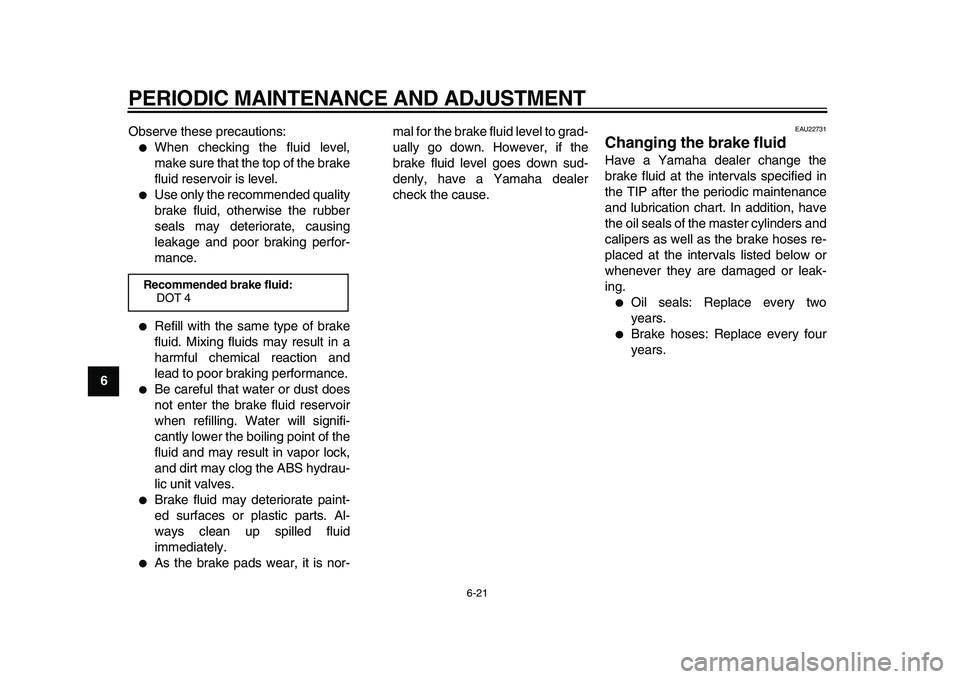
Recommended brake fluid:
DOT 4
Page 67 of 94
PERIODIC MAINTENANCE AND ADJUSTMENT
6-22
2
3
4
5
67
8
9
EAU22760
Drive chain slack
The drive chain slack should be
checked before each ride and adjusted
if necessary.
EAU22773
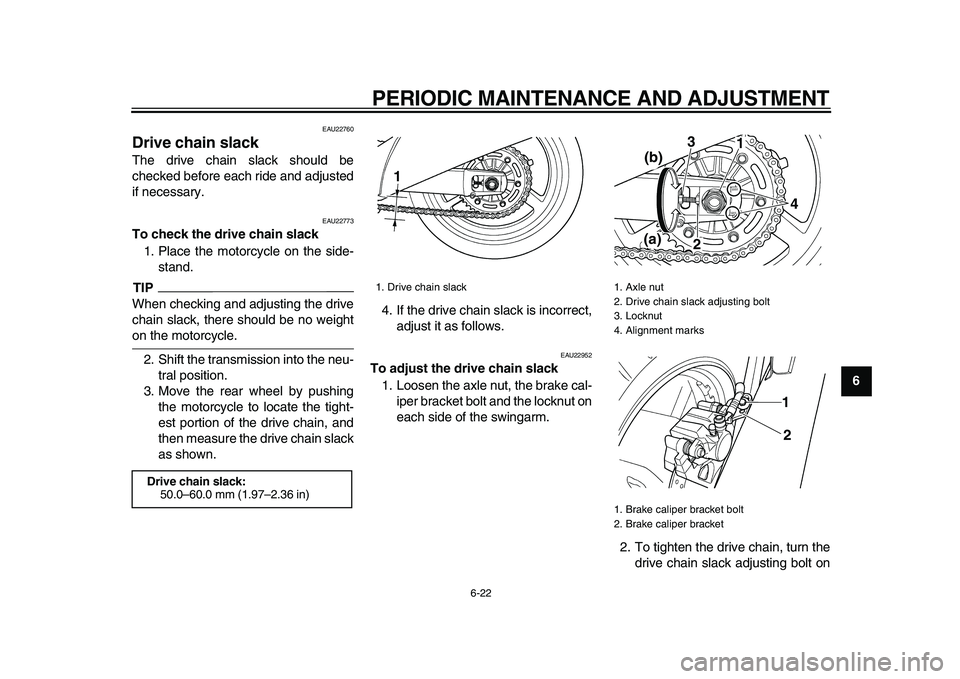
To check the drive chain slack
1. Place the motorcycle on the side-
stand.
TIP
When checking and adjusting the drive
chain slack, there should be no weight
on the motorcycle.
2. Shift the transmission into the neu-
tral position.
3. Move the rear wheel by pushing
the motorcycle to locate the tight-
est portion of the drive chain, and
then measure the drive chain slack
as shown.4. If the drive chain slack is incorrect,
adjust it as follows.
EAU22952
To adjust the drive chain slack
1. Loosen the axle nut, the brake cal-
iper bracket bolt and the locknut on
each side of the swingarm.
2. To tighten the drive chain, turn the
drive chain slack adjusting bolt on
Drive chain slack:
50.0–60.0 mm (1.97–2.36 in)
1. Drive chain slack
1
1. Axle nut
2. Drive chain slack adjusting bolt
3. Locknut
4. Alignment marks
1. Brake caliper bracket bolt
2. Brake caliper bracket
3
4 1
2 (b)
(a)
1
2
Page 68 of 94
PERIODIC MAINTENANCE AND ADJUSTMENT
6-23
1
2
3
4
5
6
7
8
9
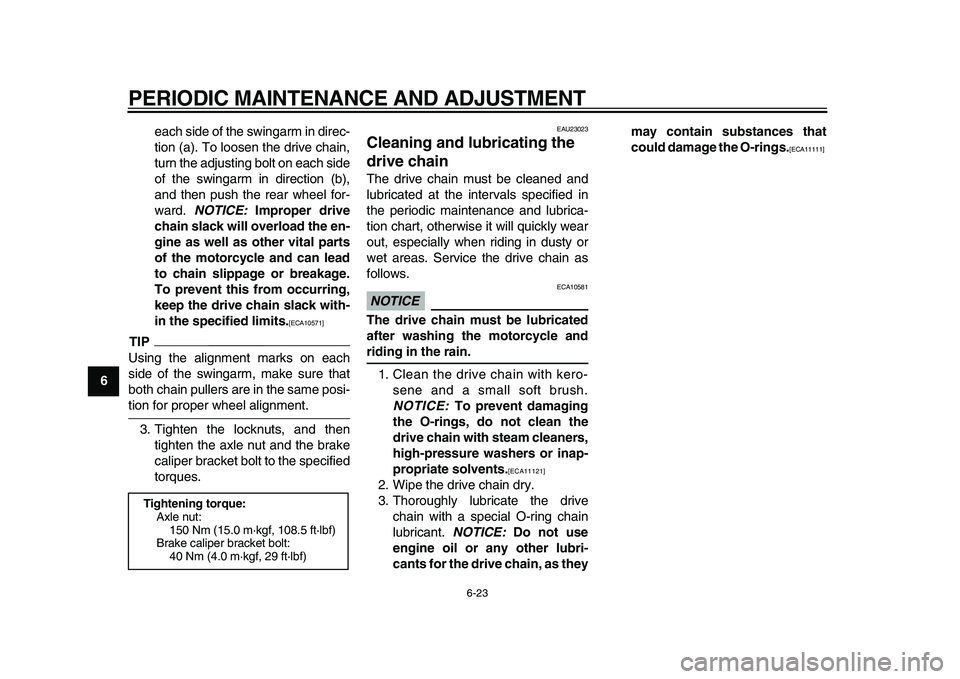
each side of the swingarm in direc-
tion (a). To loosen the drive chain,
turn the adjusting bolt on each side
of the swingarm in direction (b),
and then push the rear wheel for-
ward.
NOTICE:
Improper drive
chain slack will overload the en-
gine as well as other vital parts
of the motorcycle and can lead
to chain slippage or breakage.
To prevent this from occurring,
keep the drive chain slack with-
in the specified limits.
[ECA10571]
TIP
Using the alignment marks on each
side of the swingarm, make sure that
both chain pullers are in the same posi-
tion for proper wheel alignment.
3. Tighten the locknuts, and then
tighten the axle nut and the brake
caliper bracket bolt to the specified
torques.
EAU23023
Cleaning and lubricating the
drive chain
The drive chain must be cleaned and
lubricated at the intervals specified in
the periodic maintenance and lubrica-
tion chart, otherwise it will quickly wear
out, especially when riding in dusty or
wet areas. Service the drive chain as
follows.
NOTICE
ECA10581
The drive chain must be lubricated
after washing the motorcycle and
riding in the rain.
1.Clean the drive chain with kero-
sene and a small soft brush.
NOTICE:
To prevent damaging
the O-rings, do not clean the
drive chain with steam cleaners,
high-pressure washers or inap-
propriate solvents.
[ECA11121]
2. Wipe the drive chain dry.
3. Thoroughly lubricate the drive
chain with a special O-ring chain
lubricant.
NOTICE:
Do not use
engine oil or any other lubri-
cants for the drive chain, as theymay contain substances that
could damage the O-rings.
[ECA11111]
Tightening torque:
Axle nut:
150 Nm (15.0 m·kgf, 108.5 ft·lbf)
Brake caliper bracket bolt:
40 Nm (4.0 m·kgf, 29 ft·lbf)
Page 73 of 94
PERIODIC MAINTENANCE AND ADJUSTMENT
6-28
2
3
4
5
67
8
9 To charge the battery
Have a Yamaha dealer charge the bat-
tery as soon as possible if it seems to
have discharged. Keep in mind that the
battery tends to discharge more quickly
if the vehicle is equipped with optional
electrical accessories.
NOTICE
ECA16520
To charge a VRLA (Valve Regulated
Lead Acid) battery, a special (con-
stant-voltage) battery charger is re-
quired. Using a conventional battery
charger will damage the battery. If
you do not have access to a con-
stant-voltage battery charger, have a
Yamaha dealer charge your battery.
To store the battery
1.If the vehicle will not be used for
more than one month, remove
the battery, fully charge it, and
then place it in a cool, dry place.
NOTICE:
When removing the
battery, be sure the key is turned
to “OFF”, then disconnect the
negative lead before discon-
necting the positive lead.
[ECA16302]
2. If the battery will be stored for more
than two months, check it at least
once a month and fully charge it if
necessary.
3. Fully charge the battery before in-
stallation.
4. After installation, make sure that
the battery leads are properly con-
nected to the battery terminals.
NOTICE
ECA16530
Always keep the battery charged.
Storing a discharged battery can
cause permanent battery damage.
EAU38592
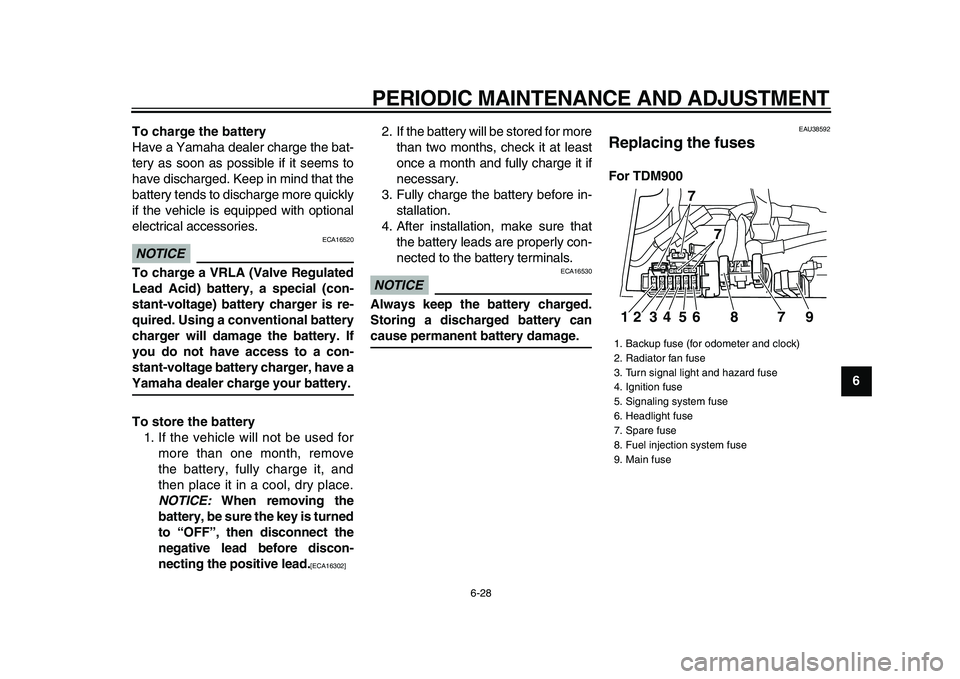
Replacing the fuses
For TDM900
1. Backup fuse (for odometer and clock)
2. Radiator fan fuse
3. Turn signal light and hazard fuse
4. Ignition fuse
5. Signaling system fuse
6. Headlight fuse
7. Spare fuse
8. Fuel injection system fuse
9. Main fuse
12 34 5 6 7 97
7
8